Luận án Tâm lý học: Khung tiếp cận suy luận dựa trên gợi ý - Georgia Tech

Dưới đây là thông tin meta tags cho bài viết "Lawrence Huizenga dissertation 2018": { "ai_description": "Tìm hiểu nội dung luận án của Lawrence Huizenga năm

Trường đại học

Georgia Institute of Technology

Chuyên ngành

Tâm lý học

Người đăng

Ẩn danh

Thể loại

Luận án tiến sĩ

2018

149
0
0

Phí lưu trữ

35 Point

Tóm tắt

I. Tổng quan về luận án Lawrence Huizenga 2018

Luận án 'An Accessibility Framework for Cue-Based Inferences' của Ashley Lawrence-Huizenga (2018) nghiên cứu cơ sở lý thuyết về quá trình ra quyết định dựa trên các tín hiệu (cues) trong tâm lý học. Tác giả đề xuất một khung tiếp cận mới nhằm giải thích cách con người xử lý thông tin không nhất quán khi đưa ra lựa chọn giữa các phương án. Nghiên cứu xây dựng trên nền tảng các lý thuyết ra quyết định trước đó như TTB (Take-The-Best) và WADD (Weighted Additive Rule), nhưng nhấn mạnh vào vai trò của khả năng truy cập thông tin trong trí nhớ. Luận án bao gồm các thí nghiệm mô phỏng và kiểm chứng lý thuyết thông qua dữ liệu thực nghiệm, góp phần làm sáng tỏ cơ chế nhận thức trong quá trình suy luận dựa trên tín hiệu.

1.1. Đối tượng và phạm vi nghiên cứu

Nghiên cứu tập trung vào quá trình suy luận dựa trên tín hiệu (cue-based inferences) trong bối cảnh ra quyết định con người. Phạm vi khảo sát bao gồm các thí nghiệm về hiệu ứng vị trí tuần tự (serial position effects) và tác động của độ trễ (delay) trong việc truy cập thông tin. Tác giả sử dụng mô hình truy cập (accessibility-based framework) để giải thích tại sao con người ưu tiên sử dụng các tín hiệu dễ truy cập hơn, ngay cả khi những tín hiệu này kém chính xác hơn. Các thí nghiệm được thiết kế nhằm kiểm chứng giả thuyết về sự phụ thuộc của quyết định vào khả năng truy cập thông tin trong trí nhớ dài hạn.

1.2. Mục tiêu và đóng góp khoa học

Mục tiêu chính của luận án là xây dựng một khung lý thuyết mới nhằm giải thích cơ chế ra quyết định dựa trên tín hiệu, vượt qua những hạn chế của các mô hình truyền thống như TTB. Đóng góp quan trọng nhất là việc chứng minh vai trò của khả năng truy cập thông tin trong trí nhớ đối với quá trình suy luận. Luận án cung cấp bằng chứng thực nghiệm cho thấy con người không chỉ dựa vào độ chính xác của tín hiệu mà còn phụ thuộc vào vị trí trình bày và khả năng ghi nhớ của chúng. Những phát hiện này mở rộng hiểu biết về cơ chế nhận thức trong ra quyết định, đặc biệt trong các tình huống thông tin mâu thuẫn.

II. Phân tích các khung lý thuyết về suy luận dựa trên tín hiệu

Các khung lý thuyết truyền thống về suy luận dựa trên tín hiệu như TTB (Take-The-Best) và WADD (Weighted Additive Rule) đều có những hạn chế nhất định. TTB giả định con người dừng tìm kiếm tín hiệu ngay sau khi tìm thấy tín hiệu phân biệt có độ chính xác cao nhất, trong khi WADD yêu cầu đánh giá toàn bộ tín hiệu có sẵn. Tuy nhiên, cả hai mô hình này đều không giải thích được hiện tượng con người ưu tiên tín hiệu dễ truy cập hơn, ngay cả khi chúng kém chính xác. Nghiên cứu của Lawrence-Huizenga chỉ ra rằng khả năng truy cập thông tin trong trí nhớ đóng vai trò quan trọng trong quá trình ra quyết định. Các thí nghiệm cho thấy con người thường lựa chọn tín hiệu xuất hiện sớm (primacy) hoặc muộn (recency) trong quá trình huấn luyện, bất kể độ chính xác của chúng.

2.1. Hạn chế của các mô hình TTB và WADD

Mô hình TTB giả định con người chỉ sử dụng tín hiệu phân biệt có độ chính xác cao nhất và dừng tìm kiếm ngay lập tức, trong khi WADD yêu cầu đánh giá toàn bộ tín hiệu có sẵn. Tuy nhiên, cả hai mô hình đều không giải thích được hiện tượng con người ưu tiên tín hiệu dễ truy cập hơn, ngay cả khi chúng kém chính xác. Ngoài ra, TTB không thể giải thích được tác động của thông tin mâu thuẫn đối với quá trình ra quyết định. Các thí nghiệm trong luận án cho thấy con người thường dành nhiều thời gian hơn để tìm kiếm thông tin khi có sự mâu thuẫn, điều mà TTB không thể dự đoán.

2.2. Vai trò của khả năng truy cập thông tin

Khả năng truy cập thông tin trong trí nhớ là yếu tố quan trọng ảnh hưởng đến quá trình suy luận dựa trên tín hiệu. Luận án chứng minh rằng con người thường ưu tiên sử dụng các tín hiệu xuất hiện sớm (primacy) hoặc muộn (recency) trong quá trình huấn luyện, bất kể độ chính xác của chúng. Điều này cho thấy khả năng truy cập thông tin trong trí nhớ dài hạn đóng vai trò quan trọng trong quá trình ra quyết định. Các thí nghiệm về hiệu ứng vị trí tuần tự (serial position effects) và tác động của độ trễ (delay) trong việc truy cập thông tin đã cung cấp bằng chứng thực nghiệm cho giả thuyết này.

III. Giải pháp khung tiếp cận dựa trên khả năng truy cập

Luận án đề xuất một khung tiếp cận mới dựa trên khả năng truy cập thông tin trong trí nhớ, nhằm giải thích cơ chế ra quyết định dựa trên tín hiệu. Khung lý thuyết này cho rằng con người không chỉ dựa vào độ chính xác của tín hiệu mà còn phụ thuộc vào khả năng truy cập của chúng trong trí nhớ. Mô hình truy cập (accessibility-based framework) giả định rằng quyết định được đưa ra dựa trên mức độ dễ truy cập của tín hiệu, thay vì chỉ dựa vào độ chính xác. Các thí nghiệm trong luận án đã kiểm chứng giả thuyết này thông qua việc mô phỏng quá trình ra quyết định trong các tình huống khác nhau, bao gồm hiệu ứng vị trí tuần tự và tác động của độ trễ.

3.1. Cơ chế hoạt động của khung truy cập

Khung truy cập hoạt động dựa trên giả thuyết rằng khả năng truy cập thông tin trong trí nhớ ảnh hưởng trực tiếp đến quá trình ra quyết định. Theo mô hình này, con người sẽ ưu tiên sử dụng các tín hiệu dễ truy cập hơn, ngay cả khi chúng kém chính xác hơn. Cơ chế này giải thích tại sao con người thường lựa chọn tín hiệu xuất hiện sớm (primacy) hoặc muộn (recency) trong quá trình huấn luyện. Các thí nghiệm trong luận án đã chứng minh rằng khả năng truy cập thông tin trong trí nhớ dài hạn đóng vai trò quan trọng trong quá trình suy luận dựa trên tín hiệu.

3.2. Thí nghiệm kiểm chứng khung lý thuyết

Các thí nghiệm trong luận án được thiết kế nhằm kiểm chứng khung lý thuyết dựa trên khả năng truy cập. Thí nghiệm 1 khảo sát hiệu ứng vị trí tuần tự (serial position effects) trong suy luận dựa trên tín hiệu, trong khi Thí nghiệm 2 đánh giá tác động của độ trễ (delay) trong việc truy cập thông tin. Kết quả cho thấy con người thường ưu tiên sử dụng các tín hiệu dễ truy cập hơn, bất kể độ chính xác của chúng. Những phát hiện này cung cấp bằng chứng thực nghiệm cho giả thuyết về vai trò của khả năng truy cập thông tin trong quá trình ra quyết định.

IV. Kết luận và ứng dụng thực tiễn

Luận án của Lawrence-Huizenga đã đóng góp quan trọng vào lĩnh vực tâm lý học nhận thức bằng cách xây dựng một khung lý thuyết mới giải thích cơ chế ra quyết định dựa trên tín hiệu. Kết quả nghiên cứu cho thấy khả năng truy cập thông tin trong trí nhớ đóng vai trò quan trọng trong quá trình suy luận, vượt qua những hạn chế của các mô hình truyền thống như TTB và WADD. Những phát hiện này có thể ứng dụng trong nhiều lĩnh vực như giáo dục, marketing, và trí tuệ nhân tạo, nơi việc hiểu rõ cơ chế ra quyết định của con người là rất quan trọng. Ngoài ra, luận án cũng mở ra hướng nghiên cứu mới về vai trò của trí nhớ trong quá trình ra quyết định, đặc biệt trong các tình huống thông tin mâu thuẫn.

4.1. Đóng góp khoa học và thực tiễn

Đóng góp khoa học quan trọng nhất của luận án là việc chứng minh vai trò của khả năng truy cập thông tin trong trí nhớ đối với quá trình suy luận dựa trên tín hiệu. Những phát hiện này mở rộng hiểu biết về cơ chế nhận thức trong ra quyết định, đặc biệt trong các tình huống thông tin mâu thuẫn. Ngoài ra, luận án cũng cung cấp những ứng dụng thực tiễn trong lĩnh vực giáo dục, marketing, và trí tuệ nhân tạo, nơi việc hiểu rõ cơ chế ra quyết định của con người là rất quan trọng.

4.2. Hướng phát triển nghiên cứu tương lai

Luận án mở ra nhiều hướng nghiên cứu mới về vai trò của trí nhớ trong quá trình ra quyết định. Các nghiên cứu tương lai có thể khám phá sâu hơn về cơ chế truy cập thông tin trong trí nhớ dài hạn, cũng như tác động của các yếu tố khác như căng thẳng hoặc mệt mỏi đến quá trình suy luận. Ngoài ra, việc tích hợp khung lý thuyết này vào các mô hình trí tuệ nhân tạo cũng là một hướng nghiên cứu đầy hứa hẹn, nhằm cải thiện khả năng ra quyết định của các hệ thống AI trong các tình huống phức tạp.
Tóm tắt và mô tả trên trang này được tạo với sự hỗ trợ của AI. Nếu bạn thấy nội dung không chính xác hoặc có vấn đề, vui lòng Báo lỗi nội dung.

30/05/2026
Lawrence huizenga dissertation 2018

Trích đoạn nội dung tài liệu

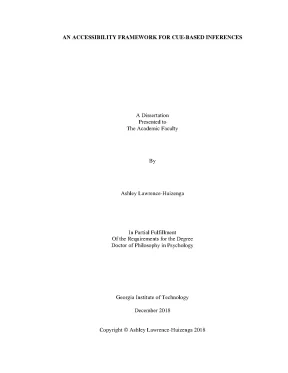
AN ACCESSIBILITY FRAMEWORK FOR CUE-BASED INFERENCES A Dissertation Presented to The Academic Faculty By Ashley Lawrence-Huizenga In Partial Fulfillment Of the Requirements for the Degree Doctor of Philosophy in Psychology Georgia Institute of Technology December 2018 Copyright © Ashley Lawrence-Huizenga 2018 An Accessibility Framework for Cue-Based Inferences Approved by: Dr. Rick Thomas, Advisor Dr. Daniel Spieler School of Psychology School of Psychology Georgia Institute of Technology Georgia Institute of Technology Dr. Frank Durso Dr.

Paul Elmore School of Psychology Geospatial Sciences and Technology Branch Georgia Institute of Technology Naval Research Laboratory Dr. Mark Wheeler School of Psychology Date Approved: November 7, 2018 Georgia Institute of Technology ACKNOWLEDGMENTS I would like to acknowledge and thank the following people who have supported me during my graduate career. First, I would like to thank my graduate advisor, Dr. Rick Thomas, for his guidance and encouragement on this dissertation.

Second, I would like to thank my dissertation committee members, Dr. Frank Durso, Dr. Mark Wheeler, Dr. Dan Spieler, and Dr.

Paul Elmore, for their helpful insights. Finally, I would also like to thank my friends and family for their support and patience. iii TABLE OF CONTENTS ACKNOWLEDGMENTS. iii LIST OF TABLES.

vi LIST OF FIGURES. 1 CHAPTER 2: LITERATURE REVIEW .1 Multi-Strategy Framework .2 Single-Strategy Frameworks .3 Shortcomings of Current Frameworks. 17 CHAPTER 3: ALTERNATIVE ACCESSIBILITY-BASED FRAMEWORK. 21 CHAPTER 4: SIMULATION OF ACCESSIBILITY-BASED FRAMEWORK .1 Experiment 1: Serial Position Effects in Cue-Based Inferences .2 Experiment 2: Effect of Delay on Cue-Based Inferences .3 Experiment 3: Cue-Based Inferences from Memory.

114 CHAPTER 6: GENERAL DISCUSSION. 131 v LIST OF TABLES Table 1 Validity of Cues for High and Low Dispersion Data Sets…………………. 29 Table 2 Average Number of Cues Select by Data Set, Threshold for Retrieval Failures, and Encoding Parameter…………………………………………. 31 Table 3 Proportion of Decision Based on a Single Cue by Data Set, Threshold for Retrieval Failures, and Encoding Parameter…………………………….33 Table 4 Proportion of Decisions Matching Compensatory Rule When Compensatory and Noncompensatory Differ by Data Set, Threshold of Retrieval Failures, and Encoding Parameter……………………………….37 Table 5 Validity of the Cues by Condition for Experiment 1……………………….45 Table 6 Average Number of Discriminations by Position in Each Training Block….

46 Table 7 Chi-square Goodness-of-fit Tests for Preference for Primacy Cue………….55 Table 8 Chi-square Goodness-of-fit Tests for Preference for Recency Cue………… 57 Table 9 Average Number of Cues Selected by Data Set, Encoding Parameter, and Decay Parameter………………………………………………………. 67 Table 10 Proportion of Decisions Based on a Single Cue by Data Set, Encoding Parameter, and Decay Parameter…………………………………………….68 Table 11 Proportion of Decision Matching Compensatory Rule When Compensatory and Noncompensatory Differ by Data Set, Encoding Parameter, and Decay Parameter…………………………………………….70 Table 12 Average Number of Cues Selected for EAM at Different Levels of the Threshold Parameter…………………………………………………………72 Table 13 Proportion of Decisions Based on a Single Cue for EAM at Different Levels of the Threshold Parameter…………………………………………. 72 Table 14 Proportion of Decisions Matching Compensatory Rule When Compensatory and Noncompensatory Differ by Dispersion of Validity and Threshold Parameter……………………………………………………. 75 Table 15 Validity of the Cues by Condition for Experiment 2……………………….76 vi Table 16 Aggregated Model Fits to Participant Cue Selection Pattern and Number of Cues Selected for Experiment 2………………………………… 85 Table 17 Proportion of Participants Classified as Best Fit by Each Model When Fitting Cue Selection Pattern and Number of Cues Selected……………….

86 Table 18 Aggregated Model Fits to Participant Cue Selection Pattern Only for Experiment 2………………………………………………………………. 87 Table 19 Proportion of Participants Classified as Best Fit by Each Model When Fitting Cue Selection Pattern Only…………………………………………. 87 Table 20 Validity of the Cues by Condition for Experiment 3……………………. 100 Table 21 Adherence Rates for Participants’ Decision Outcomes Compared to Model Predictions………………………………………………………….112 Table 22 Correlation between Participant Decision Times and Models’ Conceptual Decision Times……………………………………………….113 Table 23 Correlation between Participant Confidence and Model-Predicted Confidence………………………………………………………………….114 vii LIST OF FIGURES Figure 1 Proportion of Trials Each Cue Is Selected by Data Sets and Encoding Parameter………………………………………………………………….

35 Figure 2 Example of a Single Learning Trial in Experiment 1……………………. 48 Figure 3 Percent Correct during Training across Blocks for Experiment 1………. 50 Figure 4 Percent Correct during Training by Dispersion Condition and Validity Condition………………………………………………………………….51 Figure 5 Proportion of Trials Each Cue Was Selected by Dispersion and Mean Conditions…………………………………………………………………. 53 Figure 6 Proportion Selecting the Compensatory Option by Order Condition, Mean Condition, And Dispersion Condition…………………………….

58 Figure 7 Proportion of Trials Each Cue Was Selected by Validity Dispersion, Learning Parameter, and Decay Parameter………………………………. 69 Figure 8 Proportion of Trials Each Cue Was Selected by Threshold Parameter and Dispersion of Validity………………………………………………… 74 Figure 9 Proportion Correct on the Last 25 Trials by Participant…………………. 78 Figure 10 Number of Cues Selected by Dispersion Condition and Retention Interval…………………………………………………………………….79 Figure 11 Proportion Selecting the Compensatory Option When Compensatory and Noncompensatory Differ……………………………………………… 80 Figure 12 Proportion of Trials Each Cue Was Selected by Dispersion Condition and Retention Interval……………………………………………………. 82 Figure 13 Percent of Trials for Each Order of Selection by Cues in Order of Validity…………………………………………………………………….

83 Figure 14 Proportion of Decisions Matching a Compensatory Rule When Compensatory and Noncompensatory Differed by Dispersion and Frequency Manipulations………………………………………………….96 viii Figure 15 Average Number of Cues HyGene Generated by Experimental Condition with an Encoding Parameter of .6 for All but the Most Frequent Cue………………………………………………………………. 97 Figure 16 Average Confidence of HyGene and Activation-Only HyGene by Experimental Condition with an Encoding Parameter of .6 for All but the Most Frequent Cue……………………………………………………. 98 Figure 17 Example of Trials in the Cue Learning Phase…………………………… 101 Figure 18 Example of Test Phase Portion for Experiment 3………………………. 103 Figure 19 Calibration Curves by Dispersion and Frequency Conditions……………108 ix SUMMARY Many studies throughout the area of decision-making have shown that people are able to adapt to different decision environments.

A number of frameworks have been proposed that seek to explain adaptive decision making in the context of cue-based inferences, a type of decision where a person decides which option is highest on a variable of interest based on the attributes of those options. However, current frameworks fail to account for the role of memory in cue-based inferences. The goal of this dissertation was to test whether a framework based on the accessibility of cues in memory can provide a better account of adaptive decision-making in cue-based inferences compared to either the adaptive toolbox or current single-strategy models. Three experiments were conducted to test the accessibility framework by manipulating decision environments as well as directly manipulating memory for cues.

The results of the experiments extend previous research showing that memory affects cue-based inferences, challenging frameworks that are based on validity only. They also extend research on adaptive decision-making by showing that people are sensitive to the decision environment but that this does not always result in changes to both decision outcomes and decision processes. Overall, the accessibility framework provides a promising foundation for explaining how people make cue-based inferences, but further research is necessary to better understand how people search for cues, particularly how they decide to stop searching. x CHAPTER 1: INTRODUCTION People are often faced with decisions in which they are trying to choose which option is highest (or lowest) on some variable of interest based on the attributes of those options.

For example, a restaurant-goer might want to choose which menu item has fewer calories based on different characteristics of the menu items, such as whether they are made with red meat, whether they have dairy, whether they are high on carbs, etc. How a person makes their decision might change depending on the decision environment. For example, which attributes they use and how they combine those attributes to arrive at a decision may depend on how much time they have to make the decision and how easy the attribute information is to retrieve from the environment or from memory. There is a large body of literature that seeks to understand how people make these inferences and how people adapt their decision-making to the environment (for review see Gigerenzer, Hertwig, & Pachur, 2011).

Within the literature, these inferences are known as cue-based inferences because people are using information about the options to infer the value of a criterion of interest, which is calories in the above example. Information about the options that can be used to make inferences are known as cues, such as the presence of dairy for the menu items being compared. There is ample evidence that people making cue-based inferences adapt to the decision environment by either using fewer cues or combining the cue information differently (Bröder, 2003; Newell & Shanks, 2003; Payne, Bettman, & Johnson, 1988; Rieskamp & Hoffrage, 2008; Rieskamp & Otto, 2006). Much of the work within cue- based inferences is based on the work of Payne et al.

(1988), who proposed the idea that 1 people select adaptively among different strategies based on the decision environment. These strategies are characterized by rules for searching cues, when to stop searching, and how to combine cues. The most popular account of adaptive decision making within the cue-based inference literature is the adaptive toolbox (Gigerenzer, Todd, & ABC Research Group, 1999). The adaptive toolbox, like the theory of adaptive decision making (Payne et al., 1988), is a multi-strategy framework that assumes people select adaptively among a repository of qualitatively different strategies depending on the decision environment.

Much of this research compares under which circumstances people are likely to use compensatory strategies, high values on less useful cues can compensate for a low value on a highly useful cue, versus noncompensatory strategies, only the most useful cue is used. Recently, however, this framework has been criticized, both because the strategy selection process is poorly specified (Glöckner & Betsch, 2008a; Lee & Cummins, 2004; Newell, 2005; Söllner, Bröder, Glöckner, & Betsch, 2014) and because the increasing number of strategies in the toolbox makes it difficult to falsify (Dougherty, Thomas, & Franco-Watkins, 2008; Marewski & Link, 2014; Scheibehenne, Rieskamp, & Wagenmakers, 2013). Single-strategy frameworks have been proposed as potential solutions to the problems with multi-strategy accounts. The single-strategy frameworks, such as evidence accumulation (Lee & Cummins, 2004) and parallel constraint satisfaction (Glöckner & Betsch, 2008a), assume that people use one strategy that adjusts to the decision environment.

For example, the threshold of the amount of evidence required to make a decision adjusts to the decision environment in the evidence accumulation model (Lee & Cummins, 2004). Single-strategy frameworks can account for much the same data as the 2 multi-strategy frameworks because they are able to mimic apparent strategy changes by adjusting thresholds or information weights (Glöckner, Betsch, & Schindler, 2010; Glöckner & Hodges, 2011; Lee & Cummins, 2004; Newell & Lee, 2011). Although there is evidence for both the multi-strategy and single-strategy frameworks, none of the current frameworks provide a fully compelling account of adaptive decision-making in cue-based inferences. Most frameworks rely on the concept of pre-computed cue hierarchies based on cue validity, a measure of cue accuracy.

Specifically, cue validity is the number of times a cue correctly identifies the correct option compared to the total number of times it differs between the options. The adaptive toolbox assumes cue use is driven by cue validity and evidence accumulation models assume search follows validity order. In these frameworks, cue use is based on the cues being organized hierarchically such that cues are used in order of validity with the hierarchy being determined prior to decision-making (precomputed). The general concept of a precomputed hierarchy is not psychologically plausible because of the amount of knowledge required to calculate cue validity and the number of calculations that need to be made (Dougherty, Franco-Watkins, & Thomas, 2008).

Those frameworks that are not directly based on validity, such as parallel constraint satisfaction, still do not provide compelling accounts of decision-making because they do not fully specify how people search and select which cues are used in the decision process. Parallel constraint satisfaction tries to separate itself from the formal definition of cue validity by invoking subjective cue validity.

Nội dung được bảo vệ bản quyền — Tải xuống đầy đủ