Bối cảnh và vấn đề nghiên cứu
Trong xu thế hội nhập toàn cầu, tiếng Anh đã khẳng định vị thế là ngôn ngữ giao tiếp quốc tế phổ biến nhất. Theo số liệu của Vadivel và cộng sự (2019) được trích dẫn trong công trình, người sử dụng tiếng Anh không phải bản ngữ chiếm tới 70% tổng số các hoạt động giao tiếp bằng tiếng Anh trên thế giới; ngôn ngữ này là ngôn ngữ chính thức tại hơn 50 quốc gia, vùng lãnh thổ và là ngôn ngữ thứ hai của gần 100 quốc gia với hơn 400 triệu người bản ngữ. Tại Việt Nam, tiếng Anh là môn học bắt buộc từ bậc tiểu học và là chuẩn đầu ra thiết yếu của bậc đại học, đặc biệt đối với khối ngành kinh tế - tài chính như tại Học viện Ngân hàng.
Tuy nhiên, dù đa số sinh viên đã trải qua ít nhất 7 năm học tiếng Anh phổ thông trước khi bước vào đại học, năng lực giao tiếp thực tế của nhiều người học vẫn còn hạn chế. Nguyên nhân chính xuất phát từ phương pháp giảng dạy truyền thống quá chú trọng vào việc giải mã ngữ pháp, cấu trúc câu và các bài tập rèn luyện kỹ năng lặp lại đơn điệu, thiếu ngữ cảnh thực tế. Trước thực trạng đó, sinh viên chuyên ngành Ngôn ngữ Anh tại Học viện Ngân hàng có nhu cầu tiếp cận các phương tiện đa phương tiện trực quan, trong đó việc xem phim tiếng Anh nổi lên như một phương pháp tích hợp giữa giải trí và tiếp nhận ngôn ngữ tự nhiên. Các tài liệu học thuật trước đây (Sefero Iu, 2008; Florence, 2009) khẳng định phim ảnh cung cấp nguồn ngữ liệu chân thực (authentic linguistic input) và bối cảnh văn hóa sinh động. Ngược lại, một số nhà nghiên cứu (Kusumaningrum, 2016; Sari & Sugandi, 2015) lại chỉ ra rằng việc xem phim thiếu định hướng sư phạm có thể khiến người học bị phân tâm bởi diễn viên và tình tiết mà quên đi mục tiêu học tập ban đầu.
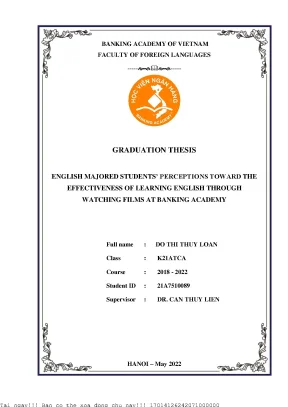
Nhằm làm rõ thực trạng và cung cấp cơ sở thực chứng toàn diện, khóa luận tốt nghiệp của tác giả Đỗ Thị Thùy Loan tập trung giải quyết ba mục tiêu nghiên cứu cụ thể:
- Khảo sát bức tranh tổng quan về hành vi xem phim tiếng Anh của sinh viên chuyên ngành Ngôn ngữ Anh tại Học viện Ngân hàng (thời gian xem, thể loại phim yêu thích, thói quen sử dụng phụ đề và mục đích xem phim).
- Đánh giá nhận thức của sinh viên về mức độ hiệu quả của việc xem phim đối với 8 khía cạnh ngôn ngữ và tâm lý - xã hội, bao gồm: kỹ năng nói, kỹ năng nghe, kỹ năng đọc, kỹ năng viết, kỹ năng giao tiếp, vốn từ vựng, nhận thức văn hóa và động lực học tập tiếng Anh.
- Phân tích các ưu điểm và rào cản thực tế khi sử dụng phim ảnh làm công cụ học tập; từ đó đề xuất các khuyến nghị phù hợp cho Học viện Ngân hàng, Khoa Ngoại ngữ và người học.
Đối tượng nghiên cứu của đề tài là nhận thức và thái độ của sinh viên chuyên ngành Ngôn ngữ Anh đối với hiệu quả của phương pháp học tiếng Anh qua phim. Địa bàn nghiên cứu được thực hiện tại Khoa Ngoại ngữ, Học viện Ngân hàng (địa chỉ: số 12 Chùa Bộc, quận Đống Đa, Hà Nội). Khóa luận được hoàn thành sau thời gian 3 tháng thực hiện trong khuôn khổ chương trình đào tạo cử nhân khóa 2018 - 2022 và nghiệm thu vào tháng 5/2022.
Cơ sở lý thuyết và phương pháp
Khóa luận xây dựng khung khái niệm dựa trên mô hình nghiên cứu tổng hợp của Norwati, Aini, Vahid và Muhammad (2021). Mô hình này liên kết các biến số nhân khẩu học và hành vi đầu vào (trình độ tiếng Anh nền tảng, thời gian xem, cách sử dụng phụ đề) với các biến số kết quả tác động lên người học, bao gồm: 4 kỹ năng ngôn ngữ cơ bản (nghe, nói, đọc, viết), kỹ năng giao tiếp, phạm vi từ vựng, nhận thức văn hóa và động lực học tập.
Hệ thống khái niệm thao tác trong nghiên cứu được định nghĩa dựa trên các tài liệu kinh điển:
- Văn hóa và Nhận thức văn hóa (Cultural Awareness): Được định nghĩa theo Bodley (1994), Cohen và cộng sự (2003) và Jiang (1994), nhấn mạnh văn hóa là hệ thống niềm tin, chuẩn mực, phong tục gắn liền không thể tách rời với ngôn ngữ.
- Kỹ năng nghe (Listening Skills): Khả năng tiếp nhận, xử lý và gắn kết thông tin âm thanh trong tích tắc (Harmer, 2000).
- Kỹ năng nói (Speaking Skills): Khả năng biểu đạt ý tưởng mạch lạc, lưu loát và phù hợp với ngữ cảnh (Torky, 2006).
- Phân loại phụ đề (Subtitles): Dựa trên phân loại của Zanon (2006) gồm 3 dạng: Phụ đề song ngữ/tiếng Anh (Bimodal Subtitling), Phụ đề chuẩn sang tiếng mẹ đẻ (Standard Subtitling) và Phụ đề đảo ngược (Reversed Subtitling).
Nghiên cứu sử dụng phương pháp nghiên cứu định lượng mô tả thông qua bảng hỏi khảo sát (Survey Quantitative Research) theo hướng dẫn của Aliaga & Gunderson (2002), Creswell (2005) và Mertler (2016). Tổng thể nghiên cứu (population) gồm toàn bộ khoảng 600 sinh viên đang theo học tại Khoa Ngoại ngữ, Học viện Ngân hàng. Cỡ mẫu nghiên cứu được xác định theo công thức của Andrew Fisher với độ tin cậy (Confidence Level) 95% ($Z = 1.96$), khoảng tin cậy (Confidence Interval) 9%, và độ lệch chuẩn giả định 0.5. Mẫu khảo sát thực tế thu về gồm $N = 120$ sinh viên từ năm thứ nhất đến năm thứ tư.
Quy trình thu thập dữ liệu gồm 4 bước: (1) Thiết kế bảng hỏi trên Google Form dựa trên tổng quan lý liệu; (2) Thử nghiệm bảng hỏi với giảng viên hướng dẫn và nhóm sinh viên mẫu để loại bỏ các câu hỏi chưa rõ ràng; (3) Phân phối bảng hỏi qua các nền tảng mạng xã hội (Facebook, Messenger, Zalo) do điều kiện học trực tuyến trong bối cảnh dịch Covid-19; (4) Thu thập, làm sạch và xử lý dữ liệu bằng Microsoft Excel 2016 và phần mềm SPSS.
Bảng hỏi gồm 21 câu chia thành 3 phần: Phần 1 khảo sát thông tin nền tảng và thói quen giải trí (7 câu trắc nghiệm); Phần 2 khảo sát hành vi xem phim (4 câu trắc nghiệm); Phần 3 gồm các mệnh đề đo lường nhận thức theo thang đo Likert 5 mức độ (từ 1: Hoàn toàn không đồng ý đến 5: Hoàn toàn đồng ý). Kết quả kiểm định độ tin cậy của thang đo bằng hệ số Cronbach's Alpha đều đạt yêu cầu học thuật:
| Nhóm thang đo |
Số lượng câu hỏi |
Hệ số Cronbach's Alpha |
| Kỹ năng nói (Speaking skills) |
4 |
0.841 |
| Thói quen sử dụng phụ đề (The use of subtitles) |
6 |
0.896 |
| Phạm vi từ vựng (Range of vocabulary) |
3 |
0.703 |
| Động lực học tiếng Anh (Motivation to learn English) |
2 |
0.689 |
| Kỹ năng đọc và viết (Reading and Writing skills) |
4 |
0.654 |
Nội dung chính theo từng chương
Chapter 1: Introduction
Chương mở đầu xác lập tính cấp thiết của đề tài trong bối cảnh hội nhập quốc tế và những thách thức trong việc giảng dạy tiếng Anh như một ngoại ngữ (EFL) tại Việt Nam. Tác giả trình bày rõ ràng 3 mục tiêu nghiên cứu, câu hỏi nghiên cứu trung tâm, ý nghĩa đóng góp của đề tài cho người học và các nhà nghiên cứu tương lai, phạm vi giới hạn của nghiên cứu và hệ thống định nghĩa thao tác cho các thuật ngữ chuyên ngành (L1, L2, Oral skills, Pronunciation, Stress, Subtitles, Confidence interval, Standard deviation...).
Chapter 2: Literature Review
Chương này tổng thuật toàn diện các nghiên cứu trong nước và quốc tế về việc ứng dụng phim ảnh trong giảng dạy và học tập ngôn ngữ:
- Kỹ năng nghe: Các thực nghiệm của Liando và cộng sự (2018), Safranj (2015), và Luo (2004) cho thấy việc tiếp xúc với phim ảnh giúp cải thiện khả năng nghe hiểu vượt trội so với phương pháp truyền thống nhờ giảm bớt áp lực tâm lý.
- Kỹ năng nói và phát âm: Nghiên cứu của Thammineni (2016), Tsai (2009) và Mirvan (2013) khẳng định việc quan sát người bản ngữ nói giúp nâng cao độ trôi chảy, ngữ điệu, trọng âm và phát âm chuẩn xác.
- Từ vựng: Khoshniyat & Dowlatabadi (2014) qua thực nghiệm phim hoạt hình Disney cùng các nghiên cứu của Al-Seghayer (2001) và Ismaili (2013) chứng minh phim ảnh cung cấp ngữ cảnh lặp lại tự nhiên, hỗ trợ ghi nhớ thành ngữ và từ vựng dài hạn.
- Kỹ năng giao tiếp và nhận thức văn hóa: Tác giả tổng hợp luận điểm từ Rivers (1994), King (2002), Kusumarasdyati (2004), Rammal (2005) về việc phim ảnh cung cấp các yếu tố cận ngôn ngữ (ngôn ngữ cơ thể, nét mặt) và mở rộng hiểu biết về văn hóa bản địa (Peterson & Coltrane, 2003).
- Khung khái niệm: Trình bày chi tiết sơ đồ khung khái niệm kế thừa từ Norwati và cộng sự (2021).
Chapter 3: Methodology
Chương này trình bày chi tiết về thiết kế nghiên cứu định lượng, địa bàn khảo sát tại Học viện Ngân hàng, công thức xác định cỡ mẫu Andrew Fisher và đặc điểm nhân khẩu học của mẫu nghiên cứu ($N=120$):
- Giới tính: Nữ giới chiếm đa số với 75.8% (91 sinh viên), nam giới chiếm 24.2% (29 sinh viên).
- Năm học: Sinh viên năm thứ tư chiếm tỷ lệ cao nhất với 41.7% (50 sinh viên), tiếp theo là năm thứ ba 31.7% (38 sinh viên), năm thứ hai 21.7% (26 sinh viên) và năm thứ nhất 5.0% (6 sinh viên).
- Trình độ tiếng Anh tự đánh giá: Upper Intermediate chiếm 36.7%, Intermediate chiếm 28.3%, Advanced chiếm 21.7%, Pre-Intermediate chiếm 10.8%, Proficient chiếm 2.5%, không có sinh viên ở mức Beginner/Elementary.
- Thời gian học tiếng Anh mỗi ngày: 4-6 giờ chiếm 40.8%; 2-4 giờ chiếm 30.8%; dưới 2 giờ chiếm 16.7%; trên 6 giờ chiếm 11.7%.
- Thói quen giải trí: Xem phim là hoạt động được ưa chuộng nhất (45.0%), tiếp theo là nghe nhạc (31.7%), đọc sách (16.7%) và các hoạt động khác (6.7%). Mục đích giải trí bằng tiếng Anh kết hợp cả thư giãn lẫn học tập chiếm 43.3%.
- Trình bày thang đo Likert, khoảng phân khoảng điểm trung bình (Mean Score) và quy trình xử lý kiểm định Cronbach's Alpha trên SPSS.
Chapter 4: Results and Discussion
Chương 4 cung cấp số liệu thực nghiệm và thảo luận chuyên sâu về hành vi và nhận thức của sinh viên:
1. Hành vi xem phim để học tiếng Anh:
- Thời gian xem: 45 sinh viên dành 2-3 giờ/ngày, 41 sinh viên dành 1-2 giờ/ngày, 21 sinh viên dành dưới 1 giờ/ngày, và 12 sinh viên dành trên 3 giờ/ngày.
- Thể loại phim: Phim hài (Comedy) được sử dụng nhiều nhất (47 lựa chọn), tiếp theo là Phim chính kịch/tâm lý (Drama - 25 lựa chọn), Lãng mạn (Romance - 16 lựa chọn), Giả tưởng (Fantasy - 12 lựa chọn), Kinh dị (Horror - 10 lựa chọn), Hành động (Action - 9 lựa chọn) và thể loại khác (1 lựa chọn).
- Thói quen phụ đề: 47.5% (57 sinh viên) chỉ bật phụ đề khi xem các chủ đề phức tạp; 29.2% (35 sinh viên) bật toàn thời gian; 17.5% (21 sinh viên) hiếm khi dùng; 5.8% (7 sinh viên) hoàn toàn không dùng.
- Ngôn ngữ phụ đề: 51.7% (62 sinh viên) chỉ dùng phụ đề tiếng Anh; 32.5% (39 sinh viên) dùng song ngữ Anh - Việt; 10.8% (13 sinh viên) chỉ dùng phụ đề tiếng Việt; 5.0% (6 sinh viên) không dùng phụ đề.
2. Nhận thức về tác động đối với các kỹ năng:
- Kỹ năng nói: Đa số sinh viên đồng ý và hoàn toàn đồng ý về tác động tích cực. Mức độ "Hoàn toàn đồng ý" cao nhất ghi nhận ở khía cạnh cải thiện ngữ điệu/chất giọng (Accent - 68 phiếu), độ trôi chảy (Fluency - 67 phiếu), ngữ điệu câu (Intonation - 58 phiếu), phát âm (Pronunciation - 49 phiếu Hoàn toàn đồng ý, 60 phiếu Đồng ý) và trọng âm (Stress - 49 phiếu Hoàn toàn đồng ý, 50 phiếu Đồng ý).
- Kỹ năng nghe: Tốc độ tiếp nhận thông tin tiếng Anh nhận được 80 phiếu "Đồng ý"; khả năng nghe hiểu toàn diện và nhận biết giọng địa phương/phương ngữ lạ cùng đạt 46 phiếu "Hoàn toàn đồng ý"; khả năng duy trì sự chú ý đạt 71 phiếu "Đồng ý".
- Kỹ năng đọc và viết: Ghi nhận sự phân hóa rõ rệt khi phần lớn sinh viên đánh giá không hiệu quả. Có 49 sinh viên "Không đồng ý" và 8 sinh viên "Hoàn toàn không đồng ý" đối với cải thiện kỹ năng đọc; 45 sinh viên "Không đồng ý" và 21 sinh viên "Hoàn toàn không đồng ý" đối với cải thiện kỹ năng viết. Mức "Hoàn toàn đồng ý" chỉ đạt 4 phiếu cho kỹ năng đọc và 2 phiếu cho kỹ năng viết.
- Kỹ năng giao tiếp: Tác động thúc đẩy rõ rệt với 73 phiếu "Đồng ý" về việc tăng mức độ sẵn sàng giao tiếp, 67 phiếu "Đồng ý" về tăng sự tự tin, 54 phiếu "Đồng ý" về việc học ngôn ngữ cơ thể và 52 phiếu về biểu cảm khuôn mặt.
- Vốn từ vựng: 62 sinh viên hoàn toàn đồng ý rằng xem phim giúp nhớ từ mới tốt hơn; 74 sinh viên đồng ý rằng phim ảnh mở rộng vốn từ nói và 70 sinh viên đồng ý về khả năng dùng từ đúng ngữ cảnh.
- Nhận thức văn hóa: Hiểu biết về lối sống đạt 80 phiếu "Đồng ý"; phong tục/truyền thống đạt 78 phiếu "Đồng ý"; giá trị/chuẩn mực xã hội đạt 63 phiếu "Đồng ý" và 43 phiếu "Hoàn toàn đồng ý".
3. Tác động của phụ đề và động lực học tập:
| Nội dung khảo sát |
Điểm trung bình (Mean Score) |
Độ lệch chuẩn (SD) |
Mức độ đánh giá |
| Phụ đề giúp hiểu nội dung phim tốt hơn |
3.71 |
0.892 |
Hoàn toàn đồng ý |
| Phụ đề giúp thu nhận nhiều từ vựng mới |
3.65 |
0.946 |
Hoàn toàn đồng ý |
| Phụ đề giúp ghi nhớ từ vựng tốt hơn |
3.55 |
0.874 |
Hoàn toàn đồng ý |
| Phim tiếng Anh giúp giảm âu lo và căng thẳng khi học |
4.13 |
0.732 |
Hoàn toàn đồng ý |
| Phim tiếng Anh giúp tăng hứng thú và động lực học tập |
3.86 |
0.813 |
Hoàn toàn đồng ý |
| Phụ đề làm phân tâm khi thưởng thức phim |
3.22 |
0.989 |
Trung lập |
| Phụ đề tạo cảm giác đang đọc thay vì đang nghe |
3.05 |
1.053 |
Trung lập |
| Phụ đề không có tác động gì đến kỹ năng ngôn ngữ |
3.04 |
1.042 |
Trung lập |
4. Đánh giá chung và các hạn chế:
Khi được hỏi về tính hiệu quả tổng thể, 86.3% sinh viên khẳng định xem phim là phương pháp học tiếng Anh tốt, trong khi 13.7% trả lời không. Ba hạn chế lớn nhất được sinh viên chỉ ra gồm: (1) Dễ bị cuốn vào cốt truyện và quên mục tiêu học tập ban đầu; (2) Tốc độ nói của người bản xứ quá nhanh khiến người học không bắt kịp từng từ; (3) Tình trạng phụ thuộc quá mức vào phụ đề làm giảm hiệu quả rèn luyện phản xạ nghe.
Chapter 5: Conclusion and Recommendation
Chương tổng kết khẳng định sự đồng thuận cao của sinh viên về tính hữu ích của việc xem phim đối với các kỹ năng tiếp nhận và biểu đạt âm thanh (nghe, nói), vốn từ vựng, nhận thức văn hóa và động lực cá nhân; đồng thời chỉ ra sự hạn chế của phương pháp này đối với kỹ năng đọc và viết học thuật. Tác giả đề xuất các nhóm giải pháp:
- Đối với Học viện Ngân hàng: Tăng cường trang bị cơ sở vật chất đa phương tiện tại các phòng học.
- Đối với Khoa Ngoại ngữ: Định hướng tích hợp các đoạn phim tài liệu, phim tình huống có chủ đích sư phạm vào bài giảng; hướng dẫn sinh viên cách khai thác phim ảnh đúng phương pháp.
- Đối với sinh viên: Lựa chọn thể loại phim phù hợp với trình độ, áp dụng kỹ thuật bật/tắt phụ đề linh hoạt và ghi chép từ vựng chủ động thay vì xem thụ động.
Kết quả và đóng góp
Khóa luận đã lượng hóa cụ thể thái độ và hành vi của người học thông qua tập số liệu thực nghiệm rõ ràng:
| Chỉ số nghiên cứu |
Giá trị thực nghiệm |
| Quy mô mẫu khảo sát hợp lệ |
$N = 120$ sinh viên chuyên ngữ |
| Tỷ lệ sinh viên đánh giá học qua phim là phương pháp tốt |
86.3% |
| Tỷ lệ ưu tiên sử dụng phụ đề tiếng Anh (English captions only) |
51.7% |
| Thể loại phim được lựa chọn nhiều nhất làm học liệu |
Hài kịch (Comedy - 47/120 lựa chọn) |
| Kỹ năng ngôn ngữ được đánh giá cải thiện mạnh nhất |
Kỹ năng nói (Accent, Fluency) & Kỹ năng nghe |
| Kỹ năng ngôn ngữ bị đánh giá ít có hiệu quả nhất |
Kỹ năng đọc (49 phiếu Disagree) & Kỹ năng viết (45 phiếu Disagree) |
| Điểm đánh giá mức độ giảm căng thẳng, áp lực khi học qua phim |
$MS = 4.13$ (Mức cao nhất trong thang đo) |
Khóa luận đóng góp về mặt lý luận và thực tiễn khi là công trình khảo sát đầu tiên thực hiện trên nhóm đối tượng sinh viên chuyên ngành Ngôn ngữ Anh tại Học viện Ngân hàng. Khác với các nghiên cứu tiền nhiệm thường chỉ phân tích đơn lẻ một kỹ năng biệt lập, nghiên cứu này đã thiết lập một cái nhìn tổng thể đa chiều, đặt đồng thời 8 khía cạnh ngôn ngữ, văn hóa và tâm lý học tập vào cùng một khung phân tích đối sánh.
Hạn chế và hướng nghiên cứu tiếp
Tác giả đã chỉ ra 3 hạn chế chính trong phạm vi nghiên cứu của khóa luận:
- Công cụ thu thập dữ liệu đơn nhất: Do áp lực về mặt thời gian và điều kiện dịch bệnh Covid-19 tại thời điểm khảo sát, nghiên cứu chỉ sử dụng hình thức bảng hỏi trực tuyến (online survey), chưa thể kết hợp các phương pháp phỏng vấn sâu (in-depth interview) hoặc kiểm chứng thực nghiệm can thiệp (experimental pre-test/post-test) để đối chiếu giữa nhận thức chủ quan và kết quả học tập thực tế.
- Quy mô mẫu khảo sát: Dù cỡ mẫu $N = 120$ đạt chuẩn tối thiểu theo công thức tính mẫu Fisher, quy mô này vẫn còn ở mức vừa phải so với tổng thể 600 sinh viên của toàn khoa.
- Tính khái quát hóa: Các kết quả và đề xuất mang tính đặc thù cao cho sinh viên Khoa Ngoại ngữ tại Học viện Ngân hàng, chưa bảo đảm tính đại diện tuyệt đối cho sinh viên không chuyên ngữ hoặc sinh viên các cơ sở giáo dục đại học khác.
Hướng nghiên cứu tiếp theo được đề xuất bao gồm: Mở rộng quy mô mẫu khảo sát, áp dụng phương pháp nghiên cứu kết hợp (mixed-methods), và thực hiện các nghiên cứu thực nghiệm dài hạn để đo lường định lượng mức độ tiến bộ của người học qua từng thể loại phim và kỹ thuật sử dụng phụ đề cụ thể.
Giá trị tham khảo
Tài liệu là nguồn tư liệu tham khảo hữu ích cho:
- Sinh viên ngành Ngôn ngữ Anh, Sư phạm Tiếng Anh khi thực hiện các khóa luận, nghiên cứu khoa học liên quan đến phương pháp học tập đa phương tiện (audiovisual language learning) và phát triển kỹ năng nghe - nói.
- Giảng viên giảng dạy tiếng Anh (EFL) trong việc thiết kế hoạt động bổ trợ trên lớp, xây dựng học liệu nghe nhìn và hướng dẫn sinh viên tự học ngoài giờ lên lớp.
- Các nhà nghiên cứu phương pháp giảng dạy ngoại ngữ quan tâm đến công cụ bảng hỏi khảo sát nhận thức, quy trình kiểm định thang đo Likert bằng Cronbach's Alpha trên phần mềm SPSS và khung phân tích dựa trên mô hình của Norwati et al. (2021).
Câu hỏi thường gặp
Khóa luận sử dụng công thức nào để xác định cỡ mẫu và quy mô mẫu thực tế là bao nhiêu?
Tác giả sử dụng công thức tính mẫu của Andrew Fisher với độ tin cậy 95% ($Z = 1.96$), khoảng tin cậy 9% và độ lệch chuẩn 0.5. Cỡ mẫu thực tế thu thập và đưa vào phân tích là 120 sinh viên thuộc Khoa Ngoại ngữ, Học viện Ngân hàng.
Thể loại phim và hình thức phụ đề nào được sinh viên sử dụng phổ biến nhất để học tiếng Anh?
Thể loại phim Hài kịch (Comedy) được lựa chọn nhiều nhất với 47/120 lượt bình chọn, vượt trội so với Phim chính kịch (Drama - 25 lượt) và Phim lãng mạn (Romance - 16 lượt). Về hình thức phụ đề, 51.7% sinh viên lựa chọn xem phim với phụ đề tiếng Anh thuần túy (English only) và 47.5% sinh viên chỉ bật phụ đề khi gặp các chủ đề phức tạp.
Theo kết quả khảo sát, việc xem phim tác động như thế nào đến kỹ năng Đọc và Viết so với kỹ năng Nghe và Nói?
Kết quả ghi nhận sự đối lập rõ nét: Trong khi kỹ năng Nghe và Nói nhận được sự đồng thuận tích cực áp đảo (đặc biệt về chất giọng, độ trôi chảy và tốc độ bắt thông tin), thì kỹ năng Đọc và Viết bị đa số sinh viên đánh giá là không hiệu quả (49 sinh viên không đồng ý về cải thiện kỹ năng đọc và 45 sinh viên không đồng ý về cải thiện kỹ năng viết).
Độ tin cậy Cronbach's Alpha của các thang đo trong nghiên cứu đạt mức nào?
Tất cả các thang đo đều đạt độ tin cậy theo chuẩn thống kê ($>0.6$): Thang đo thói quen dùng phụ đề đạt 0.896; kỹ năng nói đạt 0.841; phạm vi từ vựng đạt 0.703; động lực học tiếng Anh đạt 0.689; kỹ năng đọc và viết đạt 0.654.
Ba rào cản lớn nhất mà sinh viên gặp phải khi học tiếng Anh qua phim là gì?
Sinh viên chỉ ra 3 hạn chế chính: Dễ bị cuốn vào cốt truyện dẫn đến phân tâm khỏi mục tiêu học ngôn ngữ; tốc độ phát âm của diễn viên bản xứ quá nhanh; và sự phụ thuộc quá mức vào phụ đề làm giảm khả năng rèn luyện phản xạ nghe chủ động.
Kết luận
Khóa luận tốt nghiệp của tác giả Đỗ Thị Thùy Loan đã phân tích thực chứng nhận thức của 120 sinh viên chuyên ngành Ngôn ngữ Anh tại Học viện Ngân hàng đối với phương pháp học tiếng Anh qua phim ảnh. Kết quả nghiên cứu khẳng định phương tiện nghe nhìn này mang lại hiệu quả vượt trội trong việc phát triển kỹ năng nghe, nói, mở rộng vốn từ vựng giao tiếp, nâng cao nhận thức văn hóa bản địa và giảm bớt căng thẳng tâm lý khi học ngoại ngữ. Dù còn hạn chế nhất định đối với việc rèn luyện kỹ năng đọc và viết học thuật, công trình đã cung cấp cơ sở dữ liệu thực nghiệm đáng tin cậy cùng các khuyến nghị sư phạm thiết thực cho công tác dạy và tự học tiếng Anh tại bậc đại học.