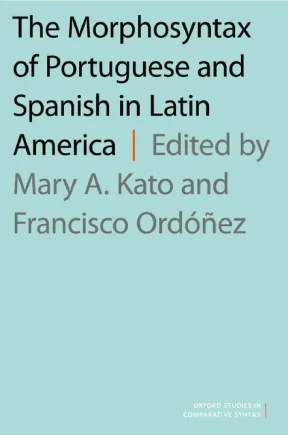
The Morphosyntax of Portuguese and Spanish in Latin America - Edited by Mary A. Kato & Francisco Ordóñez

Trường đại học

Đại học Oxford

Người đăng

Ẩn danh

Thể loại

Sách học thuật

2016

385
0
0

Phí lưu trữ

75 Point

Tóm tắt

I. Tổng quan về ngữ pháp hình thái cú pháp tiếng Bồ Đào Nha và Tây Ban Nha tại Mỹ Latinh

Ngữ pháp hình thái cú pháp (morphosyntax) nghiên cứu sự tương tác giữa hình thái từ và cấu trúc cú pháp trong ngôn ngữ. Tiếng Bồ Đào Nha và tiếng Tây Ban Nha là hai ngôn ngữ Rôman có nguồn gốc lịch sử chung nhưng phát triển theo nhiều hướng khác nhau tại Mỹ Latinh. Quá trình thực dân hóa mang hai ngôn ngữ này đến châu Mỹ, nơi chúng tiếp xúc với các ngôn ngữ bản địa và chịu ảnh hưởng từ điều kiện xã hội đặc thù. Kết quả là các biến thể Mỹ Latinh khác biệt đáng kể so với dạng chuẩn châu Âu. Các nghiên cứu trong bộ Oxford Studies in Comparative Syntax, do Mary A. Kato và Francisco Ordóñez biên tập, cung cấp khung phân tích so sánh chi tiết. Những nghiên cứu này xem xét cách các tham số cú pháp thay đổi giữa biến thể khu vực. Chủ đề chính bao gồm đại từ, vị trí chủ ngữ, hệ thống đề mục và sự khác biệt giữa các phương ngữ vùng Caribbean, Brazil và các quốc gia Andean. Việc hiểu morphosyntax giúp làm sáng tỏ quá trình biến đổi ngôn ngữ đang diễn ra tại khu vực này.

1.1. Bối cảnh lịch sử hình thành ngôn ngữ tại Mỹ Latinh

Tiếng Bồ Đào Nha và Tây Ban Nha đến Mỹ Latinh qua quá trình thực dân hóa từ thế kỷ XVI. Hai ngôn ngữ này tiếp xúc trực tiếp với hàng trăm ngôn ngữ bản địa như Quechua, Nahuatl và Guarani. Sự tiếp xúc ngôn ngữ tạo ra các biến thể mới với đặc điểm morphosyntax riêng biệt. Tại Brazil, tiếng Bồ Đào Nha phát triển khác biệt rõ rệt so với Bồ Đào Nha châu Âu. Các yếu tố xã hội như di cư nội bộ, đô thị hóa và giáo dục góp phần định hình hệ thống cú pháp. Quá trình Creol hóa tại một số vùng Caribbean cũng để lại dấu ấn đặc trưng trong cấu trúc câu. Bối cảnh lịch sử đa tầng này giải thích tại sao các biến thể Mỹ Latinh trở thành đối tượng nghiên cứu hấp dẫn cho ngôn ngữ học so sánh hiện đại.

1.2. Vị trí của nghiên cứu morphosyntax trong ngôn ngữ học hiện đại

Nghiên cứu morphosyntax chiếm vị trí trung tâm trong lý thuyết cú pháp so sánh đương đại. Phương pháp cartography of syntactic structures, phát triển bởi Guglielmo Cinque và Luigi Rizzi, cung cấp công cụ lập bản đồ chi tiết các vị trí cú pháp. Truyền thống này xuất phát từ Chomsky và được mở rộng bởi Richard Kayne qua các nghiên cứu về cấu trúc determiner và sự im lặng. Các nhà nghiên cứu áp dụng khung tham số để giải thích biến đổi liên ngôn ngữ. Morphosyntax tiếng Bồ Đào Nha và Tây Ban Nha tại Mỹ Latinh cung cấp dữ liệu quý giá cho việc kiểm chứng lý thuyết. Các hiện tượng như chủ ngữ rỗng, đảo ngữ và sự hòa hợp cho thấy cách các tham số được thiết lập lại trong môi trường ngôn ngữ mới. Nghiên cứu này đóng góp vào hiểu biết tổng quát về bản chất của ngôn ngữ con người.

II. Phân tích vấn đề hình thái cú pháp chính trong tiếng Bồ Đào Nha và Tây Ban Nha Mỹ Latinh

Nhiều vấn đề morphosyntax nổi bật trong biến thể Mỹ Latinh của hai ngôn ngữ này. Vấn đề chủ ngữ rỗng (null subject) thu hút sự chú ý đặc biệt từ giới nghiên cứu. Tiếng Bồ Đào Nha châu Âu cho phép bỏ qua đại từ chủ ngữ nhờ hệ thống chia động từ phong phú. Tuy nhiên, tiếng Bồ Đào Nha Brazil cho thấy xu hướng tăng sử dụng đại từ chủ ngữ rõ ràng. Ngược lại, biến thể Tây Ban Nha Dominican Republic thể hiện pattern phức tạp hơn với đại từ expletive 'ello'. Đại từ thân mật và trang trọng cũng biến đổi đáng kể giữa các vùng. Hệ thống hòa hợp chủ ngữ-động từ chịu ảnh hưởng từ các yếu tố như tính sống (animacy) của danh từ. Sự đồng tham chiếu trong câu phức tạp cũng tác động đến việc lựa chọn hình thức chủ ngữ. Các yếu tố pragmatics và discourse đóng vai trò quyết định trong nhiều lựa chọn cú pháp. Hiểu rõ những vấn đề này cần phương pháp tiếp cận đa chiều kết hợp dữ liệu thực nghiệm với lý thuyết hình thức.

2.1. Hiện tượng chủ ngữ rỗng và sự biến đổi theo vùng miền

Chủ ngữ rỗng là hiện tượng morphosyntax được nghiên cứu rộng rãi nhất trong tiếng Bồ Đào Nha và Tây Ban Nha. Dữ liệu từ nghiên cứu của Kato cho thấy tỷ lệ chủ ngữ rỗng trong tiếng Bồ Đào Nha Brazil đạt khoảng 74% tổng số trường hợp. Tỷ lệ này thay đổi đáng kể tùy theo tính sống của danh từ tham chiếu. Danh từ vô tri (inanimate) có tỷ lệ chủ ngữ rỗng cao hơn, đạt khoảng 94% với trọng số tương đối 0.53. Trong cấu trúc matrix-embedded, sự đồng tham chiếu với chủ ngữ câu chính thúc đẩy việc sử dụng chủ ngữ rỗng lên 91%. Ngược lại, khi tham chiếu khác biệt, tỷ lệ giảm xuống chỉ còn 49%. Tại Caribbean, đặc biệt Dominican Republic, xu hướng sử dụng chủ ngữ rỗng giảm dần. Sự khác biệt này phản ánh quá trình thay đổi tham số ngôn ngữ đang diễn ra.

2.2. Đại từ expletive và sự đảo ngữ trong biến thể Caribbean

Biến thể Tây Ban Nha Caribbean, đặc biệt Dominican Spanish, thể hiện pattern đặc biệt với đại từ expletive 'ello'. Otheguy và cộng sự ghi nhận sự xuất hiện của 'ello' như dấu hiệu chuyển đổi khỏi tham số chủ ngữ rổ̃ng. Tuy nhiên, nghiên cứu của Bullock và Toribio năm 2009 cho thấy 'ello' không bắt buộc ngay cả với cùng nhóm người nói. Hinzeliln và Kaiser năm 2007 phát hiện rằng người nói từ cả vùng đô thị và nông thôn đều ưu tiên chủ ngữ rỗng. Điều đáng chú ý là tất cả ví dụ về 'ello' đều đi kèm đảo ngữ động từ-chủ ngữ. Điều này gợi ý 'ello' hoạt động ở vị trí ngoại vi trái (left periphery) thay vì vị trí TP. Đại từ chủ ngữ cũng không đảo trong câu hỏi từ (wh-questions), khác biệt so với nhiều biến thể Caribbean khác.

III. Phương pháp nghiên cứu morphosyntax tiếng Bồ Đào Nha và Tây Ban Nha tại Mỹ Latinh

Nghiên cứu morphosyntax đòi hỏi phương pháp đa dạng kết hợp thu thập dữ liệu thực nghiệm với phân tích lý thuyết. Phương pháp định lượng sử dụng tỷ lệ phần trăm và trọng số tương đối (relative weight) để đo lường tần suất xuất hiện của các pattern cú pháp. Dữ liệu được phân loại theo nhiều nhóm yếu tố như tính sống, loại tham chiếu và vị trí cú pháp. Phương pháp thực nghiệm kiểm soát cho phép so sánh kết quả giữa thiết kế khác nhau, như nghiên cứu của Cabrera so với Otheguy. Phương pháp discourse analysis xem xét cách ngữ cảnh ảnh hưởng đến lựa chọn cú pháp. Phương pháp so sánh liên phương ngữ giúp xác định đặc điểm chung và riêng biệt giữa các biến thể. Công cụ thống kê hiện đại hỗ trợ phân tích dữ liệu lớn với độ chính xác cao. Phương pháp cartography lập bản đồ chi tiết cấu trúc câu để hiểu vị trí của từng yếu tố cú pháp. Sự kết hợp các phương pháp này tạo ra bức tranh toàn diện về morphosyntax ngôn ngữ Mỹ Latinh.

3.1. Phương pháp thu thập và phân tích dữ liệu định lượng

Thu thập dữ liệu định lượng là bước nền tảng trong nghiên cứu morphosyntax hiện đại. Phương pháp phổ biến bao gồm thu thập mẫu ngôn ngữ nói tự nhiên qua ghi âm và phiên âm. Dữ liệu cũng được thu thập qua thí nghiệm kiểm soát với câu kích thích và phản hồi có hướng dẫn. Mỗi biến ngữ được mã hóa theo nhiều nhóm yếu tố như ngôi, tính sống, loại câu và quan hệ tham chiếu. Phần mềm thống kê như GoldVarb hoặc Rbrul được sử dụng để phân tích trọng số tương đối. Giá trị trọng số trên 0.5 cho thấy yếu tố thúc đẩy pattern, dưới 0.5 cho thấy yếu tố ức chế. Phương pháp này cho phép so sánh khách quan giữa các nhóm yếu tố khác nhau. Kết quả định lượng cung cấp bằng chứng mạnh mẽ cho các giả thuyết ngôn ngữ học. Độ tin cậy của kết quả phụ thuộc vào kích thước mẫu và tính đại diện của dữ liệu.

3.2. Khung lý thuyết cú pháp hình thức và tham số ngôn ngữ

Khung lý thuyết cú pháp hình thức cung cấp nền tảng để giải thích biến đổi morphosyntax liên ngôn ngữ. Tham số Null Subject Parameter (NSP) là công cụ chính để phân loại ngôn ngữ theo khả năng cho phép chủ ngữ rỗng. Ngôn ngữ [+NSP] như tiếng Tây Ban Nha châu Âu cho phép bỏ qua chủ ngữ nhờ hệ thống chia động từ giàu. Ngôn ngữ [-NSP] như tiếng Anh yêu cầu chủ ngữ rõ ràng trong hầu hết trường hợp. Các biến thể Mỹ Latinh tạo ra thách thức cho khung tham số nhị phân truyền thống. Lý thuyết cartography của Cinque và Rizzi cung cấp bản đồ chi tiết các vị trí cú pháp chức năng. Khung này giúp xác định vị trí chính xác của đại từ, trợ từ và yếu tố discourse. Kết hợp lý thuyết tham số với cartography tạo ra phương pháp tiếp cận toàn diện hơn cho nghiên cứu morphosyntax.

IV. Kết luận và ứng dụng nghiên cứu morphosyntax tiếng Bồ Đào Nha và Tây Ban Nha

Nghiên cứu morphosyntax tiếng Bồ Đào Nha và Tây Ban Nha tại Mỹ Latinh cung cấp hiểu biết sâu sắc về biến đổi ngôn ngữ. Các phát hiện cho thấy tham số cú pháp không cố định mà thay đổi theo điều kiện xã hội và lịch sử. Biến thể Caribbean thể hiện xu hướng mạnh mẽ nhất trong việc thay đổi tham số chủ ngữ rỗng. Tiếng Bồ Đào Nha Brazil cho thấy quá trình chuyển đổi dần từ hệ thống chủ ngữ rỗng sang hệ thống đại từ rõ ràng. Dữ liệu thực nghiệm từ nhiều nguồn khác nhau hỗ trợ các kết luận lý thuyết. Phương pháp so sánh liên phương ngữ giúp xác định đặc điểm phổ quát và riêng biệt của ngôn ngữ con người. Nghiên cứu này có ứng dụng rộng rãi trong giảng dạy ngôn ngữ, biên soạn tài liệu và phát triển công nghệ xử lý ngôn ngữ tự nhiên. Hiểu biết về morphosyntax cũng hỗ trợ bảo tồn và tài liệu hóa các biến thể ngôn ngữ đang biến đổi nhanh chóng tại khu vực Mỹ Latinh.

4.1. Ứng dụng trong giảng dạy và biên soạn tài liệu ngôn ngữ

Kiến thức về morphosyntax có ứng dụng thực tiễn quan trọng trong giảng dạy ngôn ngữ. Giáo viên cần hiểu sự khác biệt giữa biến thể chuẩn châu Âu và biến thể Mỹ Latinh để thiết kế chương trình phù hợp. Tài liệu giảng dạy nên phản ánh cách người bản xứ thực sự sử dụng ngôn ngữ, không chỉ dựa vào quy tắc chuẩn. Hiểu biết về chủ ngữ rỗng giúp giáo viên giải thích tại sao học viên gặp khó khăn khi chuyển đổi giữa các biến thể. Nghiên cứu cũng hỗ trợ biên soạn từ điển và ngữ pháp mô tả chính xác hơn. Các ứng dụng trong xử lý ngôn ngữ tự nhiên cần mô hình morphosyntax chính xác cho từng biến thể vùng miền. Phát triển chatbot, dịch máy và hệ thống nhận dạng giọng nói đều cần kiến thức morphosyntax chi tiết. Đầu tư vào nghiên cứu cơ bản này mang lại lợi ích lâu dài cho nhiều lĩnh vực ứng dụng.

4.2. Hướng phát triển tương lai của nghiên cứu morphosyntax Mỹ Latinh

Nghiên cứu morphosyntax tiếng Bồ Đào Nha và Tây Ban Nha tại Mỹ Latinh đang mở rộng theo nhiều hướng mới. Công nghệ corpus lớn cho phép phân tích hàng triệu mẫu ngôn ngữ với độ chính xác cao. Phương pháp experimental syntax phát triển nhanh, cung cấp dữ liệu từ nhiều loại thí nghiệm khác nhau. Nghiên cứu tiếp xúc ngôn ngữ giữa tiếng Bồ Đào Nha và Tây Ban Nha tại vùng biên giới thu hút sự chú ý. Biến thể bản địa hóa, nơi ngôn ngữ Rôman chịu ảnh hưởng mạnh từ ngôn ngữ bản địa, là lĩnh vực đầy tiềm năng. Nghiên cứu lịch sử ngữ pháp giúp hiểu quá trình hình thành biến thể hiện tại. Hợp tác quốc tế giữa các nhóm nghiên cứu tại Mỹ Latinh, châu Âu và Bắc Mỹ tăng cường chất lượng nghiên cứu. Các dự án số hóa dữ liệu ngôn ngữ tạo nguồn tài nguyên quý giá cho thế hệ nhà nghiên cứu tương lai.
21/04/2026

Trích đoạn nội dung tài liệu

i The Morphosyntax of Portuguese and Spanish in Latin America ii Oxford Studies in Comparative Syntax Richard Kayne, General Editor Movement and Silence Aspects of Split Ergativity Richard S. Kayne Jessica Coon Restructuring and Functional Heads: The A Comparative Grammar of Borgomanerese Cartography of Syntactic Structures, Christina Tortora Volume 4 Cross-​Linguistic Studies of Imposters and Guglielmo Cinque Pronominal Agreement Scrambling, Remnant Movement and Edited by Chris Collins Restructuring in West Germanic Japanese Syntax in Comparative Roland Hinterhölzl Perspective The Syntax of Ellipsis: Evidence from Edited by Mamoru Saito Dutch Dialects Micro-​Syntactic Variation in North Jeroen van Craenenbroeck American English Mapping the Left Periphery: The Edited by Raffaella Zanuttini and Cartography of Syntactic Structures, Laurence R. Horn Volume 5 Functional Structure from Top to Toe: The Edited by Paola Benincà and Cartography of Syntactic Structures, Nicola Munaro Volume 9 Mapping Spatial PPs: The Cartography of Edited by Peter Svenonius Syntactic Structures, Volume 6 Chinese Syntax in a Cross-​linguistic Edited by Guglielmo Cinque and Perspective Luigi Rizzi Edited by Edited by Y. Audrey Li, The Grammar of Q: Q-​Particles, Andrew Simpson, and W. Dylan Tsai Wh-​Movement, and Pied-​Piping The Architecture of Determiners Seth Cable Thomas Leu Comparisons and Contrasts Beyond Functional Sequence: Richard S. Kayne The Cartography of Syntactic Structures, Discourse-​Related Features and Functional Volume 10 Projections Edited by Ur Shlonsky Silvio Cruschina The Cartography of Chinese Syntax: Functional Heads: The Cartography of The Cartography of Syntactic Structures, Syntactic Structures, Volume 7 Volume 11 Edited by Laura Brugé, Anna Edited byWei-​Tien Dylan Tsai Cardinaletti, Giuliana Giusti, Argument Licensing and Agreement Nicola Munaro, Cecilia Poletto Claire Halpert Adverbial Clauses, Main Clause Phenomena Rethinking Parameters and Composition of the Left Periphery: The Edited by Luis Eguren, Cartography of Syntactic Structures, Olga Fernández-​Soriano, Volume 8 and Amaya Mendikoetxea Liliane Haegeman Deconstructing Ergativity: Two Types of Variation in Datives Ergative Languages and Their Features Edited by Beatriz Fernández and Maria Polinsky Ricardo Etxepare The Morphosyntax of Portuguese and Locality Spanish in Latin America Edited by Ian Roberts and Edited by Mary A. Kato & Francisco Enoch Aboh Ordóñez iii The Morphosyntax of Portuguese and Spanish in Latin America Edited by Mary A. Kato and Francisco Ordóñez 1 iv 1 Oxford University Press is a department of the University of Oxford. It furthers the University’s objective of excellence in research, scholarship, and education by publishing worldwide. Oxford is a registered trade mark of Oxford University Press in the UK and certain other countries. Published in the United States of America by Oxford University Press 198 Madison Avenue, New York, NY 10016, United States of America. © Oxford University Press 2016 All rights reserved. No part of this publication may be reproduced, stored in a retrieval system, or transmitted, in any form or by any means, without the prior permission in writing of Oxford University Press, or as expressly permitted by law, by license, or under terms agreed with the appropriate reproduction rights organization. Inquiries concerning reproduction outside the scope of the above should be sent to the Rights Department, Oxford University Press, at the address above. You must not circulate this work in any other form and you must impose this same condition on any acquirer. CIP data is on file at the Library of Congress ISBN 978–0–19–046589–6 (pbk) ISBN 978–​0–​19–​046588–​9 (hbk) 9 8 7 6 5 4 3 2 1 Paberback printed by WebCom, Inc., Canada Hardback printed by Bridgeport National Bindery, Inc., United States of America v CONTENTS Foreword  vii Mary A. Kato and Francisco Ordóñez List of Contributors   xiii 1. Microparametric variation in Spanish and Portuguese: The null subject parameter and the role of the verb inflectional paradigm   1 Maria Eugênia Duarte and Humberto Soares da Silva 2. The null subject parameter revisited: The evolution from null subject Spanish and Portuguese to Dominican Spanish and Brazilian Portuguese   27 José Camacho 3. On the notion of partial (non-​) pro-​drop in Romance   49 Andrés Saab 4. Rebel without a Case: Quantifier floating in Brazilian Portuguese and Spanish   78 Renato Lacerda 5. Subject and topic hyper-​raising in Brazilian Portuguese: A case study on reference sets for economy computations   107 Jairo Nunes 6. <V-​and-​V> constructions in Portuguese: The case of <ir-​and-​V>   135 Madalena Colaço and Anabela Gonçalves 7. Inflected infinitives and restructuring in Brazilian Portuguese   157 Marcello Modesto 8. The null object in Romania Nova   177 Sonia Cyrino 9. The external possessor construction in European Portuguese and Brazilian Portuguese   204 Maria Aparecida Torres Morais and Heloisa Maria Lima-​Salles vi 10. Agreement and DOM with impersonal se: A comparative study of Mexican and Peninsular Spanish   236 Francisco Ordóñez and Esthela Treviño 11. Some syntactic and pragmatic aspects of WH-​in-​situ in Brazilian Portuguese   259 Maria Cristina Figueiredo Silva and Elaine Grolla 12. Pseudo-​clefts and semi-​clefts: An analysis based on Portuguese   286 Mary A. Kato and Carlos Mioto 13. From [o[que]] to [o que] in Brazilian Portuguese Free Relatives: A diachronic view   308 Paulo Medeiros Junior 14. A study of truncated nominal forms in Brazilian Portuguese: Their derivation and their relation to nonverbal form classes   332 Ana Paula Scher Name Index   355 Subject Index   361 Language Index   365 [ vi ] Contents vii FOREWORD MARY A . KATO AND FR ANCISCO ORDÓÑEZ The papers published in this book resulted from a project called Romania Nova, launched in 2005, in Monterrey, Mexico, and coordinated by the guest edi- tors and authors of this Foreword. Romania Nova was part of the Associação de Linguística e Filologia da America Latina (ALFAL), and its purpose was to compare Romance languages in Europe with those in Latin America and even- tually compare the Romance varieties in Latin America1 among themselves by using the common theoretical tools launched by the Principles and Parameter (P&P) theory (Chomsky 1981).2 That framework was the first serious attempt made in Generative Grammar to understand the patterns of variation found in natural languages. It pro- vided a formal and explicit theory of patterns of variation by proposing the notion of parameters, that is, principles subject to choice in natural languages. This change of focus in generative grammar—​to study syntactic variation in a formal and explicit way through the study of parameters—​has had a major impact to this day. One early consequence of the P&P theory was that variation became fun- damental, not a side problem; and it needed to be tackled to understand our language faculty. Through the study of what is different and similar, we better understand the limits of variation. As a result, specific conferences and collec- tions comparing traditional language families are now rather frequent. The second consequence of the P&P theory was the revival of diachronic studies. In studying Brazilian Portuguese (BP), linguists often resorted to internal changes to explain aspects of the grammar distinct from European Portuguese (EP) (cf. Duarte 1995; Cyrino, 1995, among others). In the future the intention is also to expand Romania Nova to compare Quebec French with the French spoken in Europe. Our research group also held meetings in Monterrey, Mexico (2005), Maceió, Brazil (2006), Montevideo, Uruguay (2008), Campos do Jordão, Brazil (2010), Alcalá de Henares, Spain (2011), Natal, Brazil (2013), and Buenos Aires, Argentina (2014). viii One fundamental question in the P&P perspective is to what degree the languages being compared are different. It is obvious that the differences in syntax between BP and, say, Chinese are greater than the differences between EP and BP. Which is the right level of difference to examine? The answer depends on the focus of research. Baker (1996, 2009) provides advantages of examining large differences in the architecture of language by comparing radi- cally different languages like English and Mohawk. However, Kayne (2000) has advocated comparing closely related languages or varieties of the same language. According to these two positions we might talk of macroparamters as in Baker’s work or microparameters in Kayne’s approach. This volume presents a series of works in comparative syntax ascribed more closely to the microparametric view in the area of the Romance languages in Latin America, which is the mission of Romania Nova. The extension and variability of the Romance languages in the Americas makes them the ideal scenario to understand how variation occurs or is restricted among closely related languages and varieties of languages. For instance, the comparison of BP and EP in the distribution of null subjects has been crucial to providing an adequate formulation of the null subject parameter (see Kato and Negrão 2000). Also, the discussion about the distribution of subjects in Caribbean Spanish (Ordóñez and Olarrea 2006; Toribio, 2000) has been fruitful in the study of what the correct characterization of the structure of wh-​questions is in natural languages. Moreover, Romania Nova permits us to discover new dialectal differences not studied before. In fact, BP, EP, Caribbean Spanish, and Peninsular Spanish are all labels that hide further syntactic distinctions. None of these macrovarieties are uniform syntactically. Of course it is likely that the Portuguese spoken, in, say, Salvador and São Sao Paulo differ less from each other than either do with respect to Lisbon Portuguese. Nevertheless, there are syntactic and morphological differences between Salvador and São Paulo that may be significant for the understanding of limits of variation as well. By the same token, Caribbean Spanish encompasses the Spanish spoken in the Dominican Republic, Cuba, Puerto Rico, and possibly the shore of Colombia and Venezuela. Nevertheless, there are notable syntactic differences between the Spanish spoken in these areas, some unexplored or even within supposed national varieties for that matter. Labels like “Brazilian Portuguese,” “European Portuguese,” and “Caribbean Spanish” in this book are used for simplicity, but we do not want to ascribe any particular theoretical meaning to them; we do not want to convey the idea that BP, Argentinian Spanish, or Mexican Spanish are uniform systems. We want to encourage the idea that discovering differences internal to these varieties is important because it makes our task richer and also more challeng- ing. Also, we think that the division between Spanish and Portuguese itself is part of a continuum of varieties. There is no good reason why one should limit one’s studies to Spanish varieties or Portuguese varieties alone. As a matter [ viii ] Foreword ix of fact, studies on cleft sentences or pro-​drop in this book show that BP and Caribbean Spanish might have a lot of common properties, which makes them different from other varieties of Spanish or Portuguese spoken in Europe, for example. With all this in mind, we decided to unite the group of researchers working mostly on Spanish in Latin America and Portuguese in Brazil. This volume contains good examples of the type of study advocated for ear- lier. The chapters either compare varieties of Portuguese and Spanish spoken in the Americas or explore a specific property of one of these varieties. The topics studied in the 10 years of the history of Romania Nova include subjects, objects, impersonal se constructions, wh-​constructions, floating quantifiers, control and infinitives, and one topic on morphology. In the domain of subjects, Duarte and Soares da Silva present a meticulous study of the occurrences of null subjects in Italian, BP, EP, Argentinian Spanish, Peninsular Spanish, and Caribbean Spanish. Their work shows the importance that inflection plays in the distribution of null subject. Camacho also studies null subjects in BP and Caribbean Spanish and concludes that inflectional paradigms in these varieties are losing their referentiality. Camacho employs the Minimalist program to render this intuition in terms of feature composition of the inflec- tion. Saab’s work is an original contribution to the understanding of the so-​called partial (non-​) pro-​drop languages in Romance, which he claims is a nonuniform phenomenon. He starts by assuming that nominative subjects are deleted at PF in consistent null subject languages through head ellipsis. One type of partial null subject language he considers is the Northern Italian dialects, which he sees as null subject languages with some subjects phonetically realized for the same reason as other cases of multiple copy realization.

Nội dung được bảo vệ bản quyền — Tải xuống đầy đủ