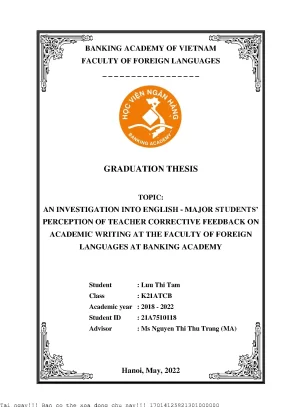
An investigation into english major students perception of teacher correctiv e feedback on academic writing at the faculty of foreign languages at banking academy

Tài liệu nghiên cứu An investigation into english major students perception of teacher correctiv e feedback on academic, tổng hợp lý thuyết và thực hành, cung cấp kiến thức chuyên

Trường đại học

Banking Academy of Vietnam

Chuyên ngành

English

Người đăng

Ẩn danh

Thể loại

graduation thesis

2022

63
1
0

Phí lưu trữ

30 Point

Mục lục chi tiết

DECLARATIONS

ACKNOWLEDGMENTS

LIST OF ABBREVIATIONS

1. CHAPTER 1: BACKGROUND OF THE STUDY

1.1. Objective of the thesis

1.2. Significance of this study

1.3. Scope and Limitations of the Thesis

1.4. Structure of the Thesis

1.5. Definition of Academic writing

1.6. Teacher written corrective feedback

1.7. Types of teacher written corrective feedback

1.8. Importance of teacher written corrective feedback

1.9. Teacher WCF raised students’ linguistic accuracy level

1.10. Corrective feedback enhance students’ motivation

1.11. Corrective feedback improves students’ and teachers' relationship

1.12. Issue in teacher written corrective feedback

1.13. Students' attitudes towards and preferences of teachers’ giving CF

1.14. Procedure of data collection

1.15. Participants and sample description

4. CHAPTER IV: DATA ANALYSIS AND DISCUSSION

4.1. Participants' background information

4.2. Reliability of the Measurement

4.3. Results on frequencies of direct teacher corrective feedback that students get in academic writing

4.4. Results on frequencies of indirect teacher corrective feedback students get in academic writing

4.5. Students' perception of teacher written corrective feedback in academic writing

5. CONCLUSION AND RECOMMENDATION

5.1. Summary of the results

5.2. Suggestions for the next studies

LIST OF TABLES

LIST OF FIGURES

ABSTRACT

Tóm tắt

I. Tổng quan về Phản hồi sửa lỗi trong Viết học thuật

Bài viết này khám phá nhận thức của sinh viên chuyên ngành tiếng Anh về phản hồi sửa lỗi từ giáo viên trong viết học thuật. Trong bối cảnh hội nhập quốc tế, kỹ năng tiếng Anh, đặc biệt là kỹ năng viết, trở nên vô cùng quan trọng. Phản hồi của giáo viên đóng vai trò then chốt trong việc giúp sinh viên nâng cao kỹ năng viết của mình. Nghiên cứu này tập trung vào việc tìm hiểu quan điểm của sinh viên về các loại phản hồi, cách thức phản hồi ảnh hưởng đến động lực (Motivation)engagement của họ, từ đó đưa ra các đề xuất cải thiện hiệu quả phản hồi trong môi trường học tập. Theo Race (2001), phản hồi là yếu tố then chốt trong quá trình học tập, thúc đẩy sự phát triển ngôn ngữ và động lực của sinh viên. Nghiên cứu này dựa trên khảo sát tại Học viện Ngân hàng, tập trung vào nhận thức của sinh viên chuyên ngành tiếng Anh về phản hồi của giáo viên.

1.1. Tầm quan trọng của Viết học thuật và Phản hồi sửa lỗi

Viết học thuật là một kỹ năng thiết yếu cho sinh viên chuyên ngành tiếng Anh, giúp họ diễn đạt ý tưởng một cách rõ ràng, chính xác và thuyết phục. Phản hồi sửa lỗi từ giáo viên đóng vai trò quan trọng trong việc giúp sinh viên nhận biết và sửa chữa lỗi sai, từ đó nâng cao kỹ năng viết. Nhận thức của sinh viên về tầm quan trọng của phản hồi ảnh hưởng trực tiếp đến mức độ tiếp thu và áp dụng các góp ý, do đó ảnh hưởng đến hiệu quả học tập. Báo cáo của Gersten et al. (2007) nhấn mạnh rằng viết học thuật là ngôn ngữ dựa trên trường học liên quan đến cuộc trò chuyện dài dòng, có lý lẽ. Việc nhận biết lỗi ngữ pháp, lỗi từ vựngcấu trúc câu nhờ phản hồi góp phần cải thiện đáng kể chất lượng bài viết học thuật.

1.2. Các loại Phản hồi của giáo viên trong Viết học thuật

Có nhiều loại phản hồi mà giáo viên có thể cung cấp cho sinh viên, bao gồm phản hồi trực tiếp, phản hồi gián tiếp, phản hồi bằng văn bản, và phản hồi trực tiếp (face-to-face). Phản hồi trực tiếp thường chỉ ra lỗi cụ thể và cách sửa, trong khi phản hồi gián tiếp gợi ý sinh viên tự tìm ra lỗi sai. Phản hồi bằng văn bản cung cấp thông tin chi tiết và có thể tham khảo lại, trong khi phản hồi trực tiếp cho phép thảo luận và làm rõ ngay lập tức. Theo Hyland và Hyland (2006), phản hồi bằng văn bản của giáo viên là kênh thông tin quan trọng, giúp giáo viên truyền tải lời khuyên và góp ý, hỗ trợ sinh viên cải thiện bài viết.

II. Thách thức về Hiệu quả phản hồi trong Viết học thuật

Mặc dù phản hồi rất quan trọng, việc đảm bảo hiệu quả phản hồi lại là một thách thức. Sinh viên có thể không hiểu rõ phản hồi, không có động lực để sửa lỗi, hoặc cảm thấy phản hồi quá chung chung và không hữu ích. Thời gian phản hồi cũng là một yếu tố quan trọng; phản hồi quá chậm có thể làm giảm tính tác động của nó. Nghiên cứu của Truscott (1996) cảnh báo rằng phản hồi sửa lỗi có thể gây hại nếu không được thực hiện đúng cách. Vì vậy, việc tìm hiểu nhận thức của sinh viên về những thách thức này là rất quan trọng để cải thiện phương pháp phản hồi.

2.1. Quan điểm của sinh viên về sự rõ ràng và hữu ích của phản hồi

Quan điểm của sinh viên về sự rõ ràng và hữu ích của phản hồi đóng vai trò then chốt trong việc quyết định xem liệu họ có thực sự tiếp thu và áp dụng các góp ý hay không. Nếu sinh viên cảm thấy phản hồi mơ hồ, khó hiểu, hoặc không liên quan đến nhu cầu của họ, họ có thể bỏ qua nó. Điều này nhấn mạnh tầm quan trọng của việc giáo viên cung cấp phản hồi cụ thể, chi tiết, và dễ hiểu. Ferris (2003) đề xuất phản hồi trực tiếp xảy ra khi giáo viên cung cấp dạng ngôn ngữ hoặc cấu trúc ngôn ngữ chính xác cho lỗi ngôn ngữ của người học. Việc đánh giá phản hồi cũng nên được thực hiện thường xuyên để đảm bảo sự phù hợp.

2.2. Ảnh hưởng của thời gian phản hồi đến Kỹ năng viết

Thời gian phản hồi có thể ảnh hưởng đáng kể đến khả năng cải thiện bài viết của sinh viên. Nếu phản hồi được cung cấp quá muộn, sinh viên có thể đã quên những gì họ đã viết và khó có thể nhớ lại quá trình suy nghĩ của mình. Điều này làm giảm tác động của phản hồi và có thể khiến sinh viên mất hứng thú với việc sửa lỗi. Phản hồi kịp thời giúp sinh viên kết nối phản hồi với lỗi viết của mình một cách hiệu quả hơn. Nghiên cứu cũng chỉ ra rằng việc sửa lỗi ngữ pháp, sửa lỗi từ vựng ngay khi sinh viên mắc lỗi sẽ giúp họ ghi nhớ lâu hơn và tránh lặp lại lỗi tương tự.

III. Phương pháp phản hồi hiệu quả Bí quyết cải thiện Viết học thuật

Nghiên cứu này khám phá các phương pháp phản hồi hiệu quả, bao gồm kết hợp phản hồi trực tiếpphản hồi gián tiếp, sử dụng phản hồi bằng văn bản chi tiết, và cung cấp phản hồi trực tiếp để thảo luận và làm rõ. Mục tiêu là tìm ra những phương pháp giúp sinh viên hiểu rõ phản hồi, có động lực để sửa lỗi, và cảm thấy phản hồi hữu ích. Việc điều chỉnh phương pháp phản hồi phù hợp với từng cá nhân và phong cách học tập của sinh viên cũng rất quan trọng. Maleki và Eslami (2013) chứng minh rằng sinh viên nhận được phản hồi ít mắc lỗi về thì hơn sinh viên không nhận được phản hồi.

3.1. Kết hợp Phản hồi trực tiếp và Phản hồi gián tiếp

Sự kết hợp giữa phản hồi trực tiếpphản hồi gián tiếp có thể mang lại hiệu quả tối ưu. Phản hồi trực tiếp giúp sinh viên sửa các lỗi cụ thể một cách nhanh chóng, trong khi phản hồi gián tiếp khuyến khích sinh viên suy nghĩ và tự tìm ra giải pháp. Sự cân bằng giữa hai loại phản hồi này giúp sinh viên vừa có được sự hỗ trợ cần thiết, vừa phát triển tư duy phản biện và khả năng tự học. Việc sửa lỗi diễn đạt, sửa lỗi cấu trúc câu nên được gợi ý bằng phản hồi gián tiếp để khuyến khích sinh viên tự tìm tòi.

3.2. Sử dụng Phản hồi bằng văn bản chi tiết để cải thiện bài viết

Phản hồi bằng văn bản chi tiết cho phép giáo viên cung cấp thông tin đầy đủ và cụ thể về những điểm mạnh và điểm yếu trong bài viết của sinh viên. Phản hồi này có thể bao gồm nhận xét về cấu trúc, lập luận, sử dụng ngôn ngữ, và các yếu tố khác. Việc cung cấp ví dụ cụ thể và đề xuất sửa đổi chi tiết giúp sinh viên hiểu rõ hơn về những gì họ cần cải thiện. Glen và Goldthwaite (2014) nhấn mạnh rằng phản hồi bằng văn bản giúp sinh viên cải thiện bài viết bằng cách chỉ ra những lỗi trong bài viết và đưa ra các câu hỏi giúp sinh viên giải thích quan điểm của mình.

IV. Ứng dụng thực tiễn Nghiên cứu về nhận thức tại Học viện Ngân hàng

Nghiên cứu được thực hiện tại Học viện Ngân hàng nhằm đánh giá nhận thức của sinh viên chuyên ngành tiếng Anh về phản hồi sửa lỗi từ giáo viên. Kết quả cho thấy sinh viên đánh giá cao phản hồi trực tiếp, nhưng cũng nhận thấy sự cần thiết của phản hồi gián tiếp để phát triển tư duy phản biện. Nhiều sinh viên bày tỏ mong muốn nhận được phản hồi nhanh chóng hơn và chi tiết hơn. Nghiên cứu sử dụng khảo sát sinh viênphỏng vấn sinh viên để thu thập dữ liệu một cách toàn diện.

4.1. Kết quả khảo sát sinh viên về Phản hồi của giáo viên

Kết quả khảo sát sinh viên cho thấy phần lớn sinh viên đánh giá cao phản hồi của giáo viên trong việc cải thiện bài viết. Tuy nhiên, một số sinh viên cho rằng phản hồi đôi khi quá chung chung và không cung cấp đủ thông tin chi tiết để họ có thể sửa lỗi một cách hiệu quả. Một số sinh viên cũng bày tỏ mong muốn nhận được phản hồi sớm hơn để có thời gian sửa lỗi trước khi nộp bài. Số liệu cũng cho thấy sự khác biệt trong nhận thức giữa các năm học, có thể do kinh nghiệm và trình độ kỹ năng viết khác nhau. Dữ liệu thu thập bằng phương pháp nghiên cứu định lượng từ khảo sát cho thấy sinh viên chuyên ngành tiếng Anh tại Học viện Ngân hàng coi trọng phản hồi trực tiếp hơn phản hồi gián tiếp.

4.2. Đề xuất cải thiện phương pháp phản hồi dựa trên quan điểm của sinh viên

Dựa trên quan điểm của sinh viên, nghiên cứu đề xuất một số biện pháp cải thiện phương pháp phản hồi, bao gồm tăng cường phản hồi gián tiếp để khuyến khích tư duy phản biện, cung cấp phản hồi chi tiết hơn và nhanh chóng hơn, và điều chỉnh phương pháp phản hồi phù hợp với từng cá nhân. Việc tạo ra một môi trường học tập cởi mở, nơi sinh viên cảm thấy thoải mái đặt câu hỏi và nhận phản hồi, cũng rất quan trọng. Các nhà nghiên cứu cũng nên sử dụng nghiên cứu định tính như phỏng vấn sinh viên để hiểu sâu hơn về các vấn đề liên quan đến phản hồi.

V. Kết luận Tác động của phản hồi và hướng nghiên cứu tương lai

Nghiên cứu này đã cung cấp những hiểu biết sâu sắc về nhận thức của sinh viên chuyên ngành tiếng Anh về phản hồi sửa lỗi trong viết học thuật. Kết quả cho thấy phản hồi đóng vai trò quan trọng trong việc cải thiện kỹ năng viết của sinh viên, nhưng cần có những điều chỉnh để đảm bảo hiệu quả phản hồi tối ưu. Các nghiên cứu trong tương lai có thể tập trung vào việc so sánh hiệu quả của các phương pháp phản hồi khác nhau, hoặc khám phá tác động của phản hồi đến động lực và sự tự tin của sinh viên. Các thực nghiệm sư phạm cũng có thể được tiến hành để đánh giá hiệu quả của các can thiệp dựa trên phản hồi.

5.1. Tóm tắt những điểm chính về Nhận thức của sinh viên

Nghiên cứu đã làm sáng tỏ nhiều khía cạnh quan trọng về nhận thức của sinh viên, bao gồm sự đánh giá cao phản hồi trực tiếp, mong muốn phản hồi nhanh chóng và chi tiết hơn, và sự cần thiết của phản hồi gián tiếp để phát triển tư duy phản biện. Những điểm này nhấn mạnh tầm quan trọng của việc giáo viên lắng nghe và đáp ứng nhu cầu của sinh viên trong quá trình cung cấp phản hồi. Luu Thi Tam (2022) nhấn mạnh rằng phản hồi hữu ích trong việc cải thiện kỹ năng viết của sinh viên.

5.2. Hướng nghiên cứu tiếp theo về phản hồi sửa lỗi

Các nghiên cứu tiếp theo có thể tập trung vào việc khám phá các yếu tố ảnh hưởng đến động lực của sinh viên trong việc sửa lỗi dựa trên phản hồi, hoặc so sánh hiệu quả của phản hồi từ giáo viên với phản hồi từ đồng nghiệp. Nghiên cứu cũng có thể khám phá vai trò của công nghệ trong việc cung cấp phản hồi và hỗ trợ sinh viên cải thiện bài viết. Cần có thêm các nghiên cứu định tính để hiểu sâu hơn về trải nghiệm của sinh viên với phản hồi sửa lỗi. Việc phân tích lỗi viết cụ thể và tác động của phản hồi đến từng loại lỗi cũng là một hướng đi tiềm năng.

23/05/2025

Trích đoạn nội dung tài liệu

BANKING ACADEMY OF VIETNAM FACULTY OF FOREIGN LANGUAGES _________________ GRADUATION THESIS TOPIC: AN INVESTIGATION INTO ENGLISH - MAJOR STUDENTS’ PERCEPTION OF TEACHER CORRECTIVE FEEDBACK ON ACADEMIC WRITING AT THE FACULTY OF FOREIGN LANGUAGES AT BANKING ACADEMY Student : Luu Thi Tam Class : K21ATCB Academic year : 2018 - 2022 Student ID : 21A7510118 Advisor : Ms Nguyen Thi Thu Trang (MA) Hanoi, May, 2022 17014125821301000000 DECLARATIONS I declare that this graduation thesis is the result of my own research under the instruction of Ms. Nguyen Thi Thu Trang. The research contents and results are almost entirely my own work and have never been published or submitted in any previous works. The references are properly cited as prescribed in the reference section.

Hanoi, 22th May, 2022 Signature Luu Thi Tam i ACKNOWLEDGMENTS Being able to complete this thesis makes me very proud of myself, and this thesis is also considered the greatest achievement that I got during my studying time at Banking Academy. However, without the help of many people, I would not be able to accomplish it. First of all, I would like to give my sincerest gratitude to Ms. Nguyen Thi Thu Trang for her expert guidance during this difficult journey of finishing my thesis.

She energetically directed me, gave me valuable feedback on the research I have worked with. The thesis would be impossible to complete without her supervision and dedicated support. Additionally, I would like to express my thank to my family and friends for always supporting, comforting, and encouraging me to complete this thesis. Finally, I would also like to thank all the students who participated in the questionnaire for the thesis.

Their contributions were integral to the research. Hopefully, this thesis will provide important information to read, even though it is far from flawless. Furthermore, any comments, thoughts, or recommendations for improving this thesis are appreciated. ii LIST OF ABBREVIATIONS WCF Written corrective feedback L2 Second Language ESL English as a Second Language GEPT General English Proficiency Test's EFL English as a Foreign Language SPSS Statistical Package for Social Sciences iii TABLE OF CONTENTS Chapter I.

Background of the Study. Objective of the thesis. Significance of this study. Scope and Limitations of the Thesis.

Structure of the Thesis. Definition of Academic writing. Teacher written corrective feedback. Types of teacher written corrective feedback.

Importance of teacher written corrective feedback. Teacher WCF raised students’ linguistic accuracy level. Corrective feedback enhance students’ motivation. Corrective feedback improves students’ and teachers' relationship.

Issue in teacher written corrective feedback. Students' attitudes towards and preferences of teachers’ giving CF. Procedure of data collection. Participants and sample description.

23 iv Chapter IV. DATA ANALYSIS AND DISCUSSION. Participants' background information. Reliability of the Measurement.

Below demonstrates the reliability degrees by questionnaire section. Results on frequencies of direct teacher corrective feedback that students get in academic writing. Results on frequencies of indirect teacher corrective feedback students get in academic writing. Students' perception of teacher written corrective feedback in academic writing.

CONCLUSION AND RECOMMENDATION. Summary of the results. Suggestions for the next studies. 43 v LIST OF TABLES Table 3.

Number of students in each academic year. Cronbach's Alpha computed summary statistics. The corrected item - total correlation of section 2. The corrected item - total correlation of section 3.

The corrected item - total correlation of section 4. Frequencies of direct corrective feedback by teachers. Frequencies of indirect corrective feedback by teachers. Students' perception on teacher written corrective feedback.

34 vi LIST OF FIGURES Figure 2. Teacher written corrective feedback. Frequencies of direct corrective feedback by teachers (in percentage). Frequencies of indirect corrective feedback by teachers (in percentage).

Perceived feedback of teacher corrective feedback (in percentage). 36 vii ABSTRACT The title of the thesis: An investigation into English-major students’ perception of teacher correctiv e feedback on academic writing at the Faculty of Foreign Languages at Banking Academy”. Author: Luu Thi Tam Advisor: Nguyen Thi Thu Trang Keywords: Writing skill, feedback, written corrective feedback Abstract: This research paper aims to determine English-major students’ perception of written corrective feedback in the Faculty of Foreign Languages at Banking Academy. 187 students who have completed academic writing classes responded to the online questionnaire.

A coherent framework is deployed to rank frequencies of direct and indirect corrective feedback given by teachers and then find out students' attitudes towards these feedback. The results show that English-major students at Banking Academy value direct corrective feedback more than indirect one. It also indicates that students are looking forward to getting feedback from their teachers and that feedback is helpful in improving their writing skills. Nevertheless, there remain some problems related to the color-coding of the feedback and the time of feedback given to students.

From the findings, the author has made several practical suggestions that could help teachers and English-major students improve their academic writing skills such as teachers should apply more indirect corrective feedback in order to enhance students’ cognition and become self-sufficient and responsible learners. The timing of giving feedback also should be as soon as possible and the color-coded feedback should also be reduced. INTRODUCTION This first chapter introduces the background information, research aims, research questions, as well as the importance and organization of the study. It also emphasizes the scope and limits of the investigation.

Background of the Study English has been increasingly popular in recent decades, and played an increasingly important role in communication. The value of English has grown even more as the globe has become more integrated and international enterprises have penetrated the Vietnamese market. English allows countries with different languages to conduct international trade and diplomacy, allowing for the flow of science, technology, commodities, and labor resources. Employees with strong English will be readily organized to work with overseas partners, and global areas, and will find it extremely simple to grow in their careers.

As a result, it is critical for individuals to increase their understanding of other languages, particularly English, in order to fulfill the demands of modern society and to improve living conditions. English is now considered a compulsory subject in Vietnamese schools. When it comes to English, there are four main skills that students are expected to master: speaking, reading, listening, and writing. Among these skills, second-language usage learners regard writing skills, particularly academic writing abilities, to be at a critical and difficult level.

As one of the top universities in Viet Nam, Banking Academy also places a premium on students' English skills and therefore, established the Faculty of Foreign Languages to provide specific English in finance. Therefore, the teachers’ written corrective feedback in those writings is considered very important in order to enhance students’ writing abilities. In order to gain a more comprehensive and detailed 1 understanding of the current situation of teacher-provided written corrective feedback in academic writing classes in The Faculty of Foreign Languages at Banking Academy, the topic “An investigation into English-major students’ perception of teacher corrective feedback on academic writing at the Faculty of Foreign Languages at Banking” was chosen. The goal of the research is to figure out students’ perception of their teacher's written corrective feedback.

Some remedies will be suggested based on the research findings. Objective of the thesis The research aims to identify English-major students’ perception of teachers given written corrective feedback in academic writing classes in The Faculty of Foreign Languages at Banking Academy. Therefore, some recommendations would be proposed to enhance the effectiveness of corrective feedback. To achieve this purpose, current ATC students of different years are asked to appreciate various components of their teachers’ feedback.

The study is being undertaken in the hopes of assisting instructors and students in determining the most effective feedback approach for improving academic writing skills. Research questions This study aims to address the question how English-major students perceive teacher corrective feedback in academic writing. Significance of this study The findings of this study may hopefully be useful for both students and teachers since they can provide some insights about giving corrective feedback to students in academic writing class. Firstly, this research specifically identifies the frequencies of students receiving different types of feedback from their teachers and detects students' preferred feedback type.

From these findings, aspects that may 2 influence the efficacy of feedback on students' writing are recognized and then allow teachers to build a relevant and helpful feedback technique. As a result, teachers can easily improve students’ writing ability. Finally, in this study, some recommendations will be made with the aim of helping students and teachers overcome negative of written feedback. Scope and Limitations of the Thesis The study looked at students majoring in English in the Faculty of Foreign Languages at Banking Academy to see how they perceive corrective feedback delivered by teachers in academic writing courses.

A survey was undertaken to gather information about learners’ perceptions of teacher remedial feedback. The study article does, however, have certain drawbacks. First, the research's findings may be less compelling due to the limited number of participants (187 students from Banking Academy). Secondly, because of Covid-19's complicated situation, certain beneficial research instruments such as interviews and writing tests were unable to be used to produce a more thorough study outcome.

Structure of the Thesis The study is divided into five sections, as follows: Chapter 1 (Introduction) provides a critique of the study's background material, including the reason for the topic decision, the study's aims, its importance, and scope and limitations. Chapter 2 (Literature review) explained the compatible theories related to teacher written corrective feedback, issues faced by students when getting corrective feedback, and previous studies by other researchers. 3 Chapter 3 (Research methodology) outlines the research's background, participants, as well as the main data collection technique. Chapter 4 (Finding and Discussion) presents statistical analysis and discusses a comprehensive explanation of the findings.

Chapter 5 (Summary and Recommendation) summarizes the study findings, which will serve as the framework for making suggestions. In addition, the chapter identifies shortcomings and potential to further research. Introduction This chapter contains a review and analysis of relevant literature, which gives a quick look at the current state of the research topic. This chapter conceptualizes teacher written corrective feedback (WCF), including its definitions, types of teacher WCF, its importance to learners, some common problems, and students' perception of teacher WCF.

Definition of Academic writing Writing, as a tool for the formation of ideas and the consolidation of language growth, is considered one of the most important inventions in human evolution, according to Robert (1990). Writing is also one of the ways to express yourself; however, second language learners, mastering challenging abilities is a challenge. Academic English, according to Gersten et al. (2007), is the school-based language associated with lengthy, reasoned conversation.

Academic writing is a writing focuses on presenting the topic rather than expressing ideas by using the third person and a formal tone. The author writes in a scholar style, using only the most appropriate words and avoiding jargon, slang, and abbreviations. The academic text can be described as linear, with a thesis and supporting arguments that contribute to the primary line of argument, and no off-topic or redundant material. Its primary objective is to disseminate knowledge rather than entertain.

Academic writing, according to Irvin (2010), is a method of assessing students by showing their understanding and proficiency of specific skills in analyzing, understanding, and presenting.78) emphasizes the importance of 5 clearness and economy in academic writing, stating that "well-ordered logical exposition, concision of lexical choice, clarity and economy in style continue to be the rhetorical norms of academic pedagogy will contribute to a smooth, functioning reading. Corrective feedback Feedback can be defined as the information given to the students as to how their skills can be improved.

Nội dung được bảo vệ bản quyền — Tải xuống đầy đủ

Tài liệu "Nghiên cứu về nhận thức của sinh viên chuyên ngành tiếng Anh về phản hồi sửa lỗi của giáo viên trong viết học thuật" cung cấp cái nhìn sâu sắc về cách mà sinh viên ngành tiếng Anh nhận thức và đánh giá phản hồi từ giáo viên trong quá trình viết học thuật. Nghiên cứu này không chỉ làm rõ tầm quan trọng của phản hồi trong việc cải thiện kỹ năng viết mà còn chỉ ra những yếu tố ảnh hưởng đến nhận thức của sinh viên về phản hồi đó. Điều này giúp sinh viên hiểu rõ hơn về cách thức mà phản hồi có thể hỗ trợ họ trong việc phát triển kỹ năng viết, từ đó nâng cao chất lượng học tập.

Để mở rộng thêm kiến thức về các khía cạnh khác trong giảng dạy tiếng Anh, bạn có thể tham khảo tài liệu Nghiên cứu về nhận thức của giáo viên về việc sử dụng Quizlet trong dạy từ vựng cho trẻ em, nơi khám phá cách mà công nghệ hỗ trợ việc học từ vựng. Bên cạnh đó, tài liệu Perceptions and practices of warm up activities by English teachers in Thai Nguyen sẽ giúp bạn hiểu thêm về các hoạt động khởi động trong lớp học tiếng Anh và tác động của chúng đến sự tham gia của sinh viên. Cuối cùng, tài liệu An investigation into factors affecting students perspective in learning speaking skills in the modern time sẽ cung cấp cái nhìn về các yếu tố ảnh hưởng đến quan điểm của sinh viên trong việc học kỹ năng nói tiếng Anh. Những tài liệu này sẽ giúp bạn có cái nhìn toàn diện hơn về các phương pháp giảng dạy và học tập trong lĩnh vực tiếng Anh.