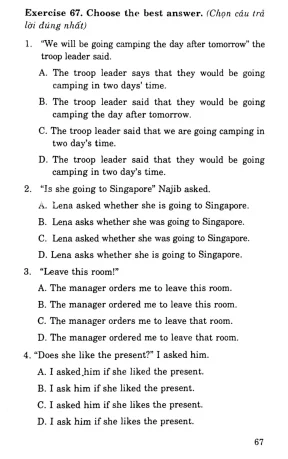
Choose th e best answ er. “We will be going camping the day aíter tomorrow” the troop leader said. The troop leader says that they would be going camping in two days’ time. The troop leader said that they would be going camping the day after tomorrow.
The troop leader said that we are going camping in two day’s time. The troop leader said that they would be going camping in two day’s time. “Is she going to Singapore” Najib asked. Lena asked whether she is going to Singapore.
Lena asks whether she was going to Singapore, c. Lena asked whether she was going to Singapore. Lena asks whether she is going to Singapore. “Leave this room!” A.
The manager orders me to leave this room. The manager ordered me to leave this room. The manager orders me to leave that room. The manager ordered me to leave that room.
“Does she like the present?” I asked him.him if she liked the present. I ask him if she liked the present. I asked him if she likes the present. I ask him if she likes the present.
I said to my nephew, “There are 24 hours in one day”. I said to my nephew th at there are twenty-four hours in one day. I say to my nephew th a t there were twenty-four hours in one day. My nephew said to me th at there are twenty-four hours in one day.
I said to my nephew th at there were twenty-four hours in one day. R ew rite th e se n te n c es in d irect sp eech. (Viết lại các câu sau đầy ở dạng lời nói trực tiểp) Example: She said Liz didn’t speak Greek. “Liz doesn’t speak Greek”.
He admitted th at he had never met us. They told us they would start the following day. We called them that we were walking in the park. She said she worked for Ford.
I replied that I had been trying to mend it since the moming. He said th at at One o’elock he had been doing nothing. They explained that they had closed down the previous year. Neil said he wished he could be independent.
She told us we had better accept it. He claimed that while he was sleeping someone screamed in the garden. Moira admitted that she would rather stay. Rewrite the reported commands and questions in the direct speech.
(Viết lại các câu đề nghị và câu hỏi ở lời nói gián tiếp sau đây sang lời nói trực tiếp) Example: He asked me to stand up - “Stand up!”. He asked me if I was sleepy. “Are you sleepy?”. He asked me what I wanted from him.
Sam wondered if they had arrived on time. I advised them not to go out at night. He wanted to know why I was crying. He asked me whether I would marry him the following year.
He asked me not to interrupt him. He wanted to know if he should lock the door. She wondered whether she might use my laptop. Nicol asked me to join her.
Lily told me not to eat so much. He wondered if I had received his message. Ezra asked us what we had been doing so long. Rew rite the rep orted sp ee ch in th e direct sp eech.
She said th at she didn’t want to come with me. He said th at he was writing a letter. She said th at she had íìnished the work. He said th at he wanted some razors.
John said th at he had been living in th a t city for ten years. He said th a t he had been waiting th ere for several hours. He said th at burglars had broken into his house the previous night. She told me th at she had been waiting for her sister.
She said th at she had never met such people beíbre. John said th at he had been gardening for two hours. He said th at he lived many years in the u s ./ He said th at he had lived many years in the ư s. She said th at she would work hard.
He said th at they would be arriving there by the next train. Alice said that she would have íìnished the work by then. Rewrite these sentences in Direct speech. My mother asked me to buy a dozen eggs from the shơp.
I told m yself that I would íĩnish painting the gate by that aíternoon. The judge asked the deíendant to speak louder. The engineer wanted the vvorkers to complete the project by the following day. Asni reported to the police about her purse being snatched.
The gardener prevented the young girl from plucking the roses. The Principal told the teachers and students to grow more plants around their school to beautiíy it. Father asked me not to open the box while he was away. The doctor told the patient to read the instructions careíully before taking the medicine.
The mother warned the boy not to swim in the old mining pool. Exercise 72, Convert the following from Indirect to direct. He assured them that he woulđ soon return. He told me that I might leave that place as soon as I could.
I admitted that I had acted íbolishly in what I said. He told them th at he had been robbed of the book which he had bought. He said he was very sorry for the fault he had com- mitted. They aíĩlrmed that he was the best worker they had seen.
He admitted th at he had not worked as hard as John had done. He heard them say th a t he did not deserve the prize. He made a promise th a t he would do it as soon as he could. They said th at he had deserved their thanks for all he had done.
Change th e follow ing sen ten ces from reported sp eech to direct speech. Jane said she play ed tennis every Saturday. David said there was an excellent bank playing later on. Christine said she had seen Amy at the bank on Monday.
The driver said he was going to turn right at the traíĩìc lights. donathan said he had returned the dictionary to the library. The doctor said he would send me/us the results as soon as they arrived. Caroline asked (me) if I would come to her party on Saturday.
The shop assistant asked if I was looking for something special. The shop assistant: “. Jack said he would lend me his grammar book if I thought it would help. Turn into direct speech.
(Chuyển sang câu trực tiếp) 1 He said that he was going to town with his sister. He told her that she had bought herselí a new hat. They said th at they were very late. She told me that she wanted to speak to me.
She said th at they had íìnished their work. She said th at he was ready to come with them. She told me that they did not know me. He said that he would answer the phone.
She told them that they could do it if they tried. She said th at he had done his homework well. They said that they were living in the house then. She said th at she had been shopping all the morning.
He told her th at he had not told her anything yet. He told me th at I might see the photo if I liked. He said th at she had vvritten him a long letter. She said th at she was giving a party th a t week to all her ữiends.
She told her íriend that the latter had an excellent cook. They said th at they had not heard the news. She said th at she liked oranges better than bananas. She said th at they were learning higher m athem atics.
She said she was ílying to Paris the next day. He asked me if I had gone to the stadium to watch the game the day before. She asked me to excuse her keeping my book so long. She told him not to let the íailure of the experiment upset him too much.
She asked me if she might offer me a cup of tea. Turn into direct sp eech. The teacher ordered Richard to go away. Mr Brown asked his visitor to come in.
His mother told Richard not to eat all the cake. The officer commanded the soldier to fire. The sergeant told the sentry to stay at his post until he was relieved. The teacher told Timothy to do the exercise correctly or he would have to stay in.
The farmer asked the visitors not to leave the gate open. RicharcTs father told him not to climb that tree in his new trousers. The teacher told Henry to get his work done properly or he would punish him. She told him to do some exercise every day if he wanted to pass his examination.
Turn into direct speech. He said that he was íeeling tired. She said th at she couldn’t go out after 8 pm. He told his sister that he intended to run away from home.
They said th at they would wait for a later train. She said th at she was going to have a baby. He said that he had never been so insulted in all his life. A member of the audience said he couldn’t hear what the lecturer was saying.
She told her mother that she had to go out and would not be back until late. He said th at he wouldn’t have believed it even if it had been true. They said that they had too much work to do and were going on strike. The Prime Minister declared that the country had never been more prosperous.
She exclaimed that there was a mouse in the room. They complained that they were so exhausted that they could not walk any íarther. The little boy cried out that his sister was drowning. My friend warned me that it would be too hot to SUĨ 1- bathe in comíbrt.
The children coníessed th at they had stolen all the apples from the tree. He regretted that he hadn’t any cigarettes to offer to his guests. She replied th at she wouldn’t answer such a silly question. The Foreign Secretary stated th at he did not intend to change his country’s policy in the near future.
He denied th at he had wasted his life. Choose the correct w ords in th e brackets. Jack shouted “Get your backpack and lunch!”. Jack told his b ro th e r_______ (get your, to get your, to get his) backpack and lunch!”.
Jack said “Don’t make me late again”. Jack told his b ro th e r______ (don’t you make me, not to make me, not to make him) late again”. Jack said to his brother, “Hurry up!”. Jack told his brother __________ (you hurry up, to hurry up, to hurry him up).
His brother said “Leave me alone!”. His brother told him ________ (to leave me alone, leave him alone, to leave him alone). “OK then”, Jack said, “Walk alone!”. Jack told his brother ________ (to walk alone, he walk alone, go walk alone).
76 6 Jack’s mother said “Be kind to your brother”. Jack’s mother said t h a t _________(he should be kind to your brother, he should be kind to his brother, to kind his brother). Jack to his brother “Please be ready on time every morning”. Jack said that he ________ (to be ready, should be ready) on time every morning”.
Jack’s brother said “Warn me ten minutes beíore you leave”.