Mathematics Teaching Practice: Guide for university and college lecturers ‘Talking of education, people have now a-days’ (said he) kot a strange @inion thaf emy thing should be taught bJ lectures. Now, I cannot see that lectures can do so much good as readiiig the books from which the lectures are taken. I know nothing that can be best taught by lectures, except where lectures are to be shewn. You may teach chymest?y bJ lectures - yoti might teach making of shoes bJ lectures!’ James Boswell: The Life of Samuel Johnston, LLD,1766 ‘Mathematicspossesses not only the tmth, hit su$weme beauty - a beauty cold and austere like that of stem perfection, such as only great ait can show.’ Betrand Russell: The Principles of Mathematics, 1902 About John Mason John Mason has been teaching mathematics ever since he was asked to tutor a fellow student when he was aged only fifteen.
In college he was first an unofficial tutor, then later an official tutor for mathematics students in the years below him, and also found the time to tutor school students as well. He began his university career in Toronto, receiving first a BSc in Mathematics from Trinity College, and then an MSc while at Massey College. He then studied for a PhD in Combinatorial Geometry in Madison, Wisconsin, where he encountered Polya’s film Let Us Teach Giessiiig. Seeing the film evoked a style of teaching he had first experienced at high school from his mathematics teacher, Geoff Steel, and his teaching changed overnight.
He then took up an appointment at the Open University, becoming involved, among other things, in the design and implementation of the f i s t mathematics summer school (5000 students over 11 weeks on three sites simultaneously). Drawing upon his own experiences as a student, he created active-problem-solvingsessions, which later became investigations. He also developed the idea of project-work for students in their second year of pure mathematics. In 1982 he wrote Thinking Matheinaticallywith Leone Burton and Kaye Stacey, a classic that has been translated into four languages and is still in use in many countries around the world.
It has been used with advanced high school students, with graduates becoming school teachers, and with undergraduates who are being invited to think about the nature of doing and learning mathematics. He is also the author of Leariziiig and Doing Mathematics, which was originally written for Open University students, then modified for students entering university generally. At the Open University he led the Centre for Mathematics Education in various capacities for fifteen years, during which time it produced the influential Routes-to Roots-ofAlgebra and numerous collections of materials for teachers at every level. His principal focus is thinking about mathematical problems, and supporting others who wish to foster and sustain their own thinking and the thinking of others.
Other interests include the study of how authors have expressed to students their awareness of generality, especially in textbooks on the boundary between arithmetic and algebra, and ways of working on and with mental imagery in teaching mathematics. The contents of this book spring from a lifetime of collecting tactics and frameworks for informing the teaching of mathematics. Along the way he has articulated a way of working, developed at the Centre, that provides methods and an epistemologically well founded basis for practitioners to develop their own practice, and to turn that into research. Mathematics Teaching Practice: Guide for university and college lecturers John H.
Mason, BSc, MSc, PhD Centre for Mathematics Education Open University Milton Keynes, UK in association with TheOpen Horwood Publishing University Chichester HORWOOD PUBLISHING LIMITED International Publishers in Science and Technology Coll House, Westergate Street, Westergate, Chichester, West Sussex, PO20 3QL England First published in 2002 Reprinted 2003,2004 0 J. All Rights Reserved. No part of this publication may be reproduced, stored in a retrieval system, or transmitted in any form or by any means, electronic, mechanical, photocopying, recording, or otherwise, with- out the permission of Honvood Publishing, Coll House, Westergate Street, Westergate, Chichester, West Sussex, PO20 3QL England. ISBN: 1-898563-79-9 British Library Cataloguing in Publication Data A catalogue record of this book is available from the British Library Printed by Antony Rowe Limited, Eastbourne V ‘The mathematical backpound of our undmpaduates is u~~derinining the quality of their depee.
’ (Suthedand and Dauhwst, 1999, p6) It is vital, in our increasingly technological society, that a wide range of people have positive experiences of mathematics, developing confidence both in using what they do know and in finding out what they do not know when they need it. Mathematics lies at the heart of many different disciplines and, whether they are taught by mathematicians or by experts in other disciplines, all students of mathematics need more than simply to master niysterious manipulative techniques. This book maintains that all students can do more, and aims to show how it can be done. Whoever does the teaching, it is vital to encourage students to engage with mathematical thinking, because otherwise they may be reduced to trying to remember and use formulae and techniques which may not be appropriate to their situation or, worse, may try to avoid using mathematics at all cost.
To assist teachers of mathematics from whatever background, this book: 0 provides a collection of useful practices for the teaching of mathematics in colleges and universities; 0 indicates some aspects of mathematics which are worth bearing in mind or being aware of while preparing, conducting, and reflecting upon sessions; 0 suggests ways of thinking about ever-present tensions in teaching. The aim is to help anybody teaching mathematics who suspects that much more is possible than was done for them, and to show that it is possible to teach so that learning is both effective and efficient, even pleasurable. This book is written from the perspective that mathematics has to be learned through actively engaging with it. This means not only actively making sense of definitions, theorems, and proofs, but also participating in other aspects of mathematical thinking such as specialising and generalising, conjecturing and convincing, imagining and expressing, organising and classifjing, and through posing and resolving problems.
Furthermore, students need to manipulate ‘things’ that inspire their confidence in order to begin to make sense of generalisations provided by a textbook or their lecturer, and eventually bring these to articulation both in their ouii words and in formal terms. Learning mathematics is not a monotonically smooth process; it frequently requires going back over old ground to see it from a fresh perspective, reformulating concepts and ideas in new and often more precise terms. The suggestions made in this book are based on this perspective, but the suggestions will be of use no matter what your perspective on mathematics and how it is most effectively learned and taught. vi The book begins with descriptions and partial diagnoses of some classic student difficulties, and descriptions of possible actions that might iniprove the situation.
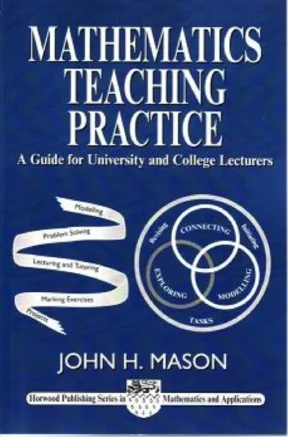
Subsequent sections then address the principal modes of interaction: lecturing, tutoring, task construction, and assessment. Throughout, the aim is to stimulate students to take tlie initiative in working on mathematics, rather than just sitting and responding passively to what is presented to them. The underlying theme is expressed in tlie image of interlocking rings, which suggest an interweaving of exploration, modelling and connection forming as purposes for tasks given to students. These can be used both to initiate and to revise or review a topic.
Outline This book is intended to support you in developing and extending your range of practices. It could also serve as the basis for building a portfolio of evidence of professional development. It is certainly not intended to be read from cover to cover. Rather, it is intended as a cross-referenced resource to call upon when you want some fresh ideas, or when some aspect of your teaching is not going quite as smoothly as you might wish.
If you have recently started teaching, you may wish to concentrate on two tactics selected from Chapter 1, and the tactic Being Mathematical from Chapter 3. Chapter 1 is built around a collection of common student mistakes and misconceptions, and suggests partial diagnoses and useful tactics for dealing with them. Chapter 2 is devoted to lecturing, and Chapter 3 to tutoring. Chapter 4 is concerned with constructing tasks for a variety of different purposes, including assessment, while Chapter 5 focuses on marking.
Chapter 6 then considers tlie role of history in teaching mathematics, while Chapter 7 summarises tlie previous chapters by raising some endemic tensions and issues in teaching mathematics, and suggesting ways of addressing them. Finally, there are two appendices: a representative collection of challenging explorations for first year undergraduate mathematics students in Appendix A, and, in Appendix B, an example of the unfolding of a particular topic according to some of the suggested framework structures. The last appendix is intended as a form of ‘worked exaniple’ of how to prepare to teach a topic, in this case convergence of series in which all terms are non-negative. The text as a whole forms a richly interconnected web of tactics and sensitivities.
Consequently, the same ideas arise in diffei-ent sections, though sometimes described using slightly different vocabulary. vii Effective Teaching Teaching well requires expertise different from that required to be a creative mathematician. Whereas experts draw their colleagues into their own world of discovery and creation, and expect their audience to be able to follow their arguments and insights, teaching students requires more than this. Not only do you have to inspire novices and draw them into your world, through being what Philip Davis calls ‘the sage on the stage’, but you also have to stand by and support them while they work on, struggle with, and reconstruct ideas for themselves, acting as ‘a guide on the side’.
Furthermore, to be really effective in supporting them, you have to be able to enter their world and remain within it, as this is the only way to really appreciate what they are struggling with. Students are people after all, with hopes and fears, strengths and weaknesses, propensities and habits. Most of them need assistance in undertaking the mental actions that experts fiid intuitive and natural. Although creativity in mathematics and in mathematics education are very different in form and function, they are interwoven components of a tapestry.
Working on your teaching develops your awareness of and sensitivity to the structure, history, and pedagogic implications of the mathematical topics that you teach. That awareness and sensitivity can also inform your research practice, as well as revealing topics for further research, both in mathematics and in mathematics education. Structural Summary Recognising the natural desire of mathematicians to be told the essential structure without a lot of words, while also acknowledging that developing one’s teaching is a long slow process, I offer a brief structural summary. As with mathematical exposition, this summary may not make a great deal of sense now, but I hope it will attract you to read further.
Of course, the best kind of summary is one that you reconstruct for yourself, just as you only really understand a theorem or a technique when you can reconstruct it for yourself when needed. There are six main modes of interaction between student, content, and tutor: 0 Expounding, or attracting your students into your world of experience, connections, and structure; 0 Explaining, or entering the world of the student and working within it; 0 Exploiing, or guiding your students in fruitful directions as they sort out details and experience connections for themselves; 0 Examining, when students validate their own developing criteria for whether they have understood, by subnlitting themselves for assessment; 0 Exercising, when students are moved to rehearse techniques and to review connections between theorems, definitions and ideas; 0 Expmsing, when students are moved to express some insight. vlll All six modes contribute to effective learning, so effective teaching employs them all.