Luận Văn: Ảnh Hưởng của Động Lực Đến Việc Học Tiếng Anh (Trường Trần Đại Nghĩa)

Luận văn: Tác động của động lực học viên đến việc học tiếng Anh tại ĐH Trần Đại Nghĩa (nghiên cứu sinh viên không chuyên ngữ). Tìm hiểu yếu tố then chốt!

Người đăng

Ẩn danh

Thể loại

M.A Minor Thesis

2014

61
0
0

Phí lưu trữ

30 Point

Mục lục chi tiết

DECLARATION OF AUTHORSHIP

ACKNOWLEDGEMENTS

ABSTRACT

TABLE OF CONTENTS

DEFINITION OF TERMS

LIST OF ABBREVIATIONS

LIST OF TABLES AND FIGURES

1. PART A: INTRODUCTION

1.1. Aims of the study

1.2. Scope of the study

1.3. Design of the study

2. PART B: DEVELOPMENT

2.1. CHAPTER 1: LITERATURE REVIEW

2.1.1. Definition of motivation

2.1.2. Motivation in English acquisition

2.1.3. Classification of motivation

2.1.3.1. Intrinsic and extrinsic motivation
2.1.3.2. Integrative and instrumental motivation

2.1.4. De-motivation in language acquisition

2.1.5. Factors that influence students’ motivation in English acquisition

2.1.5.1. Teacher-related factors
2.1.5.2. Learner-related factors
2.1.5.3. Learning condition-related factors

2.1.6. Theoretical backgrounds of second language acquisition

2.1.6.1. Definition of second language acquisition
2.1.6.2. Principles of second language acquisition

2.2. CHAPTER 2: METHODOLOGY

2.2.1. Participants and setting of the study

2.2.2. Setting of the study

2.2.3. Data collection instrument

2.2.4. Data collection procedure

2.2.5. Data analysis procedure

2.3. CHAPTER 3: FINDINGS AND DISCUSSION

2.3.1. Students’ attitude and reasons toward English and English acquisition

2.3.1.1. Students’ attitude of English
2.3.1.2. Types of students’ motivation in SLA
2.3.1.3. Students’ comments upon frequency of activities

2.3.2. Factors that influence students’ motivation in SLA at TDN University

2.3.2.1. Teacher-related factors
2.3.2.2. Student-related factors
2.3.2.3. Learning condition-related factors
2.3.2.3.1. Techniques in teaching English at TDN University

2.3.3. Factors that de-motivate students’ motivation in English acquisition

2.3.4. Conclusions of the study

2.3.5. Limitations of the study

2.3.6. Suggestions for further study

3. PART I: INTRODUCTION

3.1. Rationale

3.2. Aims of the Study

3.3. Scope of the Study

3.4. Method of the Study

3.5. Design of the Study

Tóm tắt

I. Tổng Quan Về Động Lực Học Tập Tiếng Anh Tầm Quan Trọng

Trong bối cảnh hội nhập quốc tế sâu rộng, tiếng Anh trở thành một công cụ thiết yếu cho học tập, công việc và giao tiếp. Tuy nhiên, quá trình chinh phục tiếng Anh không phải lúc nào cũng suôn sẻ. Nhiều người gặp khó khăn trong việc duy trì động lực học tập và dễ dàng bỏ cuộc. Động lực học tập tiếng Anh đóng vai trò then chốt, quyết định sự thành công trong việc nâng cao trình độ tiếng Anh. Nghiên cứu của Nguyễn Thanh Nga (2014) tại Đại học Trần Đại Nghĩa cho thấy động lực ảnh hưởng trực tiếp đến thái độ và kết quả học tập của sinh viên không chuyên ngữ. Motivation in English Learning là yếu tố thúc đẩy sự chủ động, sáng tạo và kiên trì của người học, giúp họ vượt qua những rào cản học tiếng Anh và đạt được mục tiêu. Bài viết này sẽ đi sâu vào các yếu tố ảnh hưởng đến động lực học tiếng Anh, đồng thời đưa ra các phương phápchiến lược học tiếng Anh hiệu quả để giúp bạn luôn giữ lửa đam mêchinh phục ngôn ngữ này.

1.1. Định Nghĩa Động Lực Học Tập Trong Bối Cảnh Học Tiếng Anh

Theo Gardner (2006), định nghĩa chính xác về động lực là một thách thức, nhưng có thể hiểu là lý do tại sao một người làm điều gì đó. Trong học tiếng Anh, động lực là yếu tố thúc đẩy người học nỗ lực, kiên trì và có thái độ tích cực đối với việc học. Nó bao gồm khát khao đạt được mục tiêu, nâng cao kỹ năng tiếng Anhsự yêu thích đối với ngôn ngữ và văn hóa Anh ngữ. Study Motivation không chỉ là mong muốn đạt điểm cao mà còn là niềm vuisự thỏa mãn khi vượt qua thử tháchmở rộng kiến thức thông qua tiếng Anh. Việc xác định rõ mục tiêu học tập, xây dựng kế hoạch học tiếng Anh và tạo ra một môi trường học tập tích cực là những yếu tố quan trọng để nuôi dưỡng động lực.

1.2. Tầm Quan Trọng Của English Learning Motivation Đối Với Sinh Viên

English Learning Motivation là yếu tố then chốt quyết định sự thành công của sinh viên, đặc biệt là sinh viên không chuyên ngữ. Nghiên cứu của Nguyễn Thanh Nga (2014) chỉ ra rằng động lực có ảnh hưởng lớn đến thái độ, sự tham gia và kết quả học tập của sinh viên. Motivation in English Learning giúp sinh viên vượt qua những khó khăn trong quá trình học, duy trì sự tập trung và nỗ lực, đồng thời phát triển tư duy phản biệnkhả năng tự học. Một sinh viên có động lực học tập cao sẽ chủ động tìm kiếm tài liệu học tiếng Anh, tham gia các hoạt động ngoại khóagiao tiếp bằng tiếng Anh thường xuyên hơn, từ đó nâng cao trình độkhả năng sử dụng tiếng Anh một cách tự tin. Passion for English chính là ngọn lửa thúc đẩy sinh viên chinh phục tiếng Anhmở rộng cơ hội trong tương lai.

II. Thách Thức Rào Cản Học Tiếng Anh Làm Giảm Động Lực

Bên cạnh những lợi ích to lớn, quá trình học tiếng Anh cũng tiềm ẩn nhiều thách thứcrào cản có thể làm giảm động lực của người học. Một trong những vấn đề phổ biến là phương pháp học tiếng Anh không phù hợp, dẫn đến sự nhàm chán và thiếu hiệu quả. Ngoài ra, áp lực từ việc thi cử, so sánh với người khácmôi trường học tập tiêu cực cũng có thể gây ra stressmất động lực. Việc thiếu tự tin, sợ saithiếu sự hỗ trợ từ giáo viên và bạn bè cũng là những rào cản lớn đối với người học. Overcome English Learning Barriers đòi hỏi người học phải nhận diện rõ những khó khăn mình đang gặp phải, xây dựng lộ trình học tiếng Anh phù hợp và tìm kiếm sự hỗ trợ từ cộng đồng.

2.1. Rào Cản Tâm Lý Ảnh Hưởng Đến Động Lực Học Tiếng Anh

Các rào cản tâm lý như sợ sai, thiếu tự tinlo lắng có thể ảnh hưởng nghiêm trọng đến động lực học tiếng Anh. Sợ sai khiến người học ngại giao tiếp bằng tiếng Anh, bỏ lỡ cơ hội thực hànhnâng cao kỹ năng. Thiếu tự tin làm giảm niềm tin vào khả năng của bản thân, khiến người học dễ dàng bỏ cuộc khi gặp khó khăn. Lo lắng về việc thi cử, bị đánh giá hoặc so sánh với người khác có thể gây ra stressmất tập trung. Language Learning Psychology cho thấy rằng việc xây dựng tâm lý tích cực, tự tinsẵn sàng chấp nhận rủi ro là yếu tố quan trọng để vượt qua rào cản tâm lýduy trì động lực.

2.2. Ảnh Hưởng Của Phương Pháp Học Tiếng Anh Không Phù Hợp

Một phương pháp học tiếng Anh không phù hợp có thể gây ra sự nhàm chán, thiếu hiệu quả và làm giảm động lực học tập. Phương pháp học quá tập trung vào ngữ pháptừ vựng mà ít chú trọng đến thực hành giao tiếp có thể khiến người học cảm thấy chán nản và không thấy được ứng dụng thực tế của tiếng Anh. Ngược lại, phương pháp học quá chú trọng vào giao tiếp mà bỏ qua nền tảng ngữ pháp có thể khiến người học gặp khó khăn trong việc diễn đạt ý tưởng một cách chính xác. Effective English Learning đòi hỏi người học phải tìm ra phương pháp học phù hợp với phong cách họcmục tiêu học tập của bản thân, đồng thời kết hợp các phương pháp học khác nhau để tạo sự đa dạng và thú vị.

III. Cách Tạo Động Lực Học Tiếng Anh Hiệu Quả Duy Trì Bền Vững

Để tạo động lực học tiếng Anh hiệu quả và duy trì bền vững, người học cần áp dụng nhiều phương phápchiến lược khác nhau. Việc đặt mục tiêu rõ ràng, xây dựng kế hoạch học tập cụ thể, tìm kiếm nguồn cảm hứngtạo ra một môi trường học tập tích cực là những yếu tố quan trọng. Ngoài ra, người học cũng cần thay đổi tư duy, chấp nhận sai lầm, tự thưởng cho bản thânchia sẻ thành công với người khác để luôn giữ lửa đam mêvượt qua khó khăn. Self-Motivation in Language Learning là chìa khóa để chinh phục tiếng Anhmở rộng cơ hội trong tương lai.

3.1. Goal Setting for English Xây Dựng Mục Tiêu Học Tiếng Anh Thông Minh

Goal Setting for English là bước quan trọng đầu tiên để tạo động lực học tập. Mục tiêu cần phải cụ thể, đo lường được, khả thi, liên quancó thời hạn (SMART). Thay vì đặt mục tiêu chung chung như "Tôi muốn học giỏi tiếng Anh", hãy đặt mục tiêu cụ thể hơn như "Tôi muốn đạt 6.5 IELTS trong vòng 6 tháng". Chia nhỏ mục tiêu lớn thành các mục tiêu nhỏ hơn và dễ đạt được hơn, đồng thời theo dõi tiến độ học tập thường xuyên để có thêm động lựcđiều chỉnh kế hoạch khi cần thiết. English Achievement sẽ là nguồn động lực lớn nếu bạn biết cách thiết lập mục tiêutheo dõi tiến trình của mình.

3.2. Xây Dựng English Study Plan Phù Hợp Với Năng Lực Thời Gian

Một English Study Plan chi tiết và phù hợp sẽ giúp bạn quản lý thời gian hiệu quả và tối ưu hóa quá trình học tập. Kế hoạch học tập cần bao gồm lịch trình học tập, tài liệu học tập, phương pháp học tậpcác hoạt động thực hành. Hãy lựa chọn tài liệu học tập phù hợp với trình độmục tiêu của bạn, đồng thời kết hợp các phương pháp học khác nhau để tạo sự đa dạng và thú vị. Dành thời gian cho thực hành giao tiếp, luyện tập ngữ phápmở rộng từ vựng một cách cân đối. English Study Plan chính là lộ trình giúp bạn chinh phục tiếng Anh một cách có hệ thống và hiệu quả.

IV. English Learning Strategies English Learning Habits Hiệu Quả

Việc áp dụng các English Learning Strategies hiệu quả và xây dựng English Learning Habits tốt sẽ giúp bạn học tiếng Anh một cách dễ dàng và thú vị hơn. Học từ vựng bằng hình ảnh, âm thanhngữ cảnh, luyện tập ngữ pháp thông qua các bài tập thực hànhứng dụng, nghe nhạc, xem phimđọc sách bằng tiếng Anh là những chiến lược học tập hiệu quả. Ngoài ra, việc tạo ra một thói quen học tập đều đặn, tận dụng mọi cơ hội để thực hành tiếng Anhtìm kiếm sự hỗ trợ từ cộng đồng cũng rất quan trọng. Stay Motivated Learning English khi bạn biến việc học trở thành một thói quenniềm vui.

4.1. English Vocabulary Learning Motivation Mẹo Học Từ Vựng Tiếng Anh Thú Vị

Việc học từ vựng tiếng Anh có thể trở nên nhàm chán nếu bạn chỉ học thuộc lòng danh sách từ. Hãy thử áp dụng các mẹo học từ vựng thú vị như học từ vựng theo chủ đề, sử dụng flashcard, tạo mind map, viết câu ví dụ, chơi trò chơi từ vựngluyện tập sử dụng từ vựng trong giao tiếp. Motivation for English Exams (IELTS, TOEFL) có thể đến từ việc bạn thấy mình tiến bộ trong việc sử dụng từ vựng. Hãy tận dụng các ứng dụng học từ vựng tiếng Anh để tạo sự hứng thútheo dõi tiến độ học tập.

4.2. English Grammar Learning Motivation Làm Chủ Ngữ Pháp Tiếng Anh

Để làm chủ ngữ pháp tiếng Anh, bạn cần có một nền tảng kiến thức vững chắcluyện tập thường xuyên. Hãy bắt đầu với những kiến thức cơ bản, sau đó dần dần nâng cao trình độ. Sử dụng sách giáo trình, websiteứng dụng học ngữ pháp để lý thuyết một cách hệ thống. Luyện tập ngữ pháp thông qua các bài tập thực hành, viết đoạn văntham gia các diễn đàn thảo luận. Motivation for English Exams (IELTS, TOEFL) cũng là yếu tố thúc đẩy bạn học ngữ pháp một cách nghiêm túc. Hãy nhớ rằng ngữ pháp là công cụ giúp bạn diễn đạt ý tưởng một cách chính xác và hiệu quả.

V. Ứng Dụng Kết Quả Nghiên Cứu Về Động Lực Học Tiếng Anh

Nghiên cứu của Nguyễn Thanh Nga (2014) tại Đại học Trần Đại Nghĩa đã chỉ ra những yếu tố ảnh hưởng đến động lực học tiếng Anh của sinh viên không chuyên ngữ. Kết quả nghiên cứu cho thấy động lực nội tại, phương pháp giảng dạymôi trường học tập đóng vai trò quan trọng trong việc khuyến khích sinh viên học tập tích cực. Nghiên cứu cũng nhấn mạnh tầm quan trọng của việc xây dựng mục tiêu rõ ràng, tạo sự hứng thú trong quá trình học và cung cấp sự hỗ trợ từ giáo viên và bạn bè. Ứng dụng thực tiễn của kết quả nghiên cứu này có thể giúp các trường đại học và cao đẳng thiết kế chương trình học tiếng Anh phù hợp hơn, nâng cao chất lượng giảng dạytạo động lực cho sinh viên chinh phục tiếng Anh.

5.1. Phân Tích Kết Quả Nghiên Cứu Về Motivation in English Learning

Nghiên cứu của Nguyễn Thanh Nga (2014) đã sử dụng phương pháp khảo sátphỏng vấn để thu thập dữ liệu từ sinh viên không chuyên ngữ tại Đại học Trần Đại Nghĩa. Kết quả cho thấy động lực nội tại (ví dụ: niềm yêu thích tiếng Anh, mong muốn nâng cao trình độ) có ảnh hưởng lớn hơn động lực ngoại tại (ví dụ: đạt điểm cao, tìm việc làm tốt). Phương pháp giảng dạy sáng tạo, môi trường học tập thân thiện và sự hỗ trợ từ giáo viên và bạn bè cũng được đánh giá cao. English Learning Mindset đóng vai trò quan trọng trong việc duy trì động lựcvượt qua khó khăn trong quá trình học.

5.2. Ứng Dụng Bài Học Rút Ra Từ Nghiên Cứu Về Study Motivation

Ứng dụng thực tiễn của kết quả nghiên cứu này là rất lớn. Các trường đại học và cao đẳng có thể sử dụng kết quả nghiên cứu để thiết kế chương trình học tiếng Anh phù hợp hơn với nhu cầumong muốn của sinh viên. Giáo viên có thể áp dụng các phương pháp giảng dạy sáng tạo, tạo ra một môi trường học tập tích cựccung cấp sự hỗ trợ kịp thời cho sinh viên. Sinh viên có thể tự đánh giá động lực học tập của mình, xây dựng mục tiêu rõ ràngtìm kiếm sự giúp đỡ khi cần thiết. English Progress Tracking là công cụ giúp bạn theo dõi tiến trìnhduy trì động lực trên con đường chinh phục tiếng Anh.

VI. Kết Luận Roadmap to English Fluency Duy Trì Động Lực

Động lực học tiếng Anh là yếu tố then chốt quyết định sự thành công của người học. Để chinh phục tiếng Anh và đạt được English Fluency, người học cần tạo động lực cho bản thân bằng cách đặt mục tiêu rõ ràng, xây dựng kế hoạch học tập cụ thể, tìm kiếm nguồn cảm hứngtạo ra một môi trường học tập tích cực. Đồng thời, người học cũng cần vượt qua những rào cản tâm lý, áp dụng các phương pháp học tập hiệu quảxây dựng thói quen học tập tốt. Roadmap to English Fluency không chỉ là một lộ trình học tập mà còn là một hành trình khám phá bản thânmở rộng cơ hội trong tương lai.

6.1. Tầm Quan Trọng Của English Learning Habits English Learning Mindset

English Learning HabitsEnglish Learning Mindset là hai yếu tố quan trọng để duy trì động lực học tậpđạt được thành công. Thói quen học tập đều đặn giúp bạn tích lũy kiến thứcnâng cao kỹ năng một cách từ từ nhưng chắc chắn. Tư duy tích cực giúp bạn vượt qua khó khăn, tin tưởng vào bản thântận hưởng quá trình học tập. English Achievement sẽ đến nếu bạn có một tư duy đúng đắnthói quen tốt.

6.2. Online English Learning Motivation Tận Dụng Nguồn Học Trực Tuyến

Online English Learning Motivation là một yếu tố quan trọng trong thời đại công nghệ số. Có rất nhiều nguồn học tiếng Anh trực tuyến miễn phí và trả phí, bao gồm website, ứng dụng, videokhóa học. Hãy tận dụng những nguồn học này để mở rộng kiến thức, luyện tập kỹ năngtạo sự hứng thú trong quá trình học tập. Tuy nhiên, bạn cần lựa chọn nguồn học uy tín, phù hợp với trình độmục tiêu của mình. Online English Learning Motivation sẽ giúp bạn chinh phục tiếng Anh một cách linh hoạt và hiệu quả.

22/09/2025

Trích đoạn nội dung tài liệu

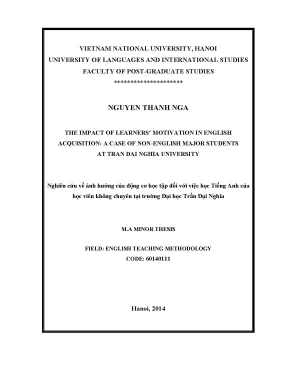
VIETNAM NATIONAL UNIVERSITY, HANOI UNIVERSITY OF LANGUAGES AND INTERNATIONAL STUDIES FACULTY OF POST-GRADUATE STUDIES ********************* NGUYEN THANH NGA THE IMPACT OF LEARNERS’ MOTIVATION IN ENGLISH ACQUISITION: A CASE OF NON-ENGLISH MAJOR STUDENTS AT TRAN DAI NGHIA UNIVERSITY Nghiên cứu về ảnh hưởng của động cơ học tập đối với việc học Tiếng Anh của học viên không chuyên tại trường Đại học Trần Đại Nghĩa M.A MINOR THESIS FIELD: ENGLISH TEACHING METHODOLOGY CODE: 60140111 Hanoi, 2014 TIEU LUAN MOI download : skknchat@gmail.com VIETNAM NATIONAL UNIVERSITY, HANOI UNIVERSITY OF LANGUAGES AND INTERNATIONAL STUDIES FACULTY OF POST-GRADUATE STUDIES ********************* NGUYEN THANH NGA THE IMPACT OF LEARNERS’ MOTIVATION IN ENGLISH ACQUISITION: A CASE OF NON-ENGLISH MAJOR STUDENTS AT TRAN DAI NGHIA UNIVERSITY Nghiên cứu về ảnh hưởng của động cơ học tập đối với việc học Tiếng Anh của học viên không chuyên tại trường Đại học Trần Đại Nghĩa M.A MINOR THESIS FIELD: ENGLISH TEACHING METHODOLOGY CODE: 60140111 SUPERVISOR: PHAN THE HUNG, Ph. Hanoi, 2014 TIEU LUAN MOI download : skknchat@gmail.com DECLARATION OF AUTHORSHIP Student’s Declaration: I, Nguyen Thanh Nga, hereby declare that the work entitled ‘The Impact of Learners’ Motivation in English Acquisition: A Case of Non-English Major Students at Tran Đai Nghia University’ is my own work. I did not copy from any other people’s works except where dues reference or acknowledgement is made explicitly in the text. Signed: ___________________ Date: _________________ i TIEU LUAN MOI download : skknchat@gmail.com ACKNOWLEDGEMENTS I am deeply indebted the Faculty of Post-graduate Studies, University of Languages and International Studies, Vietnam National University, Hanoi as an active learning environment where I have chance to receive knowledge and experience life as a post-university student.

Thanks to the school, I have been approached professional training and educating that is required by modern society. I would like to sincerely thank the teachers at the Post-graduate Studies for providing me with foundation as well as advanced knowledge of English language in learning process. I am greatly indebted to PhD Phan The Hung, as my supervisor for providing me with useful techniques to carry out the study. I also have accumulated helpful experience from his suggestions and valuable comments on the writing of this thesis.

My appreciation is also extended to a number of members of classes DH03601 of the Faculty of Infantry Weapon and DH03801 at the Faculty of Ammunition, with their truthful answers, I can complete my research. Their support is greatly appreciated. Very special thanks are due to my close friends who are Pham Le Nu Tuyet Ngan, Do Thi Tuyet Suong, Nguyen Quynh Nga. With their suggestions and contributions, I had many good ideas for my research, they are my fellow- travellers who shared happiness and difficulties with me throughout this research period.

And last, but by no means least, my heartfelt thanks go to the members of my family. They gave me the biggest encouragement to help me not feel pressure to focus on this task. Without whose unfailing love, understanding, encouragement, and support over time and distance, I could not have got this far. ii TIEU LUAN MOI download : skknchat@gmail.com ABSTRACT Motivation-a psychological aspect, which is considered as one of the most crucial factors in English acquisition, is very important in fostering learner’ positive attitude toward the L2 learning process.

However, how special the influences of motivation on non-English major students in army environment is, compared to other civilian training types. Thus, this study is conducted to investigate some elements that motivate and de-motivate students in EFL courses for basic purpose at Tran Dai Nghia University, an example of military schools. The data was collected through the survey questionnaires and interview of 78 students in two classes of two different faculties in order to find out what should be considered to improve teaching and learning quality of the L2 in this school. Key words: Motivation, acquisition, motivate, de-motivate.

iii TIEU LUAN MOI download : skknchat@gmail.com TABLE OF CONTENTS DECLARATION OF AUTHORSHIP .iii TABLE OF CONTENTS. iv DEFINITION OF TERMS .vii LIST OF ABBREVIATIONS .viii LIST OF TABLES AND FIGURES. ix PART A: INTRODUCTION 1. Aims of the study.

Scope of the study. Design of the study. 3 PART B: DEVELOPMENT CHAPTER 1: LITERATURE REVIEW .1 Definition of motivation .2 Motivation in English acquisition .3 Classification of motivation .1 Intrinsic and extrinsic motivation .2 Integrative and instrumental motivation .4 De-motivation in language acquisition .5 Factors that influence students’ motivation in English acquisition. 14 iv TIEU LUAN MOI download : skknchat@gmail.1 Teacher-related factors .3 Commitment to teaching .2 Learner-related factors .6 Age of acquisition .3 Learning condition-related factors .2 Atmosphere in the classroom .2 Theoretical backgrounds of second language acquisition .1 Definition of second language acquisition .2 Principles of second language acquisition .1 Participants and setting of the study .2 Setting of the study .1 Data collection instrument .2 Data collection procedure .3 Data analysis procedure.

26 CHAPTER 3: FINDINGS AND DISCUSSION. 27 v TIEU LUAN MOI download : skknchat@gmail.1 Students’ attitude and reasons toward English and English acquisition .1 Students’ attitude of English .2 Types of students’ motivation in SLA .3 Students’ comments upon frequency of activities .2 Factors that influence students’ motivation in SLA at TDN University .1 Teacher-related factors .2 Student-related factors .3 Learning condition-related factors .1 Techniques in teaching English at TDN University .2 Factors that de-motivate students’ motivation in English acquisition. Conclusions of the study. Limitations of the study.

Suggestions for further study .IV vi TIEU LUAN MOI download : skknchat@gmail.com DEFINITION OF TERMS Motivation: the psychological feature that orientate an action toward a desired goal. Acquisition: cognitive process of acquire skill or knowledge. Intrinsic motivation: situated within or belonging solely to nature of something. Extrinsic motivation: one kind of motivation coming from outside factors.

Integrative motivation: one kind of motivation related to be assimilated to target language -spoken countries. Instrumental motivation: one kind of motivation related to use the language as an instrument to get something. vii TIEU LUAN MOI download : skknchat@gmail.com LIST OF ABBREVIATIONS TOEFL: Test of English as a Foreign Language TOEIC: Test of English for International Communication IELTS: International English Language Testing System ESL: English as a Second Language SLA: Second Language Acquisition TDN: Tran Dai Nghia L2: Second language IM: Intrinsic motivation FL: Foreign language ESP: English For Specific Purpose EFL: English as Foreign Language ESL: English as Second Language viii TIEU LUAN MOI download : skknchat@gmail.com LISTS OF TABLES AND FIGURES Table 1: Gardner’s Social-Educational Model of Motivation Table 2: William and Burden’s (1997) framework of L2 motivation Table 3: Students' measurement of preference toward English Table 4: Students’ reasons for English acquisition Table 5: The applied activities suggested by the students Table 6: Effect of teacher-related factors on students’ motivation Table 7: The measurement of learner-related factors to learning motivation Table 8: The effect of learning-related factors toward learning motivation Table 9: Students’ feeling about learning-related factors ix TIEU LUAN MOI download : skknchat@gmail.com PART I: INTRODUCTION 1. Rationale As one of the compulsory subjects in most schools, universities, as well as institutes, English shows its importance in which the most popular language all over the world in general and in Vietnam in particular.

In addition, the development of the language has been admitted through the requirement of having such certificates as TOEFL, IELTS, TOEIC, etc… for application in a certain company or institute; learning English is not only an opportunity but also a necessary and sufficient condition for many people. However, whether the positive attitude of learning English is shown by students for their own purposes during the process or just being considered as a normal required subject to complete a studying curriculum. This is really a big reason that motivates or even though de-motivates students in the language acquisition. College of Military Technology Officer is also called Tran Dai Nghia University, Ho Chi Minh city.

As a teacher at Department of Basic Science,; from my personal observation and my own teaching experience in two years, I see that during all the English lessons with a variety of activities, only some students get involved in the tasks whereas the others keep silent or do unrelated things. Therefore, it is hard to find effectiveness and enthusiasm for English as foreign language learning in students’ learning In order to find the suggestible solutions to the problem, it is essential to carry out an investigation on students’ motivation in English learning for general purpose. In the field of second language acquisition (SLA), many researchers and linguists have believed that motivation plays the initial role in the percentage of success in English acquisition. Whether linguistic processes can be effective despite a certain individual is really the subject-talented receptor without any motivation.

1 TIEU LUAN MOI download : skknchat@gmail.com For the mentioned reasons, I would like to conduct a study on ‘The Impact of Learners’ Motivation in English Acquisition: A Case of Non-English Major Students at Tran Đai Nghia University.’ The study is to have an investigation in how subjective and objective factors can motivate and de-motivate students’ attitude in English learning. From that point, I also recommend some suggestions to encourage non-English major students who are first year students at Tran Dai Nghia University in the language learning. Aims of the Study In order to carry out the study, it begins with the aims of investigating the motivation in English acquisition for general purposes among the first year non- English students at Infantry Weapon Faculty as the representatives of military participants along with some from Information Technology Faculty, the examples of civilian students, at Tran Dai Nghia University. The research aims at the following points: - To analyze students’ perception of the English learning for general purposes.

- To evaluate the influence of students’ motivation in the language learning process in which divided into two opposite dimensions: motivating and de-motivating. - To suggest some useful tips to foster students’ motivation in English learning. The thesis aims to solve the following questions: - What kinds of factors that motivate as well as de-motivate students’ positive attitude in English acquisition? - What approaches should be applied inside English for general purpose classes in a military school? 3. Scope of the Study 2 TIEU LUAN MOI download : skknchat@gmail.com It is said that the factors influence students in the success or failure of learning a foreign language are numerous, among them motivation can be seen as the priority aspect which is taken into account.

The study mainly focuses on the elements effect the students’ positive attitude during interacting with other members inside the class in Basic English courses. The results of the study will be carefully considered to foster the activeness of students in the military environment at Tran Dai Nghia University, not for all of the students at universities in Vietnam. Method of the Study Because the result of the study will serve the process of English teaching at the school later, a case study, which is ‘an investigation using multiple sources of evidence to study a contemporary phenomenon within its real-life context’ (Bonoma et al) cited in Kaplan et al (1988, 576), is taken into account. By using a variety of data sources, the study employs the qualitative and quantitative case study approach to explore the students’ perception and attitude toward English learning through activities inside the class.

With the following characteristics, the qualitative research is suitable for further adaption, including seeking answers to a question, systematically using a predefined set of procedures to answer the questions, collecting evidence, producing findings that were not determined in advanced, producing findings that are applicable beyond the intermediate boundaries of the study. In this thesis, qualitative methods include open-ended interviewing to the students dealing with students’ attitude toward language tasks in periods, and analysis of responses to open-ended items on a survey questionnaire.

Nội dung được bảo vệ bản quyền — Tải xuống đầy đủ