Nghiên cứu đặc điểm diễn ngôn bài đọc SGK Anh 11 mới cho SV không chuyên (Nguyễn Thị Hương Giang)

Phân tích đặc điểm diễn ngôn bài đọc trong SGK Anh 11 dành cho sinh viên không chuyên. Khám phá ngôn ngữ, cấu trúc và mục đích giảng dạy.

Chuyên ngành

Ngôn ngữ học Anh

Người đăng

Ẩn danh

Thể loại

Luận văn thạc sĩ

2010

53
1
0

Phí lưu trữ

30 Point

Tóm tắt

I. Tổng quan về đặc điểm diễn ngôn bài đọc SGK Anh 11

Diễn ngôn là khái niệm trung tâm trong phân tích văn bản tiếng Anh. Bài đọc trong sách giáo khoa tiếng Anh 11 mới dành cho học sinh không chuyên chứa nhiều đặc điểm diễn ngôn đáng chú ý. Các đặc điểm này bao gồm phương tiện liên kết ngữ pháp và liên kết từ vựng. Phương tiện liên kết ngữ pháp gồm: chỉ dẫn tham chiếu, thế thế, lược bỏ và liên từ. Phương tiện liên kết từ vựng bao gồm: từ đồng nghĩa, từ trái nghĩa, từ siêuordinate và cụm từ cố định. Nghiên cứu của Nguyễn Thị Hương Giang (2010) đã phân tích 16 bài đọc trong SGK tiếng Anh 11 mới. Kết quả cho thấy các phương tiện liên kết xuất hiện với tần suất khác nhau. Hiểu rõ các đặc điểm diễn ngôn giúp học sinh nâng cao khả năng đọc hiểu. Đây là nền tảng quan trọng cho việc dạy và học tiếng Anh hiệu quả.

1.1. Khái niệm diễn ngôn và văn bản

Diễn ngôn (discourse) là đơn vị ngôn ngữ lớn hơn câu, được sử dụng trong giao tiếp thực tế. Văn bản (text) là sản phẩm hữu hình của diễn ngôn viết. Hai khái niệm này có mối liên hệ mật thiết với nhau. Diễn ngôn nhấn mạnh khía cạnh giao tiếp và ngữ cảnh sử dụng ngôn ngữ. Văn bản tập trung vào cấu trúc nội tại của ngôn ngữ. Trong SGK tiếng Anh 11, các bài đọc hiểu là dạng văn bản được xây dựng có chủ đích. Chúng chứa đựng các đặc điểm diễn ngôn phục vụ mục tiêu giáo dục. Việc phân tích diễn ngôn giúp người học hiểu sâu sắc cấu trúc bài đọc.

1.2. Vai trò của liên kết trong đọc hiểu

Liên kết (cohesion) là yếu tố then chốt tạo nên sự mạch lạc cho văn bản. Liên kết bao gồm hai loại chính: liên kết ngữ pháp và liên kết từ vựng. Liên kết ngữ pháp sử dụng các phương tiện như tham chiếu, thế thế, lược bỏ và liên từ. Liên kết từ vựng sử dụng các mối quan hệ từ vựng như đồng nghĩa, trái nghĩa, cụm từ cố định. Các phương tiện liên kết giúp người đọc theo dõi dòng ý tưởng trong bài đọc. Đối với học sinh không chuyên, nhận biết các phương tiện liên kết là kỹ năng quan trọng. Kỹ năng này hỗ trợ đắc lực cho quá trình đọc hiểu và phân tích văn bản tiếng Anh.

II. Phân tích phương tiện liên kết ngữ pháp trong bài đọc

Phương tiện liên kết ngữ pháp đóng vai trò quan trọng trong việc tạo sự mạch lạc cho bài đọc. Nghiên cứu đã chỉ ra ba loại tham chiếu chính trong các bài đọc SGK Anh 11. Tham chiếu nhân xưng sử dụng các đại từ như I, you, he, she, we, they. Tham chiếu chỉ định sử dụng this, that, these, those, the. Tham chiếu so sánh sử dụng các từ so sánh hơn và so sánh nhất. Điểm đáng chú ý là cách sử dụng đại từ 'we' trong bài đọc rất đa dạng. 'We' có thể chỉ người viết và người đọc, hoặc chỉ con người nói chung. Trong một số ngữ cảnh, 'we' còn được dùng để chỉ các thực thể phi con người. Thế thế và lược bỏ cũng xuất hiện trong bài đọc với vai trò liên kết. Liên từ là phương tiện kết nối các ý tưởng logic trong văn bản. Các liên từ phổ biến bao gồm: and, but, however, therefore, because.

2.1. Các loại tham chiếu trong bài đọc

Tham chiếu nhân xưng là loại phổ biến nhất trong bài đọc SGK Anh 11. Loại tham chiếu này sử dụng các đại từ nhân xưng để chỉ lại đối tượng đã được nhắc đến. Tham chiếu chỉ định sử dụng mạo từ 'the' và các đại từ chỉ định. Loại tham chiếu này giúp người đọc xác định đối tượng cụ thể đang được đề cập. Tham chiếu so sánh tạo mối liên hệ giữa các đối tượng qua tính từ so sánh. Việc phân biệt ba loại tham chiếu giúp học sinh hiểu rõ cấu trúc văn bản. Học sinh cần được hướng dẫn nhận biết từng loại tham chiếu trong ngữ cảnh cụ thể.

2.2. Thế thế lược bỏ và liên từ

Thế thế là phương tiện thay thế một từ hoặc cụm từ bằng từ khác có cùng chức năng. Các từ thế thế phổ biến gồm: one, ones, do, so, not. Lược bỏ là hiện tượng bỏ bớt một số thành phần ngữ pháp để tránh lặp lại. Lược bỏ thường xuất hiện trong các câu phức hợp và câu ghép. Liên từ kết nối các mệnh đề và đoạn văn theo quan hệ logic. Liên từ additive như and, furthermore bổ sung thêm ý tưởng. Liên từ adversative như but, however chỉ sự tương phản. Liên từ causal như because, therefore chỉ nguyên nhân và kết quả. Nhận biết các phương tiện này giúp học sinh nắm bắt mối liên hệ giữa các phần trong bài đọc.

III. Phân tích phương tiện liên kết từ vựng trong SGK Anh 11

Liên kết từ vựng là phương tiện tạo sự mạch lạc qua hệ thống từ vựng trong văn bản. Các bài đọc SGK Anh 11 sử dụng nhiều phương tiện liên kết từ vựng đa dạng. Từ đồng nghĩa và trái nghĩa giúp tạo mối liên hệ giữa các khái niệm trong bài đọc. Từ siêuordinate (từ chỉ loại) và từ hyponym (từ chỉ loài) xây dựng hệ thống phân loại. Cụm từ cố định (collocation) là hiện tượng các từ thường xuất hiện cùng nhau. Nghiên cứu cho thấy collocation là phương tiện liên kết từ vựng phổ biến nhất. Ví dụ: 'make a decision', 'take action', 'pay attention' xuất hiện nhiều trong bài đọc. Từ đồng nghĩa không chỉ là từ có nghĩa giống hệt mà còn là từ có nghĩa tương đồng trong ngữ cảnh. Việc nắm vững liên kết từ vựng giúp học sinh mở rộng vốn từ và hiểu bài đọc sâu sắc hơn.

3.1. Từ đồng nghĩa trái nghĩa và siêuordinate

Từ đồng nghĩa trong bài đọc SGK Anh 11 thường được dùng để tránh lặp từ. Người viết sử dụng từ đồng nghĩa để tạo sự đa dạng cho văn bản. Từ trái nghĩa tạo mối tương phản rõ ràng giữa các khái niệm. Các cặp trái nghĩa phổ biến như: old/young, rich/poor, success/failure. Từ siêuordinate là từ chỉ khái niệm chung bao hàm nhiều khái niệm cụ thể. Ví dụ: 'animal' là từ siêuordinate của 'dog', 'cat', 'bird'. Nhận biết các mối quan hệ từ vựng này giúp học sinh hiểu cấu trúc ngữ nghĩa bài đọc. Giáo viên nên hướng dẫn học sinh xây dựng bản đồ từ vựng cho mỗi bài đọc.

3.2. Vai trò của collocation trong đọc hiểu

Collocation là hiện tượng các từ xuất hiện cùng nhau với tần suất cao trong ngôn ngữ. Trong SGK Anh 11, collocation xuất hiện rất phổ biến trong các bài đọc. Các loại collocation gồm: tính từ + danh từ, động từ + danh từ, động từ + trạng từ. Ví dụ: 'strong coffee', 'heavy rain', 'make progress'. Collocation giúp người đọc dự đoán nghĩa của từ trong ngữ cảnh. Đối với học sinh không chuyên, collocation là thách thức lớn trong đọc hiểu. Giáo viên cần tích cực giảng dạy và luyện tập collocation cho học sinh. Việc nắm vững collocation giúp học sinh đọc nhanh hơn và hiểu chính xác hơn.

IV. Ứng dụng và gợi ý cho việc dạy học tiếng Anh

Kết quả phân tích đặc điểm diễn ngôn mang lại nhiều gợi ý quý giá cho giáo viên. Giáo viên cần nhận thức rõ vai trò của phương tiện liên kết trong bài đọc. Khi giảng bài đọc, giáo viên nên chỉ ra các phương tiện liên kết chính xuất hiện. Giải thích cách sử dụng của các phương tiện liên kết phổ biến nhất trong bài. Đảm bảo rằng kiến thức về liên kết mang lại lợi ích thiết thực cho học sinh. Hướng dẫn học sinh nhận biết và phân tích các phương tiện liên kết khi đọc. Tổ chức các hoạt động thực hành nhận biết liên kết ngữ pháp và từ vựng. Sử dụng bài tập điền từ, nối từ, phân tích văn bản để rèn luyện kỹ năng. Giúp học sinh xây dựng thói quen chú ý đến các từ liên kết khi đọc. Với cách tiếp cận này, khả năng đọc hiểu của học sinh không chuyên sẽ cải thiện đáng kể.

4.1. Gợi ý cho giáo viên giảng dạy đọc hiểu

Giáo viên nên tích hợp kiến thức về diễn ngôn vào bài giảng đọc hiểu. Trước khi đọc, giới thiệu một số phương tiện liên kết học sinh sẽ gặp trong bài. Trong khi đọc, đánh dấu và giải thích các phương tiện liên kết quan trọng. Sau khi đọc, tổng hợp lại các phương tiện liên kết đã học để củng cố kiến thức. Sử dụng phương pháp so sánh văn bản có liên kết và không liên kết để minh họa. Thiết kế bài tập yêu cầu học sinh tìm và phân tích phương tiện liên kết. Khuyến khích học sinh sử dụng phương tiện liên kết khi viết bài. Đánh giá khả năng nhận biết liên kết của học sinh qua các bài kiểm tra đọc hiểu.

4.2. Gợi ý cho học sinh không chuyên

Học sinh cần xây dựng thói quen chú ý đến các từ liên kết khi đọc tiếng Anh. Bắt đầu bằng việc nhận biết các liên từ phổ biến như: and, but, because, however. Học thuộc các cụm từ cố định thường xuất hiện trong bài đọc SGK. Sử dụng bảng tổng hợp phương tiện liên kết để tra cứu khi đọc. Thực hành đọc hiểu với chiến lược chú ý đến mối liên hệ giữa các câu và đoạn. Ghi chép lại các phương tiện liên kết mới gặp trong quá trình đọc. Thảo luận với bạn bè về cách sử dụng phương tiện liên kết trong bài đọc. Luyện tập thường xuyên để cải thiện khả năng nhận biết và sử dụng liên kết.
Tóm tắt và mô tả trên trang này được tạo với sự hỗ trợ của AI từ nội dung tài liệu gốc; tài liệu do người dùng đóng góp và được kiểm duyệt trước khi xuất bản. Báo lỗi nội dung.

28/05/2026
A study on some discourse features in the reading texts in the vietnamese new english textbook for non english major students with implication for teaching and learning m a thesis linguistics 5 04 09

Trích đoạn nội dung tài liệu

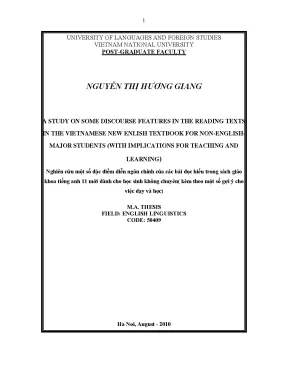
1 UNIVERSITY OF LANGUAGES AND FOREIGN STUDIES VIETNAM NATIONAL UNIVERSITY POST-GRADUATE FACULTY NGUYỄN THỊ HƯƠNG GIANG A STUDY ON SOME DISCOURSE FEATURES IN THE READING TEXTS IN THE VIETNAMESE NEW ENLISH TEXTBOOK FOR NON-ENGLISH- MAJOR STUDENTS (WITH IMPLICATIONS FOR TEACHING AND LEARNING) Nghiên cứu một số đặc điểm diễn ngôn chính của các bài đọc hiểu trong sách giáo khoa tiếng anh 11 mới dành cho học sinh không chuyên( kèm theo một số gợi ý cho việc dạy và học) M. THESIS FIELD: ENGLISH LINGUISTICS CODE: 50409 Ha Noi, August - 2010 TIEU LUAN MOI download : skknchat@gmail.com 2 UNIVERSITY OF LANGUAGES AND FOREIGN STUDIES VIETNAM NATIONAL UNIVERSITY POST-GRADUATE FACULTY NGUYỄN THỊ HƯƠNG GIANG A STUDY ON SOME DISCOURSE FEATURES IN THE READING TEXTS IN THE VIETNAMESE NEW ENLISH TEXTBOOK FOR NON-ENGLISH- MAJOR STUDENTS (WITH IMPLICATIONS FOR TEACHING AND LEARNING) Nghiên cứu một số đặc điểm diễn ngôn chính của các bài đọc hiểu trong sách giáo khoa tiếng anh 11 mới dành cho học sinh không chuyên( kèm theo một số gợi ý cho việc dạy và học) M. THESIS FIELD: ENGLISH LINGUISTICS CODE: 50409 SUPERVISOR: Dr. NGUYỄN HOÀ Ha Noi, August - 2010 TIEU LUAN MOI download : skknchat@gmail.com 4 Table of content ACKNOWLEDGEMENT i TABLE OF CONTENT ii LIST OF TABLES AND FIGURES iii Part I: INTRODUCTION vi 1.

Aim of the study vii 3. Scope of the study vii 4. Method of the study vii 5. Organization of the study viii Part II: DEVELOPMENT 1 Chapter 1: Theoretical background 1 1.

Theory of discourse 1 1. Definition of discourse 1 1. Discourse versus text 2 1. Spoken and written discourse 2 1.

Context in discourse analysis 4 1. Discourse analysis and language teaching 5 1. Definition of text 6 1. Roles of text in language teaching 8 1.

The concept of cohesion 8 1. Cohesion versus coherence 9 1. Main types of cohesion 9 1. Lexical devices 13 TIEU LUAN MOI download : skknchat@gmail.

Aspects of coherence 15 1. Logical coherence 16 Chapter 2: Analysis of main discourse features in the reading text in the Vietnamese new English 11 textbook for non-English - major students 17 2. Concluding remarks on reference 24 2. Concluding remarks on substitution 26 2.

Concluding remarks on ellipsis 27 2. Concluding remarks on conjunction 31 2. Lexical cohesive devices: 32 2. Super-ordinate and general word 36 2.

Collocation 37 TIEU LUAN MOI download : skknchat@gmail. Concluding remarks on lexical cohesive devices: 38 Part III: Conclusion 40 1. Major findings and conclusion remarks 40 2. Implications for teaching and learning English for non - English- major students at Tran Phu High School 41 3.

Suggestions for further study 42 REFERENCE ix APPENDIXES x TIEU LUAN MOI download : skknchat@gmail.com 7 LIST OF TABLES AND FIGURES Table 1: 1. Literacy text types Table 1: 2. Personal reference Table 1: 3. Demonstrative reference Table 1: 4.

Comparative reference Table 1: 5. Grammatical and lexical cohesion Figure 2: 1 Analysis of three types of reference in the chosen reading texts Figure 2: 2. Analysis of four types of conjunction in the chosen reading texts Figure 2:3. Analysis of lexical cohesive devives in the chosen reading texts TIEU LUAN MOI download : skknchat@gmail.com 8 Part I: INTRODUCTION 1.

Rationale: Nowadays, teachers of languages in Vietnam with the pressure of professionalization are more aware of the important role of linguistics in their field. They spend much time and energy not only keeping up with the field but also doing a lot of research on linguistics in general and discourse analysis in particular. To a teacher of language, it is vital to understand how textbooks are seen in the light of discourse analysis, i. how language is used in when designing teaching materials or engaging learners in learning activities aimed at improving their target language proficiency or when evaluating piece of materials before deciding using them.

“Discourse feature” is a broad category which covers a variety of criteria, including both intra-linguistics factors and extra-linguistics elements, such as cohesive, theme-rhyme structure, text structure, speech acts, writer‟s/ speaker‟s intensions, background knowledge, etc. Halliday and Hasan (1976:3) claim that: if a passage of English containing more than one sentence perceived as a text, there will be certain linguistics features present in that passage which can be identified as contributing to its total unity and giving it texture”. To the researcher, the linguistics features that are of great importance and interests are those of generic structure and cohesion due to the belief that these two factors make influential contribution to defining a genre of discourse. High school English teachers in general and English teachers at Tran Phu high school, Vinh Phuc province in particular focus so intensively on their English subject.

And they warmly welcome the new set of English textbooks for non-English-major students which based on quite a new approach - communicative approach - is highly appreciated by both teachers and students. As a teacher of English here, I am deeply aware of challenges in dealing with the interest but demanding subject of English. I also realize some obstacles that needs in solving the teaching and learning process of this subject. Most of my students face up with the difficulties in reading and deeply understanding the reading texts in the textbook.

These difficulties surely will hinder the effectiveness and improvement of students‟ study. Further more, though there are many researchers who have been paying much attention and doing researches on cohesive devices used in the textbooks not for high school students but for those who learn English with special TIEU LUAN MOI download : skknchat@gmail. Therefore, I decided to study on some discourse features in the reading texts in the Vietnamese new English 11 textbook for non-English - major students (because of the limit of time and my knowledge), from the point of view of discourse analysis, the researcher only focus on cohesion devices used in the reading texts. These cohesive devices are related to properties that make the text a unified whole.

They refer to both text characteristics and readers‟ interaction with the text. Awareness of coherence as a quality that make a text conform to a consistent world picture, to experiences, culture, and convention and cohesive devices used the linguistics means by which elements of a text are arranged and concern is vital for students of English in improving reading comprehension. Based on my analysis from the point of view of cohesive devices, some suggestions are given for improving the effectiveness of teaching reading skill and learning reading skill for English teachers and students. Aim of the study: Examining the cohesive devices in the reading texts in the Vietnamese new English 11 textbook for non-English - major students including grammatical cohesive devices, lexical cohesive devices and conjunctions, with the aim of working out the typical features of cohesive in reading texts in the Vietnamese new English 11 textbook for non- English - major students which to satisfy the research questions:  What are cohesive devices mainly used in the reading texts in the Vietnamese new English 11 textbook for non-English - major students?  How are those cohesive devices performed in the reading texts in the Vietnamese new English 11 textbook for non-English - major students? 3.

Scope of the study: Focuses of consideration for the investigation of one of the greatest category of the discourse features that is cohesion, used in collected reading texts in a certain textbook: the Vietnamese new English 11 textbook for non-English - major students 4. Method of the study: To reach the final goal of revealing the discourse features of the reading texts in the Vietnamese new English 11 textbook for non-English - major students, the methods of description, analysis and statistic in linguistics are used in this thesis and are carried out in the following steps: TIEU LUAN MOI download : skknchat@gmail.com 10  Collecting data, including relevant theories for analysis, Reading texts in the Vietnamese new English 11 textbook for non-English - major students will be collected. Relevant theories will be extracted from various linguistics book written by several linguistics, such as: Cook (1989), Hatim and Mason (1990), Swales (1990), Halliday and Hasan (1976), etc, as unavailable in printed books in Vietnam, will be collected from the Internet sources, the address of which will be provided in the list of References at the end of this thesis.  Relevant theories will be presented on the ground of several linguists‟ view of points.

 16 reading texts in the Vietnamese new English 11 textbook for non-English - major students will be comprehensively investigated for cohesive devices so as to find out the most typical cohesive devices used in written text.  Based on the results of the analysis, some concluding remarks can be generalized and some implication for teaching and learning reading skills can be proposed. Organization of the study This research is composed of three main parts. Part I, the Introduction, present briefly the rationale, the aims, the scope, and the methods of the study as well as the organization of the study.

Part II is the Development, which consist of two chapters. Chapter 1 discusses the Theoretical Background related to discourse analysis. In this chapter, the researcher will present the basic concept of discourse and discourse analysis, the discourse features, text types and its important roles as all the reading texts in the chosen textbook is performed in the text form, as well as the notion of cohesion which mainly focus on Chapter 2 is devoted to the analysis of Cohesive Devices used in the reading text in the Vietnamese new English 11 textbook for non-English - major students so as to reveal some typical features. And finally, some remarks are discussed to answer the research questions.

Part III is the Conclusion. In this part, a review of the study is presented, together with some implication for teaching and learning, and suggestions for further studies. The study is ended with Appendixes showing list of Reading texts taken into consideration. TIEU LUAN MOI download : skknchat@gmail.com 11 Part II: DEVELOPMENT Chapter 1: THEORETICAL BACKGROUND 1.

Theory of discourse 1. Definition of discourse The concept of discourse has been paid considerable attention to by many linguists. Different authors have different definitions of discourse. Let‟s look at some of them to achieve the similar as well as the different among them.

According to Crystal (1992:25) discourse is “a continuous stretch of (especially spoken) language larger than a sentence, often constituting a coherent unit, such as a sermon, an argument, a joke or a narrative” Cook (1989: 156) shares the same idea with Crystal in stating that discourse is “stretches of language perceived to be meaningful, unified and purposeful”. In his point of view, discourse may be composed of one or more well-formed grammatical sentences – and indeed it often is – but it does not have to be. There can be some grammatical mistakes in a discourse, which do not affect the overall structure and meaning of the discourse. Discourse treats the rules of grammar as a resource, conforming to them when it needs to, but departing from them when it does not.

Discourse can be anything from a conversation to a great novel or a length legal case. Cook also argues that “What‟ matters is not its conformity to rules, but the fact that it communicates and is recognized by its receivers as coherent” discourse is supposed to be meaningful and thus used to communicate with one person in a way that another person does not have the necessary knowledge to make sense of. Halliday & Hasan define discourse as follow: “We can define text (discourse) in the simplest way perhaps, by saying that it is language that is functional. By functional, we simply mean language that is doing the same job in some context as opposed to isolated words or sentences that I might put on the blackboard.

Nội dung được bảo vệ bản quyền — Tải xuống đầy đủ