Luận văn Thần học về truyền tải mạc khải: Aquinas và Ratzinger - Andrew Wood

Nghiên cứu chi tiết luận văn thạc sĩ của Andrew Wood về chủ đề nghiên cứu khoa học. Phân tích phương pháp luận và kết quả nổi bật trong đề tài

Trường đại học

Australian Catholic University

Chuyên ngành

Triết học

Người đăng

Ẩn danh

Thể loại

Luận văn thạc sĩ

2015

143
1
0

Phí lưu trữ

35 Point

Tóm tắt

I. Tổng quan về luận văn thạc sĩ Andrew Wood về truyền thống thần học

Luận văn thạc sĩ của Andrew Wood tập trung so sánh thần học truyền thống mặc khải thần linh của Thomas Aquinas và Joseph Ratzinger. Đề tài nghiên cứu nhằm phân tích cách hai nhà thần học này lý giải quá trình truyền tải mặc khải thần thánh qua các thế hệ. Nội dung chính của luận văn bao gồm khái niệm về mặc khải thần linh, vai trò của truyền thống trong thần học, cũng như sự khác biệt giữa quan điểm kinh viện thời trung cổ và thần học hiện đại. Wood đã sử dụng phương pháp phân tích văn bản kinh điển kết hợp so sánh hệ thống thần học nhằm làm rõ những điểm tương đồng và dị biệt giữa hai tư tưởng. Kết quả nghiên cứu góp phần làm phong phú thêm hiểu biết về thần học mặc khải trong bối cảnh triết học và thần học đương đại.

1.1. Bối cảnh lịch sử và mục đích nghiên cứu

Luận văn được thực hiện trong bối cảnh thần học phương Tây thế kỷ XXI, khi thần học mặc khải đang đối diện với những thách thức từ khoa học tự nhiên và triết học hậu hiện đại. Andrew Wood nhấn mạnh nhu cầu so sánh hai hệ thống thần học quan trọng: Thomas Aquinas, đại diện cho thần học kinh viện thời trung cổ, và Joseph Ratzinger (sau này là Giáo hoàng Biển Đức XVI), đại diện cho thần học đương đại. Mục đích nghiên cứu nhằm xác định những điểm hội tụ và khác biệt trong cách hai nhà thần học này lý giải quá trình truyền tải mặc khải thần thánh. Wood cũng khám phá những ảnh hưởng lẫn nhau giữa thần học kinh viện và thần học đương đại trong lĩnh vực này.

1.2. Phương pháp luận và cấu trúc luận văn

Wood áp dụng phương pháp phân tích văn bản kinh điển kết hợp so sánh hệ thống thần học. Luận văn được cấu trúc thành hai phần chính: phân tích thần học của Thomas Aquinas về truyền thống mặc khải, và so sánh quan điểm của ông với Joseph Ratzinger. Wood sử dụng các nguồn tư liệu chính như Summa Theologiae của Aquinas và các tác phẩm thần học của Ratzinger. Phương pháp luận của ông dựa trên cách tiếp cận triết học phân tích, kết hợp với phân tích văn bản thần học. Kết cấu này cho phép độc giả theo dõi sự phát triển của tư tưởng thần học mặc khải qua các thời kỳ lịch sử.

II. Phân tích những vấn đề trong thần học truyền thống mặc khải

Nghiên cứu của Andrew Wood tập trung vào những thách thức trong việc truyền tải mặc khải thần thánh giữa hai hệ thống thần học khác biệt. Thomas Aquinas xem mặc khải thần thánh như một 'hành động ngôn từ thần thánh', trong khi Joseph Ratzinger nhấn mạnh đến yếu tố lịch sử và tiến hóa của mặc khải. Wood phát hiện ra những khác biệt quan trọng trong cách hai nhà thần học này giải thích vai trò của truyền thống trong việc bảo tồn và truyền tải mặc khải. Aquinas nhấn mạnh đến sự ổn định của giáo huấn Giáo hội, trong khi Ratzinger chú trọng đến sự phát triển hữu cơ của thần học. Những khác biệt này phản ánh những thay đổi triết học và thần học diễn ra giữa thời trung cổ và thế kỷ XX.

2.1. Khái niệm mặc khải thần thánh trong thần học kinh viện

Thomas Aquinas xem mặc khải thần thánh như một 'hành động ngôn từ thần thánh', trong đó Thiên Chúa tự biểu lộ chính mình qua lời nói. Theo Aquinas, mặc khải diễn ra qua hai giai đoạn: mặc khải nguyên thủy trong thời Cựu Ước và sự hoàn thành trong thời Tân Ước. Aquinas nhấn mạnh vai trò của các tiên tri và tông đồ như những trung gian quan trọng trong quá trình truyền tải mặc khải. Ông cũng phát triển học thuyết về 'sacra doctrina' (thần học thánh) như một khoa học thần thánh dựa trên mặc khải. Wood phân tích cách Aquinas kết hợp thần học với triết học Aristotle để xây dựng hệ thống thần học của mình.

2.2. Những thách thức trong thần học đương đại

Joseph Ratzinger, trong khi thừa nhận di sản của Aquinas, nhấn mạnh đến yếu tố lịch sử và tiến hóa trong thần học mặc khải. Ratzinger quan niệm mặc khải không chỉ là sự truyền đạt thông tin mà là một quá trình sống động, trong đó Thiên Chúa tiếp tục nói qua lịch sử loài người. Wood phân tích cách Ratzinger đối thoại với những thách thức từ triết học hiện sinh và thần học giải phóng. Ông cũng nghiên cứu những đóng góp của Ratzinger trong việc tái khám phá thần học của các giáo phụ. Những khác biệt giữa Aquinas và Ratzinger phản ánh sự thay đổi trong cách tiếp cận thần học giữa thời trung cổ và thế kỷ XX.

III. Giải pháp phương pháp luận trong nghiên cứu của Andrew Wood

Để giải quyết những khác biệt giữa hai hệ thống thần học, Andrew Wood đề xuất phương pháp luận dựa trên phân tích so sánh hệ thống thần học. Ông sử dụng cách tiếp cận triết học phân tích để làm rõ những khái niệm nền tảng trong thần học mặc khải của Aquinas và Ratzinger. Wood nhấn mạnh tầm quan trọng của việc đọc các văn bản gốc kết hợp với phân tích ngữ cảnh lịch sử. Phương pháp này cho phép ông xác định những điểm tương đồng ẩn giấu giữa hai hệ thống thần học. Wood cũng sử dụng các công cụ phân tích văn bản hiện đại để làm rõ cấu trúc lập luận trong các tác phẩm thần học. Kết quả là một bức tranh toàn diện về thần học mặc khải trong bối cảnh lịch sử rộng lớn hơn.

3.1. Phương pháp phân tích văn bản kinh điển

Wood sử dụng phương pháp phân tích văn bản kinh điển kết hợp với phân tích ngữ cảnh lịch sử. Ông nghiên cứu các tác phẩm chính của Aquinas, đặc biệt là Summa Theologiae, và các bài giảng thần học của Ratzinger. Phương pháp này bao gồm việc phân tích cấu trúc lập luận, xác định các khái niệm nền tảng, và so sánh cách sử dụng ngôn ngữ thần học. Wood cũng xem xét các bình luận thần học đương đại về các tác phẩm của Aquinas. Phương pháp này cho phép ông phát hiện những điểm tương đồng và khác biệt quan trọng giữa hai hệ thống thần học.

3.2. So sánh hệ thống thần học và triết học

Wood áp dụng phương pháp so sánh hệ thống thần học để làm rõ những khác biệt giữa Aquinas và Ratzinger. Ông phân tích cách hai nhà thần học xây dựng các khái niệm nền tảng như mặc khải, truyền thống, và giáo huấn Giáo hội. Wood cũng nghiên cứu cách họ kết hợp thần học với triết học, đặc biệt là triết học Aristotle trong trường hợp của Aquinas. Ông nhấn mạnh tầm quan trọng của việc hiểu rõ bối cảnh triết học của mỗi nhà thần học. Phương pháp này cho phép ông đưa ra những kết luận quan trọng về sự phát triển của thần học mặc khải trong lịch sử.

IV. Kết luận và ứng dụng nghiên cứu thần học mặc khải

Nghiên cứu của Andrew Wood cung cấp những đóng góp quan trọng cho thần học đương đại bằng cách làm rõ những khác biệt và tương đồng giữa thần học mặc khải của Thomas Aquinas và Joseph Ratzinger. Kết luận chính là sự phát triển hữu cơ của thần học mặc khải qua các thời kỳ lịch sử, trong đó truyền thống đóng vai trò quan trọng trong việc bảo tồn và truyền tải mặc khải. Wood nhấn mạnh tầm quan trọng của việc đối thoại giữa các hệ thống thần học khác biệt. Nghiên cứu của ông cũng cung cấp những ứng dụng quan trọng cho việc giảng dạy thần học và nghiên cứu thần học đương đại. Những phát hiện này góp phần làm phong phú thêm hiểu biết về thần học mặc khải trong bối cảnh đa dạng ngày nay.

4.1. Những đóng góp chính của luận văn

Wood đã xác định được những điểm tương đồng quan trọng giữa Aquinas và Ratzinger, đặc biệt là trong cách họ hiểu mặc khải như một quá trình sống động. Ông cũng làm rõ những khác biệt trong cách họ giải thích vai trò của truyền thống trong thần học. Những đóng góp chính bao gồm việc phát triển phương pháp luận so sánh hệ thống thần học, và ứng dụng thành công phương pháp này vào nghiên cứu thần học mặc khải. Wood cũng cung cấp những hiểu biết mới về sự phát triển hữu cơ của thần học mặc khải qua các thời kỳ lịch sử.

4.2. Hướng nghiên cứu tương lai và ứng dụng thực tiễn

Wood đề xuất một số hướng nghiên cứu tương lai, bao gồm việc áp dụng phương pháp luận của ông vào nghiên cứu các hệ thống thần học khác. Ông cũng nhấn mạnh tầm quan trọng của việc đối thoại giữa các hệ thống thần học khác biệt trong bối cảnh toàn cầu hóa. Những ứng dụng thực tiễn bao gồm việc cải thiện việc giảng dạy thần học mặc khải trong các trường đại học, và cung cấp nền tảng cho các nghiên cứu thần học đương đại. Wood cũng đề xuất việc nghiên cứu sâu hơn về vai trò của truyền thống trong thần học đương đại.
Tóm tắt và mô tả trên trang này được tạo với sự hỗ trợ của AI. Nếu bạn thấy nội dung không chính xác hoặc có vấn đề, vui lòng Báo lỗi nội dung.

31/05/2026
Andrew wood s master s thesis

Trích đoạn nội dung tài liệu

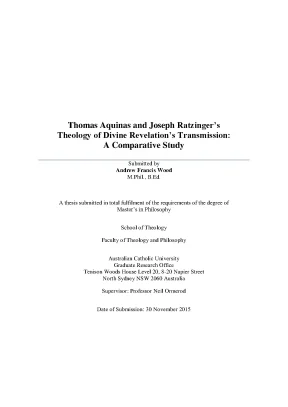
Thomas Aquinas and Joseph Ratzinger‟s Theology of Divine Revelation‟s Transmission: A Comparative Study Submitted by Andrew Francis Wood M. A thesis submitted in total fulfilment of the requirements of the degree of Master‟s in Philosophy School of Theology Faculty of Theology and Philosophy Australian Catholic University Graduate Research Office Tenison Woods House Level 20, 8-20 Napier Street North Sydney NSW 2060 Australia Supervisor: Professor Neil Ormerod Date of Submission: 30 November 2015 This thesis contains no material published elsewhere or extracted in whole or in part from a thesis by which I have qualified for or been awarded another degree or diploma. No parts of this thesis have been submitted towards the award of any other degree or diploma in any other tertiary institution. No other person‟s work has been used without due acknowledgment in the main text of the thesis.

All research procedures reported in the thesis received the approval of the relevant Ethics/Safety Committees (where required). Further paragraphs will be included in the Statement of Authorship and Sources if applicable, specifying: (a) the extent of collaboration with another person or persons (b) the extent and the nature of any other assistance (e. statistical analysis, computer programming, editing) received in the pursuit of the research and preparation of the thesis CONTENTS Abstract. v Chapter One: Introduction.

The Justification for the need to undertake a Comparative Study of Thomas Aquinas and Joseph Ratzinger‟s theology of Divine Revelation‟s Transmission. The Goals and Methodological Approach of this Master‟s Thesis. 3 Chapter Two: Thomas Aquinas‟s Theology of Divine Revelation‟s Transmission. Summary of Thomas‟s Notion of Divine Revelation Theology: Its Historical Dimension, as it Essentially resides in Prophetic Judgment an as it is a Divine „Speech-act‟.

The Two Stages of Divine Revelation and its Historical Dimension in Thomas‟s Theology of Divine Revelation. The Role of Prophetic Judgment in Thomas‟s Theology of Divine Revelation. Divine Revelation as a „Speech-Act‟ in Thomas‟s Theology of Divine Revelation. Thomas‟s Trinitarian Theology as the Metaphysical Foundation of his Revelation Theology.

Thomas‟s Understanding of Revelation‟s Transmission or Communication. Thomas‟s Understanding of Revelatio, Theologia and Sacra Doctrina. Thomas‟s Understanding of how Divine Revelation‟s Sacra Doctrina is Transmitted to Successive Generations. Thomas‟s Understanding of Revelation‟s Communication by the Prophets and Christ‟s Apostles.

Thomas‟s Understanding of how Divine Revelation is transmitted to Successive Generations: Modern Theologian‟s Views of how Thomas conceives this Transmission. Réginald Garrigou-Lagrange‟s (1945) Neo-Thomistic Doctrine of Revelationis Mediatæ and Thomas‟s Understanding of Tradition. Gottfried Geenen‟s (1952) “The Place of Tradition in the Theology of St Thomas” .45 ~i~ MASTERS IN PHILOSOPHY: RESEARCH THESIS 3. „The Communication of Revelation‟ in Per-Erik Persson‟s 1970 Study: Sacra Doctrina: Reason and Revelation in Aquinas.

„Thomas Aquinas: Revelation and the Mission of the Son and Holy Spirit‟ in Matthew Levering‟s 2014 Study. Thomas‟s Understanding of Scripture‟s Role in the Transmission of Revelation. Weisheipl‟s „The Meaning of Sacra Doctrina in Summa theologiæ I, q.1,‟: Thomas‟s Distinction between Sacra Doctrina and Sacra Scriptura and the Necessity of Scripture for Thomas given the Occasion of Divine Revelation. Thomas‟s Distinction between the Sensus Litteralis and the Sensus Mysticus in Per-Erik Persson‟s 1970 Sacra Doctrina: Reason and Revelation in Aquinas.

Leo Elders‟ 1990 article “Aquinas on Holy Scripture as the Medium of Divine Revelation” and Thomas‟s Understanding of the Senses of Scripture as Conveying Divine Revelation .66 Chapter Three: Joseph Ratzinger‟s Theology of Divine Revelation‟s Transmission. Ratzinger‟s Theology of Divine Revelation as It is in Itself. Ratzinger‟s Understanding of the Essential Act of Divine Revelation: a Dialogical Historical Event. Ratzinger‟s Understanding of the Christocentricity of Revelation‟s Dialogical Historical Event.

Bonaventure‟s Trinitarian Theology as the Metaphysical Foundation of Ratzinger‟s Theology of Revelation. Ratzinger‟s “Revelation and Tradition: A Question of the Concept of Tradition and his Interpretation of the Tridentine Decree on Tradition” (1965). Ratzinger‟s “Revelation and Tradition: A Question of the Concept of Tradition”. Ratzinger‟s Consideration of Important Background Questions to the Concept of Tradition.

Ratzinger‟s Notion of the Relation between Revelation and Tradition. Revelation and Scripture. Diverse Significations of Scripture in the Old and New Covenants: Scripture as Letter and Spirit. Revelation‟s Christocentricity and Scripture‟s Material Sufficiency.

Ratzinger‟s Notion of the Nature of Tradition. The Function of Exegesis in Revelation‟s Communication. The Pneumatological Aspect of Tradition: Ratzinger‟s “Interpretation of the Tridentine Decree on Tradition” .96 Chapter Four: The Comparison of Thomas Aquinas and Joseph Ratzinger‟s Theology of Divine Revelation‟s Transmission. Essential Aspects of Thomas Aquinas‟s Theology of Divine Revelation‟s Transmission.

Thomas‟s Notion of What of Divine Revelation is Actually Transmitted or Communication to Successive Generations: Sacra Doctrina. How Thomas Understands Sacra Doctrina to have been Communicated from Revelation‟s Original Recipients to Others: Thomas‟s Distinction between Revelatio, Sacra Doctrina and Theologia. Thomas‟s Notion of Tradition. The Metaphysical Foundation of Thomas‟s Understanding of how Revelation is transmitted to Successive Generations.

Thomas‟s Notion of Scripture and its Role in the transmission of Divine Revelation to Successive Generations. Essential Aspects of Joseph Ratzinger‟s Theology of Divine Revelation‟s Transmission. Ratzinger‟s Theology of Revelation‟s Transmission: Revelation‟s Dynamism, Scripture and Tradition. Ratzinger‟s Understanding of the Notion of Tradition.

Ratzinger‟s Understanding of the Role of Scripture in Revelation: Letter and Spirit. The Metaphysical Foundation of Ratzinger‟s Revelation Theology. 115 ~ iii ~ MASTERS IN PHILOSOPHY: RESEARCH THESIS 3. The Comparative Analysis: Similarities and Differences between Thomas Aquinas and Joseph Ratzinger‟s Theology of Divine Revelation.

Foundational Differences: Thomas Aquinas‟s Intellectualism as a University Professor and Joseph Ratzinger‟s Personalism for Pastoral Concerns. Divine Revelation‟s Transmission: The Intellectualism of Thomas‟s Sacra Doctrina and the Personalistic Dynamism of Ratzinger‟s Revelatory Dialogue. Notions of Tradition: Thomas‟s Conveyance of Sacra Doctrina and Ratzinger‟s Entrance into the „Christ-event‟. Scripture‟s Role in Revelation‟s Transmission: Thomas‟s Identification of Revelation‟s Need for Metaphoric and Symbolic Language and Scripture‟s Senses, and Ratzinger‟s Letter and Spirit (Gramma and Pneuma) of Scripture.

The Trinitarian Metaphysical Foundations of their Revelation Theology: Thomas‟s Intellectualism and Ratzinger‟s Bonaventurian Voluntarism. Conclusion: The Achievement of the Thesis‟s Goals. 125 ~ iv ~ Abstract This thesis is a comparative study of Thomas Aquinas (1225-1274) and Joseph Ratzinger‟s (b.1927) theology of divine Revelation‟s transmission. The thesis is divided into four chapters: Firstly, the introductory chapter provides the thesis‟s purpose, and outlines its scope, goals and methodological approach.

The second and third chapters consider their respective theology of how divine Revelation is transmitted. The fourth chapter initially provides a summary of the previous chapters‟ findings before offering a comparison of the two approaches, outlining their similarities and differences. Chapter two first offers a summary of Thomas‟s essential notion of Revelation: a historical act of prophetic illumination, which, since it is the Word of God which is revealed, is essentially a „speech-act.‟ Then, I expose Thomas‟s Trinitarian theology as it‟s the metaphysical foundation of his Revelation theology. After which I extensively investigate Thomas‟s notion of how Revelation is transmitted: it essentially consists in the communication of Sacra Doctrina.

Chapter three first provides a summary of Ratzinger‟s essential notion of Revelation: a divine dialogue which unfolds in history. I then expose Bonaventure‟s (1221-1274) Trinitarian theology as the metaphysical foundation of Ratzinger‟s Revelation theology. After which I investigate Ratzinger‟s notion of tradition in relation to his notion of Revelation and its pneumatological aspect. Chapter four summarises the key findings.

Their fundamental thrusts—namely, Aquinas‟s intellectualism and Ratzinger‟s personalism—impact their understanding of Revelation‟s transmission. For Thomas, it is not so much divine Revelation (Revelatio) which is transmitted, but Sacra Doctrina, which results from Revelatio; while Ratzinger holds that it is Revelation itself which is transmitted since it is an on-going dialogue. Therefore, their notions of tradition also differ: Thomas sees it as the continual conveyance of Sacra Doctrina, while Ratzinger views it as our entrance into the „Christ- event.‟ These respective notions have their metaphysical foundations in their respective Trinitarian theologies. ~v~ ~6~ Chapter One: Introduction This Master‟s thesis will consider the fundamental tenets of both Saint Thomas Aquinas (1225-1274) and Joseph Aloysius Ratzinger‟s (b.1927) understanding of the manner by which divine Revelation is transmitted from its original recipients to successive generations.

In this introductory chapter I will therefore provide a brief justification for this comparative study (Section 1.), followed by an outline of the scope of this thesis and the goals it needs to achieve (Section 2. The Justification for the need to undertake a Comparative Study of Thomas Aquinas and Joseph Ratzinger‟s theology of Divine Revelation‟s Transmission As I hope to show more extensively in a future doctoral dissertation on Thomas Aquinas and Joseph Ratzinger‟s theology of divine Revelation, there are six important considerations concerning Ratzinger‟s theological career which offer us a lacuna in which a comparative study of his Revelation theology with that of Aquinas‟ needs to be undertaken. These considerations are: firstly, that although, in his early years and his foundational theological development, Ratzinger was inadvertently steered away from the study of Aquinas, 1 he never had an aversion to the great mediaeval Dominican, but rather to the nineteenth and early twentieth-century neo-scholastic and neo-Thomistic methodological approaches2; secondly, that from the early to middle part of his career, 1 See Joseph Ratzinger, Aus Meinem Leben: Erinnerungen (1927-1977) (Stuttgart: Deutsche Verlags-Anstalt, 1998); English translation, from which all subsequent English quotes will be taken: Joseph Ratzinger, Milestones: Memoirs: 1927-1977, trans., Erasmo Leiva- Merikakis (San Francisco: Ignatius Press, 1998), 44. It is here, while speaking of Arnold Wilmsen, his seminar professor who initially exposed him to Thomism, Ratzinger says: “he … no longer asked questions but limited himself to defending passionately, against all questions, what he had found.” And, “I had difficulties in penetrating the thought of Thomas Aquinas, whose crystal-clear logic seemed to me to be too closed in on itself, too impersonal and ready- made.

This may also have had something to do with the fact that Arnold Wilmsen, the philosopher who taught us Thomas, presented us with a rigid, neoscholastic Thomism that was simply too far afield from my own questions.” 2 There are numerous places in Ratzinger‟s corpus where he speaks fondly of Thomas Aquinas‟s theological work. For example: Pope Benedict XVI, Light of the World: The Pope, the Church, the Signs of the Times (San Francisco: Ignatius Press, 2010), 17. See also, Joseph Ratzinger, “On the Relationship of Structure and Content in Christian Faith,” in Principles of Catholic Theology, 83. Here Ratzinger, while speaking of the great saints throughout the ages who are our travelling companions, he mentions, “Augustine, Francis of ~1~ MASTERS IN PHILOSOPHY: RESEARCH THESIS Ratzinger worked diligently on questions concerning fundamental theology, in particular on the nature of divine Revelation and its transmission3; thirdly, that Ratzinger believes the fundamental tenets of his thoughts throughout his theological career have remained consistent.

He believes that even though his thought has undergone developments over the decades the fundamental direction of his thought has not changed4; fourthly, that he is categorised by some more modern scholars as a second generation Ressourcement théologien,5 and that a general characteristic of the Ressourcement movement, according to Jürgen Mettepenningen, is a desire among its principal Catholic proponents to return to a fresh reading of Thomas Aquinas, in his own historical context 6; fifthly, that Ratzinger contributed considerably to the Second Assisi, Thomas Aquinas”; See Pope Benedict XVI, Light of the World, 102, where he speaks of his first scholarly work being a translation of Thomas‟s Quaestio disputata de caritate; Emery de Gaál Gyulai, The Theology of Pope Benedict XVI: The Christocentric Shift (New York: Palgrave Macmillan, 2010), 18: “As a novice seminarian, Ratzinger translated the first German version of Thomas Aquinas‟s treatise Quaestio disputata de caritate (A Disputed Question on Charity), which would prove foundational for his encyclical as pope, Deus Caritas Est”; Peter Seewald, Benedict XVI: An Intimate Portrait, trans. Here Seewald asked Ratzinger: “Whom do you admire?” To which Ratzinger responded: “Augustine. Thomas Aquinas—I have worked on him.

Nội dung được bảo vệ bản quyền — Tải xuống đầy đủ