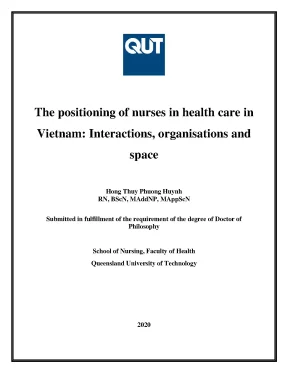
Tổng quan về luận án
Luận án tiến sĩ "The positioning of nurses in health care in Vietnam: Interactions, organisations and space" của tác giả Hong Thuy Phuong Huynh (2020) bảo vệ tại Đại học Công nghệ Queensland (Queensland University of Technology - QUT) dưới sự hướng dẫn của Phó Giáo sư Carol Windsor và Phó Giáo sư Karen Theobald, là công trình tiên phong giải cấu trúc vị thế xã hội và thực hành nghề nghiệp của điều dưỡng viên tại Việt Nam dưới lăng kính xã hội học tương tác và không gian học. Nghiên cứu khai thác bối cảnh cải cách sâu rộng của hệ thống y tế (Vietnamese Health System - VHS) và giáo dục đại học (Vietnamese Higher Education - VHE) thời kỳ hậu Đổi Mới (1986), tiêu biểu là các chính sách phi tập trung hóa (decentralisation) và xã hội hóa (socialisation) theo Nghị quyết 14/2005/NQ-CP và Luật Giáo dục Đại học số 08/2012/QH13.
Research gap cốt lõi được định vị từ sự đứt gãy (disjuncture) sâu sắc giữa việc chuẩn hóa đào tạo đại học theo khung năng lực quốc tế và thực tế thực hành lâm sàng bị hạn chế. Mặc dù Bộ Y tế (MOH) đã ban hành Chuẩn năng lực cơ bản của Điều dưỡng Việt Nam (Quyết định 1352/QD-BYT, 2012) với Tiêu chuẩn 9 nhấn mạnh năng lực đánh giá người bệnh (patient assessment), các nghiên cứu quốc tế chỉ ra rằng điều dưỡng chỉ áp dụng khoảng 30% kỹ năng thăm khám được đào tạo vào lâm sàng (Birks et al., 2013; Giddens & Eddy, 2009). Chưa có công trình nào tại Việt Nam giải thích cơ chế tương tác vi mô và cấu trúc vĩ mô định hình sự hạn chế này.
Hệ thống câu hỏi nghiên cứu và giả thuyết định hướng được xác lập:
- Câu hỏi 1 (RQ1): Điều dưỡng viên Đăng ký (Registered Nurses - RNs) tại Việt Nam nhận thức và trải nghiệm việc đánh giá thể chất người bệnh trên lâm sàng như thế nào?
- Câu hỏi 2 (RQ2): Quá trình thương lượng (negotiation) và trung gian hóa (mediation) giữa điều dưỡng với bác sĩ, người nhà bệnh nhân và hệ thống quản lý diễn ra ra sao để định hình trật tự thực hành?
- Câu hỏi 3 (RQ3): Chiều kích không gian (vật chất và biểu tượng) định hình quyền tự chủ chuyên môn của điều dưỡng như thế nào?
- Câu hỏi 4 (RQ4): Những mâu thuẫn chính sách vĩ mô giữa Bộ Y tế và Bộ Giáo dục & Đào tạo (MOET) tác động thế nào đến sự phát triển của ngành điều dưỡng?
- Câu hỏi 5 (RQ5): Bối cảnh lịch sử chiến tranh và văn hóa Nho giáo gia trưởng (Confucianism) tái sản xuất vị thế phụ thuộc của người điều dưỡng ra sao?
Khung lý thuyết của luận án tích hợp Thuyết Tương tác Biểu trưng (Symbolic Interactionism - SI), Thuyết Trật tự Thương lượng (Negotiated Order Theory) của Anselm Strauss, Lý thuyết Trình diễn Xã hội của Erving Goffman, và Lý thuyết Không gian Xã hội của David Harvey và Pierre Bourdieu. Phạm vi nghiên cứu bao gồm mẫu chủ đích gồm 29 điều dưỡng viên công tác tại 8 khoa lâm sàng thuộc Bệnh viện Chợ Rẫy (bệnh viện hạng Đặc biệt tuyến Trung ương) kết hợp phân tích văn bản quy phạm pháp luật quốc gia, tạo ra đột phá học thuật trong việc vạch trần các nghịch lý cấu trúc đè nặng lên lực lượng gồm 141.494 điều dưỡng (năm 2011, dự kiến đạt 225.345 vào năm 2020 theo Quyết định 2992/QD-BYT).
+-------------------------------------------------------------------------------+
|                       KHUNG ĐỊNH VỊ VỊ THẾ ĐIỀU DƯỠNG                          |
+-------------------------------------------------------------------------------+
|  VĨ MÔ (Macro Structure)                                                      |
|  - Di sản Nho giáo & Lịch sử Y học Thời chiến                                |
|  - Xung đột Chính sách Thể chế: Bộ Y tế (Nhiệm vụ) vs Bộ GD&ĐT (Năng lực)     |
|  - Cơ chế Tiền lương & Định ngạch (Thông tư Liên tịch 26/2015/TTLT-BYT-BNV)   |
+---------------------------------------+---------------------------------------+
                                        |
                                        v
+---------------------------------------+---------------------------------------+
|  TRUNG MÔ (Meso - Negotiated Order)                                           |
|  - Trật tự Thương lượng tại Khoa phòng Bệnh viện Hạng Đặc biệt                |
|  - Ranh giới Chuyên môn Thẩm thấu (Permeable Boundaries) với Bác sĩ           |
|  - Sự thâm nhập của Người nhà Bệnh nhân vào Không gian Chăm sóc               |
+---------------------------------------+---------------------------------------+
                                        |
                                        v
+---------------------------------------+---------------------------------------+
|  VI MÔ (Micro - Social Performance & Space)                                   |
|  - Nội tâm hóa Vị thế Phụ thuộc (Internalising Subordination)                |
|  - Không gian Vật chất vs Không gian Biểu tượng (Harvey & Bourdieu)           |
|  - Vùng Tự do Thực hành Lâm sàng & Trực giác Điều dưỡng                       |
+-------------------------------------------------------------------------------+
Literature Review và Positioning
Tổng quan y văn quốc tế về đánh giá người bệnh và nhận diện sớm suy giảm lâm sàng (clinical deterioration) cho thấy năng lực thăm khám của điều dưỡng là tiền đề sinh tử cho an toàn người bệnh (Cooper et al., 2010; Kyriacos, Jelsma & Jordan, 2011). Nghiên cứu hồi cứu 1.000 hồ sơ tử vong tại 10 bệnh viện ở Anh của Hogan et al. (2012) chứng minh 29.7% các ca tử vong có thể phòng ngừa xuất phát trực tiếp từ sự chậm trễ hoặc thất bại trong khâu đánh giá lâm sàng. Các báo cáo của NCEPOD (2005, 2012) và Ủy ban An toàn & Chất lượng Y tế Úc (ACSQH, 2010) thiết lập các chuẩn mực như Hệ thống Phản ứng Nhanh (RRS) và Thang Cảnh báo Sớm (Early Warning Scores - EWS). Tuy nhiên, y văn bộc lộ hai luồng tranh luận đối lập sâu sắc:
+-------------------------------------------------------------------------------+
|                         TRANH LUẬN Y VĂN QUỐC TẾ                              |
+-------------------------------------------------------------------------------+
|  LUỒNG 1: QUAN ĐIỂM CHUẨN HÓA KỸ THUẬT (Technocratic/Positivist)              |
|  - Coi việc đánh giá là tập hợp kỹ năng đo lường dấu hiệu sinh tồn.           |
|  - Thúc đẩy chuẩn hóa công cụ: EWS, RRS, ITPA (Fennessey & Wittmann-Price,    |
|    2011; Pimentel et al., 2013).                                              |
|  - Giả định rằng đào tạo kỹ năng sẽ tự động chuyển giao vào thực hành.        |
+---------------------------------------+---------------------------------------+
                                        | Đối kháng
                                        v
+---------------------------------------+---------------------------------------+
|  LUỒNG 2: QUAN ĐIỂM XÃ HỘI HỌC CẤU TRÚC (Sociological/Structuralist)          |
|  - Đánh giá lâm sàng bị triệt tiêu bởi ranh giới quyền lực y khoa.            |
|  - Bác sĩ duy trì quyền thống trị, coi điều dưỡng là "người giúp việc"       |
|    (handmaiden role) (Churchman & Doherty, 2010; Johnson & Kring, 2012).      |
|  - Tự chủ điều dưỡng bị xói mòn trong môi trường thứ bậc (Traynor et al.,    |
|    2010; Papathanassoglou et al., 2012).                                      |
+-------------------------------------------------------------------------------+
So sánh quốc tế làm nổi bật khoảng trống nghiên cứu:
- Tại Hoa Kỳ: Giddens (2007) và Giddens & Eddy (2009) khẳng định điều dưỡng chỉ thực hiện thường quy một nhóm nhỏ kỹ năng khám thực thể cơ bản dù được đào tạo toàn diện.
- Tại Úc: Birks et al. (2013) khảo sát 1.220 RNs và Osborne et al. (2015) khảo sát 434 RNs/nữ hộ sinh tại Queensland kết luận các rào cản liên chuyên khoa khiến điều dưỡng tự giới hạn việc thăm khám trong phạm vi 4 dấu hiệu sinh tồn cốt lõi.
- Tại Anh & xứ Wales: Edmunds, Ward & Barnes (2010) ghi nhận điều dưỡng chuyên khoa tim mạch phải có "sự cho phép của đồng nghiệp y khoa" mới được thực hiện đánh giá thực thể.
- Tại các nước đang phát triển (Iran, Singapore): Adib-Hajbaghery & Safa (2013) và Chua et al. (2013) ghi nhận điều dưỡng thực hiện kỹ năng dưới chuẩn do thiếu thẩm quyền và phụ thuộc nhận dạng mẫu trực giác.
Luận án này định vị học thuật vượt qua các cách tiếp cận kỹ trị thuần túy bằng cách thiết lập một khung phân tích phản tư phê phán (critical-reflexive), lần đầu tiên phân tích sự định vị của điều dưỡng tại một quốc gia Đông Nam Á quá độ kinh tế, nơi các cấu trúc Nho giáo ngàn năm đan xen với cơ chế quản lý tập trung thời hậu chiến và áp lực kinh tế thị trường định hướng xã hội chủ nghĩa.
Đóng góp lý thuyết và khung phân tích
Đóng góp cho lý thuyết
Luận án tạo ra bước chuyển hệ hình (paradigm shift) khi phê phán việc áp đặt các mô hình điều dưỡng phương Tây nguyên bản vào bối cảnh các nước chuyển đổi, đồng thời mở rộng và chất vấn các lý thuyết nền tảng:
- Mở rộng Thuyết Tương tác Biểu trưng (George Herbert Mead, 1934; Herbert Blumer, 1969): Chứng minh rằng "hành động xã hội" (social performance) của điều dưỡng không chỉ được hình thành qua cử chỉ (gestures) và biểu tượng ý nghĩa (significant symbols) trong tương tác trực tiếp, mà còn bị chi phối bởi các biểu tượng quyền lực lịch sử (Confucian patriarchal symbols) được tích hợp vào căn tính nghề nghiệp.
- Phát triển Thuyết Trật tự Thương lượng (Anselm Strauss, 1978): Khái niệm hóa "ranh giới chuyên môn thẩm thấu" (permeable professional boundaries). Trong bệnh viện Việt Nam, trật tự không phải là bất biến mà là sản phẩm của các cuộc vi thương lượng (micro-negotiations) liên tục giữa điều dưỡng, bác sĩ điều trị và người nhà bệnh nhân.
- Tích hợp Lý thuyết Không gian và Quyền lực Biểu trưng (David Harvey, 2006; Pierre Bourdieu, 1989): Luận chứng rằng không gian lâm sàng không thuần túy là không gian vật lý (material space) mà là một cấu trúc xã hội - biểu tượng (symbolic space). Quyền tự chủ của điều dưỡng chỉ xuất hiện tại những "vùng không gian giải phóng" tạm thời khi vắng mặt bóng dáng của bác sĩ hoặc hệ thống giám sát hành chính.
Hệ thống mệnh đề lý thuyết (Theoretical Propositions) được xác lập:
- Mệnh đề P1: Mức độ tự chủ trong đánh giá lâm sàng của điều dưỡng tỷ lệ nghịch với mật độ xuất hiện của bác sĩ trong không gian vật lý của buồng bệnh.
- Mệnh đề P2: Thực hành điều dưỡng tại Việt Nam là một quá trình nội tâm hóa tính phục tùng, được che đậy dưới hình thức thích ứng chiến lược để duy trì trật tự làm việc tập thể.
- Mệnh đề P3: Sự phân mảnh thể chế giữa cơ quan quản lý đào tạo (MOET) và cơ quan quản lý lao động (MOH) tạo ra trạng thái "lưỡng phân vai trò", làm vô hiệu hóa các chuẩn năng lực tiên tiến trên lâm sàng.
- Mệnh đề P4: Không gian chăm sóc tại bệnh viện công lập Việt Nam là một không gian tam giác chia sẻ quyền lực bắt buộc giữa Điều dưỡng - Thầy thuốc - Thân nhân người bệnh.
+-------------------------------------------------------------------------------+
|                       MÔ HÌNH LÝ THUYẾT ĐA CHIỀU (3S)                         |
|             (Self-Identity, Structural Order, Spatial Practice)               |
+-------------------------------------------------------------------------------+
|  1. CĂN TÍNH NỘI TÂM HÓA (Internalised Self)                                  |
|     (Mead, Blumer, Goffman)                                                   |
|     - Trực giác lâm sàng vô hình hóa                                          |
|     - Thấu cảm và sự thỏa hiệp trước quyền uy y khoa                          |
+---------------------------------------+---------------------------------------+
                                        | Tương tác
                                        v
+---------------------------------------+---------------------------------------+
|  2. TRẬT TỰ THƯƠNG LƯỢNG THỂ CHẾ (Institutional Negotiated Order)             |
|     (Strauss)                                                                 |
|     - Ranh giới chuyên môn thẩm thấu (Permeable boundaries)                   |
|     - Vi thương lượng duy trì cân bằng chức năng                              |
+---------------------------------------+---------------------------------------+
                                        | Định hình
                                        v
+---------------------------------------+---------------------------------------+
|  3. KHÔNG GIAN XÃ HỘI & QUYỀN LỰC BIỂU TƯỢNG (Social Space & Symbolic Power)  |
|     (Harvey, Bourdieu)                                                        |
|     - Không gian vật chất (Trạm điều dưỡng, Giường bệnh)                      |
|     - Không gian biểu tượng (Uy quyền phân cấp, Vùng tự do thực hành)          |
+-------------------------------------------------------------------------------+
Khung phân tích độc đáo
Khung phân tích của luận án tích hợp bốn trường phái lý thuyết: Chủ nghĩa thực dụng (Pragmatism: Charles S. Peirce, William James, John Dewey), Tương tác biểu trưng (SI), Trật tự thương lượng (Strauss) và Lý thuyết Không gian xã hội (Harvey). Cách tiếp cận này phá vỡ thế lưỡng phân giữa cấu trúc (structure) và tác nhân (agency).
Điều kiện biên (Boundary conditions): Khung phân tích này áp dụng tối ưu cho các bệnh viện công lập tuyến cuối tại các nền kinh tế đang phát triển hoặc chuyển đổi chính trị - xã hội, nơi hệ thống y tế chịu áp lực quá tải nghiêm trọng, chế độ đãi ngộ viên chức theo ngạch bậc hành chính, và cấu trúc văn hóa truyền thống đề cao thứ bậc gia trưởng vẫn chi phối sâu sắc môi trường làm việc chuyên môn.
Phương pháp nghiên cứu tiên tiến
Thiết kế nghiên cứu
Luận án tuân thủ triết học kiến tạo - diễn giải (constructivist-interpretivist paradigm) bắt nguồn từ truyền thống thực dụng luận (pragmatist tradition). Thiết kế nghiên cứu vận dụng phương pháp Lý thuyết Kiến tạo từ Dữ liệu (Constructivist Grounded Theory) của Kathy Charmaz (2014) kết hợp với Phương pháp luận Phản tư (Reflexive Methodology) đa tầng của Mats Alvesson và Kaj Sköldberg (2009).
+-------------------------------------------------------------------------------+
|                    TIẾN TRÌNH PHƯƠNG PHÁP NGHIÊN CỨU                          |
+-------------------------------------------------------------------------------+
|  TRIẾT HỌC THỰC DỤNG LUẬN & KIẾN TẠO XÃ HỘI (Pragmatism & Constructivism)     |
+---------------------------------------+---------------------------------------+
                                        |
                                        v
+---------------------------------------+---------------------------------------+
|  PHƯƠNG PHÁP THU THẬP ĐA NGUỒN (Triangulation of Data Generation)             |
|  - 29 Phỏng vấn bán cấu trúc sâu (Semi-structured in-depth interviews)        |
|  - Hàng trăm giờ Quan sát thực địa (Field observations across 8 departments)  |
|  - Tổng hợp 25+ Văn bản chính sách (MOH, MOET, MOHA, VNA 1993-2018)           |
+---------------------------------------+---------------------------------------+
                                        |
                                        v
+---------------------------------------+---------------------------------------+
|  PHÂN TÍCH DỮ LIỆU LIÊN TỤC (Iterative Analysis - Charmaz, 2014)              |
|  - Mã hóa ban đầu (Initial Coding) -> Mã hóa tập trung (Focused Coding)       |
|  - Viết bản ghi nhớ lý thuyết (Theoretical Memo-writing)                      |
|  - Lấy mẫu lý thuyết (Theoretical Sampling) -> Bão hòa lý thuyết              |
+---------------------------------------+---------------------------------------+
                                        |
                                        v
+---------------------------------------+---------------------------------------+
|  PHẢN TƯ ĐA TẦNG (Reflexive Methodology - Alvesson & Sköldberg, 2009)         |
|  - Tương tác vị thế Trong cuộc - Ngoài cuộc (Insider/Outsider Positionality)   |
|  - Giải cấu trúc quyền lực biểu tượng & Ngôn ngữ chính sách                   |
+-------------------------------------------------------------------------------+
Cỡ mẫu và tiêu chí lựa chọn được xác định chính xác thông qua chiến lược chọn mẫu mục đích (purposeful sampling) và lấy mẫu lý thuyết (theoretical sampling):
- Quy mô: 29 Điều dưỡng viên Đăng ký (RNs).
- Địa bàn: 8 khoa phòng lâm sàng đa dạng (Hồi sức tích cực - ICU, Nội khoa, Ngoại khoa, Cấp cứu, Tim mạch, v.v.) tại một bệnh viện đa khoa hạng Đặc biệt quy mô hơn 2.000 giường tại Thành phố Hồ Chí Minh.
- Tiêu chuẩn lựa chọn: Điều dưỡng có chứng chỉ hành nghề theo Thông tư 14/2011/TT-BYT, tối thiểu 9 tháng thực hành lâm sàng trực tiếp, trải rộng các bậc học vấn: Cử nhân Điều dưỡng (4 năm), Cao đẳng (3 năm), và Trung cấp (2 năm).
Quy trình nghiên cứu rigorous
-
Giao thức thu thập dữ liệu (Data Collection Protocols):
- Phỏng vấn bán cấu trúc: 29 cuộc phỏng vấn sâu cá nhân, ghi âm trực tiếp và chuyển biên từng chữ (verbatim transcription).
- Quan sát thực địa: Quan sát không tham dự và tham dự bán phần tại các trạm điều dưỡng, buồng bệnh nhân, phòng giao ban và hành lang; ghi chép nhật ký thực địa theo biểu mẫu chuẩn hóa (Field notes template).
- Phân tích tài liệu thể chế: Phân tích hệ thống chính sách gồm Luật Khám bệnh, chữa bệnh, Luật Giáo dục Đại học, các Thông tư Liên tịch (TTLT 26/2015/TTLT-BYT-BNV), Chuẩn năng lực điều dưỡng (Quyết định 1352/QĐ-BYT) và chương trình khung Cử nhân Điều dưỡng.
-
Tam giác giác hóa (Triangulation) & Độ tin cậy (Trustworthiness):
- Data triangulation: Kết hợp lời kể phỏng vấn, hành vi quan sát thực tế và văn bản quy phạm pháp luật.
- Investigator & Reflexive rigor: Tác giả đảm nhận vai trò kép "người trong cuộc" (giảng viên điều dưỡng, RN) và "người ngoài cuộc" (nghiên cứu sinh tiến sĩ tại Úc). Áp dụng nguyên lý của Rose (1985, p. 77): "There is no neutrality. There is only greater or less awareness of one’s bias" và chiến lược của Alvesson & Kärreman (2011, p. 18) xem nghiên cứu là quá trình giải mã điều bí ẩn thay vì "a narrow way of seeing that determines the results a priori".
- Đạo đức nghiên cứu: Phê duyệt đạo đức kép từ Hội đồng Đạo đức Đại học Y Dược TP.HCM (Phụ lục D) và Hội đồng Đạo đức QUT (Research Ethics Integrity and Safety - REIS).
Data và phân tích
Phân tích dữ liệu diễn ra theo quy trình quy nạp trừu tượng hóa khái niệm có hệ thống (systematic abstraction of theoretical concepts):
- Giai đoạn 1: Mã hóa dòng theo dòng (Line-by-line coding) nhằm phát hiện các hành động vi mô và sự thỏa hiệp.
- Giai đoạn 2: Mã hóa tập trung (Focused coding) phân loại các chủ đề nổi bật về ranh giới, quyền lực, sự can thiệp của người nhà và xung đột nhiệm vụ.
- Giai đoạn 3: Viết bản ghi nhớ lý thuyết (Memo-writing) liên tục đối chiếu dữ liệu để đạt ngưỡng bão hòa lý thuyết (theoretical saturation).
- Trích xuất 3 phạm trù lý thuyết cốt lõi phản ánh tính biện chứng giữa Tác nhân và Cấu trúc: Internalising nursing practice (Chương 5), Institutionalising nursing practice (Chương 6), và Social space of nursing practice (Chương 7).
Phát hiện đột phá và implications
Những phát hiện then chốt
+-------------------------------------------------------------------------------+
|                      BỐN PHÁT HIỆN ĐỘT PHÁ CỦA LUẬN ÁN                        |
+-------------------------------------------------------------------------------+
|  PHÁT HIỆN 1: NỘI TÂM HÓA VỊ THẾ PHỤ THUỘC (Internalising Subordination)      |
|  - Điều dưỡng tự hạn chế khám thực thể do áp lực vai trò "phụ tá y tế".      |
|  - Trực giác lâm sàng bị vô hình hóa, không được diễn đạt thành thuật ngữ.     |
+---------------------------------------+---------------------------------------+
                                        |
                                        v
+---------------------------------------+---------------------------------------+
|  PHÁT HIỆN 2: RANH GIỚI THẨM THẤU & TRẬT TỰ THƯƠNG LƯỢNG                      |
|  - Ranh giới giữa Bác sĩ và Điều dưỡng co giãn tùy theo ca trực và áp lực.    |
|  - Sự can thiệp của thân nhân bệnh nhân vừa là gánh nặng vừa là kênh đàm phán.|
+---------------------------------------+---------------------------------------+
                                        |
                                        v
+---------------------------------------+---------------------------------------+
|  PHÁT HIỆN 3: ĐỘNG LỰC HỌC KHÔNG GIAN (Spatial Dynamics of Autonomy)          |
|  - Trạm điều dưỡng: Không gian bị giám sát, hành chính hóa.                   |
|  - Đầu giường bệnh (vắng bác sĩ): Không gian tự do thực hành thực chất.       |
+---------------------------------------+---------------------------------------+
                                        |
                                        v
+---------------------------------------+---------------------------------------+
|  PHÁT HIỆN 4: NGHỊCH LÝ CHÍNH SÁCH VĨ MÔ (Macro Policy Disjuncture)           |
|  - Đào tạo chuẩn hóa (MOET) >< Bổ nhiệm theo danh mục đầu việc (MOH/MOHA).    |
|  - Hệ số lương bất bình đẳng kìm hãm động lực học tập nâng cao trình độ.      |
+-------------------------------------------------------------------------------+
- Sự nội tâm hóa vị thế phụ thuộc (Internalising nursing practice): Dữ liệu chỉ ra rằng điều dưỡng viên tự nguyện tiếp nhận các chuẩn mực lệ thuộc vào y lệnh y khoa như một cơ chế tự vệ tâm lý và bảo đảm an toàn nghề nghiệp. Dù được đào tạo kỹ năng khám toàn diện từ đầu đến chân (head-to-toe assessment), họ chủ động thu hẹp vai trò của mình vào việc đo sinh hiệu đơn thuần, chuyển hóa tri thức trực giác lâm sàng phong phú thành trạng thái ẩn tàng không được văn bản hóa.
- Ranh giới chuyên môn thẩm thấu và trật tự thương lượng lâm sàng (Institutionalising nursing practice): Khác với các bệnh viện phương Tây nơi ranh giới pháp lý được phân định nghiêm ngặt, ranh giới chuyên môn tại bệnh viện Việt Nam có tính "thẩm thấu" (permeable). Điều dưỡng liên tục thực hiện các vi thương lượng với bác sĩ để bù đắp các khoảng trống chăm sóc trong điều kiện quá tải, đồng thời thương lượng với thân nhân người bệnh – những người thực hiện tới 70% các hoạt động chăm sóc cơ bản (Jones et al., 2000).
- Tính phân mảnh không gian và quyền tự do hành nghề (Spatiality of nursing): Khám phá mang tính đột phá chỉ ra rằng quyền tự chủ của điều dưỡng dịch chuyển linh hoạt theo vị trí vật lý và biểu tượng. Tại trạm điều dưỡng (nơi tập trung hồ sơ bệnh án và sự giám sát của lãnh đạo khoa/bác sĩ), điều dưỡng thể hiện vai trò thừa hành tuân phục; tại đầu giường bệnh nhân khi vắng mặt bác sĩ, họ trở thành những người ra quyết định lâm sàng độc lập và linh hoạt xử trí các diễn biến bất thường.
- Nghịch lý cấu trúc và xung đột lợi ích vĩ mô: Luận án bóc tách sự mâu thuẫn giữa hai dòng chính sách nhà nước: Một mặt, MOET và các dự án quốc tế (như Atlantic Philanthropy, HPET) thúc đẩy chương trình đào tạo Cử nhân Điều dưỡng dựa trên chuẩn năng lực quốc tế; mặt khác, Thông tư Liên tịch 26/2015/TTLT-BYT-BNV và Nghị định 27/2016/QH14 của MOH/MOHA vẫn duy trì cơ chế phân loại công việc theo danh mục thủ thuật và bảng lương theo ngạch bậc hành chính cào bằng:
- Hệ số lương khởi điểm Cử nhân (Hạng III) chỉ là 2.34 (sau tăng lên 2.65), tương đương mức lương tối thiểu 3.252.600 VND/tháng năm 2018.
- Bậc Thạc sĩ (Hạng II) khởi điểm 4.40 (tăng lên 4.78), trong khi chênh lệch thu nhập thực tế không bù đắp được chi phí đào tạo.
- Định nghĩa của VNA (1997) dịch bởi Jones et al. (2000, p. 318) coi điều dưỡng là: "a profession which is a science and art and humanistic giving of holistic care to people to prevent illness, maintain and promote health, and provide rehabilitation for individuals, families, and communities", nhưng trên thực tế 70% điều dưỡng bệnh viện chỉ thực hiện chức năng chăm sóc thừa hành đơn thuần.
Implications đa chiều
- Đóng góp lý thuyết: Cung cấp mô hình phân tích đa tầng (Micro - Meso - Macro) giải thích sự định vị nghề nghiệp trong các nền y tế đang chuyển đổi, đóng góp trực tiếp vào xã hội học y tế và lý thuyết nghề nghiệp (sociology of professions).
- Đổi mới phương pháp luận: Thiết lập chuẩn mực nghiên cứu phản tư (reflexivity) cho các nhà nghiên cứu bản địa khi tiếp cận các chủ đề nhạy cảm về quyền lực và thứ bậc trong tổ chức y tế công.
- Ứng dụng thực tiễn: Cung cấp cơ sở khoa học để thiết kế lại quy trình bàn giao lâm sàng, thiết lập các biểu mẫu thẩm định tình trạng người bệnh độc lập cho điều dưỡng thay vì chỉ ghi chép theo y lệnh.
- Khuyến nghị chính sách:
- Thống nhất cơ quan chủ quản xây dựng chuẩn chức danh nghề nghiệp giữa Bộ Y tế và Bộ Nội vụ, công nhận thẩm quyền khám lâm sàng độc lập của Cử nhân Điều dưỡng.
- Bãi bỏ hoàn toàn hệ thống đào tạo trung cấp y tế (2 năm), thực thi lộ trình chuẩn hóa trình độ cao đẳng/đại học theo cam kết Thỏa thuận Khung ASEAN về Dịch vụ Điều dưỡng (MRANS).
- Cải cách thang bảng lương y tế, gắn bậc lương với danh mục năng lực chuyên môn thay vì thâm niên hành chính thuần túy.
Limitations và Future Research
Luận án thừa nhận một cách khách quan các giới hạn nghiên cứu:
- Bối cảnh nghiên cứu đơn trung tâm: Dữ liệu định tính được thu thập chủ yếu tại một bệnh viện đa khoa hạng Đặc biệt tuyến Trung ương tại miền Nam Việt Nam (Bệnh viện Chợ Rẫy), do đó các sắc thái văn hóa - tổ chức tại các bệnh viện tuyến huyện (DHC), trạm y tế xã (CHS) hoặc các bệnh viện phía Bắc chưa được bao quát toàn diện.
- Thiếu vắng dữ liệu định lượng dọc: Nghiên cứu chưa đo lường tác động trực tiếp của các kiểu thương lượng lâm sàng đối với các chỉ số kết cục người bệnh (như tỷ lệ tử vong, thời gian nằm viện, tỷ lệ biến cố bất lợi).
- Giới hạn góc nhìn đa bên: Trọng tâm nghiên cứu tập trung vào trải nghiệm của điều dưỡng; tiếng nói của bác sĩ, nhà quản lý bệnh viện và thân nhân bệnh nhân chỉ được phản ánh gián tiếp qua lăng kính tương tác của điều dưỡng.
Chương trình nghiên cứu 5-10 năm tới:
- Hướng 1: Mở rộng khảo sát định lượng quy mô quốc gia (National Survey) kiểm định mô hình cấu trúc (SEM) về mối quan hệ giữa Nhận thức ranh giới quyền lực, Không gian thực hành và Năng lực ra quyết định lâm sàng của điều dưỡng.
- Hướng 2: Nghiên cứu so sánh xuyên quốc gia (Cross-national comparative study) giữa các nước trong khối ASEAN (Việt Nam, Thái Lan, Philippines, Indonesia) trong việc thực thi Thỏa thuận công nhận lẫn nhau về dịch vụ điều dưỡng (MRANS).
- Hướng 3: Đánh giá thực nghiệm hiệu quả triển khai mô hình Điều dưỡng chuyên khoa sâu (Nurse Practitioner - NP) và Hệ thống Cảnh báo Sớm (EWS) thích ứng với điều kiện bệnh viện công lập quá tải tại Việt Nam.
- Hướng 4: Nghiên cứu xã hội học giới chuyên sâu về sự giao thoa giữa cấu trúc gia trưởng Nho giáo, tính nữ và sự định giá thấp của xã hội đối với lao động chăm sóc y tế.
Tác động và ảnh hưởng
+-------------------------------------------------------------------------------+
|                       TÁC ĐỘNG VÀ TẦM ẢNH HƯỞNG                               |
+-------------------------------------------------------------------------------+
|  VIỆN HÀN LÂM (Academia)                                                      |
|  - Khung tham chiếu cho các luận án tiến sĩ về Xã hội học Y tế Đông Nam Á.    |
|  - Mở ra hướng nghiên cứu không gian học trong môi trường lâm sàng.           |
+---------------------------------------+---------------------------------------+
                                        |
                                        v
+---------------------------------------+---------------------------------------+
|  HỆ THỐNG Y TẾ & BỆNH VIỆN (Clinical Systems)                                 |
|  - Tái cấu trúc quy trình phân định nhiệm vụ Bác sĩ - Điều dưỡng.             |
|  - Thừa nhận vai trò của Thân nhân Bệnh nhân trong quy trình chăm sóc.        |
+---------------------------------------+---------------------------------------+
                                        |
                                        v
+---------------------------------------+---------------------------------------+
|  CHÍNH SÁCH QUỐC GIA & QUỐC TẾ (Policy & Global Integration)                   |
|  - Cung cấp luận cứ sửa đổi Chuẩn năng lực Điều dưỡng Quốc gia.               |
|  - Hỗ trợ tiến trình hội nhập Khung năng lực Điều dưỡng ASEAN (MRANS).        |
+-------------------------------------------------------------------------------+
Công trình của Huynh (2020) tạo ra ảnh hưởng học thuật sâu rộng:
- Ảnh hưởng học thuật: Thiết lập một khung diễn giải kinh điển về sự tương tác giữa cấu trúc vĩ mô và hành động vi mô trong điều dưỡng, ước tính trở thành tài liệu trích dẫn nền tảng cho các nghiên cứu về nhân lực y tế tại các thị trường mới nổi.
- Chuyển đổi thực tiễn lâm sàng: Cung cấp bằng chứng cho các giám đốc bệnh viện và trưởng phòng điều dưỡng tái cấu trúc quy trình làm việc, thiết lập các không gian giao tiếp lâm sàng an toàn nhằm giảm thiểu sai sót y khoa.
- Tác động chính sách cấp Bộ: Đóng góp cơ sở thực chứng trực tiếp cho Bộ Y tế, Hội Điều dưỡng Việt Nam (VNA) trong quá trình sửa đổi Luật Khám bệnh, chữa bệnh và xây dựng Đề án phát triển nguồn nhân lực y tế giai đoạn 2021-2030.
- Giá trị xã hội và quốc tế: Nâng cao nhận thức cộng đồng về giá trị khoa học độc lập của nghề điều dưỡng, thúc đẩy bình đẳng giới và giải phóng lao động chăm sóc khỏi định kiến phụ tá y khoa truyền thống.
Đối tượng hưởng lợi
+-------------------------------------------------------------------------------+
|                       ĐỐI TƯỢNG HƯỞNG LỢI TRỰC TIẾP                           |
+-------------------------------------------------------------------------------+
|  1. NGHIÊN CỨU SINH & HỌC GIẢ (Doctoral Researchers & Academics)              |
|     - Tiếp cận phương pháp Grounded Theory kiến tạo & Phản tư đa tầng.        |
|     - Khai thác nguồn tài liệu lý thuyết tích hợp SI, Strauss, Harvey.        |
+-------------------------------------------------------------------------------+
|  2. NHÀ QUẢN LÝ BỆNH VIỆN & TRƯỞNG KHOA (Hospital Administrators)             |
|     - Nhận diện các điểm nghẽn trong quan hệ Bác sĩ - Điều dưỡng.             |
|     - Tối ưu hóa bố trí không gian vật lý buồng bệnh để tăng an toàn lâm sàng.|
+-------------------------------------------------------------------------------+
|  3. NHÀ LẬP PHÁP & HOẠCH ĐỊNH CHÍNH SÁCH (Policy Makers - MOH, MOET, MOHA)    |
|     - Bằng chứng khắc phục sự đứt gãy giữa đào tạo và sử dụng nhân lực.       |
|     - Cơ sở điều chỉnh chính sách tiền lương và ngạch bậc viên chức y tế.     |
+-------------------------------------------------------------------------------+
|  4. GIẢNG VIÊN & ĐIỀU DƯỠNG LÂM SÀNG (Nurse Educators & Clinical RNs)         |
|     - Điều chỉnh giáo trình Thăm khám Thể chất gắn liền với kỹ năng đàm phán. |
|     - Thấu hiểu vị thế để tự chủ hóa thực hành nghề nghiệp.                   |
+-------------------------------------------------------------------------------+
Câu hỏi chuyên sâu
1. Đóng góp lý thuyết độc đáo nhất của luận án là gì và đã mở rộng lý thuyết nào?
Đóng góp lý thuyết độc đáo nhất là việc phát triển khái niệm "Không gian xã hội của thực hành điều dưỡng" (Social space of nursing practice), tích hợp Thuyết Trật tự Thương lượng của Anselm Strauss với Lý thuyết Sản xuất Không gian của David Harvey và Quyền lực Biểu trưng của Pierre Bourdieu. Luận án chứng minh rằng quyền tự chủ nghề nghiệp không phải là một thuộc tính cá nhân cố định hay một thẩm quyền pháp lý bất biến, mà là một thực thể động được kiến tạo thông qua sự dịch chuyển không gian vật chất và không gian biểu tượng. Luận án mở rộng thuyết tương tác biểu trưng bằng cách chứng minh rằng các cấu trúc vĩ mô (văn hóa Nho giáo, thể chế tiền lương nhà nước) được tái tạo và duy trì thông qua các vi tương lượng thường nhật tại các không gian lâm sàng cụ thể.
2. Đổi mới phương pháp luận của luận án thể hiện như thế nào khi so sánh với các nghiên cứu trước đây?
So với các nghiên cứu định lượng mô tả thuần túy trước đây tại Hoa Kỳ (Giddens, 2007; Osborne et al., 2015) vốn chỉ dừng lại ở việc đo lường tần suất sử dụng kỹ năng khám, hoặc các nghiên cứu định tính mô tả hiện tượng đơn thuần (Edmunds et al., 2010), luận án này đổi mới phương pháp luận qua việc áp dụng Phương pháp luận phản tư đa tầng (Reflexive Methodology của Alvesson & Sköldberg, 2009) kết hợp với Lý thuyết Kiến tạo từ Dữ liệu (Charmaz, 2014). Tác giả khai thác vị thế kép của mình (vừa là giảng viên điều dưỡng vừa là RN) để liên tục di chuyển giữa góc nhìn "người trong cuộc" (insider) và "người ngoài cuộc" (outsider), thực hiện tam giác hóa giữa lời kể phỏng vấn, quan sát thực địa vi mô và giải cấu trúc các văn bản chính sách vĩ mô từ thời Đổi Mới.
3. Phát hiện bất ngờ nhất (counter-intuitive finding) có bằng chứng dữ liệu hỗ trợ là gì?
Phát hiện bất ngờ nhất là: Trình độ học vấn cao hơn (Cử nhân Điều dưỡng 4 năm) không đồng nghĩa với quyền tự chủ lâm sàng cao hơn tại bệnh viện. Trên thực tế, các cử nhân điều dưỡng lại trải qua mức độ thất vọng và xung đột vai trò gay gắt hơn so với điều dưỡng trung cấp. Dữ liệu văn bản chính sách chỉ ra rằng Thông tư Liên tịch 26/2015/TTLT-BYT-BNV áp dụng cùng một bản mô tả công việc dựa trên danh mục thủ thuật cho mọi cấp bậc điều dưỡng, trong khi bảng lương theo Nghị định 27/2016/QH14 quy định mức lương khởi điểm cử nhân (hệ số 2.34 - 2.65) hầu như không tạo ra sự khác biệt có ý nghĩa kinh tế so với điều dưỡng trung cấp (hệ số 1.26 - 2.06), dẫn đến việc triệt tiêu động lực thực hành các kỹ năng đánh giá phức tạp được đào tạo ở bậc đại học.
4. Luận án có cung cấp quy trình nhân rộng (Replication Protocol) hay không?
Có. Luận án cung cấp hệ thống phụ lục phương pháp luận chi tiết làm quy trình chuẩn cho việc tái lập nghiên cứu tại các bối cảnh tương đồng, bao gồm: Ma trận lấy mẫu mục đích (Bảng 4.1), Mẫu ghi chép quan sát thực địa chuẩn hóa (Bảng 4.3), Phân loại tài liệu tổng hợp (Bảng 4.4), Tiến trình ghi chép nhật ký thực địa và viết bản ghi nhớ lý thuyết (Bảng 4.5 & 4.8), Khung 4 cấp độ diễn giải phản tư (Bảng 4.7), Phiếu thông tin người tham gia và Bản câu hỏi phỏng vấn bán cấu trúc (Phụ lục E & F).
5. Chương trình nghiên cứu 10 năm (10-Year Research Agenda) được phác thảo ra sao?
Chương trình nghiên cứu 10 năm được định hình quanh ba trụ cột chiến lược:
- Nghiên cứu thể chế và chính sách (Năm 1-3): Đánh giá tác động của Luật Khám bệnh, chữa bệnh sửa đổi đối với việc phân định thẩm quyền kê đơn chăm sóc và đánh giá lâm sàng độc lập của điều dưỡng.
- Thử nghiệm can thiệp lâm sàng (Năm 4-6): Phát triển và thử nghiệm ngẫu nhiên có đối chứng (RCT) công cụ Đánh giá Người bệnh Tương tác Phù hợp (ITPA) và Thang điểm Cảnh báo Sớm (EWS) bản địa hóa tại các khoa Hồi sức tích cực và Cấp cứu tại Việt Nam.
- Nghiên cứu hội nhập khu vực và quốc tế (Năm 7-10): Nghiên cứu dọc theo dõi sự dịch chuyển lao động điều dưỡng Việt Nam trong khối ASEAN theo thỏa thuận MRANS, phân tích sự tái định vị căn tính nghề nghiệp của điều dưỡng Việt Nam trong môi trường y tế đa văn hóa toàn cầu.
Kết luận
Luận án tiến sĩ của Hong Thuy Phuong Huynh (2020) đóng góp 5 giá trị học thuật và thực tiễn cốt lõi:
- Xác lập công trình khoa học đầu tiên giải cấu trúc toàn diện vị thế và thực hành của điều dưỡng tại Việt Nam bằng phương pháp tiếp cận xã hội học phê phán và tương tác biểu trưng.
- Phát hiện và lý giải khoa học cơ chế đứt gãy sâu sắc giữa chương trình đào tạo chuẩn năng lực đại học (MOET) và thực tế thực hành bị hành chính hóa theo danh mục thủ thuật (MOH/MOHA).
- Đóng góp khung lý thuyết đột phá tích hợp Tương tác biểu trưng - Trật tự thương lượng - Không gian xã hội, cung cấp công cụ phân tích mới cho xã hội học nghề nghiệp y tế toàn cầu.
- Nhận diện vai trò mang tính cấu trúc của văn hóa Nho giáo gia trưởng và di sản y học thời chiến trong việc tái tạo tính phục tùng của điều dưỡng, đồng thời vạch ra các "vùng không gian tự do" nơi điều dưỡng thực thi quyền tự chủ lâm sàng thực chất.
- Cung cấp luận cứ khoa học chuẩn xác định hình các cải cách thể chế, từ chuẩn hóa chức danh nghề nghiệp, cải cách thang bảng lương, đến việc xây dựng lộ trình hội nhập điều dưỡng Việt Nam vào thị trường y tế quốc tế theo chuẩn ASEAN.