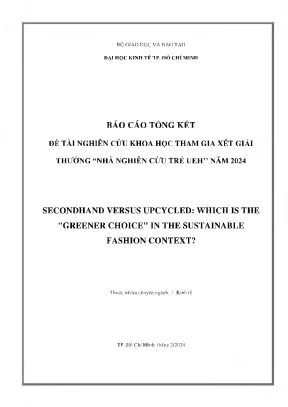
Secondhand so với Upcycled: Lựa chọn nào xanh hơn trong bối cảnh thời trang bền vững?

Secondhand hay upcycled lựa chọn nào xanh hơn trong thời trang bền vững? Khám phá ưu điểm, nhược điểm và tác động môi trường của từng phương pháp.

Chuyên ngành

Kinh tế

Người đăng

Ẩn danh

Thể loại

Báo cáo tổng kết đề tài nghiên cứu khoa học

2024

112
10
0

Phí lưu trữ

35 Point

Mục lục chi tiết

ABSTRACT

TABLE OF CONTENTS

LIST OF TABLES

LIST OF FIGURES

LIST OF ABBREVIATION

1. CHAPTER 1: INTRODUCTION

1.1. REASONS CHOOSE THE TOPIC

1.2. THE CONTRIBUTION OF THIS RESEARCH

2. CHAPTER 2: LITERATURE REVIEW AND HYPOTHESIS DEVELOPMENT

2.1. Value - Attitude - Behaviour Theory (VAB)

2.2. Motivators and Barriers for Buying Intention of Upcycled Fashion Products in China - Fe Yoo, Hye Jung Jung, and Kyung Wha Oh (2021)

2.3. Consumers’ Value and Risk Perceptions of Circular Fashion: Comparison between Secondhand, upcycled, and Recycled Clothing - Inhwa Kim, Hye Jung Jung and Yuri Lee (2021)

2.4. Perceived Consumption Value, Pro-Environmental Belief, Attitude, eWOM, and Purchase Intention Toward upcycling Fashion Products - Eunju Ko, Chun Eunha, Wei Jiang, Jihye Yu (2018)

2.5. Bridge the gap: Consumers' purchase intention and behavior regarding sustainable clothing - Theresa Maria Rausch, and Cristopher Siegfried Kopplin (2021)

3. CHAPTER III: RESEARCH METHODOLOGY

3.1. Measurement of Emotional Value (EV)

3.2. Measurement of Environmental Value (EVV)

3.3. Measurement of Aesthetic Risk (AR)

3.4. Measurement of Sanitary Risk (SR)

3.5. Measurement of Product Attitude (PA)

3.6. Measurement of Individualism (ID)

3.7. Measurement of E-WOM (EW)

3.8. Measurement of Purchase Intention (PI)

3.9. Measurement of Greenwashing Concern (GC)

4. CHAPTER IV: RESEARCH RESULTS

4.1. CHARACTERISTICS OF RESPONDENTS

4.2. DESCRIPTIVE MEASUREMENT RESULT

4.3. Outer loadings of observed variables

4.4. Reliability and Convergent Validity of Constructions

4.5. ASSESSMENT OF STRUCTURAL MODEL

4.6. Path coefficient and hypothesis testing

4.7. Second-hand clothing

4.8. DISCUSSION OF RESULTS

5. CHAPTER V: CONCLUSION AND RECOMMENDATION

5.1. LIMITATIONS AND FUTURE RESEARCH

APPENDIX 1: SURVEY QUESTIONNAIRE

APPENDIX 2: INSPECTING RESULTS

LIST OF TABLES

LIST OF FIGURES

LIST OF ABBREVIATION

Tóm tắt

I. Thời trang bền vững Tổng quan về Secondhand Upcycled

Ngành thời trang gây tác động đáng kể đến môi trường. Hàng năm, khoảng 100 tỷ sản phẩm may mặc được sản xuất, và 92 triệu tấn trong số đó kết thúc ở các bãi chôn lấp. Các vật liệu nhựa có nguồn gốc từ nhiên liệu hóa thạch, như polyester, chiếm gần 60% quần áo. Ngành dệt may là ngành công nghiệp gây ô nhiễm thứ hai, tạo ra 42 triệu tấn chất thải nhựa hàng năm. Khoảng 20% lượng nước thải trên thế giới đến từ ngành may mặc. Mỗi cá nhân sử dụng trung bình 11.4 kg quần áo mỗi năm, tương đương 442 kg CO2 thải ra. Trước những thách thức này, bảo vệ môi trường trở thành vấn đề toàn cầu. Trong ngành thời trang, xu hướng tiêu dùng bền vững hướng tới circular fashion đang nhận được nhiều sự quan tâm từ người tiêu dùng, đặc biệt là các sản phẩm secondhand clothingupcycled clothing.

1.1. Ảnh hưởng của Fast Fashion đến Môi Trường Xã Hội

Sự phát triển của fast fashion đã làm gia tăng đáng kể lượng textile waste và gây ra những hệ lụy tiêu cực đến environmental sustainability. Việc sản xuất hàng loạt quần áo giá rẻ, chất lượng kém dẫn đến vòng đời sản phẩm ngắn, khuyến khích tiêu dùng quá mức và tạo ra lượng lớn rác thải dệt may. Bên cạnh đó, quy trình sản xuất fast fashion thường sử dụng nhiều hóa chất độc hại, tiêu tốn nước và năng lượng, gây ô nhiễm môi trường nghiêm trọng. Đồng thời, điều kiện làm việc tồi tệ trong các nhà máy sản xuất fast fashion cũng là một vấn đề nhức nhối, vi phạm các nguyên tắc fashion ethics.

1.2. Sự Trỗi Dậy của Circular Fashion Kinh Tế Tuần Hoàn

Circular fashion là một mô hình kinh doanh mới, hướng đến việc kéo dài vòng đời của sản phẩm thời trang, giảm thiểu lãng phí và ô nhiễm. Mô hình này dựa trên các nguyên tắc của circular economy, bao gồm thiết kế sản phẩm bền vững, sử dụng recycled clothing hoặc upcycled clothing, khuyến khích tái sử dụng, sửa chữa và tái chế. Secondhand clothingupcycled clothing là hai hình thức phổ biến của circular fashion, góp phần giảm thiểu tác động tiêu cực đến môi trường.

II. Secondhand Upcycled Ưu điểm Thách thức cho Bền Vững

Secondhand clothing mang lại lợi ích rõ ràng trong việc giảm thiểu nhu cầu sản xuất quần áo mới, tiết kiệm tài nguyên và năng lượng. Thị trường secondhand market đang phát triển mạnh mẽ, đặc biệt được ưa chuộng bởi Gen Z. Tuy nhiên, secondhand clothing cũng có những thách thức như vấn đề vệ sinh, chất lượng và mẫu mã. Upcycled clothing, mặt khác, mang đến giải pháp sáng tạo bằng cách biến những sản phẩm cũ thành những thiết kế hoàn toàn mới. Tuy nhiên, upcycling techniques đòi hỏi kỹ năng, thời gian và có thể làm tăng giá thành sản phẩm. Cần cân nhắc kỹ lưỡng để lựa chọn secondhand hay upcycled phù hợp với nhu cầu và giá trị của bản thân, hướng đến sustainable fashion.

2.1. Ưu Điểm Vượt Trội của Secondhand Clothing trong Tiêu Dùng

Secondhand clothing giúp giảm lượng textile waste đổ ra các bãi rác, từ đó giảm thiểu ô nhiễm môi trường. Nó cũng giảm thiểu nhu cầu sản xuất quần áo mới, tiết kiệm tài nguyên thiên nhiên và năng lượng sử dụng trong quá trình sản xuất. Ngoài ra, used clothing thường có giá thành rẻ hơn so với quần áo mới, giúp người tiêu dùng tiết kiệm chi phí. Việc mua vintage clothing cũng là một cách để thể hiện phong cách cá nhân và tìm kiếm những món đồ độc đáo, không đụng hàng.

2.2. Giá Trị Gia Tăng từ Upcycled Clothing Tính Sáng Tạo Bền Vững

Upcycled clothing mang đến giải pháp sáng tạo và độc đáo cho việc tái chế quần áo cũ. Bằng cách sử dụng upcycling techniques, những sản phẩm cũ kỹ có thể được biến thành những thiết kế hoàn toàn mới, mang đậm tính cá nhân và phong cách riêng. Upcycled clothing không chỉ giúp giảm thiểu textile waste mà còn tạo ra những sản phẩm eco-friendly fashion có giá trị cao hơn, góp phần thúc đẩy conscious consumerism và thay đổi tư duy tiêu dùng của người dân.

2.3. Những Rào Cản Cần Vượt Qua Vệ Sinh Chất Lượng Quan Điểm Xã Hội

Mặc dù có nhiều ưu điểm, cả secondhand clothingupcycled clothing đều đối mặt với những thách thức nhất định. Vấn đề vệ sinh, chất lượng sản phẩm, và quan điểm xã hội là những rào cản cần vượt qua để thúc đẩy sự phát triển của thị trường circular fashion. Cần có những giải pháp để đảm bảo vệ sinh an toàn cho used clothing, nâng cao chất lượng sản phẩm upcycled clothing, và thay đổi nhận thức của người tiêu dùng về thời trang bền vững.

III. So sánh Carbon Footprint Secondhand Upcycled Lựa Chọn Xanh Hơn

Việc đánh giá environmental impact of fashion đòi hỏi sự so sánh chi tiết về carbon footprint of clothing giữa secondhand clothingupcycled clothing. Mặc dù cả hai đều góp phần giảm fashion waste reduction, quá trình sản xuất và vận chuyển upcycled clothing có thể tiêu thụ năng lượng. Nghiên cứu cần tập trung vào đánh giá toàn diện clothing life cycle để xác định lựa chọn nào thực sự 'xanh' hơn trong bối cảnh sustainable fashion.

3.1. Phân tích Vòng Đời Sản Phẩm LCA cho Secondhand và Upcycled

Để so sánh một cách khoa học và chính xác tác động môi trường của secondhand clothingupcycled clothing, cần tiến hành phân tích vòng đời sản phẩm (Life Cycle Assessment - LCA). LCA sẽ đánh giá tất cả các giai đoạn từ thu gom, phân loại, vận chuyển, giặt là, sửa chữa (đối với secondhand) hoặc thiết kế lại, sản xuất (đối với upcycled) cho đến khi sản phẩm hết vòng đời.

3.2. Yếu Tố Ảnh Hưởng Carbon Footprint Vận Chuyển Sản Xuất Chất Liệu

Carbon footprint của secondhand clothing chủ yếu đến từ quá trình vận chuyển và giặt là. Upcycled clothing, tuy không cần nguyên liệu mới, lại tiêu thụ năng lượng trong quá trình thiết kế lại và sản xuất. Việc lựa chọn sustainable materials và sử dụng năng lượng tái tạo có thể giảm thiểu tác động môi trường của cả hai loại hình thời trang bền vững.

IV. Giá trị Rủi ro Ảnh hưởng tới Ý định Mua Secondhand Upcycled

Nghiên cứu chỉ ra rằng perceived valueperceived risk đóng vai trò quan trọng trong việc quyết định purchase intention đối với cả secondhand clothingupcycled clothing. Emotional value có tác động tích cực đến thái độ đối với sản phẩm, trong khi environmental value không ảnh hưởng đến thái độ đối với upcycled clothing. Aesthetic risk có tác động tích cực đến thái độ đối với upcycled clothing, và sanitary risk có tác động tiêu cực đến thái độ đối với secondhand clothing. Việc hiểu rõ những yếu tố này giúp doanh nghiệp sustainable clothing brands xây dựng chiến lược marketing hiệu quả hơn.

4.1. Tác Động của Giá Trị Cảm Xúc Giá Trị Môi Trường

Người tiêu dùng thường tìm kiếm emotional value khi mua secondhand clothingupcycled clothing, như cảm giác hoài niệm, độc đáo, hoặc thể hiện cá tính. Tuy nhiên, không phải ai cũng đánh giá cao environmental value khi mua upcycled clothing. Do đó, doanh nghiệp cần tập trung vào việc truyền tải thông điệp về cả giá trị cảm xúc và giá trị môi trường của sản phẩm.

4.2. Ảnh Hưởng của Rủi Ro Thẩm Mỹ Rủi Ro Vệ Sinh

Aesthetic risk (rủi ro về thẩm mỹ) và sanitary risk (rủi ro về vệ sinh) là những yếu tố quan trọng ảnh hưởng đến quyết định mua secondhand clothingupcycled clothing. Người tiêu dùng có thể lo ngại về tính thẩm mỹ của upcycled clothing và sự an toàn vệ sinh của used clothing. Do đó, doanh nghiệp cần đảm bảo chất lượng sản phẩm và cung cấp thông tin rõ ràng về nguồn gốc, quy trình làm sạch, và chất liệu.

V. Nghiên cứu tại Việt Nam Tiềm năng Thách thức Thị trường Secondhand

Nghiên cứu cho thấy 41% người tiêu dùng Việt Nam ưu tiên mua secondhand goods hơn hàng mới, đặc biệt là Gen Z và Millennials. Tuy nhiên, thị trường upcycled clothing vẫn còn nhỏ do giá cao và thiếu nhận thức. Việt Nam có tiềm năng lớn trong circular fashion, với 86% người tiêu dùng đã mua sản phẩm sustainable fashion và 80% sẵn sàng trả giá cao hơn. Cần có những giải pháp để nâng cao nhận thức, giảm giá thành và khuyến khích sustainable consumption.

5.1. Xu hướng Tiêu Dùng Bền Vững tại Việt Nam Cơ Hội cho Doanh Nghiệp

Thị trường thời trang bền vững tại Việt Nam đang phát triển mạnh mẽ, với sự quan tâm ngày càng tăng của người tiêu dùng đến các vấn đề môi trường và xã hội. Đây là cơ hội lớn cho các doanh nghiệp sustainable clothing brands để phát triển và mở rộng thị trường. Các doanh nghiệp cần tập trung vào việc cung cấp sản phẩm chất lượng, giá cả hợp lý, và truyền tải thông điệp về giá trị bền vững.

5.2. Chiến Lược Phát Triển Thị Trường Secondhand Upcycled Clothing

Để phát triển thị trường secondhand clothingupcycled clothing tại Việt Nam, cần có sự phối hợp của nhiều bên liên quan, bao gồm doanh nghiệp, chính phủ, và người tiêu dùng. Doanh nghiệp cần đầu tư vào công nghệ, cải thiện quy trình sản xuất, và xây dựng thương hiệu uy tín. Chính phủ cần có chính sách hỗ trợ, khuyến khích sustainable fashion, và nâng cao nhận thức của người tiêu dùng. Người tiêu dùng cần thay đổi thói quen mua sắm, lựa chọn sản phẩm bền vững, và ủng hộ các doanh nghiệp có trách nhiệm với môi trường.

VI. Tương lai Thời trang Bền vững Secondhand Upcycled dẫn đầu

Circular fashion kết hợp sustainable fashioncircular economy. Quần áo, giày dép và phụ kiện được tạo ra, sản xuất và sử dụng bền vững. Nghiên cứu về circular fashion vẫn còn sơ khai. Cần mở rộng kiến thức về consumer perceptions để xác định yếu tố ảnh hưởng đến ý định mua sustainable apparel. Secondhand clothingupcycled clothing có vai trò quan trọng trong tương lai của thời trang bền vững.

6.1. Nghiên cứu Tiếp Theo EWOM Vai Trò của Mạng Xã Hội

Các nghiên cứu tiếp theo nên tập trung vào vai trò của Electronic Word-of-Mouth (EWOM) và mạng xã hội trong việc thúc đẩy sustainable consumption. EWOM có thể lan truyền thông tin nhanh chóng và hiệu quả, ảnh hưởng đến consumer perceptionspurchase intention. Các doanh nghiệp green fashion có thể sử dụng EWOM để quảng bá sản phẩm, xây dựng thương hiệu, và tạo dựng mối quan hệ với khách hàng.

6.2. Cá nhân hóa Giáo dục Chìa khóa cho Tiêu dùng Bền vững

Để thúc đẩy sustainable consumption một cách hiệu quả, cần có các giải pháp cá nhân hóa và giáo dục. Cá nhân hóa giúp người tiêu dùng tìm thấy sản phẩm phù hợp với nhu cầu và phong cách của họ. Giáo dục giúp người tiêu dùng hiểu rõ hơn về tác động của fast fashion và lợi ích của thời trang bền vững. Bằng cách kết hợp cá nhân hóa và giáo dục, có thể tạo ra một cộng đồng conscious consumerism mạnh mẽ.

18/04/2025

Trích đoạn nội dung tài liệu

BỘ GIÁO DỤC VÀ ĐÀO TẠO ĐẠI HỌC KINH TÈ TP. HÒ CHÍ MINH BÁO CÁO TÔNG KỂT ĐỀ TÀI NGHIÊN CỨU KHOA HỌC THAM GIA XÉT GIẢI THƯỞNG “NHÀ NGHIÊN CÚT TRẺ UEH” NĂM 2024 SECONDHAND VERSUS UPCYCLED: WHICH IS THE "GREENER CHOICE" IN THE SUSTAINABLE FASHION CONTEXT? Thuộc nhóm chuyên ngành: 1. Kinh tế TP. Hồ Chí Minh, tháng 2/2024 ABSTRACT As the world is facing environmental challenges and climate change, there has been an increasing adoption of the circular economy paradigm.

In the fashion industry, the rise of "circular fashion" is a concept rooted in the broader circular economy movement. This approach aims to minimize waste and pollution throughout the lifecycle of clothing. The purpose of this study was to investigate the influence of consumer's perceived value and risk on purchase intention circular fashion in the context of Vietnam. Specifically, we divided the types of circular fashion into two sub-dimensions: Secondhand and Upcycled clothing.

In particular, our research will compare and identify the difference in consumers' purchase intentions for Secondhand and Upcycled clothing. We also explore the moderating role of Individualism and Greenwashing Concern in this study. We built up a research framework grounded in the Value-Attitude-Behavior theory. Data for this study were sourced from secondary sources and quantitative research findings.

To gather primary data, an online survey questionnaire was distributed via Google Forms to 600 participants. The collected data will undergo analysis using SMARTPLS4. The findings show a positive influence of Emotional value (EV) on product attitude for both product types; Environmental values (EVV) do not influence positive attitudes toward Upcycled clothing. Different from expectations, Aesthetic risk (AR) has a positive effect on Upcycled clothing attitude, no effect of Sanitary risk (SR) was found; for Secondhand clothing, we found a negative effect of Sanitary risk (SR) on Product Attitude.

A moderating effect of Individualism (ID) was found in the paths between the perception value and product attitudes on both products. Also, finding a moderating effect of Greenwashing Concern (GC) on the relationship of Product Attitude and Intention to Purchase Upcycled clothing. These findings have implications for businesses, policymakers, and other stakeholders seeking to promote sustainable consumption practices and foster a circular economy in the fashion industry. Keywords: Circular fashion; Secondhand clothing; Upcycled clothing; Perceived value; Perceived risk; Individualism; Greenwashing Concern, Product attitude; Purchase Intention.

II TABLE OF CONTENTS ABSTRACT.I TABLE OF CONTENTS.II LIST OF TABLES.V LIST OF FIGURES. VI LIST OF ABBREVIATION. VII CHAPTER 1: INTRODUCTION. REASONS CHOOSE THE TOPIC.

THE CONTRIBUTION OF THIS RESEARCH. 7 CHAPTER 2: LITERATURE REVIEW AND HYPOTHESIS DEVELOPMENT. Value - Attitude - Behaviour Theory (VAB). Motivators and Barriers for Buying Intention of Upcycled Fashion Products in China - Fe Yoo, Hye Jung Jung, and Kyung Wha Oh (2021).

Consumers’ Value and Risk Perceptions of Circular Fashion: Comparison between Secondhand, upcycled, andRecycled Clothing - Inhwa Kim, Hye Jung Jung and Yuri Lee (2021). Perceived Consumption Value, Pro-Environmental Belief, Attitude, eWOM, and Purchase Intention Toward upcycling Fashion Products - Eunju Ko, Chun Eunha, Wei Jiang, Jihye Yu (2018). Bridge the gap: Consumers' purchase intention and behavior regarding sustainable clothing - Theresa Maria Rausch, and Cristopher Siegfried Kopplin (2021). 26 CHAPTER III: RESEARCH METHODOLOGY.

Measurement of Emotional Value (EV). Measurement of Environmental Value (EVV). Measurement of Aesthetic Risk (AR). Measurement of Sanitary Risk (SR).

Measurement of Product Attitude (PA). Measurement of Individualism (ID). Measurement of E-WOM (EW). Measurement of Purchase Intention (PI).

Measurement of Greenwashing Concern (GC). 31 CHAPTER IV: RESEARCH RESULTS. CHARACTERISTICS OF RESPONDENTS. DESCRIPTIVE MEASUREMENT RESULT.

Outer loadings of observed variables. Reliability and Convergent Validity of Constructions. ASSESSMENT OF STRUCTURAL MODEL. Path coefficient and hypothesis testing.

Second-hand clothing. DISCUSSION OF RESULTS. 57 CHAPTER V: CONCLUSION AND RECOMMENDATION. LIMITATIONS AND FUTURE RESEARCH.

80 APPENDIX 1: SURVEY QUESTIONNAIRE. 80 APPENDIX 2: INSPECTING RESULTS. 84 V LIST OF TABLES Table 1.16 Table 2: Target audience. Sample demographic characteristics report.35 Table 4: Statistical value of indicators.

Outer Loadings of Second-hand Clothing. Outer Loadings of upcycled Clothing. Assessment of measurement model (Second-hand clothing). Assessment of measurement model (Upcycled clothing).

Heterotrait-Monotrait Ratio Matrix of Second-hand clothing. Heterotrait-Monotrait Ratio Matrix of upcycled clothing. Collinearity Statistics: variance inflation factor (VIF) result of Second - Hand Clothing. Collinearity Statistics: variance inflation factor (VIF) result of Upcycled Clothes 50 Table 13.

Assessment of structural model of Second-hand clothing. Assessment of structural model of Upcycled clothing.56 VI LIST OF FIGURES Figure 1. Structural model and results of PLS-SEM (Second-handclothing). Structural model and results of PLS-SEM (Upcycled clothing).

55 VII LIST OF ABBREVIATION No. Abbreviations Words 1 EV Emotional Value 2 EVV Environmental Value 3 AR Aesthetic Risk 4 SR Sanitary Risk 5 PA Product Attitude 6 ID Individualism 7 EW Electronic-World-of-Mouth 8 Pl Purchase Intention 9 GC Greenwashing Concern 10 eWOM Electronic-World-of-Mouth 11 VAB Value - Attitude - Behaviour theory 12 TRA Theory of reasoned action 13 SHB Secondhand buying 14 SEM Structural Equation Modeling Partial Least Square-Structural 15 PLS-SEM Equation Modeling 16 CR Composite reliability 17 AVE Average Variance Extracted 18 HTMT Heterotrait-Monotrait Ratio VIII 19 VIF Variance Inflation Factor 20 EFA Exploratory Factor Analysis 21 KOLS Key Opinion Leaders 22 GENZ Generation z 23 SC Secondhand clothing 24 uc upcycled Clothing 1 CHAPTER 1: INTRODUCTION 1. BACKGROUND The fashion industry has a significant impact on the environment and contributes to a global concern, as it is part of our everyday lives and is considered to be one of the most wasteful and polluting industries. 2019; Jia et al.

2020; Ki et al. With approximately 100 billion garments produced annually, 92 million tonnes end up in landfills, as reported by Businesswaste. By the end of the decade, fast fashion waste is predicted to increase to 134 million tonnes annually (Earth. According to statistics from TheRoundup.org updated as of April 2023: plastic materials derived from fossil fuels, like polyester, acrylic, and nylon fabrics, are used to make almost 60% of all clothing; the textile industry is the second-highest industrial sector after packaging, generating 42 million tons of plastic waste annually from textile manufacture; 20% of the world’s wastewater comes from the garment sector; worldwide, each individual uses 11.4 kg of clothing annually on average; Per person, this results in emissions of 442 kg of CO2; this produces the equivalent of 442 kgs of CO2 emissions per capita together, the garment and footwear industries are accountable for 8% of the world's greenhouse gas emissions; every time a synthetic garment is washed, it releases tiny plastic micro fibers into the water; an estimated 500,000 tons of these contaminants end up in the ocean annually; that is the same as more than 50 billion bottles' worth of plastic pollution.

It is not difficult to see why the fashion industry is regarded as one of the primary factors, second only to the oil industry, contributing to environmental pollution. Facing the above challenges, environmental protection is becoming a global issue for humanity. In the fashion industry, sustainable consumption trends towards circular fashion are receiving a lot of response from consumers: Secondhand and Upcycled Clothing. As more consumers grow aware of the damaging impact that fast fashion has on the environment, they are turning to more ethical and sustainable fashion procedures, such as buying secondhand clothing to cut down on overconsumption that reduces natural resources and pollutes the environment, (Koay et al.

The secondhand market is already worth 3% to 5% of the overall apparel; Gen-Z consumers are the most apt to both buy (31%) and sell (44%) secondhand items, with millennials close behind, PR Newswire, (2022). In fact, according to the report, one of every three apparel items 2 bought in 2022 was secondhand - and two of every live items in Gen Z's wardrobe are secondhand. In Vietnam, GlobalData’s findings reveal that 41 % of respondents prioritize purchasing secondhand goods over new ones, particularly among the Gen z and Millennial demographics, with a notable emphasis on sustainability. Unlike Secondhand, upcycled offers a more interesting solution to fashion products considered outdated by using details, and fabrics.

of the outfit to create a completely new design. According to a recent Vogue article, upcycling is one of the trends of 2023, especially among younger people who have a fresh and more conscious approach towards sustainability and upcycled fashion. As of January 2024, there are 5.6 million posts on Instagram using the hashtag #upcycling and there are 443.000 posts with the hashtag #upcyclingfashion, Missoma, (2024). The trend of upcycled fashion is gradually becoming popular and favored by young people because the products are more creative, aesthetic, and environmentally friendly.

Especially young people in developed countries like America, Europe, and Korea. Statistics show that 21% of American consumers upcycle products. However, in Vietnam, this trend is not popular. Eco-fashion products in general or upcycling, in particular, are still a niche market because of high prices and lack of awareness about the benefits of these products, Speier, 2016.

Besides, according to a 2022 Statista survey, Vietnam leads Southeast Asia with 86% of consumers having purchased sustainable fashion products. Moreover, a Nielsen Vietnam survey indicates that 80% of Vietnamese consumers express a willingness to pay a premium for sustainable products, Bao Thanh Nien (2023). In conclusion, Vietnam is witnessing a significant shift towards circular fashion consumption, driven by increasing consumer environmental awareness. With a growing inclination towards circular fashion practices and increasing engagement in sustainable consumption activities, this market promises to play an important role in shaping the fashion industry's future in Vietnam, towards sustainability and responsibility.

REASONS CHOOSE THE TOPIC Circular fashion mixes aspects of both sustainable fashion and the circular economy. Clothes, shoes, and accessories that are created, sourced, produced, and offered to be used and circulated in society sustainably and efficiently for as long as possible in their most valuable form, and then being safely returned to the biosphere when they are out of human use, are referred to as “Circular fashion”, Anna, B. 3 The circular fashion approach contributes to both environmental regeneration and a prosperous fashion industry by producing eco-friendly goods and services for consumers, Koszewska, M. Despite the growing trend, research on circular fashion remains largely at a foundational level.

In the majority of past research, the features of recycled and reused fashion items have been examined from the perspective of marketing, taking into consideration basic concepts of sustainable fashion like green, eco-friendly, and eco­ fashion. Previous studies have analyzed the characteristics of reused and recycled fashion products from an aesthetic dimension or have analyzed the overall concepts of sustainable fashion such as eco-friendly fashion, eco-fashion, and green fashion from a marketing perspective, Kim et al. Wei & Jung's study addressed the total perceived utility of sustainable fashion products, including their general product value (i., functional, emotional, social) and green value; they examined the impact of perceived values and the role of psychological factors (e., face-saving) on consumer intention to purchase sustainable fashion products. Consumers* understanding of sustainable apparel is often vague, and their buying decisions between sustainable and non-sustainable apparel often depend on aesthetic, functional, and financial benefits, resulting in low involvement of consumers' sustainable apparel consumption, Rahman et al.

Machado et al., (2019), demonstrated that the second-hand clothes business model reduces the use of resources by reusing waste in the form of used products and prolonged product life spans through ownership shifts. Most past studies have found that perceived value and risk does play an important role in deterring consumers’ intention to purchase circular fashion: Koay et al., (2023) found that financial risk, aesthetic risk, and social risk are significant predictors of purchase intention for secondhand clothing consumers; also, Kim et al., (2021) reported that aesthetic risk and sanitary risk have a negative influence on attitudes towards secondhand doting; Yu et al., 2019 found that three values (i., green, emotional, aesthetic) had a significantly positive effect on both product attitude and purchase intention on Upcycled products. These studies merely explored the direct effects of various types of risks or values on intentions without considering how different types of moderating variables could act together concurrently.

Nội dung được bảo vệ bản quyền — Tải xuống đầy đủ

Tài liệu bạn cung cấp có tiêu đề rỗng ("null"). Tuy nhiên, dựa trên các tài liệu liên quan trong danh sách của bạn, chúng ta có thể suy đoán tài liệu này có thể liên quan đến một chủ đề về tài chính, quản lý, hoặc ngân hàng.

Để hiểu sâu hơn về các khía cạnh liên quan đến tài chính và ngân hàng, bạn có thể tham khảo tài liệu "Thanh khoản dư thừa và sự ổn định ngân hàng kinh nghiệm quản trị rủi ro thanh khoản theo basel iii tại việt nam," để tìm hiểu về cách quản lý thanh khoản và đảm bảo sự ổn định của ngân hàng. Nếu bạn quan tâm đến quản lý tài chính trong một bối cảnh khác, hãy xem qua tài liệu "Quản lý tài chính của liên đoàn lao động tỉnh đồng nai." Ngoài ra, bạn có thể tìm hiểu về "Sự hài lòng của khách hàng đối với dịch vụ ngân hàng điện tử của ngân hàng nông nghiệp và phát triển nông thôn việt nam chi nhánh huyện tân phú tỉnh đồng nai" để hiểu rõ hơn về trải nghiệm người dùng trong lĩnh vực ngân hàng điện tử. Mỗi liên kết này là một cơ hội để bạn khám phá thêm các khía cạnh khác nhau và làm giàu kiến thức của mình.