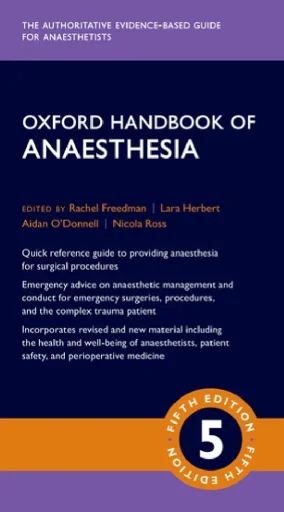
OXFORD HANDBOOK OF ANAESTHESIA Can ey DO Da ca. ea conduct fr emergency surgeries, procedures, and thecomplextraườa pient Ta an ni ii "ah as & ` %, 2 z 4 D »Rd Corn OXFORD HANDBOOK OF th “thy, Oxford Handbook for the Foundation Oxford Handbook of Infectious Diseases and 5 Programme 5e Microbiology 2e Oxford Handbook of Acute Medicine 4e Oxford Handbook of Integrated Dental Oxford Hai ndbook of Anaesthesia 5e Biosciences 2e Oxford Handbook of Cardiclogy 2e Oxford Handbook of Humanitarian: Medicine Oxford Handbook of Ctinical and Healthcare Oxford Handbock of Key Clinical Evidence 2e Research Oxford Handbook of Medical Dermatology 2e Oxford Handbook of Cinical and Laboratory Oxford Handbook of Medical Imaging Investigation 4e Oxford Handbook of Medical Sciences 2e Oxford Handbook of Clinical Dentistry 7e Oxford Handbook far Medicai School Oxford Handbook of Ctinical Diagnosis Je Oxford Handbook of Medical Statistics Oxford Handbook of Clinical Examination and Oxford Handbook of Neonatology 2e Practical Skills Ze Oxford rlandbook of Nephrology and Cxord Handbook of Ctinical Haematology 4e Hypertensien 2e Oxford Handbook of Clinical Immunology Oxford rlandbook oŸ Neuroloay 2e and Allergy 4e Oxford Handbook of Nutrition and Oxford Handbook of Clinical Medicine — Mini Dietetics 3e Edition 1Ge Oxford Handbock of Obstetrics and Oxford Handbook of Ciinical Medicine 10¢ Gynaecology 3e Oxford Handbook of C linical Pathology Oxford Handbook of Occups tional Heaith 2e Cxord Handbook of cal Pharmacy 3e Oxford Handbook of Oncology 42 Oxford Handbook of nical Specialties 11e Oxford Handbook of Gperative Surgery 3e Oxford Handbook of Clinical Surgery 4e Oxford Handbook of Ophthalmology 4e Oxford Handbook of Complementary Oxford Handbock of Cral and Maxillofacial Medicine Surgery 2e Oxford Handbook of Critical Care 3a Oxford Handbook of Orthopaedics Oxford Handbook of Dental Patient Care and Trauma Oxford Handbook of Dialysis 4e Oxford Handbock of Paediatrics 3e Cxord Handbook of Emergency Oxford Handbook of Pain Management Medicine Se Oxford Handbook of Palliative Care 3e ' Oxford Handbook of E ndocrinology and Oxford Handbook of Practical Drug Diabetes 3e Therapy 2e Oxford Handbook of ENT and Head and Oxford Handbook of Pre-Hospital Care Nack Surgery Je Oxford Handbook cf Psychiatry 4e Cxord Handbook of Epidemiology for Oxford Handbook of Public Health Practice 3e Clinici Oxford Handbock of Rehabilitation Oxford Handbook of Expedition and Medicine 3e Wilderness Medicine 2e Oxford Handbock of Reproductive Medicine Oxford Handbook of Forensic Medicine & Family Planning 2e Oxford Handbook of Gastroenterology & Oxford Handbook of Respiratory Medicine 3e Mepatolagy 2e Oxford dandbock cf Rheumatology 4e Oxford Handbook of General Practic Oxford Handbook of Sport and Exercise Oxford Handbook of Genetics Medicine Oxford Handbook of Genitourinary Medicine, Handbook of Surgical Consen HIV, and Sexual Health 3e Oxford Handback of Tropical Med Oxford Handbook of Geriatric Medicine 3e Oxford Handbook of Urology 4e »< ar wo +> F4 Q3 "I O O O O + O O ~ O & À PY NY SS SN Ge 8 S84 SY C sFH = mass Sk Shook Ñ ve FIFTH EDITION Rachel Freedman Consultant Anaesthetist, fmperia! College Healthcare NHS Trust, London, UK Lara Herbert Consultant Anaesthetist, Royal Cornwall Hospitals NHS Trust, UK Aidan ©’ Donnell Consultant Anaesthetist, Waikato District Health Board, Hamilton, NZ Nicola Ross Consultant Anaesthetist, Royal Devon and Exeter NHS Foundation Trust, U WITH ADVISORY EDITORS fain H Wilson Consultant Anaesthetist, Royal Devon and Exeter NHS Foundation Trust, UK Keith G Allman Consultant Anaesthetist, Royal Devon and Exeter NHS Foundation Trust, UK OXFORD UNIVERSITY PRESS OXFORD a, Great Clarendon Street, Oxford, OX2 6DP, United Kingdom Oxford University Press is a department of the University of Oxford. It furthers the University’s objective of excellence in r esearch, scholarship, and education by publishing worldwide. Oxford is a registered “ES trade mark of Oxford University Press in the UK and in certain other countries © Oxford University Press 2022; Chapter 15 © Tim Cook, fulius Cranshaw, and Emira Kursumovic 2022 The moral rights of the authors have been asserted First edidon 2002 Second edition 2006 Third edition 2011 Fourth edition 2016 Fifth edition 2022 lrnpression: 1 All rights reserved, No part of this publication may be reproduced, stored in a retrieval systern, or transmitted, in any form or by any means, without the rior permission in writing of Oxford University Press, or as expressly permitted by law, by licence or under terms agreed with the appropriate reprographics rights organization.
Enquiries concerning reproduction outside the scope of the above should be sent to the Rights Department, Oxford University Press, at the address above ‘You must not circulate this work in any other form and you must impose thi is same condition on any acquirer Published in the United States of America by Oxford University Press 198 Madison Avenue, New York, NY 10016, United States of America British Library Cataloguing in Publication Data Data available Library of Congress Control Number: 2021935486 ISBN 978--0--19-885305-3 DO: 10.0004 Printed and bound in China by C&C Offset Printing Co. Oxford University Press makes no representation, express or implied, that the drug dosages in this book are correct. Readers must therefore always check the product information and clinical procedures with the most up-to-date published product information and data sheets provided by the manufacturers and the most recent codes of conduct and safety regulations. The authors and the publishers do not accept responsibility or legal liability for any errors in the text or for the misuse or misapplication of material in this work.
Except where otherwise stated, drug dosages end recommendations are for the non-pregnant adult who is not breast. feeding Links to third party websites are provided by Oxford in good faith and for information only, Oxford disclaims anyr responsibility f for the materials contained in any third party website referenced in this work. Preface Welcome to the fifth edition of the Oxford Handbook of Anaesthesia. This edition sees a new editorial team.
Rachel Freedman, Lara Herbert, Aidan O’Donnell, and Nicki Ross have taken over from Keith Allman and lain Wilson, who have continued to provide advice and encouragement during the development of this edition. Keith and lain started this book from scratch and have been at the wheel for almost 20 years. Now they have handed us the keys and let us drive—we promise to try not to crash into anything. We must begin by acknowledging the thousands of hours of work con- tributed by the authors that have been involved in the previous editions.
The handbook is a success because of the work that has gone before. Our aim with the fifth edition is to make this the most useful anaesthetic handbook in the world. The layout of the book has been changed to bring disparate topics together, and to make the flow of the book more aligned with the sequence of a patient’s perioperative journey. We have maintained an emphasis on patient safety, practicality, and good practice throughout.
Familiar sections have been completely revised or expanded, including Preoperative considerations, Regional anaesthesia, and Major trauma. New sections have been added, including sensible advice about looking after yourself and what to do when things go wrong. We have welcomed a large number of new contributors with a wider international spread to enrich the content. We have tried to do all this while keeping the size of the book manageable.
The Oxford Handbook of Anaesthesia remains a comprehensive and practical guide to anaesthesia. It has proven popular in many countries throughout the world. It has been translated into Polish and Romanian. A low-cost edition is available in many countries across Asia (Afghanistan, Bangladesh, Bhutan, Cambodia, China, India, Indonesia, Laos, Malaysia, Myanmar, Nepal, Pakistan, Philippines, Syria, Taiwan, Thailand, Turkey, Vietnam, and Yemen) and Africa (Libya, Egypt).
We hope that you will enjoy this latest edition of the handbook and find the changes helpful. We welcome your feedback, so that we can keep improving the book. Despite all our efforts, it is possible that an occasional error exists; please be careful. We would like to thank our partners for their long-suffering support.
Our own families have grown larger, and we welcome Andrew and Joshua, who were born while this book was gestating. We thank our many contributors for their expertise and hard work; and Keith and lain, without whom the book would not exist. Unlike Keith and lain, our editorial team is located in four different cities in two different countries, so we have not had the luxury of meeting over a beer. We have instead sat through many hours of discussion in a virtual public house we fondly refer to as The Skype Arms.
If lain were to buy us one drink for each time he told us this book was nearly finished, we would have a merry night indeed. vi PREFACE We hope this edition will augment the already fantastic work anaesthetists are doing all around the world to keep their patients safe. In the words of Lewis Carrol: ‘One of the deep secrets of life is that all that is really worth the doing is what we do for others’. Rachel, Lara, Aidan and Nicki (www.com/uk/medicine/handbooks) February 2021 Contents Contributors ix Abbreviations xiv Good practice and safety = Preoperative considerations WN Preoptimisation At-risk populations BR Cardiovascular disease Can Respiratory disease CƠ.