Hồ sơ mời nộp đề xuất RFA mở rộng mô hình Project ECHO tại New York

Nghiên cứu chi tiết về đề tài Final Project Echo II RFA 06 27 18 1 trong lĩnh vực chuyên ngành. Phân tích quy trình, kết quả và ứng dụng thực tế của dự án.

Trường đại học

New York State Department of Health

Chuyên ngành

Y tế công cộng

Người đăng

Ẩn danh

Thể loại

Đề tài nghiên cứu

2018

56
0
0

Phí lưu trữ

30 Point

Tóm tắt

I. Tổng quan về Final Project Echo II RFA 2018

Final Project Echo II RFA 2018 là sáng kiến mở rộng Mô hình ECHO (Extension for Community Healthcare Outcomes) do Sở Y tế Bang New York phối hợp với Health Research, Inc. triển khai. Được phát hành ngày 27/6/2018, RFA nhằm tài trợ cho tối đa 4 trung tâm đầu mối (hub site) triển khai mô hình ECHO trong 16 tháng (10/2018-1/2020). Mục tiêu chính là xây dựng mạng lưới chia sẻ kiến thức ảo giữa chuyên gia chuyên khoa và bác sĩ chăm sóc ban đầu thông qua công nghệ hội nghị truyền hình. Dự án tập trung vào điều trị các bệnh mãn tính phức tạp, nâng cao năng lực chăm sóc sức khỏe cộng đồng. Các ứng viên phải đáp ứng yêu cầu tối thiểu về năng lực vận hành ECHO và cam kết tuân thủ quy định ngân sách liên bang.

1.1. Mục tiêu chính của RFA 2018

Mục tiêu cốt lõi là mở rộng Mô hình ECHO tại New York thông qua tài trợ cho các trung tâm đầu mối hoạt động. Các hub site sẽ tổ chức các buổi hội thảo ảo (teleECHO clinics) kết nối chuyên gia chuyên khoa với bác sĩ tuyến đầu. Dự án nhằm mục đích giảm khoảng cách chăm sóc y tế giữa khu vực thành thị và nông thôn, đặc biệt tại các cộng đồng thiếu nguồn lực. Ngoài ra, RFA thúc đẩy đổi mới trong quản lý bệnh mãn tính như tiểu đường, tâm thần và rối loạn sử dụng chất gây nghiện. Các ứng viên phải chứng minh khả năng triển khai công nghệ và duy trì hoạt động trong suốt thời gian dự án.

1.2. Đối tượng và phạm vi áp dụng

RFA 2018 hướng đến các tổ chức y tế công lập, bệnh viện đại học, trung tâm y tế cộng đồng đủ điều kiện nộp đơn. Phạm vi bao gồm toàn bộ bang New York, ưu tiên các khu vực nông thôn hoặc thiếu chuyên gia theo định nghĩa của bang. Các ứng viên phải chứng minh kinh nghiệm vận hành hệ thống telehealth hoặc mô hình ECHO tương tự. Yêu cầu tối thiểu bao gồm khả năng cung cấp không gian hội nghị truyền hình, đội ngũ chuyên gia chuyên khoa, và hệ thống quản lý dữ liệu bệnh nhân. Dự án không giới hạn về loại bệnh lý nhưng tập trung vào các bệnh mãn tính cần quản lý dài hạn.

II. Phân tích các vấn đề trong RFA Project ECHO II 2018

RFA Project ECHO II 2018 giải quyết ba vấn đề chính trong hệ thống chăm sóc sức khỏe New York: sự thiếu hụt chuyên gia chuyên khoa ở tuyến cơ sở, bất bình đẳng trong tiếp cận dịch vụ y tế giữa thành thị-nông thôn, và chi phí điều trị bệnh mãn tính ngày càng tăng. Mô hình ECHO được thiết kế nhằm khắc phục những hạn chế này thông qua đào tạo từ xa, cho phép bác sĩ tuyến đầu quản lý bệnh nhân phức tạp dưới sự hướng dẫn của chuyên gia. Tuy nhiên, RFA cũng đặt ra thách thức về năng lực tài chính và công nghệ của các ứng viên. Việc triển khai teleECHO clinics đòi hỏi hạ tầng internet ổn định, phần mềm bảo mật, và đội ngũ IT hỗ trợ. Ngoài ra, các ứng viên phải đảm bảo tuân thủ quy định liên bang về bảo vệ dữ liệu bệnh nhân (HIPAA) và tiêu chuẩn ngân sách liên bang.

2.1. Thách thức trong triển khai Mô hình ECHO

Triển khai Mô hình ECHO gặp phải nhiều rào cản kỹ thuật và tổ chức. Đầu tiên là yêu cầu về hạ tầng công nghệ, bao gồm băng thông internet đủ mạnh, thiết bị hội nghị truyền hình chất lượng, và hệ thống quản lý dữ liệu bệnh nhân. Thứ hai là vấn đề đào tạo nhân lực: các hub site cần tuyển dụng chuyên gia chuyên khoa sẵn sàng tham gia giảng dạy trực tuyến. Thứ ba là thách thức trong quản lý dự án, đặc biệt là đảm bảo sự tham gia liên tục của các bác sĩ tuyến đầu (spoke sites). RFA yêu cầu các ứng viên trình bày kế hoạch chi tiết về huy động nguồn lực, đào tạo, và duy trì hoạt động sau khi dự án kết thúc.

2.2. Yêu cầu về tuân thủ pháp lý và tài chính

RFA 2018 áp đặt nhiều yêu cầu pháp lý nghiêm ngặt nhằm đảm bảo sử dụng hiệu quả ngân sách liên bang. Các ứng viên phải tuân thủ Đạo luật Phòng chống Phân biệt đối xử (Title VI of Civil Rights Act), Đạo luật về Người khuyết tật (Section 504), và các quy định lao động liên bang. Ngoài ra, dự án phải đảm bảo ưu tiên tuyển dụng người khuyết tật và cựu chiến binh theo quy định. Về mặt tài chính, RFA yêu cầu báo cáo chi tiết về sử dụng ngân sách, bao gồm chi phí vận hành, đào tạo, và đánh giá hiệu quả. Các ứng viên phải chứng minh khả năng quản lý tài chính trong suốt thời gian dự án 16 tháng.

III. Giải pháp triển khai Final Project Echo II RFA 2018

Để triển khai thành công Final Project Echo II RFA 2018, các ứng viên cần áp dụng phương pháp tiếp cận hệ thống kết hợp công nghệ, đào tạo, và quản lý dự án. Giải pháp cốt lõi là xây dựng mạng lưới hub-spoke vững mạnh, trong đó hub site đóng vai trò trung tâm kiến thức và spoke sites là các điểm chăm sóc tuyến đầu. Các hub site phải triển khai kế hoạch đào tạo liên tục cho chuyên gia chuyên khoa và bác sĩ tuyến đầu thông qua teleECHO clinics. Giải pháp công nghệ bao gồm đầu tư vào nền tảng hội nghị truyền hình an toàn (tuân thủ HIPAA), hệ thống quản lý bệnh nhân điện tử, và công cụ đánh giá hiệu quả. Ngoài ra, các ứng viên nên xây dựng mối quan hệ đối tác với các tổ chức y tế địa phương để tăng cường khả năng huy động nguồn lực và mở rộng phạm vi tác động.

3.1. Phương pháp xây dựng mạng lưới hub spoke

Xây dựng mạng lưới hub-spoke đòi hỏi sự phối hợp chặt chẽ giữa trung tâm đầu mối (hub) và các điểm chăm sóc tuyến đầu (spoke). Hub site chịu trách nhiệm phát triển giáo trình đào tạo, tuyển dụng chuyên gia chuyên khoa, và tổ chức các buổi teleECHO clinics theo lịch trình định kỳ. Spoke sites phải cam kết tham gia đầy đủ, cung cấp dữ liệu bệnh nhân, và triển khai các can thiệp y tế theo hướng dẫn. Giải pháp bao gồm triển khai khảo sát đánh giá nhu cầu (Practice Readiness Survey) trước khi spoke sites tham gia. Hub site cũng phải thiết lập cơ chế giám sát chất lượng, bao gồm thu thập phản hồi từ spoke sites và đánh giá kết quả lâm sàng.

3.2. Chiến lược quản lý tài nguyên và tuân thủ

Quản lý tài nguyên hiệu quả là yếu tố quyết định thành bại của dự án. Các ứng viên cần lập kế hoạch ngân sách chi tiết, bao gồm chi phí ban đầu (thiết bị, đào tạo) và chi phí vận hành (lương chuyên gia, bảo trì phần mềm). Giải pháp bao gồm tìm kiếm tài trợ bổ sung từ các nguồn địa phương hoặc tư nhân để giảm gánh nặng ngân sách liên bang. Về mặt tuân thủ, dự án cần triển khai hệ thống giám sát tuân thủ pháp luật, bao gồm đào tạo nhân viên về HIPAA, quy định lao động, và chính sách chống phân biệt đối xử. Các ứng viên nên thành lập ủy ban tuân thủ chuyên trách để theo dõi và báo cáo định kỳ.

IV. Kết luận và ứng dụng thực tế Final Project Echo II

Final Project Echo II RFA 2018 đại diện cho bước tiến quan trọng trong việc cải thiện khả năng tiếp cận dịch vụ chăm sóc sức khỏe chuyên khoa tại New York thông qua công nghệ telehealth. Sau khi triển khai thành công, dự án sẽ tạo ra mô hình bền vững có thể nhân rộng cho các bang khác. Kết quả dự kiến bao gồm nâng cao năng lực chăm sóc bệnh mãn tính tại tuyến cơ sở, giảm chi phí điều trị thông qua quản lý bệnh nhân hiệu quả, và cải thiện kết quả sức khỏe cộng đồng. Các ứng viên thành công sẽ trở thành đối tác chiến lược của Sở Y tế Bang New York trong việc triển khai Mô hình ECHO. Dự án cũng sẽ đóng góp dữ liệu quan trọng cho nghiên cứu về hiệu quả của telehealth trong quản lý bệnh mãn tính, hỗ trợ xây dựng chính sách y tế trong tương lai.

4.1. Đánh giá hiệu quả dự án

Hiệu quả của Final Project Echo II sẽ được đánh giá thông qua bốn tiêu chí chính: (1) Số lượng bác sĩ tuyến đầu tham gia teleECHO clinics, (2) Tỷ lệ bệnh nhân được quản lý thành công các bệnh mãn tính, (3) Mức độ hài lòng của bệnh nhân và bác sĩ, (4) Tỷ lệ tuân thủ ngân sách và thời gian triển khai. Các hub sites sẽ thu thập dữ liệu định kỳ thông qua khảo sát, hồ sơ bệnh án điện tử, và báo cáo hoạt động. Dữ liệu sẽ được phân tích bởi nhóm đánh giá độc lập để xác định các yếu tố thành công và bài học kinh nghiệm. Kết quả đánh giá sẽ được công bố công khai nhằm thúc đẩy minh bạch và cải tiến liên tục.

4.2. Tiềm năng nhân rộng mô hình

Mô hình ECHO triển khai thành công tại New York có tiềm năng nhân rộng sang các bang khác hoặc thậm chí quốc tế, đặc biệt tại các khu vực có hệ thống chăm sóc sức khỏe yếu kém. Tính bền vững của mô hình phụ thuộc vào khả năng huy động nguồn lực liên tục, bao gồm tài trợ từ chính phủ, bảo hiểm y tế, hoặc các tổ chức phi lợi nhuận. Các ứng viên thành công nên xây dựng kế hoạch dài hạn sau khi dự án kết thúc, bao gồm tìm kiếm tài trợ mới, mở rộng mạng lưới spoke sites, và phát triển các chương trình đào tạo bổ sung. Mô hình cũng có thể được điều chỉnh để áp dụng cho các lĩnh vực y tế khác như sức khỏe tâm thần, chăm sóc người cao tuổi, hoặc quản lý đại dịch.
Tóm tắt và mô tả trên trang này được tạo với sự hỗ trợ của AI. Nếu bạn thấy nội dung không chính xác hoặc có vấn đề, vui lòng Báo lỗi nội dung.

31/05/2026
Final project echo ii rfa 06 27 18 1

Trích đoạn nội dung tài liệu

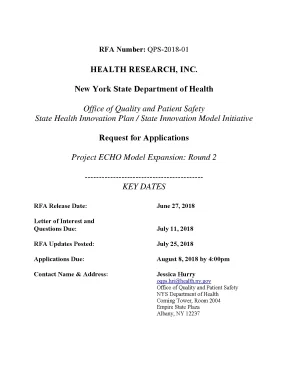
RFA Number: QPS-2018-01 HEALTH RESEARCH, INC. New York State Department of Health Office of Quality and Patient Safety State Health Innovation Plan / State Innovation Model Initiative Request for Applications Project ECHO Model Expansion: Round 2 ------------------------------------------ KEY DATES RFA Release Date: June 27, 2018 Letter of Interest and Questions Due: July 11, 2018 RFA Updates Posted: July 25, 2018 Applications Due: August 8, 2018 by 4:00pm Contact Name & Address: Jessica Hurry oqps.gov Office of Quality and Patient Safety NYS Department of Health Corning Tower, Room 2004 Empire State Plaza Albany, NY 12237 Table of Contents Section Page # I. Introduction Summary 3 Project ECHO Background 3 State Health Innovation Plan Background 4 II. Who May Apply Minimum Eligibility Requirements 5 Preferred Eligibility Requirements 5 III.

Project Narrative/Work Plan Outcomes Project ECHO Program Initiation Activities 7 Project ECHO Clinics 7 Use of Award Funds 9 IV. Question and Answer Phase 11 C. Letter of Interest (Optional) 11 D. How to File an Application 12 F.

HRI/Department’s Reserved Rights 12 G. Term of Contract 14 H. Payment and Reporting Requirements of Awardees 14 I. HRI General Terms & Conditions 15 V.

Completing the Application A. Application Format and Content 26 B. Review Process 30 VI. Attachments 31 Attachment 1: Application Cover Sheet Attachment 2: NYS Academic Medical Centers Attachment 3: Rural Area Definitions Attachment 4: Project ECHO Replication Guidelines Attachment 5: APC Core Measure Set Attachment 6: Work Plan Template Attachment 7: Letter of Interest Format Attachment 8: Budget Instructions Attachment 9: ECHO Institute IT FAQs Attachment 10: Project ECHO Model Expansion Map – SIM funded Project ECHO Hub Site Locations and Focus Areas I.

Introduction Summary The New York State Department of Health (NYSDOH), Office of Quality and Patient Safety, in conjunction with the Office of Primary Care and Health Systems Management, and Health Research, Inc. (HRI) announce the availability of federal funds to implement and/or expand the Project ECHO (Extension for Community Healthcare Outcomes) model in health care settings in New York State. Awardees will be expected to operate a Project ECHO “hub” site, implementing a guided practice model that uses telecommunications technology to link expert specialist teams with primary care clinicians in a virtual knowledge-sharing network. It is anticipated that awards will be made to support up to four (4) Project ECHO hub sites over a 16-month period from October 1, 2018 to January 31, 2020.

Final award amounts will be determined based upon successful applications and available funding. Project ECHO Background Project ECHO is an innovative tele-mentoring model that develops the capacity of the front- line primary care workforce to safely and effectively treat complex, chronic medical conditions. Project ECHO uses video-conferencing technology to establish a virtual “knowledge network” between a “hub” (team of inter-disciplinary specialists located at a medical center) and multiple “spokes” (primary care clinicians located at sites in underserved communities) for training and mentoring. Project ECHO clinic sessions, referred to as teleECHO clinics, are virtual grand rounds that include case-based learning, review of treatment protocols, sharing of best practices, and didactic presentations to enhance the skills and knowledge of primary care clinicians to treat specific diseases.

Participants learn from specialists and other primary care clinicians, and are able to earn Continuing Medical Education (CME) credits for participation. The Project ECHO model was originally developed at the University of New Mexico and designed to train primary care providers in effective hepatitis C virus (HCV) management and treatment, and to improve access to HCV care in rural settings (http://echo. Since its inception, the Project ECHO model has addressed over 55 complex conditions, including HCV, HIV, substance use disorders, diabetes and endocrinology, chronic pain, tuberculosis, autism, palliative care, and crisis intervention training. The program has been successfully replicated in many states and widely evaluated.

A prospective cohort study of Project ECHO’s HCV clinic demonstrated that care delivered by primary care providers with teleECHO support is safe and as effective as treatment provided by specialists at the University of New Mexico Hospital’s Hepatitis C Clinic. In addition, numerous evaluations have demonstrated that the self-assessed skills, competence, and job satisfaction of participating providers have improved significantly following their involvement in teleECHO clinics. 3 State Health Innovation Plan Background In December 2014, HRI and the NYSDOH were awarded a $100 million State Innovation Models (SIM) cooperative agreement by the Centers for Medicare and Medicaid Innovation (CMMI) to implement the State Health Innovation Plan (SHIP) (http://www.gov/technology/innovation_plan_initiative/). Central to New York’s proposal is a multidisciplinary approach to health system redesign that includes primary care delivery system and payment reform.

New York’s reform plans are further supported by the promotion of health information technologies, work to improve access to care, and development of the health care workforce to support new delivery models. A key component of the SHIP is the development and implementation of an integrated care delivery system with a foundation in Advanced Primary Care (APC). APC is achieved by supporting enhanced capabilities, processes, and performance of primary care providers based on lessons learned from the Comprehensive Primary Care initiative (CPCi), Medicare Advanced Primary Care Program (MAPCP), and National Committee for Quality Assurance (NCQA) Patient Centered Medical Home (PCMH). Each of these initiatives is premised on primary care assuming a central role in health system reform, through the coordination of care, to achieve optimal health and well-being for patients.

A secondary component of the SHIP relates to expansion of New York State’s (NYS) primary care workforce through innovations in professional education and training. Although New York's physician-to-population ratio is currently above the national average, there are physician shortages in many communities and specialties. When compared to national ratios, NYS exhibits a maldistribution of primary care physicians in specific geographic regions, primarily in densely populated urban neighborhoods and rural communities, and in communities with high proportions of low-income and Medicaid populations. The greatest gap between supply and demand growth statewide is projected in specialties, including psychiatry.

Other statistics demonstrate the need for more physicians due to retirements and reductions in hours across NYS, particularly in rural areas. Health system transformation in NYS demands a future workforce more advanced and nimble than that which we have today. In response, NYS identified four health care workforce strategies: 1. Expand the supply of clinically-trained workers in key geographies by working with providers and educators to change admissions, education, and training programs; sharpen recruitment and retention policies and incorporate telehealth technology to expand the geographical reach of the existing workforce.

Update standards and educational programs to reflect the needs of delivering the APC model, particularly trainings around care coordination, quality and performance improvement techniques, multidisciplinary teamwork, and necessary administrative and business skills. Identify potential primary care-related workforce flexibility opportunities by putting in place the infrastructure to test and evaluate workforce models of care and their implications for professionals to work to the full extent of their professional competence. Develop more robust working data, analytics, and planning capacity throughout the State. Project ECHO supports these strategies and helps to address the following goals: • Shortages in and maldistribution of the primary care workforce; • Gaps in training curricula and the workforce skills base, particularly around team- based, whole-patient-focused care; • Lack of flexibility to enable health care professionals to practice to the full extent of their professional competence and move easily between care settings and geographies.

Project ECHO is described as a lifelong learning and guided practice model that revolutionizes medical education and exponentially increases workforce capacity to provide best-practice specialty care and reduce health disparities. It is expected that replication and expansion of the Project ECHO model in health care settings across NYS will increase the capacity of the existing primary care workforce throughout the State; better equip primary care clinicians to meet the demands of APC practice and provide comprehensive, best- practice care to patients with complex health conditions in their own communities; and enable practitioners to work to the highest level of their licensure. Who May Apply A. Minimum Eligibility Requirements Applications will be accepted from organizations that are teaching hospitals that are physically located in NYS.

For the purposes of this RFA, a teaching hospital is defined as a hospital or medical center that provides clinical education and training to future and current physicians, and that receives Medicaid reimbursement for direct or indirect graduate medical education. Preferred Eligibility Requirements Preference will be given to applicants that: 1. Are teaching hospitals that are part of an academic medical/health centers. For the purposes of this RFA, an academic medical/health center is an organization that is administratively integrated with a medical school(s) and that is the principal site for education of both medical students and postgraduate medical specialty trainees.

A complete listing of NYS academic medical centers is provided in Attachment 2. Propose to primarily serve primary care clinicians located in rural NYS areas, in 5 Medically Underserved Areas and Populations (MUAs and MUPs), and/or in designated Health Professional Shortage Areas (HPSAs). The term primarily serve means that a majority (more than 50%) of affiliated “spoke” sites to which the applicant will provide ongoing training and mentoring are located in areas meeting one or more of the above designations. Rural Area Definitions are provided in Attachment 3.

MUAs, MUPs, and HPSAs are identified at http://www.gov/shortage/find. Demonstrate commitments from 20 or more participating primary care practice “spoke” sites located in NYS. Primary care practice sites co-located at one address, but not belonging to the same practice, may count as more than one “spoke” site. The goal of this RFA is to increase geographic and clinical diversity of SIM-funded Project ECHO hub sites across NYS.

In determining awards, priority consideration will be given to applications to establish Project ECHO sites that help achieve an expanded geographic distribution of funds. In addition, priority consideration will be given to applications that establish a Project ECHO site that will address shortages in certain specialties or focus areas, including psychiatry. Project Narrative/ Work Plan Outcomes Project ECHO Model Expansion funding shall be used to support replication of Project ECHO in health care settings across NYS. Funds awarded will assist applicants with establishing the infrastructure to implement a new Project ECHO hub site or to expand the scope of services provided at their existing Project ECHO hub site.

The anticipated start date for the contract will be October 1, 2018 and funds are limited to 16 months. The primary goal is to increase the use of the Project ECHO model in NYS to support achievement of key workforce strategies outlined in the SHIP. It is expected that expansion of the Project ECHO model will serve to disseminate medical knowledge, enhance the capacity of the existing primary care workforce, and better equip primary care clinicians to effectively meet the demands of APC practice. As a result of participating in Project ECHO, primary care practice sites will be able to effectively treat patients locally, provide timelier access to high-quality team-based primary care, and reduce unnecessary referrals to specialists.

By the end of the contract period, contractors will have either established a fully operational Project ECHO program or expanded their existing Project ECHO program to address increased needs, serve multiple rural and underserved spoke sites, and provide specialty clinical expertise to address specific diseases, health conditions, or target areas that are significant to the spoke site communities. Organizations are expected to have developed sustainability plans to continue to operate their Project ECHO program once grant funding has ended. Project ECHO Program Initiation Activities Applicants must propose to: 1. Establish a new Project ECHO hub site, or 2.

Expand the scope of services provided at their existing Project ECHO hub site. Applicants proposing to establish a new Project ECHO hub site must demonstrate a commitment to fidelity of the Project ECHO model by adhering to the requirements outlined by the ECHO Institute at the University of New Mexico to become a Project ECHO Replication Partner as shown in Attachment 4.

Nội dung được bảo vệ bản quyền — Tải xuống đầy đủ