Kế hoạch ứng dụng dự án DSRIP của Sở Y tế New York Adirondack

Tìm hiểu kế hoạch phát triển dự án Adirondack chi tiết từ ý tưởng đến triển khai. Hướng dẫn xây dựng lộ trình, mục tiêu và chiến lược hiệu quả

Trường đại học

New York Department of Health

Chuyên ngành

Y tế công cộng

Người đăng

Ẩn danh

Thể loại

Đề án

2014

103
0
0

Phí lưu trữ

35 Point

Tóm tắt

I. Tổng quan về kế hoạch dự án Adirondack

Kế hoạch dự án Adirondack xuất phát từ chương trình DSRIP của Sở Y tế New York. Chương trình này nhằm cải tổ hệ thống chăm sóc sức khỏe. Mục tiêu chính là xây dựng hệ thống chăm sóc tích hợp. Hệ thống tập trung vào y học dựa trên bằng chứng và quản lý sức khỏe cộng đồng. Cấu trúc tổ chức cần có sự lãnh đạo cam kết. Quản trị rõ ràng và kênh truyền thông minh bạch là điều kiện tiên quyết. Mạng lưới nhà cung cấp phải được tích hợp lâm sàng chặt chẽ. Các đòn bẩy tài chính giúp khuyến khích và duy trì can thiệp. Mục đích cuối cùng là giảm hoạt động nhập viện không cần thiết. Kế hoạch dự án đóng vai trò khung sườn cho toàn bộ quá trình triển khai. Mỗi bước thực hiện đều gắn với mốc thời gian cụ thể. Các bên liên quan phải phối hợp chặt chẽ để đạt hiệu quả. Việc lập kế hoạch chi tiết giúp giảm rủi ro thất bại. Nó cũng tạo nền tảng đo lường tiến độ minh bạch. Toàn bộ quy trình hướng đến cải thiện sức khỏe dân số mục tiêu.

1.1. Bối cảnh hình thành kế hoạch

Kế hoạch dự án Adirondack ra đời trong bối cảnh cải cách y tế tại New York. Chương trình DSRIP đặt mục tiêu giảm chi phí bệnh viện không cần thiết. Các nhà cung cấp dịch vụ y tế phải liên kết chặt chẽ hơn. Việc hình thành kế hoạch dựa trên phân tích nhu cầu dân số địa phương. Dữ liệu sức khỏe cộng đồng được thu thập kỹ lưỡng trước khi lập kế hoạch. Các vấn đề như thiếu bác sĩ chăm sóc ban đầu được xác định rõ. Kế hoạch cũng xem xét khả năng tiếp cận dịch vụ của nhóm dân cư khó khăn. Mục tiêu là xây dựng hệ thống bền vững lâu dài.

1.2. Phạm vi và mục tiêu chính

Phạm vi kế hoạch bao gồm nhiều lĩnh vực y tế khác nhau. Chăm sóc ban đầu, sức khỏe tâm thần và điều trị nghiện được đưa vào trọng tâm. Mục tiêu chính là tạo hệ thống chăm sóc liền mạch giữa các cấp độ dịch vụ. Kế hoạch hướng đến việc giảm số lần nhập viện tránh được. Đồng thời, chương trình thúc đẩy phòng ngừa bệnh mãn tính hiệu quả hơn. Các chỉ số đo lường được thiết lập rõ ràng cho từng giai đoạn. Việc đạt mục tiêu phụ thuộc vào sự tham gia của nhiều đối tác. Đây là nền tảng cho các phần phân tích tiếp theo.

II. Phân tích thách thức trong triển khai dự án

Việc triển khai kế hoạch dự án Adirondack gặp nhiều thách thức thực tế. Tình trạng thiếu bác sĩ chăm sóc ban đầu là vấn đề nổi cộm. Khu vực nông thôn chịu ảnh hưởng nặng nề nhất từ tình trạng này. Nhiều bệnh nhân sống trong hoàn cảnh nghèo khó khăn tiếp cận. Việc thu hút họ tham gia chương trình chăm sóc đòi hỏi nỗ lực lớn. Một số nhà cung cấp dịch vụ tỏ ra do dự khi tham gia. Họ lo ngại về nguồn lực hạn chế của hệ thống hiện tại. Thời gian khám bệnh ngắn cũng gây khó khăn cho việc đào tạo nhân viên. Nhân viên y tế cần thời gian để hoàn thành các công cụ đánh giá bệnh nhân. Việc theo dõi và hướng dẫn bệnh nhân sau khám cũng tốn nhiều công sức. Những rào cản văn hóa và trình độ hiểu biết y tế thấp càng làm phức tạp vấn đề. Các thách thức này đòi hỏi giải pháp đồng bộ và linh hoạt.

2.1. Thiếu hụt nguồn lực chăm sóc ban đầu

Tình trạng thiếu bác sĩ chăm sóc ban đầu ảnh hưởng trực tiếp đến chất lượng dịch vụ. Khu vực có mật độ dân cư thấp chịu tác động rõ rệt nhất. Bệnh nhân phải chờ đợi lâu hơn để được khám. Điều này làm giảm hiệu quả phòng ngừa bệnh sớm. Đội ngũ y tá và nhân viên cấp trung có thể hỗ trợ giảm áp lực. Việc tận dụng tối đa năng lực chuyên môn của họ là giải pháp khả thi. Tuy nhiên, cần đào tạo bổ sung để đảm bảo chất lượng dịch vụ đồng đều.

2.2. Rào cản trong việc thu hút bệnh nhân

Nhiều bệnh nhân sống trong cảnh nghèo khó ngại tiếp cận dịch vụ y tế. Rào cản văn hóa và ngôn ngữ càng làm tăng khoảng cách này. Trình độ hiểu biết y tế thấp khiến bệnh nhân khó tuân thủ điều trị. Việc xác định và liên hệ với nhóm dân cư mục tiêu gặp nhiều khó khăn. Thiếu niềm tin vào hệ thống y tế cũng là rào cản đáng kể. Các chương trình cần xây dựng lòng tin qua thời gian dài. Sự tham gia của cộng đồng địa phương đóng vai trò quan trọng trong quá trình này.

III. Giải pháp và phương pháp triển khai hiệu quả

Giải pháp cho các thách thức trên đòi hỏi cách tiếp cận đa chiều. Đào tạo nhân viên theo mô hình Bridges Out of Poverty giúp cải thiện tương tác. Nhân viên y tế học cách làm việc hiệu quả với người nghèo. Việc tận dụng nhân sự cấp trung giảm bớt áp lực cho bác sĩ chính. Chiến lược nhân lực kết hợp với đào tạo văn hóa tạo hiệu quả kép. Nhân viên có kỹ năng phù hợp cung cấp dịch vụ chất lượng cao hơn. Việc xác định các bác sĩ tiên phong giúp lan tỏa mô hình mới. Kết quả nghiên cứu về cải thiện sức khỏe được công bố rộng rãi. Nhóm công tác về sức khỏe cộng đồng được thành lập để tháo gỡ rào cản. Nhóm này xây dựng chiến lược tiếp cận nhóm dân cư mục tiêu. Công cụ theo dõi và chấm điểm mức độ tham gia bệnh nhân được công khai. Việc công khai kết quả khuyến khích các nhà cung cấp tham gia tích cực hơn.

3.1. Đào tạo và nâng cao năng lực nhân viên

Đào tạo theo mô hình Bridges Out of Poverty trang bị kỹ năng thực tế cho nhân viên. Họ học cách giao tiếp hiệu quả với bệnh nhân có hoàn cảnh khó khăn. Chương trình đào tạo văn hóa và hiểu biết y tế được tổ chức song song. Nhân viên cấp trung được khuyến khích làm việc ở mức năng lực cao nhất. Điều này giúp giảm tải cho bác sĩ chính trong hệ thống. Kết quả là chất lượng chăm sóc được cải thiện đồng đều hơn. Đầu tư vào con người mang lại hiệu quả bền vững lâu dài.

3.2. Xây dựng mạng lưới hỗ trợ và giám sát

Nhóm công tác về sức khỏe cộng đồng đóng vai trò điều phối chiến lược. Nhóm xác định cách tiếp cận phù hợp với từng nhóm dân cư. Kinh nghiệm từ các đơn vị đã triển khai thành công được chia sẻ rộng rãi. Việc công khai kết quả PAM ở cấp bác sĩ tạo động lực cạnh tranh tích cực. Các bác sĩ tiên phong được ghi nhận và tuyên dương công khai. Cơ chế giám sát liên tục giúp phát hiện sớm vấn đề phát sinh. Hệ thống báo cáo minh bạch củng cố niềm tin giữa các bên liên quan.

IV. Kết luận và ứng dụng thực tiễn của dự án

Kế hoạch dự án Adirondack mang lại khung hành động rõ ràng cho hệ thống y tế. Việc tích hợp chăm sóc ban đầu và sức khỏe tâm thần tạo hiệu quả toàn diện. Các mốc và chỉ số đo lường giúp theo dõi tiến độ minh bạch. Đầu tư vào công nghệ và đào tạo nhân lực tạo nền tảng bền vững. Hệ thống hồ sơ sức khỏe điện tử được nâng cấp liên tục. Công cụ giám sát thời gian thực hỗ trợ đội ngũ chăm sóc ra quyết định nhanh. Nhiều nhà cung cấp được kết nối vào mạng lưới thông tin khu vực. Cơ sở dữ liệu bệnh nhân ngày càng đầy đủ và chính xác hơn. Ứng dụng thực tiễn của kế hoạch thể hiện qua việc giảm nhập viện tránh được. Cộng đồng dân cư khó khăn được tiếp cận dịch vụ tốt hơn. Mô hình này có thể nhân rộng sang các khu vực khác. Thành công của dự án phụ thuộc vào sự cam kết lâu dài của các bên.

4.1. Kết quả đạt được và bài học kinh nghiệm

Dự án chứng minh hiệu quả của cách tiếp cận tích hợp trong chăm sóc sức khỏe. Số lượng bệnh nhân được theo dõi liên tục tăng đáng kể. Tỷ lệ nhập viện tránh được giảm rõ rệt tại các khu vực triển khai. Bài học kinh nghiệm cho thấy đào tạo nhân lực là yếu tố then chốt. Sự phối hợp giữa các nhà cung cấp quyết định thành công chung. Công khai dữ liệu hiệu suất tạo động lực cải thiện liên tục. Những kinh nghiệm này có giá trị tham khảo cho các chương trình y tế tương tự.

4.2. Hướng phát triển và mở rộng trong tương lai

Hướng phát triển tiếp theo tập trung vào mở rộng mạng lưới RHIO. Nhiều nhà cung cấp mới sẽ được kết nối vào hệ thống thông tin chung. Công nghệ giám sát sức khỏe dân số sẽ được nâng cấp sâu hơn. Việc tích hợp dữ liệu đến cấp độ từng bệnh nhân giúp cá nhân hóa chăm sóc. Các sổ đăng ký bệnh mãn tính hỗ trợ nhận diện nhóm nguy cơ cao. Mô hình chăm sóc tích hợp có thể áp dụng cho nhiều bang khác. Đầu tư dài hạn vào hạ tầng công nghệ là điều kiện tiên quyết cho mở rộng.
Tóm tắt và mô tả trên trang này được tạo với sự hỗ trợ của AI. Nếu bạn thấy nội dung không chính xác hoặc có vấn đề, vui lòng Báo lỗi nội dung.

31/05/2026
Adirondack project plan

Trích đoạn nội dung tài liệu

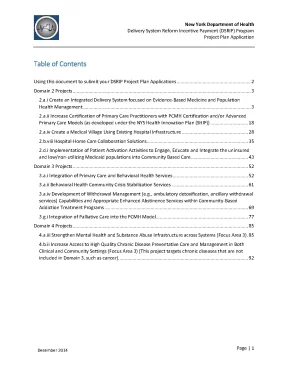
New York Department of Health Delivery System Reform Incentive Payment (DSRIP) Program Project Plan Application Table of Contents Using this document to submit your DSRIP Project Plan Applications .i Create an Integrated Delivery System focused on Evidence-Based Medicine and Population Health Management .ii Increase Certification of Primary Care Practitioners with PCMH Certification and/or Advanced Primary Care Models (as developed under the NYS Health Innovation Plan (SHIP)) .iv Create a Medical Village Using Existing Hospital Infrastructure .viii Hospital-Home Care Collaboration Solutions.i Implementation of Patient Activation Activities to Engage, Educate and Integrate the uninsured and low/non-utilizing Medicaid populations into Community Based Care .i Integration of Primary Care and Behavioral Health Services .ii Behavioral Health Community Crisis Stabilization Services .iv Development of Withdrawal Management (e., ambulatory detoxification, ancillary withdrawal services) Capabilities and Appropriate Enhanced Abstinence Services within Community-Based Addiction Treatment Programs .i Integration of Palliative Care into the PCMH Model.iii Strengthen Mental Health and Substance Abuse Infrastructure across Systems (Focus Area 3).ii Increase Access to High Quality Chronic Disease Preventative Care and Management in Both Clinical and Community Settings (Focus Area 3) (This project targets chronic diseases that are not included in Domain 3, such as cancer). 92 December 2014 Page | 1 New York Department of Health Delivery System Reform Incentive Payment (DSRIP) Program Project Plan Application Using this document to submit your DSRIP Project Plan Applications Please complete all relevant text boxes for the DSRIP Projects that you have selected. The Scale and Speed of Implementation sections for each of the Domain 2 and 3 projects have been removed from this document (highlighted in yellow) and are provided in a separate Excel document. You must use this separate document to complete these sections for each of your selected projects.

Once you have done this, please upload the completed documents to the relevant section of the MAPP online application portal. December 2014 Page | 2 New York Department of Health Delivery System Reform Incentive Payment (DSRIP) Program Project Plan Application Domain 2 Projects 2.i Create an Integrated Delivery System focused on Evidence-Based Medicine and Population Health Management Project Objective: Create an Integrated Delivery System focused on Evidence-Based Medicine and Population Health Management. Project Description: This project will require an organizational structure with committed leadership, clear governance and communication channels, a clinically integrated provider network, and financial levers to incentivize and sustain interventions to holistically address the health of the attributed population and reduce avoidable hospital activity. For this project, avoidable hospital activity is defined as potentially- preventable admissions and readmissions (PPAs and PPRs) that can be addressed with the right community-based services and interventions.

This project will incorporate medical, behavioral health, post-acute, long term care, social service organizations and payers to transform the current service delivery system – from one that is institutionally-based to one that is community-based. This project will create an integrated, collaborative, and accountable service delivery structure that incorporates the full continuum of services. If successful, this project will eliminate fragmentation and evolve provider compensation and performance management systems to reward providers demonstrating improved patient outcomes. Each organized integrated delivery system (IDS) will be accountable for delivering accessible evidence- based, high quality care in the right setting at the right time, at the appropriate cost.

By conducting this project, the PPS will commit to devising and implementing a comprehensive population health management strategy – utilizing the existing systems of participating Health Home (HH) or Accountable Care Organization (ACO) partners, as well as preparing for active engagement in New York State’s payment reform efforts. Project Requirements: The project must clearly demonstrate the following project requirements. In addition, please be sure to reference the document, Domain 1 DSRIP Project Requirements Milestones and Metrics, which will be used to evaluate whether the PPS has successfully achieved the project requirements. All PPS providers must be included in the Integrated Delivery System.

The IDS should include all medical, behavioral, post-acute, long-term care, and community-based service providers within the PPS network; additionally, the IDS structure must include payers and social service organizations, as necessary, to support its strategy. Utilize partnering HH and ACO population health management systems and capabilities to implement the strategy towards evolving into an IDS. Ensure patients receive appropriate health care and community support, including medical and behavioral health, post-acute care, long term care and public health services. Ensure that all PPS safety net providers are actively sharing EHR systems with local health information exchange/RHIO/SHIN-NY and sharing health information among clinical partners, December 2014 Page | 3 New York Department of Health Delivery System Reform Incentive Payment (DSRIP) Program Project Plan Application including direct exchange (secure messaging), alerts and patient record look up, by the end of Demonstration Year (DY) 3.

Ensure that EHR systems used by participating safety net providers must meet Meaningful Use and PCMH Level 3 standards by the end of Demonstration Year (DY) 3. Perform population health management by actively using EHRs and other IT platforms, including use of targeted patient registries, for all participating safety net providers. Achieve 2014 Level 3 PCMH primary care certification for all participating PCPs, expand access to primary care providers, and meet EHR Meaningful Use standards by the end of Demonstration Year (DY) 3. Contract with Medicaid Managed Care Organizations and other payers, as appropriate, as an integrated system and establish value-based payment arrangements.

Establish monthly meetings with Medicaid MCOs to discuss utilization trends, performance issues, and payment reform. Re-enforce the transition towards value-based payment reform by aligning provider compensation to patient outcomes. Engage patients in the integrated delivery system through outreach and navigation activities, leveraging community health workers, peers, and culturally competent community-based organizations, as appropriate. Project Response & Evaluation (Total Possible Points – 100): 1.

Project Justification, Assets, Challenges, and Needed Resources (Total Possible Points – 20) a. Utilizing data obtained from the Community Needs Assessment (CNA), please address the identified gaps this project will fill in order to meet the needs of the community. Please link the findings from the Community Needs Assessment with the project design and sites included. For example, identify how the project will develop new resources or programs to fulfill the needs of the community.

A total of 693,954 people live in the largely rural 11,859 square mile AHI North Country PPS (AHINCPPS) service area. The PPS population is older than the state average. All nine counties have fewer children and five counties have more adults age 65 plus. Three counties have very high percentages of older adults, Warren, 17.3% compared to Upstate at 14.

In the AHINCPPS service area, there is lower primary care use and higher ED use compared to the state, especially for adults aged 18-64 years old and older adults aged 64+. The PPS population disproportionately suffers from chronic disease compared to NY State as a whole. Clinton, Essex, Franklin, St. Lawrence, and Warren Counties have a higher percent of Adults with Diabetes (ranging from 9.7%) than NY State (9%).

The percent of Adults with Asthma is higher in seven of the nine counties (ranging from 11.3%) than in NY State (9. Six of the nine counties have higher rates of Adults with Heart Disease (ranging from 8.2%) than NY State (7. Eight of the nine counties have a higher percent of Adults with High Blood Pressure (ranging from 28.1%) than NY State (25. Admissions for ambulatory sensitive conditions (Prevention Quality Indicators, or PQIs) point to a need to improve primary care quality and access.

The PQI overall composite measure and December 2014 Page | 4 New York Department of Health Delivery System Reform Incentive Payment (DSRIP) Program Project Plan Application the acute, chronic, diabetes, respiratory, and circulatory composites all show poorer performance in Franklin, Clinton, St. Lawrence, and Fulton counties compared to NY State for the overall composite PQI and each sub-composite score. Essex County had an overall composite better than the state in 2011, but worse than the state in 2012. In the PPS’ service area the behavioral health Major Diagnostic Categories (mental diseases and disorders and substance abuse) accounted for 49% of inpatient admissions and 58% of ED visits by MDCs.

Based on NY State data, 68% of adults with mental health disorders also have a medical disorder, and 29% of adults with a medical disorder also have a mental health disorder. With respect to potentially inappropriate ED use (PPVs) among Medicaid patients, all counties perform worse than NY State, except Washington and Hamilton, and Warren County in 2012. Lawrence, Essex, Clinton, Fulton, and Franklin have particularly high rates; these, along with Essex, are the same counties with high PQIs. The CNA findings point to a need for a more integrated delivery system, with greater access to preventative services, primary care, chronic disease management, transitional care, and community-based supports.

The PQIs, PDIs, and PPVs, which focus on ambulatory care sensitive conditions, provide direct evidence of the need to strengthen the primary care infrastructure. The impact of behavioral health and substance abuse disorders on utilization and poor outcomes points to a need for a more coordinated system of primary care integrated with behavioral health services. The PPS is developing an integrated delivery system that includes providers from across the full care continuum, supported by strong governance, a regional health information technology plan, and a financial model that rewards quality and collaboration. AHINCPPS will also build on the relationships with Medicaid MCOs that have been developed through the Adirondack Medical Home initiative and the four Health Home networks to coordinate efficient care delivery and develop accountable payment reform strategies that aligns provider compensation with patient outcomes.

Development of Regional Health Innovation Teams (RHITs) will be a core piece of our IDS strategy. The RHITs will host services that will help coordinate care across the spectrum and ensure optimum utilization of appropriate resources. Hixny, the local RHIO will provide “Dial Tone” services to promote real time information sharing, alerting care givers to changes in status and facilitating care coordination. Please provide a succinct summary of the current assets and resources that can be mobilized and employed to help achieve this DSRIP Project.

In addition, identify any needed community resources to be developed or repurposed. Current Assets and Resources The region has a history of collaboration that has served the PPS well through the DSRIP planning activities and will continue to serve it well as it works toward implementation of its DSRIP projects. The nine county service area includes: 13 hospitals, 7 federally qualified health December 2014 Page | 5 New York Department of Health Delivery System Reform Incentive Payment (DSRIP) Program Project Plan Application centers, 337 PCMH certified primary care practices, 31 nursing homes, 4 Health Homes, 15 Certified Health Home Agencies, 6 hospices, 4 assisted living facilities, and among OMH- affiliated programs, 7 inpatient mental health providers, 25 outpatient mental health programs, 8 emergency mental health programs, and 45 residential mental health programs. The vast majority of all of these organizations have been actively involved in the PAC.

The region’s public health departments provide many functions: surveillance, assessment and planning, service delivery, screening, health education, and health promotion. Community health organizations and coalitions are an asset; there are 11 known coalitions in the PPS region, including the Comprehensive Adolescent Pregnancy Prevention Projects and Tobacco Free Coalitions. Additional resources include a long list of community-based organizations that include food bank services, housing, advocacy, faith based, peer support, and community health education. The State’s 211 hotline provides information and access to many of these services.

Resources to be Developed While some gains have been made in primary care access in recent years, there continues to be a need to increase access to primary care. The data by county shows that for Medicaid beneficiaries in the PPS region primary care utilization tends to be slightly lower than NY State averages. In five counties, ED use is at least five percentage points higher than the NY State average. This trend is most pronounced in the five rural counties that are designated Health Professional Shortage Areas indicating a need for more capacity.

Nội dung được bảo vệ bản quyền — Tải xuống đầy đủ