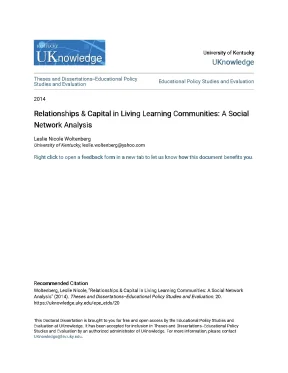
Tổng quan luận án
Luận án tiến sĩ mang tên Relationships & Capital in Living Learning Communities: A Social Network Analysis (tạm dịch: Mối quan hệ và Vốn xã hội trong các Cộng đồng Học tập Sống: Một Phân tích Mạng Xã hội) được thực hiện bởi nghiên cứu sinh Leslie Nicole Woltenberg dưới sự hướng dẫn của Giáo sư Jane Jensen (Trưởng ban hướng dẫn) và Giáo sư Jeff Bieber (Giám đốc Chương trình Sau đại học), bảo vệ năm 2014 tại Khoa Chính sách Giáo dục và Đánh giá (Department of Educational Policy Studies and Evaluation), Trường Đại học Sư phạm (College of Education) thuộc Đại học Kentucky (University of Kentucky), Hoa Kỳ.
Tính cấp thiết và khoảng trống nghiên cứu
Trong giáo dục đại học đương đại, các mô hình cộng đồng học tập (Learning Communities - LC) và cộng đồng học tập sống/nội trú (Living Learning Communities - LLC) đã chuyển dịch từ một xu hướng thử nghiệm thành cấu trúc trọng tâm tại nhiều trường đại học. Sự phát triển này phản ánh bước chuyển dịch quan niệm từ mô hình giảng dạy truyền thống sang mô hình học tập lấy người học làm trung tâm, đề cao giá trị của học tập đồng hành ngoại khóa, học tập hợp tác và sự phát triển sinh viên.
Mặc dù hệ thống tài liệu nghiên cứu phong phú đã chứng minh sinh viên tham gia cộng đồng học tập có tỷ lệ duy trì học tập (retention) cao hơn, đạt kết quả học tập tốt hơn, kết nối xã hội tốt hơn và chuyển tiếp thuận lợi từ trung học lên đại học, phần lớn các công trình trước đây chỉ tập trung đánh giá hiệu quả đầu ra tổng thể hoặc mang tính chất định tính mô tả rời rạc. Tác giả chỉ ra khoảng trống nghiên cứu căn bản: các tài liệu hiện có giải thích lịch sử phát triển, cung cấp cơ sở lý thuyết vì sao các cộng đồng này nên hoạt động hiệu quả và đo lường giá trị vĩ mô, nhưng thiếu vắng các nghiên cứu khám phá sâu bản chất những gì thực sự diễn ra bên trong cộng đồng. Cụ thể, cơ chế tương tác vi mô giữa sinh viên với nhau, quá trình học hỏi lẫn nhau và cách thức vốn xã hội được hình thành, trao đổi và tích lũy trong mạng lưới nội trú vẫn chưa được định lượng và mô hình hóa rõ ràng.
Mục tiêu và câu hỏi nghiên cứu
Nghiên cứu được thiết kế nhằm khám phá các mối liên hệ có thể có giữa các mối quan hệ bạn bè cùng trang lứa và vai trò cá nhân của từng sinh viên trong một mạng lưới xã hội đối với các kết quả đầu ra như thành tích học tập tự báo cáo và mức độ hài lòng cá nhân trong năm đầu tiên tại trường đại học.
Câu hỏi nghiên cứu định hướng toàn bộ luận án là:
Câu hỏi nghiên cứu: How does a student’s role within a residential community of peers relate to success in college? (Vai trò của một sinh viên trong một cộng đồng bạn bè nội trú liên hệ như thế nào với sự thành công ở đại học?)
Khái niệm "thành công" trong khuôn khổ luận án được đo lường và thao tác hóa theo hai chiều kích:
- Thành công theo định nghĩa học thuật truyền thống: Thể hiện qua điểm trung bình học tập (Grade Point Average - GPA) tự báo cáo của sinh viên trong một kỳ học xác định (học kỳ mùa Thu năm 2013 - học kỳ đầu tiên của bậc đại học).
- Thành công theo cấu trúc mạng lưới: Thể hiện qua số lượng và loại hình các mối liên kết quan hệ (relational ties) mà sinh viên thiết lập và duy trì bên trong mạng lưới cộng đồng học tập xác định.
Đối tượng và phạm vi nghiên cứu
- Đối tượng nghiên cứu: Các mối quan hệ bạn bè cùng trang lứa, vai trò và vị trí của các cá nhân (sinh viên, nhân viên) trong cấu trúc mạng lưới xã hội, sự tích lũy và chuyển dịch vốn xã hội, cùng mối liên hệ với điểm GPA tự báo cáo.
- Phạm vi không gian: Một cộng đồng học tập sống chuyên ngành Kỹ thuật (Engineering Learning Community) tại một trường đại học công lập đào tạo 4 năm ở khu vực miền Nam Hoa Kỳ, bao gồm sinh viên cư trú tại hai khu ký túc xá ERC và MAE.
- Phạm vi thời gian: Dữ liệu khảo sát mạng lưới và trải nghiệm sinh viên được thu thập vào học kỳ mùa Xuân năm 2014 (Spring 2014), đo lường kết quả học tập của học kỳ mùa Thu năm 2013 (Fall 2013).
Tổng quan tài liệu và vị trí của luận án
Luận án hệ thống hóa tài liệu học thuật xoay quanh ba mảng chủ đề chính:
1. Tổng quan lịch sử giáo dục đại học và các cộng đồng nội trú
Tác giả truy nguyên nguồn gốc của mô hình cộng đồng nội trú từ các trường đại học Oxford và Cambridge tại Anh (Adelman, 1969; Lenning & Ebbers, 1999), nơi đời sống học thuật kết hợp chặt chẽ với sinh hoạt xã hội. Tại Hoa Kỳ, Woodrow Wilson tại Đại học Princeton đã thúc đẩy hồi sinh mô hình đại học nội trú để tạo môi trường gắn kết tự nhiên giữa giảng viên và sinh viên cả trong lẫn ngoài lớp học (Ryan, 1992). Vào thập niên 1930, khoảng 40 trường đại học nội trú đã ra đời, tiêu biểu là kế hoạch nhà ở năm 1929 của Đại học Harvard nhằm thúc đẩy đời sống xã hội và giao lưu học thuật (Duke, 1997).
Song song đó là sự hình thành chương trình giáo dục đại cương trong hai năm đầu đại học tại Mỹ. Alexander Meiklejohn đã sáng lập Trường Cao đẳng Thực nghiệm (Experimental College) tại Đại học Wisconsin vào năm 1927 nhằm khắc phục sự rời rạc của giáo dục và kết hợp môi trường sống với môi trường học tập (Meiklejohn, 1932; Tinto, 2003). Cùng thời kỳ, nhà triết học John Dewey phổ biến quan điểm giáo dục lấy người học làm trung tâm, nhấn mạnh học tập chủ động và hợp tác (Dewey; Smith et al., 2004; Tinto & Goodsell, 1994). Các tư tưởng này tạo tiền đề cho các nghiên cứu tiếp theo của Pascarella & Terenzini về sự kiến tạo tri thức xã hội và quan điểm phát triển sinh viên.
2. Các mô hình cộng đồng học tập đương đại
Tác giả điểm lại định nghĩa kinh điển của Alexander Astin về cộng đồng học tập nhằm xây dựng bản sắc nhóm và tính gắn kết (Astin, 1984, 1993), cùng khái niệm "môi trường học tập liền mạch" (seamless learning environments) của Shapiro & Levine (1999). Theo Jaffee (2004), bốn yếu tố then chốt thúc đẩy học tập gồm: sự giao thoa chủ đề môn học, học tập cùng bạn bè, sự tham gia chủ động và việc thiết lập kết nối cá nhân với sinh viên và giảng viên.
Luận án tổng hợp mô hình phân loại kết hợp từ công trình của Lenning & Ebbers (1999) và Shapiro & Levine (1999) thành ba dạng chính:
- Cộng đồng học tập theo chương trình (Curricular learning communities): Tập trung vào việc liên kết môn học (nhóm 25-50 sinh viên), bao gồm các nhóm sở thích năm nhất (FIGs), cụm khóa học, chương trình nghiên cứu phối hợp (Jaffee, 2004; Hurd & Stein, 2004).
- Nhóm đoàn hệ (Cohorts): Tập trung vào các khóa học liên kết và hoạt động xã hội nhưng không nhất thiết chia sẻ không gian nội trú chung (Finley, 1995; Lenning & Ebbers, 1999).
- Cộng đồng học tập nội trú (Residential learning communities): Kết hợp không gian cư trú với các chương trình học thuật và ngoại khóa nhằm nâng cao nhận thức và phát triển trí tuệ (Terenzini et al., 1999; Lenning & Ebbers, 1999).
Nghiên cứu cũng tham chiếu công trình tiêu biểu Learning Communities: Reforming Undergraduate Education của Barbara Leigh Smith, Jean MacGregor, Roberta Matthews, và Faith Gabelnick (2004) với năm thực hành cốt lõi: cộng đồng (community), đa dạng (diversity), phản tư và đánh giá (reflection and assessment), tích hợp (integration), và học tập chủ động (active learning).
3. Tổng quan nghiên cứu kết quả đầu ra và khoảng trống
Các nghiên cứu trước đây thông qua Khảo sát Trải nghiệm Sinh viên Đại học (CSEQ) và mô hình duy trì học tập của Vincent Tinto (1987, 1994, 1998, 2003) chỉ ra rằng sinh viên LLC có mức độ hội nhập học thuật và xã hội cao hơn. Price (2005) tại University of Texas at El Paso ghi nhận tỷ lệ duy trì học tập của sinh viên tham gia chương trình học tập sống đạt 80% so với 68% ở nhóm không tham gia. Nhiều nghiên cứu khác (Kuh, 1981; MacGregor & Smith, 1992; Edwards & McKelfresh, 2002; Whitt et al.) xác nhận sinh viên ở ký túc xá có điểm GPA cao hơn và động lực học tập tốt hơn.
Tuy nhiên, các phê phán học thuật (như Georgia Institute of Technology, 2000; Terenzini, Pascarella, & Blimling, 1999; Pemberton, 1996) cho rằng các kết quả này có thể đạt được độc lập mà không cần LLC, hoặc cảnh báo về các tác động phụ như hiện tượng tư duy tập thể (group-think) và tính độc quyền.
Vị trí của luận án: Luận án của Woltenberg định vị như một công trình tiên phong sử dụng phương pháp Phân tích Mạng Xã hội (Social Network Analysis - SNA) để "mở hộp đen" của cộng đồng học tập sống, định lượng trực tiếp các mắt xích tương tác và vai trò cá nhân thay vì chỉ nhìn vào các chỉ số đầu ra rời rạc.
Cơ sở lý thuyết và phương pháp nghiên cứu
Cơ sở lý thuyết
Luận án tích hợp một khung lý thuyết đa tầng nhằm phân tích các mối quan hệ xã hội và sự luân chuyển tri thức:
- Khung lý thuyết Cộng đồng Thực hành (Communities of Practice - CoP):
- Được phát triển bởi Etienne Wenger và Jean Lave (1991) với khái niệm "sự tham gia ngoại vi hợp pháp" (legitimate peripheral participation). Quá trình học tập diễn ra thông qua sự tương tác xã hội giữa người mới (novice) và chuyên gia (expert).
- Ba đặc trưng cốt lõi của CoP (Wenger, 2004; Wenger, McDermott, & Snyder, 2000):
- Miền (Domain): Lĩnh vực kiến thức hoặc mối quan tâm chung kết nối các thành viên (trong luận án là khối ngành Kỹ thuật).
- Cộng đồng (Community): Tập hợp các cá nhân tương tác, xây dựng mối quan hệ và học hỏi lẫn nhau.
- Thực hành (Practice): Khối kiến thức, tài nguyên và công cụ được các thành viên chia sẻ và phát triển chung.
- Các lý thuyết bổ trợ về chuyển dịch tri thức:
- Khái niệm Cộng đồng nhận thức (Epistemic communities) của Peter Haas (1992).
- Khái niệm Bộ nhớ tương tác nhóm (Transactive memory) của Daniel Wegner (1985) về việc phân công trách nhiệm lưu giữ tri thức chuyên biệt trong nhóm.
- Quan sát của Julian Orr (1996) về đối thoại phi chính thức trong việc chia sẻ kinh nghiệm kỹ thuật.
- Lý luận tâm lý học văn hóa - xã hội của Lev Vygotsky (1978, 1986) về phát triển nhận thức gắn liền với hoạt động xã hội.
- Không gian vật lý như một tác tử mạng lưới (Physical Space as an Actor):
- Dựa trên công trình Knowledge in Motion của Jan Nespor (1994), áp dụng quan điểm đối xứng của lý thuyết mạng lưới tác tử (actor-network theory) xem không gian vật lý, chương trình học, sách vở và bài tập như những tác tử có vai trò định hình các mối quan hệ xã hội.
- Thuyết Thực tế ảo thực sự (Real Virtuality) của Manuel Castells (2000) và các nghiên cứu kiến trúc ký túc xá của Charles Schroeder (Blimling et al.), Goodsell, Love, & Tokuno (1999).
- Vốn xã hội và Lý thuyết Tự tác giả (Self-Authorship):
- Khái niệm vốn xã hội của Gargiulo & Benassi (1999), Pierre Bourdieu, James Coleman (1988), Robert Putnam (1995) và Ronald Burt (2002, 2005) về lợi thế cạnh tranh của các lỗ hổng cấu trúc (structural holes), vai trò của cầu nối/môi giới (brokerage) và sự đóng kín mạng lưới (closure).
- Nghiên cứu của Cote & Levine (1997) về động lực tạo dựng quan hệ để gia tăng vốn con người và xã hội.
- Mô hình Đối tác Học tập (Learning Partnership Model - LPM) của Marcia Baxter Magolda (2004) dựa trên thuyết Thách thức và Hỗ trợ của Sanford (1967) giúp sinh viên chuyển đổi từ việc phụ thuộc vào quyền lực bên ngoài sang Tự tác giả (Self-authorship) qua ba nguyên tắc: xác thực năng lực hiểu biết của người học, đặt việc học vào trải nghiệm thực tế, và cùng kiến tạo ý nghĩa (Kramer, 2007; MacGregor, 1991).
Phương pháp nghiên cứu
- Thiết kế nghiên cứu: Tiếp cận phương pháp hỗn hợp (mixed-methods) lấy Phân tích Mạng Xã hội (Social Network Analysis - SNA) làm phương pháp định lượng trung tâm để mô hình hóa cấu trúc tương tác.
- Khung phân tích mạng:
- Đơn vị phân tích (Node/Actor): Từng sinh viên và nhân viên trong cộng đồng.
- Mối liên kết (Tie/Linkage): Dòng trao đổi thông tin, mối quan hệ quen biết, tình bạn, tìm kiếm lời khuyên, quan hệ với nhân viên và quan hệ đối kháng.
- Độ mạnh liên kết (Tie strength): Phân cấp từ quan hệ quen biết thông thường đến "bạn bè" và "bạn thân" (strong ties).
- Chỉ số cấu trúc: Mật độ mạng (density), độ gắn kết (cohesion), vị trí trung tâm (centrality), các nút môi giới (broker nodes), mạng lưới vị nhân (EgoNet).
- Công cụ thu thập dữ liệu: Bản khảo sát Engineering Learning Community Survey, Spring 2014 (Phụ lục A) được gửi qua thư điện tử đến toàn bộ sinh viên trong cộng đồng.
- Kỹ thuật phân tích dữ liệu:
- Trực quan hóa bản đồ mạng lưới (Network mapping/visualization).
- Phân tích hồi quy tuyến tính (Linear Regression Analysis) kiểm định tác động của các thuộc tính mạng lưới (mức độ phổ biến, liên kết với nhân viên, vai trò cho lời khuyên, giới tính) lên điểm GPA tự báo cáo của học kỳ mùa Thu 2013.
Nội dung chính theo từng chương
Cấu trúc luận án gồm 5 chương chính và hệ thống bảng biểu, hình vẽ minh họa:
| Chương / Danh mục |
Tên chương / Nội dung trong văn bản |
| Chapter 1 |
Introduction (Mở đầu, câu hỏi nghiên cứu, bối cảnh, định nghĩa thuật ngữ, tổ chức nghiên cứu) |
| Chapter 2 |
Literature Review (Tổng quan lịch sử, các mô hình cộng đồng học tập, nghiên cứu kết quả đầu ra, khung lý thuyết Cộng đồng Thực hành, chuyển dịch tri thức, không gian vật lý, vốn xã hội và tự tác giả) |
| Chapter 3 |
Research Design (Thiết kế nghiên cứu, quy trình chọn mẫu, công cụ khảo sát và phân tích dữ liệu) |
| Chapter 4 |
Research Findings & Interpretation (Phát hiện nghiên cứu và diễn giải chi tiết qua các mạng lưới và phân tích hồi quy) |
| Chapter 5 |
Summary, Limitations, & Suggestions for Future Studies (Tóm tắt, ý nghĩa kết quả, hạn chế, kiến nghị nghiên cứu tương lai và ứng dụng thực tiễn) |
Danh mục Bảng và Hình trong Luận án
| Ký hiệu |
Tên Bảng / Hình trong văn bản |
Trang |
| Table 1 |
Academic Majors within the Engineering Community |
54 |
| Table 2 |
Excerpt from Network Centrality Data Output |
76 |
| Table 3 |
Self-Reported GPA Data for Fall 2013 |
81 |
| Table 4 |
Popularity & GPA Regression output |
84 |
| Table 5 |
Central Nodes in Knowing Network |
85 |
| Table 6 |
Staff-Tie EgoNet Composition Excerpt |
86 |
| Table 7 |
Relationships with Staff & GPA Regression |
87 |
| Table 8 |
Advice-giving EgoNet Composition excerpt |
90 |
| Table 9 |
Advice, Gender, & GPA Regression Output |
91 |
| Table 10 |
Broker Nodes’ Engineering Majors List |
96 |
| Figure 1 |
Knowing Network visualization |
64 |
| Figure 2 |
Females-only Knowing Network |
66 |
| Figure 3 |
Males-only Knowing Network |
67 |
| Figure 4 |
Knowing Network with Strength of Tie Network |
71 |
| Figure 5 |
ERC-only Friends & Close Friends |
72 |
| Figure 6 |
MAE-only Friends & Close Friends |
73 |
| Figure 7 |
Close Friend Strength Network (ERC & MAE) |
74 |
| Figure 8 |
Friendship Network with Centrality |
78 |
| Figure 9 |
Friendship Centrality |
93 |
| Figure 10 |
Brokers within Friendship Centrality |
95 |
| Figure 11 |
Adversary Centrality |
98 |
Tóm tắt nội dung chi tiết từng chương
Chapter One: Introduction
Chương này thiết lập cơ sở lập luận về sự tiến hóa của các khu nội trú đại học thành các trung tâm sáng tạo và hỗ trợ sinh viên thành công. Tác giả xác định câu hỏi nghiên cứu, định vị nghiên cứu trong bối cảnh một cộng đồng sinh viên năm nhất ngành Kỹ thuật tại một trường đại học công lập miền Nam Hoa Kỳ. Chương cũng làm rõ các định nghĩa thao tác hóa quan trọng:
- Student Affairs / Residence Life: Đội ngũ phụ trách công tác sinh viên và quản lý đời sống nội trú.
- Learning Community: Môi trường sống và học tập chung trong ký túc xá có liên kết học thuật và xã hội.
- Community of Practice: Mạng lưới quan hệ tạo cơ hội học tập (Lave & Wenger, 1991).
- Social Capital: Tổng nguồn lực thực tế hoặc tiềm năng tích lũy qua mạng lưới quan hệ (Gargiulo & Benassi, 1999).
- Node/Actor: Cá nhân trong mạng lưới; Tie/Linkage: Mối quan hệ liên kết giữa các nút.
- Network Structure & Strong Ties: Cấu trúc mẫu hình liên kết và các mối quan hệ mật thiết đa mục đích (bạn thân).
Chapter Two: Literature Review
Chương 2 cung cấp nền tảng học thuật toàn diện qua ba mảng lớn:
- Tổng quan lịch sử: Quá trình phát triển từ các trường đại học Oxford, Cambridge đến mô hình đại học nội trú tại Harvard, Yale, Princeton và thử nghiệm của Meiklejohn tại Wisconsin, cùng ảnh hưởng của triết lý giáo dục John Dewey.
- Mô hình và kết quả nghiên cứu: Tổng kết các mô hình của Lenning & Ebbers, Shapiro & Levine, Smith et al. (2004), và lý thuyết duy trì của Tinto (1987, 1998, 2003). Tác giả làm nổi bật bốn yếu tố tác động đến học tập và chỉ ra khoảng trống về việc nghiên cứu quá trình tương tác nội tại của cộng đồng.
- Khung lý thuyết: Trình bày chi tiết lý thuyết Cộng đồng Thực hành (Lave & Wenger, 1991), chuyển dịch tri thức (Haas, 1992; Wegner, 1985; Orr, 1996; Vygotsky, 1978), vai trò tác tử của không gian vật lý (Nespor, 1994; Kuh, 1981; Castells, 2000), lý thuyết vốn xã hội (Burt, 2002; Coleman, 1988; Putnam, 1995) và quá trình phát triển năng lực Tự tác giả thông qua Mô hình Đối tác Học tập (Baxter Magolda, 2004; Kramer, 2007).
Chapter Three: Research Design
Chương này mô tả chi tiết phương pháp nghiên cứu, quy trình triển khai công cụ khảo sát mạng lưới (Engineering Learning Community Survey, Spring 2014) và các kỹ thuật xử lý dữ liệu. Bảng 1 (Table 1, trang 54) mô tả cơ cấu các chuyên ngành kỹ thuật trong cộng đồng. Tác giả giải thích quy trình mã hóa dữ liệu mạng lưới để chuẩn bị cho việc trực quan hóa cấu trúc liên kết và chạy các mô hình phân tích hồi quy.
Chapter Four: Research Findings & Interpretation
Chương 4 trình bày toàn bộ kết quả phân tích mạng lưới và kiểm định thống kê:
- Phân tích mạng lưới quen biết (Knowing Networks): Trực quan hóa tổng thể (Figure 1), phân tích tiểu mạng lưới nữ sinh (Figure 2) và tiểu mạng lưới nam sinh (Figure 3), xác định các nút trung tâm trong mạng lưới quen biết (Table 5).
- Phân tích độ mạnh liên kết (Strength of Tie Networks): Mô hình hóa mạng lưới kết hợp độ mạnh liên kết (Figure 4), mạng lưới bạn bè và bạn thân riêng tại khu ERC (Figure 5), riêng tại khu MAE (Figure 6), và mạng lưới bạn thân tích hợp cả ERC và MAE (Figure 7). Dữ liệu mức độ trung tâm mạng lưới được trích xuất tại Table 2.
- Phân tích mạng lưới tình bạn, môi giới và đối kháng: Đo lường vị trí trung tâm tình bạn (Figure 8, Figure 9), xác định các nút giữ vai trò môi giới (Broker Nodes) kết nối các nhóm sinh viên khác nhau (Figure 10) cùng danh sách chuyên ngành kỹ thuật của các nút môi giới (Table 10). Mạng lưới quan hệ đối kháng/bất đồng cũng được trực quan hóa (Figure 11).
- Phân tích hồi quy với điểm GPA:
- Dữ liệu điểm GPA tự báo cáo học kỳ mùa Thu 2013 được tổng hợp tại Table 3.
- Mức độ phổ biến và GPA: Kết quả hồi quy (Table 4) cho thấy mức độ phổ biến trong mạng lưới quen biết không phải là biến dự báo có ý nghĩa thống kê đối với điểm GPA cao hơn.
- Liên kết với nhân viên và GPA: Phân tích mạng lưới vị nhân về quan hệ với nhân viên (Table 6) và kết quả hồi quy (Table 7) xác nhận việc có nhiều liên kết với nhân viên ký túc xá không đồng nghĩa với việc đạt điểm GPA cao hơn.
- Vai trò cho lời khuyên, giới tính và GPA: Phân tích mạng lưới vị nhân về việc cho lời khuyên (Table 8) và kết quả hồi quy đa biến (Table 9) chỉ ra vai trò là người được tìm kiếm để xin lời khuyên và yếu tố giới tính không có mối liên hệ mang ý nghĩa thống kê đối với GPA.
Chapter Five: Summary, Limitations, & Suggestions for Future Studies
Chương cuối tóm tắt các phát hiện chính, phân tích ý nghĩa lý luận và thực tiễn:
- Khẳng định cộng đồng học tập đã hoàn thành mục tiêu cốt lõi: biến một nhóm người lạ ban đầu thành một mạng lưới bạn bè gắn kết, tạo ra môi trường tương tác dày đặc và hỗ trợ lẫn nhau.
- Môi trường quan hệ phong phú hoạt động như một "giàn giáo" (scaffolding) giúp sinh viên năm nhất cùng kiến tạo tri thức và chuyển đổi nhận thức từ chỗ phụ thuộc vào thẩm quyền bên ngoài sang năng lực Tự tác giả (Self-authorship).
- Trình bày các hạn chế của nghiên cứu, đề xuất hướng nghiên cứu tiếp theo và gợi ý ứng dụng thực tiễn cho các nhà quản lý công tác sinh viên và giảng viên đại học.
Kết quả và những đóng góp mới
Kết quả nghiên cứu chính
- Đặc tính cấu trúc mạng lưới:
- Phân tích mạng lưới xã hội xác nhận cộng đồng học tập sống chuyên ngành Kỹ thuật sở hữu mật độ mạng lưới mạnh (strong network density), độ gắn kết cao (cohesion) và cấu trúc phù hợp cho dòng luân chuyển vốn xã hội lý tưởng.
- Cộng đồng chứng minh tính hiệu quả trong việc thiết lập sự quen thuộc và cung cấp môi trường nuôi dưỡng các mối quan hệ tình bạn bền vững giữa các sinh viên với nhau và giữa sinh viên với đội ngũ nhân viên ký túc xá.
- Mối liên hệ giữa các thuộc tính mạng lưới và kết quả học tập (GPA):
- Phân tích hồi quy chứng minh: mức độ phổ biến (popularity), việc sở hữu nhiều liên kết quan hệ với nhân viên (relational ties to staff), và việc trở thành người được bạn bè tìm kiếm để xin lời khuyên (being sought-after for advice) không phải là các biến dự báo có ý nghĩa thống kê đối với mức điểm GPA cao hơn trong học kỳ đầu đại học.
- Phát triển nhận thức và sự tự tác giả:
- Mặc dù không trực tiếp làm tăng điểm số cá nhân một cách cơ học, môi trường quan hệ dày đặc đã tạo điều kiện cho sinh viên phát triển năng lực cùng kiến tạo tri thức (construct knowledge alongside their peers).
- Mạng lưới đóng vai trò giàn giáo phát triển, hỗ trợ sinh viên thực hiện bước chuyển đổi quan trọng về mặt nhận thức: từ sự phụ thuộc hoàn toàn vào thẩm quyền bên ngoài sang mức độ nhận thức phức hợp hơn và đạt được tính Tự tác giả (self-authorship) trong quá trình tạo lập ý nghĩa.
Đóng góp về lý luận và phương pháp
- Bổ sung vào hệ thống lý thuyết về cộng đồng học tập bằng cách áp dụng khung phân tích Cộng đồng Thực hành (Communities of Practice) kết hợp với phương pháp Phân tích Mạng Xã hội (SNA), mở ra cách thức định lượng và trực quan hóa cấu trúc tương tác vi mô bên trong ký túc xá sinh viên.
- Đóng góp mô hình khái niệm kết hợp giữa lý thuyết vốn xã hội, lý thuyết mạng lưới tác tử (vai trò của không gian vật lý) và mô hình đối tác học tập hướng đến sự tự tác giả.
Đề xuất và giải pháp ứng dụng thực tiễn
- Giúp các nhà quản trị đại học, cán bộ phụ trách công tác sinh viên (Student Affairs) và nhân viên đời sống nội trú (Residence Life) hiểu rõ tầm quan trọng của việc kiến tạo môi trường vật lý và xã hội thúc đẩy tương tác đồng đẳng.
- Khuyến nghị xây dựng các chương trình nội trú mang tính chủ đích (intentionality), tạo không gian cân bằng giữa hoạt động học thuật và sinh hoạt xã hội, đồng thời tận dụng đội ngũ nhân viên như những người kết nối và hỗ trợ thiết lập giàn giáo phát triển cho sinh viên năm nhất.
Hạn chế và hướng nghiên cứu tiếp
Hạn chế của nghiên cứu
- Chỉ số học tập tự báo cáo: Dữ liệu kết quả học tập (GPA học kỳ mùa Thu 2013) dựa trên hình thức tự báo cáo của sinh viên trong khảo sát, không phải dữ liệu trích xuất trực tiếp từ hệ thống quản lý học tập chính thức của nhà trường.
- Phạm vi mẫu nghiên cứu: Đề tài được thực hiện trên một quần thể đơn lẻ là cộng đồng học tập sống ngành Kỹ thuật tại một trường đại học công lập 4 năm ở miền Nam Hoa Kỳ, do đó tính khái quát hóa cho các bối cảnh hoặc ngành học khác có thể bị hạn chế.
- Thiết kế cắt ngang (Cross-sectional): Khảo sát mạng lưới được tiến hành tại một thời điểm (học kỳ mùa Xuân 2014), phản ánh lát cắt cấu trúc mạng lưới tại thời điểm đó chứ chưa theo dõi sự biến đổi động của mạng lưới theo thời gian dài.
Hướng nghiên cứu tiếp theo
- Mở rộng phân tích mạng lưới xã hội sang các mô hình cộng đồng dành cho sinh viên năm thứ hai trở đi (second-year experiences and beyond) để kiểm tra tính bền vững của các mối liên kết quan hệ.
- Áp dụng phương pháp phân tích mạng lưới cho các nhóm sinh viên khác nhau (sinh viên thuộc các tổ chức đoàn thể, các chuyên ngành khoa học xã hội, hoặc các lớp học quy mô khác nhau).
- Thực hiện các nghiên cứu theo chiều dọc (longitudinal studies) để theo dõi sự luân chuyển vốn xã hội và sự biến đổi của cấu trúc mạng lưới qua nhiều năm học đại học.
Giá trị tham khảo
Luận án cung cấp giá trị tham khảo chuyên môn cho nhiều nhóm đối tượng trong giáo dục đại học:
- Nghiên cứu sinh và học giả chuyên ngành Giáo dục học / Chính sách Giáo dục: Cung cấp khung phương pháp luận kết hợp giữa Phân tích Mạng Xã hội (SNA) và lý thuyết Cộng đồng Thực hành (CoP) để nghiên cứu các môi trường giáo dục đồng đẳng.
- Cán bộ quản lý Công tác Sinh viên (Student Affairs) và Quản lý Ký túc xá (Residence Life): Cung cấp góc nhìn thực chứng về cách bố trí không gian vật lý, thiết kế chương trình ngoại khóa và vai trò của nhân viên nội trú trong việc hình thành mạng lưới xã hội hỗ trợ sinh viên.
- Các nhà hoạch định chính sách giáo dục đại học: Cung cấp bằng chứng về giá trị phát triển nhận thức và khả năng tự tác giả của sinh viên trong các mô hình cộng đồng học tập sống, hỗ trợ việc ra quyết định phân bổ nguồn lực và đầu tư cơ sở hạ tầng ký túc xá.
Câu hỏi thường gặp
1. Câu hỏi nghiên cứu chính của luận án là gì và khái niệm "thành công" được đo lường như thế nào?
Trả lời: Câu hỏi nghiên cứu định hướng của luận án là: "How does a student’s role within a residential community of peers relate to success in college?" (Vai trò của sinh viên trong một cộng đồng bạn bè nội trú liên hệ như thế nào với sự thành công ở đại học?). Khái niệm thành công được đo lường qua hai khía cạnh: (1) thành tích học tập truyền thống thể hiện qua điểm GPA tự báo cáo trong học kỳ mùa Thu 2013; và (2) số lượng cùng loại hình các mối liên kết quan hệ mà sinh viên thiết lập trong mạng lưới cộng đồng.
2. Kết quả phân tích hồi quy trong Chương 4 cho thấy những biến số mạng lưới nào không có ý nghĩa thống kê dự báo điểm GPA cao hơn?
Trả lời: Theo các bảng kết quả hồi quy tại Chương 4 (Bảng 4, Bảng 7, Bảng 9), ba biến số mạng lưới gồm: mức độ phổ biến trong mạng lưới (popularity), các liên kết quan hệ với nhân viên ký túc xá (relational ties to staff), và việc là người được bạn bè tìm kiếm để xin lời khuyên (being sought-after for advice) đều không phải là các biến dự báo có ý nghĩa thống kê đối với mức điểm GPA cao hơn.
3. Tác giả đã sử dụng những khung lý thuyết nền tảng nào để giải thích quá trình học tập và phát triển của sinh viên?
Trả lời: Luận án sử dụng lý thuyết Cộng đồng Thực hành (Communities of Practice) của Etienne Wenger và Jean Lave (1991) làm khung phân tích trung tâm, kết hợp với lý thuyết Vốn xã hội (Ronald Burt, James Coleman, Robert Putnam, Gargiulo & Benassi), quan điểm Không gian vật lý như một tác tử mạng lưới trong công trình Knowledge in Motion của Jan Nespor (1994), và Mô hình Đối tác Học tập (Learning Partnership Model) hướng đến năng lực Tự tác giả (Self-authorship) của Marcia Baxter Magolda (2004).
4. Cộng đồng học tập cụ thể được khảo sát trong luận án thuộc chuyên ngành nào và tại địa điểm nào?
Trả lời: Nghiên cứu được thực hiện tại một cộng đồng học tập sống chuyên ngành Kỹ thuật (Engineering Learning Community), đặt tại hai khu ký túc xá (ERC và MAE) của một trường đại học công lập đào tạo 4 năm ở khu vực miền Nam Hoa Kỳ.
5. Phát hiện quan trọng nhất về mặt cấu trúc mạng lưới và sự phát triển của sinh viên trong cộng đồng này là gì?
Trả lời: Nghiên cứu xác nhận cộng đồng có mật độ mạng lưới dày đặc, độ gắn kết cao và cấu trúc thích hợp cho dòng luân chuyển vốn xã hội. Môi trường này đã chuyển hóa thành công một nhóm người lạ thành một mạng lưới bạn bè hỗ trợ nhau, tạo nên giàn giáo giúp sinh viên cùng kiến tạo tri thức và chuyển đổi từ việc phụ thuộc vào quyền lực bên ngoài sang năng lực Tự tác giả (self-authorship).
Kết luận
Luận án tiến sĩ của Leslie Nicole Woltenberg (2014) tại Đại học Kentucky đã ứng dụng phương pháp Phân tích Mạng Xã hội kết hợp khung lý thuyết Cộng đồng Thực hành để khám phá cấu trúc tương tác bên trong một cộng đồng học tập sống ngành Kỹ thuật. Kết quả nghiên cứu chỉ ra rằng mặc dù mức độ phổ biến, việc cho lời khuyên hay liên kết với nhân viên không trực tiếp dự báo điểm GPA cao hơn, mạng lưới quan hệ dày đặc và gắn kết đã đóng vai trò giàn giáo thúc đẩy quá trình cùng kiến tạo tri thức và phát triển năng lực tự tác giả của sinh viên năm nhất. Công trình cung cấp một mô hình nghiên cứu thực chứng hữu ích cho các nhà nghiên cứu giáo dục và nhà quản lý đại học trong việc tối ưu hóa thiết kế các môi trường học tập nội trú.