Khảo Sát Sử Dụng Hoạt Động Sau Bài Đọc tại THPT Hòn Gai - Luận văn Thạc Sĩ

Luận văn thạc sĩ: Khảo sát việc sử dụng các hoạt động sau khi đọc của giáo viên tại trường THPT Hòn Gai. Nghiên cứu về phương pháp giảng dạy tiếng Anh hiệu quả.

Chuyên ngành

Methodology of English Teaching

Người đăng

Ẩn danh

Thể loại

M.A Minor Thesis

2012

83
1
0

Phí lưu trữ

30 Point

Mục lục chi tiết

Declaration

Acknowledgement

Table of contents

List of figures and abbreviations

1. PART A: INTRODUCTION

1.1. Research aims and research questions

1.2. Significance of the study

1.3. Scope of the study

1.4. Expected outcome and contributions of the study

1.5. Design of the study

2. PART B: DEVELOPMENT

2.1. Chapter I: Literature review

2.1.1. Definitions of reading

2.1.2. The importance of reading

2.1.3. General views on post-reading activities

2.1.3.1. Definitions of post-reading activities

2.2. Types of post-reading activities

2.3. The effectiveness when using post-reading activities

2.4. The difficulties when doing post-reading activities

2.5. Chapter II: The study

2.5.1. Description of subject

2.5.2. Data collection instrument

2.5.3. Data collection procedure

2.5.3.1. For the questionnaire
2.5.3.2. For the observation
2.5.3.3. For the interview

2.5.4. Data analysis method

2.5.5. Data analysis procedure

2.5.5.1. For the questionnaire
2.5.5.2. For the interview

2.5.6. Survey questionnaire for teachers

2.5.7. The frequency that teachers implement post-reading activities in a class

2.5.8. The table shows the frequency that teachers implement post-reading activities in a class

2.5.9. The pie chart shows frequency that teachers implement post-reading activities in a class

2.5.10. The post – reading activities that teachers implement

2.5.11. The table shows the post – reading activities that teachers implement

2.5.12. The bar chart shows the post – reading activities that teachers implement

2.5.13. The effectiveness of post-reading activities suggested by the teachers of English

2.5.14. The difficulties that encountered by the teachers when implementing post- reading activities

2.5.15. The result table shows the difficulties that encountered by the teachers when implementing post- reading activities

2.5.16. The bar chart shows the difficulties that encountered by the teachers when implementing post- reading activities

2.5.17. The ways to overcome those difficulties suggested by the teachers

2.5.18. Survey questionnaire for students

2.5.19. The effectiveness of post-reading activities in students‘ thinking

2.5.20. The table shows the students‘ thinking about the effectiveness of post-reading activities

2.5.21. The bar chart shows the students‘ thinking about the effectiveness of post-reading activities

2.5.22. The post-reading activities that students prefer to take part in

2.5.23. The table shows the post-reading activities that students prefer to take part in

2.5.24. The bar chart shows the post-reading activities that students prefer to take part in

2.5.25. The difficulties students have to face when taking part in post-reading activities

2.5.26. The table shows the difficulties students have to face when taking part in post-reading activities

2.5.27. The bar chart shows the difficulties students have to face when taking part in post-reading activities

2.5.28. The ways to overcome those difficulties suggested by the students

2.5.29. The table shows how students overcome the difficulties encountered when taking part in post-reading activities

2.5.30. The bar chart shows how students overcome the difficulties encountered when taking part in post-reading activities

2.6. Chapter III: Findings and discussion

2.6.1. How is teachers‘ use of post-reading activities implemented at Hon Gai high school?

2.6.2. What is the effectiveness of post-reading activities as perceived by teachers and students?

2.6.3. What are difficulties encountered by students and teachers when doing post-reading activities?

2.6.4. Observation

3. PART C: CONCLUSION

REFERENCES

Appendix 1a

Appendix 1b

Appendix 2a

Appendix 2b

Appendix 3

Appendix 4

Tóm tắt

I. Tổng Quan Hoạt Động Sau Bài Đọc Ngữ Văn THPT Hòn Gai

Nghiên cứu này tập trung vào việc sử dụng hoạt động sau bài đọc tại THPT Hòn Gai, một phương pháp quan trọng trong việc nâng cao kỹ năng đọc của học sinh. Việc đọc hiểu không chỉ dừng lại ở việc nắm bắt thông tin mà còn bao gồm việc suy ngẫm, phân tích và vận dụng kiến thức vào thực tế. Nhiều nghiên cứu đã chỉ ra mối tương quan mạnh mẽ giữa kỹ năng đọc và thành công trong học tập. Trong bối cảnh Việt Nam, nơi phương pháp giảng dạy ngày càng được cải tiến, các hoạt động sau bài đọc đóng vai trò then chốt trong việc giúp học sinh chủ động và tự tin hơn trong quá trình học Ngữ Văn. Hoạt động sau bài đọc khuyến khích học sinh suy ngẫm về nội dung đã đọc, giúp thông tin được ghi nhớ và vận dụng hiệu quả hơn. Nghiên cứu của Alderson (2000) về 'Assessing reading' đã phân tích hiệu quả của các hoạt động đọc, bao gồm cả hoạt động sau bài đọc. Mặc dù vậy, vẫn còn tồn tại khoảng cách giữa lý thuyết và thực tiễn, đặc biệt là trong việc khai thác tối đa tiềm năng của hoạt động sau bài đọc trong các trường THPT.

1.1. Định Nghĩa và Mục Tiêu của Hoạt Động Sau Bài Đọc

Hoạt động sau bài đọc là các hoạt động được thực hiện sau khi học sinh đã hoàn thành việc đọc một văn bản, nhằm củng cố kiến thức, phát triển tư duy phản biệnkhơi gợi cảm hứng học tập. Mục tiêu chính là đảm bảo học sinh thực sự hiểu và có thể vận dụng kiến thức từ văn bản. Theo Chastain (1998), hoạt động sau bài đọc giúp học sinh làm rõ những ý nghĩa chưa rõ ràng, tập trung vào ý nghĩa tổng thể của văn bản hơn là các khía cạnh ngữ pháp hay từ vựng đơn thuần. Ur (1996) đề xuất tóm tắt nội dung là một hình thức của hoạt động sau bài đọc, trong đó học sinh được yêu cầu tóm tắt nội dung chính bằng một hoặc hai câu. Các hoạt động như thảo luận, trả lời câu hỏi, và rút ra kết luận cũng giúp học sinh hoàn thiện bức tranh toàn cảnh về văn bản (Karakas, 2002).

1.2. Tầm Quan Trọng của Hoạt Động Sau Bài Đọc tại THPT Hòn Gai

Tại THPT Hòn Gai, hoạt động sau bài đọc đóng vai trò quan trọng trong việc giúp học sinh tiếp cận và hiểu sâu sắc hơn các tác phẩm văn học. Các hoạt động này không chỉ giúp học sinh ghi nhớ thông tin mà còn khuyến khích các em phân tích tác phẩm, thảo luận văn học, và liên hệ thực tế. Điều này đặc biệt quan trọng trong bối cảnh học sinh THPT cần phát triển tư duy phản biện và khả năng vận dụng kiến thức vào các tình huống thực tế. Việc sử dụng hoạt động sau bài đọc hiệu quả có thể giúp khơi gợi cảm hứng học tậptăng cường tương tác học sinh, từ đó nâng cao chất lượng giảng dạy và học tập Ngữ Văn.

II. Thách Thức trong Triển Khai Hoạt Động Sau Bài Đọc Hiệu Quả

Mặc dù có nhiều lợi ích, việc triển khai hoạt động sau bài đọc hiệu quả tại THPT Hòn Gai vẫn đối mặt với nhiều thách thức. Những khó khăn này bao gồm hạn chế về thời gian, trình độ tiếng Anh của học sinh, sự khác biệt về trình độ giữa các học sinh, và quy mô lớp học lớn. Những yếu tố này có thể ảnh hưởng đến khả năng của giáo viên trong việc thiết kế và quản lý các hoạt động sau bài đọc một cách hiệu quả. Điều quan trọng là phải tìm ra các giải pháp để vượt qua những thách thức này và đảm bảo rằng tất cả học sinh đều có cơ hội tham gia và hưởng lợi từ hoạt động sau bài đọc.

2.1. Hạn Chế Về Thời Gian và Quy Mô Lớp Học Lớn

Thời gian là một trong những thách thức lớn nhất. Với thời lượng có hạn của mỗi tiết học, giáo viên phải cân đối giữa việc giới thiệu kiến thức mới, củng cố bài học và tổ chức hoạt động sau bài đọc. Quy mô lớp học lớn cũng gây khó khăn trong việc quản lý và đảm bảo tất cả học sinh đều tham gia tích cực. Giáo viên thường không có đủ thời gian để hỗ trợ từng học sinh, đặc biệt là những em có trình độ tiếng Anh còn hạn chế. Điều này có thể dẫn đến việc một số học sinh cảm thấy bị bỏ lại phía sau và mất hứng thú với hoạt động sau bài đọc.

2.2. Trình Độ Tiếng Anh và Sự Khác Biệt Giữa Học Sinh

Trình độ tiếng Anh không đồng đều giữa các học sinh cũng là một thách thức đáng kể. Một số học sinh có thể gặp khó khăn trong việc hiểu văn bản gốc, trong khi những em khác lại dễ dàng nắm bắt thông tin. Sự khác biệt này đòi hỏi giáo viên phải có phương pháp giảng dạy linh hoạt và điều chỉnh hoạt động sau bài đọc sao cho phù hợp với trình độ của từng học sinh. Cần có các hoạt động hỗ trợ cho những học sinh yếu hơn, đồng thời vẫn tạo cơ hội cho những em giỏi hơn được thử thách và phát triển hơn nữa.

III. Phương Pháp Cải Thiện Hoạt Động Sau Bài Đọc Tại THPT Hòn Gai

Để cải thiện hiệu quả của hoạt động sau bài đọc tại THPT Hòn Gai, cần có sự kết hợp của nhiều phương pháp khác nhau. Điều này bao gồm việc đa dạng hóa các loại hoạt động sau bài đọc, sử dụng các công cụ hỗ trợ giảng dạy, và tạo ra một môi trường học tập tích cực và khuyến khích sự tham gia của tất cả học sinh. Bên cạnh đó, cần có sự phối hợp chặt chẽ giữa giáo viên, học sinh và phụ huynh để đảm bảo rằng hoạt động sau bài đọc được thực hiện một cách hiệu quả và mang lại lợi ích tối đa cho học sinh.

3.1. Đa Dạng Hóa Các Loại Hình Hoạt Động Sau Bài Đọc

Một trong những cách hiệu quả nhất để cải thiện hoạt động sau bài đọc là đa dạng hóa các loại hình hoạt động. Thay vì chỉ sử dụng các hoạt động truyền thống như trả lời câu hỏi hay tóm tắt nội dung, giáo viên có thể thử nghiệm các hoạt động sáng tạo hơn như đóng vai, tranh biện, thảo luận nhóm, hoặc thậm chí sử dụng các công cụ trực tuyến để tạo ra các trò chơi tương tác. Việc đa dạng hóa các loại hình hoạt động sẽ giúp học sinh cảm thấy hứng thú hơn và tham gia tích cực hơn vào quá trình học tập. Theo Graves và Bonie B. Graves (2003), có tám loại hình hoạt động sau bài đọc chính: đặt câu hỏi, thảo luận, viết, kịch, hoạt động nghệ thuật, hoạt động ứng dụng, xây dựng kết nối, và giảng lại.

3.2. Tăng Cường Tương Tác Nhóm và Sử Dụng Công Nghệ

Hoạt động nhóm Ngữ Văn nên được khuyến khích nhằm giúp học sinh hỗ trợ lẫn nhau và phát triển kỹ năng làm việc nhóm. Sử dụng các công cụ công nghệ, như phần mềm học tập tương tác hoặc diễn đàn trực tuyến, có thể giúp tăng cường tương tác học sinh và tạo ra một môi trường học tập đa dạng hơn. Việc sử dụng công nghệ cũng có thể giúp giáo viên theo dõi tiến độ của học sinh và cung cấp phản hồi kịp thời.

IV. Ứng Dụng Thực Tiễn và Kết Quả Nghiên Cứu tại THPT Hòn Gai

Nghiên cứu tại THPT Hòn Gai cho thấy rằng việc áp dụng các phương pháp cải thiện hoạt động sau bài đọc đã mang lại những kết quả tích cực. Học sinh trở nên chủ động hơn trong việc học tập, kỹ năng đọc của các em được cải thiện đáng kể, và khơi gợi cảm hứng học tập. Giáo viên cũng cảm thấy hài lòng hơn với hiệu quả giảng dạy của mình. Những kết quả này cho thấy tiềm năng lớn của hoạt động sau bài đọc trong việc nâng cao chất lượng giáo dục tại THPT.

4.1. Đánh Giá Hiệu Quả của Các Phương Pháp Mới

Việc đánh giá hiệu quả của các phương pháp mới được thực hiện thông qua khảo sát, phỏng vấn giáo viên và học sinh, và quan sát trực tiếp các tiết học. Kết quả cho thấy rằng các phương pháp đa dạng hóa hoạt động sau bài đọc, tăng cường tương tác học sinh, và sử dụng công nghệ đã mang lại những cải thiện đáng kể về kỹ năng đọc, tư duy phản biện, và sự hứng thú học tập của học sinh. Các hoạt động như đóng vai và thảo luận nhóm được đánh giá cao vì chúng tạo cơ hội cho học sinh vận dụng kiến thức và phát triển kỹ năng giao tiếp.

4.2. Phản Hồi từ Giáo Viên và Học Sinh

Giáo viên chia sẻ rằng việc áp dụng các phương pháp mới giúp họ tạo ra một môi trường học tập sôi động và hấp dẫn hơn. Học sinh cũng bày tỏ sự hài lòng với các hoạt động sau bài đọc sáng tạo và tăng cường tương tác học sinh, cho rằng chúng giúp họ hiểu sâu sắc hơn về văn bản và phát triển kỹ năng quan trọng. Tuy nhiên, cả giáo viên và học sinh đều nhấn mạnh rằng cần có sự hỗ trợ và đầu tư hơn nữa về cơ sở vật chất và nguồn lực để triển khai hoạt động sau bài đọc một cách hiệu quả hơn.

V. Kết Luận và Tương Lai của Nghiên Cứu Hoạt Động Sau Bài Đọc

Nghiên cứu này đã cung cấp những bằng chứng rõ ràng về tầm quan trọng của hoạt động sau bài đọc trong việc nâng cao chất lượng giáo dục tại THPT Hòn Gai. Việc áp dụng các phương pháp cải thiện hoạt động sau bài đọc đã mang lại những kết quả tích cực, tuy nhiên vẫn còn nhiều thách thức cần vượt qua. Trong tương lai, cần có những nghiên cứu sâu hơn về các yếu tố ảnh hưởng đến hiệu quả của hoạt động sau bài đọc và các giải pháp để tối ưu hóa việc triển khai hoạt động sau bài đọc trong bối cảnh cụ thể của từng trường học.

5.1. Tóm Tắt Các Kết Quả Chính và Bài Học Kinh Nghiệm

Các kết quả chính của nghiên cứu cho thấy rằng hoạt động sau bài đọc đóng vai trò quan trọng trong việc củng cố kiến thức, phát triển tư duy phản biện, và khơi gợi cảm hứng học tập. Các phương pháp đa dạng hóa hoạt động sau bài đọc, tăng cường tương tác học sinh, và sử dụng công nghệ đã mang lại những cải thiện đáng kể về kỹ năng đọc và sự hứng thú học tập. Bài học kinh nghiệm rút ra là cần có sự phối hợp chặt chẽ giữa giáo viên, học sinh và phụ huynh, cũng như sự hỗ trợ và đầu tư về cơ sở vật chất và nguồn lực để triển khai hoạt động sau bài đọc một cách hiệu quả.

5.2. Hướng Nghiên Cứu Tiếp Theo và Đề Xuất Chính Sách

Trong tương lai, cần có những nghiên cứu sâu hơn về các yếu tố ảnh hưởng đến hiệu quả của hoạt động sau bài đọc, như trình độ tiếng Anh của học sinh, quy mô lớp học, và sự hỗ trợ từ nhà trường và gia đình. Nghiên cứu cũng có thể tập trung vào việc phát triển các giáo án Ngữ Văn sáng tạo và hiệu quả hơn, cũng như đánh giá tác động của đổi mới phương pháp dạy học đối với kỹ năng đọc của học sinh. Về mặt chính sách, cần có những quy định và hướng dẫn cụ thể hơn về việc triển khai hoạt động sau bài đọc trong các trường THPT, cũng như sự hỗ trợ về nguồn lực và đào tạo giáo viên để đảm bảo rằng tất cả học sinh đều có cơ hội hưởng lợi từ phương pháp này.

Tóm tắt và mô tả trên trang này được tạo với sự hỗ trợ của AI. Nếu bạn thấy nội dung không chính xác hoặc có vấn đề, vui lòng Báo lỗi nội dung.

22/09/2025
Luận văn thạc sĩ a survey of teachers use of post reading activities at hon gai high school

Trích đoạn nội dung tài liệu

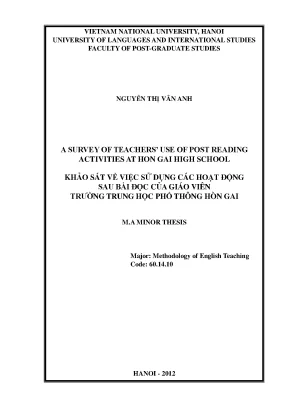
VIETNAM NATIONAL UNIVERSITY, HANOI UNIVERSITY OF LANGUAGES AND INTERNATIONAL STUDIES FACULTY OF POST-GRADUATE STUDIES NGUYỄN THỊ VÂN ANH A SURVEY OF TEACHERS’ USE OF POST READING ACTIVITIES AT HON GAI HIGH SCHOOL KHẢO SÁT VỀ VIỆC SỬ DỤNG CÁC HOẠT ĐỘNG SAU BÀI ĐỌC CỦA GIÁO VIÊN TRƯỜNG TRUNG HỌC PHỔ THÔNG HÒN GAI M.A MINOR THESIS Major: Methodology of English Teaching Code: 60.10 HANOI - 2012 TIEU LUAN MOI download : skknchat@gmail.com VIETNAM NATIONAL UNIVERSITY, HANOI UNIVERSITY OF LANGUAGES AND INTERNATIONAL STUDIES FACULTY OF POST-GRADUATE STUDIES NGUYỄN THỊ VÂN ANH A SURVEY OF TEACHERS’ USE OF POST READING ACTIVITIES AT HON GAI HIGH SCHOOL KHẢO SÁT VỀ VIỆC SỬ DỤNG CÁC HOẠT ĐỘNG SAU BÀI ĐỌC CỦA GIÁO VIÊN TRƯỜNG TRUNG HỌC PHỔ THÔNG HÒN GAI M.A MINOR THESIS Major: Methodology of English Teaching Code: 60.10 Supervisor: HOÀNG THỊ HỒNG HẢI, MA HANOI - 2012 TIEU LUAN MOI download : skknchat@gmail.com TABLE OF CONTENTS Page Declaration i Acknowledgement ii Table of contents iii List of figures and abbreviations vii PART A: INTRODUCTION 1. Research aims and research questions 2 2.Significance of the study 2 4. Scope of the study 2 5. Expected outcome and contributions of the study 3 6.

Design of the study 3 PART B: DEVELOPMENT Chapter I: Literature review 5 1. Definitions of reading 5 2. The importance of reading 5 3. General views on post-reading activities 6 3.

Definitions of post-reading activities 6 iii TIEU LUAN MOI download : skknchat@gmail. Types of post-reading activities 7 3. The effectiveness when using post-reading 8 activities 3. The difficulties when doing post-reading 10 activities Chapter II: The study 12 1.

Description of subject 12 2. Data collection instrument 12 2. Data collection procedure 14 3. For the questionnaire 14 3.

For the observation 15 3. For the interview 15 4. Data analysis method 16 5. Data analysis procedure 17 5.

For the questionnaire 17 5. For the interview 17 6. Survey questionnaire for teachers 17 6. The frequency that teachers implement post-reading 17 iv TIEU LUAN MOI download : skknchat@gmail.com activities in a class 6.

The table shows the frequency that teachers implement 17 post-reading activities in a class 6. The pie chart shows frequency that teachers implement 18 post-reading activities in a class 6. The post – reading activities that teachers implement 19 6. The table shows the post – reading activities that teachers 19 implement 6.

The bar chart shows the post – reading activities that 19 teachers implement 6. The effectiveness of post-reading activities suggested by 21 the teachers of English 6. The difficulties that encountered by the teachers when 21 implementing post- reading activities 6. The result table shows the difficulties that encountered by 21 the teachers when implementing post- reading activities 6.

The bar chart shows the difficulties that encountered by 22 the teachers when implementing post- reading activities 6. The ways to overcome those difficulties suggested by the 23 teachers 6. Survey questionnaire for students 24 6. The effectiveness of post-reading activities in students‘ 24 thinking 6.

The table shows the students‘ thinking about the 24 effectiveness of post-reading activities v TIEU LUAN MOI download : skknchat@gmail. The bar chart shows the students‘ thinking about the 25 effectiveness of post-reading activities 6. The post-reading activities that students prefer to take part 26 in 6. The table shows the post-reading activities that students 26 prefer to take part in 6.

The bar chart shows the post-reading activities that 27 students prefer to take part in 6. The difficulties students have to face when taking part in 29 post-reading activities 6. The table shows the difficulties students have to face 29 when taking part in post-reading activities 6. The bar chart shows the difficulties students have to face 30 when taking part in post-reading activities 6.

The ways to overcome those difficulties suggested by the 31 students 6. The table shows how students overcome the difficulties 31 encountered when taking part in post-reading activities 6. The bar chart shows how students overcome the 31 difficulties encountered when taking part in post-reading activities Chapter III: Findings and discussion 1. How is teachers‘ use of post-reading activities 33 implemented at Hon Gai high school? 1.

What is the effectiveness of post-reading activities as 33 perceived by teachers and students? vi TIEU LUAN MOI download : skknchat@gmail. What are difficulties encountered by students and teachers 34 when doing post-reading activities? 1. Observation 35 PART C: CONCLUSION 37 REFERENCES 40 Appendix 1a I Appendix 1b IV Appendix 2a VII Appendix 2b XIV Appendix 3 XXII Appendix 4 XXVII vii TIEU LUAN MOI download : skknchat@gmail.com LIST OF TABLES, FIGURESANDABBREVIATIONS 1. List of tables Table 1: The frequency that teachers implement post reading activities in a class 17 Table 2: The post reading activities that teachers implement 19 Table 3: The difficulties encountered by the teachers when 21 implementing post reading activities Table 4: The students‘ thinking about the effectiveness of post 24 reading activities Table 5: The post reading activities that students prefer to take part 26 in Table 6: The difficulties encountered by students when participating 29 in post reading activities.

Table 7: How students get overcome the difficulties encountered 31 when taking part in post reading activities 2. List of figures Figure 1: The frequency that teachers implement post reading 17 activities in a class Figure 2: The post reading activities that teachers implement 19 Figure 3: The difficulties encountered by the teachers when 22 implementing post - reading activities Figure 4: The students‘ thinking about the effectiveness of post 25 reading activities viii TIEU LUAN MOI download : skknchat@gmail.com Figure 5: The post reading activities that students prefer to take part 28 in Figure 6: The difficulties encountered by students when 30 participating in post reading activities Figure 7: How students get overcome the difficulties encountered 31 when taking part in post reading activities 3.List of abbreviations EFL: English as a Foreign Language SRE: Scaffold Reading Experience ix TIEU LUAN MOI download : skknchat@gmail.com PART A: INTRODUCTION 1. Rationale The importance ofEnglishhas been more and morefully recognized. It can be easily noticed that reading skill is a very important factor in developing students‘ English learning.

Educational researchers have found that there is a strong correlation between reading skills and academic success. In other words, a student who is a good reader is more likely to do well in school and pass exams than a student who is a weak reader. In fact, much of research has been done to find out the various methods and techniques that help students enhance their own language ability in general and reading skill in particular. In Vietnam, in recent years teaching methods have been more and more improved.

There have been a lot of activities organized in order to enhance the effectiveness and help students be more active and self-confident in learning English in general and reading skills in particular. Many universities and high schools, including Hon Gai high school apply post reading activities which can be seen as one of the most effective way to develop students‘ reading competence. It is stated that post-reading activities encourage student to reflect upon what they have read. For the information to stay with the students, they need to go beyond simply reading it to using it.

Until now, there have been a lot of researches done in the area of post reading activities. In 2000, Alderson wrote ‗Assessing reading‘ with the aim of analyzing the effectiveness of reading activities, including post reading activities.d) wrote ―post reading activities – how teachers can end the lesson effectively‖ to give some advice so that teachers can apply when implementing post reading activities. However, there is a gap between the theory and the practice. In high schools in general, the advantages of post 1 TIEU LUAN MOI download : skknchat@gmail.com reading activities have not been fully made use of.

In addition, teachers and students encounter some difficulties relating to the students‘ level, time, etc; as a result, the implementation of these activities has not been effective. All mentioned above, the researcher decides to do a research on ―A survey of teachers‘ use of post reading activities at Hon Gai high school. Research aims and research questions 2. Research aims First and foremost, this paper is to present the ways of organizing post reading activities at Hon Gai high school.

Second, students‘ perception and teachers‘ of the effectiveness of this activity will be exploited. Third, a detailed investigation is carried out to specify the difficulties encountered by teachers as well as students when doing post-reading activities. Besides, basing on the findings of the study, researcher presents the solutions suggested by respondents to get over these problems. In brief, the study will focus on the following questions: 2.

How is teachers‘ use of post-reading activities implemented at Hon Gai high school? 2. What is the effectiveness of post-reading activities as perceived by teachers and students? 3. What are difficulties encountered by students and teachers when doing post reading activities? 3. Significance of the study Post reading activities have to be improved as one of the most effective ways in language teaching and learning.

The question of how post reading activities; however, is hardly paid attention to. Besides, there are not many researchers showing the interests in exploring the effectiveness as well as the difficulties encountered by students and teachers when doing this type of activity. Although the study is carried out with a small scale, the researcher do 2 TIEU LUAN MOI download : skknchat@gmail.com hope that its result can help teachers and students at Hon Gai high school in particular and high schools in general have clear and thorough understandings about the effectiveness and difficulties when participating in post reading activities in reading lessons. From that, they will find and adapt the best solutions in order to improve teaching and learning reading skills.

Scope of the study As mentioned above, the study is carried out with a small scale one. Because of the time limitation, the samples are restricted to 50 students at 10 classes and 10 teachers who are responsible for teaching English grade 10 at Hon Gai high school. Expected outcome and contributions of the study Overall, the research could be considerably helpful for teachers as well as researchers working on related studies. Based on the findings of the research, several pedagogical implications would be drawn.

For the teachers of English in general and teachers of English at Hon Gai high school, the study, once completed, is expected to raise teachers‘ awareness of the effectiveness of post reading activities in improving reading skills for their students. In addition, the study will supply teachers with the difficulties as well as the suggestions so that they could take their own initiatives to exploit the suitable post reading activities when teaching reading lessons. Besides, with regard to researchers, those who happen to develop an interest in this topic could certainly rely on this research to find reliable and useful information for their related studies in the future. Design of the study The thesis consists of three parts: Part A: Introduction 3 TIEU LUAN MOI download : skknchat@gmail.com The introduction refers to the statement of the problem, research aims, research questions, significance, scope, expected outcome and contributions and the design of the study Part B: Development Chapter I: “ Literature review” presents some background knowledge of the issue for further steps of the study.

Chapter II: “ The study” presents the detailed results of the survey together with the findings and discussion. Chapter III: “Findings and discussions” Part C: Conclusion The conclusion summarizes all the main findings of the thesis, the recommendations and mentions the limitation of the study 4 TIEU LUAN MOI download : skknchat@gmail.com PART B: DEVELOPMENT Chapter I: Literature review 1.

Nội dung được bảo vệ bản quyền — Tải xuống đầy đủ