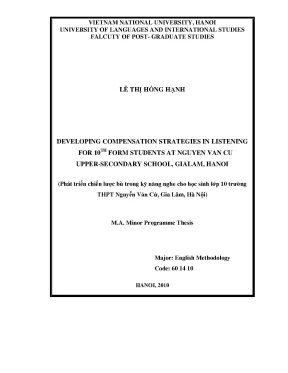
Luận văn: Phát triển chiến lược bù kỹ năng nghe cho học sinh lớp 10 THPT Nguyễn Văn Cừ

Tổng hợp chiến lược nghe hiểu tiếng Anh lớp 10 hiệu quả, giúp học sinh nắm vững kỹ năng và tự tin chinh phục điểm số cao trong các bài thi.

Chuyên ngành

English Methodology

Người đăng

Ẩn danh

Thể loại

M. Minor Programme Thesis

2010

65
0
0

Phí lưu trữ

30 Point

Mục lục chi tiết

Declaration

Table of contents

List of abbreviations

List of tables

List of figures

1. PART A: INTRODUCTION

1.1. Aims of the study

1.2. Scope of the study

1.3. Methods of the study

1.4. Design of the study

2. CHAPTER 1: LITERATURE REVIEW

2.1. Definitions of listening comprehension

2.2. Listening comprehension process

2.3. Possible problems in listening comprehension

2.4. Language learning strategies

2.4.1. Definitions of language learning strategies

2.4.2. Classification of language learning strategies

2.4.3. The importance of language learning strategies for students

2.5. Compensation strategies in listening

2.5.1. Definition of compensation strategies

2.5.2. The importance of compensation strategies in listening

2.5.3. Guidelines on applying compensation strategies in listening

3. CHAPTER 2: DATA COLLECTION, FINDINGS AND DISCUSSIONS

3.1. Setting of the study

3.2. Subjects of the study

3.3. Methods and instruments

3.4. Findings and discussions

3.4.1. Teachers’ perception and evaluation of compensation strategies in listening

3.4.2. Students’ perception and evaluation of compensation strategies in listening

3.4.3. The current situation of applying compensation strategies in listening

3.4.4. Students’ difficulties and preferences in applying compensation strategies in listening

3.4.4.1. Students’ difficulties in applying compensation strategies in listening
3.4.4.2. Students’ preferences in applying compensation strategies in listening

4. CHAPTER 3: RECOMMENDATIONS FOR DEVELOPING COMPENSATION STRATEGIES

4.1. Raising awareness of compensation strategy training

4.2. Integrating strategy training into the lessons

4.3. Teaching basic grammatical rules and phonological rules

4.4. Teaching discourse marker clues

4.5. Exploiting background knowledge

4.6. Recalling key words and structures

4.7. Making full use of visual aids

4.8. Providing pairwork and groupwork

4.9. Providing a variety of listening tasks

4.10. Limitations and suggestions for further research

Appendix 1: Interviews for teachers

Appendix 2: Survey questionnaires for students

Appendix 3: A sample of an interview transcript

Appendix 4: A sample of a class observation

Appendix 5: A suggested lesson plan of integrating strategy instruction

Tóm tắt

I. Tổng Quan Kỹ Năng Nghe Hiểu Lớp 10 Tầm Quan Trọng và Thách Thức

Kỹ năng nghe hiểu đóng vai trò then chốt trong quá trình học tiếng Anh, đặc biệt đối với học sinh lớp 10. Đây là giai đoạn các em bắt đầu tiếp xúc với những chủ đề phức tạp hơn, đòi hỏi khả năng nghe hiểu tiếng Anh cơ bản lớp 10 một cách hiệu quả. Tuy nhiên, nhiều học sinh gặp khó khăn trong việc nắm bắt thông tin từ các bài nghe, dẫn đến kết quả học tập không như mong muốn. Nguyên nhân có thể xuất phát từ nhiều yếu tố như vốn từ vựng hạn chế, chưa quen với ngữ điệu và tốc độ nói của người bản xứ, hoặc thiếu các phương pháp nghe hiểu hiệu quả lớp 10. Việc trang bị kỹ năng nghe hiểu lớp 10 một cách bài bản không chỉ giúp học sinh cải thiện điểm số mà còn tạo nền tảng vững chắc cho việc học tiếng Anh ở các cấp học cao hơn. Theo nghiên cứu của Lê Thị Hồng Hạnh, việc phát triển các chiến lược bù đắp (compensation strategies) có vai trò quan trọng trong việc hỗ trợ học sinh vượt qua những hạn chế trong kỹ năng nghe hiểu tiếng Anh lớp 10 (Lê Thị Hồng Hạnh, 2010). Bài viết này sẽ đi sâu vào phân tích các vấn đề liên quan đến kỹ năng nghe hiểu lớp 10, đồng thời đề xuất những giải pháp thiết thực giúp học sinh nâng cao khả năng này.

1.1. Vì sao kỹ năng nghe hiểu quan trọng với học sinh lớp 10

Kỹ năng nghe hiểu không chỉ đơn thuần là khả năng nghe được âm thanh mà còn bao gồm quá trình xử lý và hiểu ý nghĩa của thông tin được truyền tải. Với học sinh lớp 10, đây là một kỹ năng quan trọng vì nhiều lý do. Thứ nhất, nó giúp các em tiếp thu kiến thức một cách hiệu quả hơn trong các bài giảng và hoạt động học tập trên lớp. Thứ hai, nó tạo điều kiện để các em giao tiếp tự tin hơn trong các tình huống thực tế. Cuối cùng, nó là tiền đề để các em đạt được những thành công lớn hơn trong học tập và sự nghiệp sau này. Kỹ năng nghe hiểu tiếng Anh trong học tập giúp học sinh tiếp cận nguồn tài liệu phong phú và đa dạng, từ đó mở rộng kiến thức và nâng cao trình độ. Việc cải thiện kỹ năng nghe hiểu tiếng Anh lớp 10 không chỉ là mục tiêu trước mắt mà còn là sự đầu tư lâu dài cho tương lai.

1.2. Các thách thức phổ biến trong kỹ năng nghe hiểu của lớp 10

Nhiều học sinh lớp 10 gặp phải những khó khăn nhất định trong quá trình luyện nghe. Một trong những nguyên nhân chính là do vốn từ vựng còn hạn chế. Khi không hiểu được nghĩa của từ, các em sẽ khó lòng nắm bắt được ý chính của bài nghe. Bên cạnh đó, việc chưa quen với ngữ điệu và tốc độ nói của người bản xứ cũng là một trở ngại lớn. Ngoài ra, nhiều học sinh còn thiếu các chiến thuật làm bài nghe hiểu tiếng Anh lớp 10 hiệu quả, dẫn đến việc bỏ lỡ thông tin quan trọng hoặc hiểu sai ý nghĩa của bài nghe. Theo nghiên cứu của Lê Thị Hồng Hạnh, khó khăn lớn nhất của học sinh là hiểu và vận dụng các quy tắc ngữ âm (82%) (Lê Thị Hồng Hạnh, 2010).

II. Vấn Đề Thường Gặp Thiếu Chiến Lược Luyện Nghe Hiểu Hiệu Quả

Một trong những nguyên nhân chính khiến học sinh lớp 10 gặp khó khăn trong kỹ năng nghe hiểu lớp 10 là do thiếu các chiến lược luyện nghe hiệu quả. Nhiều em chỉ đơn thuần nghe đi nghe lại bài nghe mà không có bất kỳ phương pháp hay kỹ thuật nào hỗ trợ. Điều này không chỉ gây lãng phí thời gian mà còn khiến các em cảm thấy chán nản và mất động lực học tập. Để giải quyết vấn đề này, việc trang bị cho học sinh những chiến lược luyện nghe phù hợp là vô cùng cần thiết. Các chiến lược này có thể bao gồm việc luyện tập nghe hiểu chủ động lớp 10, sử dụng các tài liệu nghe hiểu tiếng Anh lớp 10 phù hợp, và áp dụng các kỹ thuật luyện thi nghe hiểu tiếng Anh lớp 10 hiệu quả. Đồng thời, giáo viên cũng cần hướng dẫn học sinh cách tự học nghe hiểu tiếng Anh lớp 10 một cách chủ động và có hệ thống.

2.1. Phân tích các chiến lược nghe hiểu hiện tại học sinh đang sử dụng

Thông thường, học sinh sử dụng chiến lược nghe bị động. Họ đơn giản nghe một đoạn văn bản âm thanh nhiều lần mà không thực sự tương tác với nội dung. Hoặc có thể có những bạn dựa dẫm quá nhiều vào việc dịch nghĩa từng từ, gây chậm trễ trong việc nắm bắt ý chính. Theo khảo sát, phần lớn học sinh chỉ sử dụng các chiến lược ở mức độ trung bình hoặc thấp. Các chiến lược sử dụng thường xuyên nhất là dùng tiêu đề và các manh mối trực quan, dùng kiến thức nền. Các chiến lược ít được dùng nhất là dùng manh mối ngữ âm. Hơn nữa, các em còn ít khi tận dụng các dạng bài nghe hiểu tiếng Anh lớp 10 khác nhau để luyện tập.

2.2. Hậu quả của việc thiếu chiến lược nghe hiểu hiệu quả

Việc thiếu chiến lược nghe hiệu quả dẫn đến nhiều hệ lụy. Học sinh cảm thấy nản lòng khi không thể hiểu nội dung bài nghe. Điều này ảnh hưởng trực tiếp đến kết quả học tập và sự tự tin của các em. Bên cạnh đó, việc không có kỹ năng nghe tốt cũng gây khó khăn trong giao tiếp và tiếp cận các nguồn thông tin bằng tiếng Anh. Tóm lại, việc trang bị các chiến lược nghe hiệu quả là yếu tố then chốt để học sinh vượt qua những khó khăn và đạt được thành công trong kỹ năng nghe hiểu tiếng Anh lớp 10.

III. Bí Quyết Nghe Hiểu Chủ Động Nâng Cao Hiệu Quả Lớp 10

Để cải thiện kỹ năng nghe hiểu tiếng Anh lớp 10 một cách hiệu quả, việc áp dụng phương pháp nghe chủ động là vô cùng quan trọng. Nghe chủ động không chỉ đơn thuần là nghe mà còn bao gồm việc tập trung cao độ, suy nghĩ, phân tích và đánh giá thông tin. Để thực hiện điều này, học sinh cần trang bị cho mình những kỹ năng cần thiết như nghe hiểu tiếng Anh có phụ đề lớp 10, ghi chú thông tin quan trọng, đặt câu hỏi để làm rõ những điểm chưa hiểu, và tóm tắt nội dung sau khi nghe. Bên cạnh đó, việc lựa chọn tài liệu nghe hiểu tiếng Anh lớp 10 phù hợp với trình độ và sở thích cũng là một yếu tố quan trọng giúp học sinh duy trì hứng thú và đạt được hiệu quả cao nhất.

3.1. Kỹ thuật ghi chú hiệu quả trong quá trình luyện nghe

Ghi chú là một kỹ năng quan trọng giúp học sinh nắm bắt thông tin và ghi nhớ nội dung bài nghe. Tuy nhiên, việc ghi chú không hiệu quả có thể gây xao nhãng và làm giảm khả năng tập trung. Để ghi chú hiệu quả, học sinh cần tập trung vào những thông tin quan trọng như tên, địa điểm, thời gian, số liệu, và các ý chính. Nên sử dụng các ký hiệu, viết tắt, và sơ đồ để tiết kiệm thời gian và không gian. Sau khi nghe xong, cần xem lại và chỉnh sửa lại những ghi chú để đảm bảo tính chính xác và dễ hiểu. Kỹ năng ghi chú tốt là một phần quan trọng trong chiến thuật làm bài nghe hiểu tiếng Anh lớp 10.

3.2. Cách đặt câu hỏi và làm rõ thông tin trong khi nghe

Đặt câu hỏi là một cách hiệu quả để làm rõ những điểm chưa hiểu và tăng cường sự tương tác với bài nghe. Tuy nhiên, việc đặt câu hỏi không đúng thời điểm có thể gây gián đoạn và làm mất tập trung. Nên đặt câu hỏi sau khi nghe xong một đoạn hoặc một phần của bài nghe. Có thể sử dụng các câu hỏi như "Bạn có thể giải thích rõ hơn về ... được không?", "Ý của bạn là gì khi nói ...?", hoặc "Tôi không hiểu rõ về ...". Việc đặt câu hỏi và làm rõ thông tin giúp học sinh nghe hiểu chủ động lớp 10 hơn và nắm bắt nội dung bài nghe một cách toàn diện.

3.3. Lựa chọn tài liệu luyện nghe phù hợp trình độ

Chọn nguồn tài liệu phù hợp là yếu tố then chốt để luyện nghe tiếng Anh lớp 10 hiệu quả. Tránh chọn các tài liệu quá khó, gây nản chí. Nên bắt đầu với các bài nghe ngắn, có tốc độ vừa phải và chủ đề quen thuộc. Sau đó, dần dần tăng độ khó và thời lượng của bài nghe. Các nguồn tài liệu phù hợp có thể là các bài hội thoại, phỏng vấn, bản tin, hoặc các video clip trên YouTube. Quan trọng là tài liệu phải phù hợp với sở thích của học sinh để duy trì hứng thú và động lực học tập.

IV. Phương Pháp Nghe Hiểu Cho Lớp 10 Tận Dụng Nguồn Tài Liệu

Việc luyện nghe tiếng Anh lớp 10 sẽ trở nên hiệu quả hơn nếu học sinh biết cách tận dụng các nguồn tài liệu có sẵn. Hiện nay có rất nhiều nguồn tài liệu luyện nghe phong phú và đa dạng, từ sách giáo khoa, sách bài tập, đến các trang web và ứng dụng học tiếng Anh trực tuyến. Học sinh cần biết cách lựa chọn và sử dụng các nguồn tài liệu này một cách hiệu quả để đạt được kết quả tốt nhất. Đồng thời, việc tạo ra môi trường luyện nghe thường xuyên cũng là một yếu tố quan trọng giúp học sinh nâng cao kỹ năng nghe hiểu lớp 10.

4.1. Sách giáo khoa và bài tập Nền tảng vững chắc

Sách giáo khoa và sách bài tập là những nguồn tài liệu cơ bản và quan trọng nhất để luyện nghe tiếng Anh lớp 10. Các bài nghe trong sách thường được thiết kế phù hợp với trình độ và chương trình học của học sinh. Học sinh cần làm bài tập đầy đủ và cẩn thận, đồng thời xem lại các bài nghe nhiều lần để nắm vững nội dung và từ vựng. Bên cạnh đó, nên tìm kiếm các bài tập bổ trợ trên mạng hoặc trong các sách tham khảo để luyện tập thêm.

4.2. Website và ứng dụng học tiếng Anh Đa dạng và tiện lợi

Hiện nay có rất nhiều trang web và ứng dụng học tiếng Anh cung cấp các bài nghe phong phú và đa dạng, với nhiều chủ đề và trình độ khác nhau. Học sinh có thể dễ dàng tìm kiếm và lựa chọn các bài nghe phù hợp với sở thích và nhu cầu của mình. Một số trang web và ứng dụng nổi tiếng như BBC Learning English, VOA Learning English, Duolingo, và ELSA Speak. Sử dụng các ứng dụng có tính tương tác cao, giúp học sinh luyện nghe tiếng Anh lớp 10 một cách thú vị và hiệu quả.

V. Bài Tập Luyện Nghe Hiểu Tiếng Anh Lớp 10 Thực Hành và Đánh Giá

Để đánh giá trình độ kỹ năng nghe hiểu lớp 10 và xác định những điểm cần cải thiện, việc thực hành các bài tập luyện nghe là vô cùng quan trọng. Các bài tập này có thể bao gồm các dạng bài như trắc nghiệm, điền từ, đúng sai, và trả lời câu hỏi. Sau khi làm bài tập, học sinh cần tự kiểm tra và đánh giá kết quả để rút ra kinh nghiệm và lên kế hoạch luyện tập phù hợp. Đồng thời, việc tham gia các kỳ thi thử luyện thi nghe hiểu tiếng Anh lớp 10 cũng là một cách tốt để đánh giá trình độ và làm quen với cấu trúc đề thi.

5.1. Các dạng bài tập luyện nghe phổ biến và hiệu quả

Có nhiều dạng bài tập luyện nghe khác nhau, mỗi dạng bài có những ưu điểm và nhược điểm riêng. Dạng bài trắc nghiệm giúp học sinh rèn luyện khả năng chọn lọc thông tin và suy luận. Dạng bài điền từ giúp học sinh rèn luyện khả năng ghi nhớ và sử dụng từ vựng. Dạng bài đúng sai giúp học sinh rèn luyện khả năng phân tích và đánh giá thông tin. Dạng bài trả lời câu hỏi giúp học sinh rèn luyện khả năng hiểu và diễn đạt ý kiến. Nên kết hợp nhiều dạng bài tập khác nhau để phát triển kỹ năng nghe hiểu lớp 10 một cách toàn diện.

5.2. Tự đánh giá và rút kinh nghiệm sau mỗi bài tập

Sau khi làm xong mỗi bài tập, học sinh cần dành thời gian để tự đánh giá và rút kinh nghiệm. Xem lại những câu trả lời sai và tìm hiểu nguyên nhân. Ghi chú lại những từ vựng và cấu trúc ngữ pháp mới. Tìm kiếm các nguồn tài liệu tham khảo để hiểu rõ hơn về những chủ đề còn mơ hồ. Việc tự đánh giá và rút kinh nghiệm giúp học sinh nhận ra những điểm yếu của mình và lên kế hoạch luyện tập phù hợp để cải thiện kỹ năng nghe hiểu tiếng Anh lớp 10.

VI. Kết Luận và Tương Lai Phát Triển Kỹ Năng Nghe Hiểu Toàn Diện

Kỹ năng nghe hiểu là một yếu tố quan trọng giúp học sinh lớp 10 thành công trong học tập và giao tiếp tiếng Anh. Để phát triển kỹ năng nghe hiểu lớp 10 một cách toàn diện, học sinh cần trang bị cho mình những chiến lược luyện nghe hiệu quả, tận dụng các nguồn tài liệu có sẵn, và thực hành các bài tập luyện nghe thường xuyên. Đồng thời, sự hỗ trợ và hướng dẫn của giáo viên cũng là một yếu tố quan trọng giúp học sinh đạt được kết quả tốt nhất. Trong tương lai, việc phát triển các phương pháp luyện nghe tiếng Anh lớp 10 trực tuyến và cá nhân hóa sẽ giúp học sinh học tập một cách hiệu quả và linh hoạt hơn.

6.1. Tóm tắt các chiến lược và phương pháp luyện nghe hiệu quả

Bài viết đã trình bày một số chiến lược và phương pháp luyện nghe hiệu quả cho học sinh lớp 10, bao gồm nghe chủ động, tận dụng các nguồn tài liệu có sẵn, và thực hành các bài tập luyện nghe thường xuyên. Quan trọng nhất là học sinh cần tìm ra những phương pháp phù hợp với bản thân và kiên trì luyện tập để đạt được kết quả tốt nhất.

6.2. Gợi ý cho việc tiếp tục phát triển kỹ năng nghe hiểu

Để tiếp tục phát triển kỹ năng nghe hiểu tiếng Anh lớp 10, học sinh nên tham gia các câu lạc bộ tiếng Anh, xem phim và nghe nhạc bằng tiếng Anh, và giao tiếp với người bản xứ. Điều quan trọng là tạo ra môi trường luyện nghe thường xuyên và liên tục để duy trì và nâng cao trình độ.

22/09/2025
Luận văn thạc sĩ developing compensation strategies in listening for 10th form students at nguyen van cu upper secondary school gia lam hanoi

Trích đoạn nội dung tài liệu

VIETNAM NATIONAL UNIVERSITY, HANOI UNIVERSITY OF LANGUAGES AND INTERNATIONAL STUDIES FALCUTY OF POST- GRADUATE STUDIES LÊ THỊ HỒNG HẠNH DEVELOPING COMPENSATION STRATEGIES IN LISTENING FOR 10TH FORM STUDENTS AT NGUYEN VAN CU UPPER-SECONDARY SCHOOL, GIALAM, HANOI (Phát triển chiến lược bù trong kỹ năng nghe cho học sinh lớp 10 trường THPT Nguyễn Văn Cừ, Gia Lâm, Hà Nội) M. Minor Programme Thesis Major: English Methodology Code: 60 14 10 HANOI, 2010 TIEU LUAN MOI download : skknchat@gmail.com VIETNAM NATIONAL UNIVERSITY, HANOI UNIVERSITY OF LANGUAGES AND INTERNATIONAL STUDIES FALCUTY OF POST- GRADUATE STUDIES LÊ THỊ HỒNG HẠNH DEVELOPING COMPENSATION STRATEGIES IN LISTENING FOR 10TH FORM STUDENTS AT NGUYEN VAN CU UPPER-SECONDARY SCHOOL, GIALAM, HANOI (Phát triển chiến lược bù trong kỹ năng nghe cho học sinh lớp 10 trường THPT Nguyễn Văn Cừ, Gia Lâm, Hà Nội) M. Minor Programme Thesis Major: English Methodology Code: 60 14 10 Supervisor: VŨ MAI TRANG, M. HANOI, 2010 TIEU LUAN MOI download : skknchat@gmail.com TABLE OF CONTENTS Declaration …………………………………………………………………………………….iii Table of contents……………………………………………………………………………….iv List of abbreviations………………………………………………………………………….vii List of tables………………………………………………………………………………….viii List of figures………………………………………………………………………………….ix PART A: INTRODUCTION.

Aims of the study. Scope of the study. Methods of the study. Design of the study.

4 CHAPTER 1: LITERATURE REVIEW. Definitions of listening comprehension. Listening comprehension process. Possible problems in listening comprehension.

Language learning strategies. Definitions of language learning strategies. Classification of language learning strategies. The importance of language learning strategies for students…………………….

Compensation strategies in listening. Definition of compensation strategies. The importance of compensation strategies in listening. Guidelines on applying compensation strategies in listening.13 CHAPTER 2: DATA COLLECTION, FINDINGS AND DISCUSSIONS.

Setting of the study. Subjects of the study. Methods and instruments.16 TIEU LUAN MOI download : skknchat@gmail. Findings and discussions.

Teachers’ perception and evaluation of compensation strategies in listening. Students’ perception and evaluation of compensation strategies in listening. The current situation of applying compensation strategies in listening. Students’ difficulties and preferences in applying compensation strategies in listening.

Students’ difficulties in applying compensation strategies in listening. Students’ preferences in applying compensation strategies in listening .27 CHAPTER 3: RECOMMENDATIONS FOR DEVELOPING COMPENSATION STRATEGIES. Raising awareness of compensation strategy training. Integrating strategy training into the lessons.

Teaching basic grammatical rules and phonological rules. Teaching discourse marker clues. Exploiting background knowledge. Recalling key words and structures.

Making full use of visual aids. Providing pairwork and groupwork. Providing a variety of listening tasks. Limitations and suggestions for further research .I Appendix 1: Interviews for teachers………………………………………….I Appendix 2: Survey questionnaires for students.

III Appendix 3: A sample of an interview transcript.XI Appendix 4: A sample of a class observation.XIII Appendix 5: A suggested lesson plan of integrating strategy instruction.XVI TIEU LUAN MOI download : skknchat@gmail.com LIST OF ABBREVIATIONS EFL: English as a Foreign Language LLS: Language Learning Strategies NVC School: Nguyen Van Cu Upper-secondary School TIEU LUAN MOI download : skknchat@gmail.com LIST OF TABLES Table 1: Classification of language learning strategies Table 2: Classification of compensation strategies Table 3: Descriptive statistics for frequency of compensation strategy use Table 4: Students’ difficulties in applying compensation strategies in listening Table 5: Students’ preferences in applying compensation strategies in listening TIEU LUAN MOI download : skknchat@gmail.com LIST OF FIGURES Figure 1: Frequency of use for strategy “using titles and visual clues” Figure 2: Frequency of use for strategy “using background knowledge clues” Figure 3: Frequency of use for strategy “using contextual clues” Figure 4: Frequency of use for strategy “writing sound transcript” Figure 5: Frequency of use for strategy “using background noise clues” Figure 6: Frequency of use for strategy “using grammatical clues” Figure 7: Frequency of use for strategy “using discourse marker clues” Figure 8: Frequency of use for strategy “using phonological clues” TIEU LUAN MOI download : skknchat@gmail.com PART A: INTRODUCTION 1. Rationale English language teaching in the recent years has moved from traditional approaches, involving the explicit teaching of grammar and translation, to various versions of communicative methodology. Consequently, a greater emphasis has been placed on learners and what strategies they adopt to be successful. Well-known researchers such as Cohen (1988), O‟Malley and Chamot (1990), and Oxford (1990) have pointed out that learning strategies are among the main factors that help determine how well students learn a second or foreign language.

Therefore, it is the role of the teacher to help students discover and apply appropriate learning strategies in their learning. The necessary to equip students with listening strategies to help them develop their listening skill at upper-secondary schools in Vietnam can be seen clearly. The new series of English textbooks for students have been used in schools in Viet Nam for some years and it seems that listening skill is the most difficult one for our students to master. Listening is also the skill that causes a lot of difficulties for teachers to prepare and carry out the lesson because the old textbooks do not have a separate part for teaching and learning listening skill.

The students who are using the new kind of textbooks often find it hard to catch up with the listening text and as a result they fail to comprehend what is spoken. Besides, they come to listening activities with little knowledge of how to listen effectively and successfully. The situation at Nguyen Van Cu Upper-secondary School is the same, if not to say it is more serious. We have many weak students who lack vocabulary, grammatical knowledge and have poor pronunciation.

Listening lessons are really hard for them. There is a variety of strategies that can be employed in listening skill such as memory strategies; cognitive strategies; compensation strategies; metacognitive strategies; affective strategies; and social strategies (Oxford, 1990). However, compensation strategies which involve in the ability of guessing intelligently from linguistic clues and other clues are of great help to weak students. These strategies help students to overcome their limitations to guess what is heard.

The facts above explain the reasons why the researcher conducts the study “Developing compensation strategies in listening for 10th form students at Nguyen Van Cu TIEU LUAN MOI download : skknchat@gmail.com upper-secondary school, Gialam, Hanoi”. It is hoped that this study can be of some help to teachers and students in listening lessons. Aims of the study First of all, the study aims at investigating the perception of compensation strategies in listening by teachers and 10th form students at Nguyen Van Cu Upper-secondary School; the target students‟ frequency of use of these strategies; and their difficulties and preferences in applying these strategies. Secondly, the author intends to propose pedagogical implications and suggestions for developing the target students‟ compensations strategies in listening.

To achieve these aims, four research questions have been presented as follows: 1. How do teachers and 10th form students at NVC School perceive compensation strategies in listening and their importance? 2. How often do 10th form students at NVC School apply compensation strategies in listening? Which specific strategies do they use? 3. What are the difficulties and preferences of 10th form students at NVC School in applying compensation strategies in listening? 4.

What recommendations should be made for teachers to help 10 th form students at NVC School develop compensation strategies in listening? 3. Scope of the study Firstly, this study only focuses on compensation strategies used in listening (guessing intelligently) although the new kind of textbook covers all of four skills, namely reading, speaking, listening and writing as well as there are a lot of English language learning strategies that can be employed. Secondly, due to the small scale of the study the subjects are restricted only to 10 th form teachers and students at Nguyen Van Cu upper-secondary school, who are using the new kind of textbook. Methods of the study The author has applied the following methods in this study: Data collection results from interviews (for teachers), survey questionnaires (for students) and class observations.

Data analysis is done through coding, classifying, and reporting the information. Design of the study The study is divided into three parts. TIEU LUAN MOI download : skknchat@gmail.com Part A Introduction shows the research problem and the rationale for the research. Subsequently, it presents the aims, the scope, the methods and the design of the study.

Part B Development consists of three chapters. Chapter 1 provides a summary of theoretical background which covers a review in key concepts relating to the research topic as well as the literature in the field. Chapter 2 deals with the setting of the study and the data collection process. The results obtained are also analysed and interpreted in this part, so that major findings are revealed and discussed.

Chapter 3 is concerned with recommendations for developing 10th form students‟ compensation strategies in listening at the target school. These recommendations are drawn from the literature review and from the findings in Chapter 2. Part C Conclusion reviews the main findings of the study and provides suggestions for further studies. TIEU LUAN MOI download : skknchat@gmail.com PART B: DEVELOPMENT CHAPTER 1: LITERATURE REVIEW 1.

Definitions of listening comprehension Language is the tool of communication, while listening is the most important part of language communication and it is the basic path to understand others. Listening is more than merely hearing words and comprehension is often considered to be the first-order goal of listening, and the highest priority of the listener. During the last few decades, scholars have been trying to find out the nature of listening comprehension and as a result different definitions of listening comprehension have been proposed. Underwood (1989: 1) puts a simple and easy-to-understand definition.

According to her, listening “is the activity of paying attention to and trying to get meaning from something we hear.” Underwoord emphasizes the consciousness of listeners by using the phrase “paying attention”. Besides, listening here is not stressed the word level but the meaning of the whole utterance. She clarifies that “ to listen successfully to spoken language, we need to be able to work out what speakers mean when they use particular words in particular ways on particular occasions, and not simply understand the words themselves. ” In Rubin‟s point of view, “listening is conceived of as an active process in which listeners select and interpret information which comes from auditory and visual clues in order to define what is going on and what the speakers are trying to express.” (Rubin, 1995: 7 as cited in Helgesen & Brown, 2007: 3) The author emphasizes the activeness of listeners in the listening process and also identifies two distinctive features of listening comprehension which are selecting and interpreting.

Selecting means listeners use only part of the incoming information whereas interpreting means listeners make sense of the input from their background knowledge as well as the new information. More specifically, Richards and Schmidth (2002: 313) as cited in Helgesen & Brown (2007: 3) views listening comprehension as “the process of understanding speech in a first or second language. The study of listening comprehension in second language focuses on the role of individual linguistic units (e., phonemes, words, grammatical structures) as well as the role of the listeners’ expectations, the situation and context, background knowledge and topic.” In this definition, the writers mention the role of non-linguistic units such as the context, the background knowledge. These things are often neglected in traditional points of TIEU LUAN MOI download : skknchat@gmail.com views which regard the listeners as tape recorders.

I agree most with this definition because it covers all of the necessary factors relating to listening comprehension. Besides the controversies over the definition of listening comprehension, there also exist the concerns about the process of listening comprehension. Listening comprehension process Listening is different from hearing in the aspect of listeners‟ paying attention. Paying attention results in the fact that listeners actively process what they hear.

According to Underwood (1989: 4) the aural process has three stages.

Nội dung được bảo vệ bản quyền — Tải xuống đầy đủ