Colonial Vietnam's Development of National Language & Literature, 1900-1945

Phân tích ý nghĩa tiềm ẩn của chuỗi số '10 1 1 1010 5693'. Bài viết探讨 các khả năng mã hóa, mã dữ liệu hoặc con số mang tính biểu tượng trong bối cảnh cụ thể.

Trường đại học

Đại học Michigan

Chuyên ngành

Xã hội học

Người đăng

Ẩn danh

Thể loại

Luận án tiến sĩ

2013

295
0
0

Phí lưu trữ

55 Point

Tóm tắt

I. Tổng quan về sự phát triển văn hóa dân tộc Việt Nam thời thuộc địa 1900 1945

Giai đoạn 1900-1945 đánh dấu bước ngoặt quan trọng trong quá trình hình thành nền văn hóa dân tộc Việt Nam dưới thời Pháp thuộc. Nghiên cứu của Yufen Chang từ Đại học Michigan phân tích ba trụ cột văn hóa cốt lõi gồm chữ viết quốc ngữ, văn học dân tộc và quốc học. Trong bối cảnh chịu ảnh hưởng sâu sắc của văn hóa Trung Hoa qua hàng nghìn năm, các sĩ phu Việt Nam phải đối mặt với thách thức kép: vừa kế thừa di sản văn hiến, vừa tiếp thu văn minh phương Tây. Quá trình này không đơn thuần là sao chép mà đòi hỏi sự phân biệt, điều chỉnh và sáng tạo nhằm bảo tồn bản sắc dân tộc. Hệ thống giáo dục Pháp-Việt phát triển mạnh mẽ với số trường học tăng đáng kể qua các năm 1920, 1923, 1926 và 1929, tạo nền tảng cho sự chuyển đổi văn hóa sâu rộng. Các nhà trí thức thuộc địa đã xác định ngôn ngữ viết, văn học bản xứ và học thuật dân tộc là ba lĩnh vực then chốt trong nỗ lực xây dựng nền văn hóa độc lập.

1.1. Bối cảnh lịch sử văn hóa Việt Nam cuối thế kỷ XIX

Cuối thế kỷ XIX, thế giới trí thức Nho học Việt Nam trải qua giai đoạn chuyển đổi từ văn hiến sang văn minh. Trước khi Pháp thuộc, chữ Hán chiếm vị trí thống trị trong hệ thống viết, khác biệt so với Nhật Bản và Hàn Quốc nơi chữ viết bản địa đã phát triển mạnh. Thi cử khoa bảng được du nhập vào Việt Nam năm 1075 với lịch sử Trung Hoa là môn thi chính. Các nhà Nho tin rằng văn tức là quy luật vũ trụ, thể hiện qua chữ viết, lễ giáo và nền văn minh Trung Hoa. Hệ tư tưởng này chi phối toàn bộ đời sống tinh thần của xã hội Việt Nam trước thuộc địa.

1.2. Vai trò của chữ quốc ngữ trong quá trình chuyển đổi

Chữ quốc ngữ đóng vai trò then chốt trong quá trình Việt hóa văn hóa. Các cộng tác viên Pháp như Tôn Thọ Tường tích cực quảng bá quốc ngữ, nhấn mạnh ưu điểm dễ học chỉ cần vài tháng so với chữ Hán phải mất cả đời. Năm nhà Nho Công giáo nổi tiếng sớm tham gia dịch thuật và phổ biến quốc ngữ. Tác phẩm Lục Vân Tiên của Nguyễn Đình Chiểu được Trương Vĩnh Ký phiên âm sang quốc ngữ ngay sau khi tác giả qua đời, cho thấy sự lan tỏa nhanh chóng của chữ viết mới.

II. Phân tích quá trình mô phỏng và phân biệt văn hóa trong thời kỳ thuộc địa

Quá trình mô phỏng và phân biệt văn hóa là trung tâm nghiên cứu của Chang về Việt Nam thuộc địa. Các nhà trí thức Việt Nam không đơn thuần chấp nhận hay từ chối ảnh hưởng bên ngoài mà thực hiện chiến lược phức tạp hơn. Họ mô phỏng văn minh phương Tây về khoa học kỹ thuật nhưng đồng thời phân biệt bản sắc dân tộc qua văn học và nghệ thuật. Sự tương tác giữa ba quyền lực văn hóa hegemonic gồm Trung Quốc, Pháp và Nhật Bản tạo nên trường văn hóa đa chiều. Mỗi nhóm trí thức xây dựng vốn chính trị riêng dựa trên khả năng điều chỉnh giữa các nguồn ảnh hưởng khác nhau. Quá trình tổng hợp hóa xuất hiện khi tri thức truyền thống được tái diễn giải qua lăng kính hiện đại, tạo ra thể loại văn học mới và phương pháp học thuật mới. Sự phân biệt thể hiện rõ qua việc các nhà văn hóa tìm kiếm linh hồn dân tộc trong những năm 1920, tách khỏi ảnh hưởng Trung Hoa nhưng không hoàn toàn theo Tây.

2.1. Mối quan hệ giữa văn hiến và văn minh

Văn hiến đại diện cho truyền thống Nho học với hệ thống chữ viết, lịch sử và lễ giáo Trung Hoa. Văn minh chỉ nền văn minh hiện đại phương Tây với khoa học, dân chủ và tiến bộ. Giao điểm giữa hai khái niệm này tạo ra không gian sáng tạo cho trí thức Việt Nam. Họ tìm cách kết hợp giá trị nhân văn của văn hiến với tinh thần tiến bộ của văn minh. Cuộc tranh luận giữa bảo thủ và cải cách phản ánh sự giằng xé nội tâm của tầng lớp sĩ phu trước thời cuộc biến đổi.

2.2. Các nhóm trí thức và vị thế văn hóa

Trí thức thuộc địa Việt Nam phân hóa thành nhiều nhóm dựa trên vốn văn hóa và chính trị. Nhóm cộng tác viên quân sự-chính trị như Trần Bá Lộc, Hoàng Cao Khải giúp Pháp đàn áp khởi nghĩa nhưng thiếu năng lực văn hóa. Nhóm Nho sĩ Công giáo đóng góp lớn về dịch thuật và giáo dục. Nhóm sĩ phu yêu nước như Nguyễn Đình Chiểu sáng tác cả truyện Nôm và thơ chữ Hán thể hiện tinh thần phản kháng. Sự phân hóa này phản ánh cấu trúc quyền lực phức tạp trong trường văn hóa thuộc địa.

III. Giải pháp xây dựng bản sắc văn hóa dân tộc qua ngôn ngữ và học thuật

Các giải pháp xây dựng bản sắc văn hóa dân tộc xoay quanh ba trụ cột chính: quốc ngữ hóa, văn học hóa và quốc học hóa. Quốc ngữ hóa nhằm thay thế chữ Hán bằng chữ viết bản địa dễ tiếp cận đại chúng. Văn học hóa thúc đẩy sáng tác văn học phản ánh đời sống và tâm hồn Việt Nam. Quốc học hóa xây dựng hệ thống học thuật dựa trên lịch sử và văn hóa dân tộc thay vì phụ thuộc vào chương trình Trung Hoa. Hệ thống trường Pháp-Việt phát triển mạnh tạo điều kiện phổ cập giáo dục hiện đại. Tuy nhiên, quá trình này không tránh khỏi mâu thuẫn khi giáo dục Pháp cũng đồng thời truyền bá văn hóa thực dân. Các nhà cải cách phải khéo léo tận dụng cơ sở hạ tầng giáo dục Pháp để phục vụ mục tiêu dân tộc hóa. Nghệ thuật trở thành người Việt xuất hiện rõ nét trong thập niên 1930 với sự kết hợp giữa mô phỏng và phân biệt.

3.1. Phát triển hệ thống giáo dục Pháp Việt

Hệ thống trường Pháp-Việt mở rộng nhanh chóng qua các giai đoạn 1920-1929 với số lượng trường và học sinh tăng đều. Ba kỳ thuộc địa Bắc Kỳ, Trung Kỳ và Nam Kỳ có tốc độ phát triển khác nhau phản ánh chính sách giáo dục phân vùng. Trường sơ học, trường tiểu học, trường cao đẳng tiểu học và trường trung học tạo thành hệ thống giáo dục hoàn chỉnh. Quá trình này vừa phổ cập tiếng Pháp vừa tạo diễn đàn cho ý thức dân tộc phát triển.

3.2. Vai trò của Cao Đài và các phong trào văn hóa

Phong trào Cao Đài xuất hiện như hiện tượng tổng hợp hóa văn hóa độc đáo. Tam thánh ký hiệp ước thể hiện sự kết hợp giữa Đông và Tây, truyền thống và hiện đại. Các phong trào văn hóa dân tộc khác cũng nổ ra mạnh mẽ trong thập niên 1920-1930 với nhiều tờ báo, tạp chí và nhà xuất bản ra đời. Không gian công cộng mới hình thành cho phép thảo luận về bản sắc dân tộc, quyền tự trị và tương lai đất nước.

IV. Kết luận và ứng dụng nghiên cứu văn hóa thuộc địa Việt Nam

Nghiên cứu của Chang cung cấp khung lý thuyết giá trị để hiểu quá trình hình thành bản sắc dân tộc trong bối cảnh thuộc địa. Mô hình mô phỏng-phân biệt-tổng hợp hóa có thể áp dụng cho nghiên cứu các xã hội hậu thuộc địa khác. Bài học từ Việt Nam cho thấy xây dựng văn hóa dân tộc không phải phủ nhận hoàn toàn ảnh hưởng bên ngoài mà cần chiến lược tiếp nhận có chọn lọc. Sự thành công của quốc ngữ trong việc thay thế chữ Hán và chữ Nôm chứng minh vai trò quyết định của ngôn ngữ trong quá trình quốc gia hóa. Nghiên cứu cũng nhấn mạnh tầm quan trọng của trường văn hóa nơi các nhà trí thức cạnh tranh vốn văn hóa và chính trị.Ứng dụng hiện đại của nghiên cứu này bao gồm hiểu biết về toàn cầu hóa văn hóa, bảo tồn di sản ngôn ngữ thiểu số và phát triển chính sách giáo dục đa văn hóa.

4.1. Ý nghĩa lý thuyết cho nghiên cứu hậu thuộc địa

Khung phân tích trường văn hóa của Bourdieu được Chang áp dụng sáng tạo vào bối cảnh Đông Á thuộc địa. Mô hình ba chiều mô phỏng-phân biệt-tổng hợp bổ sung cho lý thuyết văn hóa hậu thuộc địa vốn tập trung nhiều vào kháng cự. Nghiên cứu chứng minh rằng trí thức thuộc địa không đơn thuần là kẻ phản bội hay anh hùng mà là tác nhân phức tạp trong trường quyền lực. Cách tiếp cận này có giá trị cho phân tích các xã hội đang phát triển hiện nay.
4.2. Ứng dụng cho bảo tồn và phát triển văn hóa hiện đại

21/04/2026

Trích đoạn nội dung tài liệu

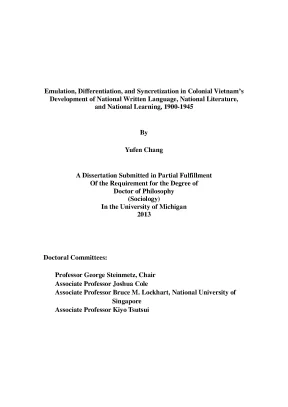
Emulation, Differentiation, and Syncretization in Colonial Vietnam’s Development of National Written Language, National Literature, and National Learning, 1900-1945 By Yufen Chang A Dissertation Submitted in Partial Fulfillment Of the Requirement for the Degree of Doctor of Philosophy (Sociology) In the University of Michigan 2013 Doctoral Committees: Professor George Steinmetz, Chair Associate Professor Joshua Cole Associate Professor Bruce M. Lockhart, National University of Singapore Associate Professor Kiyo Tsutsui Table of Contents List of Figures.iii List of Tables.v List of Appendices. When Văn Hiến Encountered Văn Minh:the Transition of the Sino-Vietnamese Intellectual world to the Vernacular Cultural Fields in the Late Nineteenth Century………………………………………………………………………26 3. Understanding Văn Minh through the Lens of Văn Hiến: the Emergence of the Vernacular Cultural Fields in the 1900s……………………………………. Imitating Văn Minh and Reassessing Văn Hiến in the Vernacular Cultural Fields in the 1910s……………………………………………………………76 5. Emulating and Differentiating from Văn Minh and Văn Hiến: Searching for National Soul in the Cultural Fields in the 1920s…………………………. The Art of Becoming Vietnamese: Emulation and Differentiation in the Cultural Fields in the 1930s……………………………………………….227 List of Appendices…………….261 ii List of Figures Figure 1.1: The male protagonist in the Chinese historical drama…………………….2: The male protagonist of the Vietnamese TV historical drama Lý Công Uẩn Đường đến thành Thăng Long Lý Công Uẩn Thăng Long……………….3: The female protagonists of the Chinese TV historical drama (left) and the Vietnamese Lý Công Uẩn - Đường đến thành Thăng Long (Lý Công Uẩn – Road to the Thăng Long city) (right)……………………………………….4: The emblem of Hanoi (Vietnamese: Hà Nội) and the Temple of Literature in Hanoi…………………………………………………………………….5: Colonial Vietnam’s emulation of, differentiation from, and syncretization of Chinese, French, and Japanese hegemonic powers…………………….6: The determinants of political capital in colonial Vietnam’s cultural fields……………………………………………………………………….1: An advertisement for government bonds in 1918………………………103 Figure 4.2: The categorization of colonial Vietnamese intellectuals’ political position………………………………………………………………….1: The growth of Franco-Vietnamese schools in 1920, 1923, 1926, and 1929…………………………………………………………………….2: The growth of students in Franco-Vietnamese schools in 1920, 1923, 1926, and 1929………………………………………………………………….3: School size of elementary, primary, upper primary and secondary schools………………………………………………………………….4: The growth of Franco-Vietnamese schools in Tonkin in 1920, 1923, 1926, and 1929………………………………………………………………….5: The growth of Franco-Vietnamese schools in Annam in 1920, 1923, 1926, and 1929…………………………………………………………………124 Figure 5.6: The growth of Franco-Vietnamese schools in Cochinchina in 1920, 1923, 1926, and 1929………………………………………………………….7: Caodaism’s three saints signing an accord…………………………….1: Growth of Franco-Vietnamese schools and village schools in 1920, 1923, 1926, 1929, 1932, 1935, and 1938……………………………………….2: Growth of Franco-Vietnamese schools in three pays in 1920, 1923, 1926, 1929, 1932, 1935, and 1938…………………………………………….3: Growth of Sino-Vietnamese schools in three pays in 1929, 1932, 1935, and 1938………………………………………………………………….4: Yearly growth of vernacular periodicals in colonial Vietnam from 1862 to 1943…………………………………………………………………….5: Growth of vernacular periodicals in colonial Vietnam in the 1860s, the 1870s, the 1880s, the 1890s, the 1900s, the 1910s, the 1920s, and the 1930s…………………………………………………………………….6: The sarcastic cartoon of Tản Đà……………………………………….7: The sarcastic cartoon of Lý Toét……………………………………….204 iv List of Tables Table 2.1: The number of the works composed by Huỳnh Tịnh Của, Trương Vĩnh Ký, Trương Minh Ký, and Nguyễn Trọng Quản………………………………39 Table 3.1: Estimated population in colonial Vietnam, 1875-1913 (in thousands), and the regional breakdown of the Đông Du student body……………………58 Table 3.2: Estimated population in colonial Vietnam, 1875-1913 (in thousands), and the regional breakdown of the Đông Du student body……………………64 Table 3.3: Shops and Other Enterprises Opened by Minh Tân Intellectuals…………65 Table 4.1: Curriculum of Franco-Vietnamese schools in the Tonkin area, 1917-1945…………………………………………………………………81 Table 4.2: Vietnamese intellectuals’ approaches in evaluating Sino-Vietnamese legacy…………………………………………………………………….3: Translators-turned writers, writers, and translators of vernacular literature in the 1910s………………………………………………………………109 Table 4.4: The education background and birth of places of prominent intellectuals in the 1910s…………………………………………………………………115 Table 4.5: The career paths of Confucian scholars and Westernized intellectuals from three pays in the 1910s………………………………………………….1: The organization of French schools and Franco-Vietnamese Schools, 1930…………………………………………………………………….2: Village schools in colonial Vietnam in 1929…………………………….1: Village school growth in three pays in 1929, 1932,1935, and 1938…….2: Clientele of central Vietnam bookstores…………………………………202 Table 6.3: Regional distribution of poets, writers, and scholars in the cultural fields in the 1930s…………………………………………………………………224 Table 6.4: Family background of the writers in the cultural fields in the 1930s……225 Table 6.5: Educational background of the writers in the cultural fields in the 1930s……………………………………………………………………. Active Intellectuals in the Vernacular Cultural Fields, 1900-1940……………. The Manifesto of the Self-Reliance Literary Group……………………………260 vi Abstract This dissertation attempts to answer the following question: how does a latecomer society that is profoundly influenced by a cultural hegemon transform into a nation? It argues that emulation of, differentiation from, and syncretization of cultural elements from different models are three important mechanisms in latecomer societies’ nation-formation process. It traces colonial Vietnam’s development of national written language, national literature, and national learning as a result of Vietnamese intellectuals’ effort to create a “marker” for a distinctive and văn minh/civilized Vietnamese nation by emulating, differentiating, and syncretizing cultural elements of the old Chinese and the new French cultural models. Amid Vietnamese intellectuals’ endeavor arose the cultural fields that included the vernacular literature field, the journalistic field, and the academic field. The cultural fields struggled for independence from the colonial state and the market economy that was brought to Vietnam by the colonial state. Intellectuals’ position within the fields was determined by their contribution to Vietnam’s progress toward văn minh/civilization. Intellectuals’ goals with regard to and understandings of the nation shifted, as did their perceptions of and relationships with the French and Chinese cultural models. Early in the colonial period, priority was placed on establishing Vietnam as a civilized nation, and the question of its uniqueness received less attention. Intellectuals sought to familiarize themselves with the French cultural model, using it to critically appraise the Chinese model and eliminate any elements that had rendered pre-colonial Vietnam uncivilized. Yet, the Chinese model continued to provide vocabulary about modernization, a frame of reference for understanding the Asian experience of emulating the Western model, and popular literature for the growing reading public. Gradually, the quest for uniqueness grew stronger after several decades of emulation, and Vietnamese intellectuals began to re-examine their past attitudes toward the two models. The French model retained its lofty aura, yet some intellectuals developed a critical eye toward it and began to emulate elements of it, using it, paradoxically, to resist it. Meanwhile, other intellectuals launched an iconoclastic assault on the Chinese model, even as it remained a key resource for Vietnamese intellectuals to claim distinctiveness vis-à-vis the French model. vii Chapter One Introduction Vietnamese potters learned techniques and borrowed shapes and decorative motifs from China, but they did not slavishly follow the Chinese models…Vietnam owes huge cultural debts to China even as it has maintained a fierce independence from its powerful neighbor…Despite the innumerable cultural elements that Vietnam shares with China, it is the differences between the cultures that are constantly emphasized. —John Stevenson, “Ceramics as National Identity” 1 While much of Asia celebrates the Year of the Rabbit, Vietnam is striking a note of independence from the dominance of Chinese culture and marking the beginning of the Year of the Cat. — “How the Chinese rabbit became a cat in Vietnam” 2 Throughout its history, Vietnam has been heavily impacted by the Chinese musical tradition, as an integral part, along with Korea, Mongolia and Japan. The ancient Indochinese kingdom of Champa also had an historical effect upon this music, because the Vietnamese court found it intriguing. However, even with these foreign influences, Vietnam has a unique musical tradition stemming from its native roots. —Music of Vietnam, Wikipedia 3 1 The Elephant and the Lotus: Vietnamese Ceramics in the Museum of Fine Arts, Boston, 2007. 2 Agence France-Presse, =2011http://newsinfo.net/breakingnews/world/view/20110203-318234/How-the-Chinese-rabbi t-became-a-cat-in-Vietnam, accessed on March 11th, 2011.org/wiki/Music_of_Vietnam, accessed on March 11th, 2011. “We Vietnamese Are Inferior to None”: Vietnam in Search of National Identity When I first visited Vietnam—one of the few remaining Communist countries in the world—in August 2006, I was greeted by suffocating tropical heat and thick humidity in Hanoi, Vietnam’s capital city located near the Sino-Vietnamese borders. The weather was such that even a person who grew up in semi-tropical Taiwan like myself found it extremely difficult to endure. Thus began an ensuing series of cultural shocks that I was about to experience in relation to Vietnam over the following three years. After I settled down and started learning the modern Vietnamese language called quốc ngữ (literally “national language”) by taking language lessons and immersing myself in the local newspapers and books on Vietnamese history and culture, two things about Vietnam, among others, caught my attention. One is Vietnam’s cultural resemblance with China and the disproportionally large cultural, as well as political and economic, influence of China on Vietnam; another is a declaration that appears in many scholarly accounts of Vietnamese history and culture: Việt Nam ta (or người ta) không khiếm thua ai. Literally meaning “We Vietnamese are inferior to none,” this proclamation is often proudly made either as an introductory statement on or a concluding remark to an author’s discussion of Vietnam’s cultural accomplishments. As I learned more about Vietnam, it became apparent to me that underneath the seeming pride of this proclamation lay Vietnam’s anxiety to generate a marker that could show to the world that Vietnam is as unique and civilized as any other nation, despite the fact that it shares great cultural similarity with China. The above three quotes celebrating Vietnam’s cultural independence from China in terms of ceramics, zodiac calendar, and music offer a glimpse into Vietnam’s long-standing struggle to assert a national identify distinct from that of its powerful northern neighbor. Popular culture offers another window onto this struggle. Consider, for example, the contemporary controversy surrounding Lý Công Uẩn - Đường đến thành Thăng Long (Lý Công Uẩn – Road to the Thăng Long city), a historical TV serial drama intended to commemorate the millennial anniversary in 2010 of the establishment of the Thăng Long royal city. “Thăng Long” literally means “a rising dragon” and is the ancient name of modern Hanoi. The protagonist of the story is the founder of the posterior Lý dynasty (1009-1225), Lý Công Uẩn (974-1028), whose decision to move the Lý’s royal capital to Thăng Long is believed by modern Vietnamese historians to have had a profound impact on the history of Vietnam (Lockhart and Duiker 2006: 224–25). It is unsurprising that the Vietnamese government decided to recount Lý Công Uẩn’s journey to Hanoi to stir up patriotic sentiments among the Vietnamese people. What is 2 surprising, however, is that the Vietnamese government chose to have this serial drama shot in China by a Chinese film director whose Chinese historical dramas have been very popular in Vietnam. When the trailer was released in summer 2010, many Vietnamese were furious to discover that all the roles in this drama, including leading and supporting roles and even extras, were all dressed according to Chinese-like customs. To illustrate, below I juxtapose photos of the male and female protagonists of the Vietnamese historical drama with their counterparts from a similar Chinese historical drama. The Chinese historical drama I select here for comparison recounts a famous revenge that occurred in the Warring States period (476-221 B.) and involved wars, heroes, and beautiful women who were sent by the defeated king as spies to his rival in the fourth century B.; it was aired in 2007.1: The male protagonist in the Chinese historical drama 4 Figure 1.2: The male protagonist of the Vietnamese TV historical drama Lý Công Uẩn Đường đến thành Thăng Long Lý Công Uẩn Thăng Long 5 4 http://movie.com/49987/posters_and_images/519717/, accessed as of August 12, 2012 5 http://blog.cn/s/blog_475e2f55010001nk.html, last accessed August 12, 2012.3: The female protagonists of the Chinese TV historical drama (left) and the Vietnamese Lý Công Uẩn - Đường đến thành Thăng Long (Lý Công Uẩn – Road to the Thăng Long city) (right) 6 The resemblance between these Chinese and Vietnamese historical dramas is striking, so much so that a famous Vietnamese poet could not help but call the latter “phim Trung nói tiếng Việt,” meaning, “a Chinese film speaking in Vietnamese.

Nội dung được bảo vệ bản quyền — Tải xuống đầy đủ