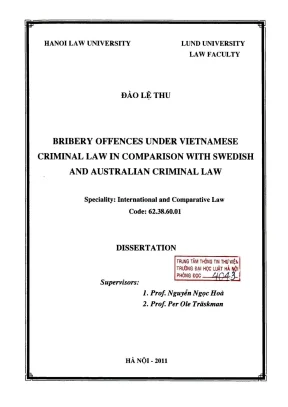
HANOI LAW UNIVERSITY LUND UNIVERSITY LAW FACULTY DAO LE THU BRIBERY OFFENCES UNDER VIETNAMESE CRIMINAL LAW IN COMPARISON WITH SWEDISH AND AUSTRALIAN CRIMINAL LAW Speciality: International and Comparative Law Code: 62. Nguyén Ngoc Hoa 2. Per Ole Tréskman HÀ NỘI- 2011 Preface If one recently wonders about what kind of crime is of the greatest threat to the stability of the state and the economy, after organized crime, bribery would certainly also be considered. Bribery and organized crime may even make a good combination to develop well together, because the former can support the latter and vice versa.
One must be concerned that many of those responsible in state and society close their eyes to the fact that the line between organized crime and bribery appear to be shifting or they even help smooth the way for this to happen. Through media coverage we are told about bribery practices throughout the world. Breaking news often includes stories of bribery in both the national and international context. Bribery cases receive much attention and concern from politicians, legal practitioners and citizens.
It is worth keeping in mind that unlike other dangerous phenomena, bribery is an internal danger. As one perceives such phenomenon has risen in society as an “enemy within,” or like a “cancer,” that can undermine the trustworthiness of state and societal decision-making processes and, thereby, not only damages specifically affected individuals and institutions, but has the ability to destroy the entire structure of state and society (Eser 2003: Preface). The threat has been recognized for decades, especially so far as concerns the stability of the state. For a long time, developed countries have embraced policies and launched campaigns against corruption, including bribery.
These activities have just started in the developing countries; however the perception and determination there are still different to some extent. There have been attempts to address it by way of criminal law and by other programs and measures in different arenas. Of course recourse to criminal law may not be the optimal solution but it is necessary in regard to the gravity and current situation of bribery. As a researcher I see the need to use criminal law as an essential tool and I also identify the difficulties posed by and the problems with such use.
These encourage me to study bribery from a criminal law point of view. This study is essential result of my PhD studies for over four years within the Joint Doctoral Program of International and Comparative Law between Hanoi Law University of Vietnam and the Faculty of Law at Lund University of Sweden. It would have been impossible without the supervision, encouragement, help and advices from all those to whom I am indebted. It is impossible to acknowledge all these persons by name.
First of all, I would like to express my general gratitude to the members of the Faculty of Law at Lund University. | would like to thank specifically the persons who have particularly made invaluable contributions to my research. I am deeply grateful to Assoc. Christoffer Wong who has taken an interest in my research, introduced me to relevant research and provided advice and comments that made my research process enlightened.
1 would like to give my special thanks to Asst. Bengt Lundell and Prof. Christina Moél who have throughout the years provided help, encouragement and sympathy. | must not forget the help provided by the Faculty Library.
I would also like to thank My Dung Ho, a master student at the Faculty of Law for her translation into English of the relevant part of the commentaries on the Swedish Penal Code, including several cases, this due to the fact that I cannot read Swedish. Next I would like to thank the professors participating in the three prolongation seminars for evaluating my research over the last four years and from whom I received many thoughtful and helpful comments and suggestions. Especial thanks must be given to Professor Lé Thi Son and Assoc. In addition, people at the other academic institutions I have visited during the course of my research have been very kind and helpful.
It was my great honour to be a visiting fellow in these institutions, enjoying wonderful research environment and obtaining a good outcome for my own work. In particular, thank so much to the professors, staff and librarians at the Max Planck Institute for Foreign and International Criminal Law in Freiburg, Germany and at the Faculty of Law of New South Wales, Australia for providing me with help and research assistance. I wish to especially express my gratitude to Professor Jill Hunter, Christopher Lemercier, Robyn Bennett-Healy and Thuy Van Nguyen to whom I am indebted not only for help in doing research but also for caring for me during the time | was at the Faculty of Law of New South Wales. Furthermore I had the chance to interview and discuss matters with wonderful and kindhearted people while doing this study.
Professor Madelene Lejonhufvud who used to be chairperson at the Swedish Institute against Corruption and professor at Stockholm University is a person I will never forget because of my Interesting meeting with her and a discussion of Swedish criminal law on bribery. In addition, I am really grateful to Lars Korsell at Brottsförebyggande rảdet of Sweden (National Council of Crime Prevention) for giving me some information about the situation regarding bribery in Sweden and for providing me with statistics. It was also a great honour to meet with Justice Rod Howie of the Supreme Court of New South Wales, Deputy Director of Public Prosecutions Commonwealth Jolliffe Jim and David Wong, an officer of the NSW Police Integrity Commission, receiving answers from each of them involving bribery criminal law and bribery practices of Australia. Thank you so much for these meaningful meetings.
| am also grateful to SIDA (the Swedish International Development Agency) and its “Strengthening Legal Education in Vietnam” project for financing my research. Especial thanks go to Associate Professor Bengt Lundell, Associate Professor Lars-Géran Malmberg, Professor Lé Hồng Hạnh, Professor Lê Minh Tâm and Professor Lê Thị Sơn for their support during my research. In addition, I am grateful to the competent people at the Faculty of Post-graduate and the Department of International Co-operation of Hanoi Law University and at the Faculty of Law of Lund University for helping me with procedures for going abroad, housing and other practical matters. I would also like to deeply thank Hanoi Law University for providing me the facilities for doing research during over last four years.
My gratitude also needs to be expressed to my colleagues at the Faculty of Criminal Law of Hanoi Law University for their encouragements and help during the time I was doing my thesis. I must thank so much people at Vietnamese legal agencies and institutions such as the People’s Supreme Court, the People’s Court of Hanoi, the National Institution of State and Law, etc., who provided me with relevant information, statistics, judgments and materials. The persons to whom I am most grateful are naturally my supervisors, Professor Per Ole Traskmän of the Faculty of Law at Lund University and Professor Nguyễn Ngoc Hòa of Hanoi Law University. As supervisors, they not only gave me instructions and suggestions but also encouraged me to develop ideas myself.
Professor Per Ole Traskman even helped me with checking a translation of the Swedish Penal Code and other Swedish legal documents concerning my research, additionally arranging meetings for me with experts and practitioners in the area of my study. They have provided me with insightful comments and have discussed essential issues of the thesis with me. I must say that I could not have completed my research without their help and encouragement. Finally, my friends and my family have contributed the greatest and warmest support and encouragement.
Thank you my fellow doctoral candidates and also my friends for help and chat, cheering me up whenI felt sad or pessimistic and discussing idea with me when I was stuck. My special gratitude is given to my best friends (and also my colleagues) at the Faculty of Criminal Law of Hanoi Law University Dr. Nguyén Tuyét Mai and Dr. Duong Tuyét Mién who not only encouraged me but also helped me both by assisting my research and sharing my difficulties.
I would like to express from the bottom of my heart my greatest indebtedness to my mother, my sister, my parents in law and, above all, my husband and children who shared with me the difficulties and the happiness. I have the greatest sympathy for them on account of my spending so much time on doing research instead of taking care of them. This study is dedicated to you all. It is necessarily to say in this Preface that I bear sole personal responsibility for the ideas and arguments presented in this thesis.
Hà Nội, 14 January 2011 Le Thu Dao [Dao Lé Thu] Table of Contents Page List of Abbreviations Introduction Chapter 1. General Issues relating to Bribery Offences 21 1. Theoretical Issues relating to Bribery Offences 21 1. The Concept of Bribery Offence 21 1.
Prevailing Types of Bribery 30 1. Theories concerning Bribery Offences 37 1. Bribery Offences as approached by International Criminal Law Standards 56 1. General Conclusions 81 Chapter 2.
Bribery Offences under the Criminal Law of Vietnam compared 84 with the Position in Swedish and Australian Law 2. Bribery Offences under the Vietnamese Penal Code 84 2. Elements of Bribery Offences 85 2. Preparation, Attempt and Complicity regarding Bribery Offences 104 2.
Criminal Sanctions and Measures for Bribery Offences 105 2. Bribery Offences under Swedish Criminal Law 109 2. Elements of Bribery Offences 110 2. Some Special Criminalized Types of Bribery 125 2.
Uncompleted Offences and Complicity 130 2. Criminal Sanctions and Measures 130 2. Bribery Offences under Australian Criminal Law 133 2. Australian law on bribery offences in general 133 2.
Elements of Bribery ofa Commonwealth Public Official 137 2. Other Bribery Offences 147 2. Attempt, Conspiracy and Complicity 154 2. The offence of corrupting benefits given to, or received by, a 156 Commonwealth public official 2.
Comparative Analysis 157 Chapter 3. Practical Issues concerning Bribery Offences in Vietnam - 167 Comparing with Sweden and Australia 3. Current Situation of Bribery Offences in Vietnam - Compared with the 167 Situation in Sweden and Australia 3. Current Situation regarding Bribery Offences in Vietnam 167 3.
The Recent Situation concerning Bribery Offences in Sweden and Australia 190 3. The Application of the Vietnamese Criminal Law on Bribery Offences - 205 Compared with that of Sweden and Australia 3. The Application of Vietnamese Criminal Law on Bribery Offences 205 3. Experiences of the Application and Interpretation of Criminal Law in 224 Sweden and Australia 3.
The Swedish experiences 225 3. The Australian experiences 238 3. Comparative Conclusions 248 Chapter 4. Recommendations for the Vietnamese Criminal Law on Bribery 352 Offences and Its Application 4.
Guiding Principles for Recommendations Zoe. Recommendations for the Revision of Bribery Provisions in the Penal Code 260 4. Recommendations concerning the offences 260 4.2, Recommendations concerning penalties and other criminal measures oie 4. Recommendations for the Interpretation and Application of the Criminal 275 Law on Bribery Final Conclusion 279 Table of Cases 281 Official Documents 284 Bibliography 289 List of Abbreviations CAER Centre for Australian Ethical Research COE Council of Europe CPI Corruption Perceptions Index CTH Commonwealth GRECO Group of States against Corruption EUR Euro EU European Union ICC International Criminal Court ICAC Independent Commission Against Corruption MCCOC Model Criminal Code Officers Committee NIS National Integrity System OECD Organization for Economic Cooperation and Development Para.
Paragraph PMU Project Management Unit SEK Swedish Crowns SIDA Swedish International Development Cooperation Agency UK United Kingdom UN United Nations US United States of America U.