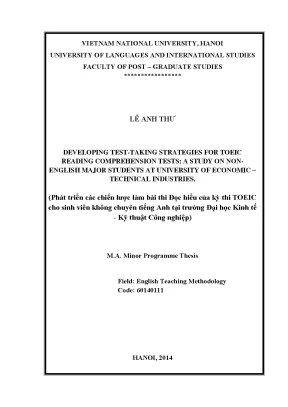
Luận văn: Phát triển chiến lược làm bài TOEIC Reading cho sinh viên UNETI

Luận văn: Nghiên cứu chiến lược làm bài thi TOEIC Reading cho sinh viên không chuyên Anh tại trường ĐH Kinh tế Kỹ thuật Công nghiệp.

Người đăng

Ẩn danh

Thể loại

Minor Programme Thesis

2014

58
0
0

Phí lưu trữ

30 Point

Mục lục chi tiết

DECLARATION

Acknowledgements

ABSTRACT

TABLE OF CONTENTS

LIST OF TABLES

LIST OF ABBREVIATIONS

1. PART I: INTRODUCTION

1. Rationale of the study

2. Aims of the study

3. Scope of the study

4. Methods of the study

5. Significance of the study

6. Design of the study

2. PART II: DEVELOPMENT

1. CHAPTER 1 – THEORETICAL BACKGROUND

1.1. Reading and Reading comprehension

1.1.1. Definitions of reading

1.1.2. Definitions of reading comprehension

1.1.3. Models of reading process

1.1.4. Reading comprehension approaches

1.2. Reading Comprehension Skills and Strategies

1.2.1. Reading for specific information

3. Finding the main ideas

4. Guessing vocabulary from the context

5. Reading Comprehension Skills

6. TOEIC reading comprehension tests

6.1. What is the TOEIC test?

6.2. TOEIC Test Area

6.3. Structure of the Test

6.4. Who takes the test?

6.5. Test formats: SP and IP

6.6. TOEIC Reading Comprehension Section

2. The context of the study

3. Data Collection Instruments

4. Data collection procedures

3. CHAPTER 3 – FINDINGS AND DISCUSSION

3.1. Students‟ attitude towards TOEIC tests at UNETI

3.2. Students‟ perception of their difficulties in taking TOEIC reading comprehension tests at UNETI

3.2.1. In the area of Vocabulary

3.2.2. In the area of Grammar

3.2.3. In the area of Discourse

3.2.4. In the area of Reading Strategies

3.3. Causes of Reading Difficulties

3.4. Students‟ frequency of strategy use across four main kinds of questions in TOEIC reading comprehension test

3.5. Recommendations on developing test-taking strategies in TOEIC reading comprehension test

3.5.1. General test-taking reading strategies

3.5.2. Specific test-taking reading strategies for common question types

3.6. Test-taking reading strategies for vocabulary questions

3.7. Test-taking reading strategies for factual questions

3.8. Test-taking reading strategies for inference questions

3. PART III – CONCLUSION

1. Limitations and of Recommendations for further Research

Tóm tắt

I. Tổng quan về TOEIC Reading Bí quyết làm bài hiệu quả nhất

Bài thi TOEIC Reading đánh giá khả năng đọc hiểu tiếng Anh trong môi trường làm việc quốc tế. Nhiều sinh viên và người đi làm gặp khó khăn trong phần thi này do thiếu chiến lược làm bài TOEIC Reading hiệu quả. Bài viết này cung cấp các mẹo thi TOEIC Readingbí quyết luyện thi TOEIC Reading giúp bạn cải thiện điểm số. Theo nghiên cứu của Lê Anh Thư tại Đại học Ngoại Ngữ - Đại học Quốc Gia Hà Nội, sinh viên không chuyên Anh gặp nhiều khó khăn trong việc sử dụng kỹ năng làm bài TOEIC Reading hiệu quả. Điều này dẫn đến kết quả thi không như mong đợi. Vì vậy, việc nắm vững cấu trúc bài thi TOEIC Reading, các dạng bài TOEIC Reading thường gặp và phương pháp làm bài TOEIC Reading khoa học là vô cùng quan trọng. Ngoài ra, việc trau dồi từ vựng TOEIC Readingngữ pháp TOEIC Reading cũng đóng vai trò then chốt trong việc đạt điểm cao. Bài viết sẽ đi sâu vào phân tích từng phần của bài thi, cung cấp các phương pháp làm bài TOEIC Reading cụ thể và các bài luyện đề TOEIC Reading giúp bạn tự tin chinh phục TOEIC Reading.

1.1. Tầm quan trọng của việc nắm vững chiến lược làm bài TOEIC Reading

Việc nắm vững chiến lược làm bài TOEIC Reading giúp thí sinh tiết kiệm thời gian, tập trung vào các phần quan trọng và tối ưu hóa điểm số. Theo ETS (Educational Testing Service), người ra đề thi TOEIC, việc hiểu rõ cấu trúc bài thi TOEIC Reading và các dạng bài TOEIC Reading là bước đầu tiên để xây dựng phương pháp làm bài TOEIC Reading hiệu quả. Nhiều thí sinh thường bỏ qua bước này và lao vào làm bài một cách ngẫu nhiên, dẫn đến việc lãng phí thời gian và mắc các lỗi không đáng có. Chính vì vậy, cần có kế hoạch ôn luyện kỹ càng và tìm hiểu các tài liệu ôn thi TOEIC Reading uy tín.

1.2. Các yếu tố ảnh hưởng đến điểm TOEIC Reading

Điểm TOEIC Reading chịu ảnh hưởng bởi nhiều yếu tố, bao gồm vốn từ vựng TOEIC Reading, khả năng ngữ pháp TOEIC Reading, kỹ năng làm bài TOEIC Reading và áp lực thời gian. Việc cải thiện từng yếu tố này sẽ góp phần nâng cao tổng điểm TOEIC Reading. Ví dụ, việc học từ vựng TOEIC Reading theo chủ đề và luyện tập ngữ pháp TOEIC Reading thường xuyên sẽ giúp bạn hiểu rõ hơn nội dung bài đọc và trả lời câu hỏi chính xác hơn. Thời gian làm bài TOEIC Reading cũng là một yếu tố quan trọng, do đó cần luyện tập để làm quen với áp lực thời gian và phân bổ thời gian hợp lý cho từng phần thi.

II. Thách thức thường gặp và cách cải thiện điểm TOEIC Reading

Nhiều thí sinh gặp phải các vấn đề chung khi làm bài thi TOEIC Reading, bao gồm thiếu từ vựng TOEIC Reading, không nắm vững ngữ pháp TOEIC Reading, gặp khó khăn trong việc đọc hiểu các đoạn văn dài và phức tạp, và không đủ thời gian làm bài TOEIC Reading. Để cải thiện điểm TOEIC Reading, cần xác định rõ các điểm yếu và có kế hoạch ôn luyện phù hợp. Ví dụ, nếu bạn yếu từ vựng TOEIC Reading, hãy tập trung học các từ vựng theo chủ đề và sử dụng flashcard để ghi nhớ. Nếu bạn yếu ngữ pháp TOEIC Reading, hãy ôn lại các kiến thức ngữ pháp cơ bản và làm các bài tập ngữ pháp liên quan đến TOEIC Reading.

2.1. Vấn đề từ vựng TOEIC Reading Giải pháp và nguồn học hiệu quả

Thiếu từ vựng TOEIC Reading là một trong những nguyên nhân chính khiến nhiều thí sinh gặp khó khăn trong phần thi TOEIC Reading. Để khắc phục vấn đề này, hãy học từ vựng TOEIC Reading theo chủ đề, sử dụng các ứng dụng học từ vựng trực tuyến và đọc các tài liệu tiếng Anh thường xuyên. Có nhiều nguồn học từ vựng TOEIC Reading miễn phí và trả phí trên mạng, hãy lựa chọn nguồn học phù hợp với trình độ và mục tiêu của bạn. Ngoài ra, việc học từ vựng thông qua ngữ cảnh cũng rất quan trọng, giúp bạn hiểu rõ nghĩa của từ trong các tình huống khác nhau. Việc sử dụng TOEIC Reading vocabulary trong thực tế cũng giúp ghi nhớ lâu hơn.

2.2. Vấn đề ngữ pháp TOEIC Reading Ôn luyện kiến thức và luyện tập thường xuyên

Không nắm vững ngữ pháp TOEIC Reading cũng là một rào cản lớn đối với nhiều thí sinh. Để cải thiện khả năng ngữ pháp TOEIC Reading, hãy ôn lại các kiến thức ngữ pháp cơ bản như thì, câu bị động, câu điều kiện, mệnh đề quan hệ... và làm các bài tập ngữ pháp liên quan đến TOEIC Reading. Bạn có thể sử dụng các sách tài liệu ôn thi TOEIC Reading hoặc các trang web học ngữ pháp trực tuyến. Việc luyện tập thường xuyên và áp dụng kiến thức ngữ pháp vào việc đọc hiểu sẽ giúp bạn nắm vững ngữ pháp TOEIC Reading một cách hiệu quả.

III. TOEIC Reading Part 5 Chiến lược và mẹo làm bài tối ưu

TOEIC Reading Part 5 tập trung vào kiểm tra khả năng ngữ pháp và từ vựng của thí sinh. Để đạt điểm cao trong phần này, cần nắm vững các kiến thức ngữ pháp cơ bản, có vốn từ vựng phong phú và biết cách phân tích câu để tìm ra đáp án đúng. Theo kinh nghiệm của nhiều người thi TOEIC Reading, việc luyện tập thường xuyên và làm quen với các dạng bài TOEIC Reading Part 5 thường gặp là rất quan trọng. Ngoài ra, cần chú ý đến thời gian làm bài TOEIC Reading, phân bổ thời gian hợp lý cho từng câu hỏi và tránh lãng phí thời gian vào các câu hỏi quá khó.

3.1. Phân tích cấu trúc và dạng bài thường gặp trong TOEIC Reading Part 5

TOEIC Reading Part 5 thường bao gồm các câu hỏi về ngữ pháp (thì, loại từ, cấu trúc câu...) và từ vựng (từ đồng nghĩa, từ trái nghĩa, cách sử dụng từ...). Việc hiểu rõ cấu trúcdạng bài thường gặp sẽ giúp bạn dễ dàng xác định loại câu hỏi và áp dụng chiến lược làm bài phù hợp. Ví dụ, nếu câu hỏi về thì, hãy xác định dấu hiệu nhận biết thì và chọn đáp án có thì phù hợp. Nếu câu hỏi về từ vựng, hãy xem xét ngữ cảnh của câu và chọn đáp án có nghĩa phù hợp nhất. Luyện tập giải nhiều luyện đề TOEIC Reading phần này giúp bạn làm quen với các dạng câu hỏi.

3.2. Phương pháp và bí quyết chọn đáp án nhanh và chính xác

Để chọn đáp án nhanh và chính xác trong TOEIC Reading Part 5, hãy áp dụng các phương pháp sau: Đọc kỹ câu hỏi và xác định loại câu hỏi. Loại bỏ các đáp án sai dựa trên kiến thức ngữ pháp và từ vựng. Chọn đáp án phù hợp nhất với ngữ cảnh của câu. Nếu gặp câu hỏi khó, hãy bỏ qua và quay lại sau. Mẹo thi TOEIC Reading quan trọng là không nên dành quá nhiều thời gian cho một câu hỏi. Luyện tập luyện đề TOEIC Reading giúp bạn cải thiện tốc độ làm bài và độ chính xác.

IV. TOEIC Reading Part 7 Kỹ năng đọc hiểu và quản lý thời gian

TOEIC Reading Part 7 là phần khó nhất của bài thi TOEIC Reading, đòi hỏi thí sinh có kỹ năng đọc hiểu tốt và khả năng quản lý thời gian hiệu quả. Phần này bao gồm các đoạn văn dài và phức tạp, và các câu hỏi về nội dung, ý chính, mục đích của đoạn văn... Để đạt điểm cao trong phần này, cần luyện tập đọc hiểu thường xuyên, nâng cao vốn từ vựng và ngữ pháp, và biết cách quản lý thời gian hợp lý. Theo kinh nghiệm của nhiều người thi TOEIC Reading, việc đọc lướt (skimming) và đọc quét (scanning) là rất quan trọng để tiết kiệm thời gian và tìm kiếm thông tin nhanh chóng.

4.1. Kỹ thuật đọc lướt skimming và đọc quét scanning hiệu quả

Kỹ thuật đọc lướt (skimming) giúp bạn nắm bắt ý chính của đoạn văn một cách nhanh chóng, trong khi kỹ thuật đọc quét (scanning) giúp bạn tìm kiếm thông tin cụ thể trong đoạn văn. Để sử dụng kỹ năng đọc lướt hiệu quả, hãy tập trung vào câu chủ đề của mỗi đoạn, các tiêu đề và các từ khóa quan trọng. Để sử dụng kỹ năng đọc quét hiệu quả, hãy xác định từ khóa trong câu hỏi và tìm kiếm các từ khóa này hoặc các từ đồng nghĩa trong đoạn văn. Luyện tập thường xuyên sẽ giúp bạn thành thạo hai kỹ năng này và tiết kiệm đáng kể thời gian làm bài TOEIC Reading.

4.2. Chiến lược trả lời các dạng câu hỏi thường gặp trong Part 7

TOEIC Reading Part 7 thường bao gồm các dạng câu hỏi sau: Câu hỏi về ý chính, câu hỏi về chi tiết, câu hỏi về suy luận, câu hỏi về mục đích của đoạn văn... Đối với câu hỏi về ý chính, hãy tìm kiếm câu chủ đề của đoạn văn. Đối với câu hỏi về chi tiết, hãy đọc kỹ đoạn văn và tìm kiếm thông tin cụ thể. Đối với câu hỏi về suy luận, hãy suy luận dựa trên thông tin trong đoạn văn. Đối với câu hỏi về mục đích của đoạn văn, hãy xem xét mục đích của người viết. Nắm vững chiến lược trả lời cho từng dạng câu hỏi sẽ giúp bạn tăng khả năng trả lời đúng và tiết kiệm thời gian.

V. Luyện thi TOEIC Reading online và tự học Nguồn tài liệu và lộ trình

Hiện nay, có rất nhiều nguồn tài liệu ôn thi TOEIC Reading và các khóa luyện thi TOEIC online. Bạn có thể lựa chọn tự học TOEIC Reading hoặc tham gia các khóa luyện thi TOEIC online tùy theo điều kiện và mục tiêu của mình. Nếu bạn tự học TOEIC Reading, hãy xây dựng một lộ trình học tập rõ ràng, tìm kiếm các tài liệu ôn thi TOEIC Reading uy tín và luyện tập thường xuyên. Nếu bạn tham gia các khóa luyện thi TOEIC online, hãy lựa chọn khóa học phù hợp với trình độ và mục tiêu của bạn, và tham gia đầy đủ các buổi học và bài tập. Việc kết hợp cả tự học TOEIC Reading và tham gia các khóa luyện thi TOEIC online có thể mang lại hiệu quả tốt nhất.

5.1. Tài liệu ôn thi TOEIC Reading chất lượng và hiệu quả

Có rất nhiều tài liệu ôn thi TOEIC Reading trên thị trường, nhưng không phải tài liệu nào cũng chất lượng và hiệu quả. Hãy lựa chọn các tài liệu ôn thi TOEIC Reading uy tín, được biên soạn bởi các chuyên gia TOEIC Reading và có nội dung cập nhật. Một số tài liệu ôn thi TOEIC Reading được nhiều người sử dụng bao gồm: bộ sách Longman Preparation Series for the TOEIC Test, bộ sách Barron's TOEIC, và các luyện đề TOEIC Reading từ ETS. Ngoài ra, bạn cũng có thể tìm kiếm các tài liệu ôn thi TOEIC Reading miễn phí trên mạng.

5.2. Xây dựng lộ trình tự học TOEIC Reading hiệu quả

Để tự học TOEIC Reading hiệu quả, hãy xây dựng một lộ trình học tập rõ ràng và tuân thủ theo lộ trình này. Lộ trình học tập nên bao gồm các bước sau: Xác định trình độ hiện tại và mục tiêu điểm số. Lựa chọn tài liệu ôn thi TOEIC Reading phù hợp. Học từ vựng và ngữ pháp theo chủ đề. Luyện tập đọc hiểu thường xuyên. Làm các luyện đề TOEIC Reading và phân tích kết quả. Điều chỉnh lộ trình học tập nếu cần thiết. Quan trọng nhất là kiên trì và nỗ lực để đạt được mục tiêu của mình.

VI. Tổng kết Kỹ năng chiến lược và tài liệu cho thành công TOEIC Reading

Thành công trong phần thi TOEIC Reading đòi hỏi sự kết hợp giữa kỹ năng, chiến lượctài liệu ôn luyện phù hợp. Việc nắm vững các kỹ năng làm bài TOEIC Reading, áp dụng các chiến lược hiệu quả và sử dụng các tài liệu ôn thi TOEIC Reading uy tín sẽ giúp bạn tự tin chinh phục bài thi và đạt được điểm số mong muốn. Hãy kiên trì luyện tập, không ngừng học hỏi và áp dụng những kiến thức và kinh nghiệm đã được chia sẻ trong bài viết này để cải thiện điểm TOEIC Reading của bạn.

6.1. Các kỹ năng TOEIC Reading cần thiết cho người mới bắt đầu

Người mới bắt đầu cần tập trung vào việc xây dựng nền tảng vững chắc về từ vựng TOEIC Readingngữ pháp TOEIC Reading. Ngoài ra, cần rèn luyện các kỹ năng TOEIC Reading cơ bản như đọc lướt, đọc quét và tìm kiếm thông tin. Tham gia các khóa học TOEIC Reading cho người mới bắt đầu có thể giúp bạn có được sự hướng dẫn và hỗ trợ tốt nhất. Quan trọng là phải có một lộ trình ôn luyện phù hợp với trình độ của bản thân.

6.2. Tiếp tục luyện tập và cải thiện điểm TOEIC Reading sau khóa học

Sau khi hoàn thành khóa học, hãy tiếp tục luyện tập thường xuyên bằng cách làm các luyện đề TOEIC Reading và đọc các tài liệu tiếng Anh. Phân tích kỹ các lỗi sai và tìm cách khắc phục. Đặt mục tiêu điểm số cao hơn và không ngừng nỗ lực để đạt được mục tiêu này. Việc cải thiện điểm TOEIC Reading là một quá trình liên tục, đòi hỏi sự kiên trì và nỗ lực không ngừng.

22/09/2025

Trích đoạn nội dung tài liệu

VIETNAM NATIONAL UNIVERSITY, HANOI UNIVERSITY OF LANGUAGES AND INTERNATIONAL STUDIES FACULTY OF POST – GRADUATE STUDIES ***************** LÊ ANH THƯ Developing test-taking strategies for TOEIC Reading Comprehension Tests: A study on non- English major students at University of Economic – Technical Industries. Minor Programme Thesis Field: English Teaching Methodology Code: 60140111 HANOI, 2014 TIEU LUAN MOI download : skknchat@gmail.com VIETNAM NATIONAL UNIVERSITY, HANOI UNIVERSITY OF LANGUAGES AND INTERNATIONAL STUDIES FACULTY OF POST – GRADUATE STUDIES ***************** LÊ ANH THƯ Developing test-taking strategies for TOEIC Reading Comprehension Tests: A study on non- English major students at University of Economic – Technical Industries. Minor Programme Thesis Field: English Teaching Methodology Code: 60140111 Supervisor: Dr. Ngô Hữu Hoàng HANOI, 2014 TIEU LUAN MOI download : skknchat@gmail.com DECLARATION I, Le Anh Thu, hereby state that, this minor thesis is the result of my own research and all the material in this study which is not my own work has been identified and acknowledged.

I also state that the substance of the thesis has not, wholly or in part, been submitted for any degree to any other universities institutions. Dated: 25/ 12/ 2013 Lê Anh Thư i TIEU LUAN MOI download : skknchat@gmail.com Acknowledgements First and foremost, I would like to express my most sincere thanks to my respected supervisor, Dr. Ngo Huu Hoang for his generous assistance, invaluable advice, guidance, constructive comments. Without his help, this study would not have possibly been completed.

I would like to take this opportunity to express my thankfulness to the Post- Grade Department for their enthusiastic help during the time of studying and writing my thesis. I also wish to acknowledge the cooperation of my colleagues and my students, especially the students at University of Economic – Technical Industries who have helped me to collect data for the study. Hereby, I also would like to thank all the readers for their attention and I highly appreciate any comments and opinions on this study. ii TIEU LUAN MOI download : skknchat@gmail.com ABSTRACT So far, most Vietnamese universities have tended to choose TOEIC as a measure unit to assess input English level and graduation for students.

TOEIC score reports provide accurate, meaningful feedback about a test taker‟s strengths and weaknesses, along with a description of the English language strengths typical of test takers performing at various score levels. However, when taking the TOEIC test, especially the TOEIC reading comprehension section, many students do meet a lot of difficulties in reading, and therefore fail to be efficient readers and get high scores. One of the primary causes is that students seem unskilled or unaware of the use of test-taking strategies for TOEIC reading comprehension tests. Then, which strategies should students be used while taking the TOEIC reading comprehension tests? A number of studies and books have already been released in the area of application of test-taking strategies to TOEIC reading comprehension part.

This study is concerned with developing test-taking strategies to help non-major English students at UNETI reduce reading difficulties, improve their skills and take the TOEIC reading comprehension tests with higher scores. The result of the study show that non-major English students at UNETI often have difficulties, to different extent, in many areas of the language such as difficulties with vocabulary, with grammar, discourse, and reading strategies. Moreover, the data collected in the study also revealed that the students‟ inefficient use of reading strategies is a great source of reading problems. Through the students‟ low frequency of strategy use to deal with question kinds in TOEIC reading comprehension tests, it is shown that students fail to apply reading strategies effectively in responding to questions during tests.

Therefore, the study suggests that to enable to successfully take the TOEIC reading comprehension test, students should actively use strategies involved as skimming and scanning skills, utilize context clues to understand difficult words and find out the synonym or paraphrase for the word. In some cases, if test-takers have no idea about a question, the application of techniques to guess should be needed. Besides, the study also recommends several test- taking strategies for each kind of questions in TOEIC reading comprehension test. iii TIEU LUAN MOI download : skknchat@gmail.com TABLE OF CONTENTS TABLE OF CONTENTS PAGE DECLARATION.

iii TABLE OF CONTENTS. iv LIST OF TABLES. vii LIST OF ABBREVIATIONS. viii PART I: INTRODUCTION 1.

Rationale of the study. Aims of the study. Scope of the study. Methods of the study.

Significance of the study. Design of the study. 3 PART II: DEVELOPMENT CHAPTER 1- THEORETICAL BACKGROUND 1. Reading and Reading comprehension.

Definitions of reading. Definitions of reading comprehension. Models of reading process. Reading comprehension approaches.

Reading Comprehension Skills and Strategies. Reading for specific information. 7 iv TIEU LUAN MOI download : skknchat@gmail. Finding the main ideas.

Guessing vocabulary from the context. Reading Comprehension Skills. TOEIC reading comprehension tests. What is the TOEIC test?.

TOEIC Test Area. Structure of the Test. Who takes the test?. Test formats: SP and IP.

TOEIC Reading Comprehension Section. The context of the study. Data Collection Instruments. Data collection procedures.

20 CHAPTER 3 – FINDINGS AND DISCUSSION 3. Students‟ attitude towards TOEIC tests at UNETI. Students‟ perception of their difficulties in taking TOEIC reading comprehension tests at UNETI. In the area of Vocabulary.

In the area of Grammar. In the area of Discourse. In the area of Reading Strategies. Causes of Reading Difficulties.

Students‟ frequency of strategy use across four main kinds of questions in TOEIC reading comprehension test. 28 v TIEU LUAN MOI download : skknchat@gmail. Recommendations on developing test-taking strategies in TOEIC reading comprehension test. General test-taking reading strategies.

Read the questions carefully. Answer every question. Read the questions before reading the passage. Use Context Clues to understand difficult words.

Specific test-taking reading strategies for common question types. Test-taking reading strategies for vocabulary questions. Test-taking reading strategies for factual questions. Test-taking reading strategies for inference questions.

37 PART III – CONCLUSION 1. Limitations and of Recommendations for further Research .I vi TIEU LUAN MOI download : skknchat@gmail.com LIST OF TABLES 1. Student‟s perception about the importance of the TOEIC test at UNETI. Difficulties in the area of vocabulary.

Difficulties in the area of Grammar. Difficulties in the area of Discourse. Difficulties in the area of Reading Strategies. Students‟ personal views of the sources of difficulties.

Table 7: Frequency of Strategy Use for Vocabulary Questions. Table 8: Frequency of Strategy Use for Inference Question.29 vii TIEU LUAN MOI download : skknchat@gmail.com LIST OF ABBREVIATION UNETI University of Economic Technical Industries ELT English language teaching TOEIC Test of English for International Communication ETS Educational Testing System TOEIC RC test TOEIC Reading Comprehension test TOEIC LC test TOEIC Listening Comprehension test viii TIEU LUAN MOI download : skknchat@gmail.com PART I – INTRODUCTION 1. Rationale Reading as an active, receptive, and decoding language skill is the main source of meaningful input in the process of learning a foreign language. Besides, according to Kim and Anderson (2011, p.

30), “reading is essential for successfully completing all college- level courses. In other words, college students who are more proficient readers are most likely to experience more success in their courses”. Meantime, tests are the most common evaluating method in nearly all educational systems and academic institutions worldwide. Generally, tests express the most students‟ total grades, particularly at the college level.

Whether the goal is college admission, certification, detection of specific behavior, or personal selection, a decision about an individual‟s ability is usually made based on his or her scores in specific tests. Therefore, it is certain that test takers have developed numerous techniques for finding correct answers to reading tests without fully or even partially understanding the text. However, in a test, to evaluate academic reading ability, the primary needs for test takers is to actually use academic reading skills in responding to items, rather than to rely on test-wiseness tricks. The Test of English for International Communication (TOEIC) has made great efforts to evaluate the reading comprehension abilities of test takers dealing with academic-like texts.

It is clear that the reading tasks in TOEIC are able to discriminate better readers from poorer readers. However, how exactly do test-takers try to complete the tasks? What reading and test-taking strategies do students use to complete the tasks? For ages of applying TOEIC tests as the standard to assess the level of English proficiency in the workplace and everyday communication of non- major English students at University of Economic and Technical Industries (UNETI), I realize that many students do not know how to utilize multiple test-taking strategies to enhance their performance in successfully taking TOEIC tests in general, and TOEIC reading comprehension tests in particular. In details, when approaching the TOEIC reading comprehension part, they frequently read the questions and carelessly scan the passage, merely guessing answers in the end, due to insufficient knowledge about text types and task design. Some can not complete the whole reading test because they lack the fast reading skill and active application of scanning or skimming strategies.

Some seem unaware of the test-taking strategies. Hence, the significance of a study on developing test-taking strategies for 1 TIEU LUAN MOI download : skknchat@gmail.com TOEIC reading comprehension tests as a way of helping non- major English students at UNETI do well in their tests seems undeniable. Aims of the Study This study was carried out with following specific purposes: 1) To investigate difficulties and causes of difficulties which non- major English students at UNETI encounter in taking TOEIC reading comprehension tests. 2) To investigate the frequency use of test-taking strategies which non- major English students at UNETI deal with question kinds in TOEIC reading comprehension tests.

3) To develop test-taking strategies to help learners reduce difficulties, improve their reading skills and take the TOEIC reading comprehension tests with higher scores. Research questions The study was carried out in order to find out the answers to two research questions: 1) What are the difficulties and causes of difficulties encountered by non- English major students at UNETI in taking TOEIC reading comprehension tests? 2) What is the frequency use of the test-taking strategies which non- major English students at UNETI deal with question kinds in TOEIC reading comprehension tests? 3) How to develop students‟ test-taking strategies for TOEIC reading comprehension tests? 4. Scope of study As the title of the study has indicated, the author only focuses on developing test-taking strategies via TOEIC reading comprehension part. Besides, because of limited time and scope of the minor thesis, the researcher can only conduct a survey on non- English major students at UNETI.

Methods of study In order to fulfill the aims of the study, the study has been carried out using both quantitative and qualitative methods. The data were collected from survey on 120 non- English major students at the UNETI. The survey questionnaire included both closed and open-ended questions to ensure data. Significance of the study Results of the study will help provide a better understanding of test-taking strategies for the TOEIC reading comprehension test placed on non- major English students at UNETI and they are expected to successfully perform in their tests.

2 TIEU LUAN MOI download : skknchat@gmail. Design of the study This study consists of three parts: Part I: Introduction. This part supplies an overview of the study with specific reference to the rationale, the aims, the methodology and the design. Part II: Development.

In this part, four chapters are presented. Chapter 1 – Literature Review deals with an exploration of the theoretical background of the research. It is concerned with the issues relevant to the topic of the research: reading and reading comprehension, and an overview of TOEIC reading comprehension tests.

Nội dung được bảo vệ bản quyền — Tải xuống đầy đủ