Đánh giá khả năng lồng tiếng hài hước: Phân tích đối chiếu bản gốc tiếng Anh và bản lồng tiếng tiếng Ý của The Simpsons, mùa 1 - Luận văn Thạc sĩ

Phân tích khả năng lồng tiếng hài hước trong phim hoạt hình The Simpsons mùa 1. Nghiên cứu đối chiếu phiên bản tiếng Anh và tiếng Ý nhằm đánh giá hiệu quả của

2002

110
0
0

Phí lưu trữ

35 Point

Tóm tắt

I. Tổng quan về phân tích khả năng lồng tiếng hài hước The Simpsons mùa 1

Nghiên cứu về khả năng lồng tiếng hài hước trong The Simpsons mùa 1 đặt trọng tâm vào quá trình chuyển thể lời thoại hài từ tiếng Anh sang tiếng Ý. Đây là lĩnh vực giao thoa giữa nghiên cứu hài hước, dịch thuật và truyền hình. Luận văn của Margherita Dore năm 2002 tại Đại học Manchester đã phân tích cách thức hài hước ngôn ngữ được xử lý trong phiên bản lồng tiếng Ý. Phần lớn các lý thuyết hài hước trước đây chỉ tập trung vào góc độ ngôn ngữ thuần túy. Rất ít nghiên cứu đặt câu hỏi về khả năng dịch chuyển hài hước giữa các ngôn ngữ khác nhau. The Simpsons mùa 1 là đối tượng lý tưởng cho nghiên cứu này vì phim chứa đựng nhiều tầng lớp hài hước đa dạng. Từ châm biếm xã hội đến chơi chữ ngôn ngữ, mỗi loại đòi hỏi chiến lược dịch thuật riêng biệt. Nghiên cứu này đặt nền móng quan trọng cho hiểu biết về dịch hài hước trong lĩnh vực nghe nhìn.

1.1. Bối cảnh nghiên cứu lý thuyết hài hước và dịch thuật

Lý thuyết hài hước đã thu hút sự quan tâm rộng rãi từ nhiều lĩnh vực nghiên cứu suốt nhiều thế kỷ. Trong thời gian gần đây, các nhà nghiên cứu như Greimas, Raskin và Attardo đã phân tích hiện tượng này từ góc độ ngôn ngữ học thuần túy. Mục tiêu là hiểu cơ chế tạo ra hài hước ngôn ngữ. Tuy nhiên, khả năng dịch chuyển hài hước giữa các ngôn ngữ vẫn là chủ đề ít được khai thác. Đồng thời, lĩnh vực nghe nhìn cũng là phạm vi tương đối mới mẻ. Các học giả dịch thuật đã bắt đầu quan tâm nhiều hơn đến nhánh phức tạp này của quá trình chuyển giao ngôn ngữ.

1.2. Đối tượng và phạm vi phân tích trong nghiên cứu

Đối tượng nghiên cứu tập trung vào mùa đầu tiên của loạt phim hoạt hình The Simpsons và phiên bản lồng tiếng Ý. Đây là series truyền hình nổi tiếng của Mỹ với lượng hài hước phong phú và đa dạng. Phiên bản Ý được chọn vì truyền thống lồng tiếng lâu đời tại quốc gia này. Italia có nền công nghiệp lồng tiếng phát triển mạnh, tạo điều kiện thuận lợi cho việc so sánh. Phạm vi phân tích bao gồm các loại hài hước khác nhau xuất hiện trong lời thoại. Từ hài hước văn hóa đặc thù đến hài hước ngôn ngữ tổng quát.

II. Thách thức và vấn đề trong lồng tiếng hài hước phim hoạt hình

Lồng tiếng hài hước trong phim hoạt hình đối mặt với nhiều thách thức phức tạp. Rào cản lớn nhất nằm ở sự khác biệt ngôn ngữ và văn hóa giữa bản gốc và bản dịch. Hài hước thường dựa trên yếu tố chơi chữ, tham chiếu văn hóa địa phương và ngữ cảnh cụ thể. Những yếu tố này rất khó chuyển tải sang ngôn ngữ khác mà vẫn giữ nguyên hiệu ứng hài hước. Các lý thuyết ngữ nghĩa học như lý thuyết isotopy của Greimas cho thấy trò đùa thường gồm hai phần có isotopy đối lập. Quá trình loại bỏ đa nghĩa thường tuân theo trình tự đọc tuyến tính. Tuy nhiên, khi chuyển sang ngôn ngữ khác, trình tự này có thể bị phá vỡ. Vi phạm các nguyên tắc giao tiếp của Grice cũng tạo ra hài hước nhưng khó tái tạo trong bản dịch. Thêm vào đó, ràng buộc kỹ thuật của lồng tiếng như đồng bộ miệng và thời lượng lời thoại càng gia tăng độ khó.

2.1. Rào cản ngôn ngữ và khác biệt văn hóa khi lồng tiếng

Mỗi ngôn ngữ có hệ thống ngữ âm, cú pháp và ngữ nghĩa riêng biệt. Hài hước tiếng Anh thường khai thác đa nghĩa từ vựng và cấu trúc câu đặc thù. Khi chuyển sang tiếng Ý, những yếu tố này mất đi hoặc thay đổi hoàn toàn. Tham chiếu văn hóa cũng là rào cản lớn. The Simpsons chứa nhiều trò đùa liên quan đến đời sống xã hội Mỹ. Khán giả Ý có thể không hiểu hoặc không cảm nhận được những tham chiếu này. Điều này đòi hỏi người dịch phải tìm giải pháp thay thế phù hợp với văn hóa mục tiêu.

2.2. Vấn đề dịch chuyển chơi chữ và tham chiếu đặc thù

Chơi chữ là hình thức hài hước khó dịch nhất trong lồng tiếng. Chúng dựa trên sự trùng âm, đa nghĩa hoặc kết hợp từ vựng đặc biệt của ngôn ngữ gốc. Attardo đã phân loại nhiều loại chơi chữ khác nhau trong lý thuyết của mình. Mỗi loại đòi hỏi cách tiếp cận dịch thuật riêng biệt. Tham chiếu văn hóa đặc thù cũng tạo ra thách thức tương tự. Các nhân vật, sự kiện hay sản phẩm văn hóa Mỹ xuất hiện nhiều trong The Simpsons. Người dịch phải quyết định giữa giữ nguyên, thay thế hoặc loại bỏ những yếu tố này.

III. Phương pháp và chiến lược dịch hài hước trong lồng tiếng

Một số phương pháp và chiến lược đã được đề xuất để xử lý hài hước trong lồng tiếng. Mô hình Lý thuyết Hài hước Ngôn ngữ Tổng quát của Attardo cung cấp khung phân tích hệ thống. Mô hình này xác định sáu tài nguyên kiến thức cần xem xét khi phân tích và dịch hài hước. Bao gồm ngôn ngữ, chiến lược kịch bản, đối tượng mục tiêu, tình huống, phương tiện và đối lập kịch bản. Attardo nhấn mạnh rằng người dịch nên cố gắng bảo tồn tất cả sự tương đồng giữa hai văn bản. Bắt đầu từ cấp độ ngôn ngữ và nếu không thể, ít nhất phải giữ nguyên đối lập kịch bản. Nguyên tắc cốt lõi là để bản dịch khác biệt ở cấp độ thấp nhất có thể phục vụ mục đích thực dụng. Ngoài ra, phương pháp phân tích dựa trên lý thuyết isotopy cũng hữu ích. Cách tiếp cận này cho phép so sánh có hệ thống giữa bản gốc và bản dịch.

3.1. Mô hình Lý thuyết Hài hước Ngôn ngữ Tổng quát

Mô hình GTVH của Attardo là công cụ phân tích quan trọng trong nghiên cứu này. Mô hình xác định sáu tài nguyên kiến thức được sắp xếp theo thứ bậc. Cấp cao nhất là ngôn ngữ, tiếp theo là đối lập kịch bản, chiến lược kịch bản, tình huống, đối tượng mục tiêu và phương tiện. Khi phân tích trò đùa, mỗi tài nguyên kiến thức cung cấp một góc nhìn riêng. Đối với dịch thuật, mô hình gợi ý bảo tồn càng nhiều tài nguyên càng tốt. Tuy nhiên, Attardo thừa nhận rằng việc bảo tồn hoàn toàn gần như không thể thực hiện trong thực tế.

3.2. Chiến lược ưu tiên trong quá trình dịch hài hước lồng tiếng

Chiến lược ưu tiên là nguyên tắc cốt lõi khi dịch hài hước trong lồng tiếng. Người dịch bắt đầu bằng việc cố gắng bảo tồn cấp độ ngôn ngữ. Nếu không thể, mục tiêu chuyển sang giữ nguyên đối lập kịch bản của trò đùa gốc. Phương pháp này cho phép linh hoạt nhưng vẫn duy trì được bản chất hài hước. Trong bối cảnh lồng tiếng, các ràng buộc kỹ thuật cũng phải được tính toán. Thời lượng lời thoại, đồng bộ miệng và nhịp phim đều ảnh hưởng đến lựa chọn dịch thuật. Chiến lược thay thế văn hóa cũng được áp dụng rộng rãi.

IV. Kết luận và ứng dụng thực tiễn của nghiên cứu lồng tiếng hài hước

Nghiên cứu về khả năng lồng tiếng hài hước trong The Simpsons mùa 1 đã đạt được nhiều kết quả quan trọng. Phân tích cho thấy hài hước hoàn toàn có thể được chuyển thể giữa các ngôn ngữ thông qua lồng tiếng. Tuy nhiên, mức độ thành công phụ thuộc vào loại hài hước và kỹ năng của người dịch. Các trò đùa dựa trên yếu tố văn hóa phổ quát dễ dịch hơn so với chơi chữ đặc thù ngôn ngữ. Mô hình GTVH cung cấp khung phân tích có hệ thống và thực tiễn. Kết quả nghiên cứu có giá trị cho nhiều lĩnh vực khác nhau. Từ đào tạo dịch giả lồng tiếng đến phát triển chiến lược bản địa hóa nội dung. Ngành công nghiệp lồng tiếng có thể áp dụng những phát hiện này để nâng cao chất lượng sản phẩm. Đặc biệt trong bối cảnh toàn cầu hóa truyền hình và phim ảnh. Nghiên cứu cũng mở ra hướng tiếp tục khám phá các thể loại hài hước phức tạp hơn.

4.1. Kết quả phân tích và giới hạn của nghiên cứu

Kết quả phân tích cho thấy phiên bản lồng tiếng Ý đã xử lý phần lớn hài hước một cách hiệu quả. Nhiều trò đùa được chuyển thể thành công bằng chiến lược thay thế văn hóa. Tuy nhiên, một số loại hài hước ngôn ngữ bị mất đi trong quá trình dịch. Giới hạn chính của nghiên cứu nằm ở phạm vi phân tích chỉ tập trung vào mùa đầu tiên. Số lượng tập phim hạn chế có thể chưa phản ánh đầy đủ các tình huống hài hước. Nghiên cứu cũng chủ yếu dựa trên phân tích định tính thay vì định lượng.

4.2. Ứng dụng thực tiễn cho ngành công nghiệp lồng tiếng

Những phát hiện từ nghiên cứu có nhiều ứng dụng thực tiễn trong ngành lồng tiếng. Dịch giả có thể sử dụng mô hình GTVH như công cụ hỗ trợ ra quyết định khi dịch hài hước. Nguyên tắc ưu tiên cấp độ tài nguyên kiến thức giúp tối ưu hóa quá trình dịch thuật. Các studio lồng tiếng có thể xây dựng hướng dẫn dựa trên kết quả nghiên cứu này. Đào tạo dịch giả cũng cần bổ sung kiến thức về lý thuyết hài hước. Đặc biệt quan trọng trong thời đại nội dung số toàn cầu hóa mạnh mẽ.
29/05/2026

Trích đoạn nội dung tài liệu

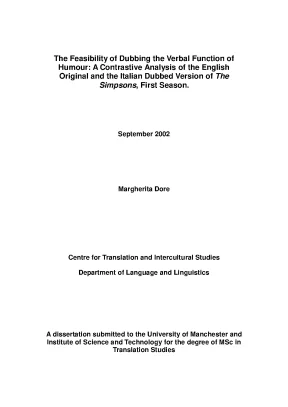
The Feasibility of Dubbing the Verbal Function of Humour: A Contrastive Analysis of the English Original and the Italian Dubbed Version of The Simpsons, First Season. September 2002 Margherita Dore Centre for Translation and Intercultural Studies Department of Language and Linguistics A dissertation submitted to the University of Manchester and Institute of Science and Technology for the degree of MSc in Translation Studies Declaration No portion of the work referred to in this dissertation has been submitted in support of an application for another degree or qualification of this or any other university or other institution of learning. Acknowledgements I am grateful to my supervisor, Peter Fawcett, for his continuous help and guidance throughout this endeavour. I would like to thank my parents, my sister, my brothers and all my friends for their moral support. I am also indebted to the government of my region (Sardinia) without whose economic support this experience would not have been possible. Last but not least, special thanks are due to John Robinson whose love and patience (and proof-reading) will never be forgotten. Abstract As a component of human behaviour, humour has received a large amount of interest throughout the centuries from theorists of many different fields of study. In the recent past have theorists in the field of humour research analysed this phenomenon strictly from a linguistic viewpoint (e.: Greimas, Raskin, Attardo) in order to understand the mechanism which creates linguistic humour. Far less interest has been shown in translation of humour itself. Similarly, given that the audiovisual medium is a relatively recent creation, theorists in its earlier past paid little attention to the role played by translation in this medium. Nevertheless, scholars in the field of translation studies have demonstrated a growing interest in this complex branch of language transfer which, as in translation in general, contributes to the communication between cultures across linguistic boundaries. In this light, this study seeks to highlight the way in which humour can be translated in the audiovisual domain by virtue of the dubbing mode. In order to do so, it will consider the case of the Italian translation of an American television series: The Simpsons. 1 Chapter I Constraints and Advantages in Dubbing with Particular Reference to the Italian Situation. 2 Dubbing: A Procedural Mixture of Constraints and Advantages . 3 Italy: A Case of Dubbing Tradition . 17 Chapter II Difficult Issues: Theories of Humour and its (Un)Translatability . 3 Semiotic and Text Theories . 4 Script-Based Theory . 5 Theories of Contextual Humour . 6 Violation of Grice's Maxims. 7 Humour and Translation: Possible or Impossible? . 35 Chapter III Humour Categorisation and Translation Strategies . 1 Culture-specific wordplay . 2 A mini-theory of humour translation . 3 Parody, Satire and Irony in Translation . 4 Humour in the Audio-visual Domain . 5 Translating the Perlocutionary Nature of Humour . 54 Chapter IV Data Analysis: The Simpsons, First Season . 4 Combining Verbal and Non-verbal Text . 5 Humour and Grice's maxims of communication . 6 Humorous Register in Dubbing (and Disparagement Theory). 7 Unexpected but Humorous Rhymes . 94 Findings and Concluding Remarks .104 ii Introduction Introduction As a component of human behaviour, humour has received a large amount of interest throughout the centuries from theorists of many different fields of study. Cicero, Freud and Bergson, to name only a few, have tried to explain the reasons for the existence of humour. Their explanations often focused on the psychological reasons which lead humans to produce humorous utterances. Only in the recent past have scholars in the field of humour research analysed this phenomenon strictly from a linguistic viewpoint. Their studies have shed new light on the mechanism which creates linguistic humour (e.: Greimas, Raskin, Attardo). Far less interest has been shown in translation of humour itself. Similarly, given that the audiovisual medium is a relatively recent creation, theorists in its earlier past paid little attention to role played by translation in this medium. Nevertheless, scholars in the field of translation studies, which is itself in its infancy, have demonstrated a growing interest in this complex branch of language transfer which, as in translation in general, contributes to the communication between cultures across linguistic boundaries. In this light, this study seeks to highlight the way in which humour can be translated in the audiovisual domain by virtue of the dubbing mode. In order to do so, it will consider the case of the Italian translation of an American television series: The Simpsons. The first chapter presents a survey on the dubbing mode, which starts with an insight into its technical production process. This underlies the need for team collaboration during the recreation of the verbal text that has to be adjusted in order to match adequately the non-verbal one present in the original audiovisual material, be it a film, a television programme and so on. The process is complex and the result often depends on the level of technical expertise of the whole team. In particular, the ability and creativity of translators and dialogists in the preliminary phases may greatly help the dubbing director and actors to deliver a satisfying performance. The role of the translator should then not be underestimated, as it often is, because it is a fundamental 1 Introduction element in the dubbing process. In this light, the chapter proceeds to focus on dubbing in Italy, where a long and established tradition has developed its peculiarities such as a tolerant attitude towards lip synchronisation and a tendency to localise the source text during translation, especially when dealing with entertainment material. The second chapter concentrates on humour and the feasibility of its translation. It first discusses some of the recent linguistic theories which mainly agree with the idea that humour is the result of incongruities or oppositions between items present in a text. Then, a discussion on the (un)translatability of humour follows. This analysis takes into account the opposite orientations of scholars in the field of translation studies and gives ground to the following discussion on the translation methods recently suggested in order to overcome the problems that humour poses in translation. The third chapter outlines the evaluation of the translatability of humorous texts according to the language and culture-specific features which characterise them, be they wordplays, parodies, satirical or ironic remarks. The focus of this chapter then shifts to the particular case of audiovisual translation of humour. In this, other elements come into play and the translator/dialogist has to take them into account. For example the connection of verbal and visual humour or the references to culture- specific humour or the presence of a live audience and the time pressure under which translators usually work are important factors influencing the final result. The solutions adopted in the case of humour translation are demonstrated to depend on the type of approach adopted. To be sure, the pragmatic functional approach seems to ensure adequate results in humour translation. This means that, in order to allow the text to produce its perlocutionary effect (amusement), the translated text partially overlooks the literary, and sometimes semantic, fidelity to the source text. The fourth chapter demonstrates the efficacy of the pragmatic functional approach through the analysis of the data collected regarding the first season of the television cartoon comedy The Simpons. The choice of this text depends on both personal and objective reasons. Personal because we are aware of the fact that the enjoyment of The Simpsons and its humour in Italian (I Simpson) overtly depends on the high level of localisation applied to it. Objective reasons are given by this programme world- 2 Introduction wide success and the fact that it has revolutionised the concept of animation. In fact it combines animation with comedy aimed at an adult audience thus becoming a landmark in this new type of television entertainment. The contrastive analysis carried out on the English original and the Italian dubbed version clearly shows that the Italian dubbing team opted for a high level of source-text manipulation for the sake of its primary function, that is its humour. This has been possible mainly because of the transfer medium used. In fact, dubbing allows the complete removal of the original verbal text, substituting it with a new target one. It goes without saying that this is impossible in subtitling where the original is retained and its translation is presented written at the bottom of the screen. Finally, we propose a few avenues of future research. 3 Chapter I Constraints and Advantages in Dubbing with Particular Reference to the Italian Situation Chapter I Constraints and Advantages in Dubbing with Particular Reference to the Italian Situation. ‘Language Transfer can be an important means of access to the life-styles, thoughts and creative productions of people from other regions in Europe and elsewhere. High quality Language Transfer is, therefore, a vital key to better understanding between countries and people in Europe’ (Luyken et al 1991: 28) 1. 1 Introduction Recently, multimedia translation in the field of translation studies has seen a relatively large amount of interest in the translation of films and television programmes. Scholars of translation, such as Marleau (1982) and Delabastita (1989, 1990), discuss a variety of problems associated with audio-visual translation. In particular, they analyse a possible range of constraints related to the most popular ways in which the aforementioned media are transposed from the source language (SL) into the target language (TL): dubbing and subtitling. The choice of one mode of translation over the other often depends on factors such as the cost of production, the traditions developed by individual countries and the relevance of the source text (ST) within the receiving culture. Similarly, Luyken et al. His empirical investigation reveals that a preference for dubbing increases with age while subtitling is preferred among highly educated audiences (ibid. However, Luyken et al. point out that the term Language Transfer has to be intended as inclusive of the different types of strategies applied, whether these include subtitling, voice-overs, commentary or dubbing. Each of these processes employs particular techniques aiming to overcome the linguistic barriers posed by the medium itself. Indeed, he crucially points out that: “Any method of Language Transfer will inevitably interfere with the original film or programme. But it should attempt to be as unobtrusive as 4 Chapter I Constraints and Advantages in Dubbing with Particular Reference to the Italian Situation possible so that, ideally, the new viewer's experience of the programme will differ as little as possible from that of the original audience. Highly professional and competent application of the various methods of Language Transfer, be it subtitling, voice-over or lip-sync dubbing, is therefore essential in order to preserve the original artistic identity of the audiovisual production to the widest possible extent. For whether emotionally supported or rejected, Language Transfer will play an increasingly significant role in the future direction of the television industry and the development of European identity.29) The emphasis on the word ‘ideally’ derives from the fact that the situation portrayed by Luyken et al. can only be described as ideal. More often that not, in fact, the process of Language Transfer faces a large number of constraints forcing translators and dialogists (or scriptwriters in subtitling) to manipulate texts in such a way that they differ greatly from the originals. However, if the aim of Language Transfer is to allow the target audience to participate in an experience as close as possible to the original, then the means applied might be justified by the scope. Moreover, the translator's high level of expertise will help to overcome the difficulties posed by each audio-visual text. If, on the one hand, translation modes in this field have to cope with specific constraints, on the other, they are able to rely upon peculiar advantages. This multiplicity of constraints and advantages is in fact the result of the very nature of mass communication, which develops through a multi-semiotic channel.

Nội dung được bảo vệ bản quyền — Tải xuống đầy đủ