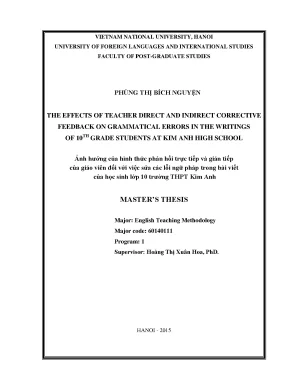
Hiệu quả phản hồi sửa lỗi ngữ pháp cho học sinh lớp 10 THPT Kim Anh

Luận văn: Hiệu quả của phản hồi trực tiếp, gián tiếp từ giáo viên lên lỗi ngữ pháp trong bài viết của học sinh lớp 10 trường THPT Kim Anh. Nghiên cứu sư phạm.

Người đăng

Ẩn danh

Thể loại

Master’s Thesis

2015

71
1
0

Phí lưu trữ

30 Point

Mục lục chi tiết

Acknowledgements

Abstract

TABLE OF CONTENTS

List of Tables

List of Figures

List of Abbreviations

1. CHAPTER 1: INTRODUCTION

1. Statement of the problem and rationale of the study. Statement of the problem and rationale of the study

Aims and objectives of the study. Aims and objectives of the study

Significance of the study. Significance of the study

Scope of the study. Scope of the study

Organization of the paper. Organization of the paper

2. CHAPTER 2: LITERATURE REVIEW

Approaches to the teaching of L2 writing. Approaches to the teaching of L2 writing

Grammatical errors in L2 writing. Grammatical errors in L2 writing

Feedback in L2 Writing. Feedback in L2 Writing

Types of feedback. Types of feedback

Direct Corrective Feedback. Direct Corrective Feedback

Indirect Corrective Feedback. Indirect Corrective Feedback

Review on studies about feedback issues. Review on studies about feedback issues

The effectiveness of corrective feedback. The effectiveness of corrective feedback

The impacts of direct and indirect corrective feedback. The impacts of direct and indirect corrective feedback

4. CHAPTER 4: RESULTS AND DISCUSSION

Data collection instruments. Data collection instruments

Data collection procedure. Data collection procedure

Verb errors in the pretest. Verb errors in the pretest

Errors of attitudinal adjectives in the pretest. Errors of attitudinal adjectives in the pretest

Errors of articles in the pretest. Errors of articles in the pretest

Post-test results. Post-test results

Answer to the first research question. Answer to the first research question

Verb tenses and forms. Verb tenses and forms

Summary of the results and discussion. Summary of the results and discussion

Answer to the second research question. Answer to the second research question

Verb tenses and forms. Verb tenses and forms

Summary of the results and discussion. Summary of the results and discussion

Summary of findings. Summary of findings

Limitations of the study and suggestions for further studies. Limitations of the study and suggestions for further studies

REFERENCES

APPENDICES

Appendix 1: Placement Test. Appendix 1: Placement Test

Appendix 2: Pre-test. Appendix 2: Pre-test

Appendix 3: Post-test. Appendix 3: Post-test

Appendix 4: Pretest result. Appendix 4: Pretest result

Tóm tắt

I. Tổng quan về Phản hồi Sửa Lỗi Ngữ Pháp cho Học sinh lớp 10

Kỹ năng viết đóng vai trò quan trọng trong giao tiếp, giúp học sinh bày tỏ ý tưởng và suy nghĩ một cách rõ ràng. Tuy nhiên, viết là một trong những kỹ năng khó thành thạo nhất. Học sinh lớp 10 thường gặp nhiều khó khăn trong việc viết đúng ngữ pháp, chính tả và dùng từ chính xác. Việc phản hồi và sửa lỗi ngữ pháp kịp thời và hiệu quả là vô cùng cần thiết để giúp các em nâng cao trình độ viết. Nhiều nghiên cứu đã chỉ ra rằng việc cung cấp phản hồi có thể giúp học sinh nhận ra những điểm yếu của mình và cải thiện đáng kể khả năng viết. Tuy nhiên, việc phản hồi như thế nào để đạt hiệu quả cao nhất vẫn là một vấn đề gây tranh cãi. Cần tìm ra phương pháp phản hồi phù hợp với trình độ và phong cách học tập của từng học sinh.

1.1. Tầm quan trọng của kỹ năng viết và ngữ pháp lớp 10

Kỹ năng viết không chỉ quan trọng trong học tập mà còn cần thiết cho công việc và cuộc sống sau này. Một bài viết tốt cần có nội dung rõ ràng, mạch lạc và sử dụng ngữ pháp chính xác. Việc nắm vững ngữ pháp giúp học sinh diễn đạt ý tưởng một cách hiệu quả, tránh gây hiểu lầm cho người đọc. Ngữ pháp tiếng Việt lớp 10 là nền tảng quan trọng để học sinh tiếp tục học tập và phát triển các kỹ năng ngôn ngữ khác. Nắm vững ngữ pháp giúp các em tự tin hơn khi viết và giao tiếp.

1.2. Các loại lỗi ngữ pháp thường gặp ở học sinh lớp 10

Học sinh lớp 10 thường mắc các lỗi ngữ pháp liên quan đến thì động từ, cách dùng từ, cấu trúc câu và dấu câu. Một số lỗi thường gặp bao gồm: sử dụng sai thì động từ (ví dụ: nhầm lẫn giữa thì quá khứ đơn và hiện tại hoàn thành), dùng sai giới từ, sai cấu trúc câu (ví dụ: thiếu chủ ngữ hoặc vị ngữ), sai chính tả và dấu câu. Việc xác định rõ các loại lỗi thường gặp giúp giáo viên tập trung vào những vấn đề quan trọng và đưa ra phản hồi phù hợp. Nghiên cứu của Phùng Thị Bích Nguyện (2015) đã chỉ ra rằng học sinh lớp 10 thường mắc lỗi với thì động từ, tính từ chỉ thái độ và mạo từ.

1.3. Mục tiêu của việc sửa lỗi ngữ pháp cho học sinh

Mục tiêu chính của việc sửa lỗi ngữ pháp là giúp học sinh nhận ra và sửa chữa những sai sót trong bài viết của mình. Việc này không chỉ giúp các em cải thiện khả năng viết mà còn nâng cao ý thức về ngữ pháp và cách sử dụng ngôn ngữ. Mục tiêu lâu dài là giúp học sinh tự tin hơn khi viết và có thể tự mình kiểm tra và sửa lỗi trong tương lai. Cần tạo ra một môi trường học tập tích cực, nơi học sinh không ngại mắc lỗi và sẵn sàng học hỏi từ những sai lầm của mình.

II. Thách thức trong việc Sửa Lỗi Ngữ Pháp cho Học Sinh lớp 10

Việc sửa lỗi ngữ pháp cho học sinh lớp 10 không phải lúc nào cũng dễ dàng. Học sinh có thể cảm thấy nản lòng khi bị chỉ ra quá nhiều lỗi sai. Giáo viên cần tìm ra cách tiếp cận phù hợp để khuyến khích học sinh sửa lỗi và tiếp tục cố gắng. Một trong những thách thức lớn nhất là sự khác biệt về trình độ giữa các học sinh trong lớp. Một số học sinh có thể nắm vững kiến thức ngữ pháp cơ bản, trong khi những học sinh khác lại gặp nhiều khó khăn. Giáo viên cần phải điều chỉnh phương pháp giảng dạy và phản hồi để đáp ứng nhu cầu của từng học sinh.

2.1. Sự khác biệt về trình độ ngữ pháp giữa các học sinh

Sự khác biệt về trình độ ngữ pháp giữa các học sinh là một thách thức lớn đối với giáo viên. Giáo viên cần phải có kiến thức sâu rộng về ngữ pháp và khả năng phân tích lỗi sai để có thể đưa ra phản hồi chính xác và phù hợp với từng học sinh. Việc sử dụng các bài tập và hoạt động đa dạng giúp giáo viên đánh giá trình độ của học sinh và điều chỉnh phương pháp giảng dạy cho phù hợp.

2.2. Khó khăn trong việc tạo động lực cho học sinh sửa lỗi

Một số học sinh có thể cảm thấy nản lòng khi bị chỉ ra quá nhiều lỗi sai. Giáo viên cần tạo ra một môi trường học tập tích cực, nơi học sinh không ngại mắc lỗi và sẵn sàng học hỏi từ những sai lầm của mình. Việc sử dụng các phương pháp phản hồi khích lệ và tập trung vào những điểm mạnh của học sinh có thể giúp tăng cường động lực học tập. Cần nhấn mạnh rằng việc mắc lỗi là một phần tất yếu của quá trình học tập và sửa lỗi là cơ hội để cải thiện.

2.3. Thiếu công cụ và tài liệu hỗ trợ sửa lỗi hiệu quả

Giáo viên có thể gặp khó khăn trong việc tìm kiếm các công cụ và tài liệu hỗ trợ sửa lỗi ngữ pháp hiệu quả. Việc sử dụng các phần mềm kiểm tra ngữ pháp và các trang web học tiếng Việt trực tuyến có thể giúp giáo viên tiết kiệm thời gian và công sức. Tuy nhiên, cần lựa chọn các công cụ và tài liệu phù hợp với trình độ và nhu cầu của học sinh. Giáo viên cũng có thể tự tạo ra các bài tập và hoạt động sửa lỗi dựa trên những lỗi sai thường gặp của học sinh.

III. Cách Phản Hồi Trực Tiếp Direct Feedback Sửa Lỗi Ngữ Pháp Lớp 10

Phản hồi trực tiếp là phương pháp sửa lỗi mà giáo viên chỉ ra lỗi sai và cung cấp đáp án đúng cho học sinh. Phương pháp này có thể hiệu quả đối với những học sinh có trình độ thấp hoặc khi cần sửa những lỗi sai cơ bản. Tuy nhiên, cần sử dụng phương pháp này một cách cẩn thận để tránh làm mất động lực học tập của học sinh. Quan trọng nhất là tạo cơ hội cho học sinh tự mình suy nghĩ và tìm ra đáp án đúng trước khi giáo viên cung cấp giải pháp.

3.1. Ưu điểm và nhược điểm của phản hồi trực tiếp lớp 10

Ưu điểm của phản hồi trực tiếp là giúp học sinh nhanh chóng nhận ra và sửa chữa lỗi sai. Tuy nhiên, nhược điểm là có thể làm giảm khả năng tư duy và tự giải quyết vấn đề của học sinh. Nghiên cứu của Phùng Thị Bích Nguyện (2015) cho thấy phản hồi trực tiếp hiệu quả trong việc sửa lỗi mạo từ. Giáo viên cần cân nhắc kỹ lưỡng ưu và nhược điểm của phương pháp này trước khi sử dụng.

3.2. Hướng dẫn cách cung cấp phản hồi trực tiếp hiệu quả

Khi cung cấp phản hồi trực tiếp, giáo viên nên chỉ ra lỗi sai một cách rõ ràng và chính xác. Nên giải thích lý do tại sao lỗi sai đó lại sai và cung cấp đáp án đúng kèm theo giải thích. Tránh sử dụng những lời phê bình gay gắt hoặc xúc phạm. Thay vào đó, nên tập trung vào việc giúp học sinh hiểu và sửa chữa lỗi sai. Ví dụ, thay vì nói "Câu này sai hoàn toàn," hãy nói "Câu này có lỗi sai về thì động từ. Bạn nên sử dụng thì quá khứ đơn vì..."

3.3. Ví dụ cụ thể về phản hồi trực tiếp cho học sinh lớp 10

Ví dụ: Học sinh viết "I go to school yesterday." Giáo viên có thể sửa lại thành "I went to school yesterday." Giáo viên cũng có thể giải thích thêm "'Yesterday' là dấu hiệu của thì quá khứ đơn, vì vậy bạn cần sử dụng động từ ở dạng quá khứ (went)."

IV. Cách Phản Hồi Gián Tiếp Indirect Feedback Sửa Lỗi Ngữ Pháp

Phản hồi gián tiếp là phương pháp sửa lỗi mà giáo viên chỉ ra vị trí của lỗi sai nhưng không cung cấp đáp án đúng. Học sinh phải tự mình tìm ra và sửa chữa lỗi sai đó. Phương pháp này khuyến khích học sinh tư duy và tự giải quyết vấn đề. Phản hồi gián tiếp phù hợp với những học sinh có trình độ khá trở lên hoặc khi cần sửa những lỗi sai phức tạp hơn. Tuy nhiên, cần đảm bảo rằng học sinh có đủ kiến thức và kỹ năng để có thể tự mình sửa lỗi.

4.1. Ưu điểm và nhược điểm của phản hồi gián tiếp

Ưu điểm của phản hồi gián tiếp là giúp học sinh phát triển khả năng tư duy và tự giải quyết vấn đề. Tuy nhiên, nhược điểm là có thể tốn nhiều thời gian và công sức của học sinh. Nếu học sinh không thể tự mình sửa lỗi, có thể cảm thấy nản lòng. Cần theo dõi sát sao quá trình sửa lỗi của học sinh và cung cấp sự hỗ trợ kịp thời.

4.2. Hướng dẫn cách cung cấp phản hồi gián tiếp hiệu quả

Khi cung cấp phản hồi gián tiếp, giáo viên nên chỉ ra vị trí của lỗi sai bằng cách gạch chân, khoanh tròn hoặc sử dụng các ký hiệu. Có thể sử dụng các ký hiệu để chỉ ra loại lỗi sai (ví dụ: "VT" cho lỗi về thì động từ, "CT" cho lỗi về cấu trúc câu). Tránh cung cấp quá nhiều gợi ý, để học sinh tự mình suy nghĩ và tìm ra đáp án đúng. Ví dụ, chỉ cần gạch chân dưới động từ sai và viết "VT" bên cạnh.

4.3. Ví dụ cụ thể về phản hồi gián tiếp cho học sinh

Ví dụ: Học sinh viết "She is go to the market." Giáo viên có thể gạch chân dưới "is go" và viết "VT" bên cạnh. Học sinh phải tự mình nhận ra rằng câu này sai về thì động từ và sửa lại thành "She is going to the market."

V. Kết hợp Phản hồi Trực Tiếp và Gián Tiếp để Sửa Lỗi Ngữ Pháp

Việc kết hợp phản hồi trực tiếp và gián tiếp có thể mang lại hiệu quả cao nhất. Giáo viên có thể sử dụng phản hồi trực tiếp để sửa những lỗi sai cơ bản và phản hồi gián tiếp để sửa những lỗi sai phức tạp hơn. Điều quan trọng là phải điều chỉnh phương pháp phản hồi phù hợp với trình độ và phong cách học tập của từng học sinh. Cần tạo ra một môi trường học tập linh hoạt, nơi học sinh có thể nhận được sự hỗ trợ phù hợp với nhu cầu của mình.

5.1. Lợi ích của việc kết hợp hai phương pháp

Việc kết hợp phản hồi trực tiếp và gián tiếp giúp học sinh vừa nhanh chóng sửa chữa lỗi sai vừa phát triển khả năng tư duy và tự giải quyết vấn đề. Phương pháp này tạo ra sự cân bằng giữa việc cung cấp kiến thức và khuyến khích học sinh tự học.

5.2. Cách áp dụng linh hoạt trong lớp học lớp 10

Giáo viên có thể sử dụng phản hồi trực tiếp cho những lỗi sai cơ bản mà nhiều học sinh mắc phải. Đối với những lỗi sai phức tạp hơn hoặc chỉ một số ít học sinh mắc phải, giáo viên có thể sử dụng phản hồi gián tiếp. Nên khuyến khích học sinh thảo luận và giúp đỡ lẫn nhau trong quá trình sửa lỗi. Cần tạo ra một không khí học tập hợp tác và hỗ trợ.

5.3. Ví dụ minh họa cách kết hợp phản hồi

Ví dụ: Học sinh viết "The book is very interest." Giáo viên có thể gạch chân dưới "interest" và viết "CT" bên cạnh (phản hồi gián tiếp). Sau đó, giáo viên có thể giải thích "Ở đây bạn cần sử dụng tính từ 'interesting' thay vì danh từ 'interest' vì bạn đang miêu tả cuốn sách." (phản hồi trực tiếp).

VI. Ứng dụng Thực Tiễn và Nghiên Cứu về Sửa Lỗi Ngữ Pháp Lớp 10

Nghiên cứu của Phùng Thị Bích Nguyện (2015) đã chỉ ra rằng cả phản hồi trực tiếp và gián tiếp đều có thể giúp học sinh lớp 10 giảm lỗi ngữ pháp trong bài viết. Tuy nhiên, phản hồi trực tiếp có vẻ hiệu quả hơn trong việc sửa lỗi mạo từ. Cần có thêm nhiều nghiên cứu để xác định phương pháp phản hồi nào là hiệu quả nhất đối với từng loại lỗi ngữ pháp và từng đối tượng học sinh. Điều quan trọng là phải liên tục cải tiến phương pháp giảng dạy và phản hồi để đáp ứng nhu cầu của học sinh.

6.1. Kết quả nghiên cứu về hiệu quả của phản hồi

Nghiên cứu của Phùng Thị Bích Nguyện (2015) cho thấy cả phản hồi trực tiếp và gián tiếp đều có thể giúp học sinh giảm lỗi ngữ pháp. Tuy nhiên, cần lưu ý rằng nghiên cứu này chỉ tập trung vào một số loại lỗi ngữ pháp nhất định và đối tượng nghiên cứu là học sinh lớp 10 tại một trường THPT cụ thể. Do đó, kết quả có thể không áp dụng được cho tất cả các trường hợp.

6.2. Ứng dụng thực tiễn trong lớp học lớp 10

Giáo viên nên sử dụng kết hợp phản hồi trực tiếp và gián tiếp để sửa lỗi ngữ pháp cho học sinh. Nên điều chỉnh phương pháp phản hồi phù hợp với trình độ và phong cách học tập của từng học sinh. Cần tạo ra một môi trường học tập tích cực, nơi học sinh không ngại mắc lỗi và sẵn sàng học hỏi từ những sai lầm của mình.

6.3. Hướng nghiên cứu trong tương lai

Cần có thêm nhiều nghiên cứu để xác định phương pháp phản hồi nào là hiệu quả nhất đối với từng loại lỗi ngữ pháp và từng đối tượng học sinh. Nghiên cứu nên tập trung vào việc đánh giá tác động lâu dài của các phương pháp phản hồi khác nhau. Cũng cần nghiên cứu về việc sử dụng công nghệ để hỗ trợ việc sửa lỗi ngữ pháp.

22/09/2025
Luận văn thạc sĩ the effects of teacher direct and indirect corrective feedback on grammatical errors in the writings of 10th grade students at kim anh high school

Trích đoạn nội dung tài liệu

VIETNAM NATIONAL UNIVERSITY, HANOI UNIVERSITY OF FOREIGN LANGUAGES AND INTERNATIONAL STUDIES FACULTY OF POST-GRADUATE STUDIES PHÙNG THỊ BÍCH NGUYỆN THE EFFECTS OF TEACHER DIRECT AND INDIRECT CORRECTIVE FEEDBACK ON GRAMMATICAL ERRORS IN THE WRITINGS OF 10TH GRADE STUDENTS AT KIM ANH HIGH SCHOOL Ảnh hưởng của hình thức phản hồi trực tiếp và gián tiếp của giáo viên đối với việc sửa các lỗi ngữ pháp trong bài viết của học sinh lớp 10 trường THPT Kim Anh MASTER’S THESIS Major: English Teaching Methodology Major code: 60140111 Program: 1 Supervisor: Hoàng Thị Xuân Hoa, PhD. HANOI - 2015 TIEU LUAN MOI download : skknchat@gmail.com ACKNOWLEDGEMENTS Firstly, I would like to express my gratitude to my supervisor, Ms. Hoang Thi Xuan Hoa, PhD. for her helpful guidance, critical comments and enthusiastic support.

I would not have been able to complete this thesis without her great encouragement. I am indebted to my colleagues for their valuable assistance for the pursuit and fulfillment of this course. My heartfelt thanks go to the students who willingly spent their time participating in the study. Last but not least, I owe a great debt of gratitude to my beloved family members and close friends, who always stand by me no matter what happens.

TIEU LUAN MOI download i: skknchat@gmail.com ABSTRACT This study investigated the effects of teacher written direct and indirect corrective feedback on 10th grade students‟ three types of grammatical errors, namely verb tenses and forms, attitudinal adjectives and articles, in their writings. Forty five students were randomly assigned into three groups and received direct corrective feedback, indirect corrective feedback and no feedback respectively. Students in each group produced three narrative paragraphs (a pretest, a revision, a post-test). The results of data analysis showed that both direct and indirect corrective feedback helped participants reduce errors related to verbs and attitudinal adjectives from the pretest to the post-test.

However, only direct feedback contributed to a significant reduction of article errors from the pretest to the post-test. Between group comparisons of the post- test results revealed that direct corrective feedback appears to be slightly more effective than indirect corrective feedback in helping participants reduce errors related to verbs and attitudinal adjectives. In addition, the effect brought about by direct and indirect feedback on reducing article errors compared to the control group was not statistically significant. The findings are discussed in the context of the related literature and areas of future research are suggested.

TIEU LUAN MOI download ii: skknchat@gmail.com TABLE OF CONTENTS Acknowledgements. ii List of Tables.vi List of Figures .vii List of Abbreviations.vii CHAPTER 1: INTRODUCTION 1. Statement of the problem and rationale of the study. Aims and objectives of the study.

Significance of the study. Scope of the study. Organization of the paper. 4 CHAPTER 2: LITERATURE REVIEW 2.

Approaches to the teaching of L2 writing. Grammatical errors in L2 writing. Feedback in L2 Writing. Types of feedback.

Direct Corrective Feedback. Indirect Corrective Feedback. Review on studies about feedback issues. The effectiveness of corrective feedback.

The impacts of direct and indirect corrective feedback .16 TIEU LUAN MOI download iii: skknchat@gmail. Data collection instruments. Data collection procedure .20 CHAPTER 4: RESULTS AND DISCUSSION 4. Verb errors in the pretest.

Errors of attitudinal adjectives in the pretest. Errors of articles in the pretest. Post-test results. Answer to the first research question.

Verb tenses and forms. Summary of the results and discussion. Answer to the second research question. Verb tenses and forms.

Summary of the results and discussion. Summary of findings. Limitations of the study and suggestions for further studies .39 REFERENCES APPENDICES: Appendix 1: Placement Test Appendix 2: Pre-test Appendix 3: Post-test Appendix 4: Pretest result TIEU LUAN MOI download iv: skknchat@gmail.com Appendix 5: Post-test result Appendix 6: Students‟ writing samples TIEU LUAN MOI download v: skknchat@gmail.com LIST OF TABLES Table 3.1- Example of direct corrective feedback and indirect corrective feedback Table 3.: Summary of data collection procedure Table 4.2 - Test of Homogeneity of Variances (Test 1 - Verb) Table 4.5 - Test of Homogeneity of Variances (Test1 - Adj) Table 4.8 - Test of Homogeneity of Variances (Test1 - Article) Table 4.10 - Paired Samples Statistics (Pair 1 – DF - Verb) Table 4.11 - Paired Samples Test (Pair 1 – DF - Verb) Table 4.12 - Paired Samples Statistics (Pair 2- IF - Verb) Table 4.13 - Paired Samples Test (Pair 2 – IF - Verb ) Table 4.14 - Paired Samples Statistics (Pair 3 – NF - Verb) Table 4.15 - Paired Samples Test (Pair 3 – NF – Verb ) Table 4.16 - Paired Samples Statistics (Pair 4 – DF – Adj) Table 4.17 - Paired Samples Test (Pair 4 – DF – Adj) Table 4.18 - Paired Samples Statistics (Pair 5 – IF – Adj) Table 4.19 - Paired Samples Test (Pair 5 – IF – Adj) Table 4.20 - Paired Samples Statistics (Pair 6- NF – Adj) Table 4.21 - Paired Samples Test (Pair 6 - NF – Adj) Table 4.21 - Paired Samples Test (Pair 6 - NF – Adj) Table 4.22 - Paired Samples Statistics (Pair 7- DF – Article) Table 4.23 - Paired Samples Test (Pair 7- DF – Article) Table 4.24 - Paired Samples Statistics (Pair 8 - IF – Article) Table 4.25 - Paired Samples Test (Pair 8 – IF – Article) Table 4.26 - Paired Samples Statistics (Pair 9 – NF – Article) TIEU LUAN MOI download vi: skknchat@gmail.27 - Paired Samples Test (Pair 9 – NF – Article) Table 4.29 - Test of Homogeneity of Variances (Test 2 – Verb) Table 4.31 - Multiple Comparisons (Test 2 – Verb) Table 4.33 - Test of Homogeneity of Variances (Test 2 - Adj) Table 4.35 - Multiple Comparisons (Test 2 – Adj) Table 4.37 - Test of Homogeneity of Variances (Test 2 – Article) Table 4.39 - Multiple Comparisons (Test 2 – Article) LIST OF FIGURES Figure 3.1: Process of setting up groups LIST OF ABBREVIATIONS EFL: English as Foreign Language ESL: English as Second Language DF: Direct Feedback IF: In Direct Feedback NF: No Feedback L2: Second Language Adj: Attitudinal Adjective TIEU LUAN MOI downloadvii: skknchat@gmail.com CHAPTER 1: INTRODUCTION 1. Statement of the problem and rationale of the study Obviously, writing plays an important role in communication because apart from speaking writing enables people to express their feelings and thoughts.

They use it to define themselves, clarify their knowledge and their ideas, to understand the problems that may face them as well as to find solutions for such problems. Being so, writing is a means for self-actualization. What people learn about themselves and develop within themselves through writing can help them to realize their individual potential and to achieve potential goals (Hughey, et al, 1983) In the field of second and foreign language learning and teaching, writing has been seen as essential integral part of any language syllabus as learning to write effectively seems to be of prime importance. Writing also enhances language acquisition because learners experiment with words, sentences, and large chunks of writing to communicate their ideas effectively and to reinforce grammar and vocabulary they are learning in class (Bello, 1997).

It helps to consolidate learning to render it available for use in other areas such as listening, speaking and reading (Mohamed, 2000). In spite of the importance of writing, it is one of the most difficult language skills to master. According to Richards and Renandya (2002), the difficulty lies not only in generating and organizing ideas, but also in translating these ideas into readable text. They argue that the skills involved in writing are highly complex, and learners have to pay attention to higher level skills of planning and organizing as well as lower level skills of spelling, punctuation, word choice, and so on.

The difficulty becomes even more pronounced if student writers are at a low level of language proficiency. In Vietnam, of four skills that students learn in the subject of English, much attention has been paid to developing writing skill. In 2005, the Ministry of Education and Training decided to reform the structure of the English test in Vietnam National High School Graduation Examination 2015 with more emphasis on the writing skill. Accordingly, apart from multiple choice grammar questions, students were asked to write a short paragraph.

However, the result of the exam indicates that students‟ TIEU LUAN MOI download 1: skknchat@gmail.com writing performance was generally poor as a large number of students could hardly do the task. Regarding students‟ attitude towards learning writing, according to Le (2008) (as cited in Pham (2009), only 6.9% of students wanted to learn writing. When asked about the reality of English writing at a specialized high school in the Mekong Delta, teachers reported that most of the students had problems with their writing such as (1) students have few opportunities to respond to teacher feedback thoughtfully and critically, (2) their written texts contain a lot of grammatical inaccuracies and (3) they have negative attitudes toward writing in English. It can be seen that the teaching and learning writing English in Vietnam seems to face considerable difficulties.

Given the importance of writing in communication and in the field of EFL learning and teaching, the difficulties facing learners in developing their writing ability over time in EFL contexts, a lot of research has been conducted in order to explore the effects of various techniques on helping ELF learners become better writers, especially the impact teacher feedback on students‟ writings. However, the controversy over the effectiveness of corrective feedback remains unresolved. According to the most extreme views, such as Truscott (2007), corrective feedback is seen as not only ineffective but also potentially harmful. In contrast, a number of L2 researchers and practitioners (e.

Bitchener and Knoch, 2008; Chandler, 2003; Ferris, 2002; Sheen, 2007) claim that corrective feedback is of value in promoting greater grammatical accuracy. Also, there have been studies that examined the relative effectiveness of varying feedback types, and direct and indirect corrective feedback has received due attention of researchers. To date, studies examining the effects of direct and indirect feedback on L2 learners‟ writing have yielded mixed results. Furthermore, in Vietnam, there is little research addressing the issue.

Especially, most previous studies have participants who are university students, and hardly any studies whose participants are high school students can be found. The above-mentioned reasons are the incentive for the researcher to conduct a study on “The effects of teacher direct and indirect corrective feedback on grammatical errors in the writings of 10th grade students at Kim Anh High School”. The results of the study are expected to make a contribution to the ongoing TIEU LUAN MOI download 2: skknchat@gmail.com debate about the issue and to help the researcher to use corrective feedback more effectively in the teaching of writing. Aims and objectives of the study The current study aims at investigating the effects of teacher direct and indirect corrective feedback on grammatical errors in the writings of 10th grade students at Kim Anh High School.

In order to achieve the aims, the study seeks to find the answer to the following research questions: 1. Do teacher written direct corrective feedback and indirect corrective feedback help 10th grade students at Kim Anh High School to reduce grammatical errors in writing from an initial task to a new task? 2. If so, which kind of feedback (direct corrective feedback or indirect corrective feedback) is more effective? This study proposes the following hypotheses: 1. Teacher direct corrective feedback and indirect corrective feedback have significant effect on helping 10th grade students at Kim Anh High School to reduce grammatical errors in writing from an initial task to a subsequent task.

Teacher direct corrective feedback is more effective.

Nội dung được bảo vệ bản quyền — Tải xuống đầy đủ