Luận văn: Nhu cầu bồi dưỡng GV Tiếng Anh THPT ở Hà Nội - ĐHQG Hà Nội

Luận văn thạc sĩ: Nhu cầu đào tạo giáo viên tiếng Anh THPT tại Hà Nội. Nghiên cứu chuyên sâu về nhu cầu và đề xuất giải pháp nâng cao chất lượng.

Chuyên ngành

ELT Methodology

Người đăng

Ẩn danh

Thể loại

Minor Thesis

2010

56
0
0

Phí lưu trữ

30 Point

Mục lục chi tiết

TABLE OF CONTENTS

1. PART I: INTRODUCTION

1.1. Background to the Study

1.2. Aims of the Study and Research Questions

1.3. Significance of the Study

1.4. Scope of the Study

1.5. Methods of the Study

1.6. Design of the Study

2. PART II: DEVELOPMEMT

1. CHAPTER 1: LITERATURE REVIEW

1.1. New Requirements towards English Language Teachers

1.1.1. Roles of the Teachers

1.1.2. Updating Understanding of CLT

1.2. General Features and Principles of CLT

1.3. Common Classroom Activities Used in CLT

1.4. Pairwork and Groupwork

1.5. Information Gap Activities

1.6. Problem-solving Tasks

1.7. Roles of Learners

1.8. Teacher Training Needs

1.8.1. Concept of Training Needs

1.8.2. Types of Needs

1.8.3. Significance of Studying Teachers’ Training Needs

1.8.4. Interrelationship Perceptions, Practice and Training Needs

1.9. Previous Studies on Teacher Training Needs

1.10. Summary

2. CHAPTER 2: THE RESEARCH

2.1. English curriculum and textbooks for high schools in Vietnam

2.2. Recent Training Workshop on Implementing the English Curriculum in Hanoi

2.3. Data Collection Procedures

2.4. Instruments for Data Collection

2.4.1. Teachers Survey Questionnaire

2.4.2. Teachers Observation Scheme

2.5. Data Analysis Procedures

2.5.1. Teachers Questionnaire Data

2.5.2. Teachers Observation Data

3. CHAPTER 3 : DATA ANALYSIS AND INTERPRETATION

3.1. Results of the Data Collected by Means of Questionnaire

3.1.1. Teachers’ Perceptions of CLT

3.1.2. Teachers’ perceptions of features and principles of CLT

3.1.3. Classroom activities used in CLT

3.1.4. Roles of the communicative language teacher

3.1.5. Roles of the learner in the CLT learning process

3.1.6. Teachers’ applicability of CLT to their classroom practices

3.2. Results of the Data Collected by Means of Teachers Observations

3.2.1. Using pair and group work activities

3.2.2. Conducting fluency-oriented and accuracy-oriented activities

3.2.3. Correcting students’ errors and giving feedback

3.2.4. Implementing roles of the teacher

3.2.5. Summary

4. CHAPTER 4: RESEARCH FINDINGS

4.1. Findings to the Research Question 1

4.2. Findings to the Research Question 2

4.3. Findings to the Research Question 3

4.4. Summary

3. PART III: CONCLUSION

3.1. Limitations of the study

3.2. Suggestions for further study

REFERENCES

APPRENDICES:

APPRENDIX 1: Survey questionnaire for English language teachers at high schools in Hanoi

APPRENDIX 2: Teacher observation scheme

LIST OF TABLES

Table 1. Participants‟ profile

Table 2. Teachers‟ perceptions of features and principles of CLT

Table 3. Teachers‟ perceptions of classroom activities used in CLT

Table 4. Teachers‟ perceptions of classroom procedures

Table 5. Teachers‟ perceptions of the roles of communicative teachers

Table 6. Teachers‟ perceptions of the roles of communicative learners

Table 7. Descriptive statistics for the teacher observations

Table 8. Descriptive statistics for the teacher observations

Tóm tắt

I. Tổng Quan Về Nhu Cầu Bồi Dưỡng GV Tiếng Anh THPT Hà Nội

Vai trò của tiếng Anh như một ngôn ngữ giao tiếp quốc tế ngày càng được khẳng định, kéo theo những điều chỉnh trong phương pháp giảng dạy và học tập. Communicative Language Teaching (CLT) đã trở thành mô hình lý thuyết chủ đạo trong giảng dạy tiếng Anh. Bộ Giáo dục và Đào tạo Việt Nam đã tích cực thúc đẩy CLT thông qua việc đổi mới chương trình tiếng Anh, tập trung vào phát triển năng lực giao tiếp cho học sinh. Tuy nhiên, dù đã có nhiều nỗ lực bồi dưỡng giáo viên tiếng Anh THPT Hà Nội, việc áp dụng CLT vẫn còn nhiều thách thức. Giáo viên gặp khó khăn trong việc tiếp thu phương pháp mới do trình độ tiếng Anh còn hạn chế, sĩ số lớp đông, cơ sở vật chất thiếu thốn và nguồn lực hỗ trợ hạn hẹp. Nhiều giáo viên vẫn sử dụng phương pháp truyền thống, lấy giáo viên làm trung tâm, khiến học sinh ít có cơ hội thực hành giao tiếp. Điều này dẫn đến nhu cầu cấp thiết về nâng cao năng lực giáo viên tiếng Anh THPT Hà Nội để đáp ứng yêu cầu đổi mới. Nghiên cứu về nhu cầu bồi dưỡng của giáo viên tiếng Anh THPT tại Hà Nội là cần thiết để đưa ra các chính sách ngôn ngữ phù hợp và nâng cao hiệu quả giảng dạy, học tập.

1.1. Vai trò của tiếng Anh trong bối cảnh toàn cầu hóa

Tiếng Anh đóng vai trò quan trọng trong giao tiếp quốc tế, kinh doanh, khoa học và công nghệ. Yêu cầu về bồi dưỡng thường xuyên GV Tiếng Anh THPT Hà Nội ngày càng cao để đáp ứng nhu cầu sử dụng tiếng Anh ngày càng tăng của xã hội.

1.2. Thách thức trong việc triển khai phương pháp CLT tại Hà Nội

Triển khai CLT gặp nhiều khó khăn do hạn chế về trình độ tiếng Anh của giáo viên, sĩ số lớp đông, thiếu cơ sở vật chất và tài liệu hỗ trợ. Điều này đòi hỏi các giải pháp đào tạo giáo viên tiếng Anh THPT Hà Nội toàn diện và phù hợp.

1.3. Mục tiêu và phạm vi của nghiên cứu nhu cầu bồi dưỡng

Nghiên cứu tập trung vào xác định nhu cầu bồi dưỡng của giáo viên tiếng Anh THPT tại Hà Nội dựa trên nhận thức về CLT, mong muốn và khoảng cách giữa lý thuyết và thực hành. Kết quả nghiên cứu sẽ đóng góp vào việc xây dựng chính sách ngôn ngữ và nâng cao chất lượng giảng dạy.

II. Thực Trạng Bồi Dưỡng Giáo Viên Tiếng Anh THPT tại Hà Nội

Mặc dù đã có nhiều khóa đào tạo và hội thảo về CLT được tổ chức, nhưng hiệu quả thực tế vẫn chưa cao. Giáo viên phản ánh rằng nội dung đào tạo còn nặng về lý thuyết, ít thực hành và thiếu tính thực tiễn. Các khóa đào tạo chưa thực sự đáp ứng nhu cầu của giáo viên, đặc biệt là những người có trình độ tiếng Anh hạn chế hoặc kinh nghiệm giảng dạy chưa nhiều. Ngoài ra, việc đánh giá kết quả đào tạo còn chưa được chú trọng, khiến khó đánh giá được hiệu quả thực sự của các khóa bồi dưỡng chuyên môn GV Tiếng Anh THPT Hà Nội. Chương trình bồi dưỡng hè GV Tiếng Anh THPT Hà Nội thường diễn ra trong thời gian ngắn, chưa đủ để giáo viên tiếp thu và áp dụng kiến thức mới vào thực tế giảng dạy. Do đó, cần có những đánh giá khách quan về thực trạng bồi dưỡng GV Tiếng Anh THPT Hà Nội để có những điều chỉnh phù hợp.

2.1. Đánh giá hiệu quả các khóa đào tạo CLT hiện nay

Cần đánh giá khách quan hiệu quả các khóa đào tạo CLT hiện nay về nội dung, phương pháp và khả năng áp dụng vào thực tế giảng dạy. Phản hồi từ giáo viên là yếu tố quan trọng để cải thiện chất lượng các khóa đào tạo.

2.2. Phản hồi của giáo viên về nội dung và phương pháp đào tạo

Giáo viên mong muốn các khóa đào tạo tập trung vào thực hành, chia sẻ kinh nghiệm và giải quyết các vấn đề thực tế trong giảng dạy. Nội dung đào tạo cần phù hợp với trình độ và kinh nghiệm của giáo viên.

2.3. Thiếu hụt về đánh giá kết quả đào tạo và bồi dưỡng

Việc đánh giá kết quả đào tạo còn chưa được chú trọng, gây khó khăn trong việc đánh giá hiệu quả thực sự của các khóa bồi dưỡng tiếng Anh theo chuẩn THPT. Cần có các hình thức đánh giá đa dạng và phù hợp để đảm bảo chất lượng đào tạo.

III. Xác Định Nhu Cầu Học Tập Của GV Tiếng Anh THPT Hà Nội

Việc xác định chính xác nhu cầu học tập của GV Tiếng Anh THPT là yếu tố then chốt để xây dựng chương trình bồi dưỡng hiệu quả. Nhu cầu này bao gồm cả nhu cầu về kiến thức chuyên môn, kỹ năng sư phạm và khả năng ứng dụng công nghệ thông tin vào giảng dạy. Giáo viên cần được trang bị kiến thức về các phương pháp giảng dạy tiên tiến, kỹ năng quản lý lớp học, tạo động lực cho học sinh và sử dụng các công cụ hỗ trợ giảng dạy hiệu quả. Ngoài ra, bồi dưỡng kỹ năng giảng dạy tiếng Anh THPT Hà Nội cũng cần chú trọng đến việc phát triển năng lực tự học và nghiên cứu khoa học của giáo viên, giúp họ có thể tự cập nhật kiến thức và nâng cao trình độ chuyên môn. Việc khảo sát, phỏng vấn và quan sát thực tế là những phương pháp hiệu quả để xác định nhu cầu học tập của giáo viên.

3.1. Khảo sát nhu cầu về kiến thức chuyên môn và kỹ năng sư phạm

Khảo sát giáo viên về nhu cầu nâng cao kiến thức về ngữ pháp, từ vựng, phát âm và các kỹ năng nghe, nói, đọc, viết. Đồng thời, đánh giá nhu cầu về kỹ năng quản lý lớp học, tạo động lực và đánh giá học sinh.

3.2. Đánh giá khả năng ứng dụng công nghệ thông tin trong giảng dạy

Đánh giá khả năng sử dụng các phần mềm, ứng dụng và công cụ trực tuyến để hỗ trợ giảng dạy và học tập. Xác định nhu cầu về đào tạo kỹ năng sử dụng công nghệ thông tin hiệu quả.

3.3. Tạo điều kiện phát triển năng lực tự học và nghiên cứu

Khuyến khích giáo viên tham gia các hoạt động tự học, nghiên cứu khoa học và chia sẻ kinh nghiệm với đồng nghiệp. Cung cấp các nguồn tài liệu và hỗ trợ cần thiết để giáo viên tự nâng cao trình độ.

IV. Giải Pháp Bồi Dưỡng GV Tiếng Anh THPT Hiệu Quả Tại Hà Nội

Để nâng cao chất lượng bồi dưỡng GV Tiếng Anh THPT tại Hà Nội, cần có những giải pháp đồng bộ và toàn diện. Cần xây dựng chương trình bồi dưỡng linh hoạt, phù hợp với nhu cầu và trình độ của từng nhóm giáo viên. Bên cạnh đó, cần tăng cường đội ngũ giảng viên có trình độ chuyên môn cao, kinh nghiệm giảng dạy thực tế và khả năng truyền đạt tốt. Trung tâm bồi dưỡng giáo viên tiếng Anh Hà Nội cần được đầu tư cơ sở vật chất hiện đại, trang thiết bị dạy học tiên tiến và nguồn tài liệu phong phú. Quan trọng nhất, cần tạo môi trường học tập cởi mở, thân thiện, khuyến khích giáo viên tích cực tham gia và chia sẻ kinh nghiệm.

4.1. Xây dựng chương trình bồi dưỡng linh hoạt và phù hợp

Thiết kế các module bồi dưỡng chuyên sâu về các kỹ năng nghe, nói, đọc, viết, ngữ pháp, từ vựng và phương pháp giảng dạy. Cho phép giáo viên lựa chọn các module phù hợp với nhu cầu và trình độ của mình.

4.2. Nâng cao chất lượng đội ngũ giảng viên và cơ sở vật chất

Tuyển chọn giảng viên có trình độ chuyên môn cao, kinh nghiệm giảng dạy thực tế và kỹ năng sư phạm tốt. Đầu tư cơ sở vật chất hiện đại, trang thiết bị dạy học tiên tiến và nguồn tài liệu phong phú.

4.3. Tạo môi trường học tập cởi mở và khuyến khích chia sẻ kinh nghiệm

Tổ chức các hoạt động giao lưu, chia sẻ kinh nghiệm giữa các giáo viên. Khuyến khích giáo viên tham gia các diễn đàn trực tuyến và các cộng đồng chuyên môn.

V. Ứng Dụng Thực Tiễn và Kết Quả Nghiên Cứu Bồi Dưỡng tại HN

Nghiên cứu về nhu cầu bồi dưỡng phương pháp giảng dạy tiếng Anh THPT Hà Nội có thể được ứng dụng để xây dựng các chương trình đào tạo phù hợp, đáp ứng yêu cầu bồi dưỡng GV Tiếng Anh THPT. Các kết quả nghiên cứu sẽ cung cấp thông tin hữu ích cho các nhà quản lý giáo dục, giúp họ đưa ra các quyết định sáng suốt về chính sách đào tạo và bồi dưỡng giáo viên. Việc đánh giá hiệu quả các chương trình bồi dưỡng sau khi triển khai là rất quan trọng, giúp xác định những điểm mạnh, điểm yếu và có những điều chỉnh phù hợp. Các khóa học bồi dưỡng tiếng Anh cho giáo viên cấp 3 cần có tính thực tiễn cao, giúp giáo viên áp dụng kiến thức và kỹ năng mới vào thực tế giảng dạy.

5.1. Xây dựng chương trình đào tạo dựa trên kết quả nghiên cứu

Sử dụng kết quả nghiên cứu để thiết kế các module đào tạo chuyên sâu về các kỹ năng nghe, nói, đọc, viết, ngữ pháp, từ vựng và phương pháp giảng dạy. Đảm bảo nội dung đào tạo phù hợp với nhu cầu và trình độ của giáo viên.

5.2. Đánh giá hiệu quả các chương trình bồi dưỡng sau triển khai

Sử dụng các phương pháp đánh giá định tính và định lượng để đánh giá hiệu quả các chương trình bồi dưỡng sau khi triển khai. Thu thập phản hồi từ giáo viên và học sinh để có những điều chỉnh phù hợp.

5.3. Đề xuất chính sách đào tạo và bồi dưỡng giáo viên phù hợp

Đề xuất các chính sách hỗ trợ giáo viên tham gia các chương trình đào tạo và bồi dưỡng. Tạo điều kiện để giáo viên có thể tự nâng cao trình độ chuyên môn và kỹ năng sư phạm.

VI. Kết Luận và Tương Lai Bồi Dưỡng Giáo Viên Tiếng Anh HN

Việc bồi dưỡng giáo viên tiếng Anh THPT Hà Nội là một quá trình liên tục và cần có sự tham gia của nhiều bên liên quan. Cần có sự phối hợp chặt chẽ giữa các trường sư phạm, các trung tâm bồi dưỡng giáo viên và các nhà quản lý giáo dục. Tương lai của việc bồi dưỡng giáo viên tiếng Anh THPT tại Hà Nội sẽ hướng đến việc cá nhân hóa chương trình đào tạo, ứng dụng công nghệ thông tin và tạo môi trường học tập cởi mở, sáng tạo. Mục tiêu cuối cùng là nâng cao năng lực chuyên môn và sư phạm của giáo viên, giúp họ đáp ứng tốt yêu cầu đổi mới giáo dục và nâng cao chất lượng giảng dạy tiếng Anh.

6.1. Vai trò của các bên liên quan trong quá trình bồi dưỡng

Xác định vai trò của các trường sư phạm, các trung tâm bồi dưỡng giáo viên và các nhà quản lý giáo dục trong quá trình bồi dưỡng giáo viên tiếng Anh THPT. Tăng cường sự phối hợp giữa các bên để đảm bảo chất lượng bồi dưỡng.

6.2. Hướng đến cá nhân hóa chương trình đào tạo và ứng dụng công nghệ

Phát triển các chương trình đào tạo cá nhân hóa, phù hợp với nhu cầu và trình độ của từng giáo viên. Ứng dụng công nghệ thông tin để tạo môi trường học tập linh hoạt và hiệu quả.

6.3. Nâng cao chất lượng giảng dạy tiếng Anh và đáp ứng yêu cầu đổi mới

Đảm bảo giáo viên có đủ kiến thức, kỹ năng và thái độ để đáp ứng tốt yêu cầu đổi mới giáo dục và nâng cao chất lượng giảng dạy tiếng Anh cho học sinh THPT.

22/09/2025

Trích đoạn nội dung tài liệu

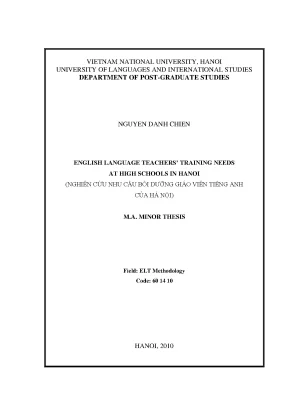
VIETNAM NATIONAL UNIVERSITY, HANOI UNIVERSITY OF LANGUAGES AND INTERNATIONAL STUDIES DEPARTMENT OF POST-GRADUATE STUDIES NGUYEN DANH CHIEN ENGLISH LANGUAGE TEACHERS’ TRAINING NEEDS AT HIGH SCHOOLS IN HANOI (NGHIÊN CỨU NHU CẦU BỒI DƯỠNG GIÁO VIÊN TIẾNG ANH CỦA HÀ NỘI) M. MINOR THESIS Field: ELT Methodology Code: 60 14 10 HANOI, 2010 TIEU LUAN MOI download : skknchat@gmail.com VIETNAM NATIONAL UNIVERSITY, HANOI UNIVERSITY OF LANGUAGES AND INTERNATIONAL STUDIES DEPARTMENT OF POST-GRADUATE STUDIES NGUYỄN DANH CHIẾN ENGLISH LANGUAGE TEACHERS’ TRAINING NEEDS AT HIGH SCHOOLS IN HANOI (NGHIÊN CỨU NHU CẦU BỒI DƯỠNG GIÁO VIÊN TIẾNG ANH CỦA HÀ NỘI) M. MINOR THESIS Field: ELT Methodology Code: 60 14 10 Supervisor: Dr. Hoàng Xuân Hoa HANOI, 2010 TIEU LUAN MOI download : skknchat@gmail.com iii TABLE OF CONTENTS Page PART I: INTRODUCTION 1 1.

Background to the Study 1 2. Aims of the Study and Research Questions 2 3. Significance of the Study 3 4. Scope of the Study 3 5.

Methods of the Study 3 6. Design of the Study 4 PART II: DEVELOPMEMT 5 CHAPTER 1: LITERATURE REVIEW 5 1. New Requirements towards English Language Teachers 5 1. Roles of the Teachers 5 1.

Updating Understanding of CLT 6 1. General Features and Principles of CLT 7 1. Common Classroom Activities Used in CLT 9 1. Pairwork and Groupwork 9 1.

Information Gap Activities 10 1. Problem-solving Tasks 11 1. Roles of Learners 11 1. Teacher Training Needs 12 1.

Concept of Training Needs 12 1. Types of Needs 13 1. Significance of Studying Teachers’ Training Needs 13 1. Interrelationship Perceptions, Practice and Training Needs 14 TIEU LUAN MOI download : skknchat@gmail.

Previous Studies on Teacher Training Needs 15 1. Summary 17 CHAPTER 2: THE RESEARCH 18 2. English curriculum and textbooks for high schools in Vietnam 18 2. Recent Training Workshop on Implementing the English Curriculum 19 in Hanoi 2.

Data Collection Procedures 20 2. Instruments for Data Collection 21 2. Teachers Survey Questionnaire 21 2. Teachers Observation Scheme 21 2.

Data Analysis Procedures 22 2. Teachers Questionnaire Data 22 2. Teachers Observation Data 22 CHAPTER 3 : DATA ANALYSIS AND INTERPRETATION 23 3. Results of the Data Collected by Means of Questionnaire 23 3.

Teachers’ Perceptions of CLT 23 3. Teachers’ perceptions of features and principles of CLT 23 3. Classroom activities used in CLT 24 3. Roles of the communicative language teacher 26 3.

Roles of the learner in the CLT learning process 27 3. Teachers’ applicability of CLT to their classroom practices 28 TIEU LUAN MOI download : skknchat@gmail. Results of the Data Collected by Means of Teachers Observations 29 3. Using pair and group work activities 30 3.

Conducting fluency-oriented and accuracy-oriented activities 31 3. Correcting students’ errors and giving feedback 32 3. Implementing roles of the teacher 33 3. Summary 34 CHAPTER 4: RESEARCH FINDINGS 35 4.

Findings to the Research Question 1 35 4. Findings to the Research Question 2 36 4. Findings to the Research Question 3 37 4. Summary 39 PART III: CONCLUSION 41 1.

Limitations of the study 41 3. Suggestions for further study 41 REFERENCES 42 APPRENDICES: APPRENDIX 1: Survey questionnaire for English language teachers at high schools in Hanoi APPRENDIX 2: Teacher observation scheme TIEU LUAN MOI download : skknchat@gmail.com vi LIST OF TABLES Table 1. Participants‟ profile Table 2. Teachers‟ perceptions of features and principles of CLT Table 3.

Teachers‟ perceptions of classroom activities used in CLT Table 4. Teachers‟ perceptions of classroom procedures Table 5. Teachers‟ perceptions of the roles of communicative teachers Table 6. Teachers‟ perceptions of the roles of communicative learners Table 7.

Descriptive statistics for the teacher observations Table 8. Descriptive statistics for the teacher observations TIEU LUAN MOI download : skknchat@gmail.com 1 PART I: INTRODUCTION 1. Background to the Study Nowadays, the role of English as an international language of communication and the current tendency of the exclusive use of target language in the classroom (England, 1998) have called for re-adjustments in the way of English language teaching and learning. As a result of the changes, Communicative Language Teaching (CLT) is well established as the dominant theoretical model in English language teaching (Thompson, 1996).

Therefore, this approach has been intensively promoted by the Ministry of Education and Training and has been recently renewed by the introduction of a new English curriculum innovation which places an emphasis on developing learners‟ communicative competence in the English language. Following the introduction, a variety of teacher training courses and workshops on CLT has been held in order to enhance the teachers‟ knowledge about CLT and to create more favourable conditions for successful teaching to be achieved. However, despite teacher training efforts, communicative teaching is still challenging for most of the English language teachers at high schools in Hanoi. They have found it difficult to acquire the new approach or adapt new methods of teaching because, like other EL teachers throughout the country, their English proficiency is low, classes are large, the buildings, furnishings and other facilities are basic, and only low levels of support can be provided in terms of materials, libraries and advisory services (Le, 1999).

Additionally, although CLT has become more popular, many of the teachers reportedly advocate traditional methods to language teaching and still play a dominant role in the majority of classrooms where activities do not seem to be learner-centred. As the implementers of the new approach, the teachers have found it challenging to develop their students‟ communicative competence in the target language or to foster the communicative approach. This is similar to the what Kennedy (1999) claimed that in this process of change, the teachers have to face many obstacles and a barrier to the implementation of the MOET‟s innovation that they are required to learn more about their subject areas, to use textbooks that are becoming more and more difficult, and to use new methods in teaching. In other words, the teachers need help to tackle a lack of teaching ideas (Goh, 1999) since they may not have a clear understanding of the underlying principles of the new approach, which leads to their running out of teaching ideas when developing learning activities for TIEU LUAN MOI download : skknchat@gmail.com 2 their students.

Apart from that, many of the teachers have to struggle to move away from the traditional teaching of rules, patterns and definitions about the language (linguistic competence) towards teaching students how to communicate genuinely, spontaneously and meaningfully in the English language (communicative competence). For those teachers who have moderate proficiency in English, and insufficient understanding of effective teaching methods and techniques, they have to suffer feelings of inadequacy and insecurity in their teaching practices. Obviously, this lack of understandings and the ineffective teaching practices, in turn, force the teachers to seek any kind of language and teaching methodology improvement through training workshops or training courses so that they can satisfy the increasing professional requirements and stay secure in their teaching positions. Moreover, the intensive changes resulted from the communicative approach and the teachers‟ limitations in teaching in diverse contexts have brought about gaps between their understandings and use of CLT for classroom practices.

This certainly creates urgent needs for enhancing the teachers‟ teaching, and requires continuous anticipation of training or retraining needs, e. the needs to be further trained in ELT methods. However, up until now, there has not been any investigation into the Hanoi‟s high school teachers‟ needs for being retrained in communicative ELT or any full understanding of the extent to which the teachers‟ perceive the communicative approach. The absence of studies related to this subject matter is the basic motive for conducting a survey research into the EL teachers‟ training needs at high schools in Hanoi.

Hopefully, the knowledge and the result of the study will contribute to the better language policy and more effective English language teaching and learning in Hanoi. Aims of the Study and Research Questions The study aims to identify the Hanoi‟s high school EL teachers‟ training needs on communicative language teaching by exploring their perceptions of CLT, their perceived needs as their desires, and their theory-practice gap that should be filled so as to satisfy new demands for communicative ELT. In order to achieve the aims of the study, the research was carried out to answer the following questions: (1) What are the EL teachers’ perceptions of CLT? TIEU LUAN MOI download : skknchat@gmail.com 3 (2) What are the methods and techniques the teachers used in their actual classroom practices? (3) What contents should be included in future ELT methodology training workshops? 3. Significance of the Study The research will be of the theory of ELT management as well as practical significance for three reasons.

First, when completed, the research results will be used as evidence on the teachers‟ performance, and will show key factors affecting the teaching quality so that decisions could be made on whether teacher retraining courses should be organized. Second, the findings of the survey research will be useful for the Hanoi DOET and its ELT specialists in deciding on the extent to which and how retraining courses should be organized if they should be. Third, on a larger scale, the research will provide education administrators and high school principles with suggestions for increasing the quality of ELT in diverse contexts. Scope of the Study Within the framework of a minor thesis, the study was limited to exploring Hanoi high school EL teachers‟ needs for being trained in CLT by identifying the teachers‟ perceptions of CLT theories - the extent to which they know about CLT in order to use it for classroom practices, and the retraining needs perceived by themselves as their wants or desires.

Therefore, there would probably be a gap or differences between the teachers‟ perceived needs and the needs resulted from the researcher‟s observations of the teachers‟ in-class teaching practices. Methods of the Study The study is an integrated descriptive-analytical, qualitative and quantitative survey research. In order to provide sufficient data, information should be collected by a number of effective methods and a variety of techniques. Nevertheless, within the scope of the research, the following main techniques are used: - Teachers survey questionnaire, which was conducted to investigate the English language teachers‟ perceptions of CLT theories; TIEU LUAN MOI download : skknchat@gmail.com 4 - Teachers observations, which was employed to find out some of the techniques and methods the teachers used in their classroom practices in order to identify gaps between their perceptions and use/implementation of CLT.

Design of the Study The study is composed of three parts, including Introduction, Development, and Conclusion. Part I, Introduction, presents the background to the study, aims, research questions, significance, scope, methods, and design of the study. Part II, Development, as the main developing part of the thesis, consists of three chapters. Chapter One provides a review of literature relevant CLT and such perspectives as training needs, perceptions, and the interrelation between teachers‟ perception and practice.

Chapter Two gives a general description of the research with relevant aspects. Chapter Three is a representation of the research findings and discussion. Part III, Conclusion, is a summary of the main issues addressed in the research, limitations of the study, and some suggestions for further study. TIEU LUAN MOI download : skknchat@gmail.com 5 PART II: DEVELOPMEMT CHAPTER 1: LITERATURE REVIEW The purpose of this chapter is to review the literature relevant to the teachers‟ needs for being retrained in CLT.

The chapter consists of three sections. The first section addresses an overview of CLT requirements towards the teachers such as roles of the teachers in CLT, understanding of CLT‟s features and principles, and classrooms activities. The second section provides concepts of needs, perception, and practice. New Requirements towards English Language Teachers As teaching is a constantly evolving process of growth and change, English language teachers have to constantly look for alternative ways to improve instructional practices.

Nội dung được bảo vệ bản quyền — Tải xuống đầy đủ