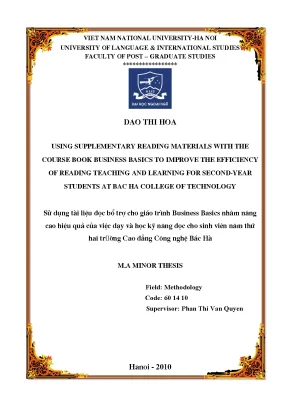
Sử dụng tài liệu đọc bổ trợ để cải thiện kỹ năng đọc cho sinh viên năm 2

Luận văn ThS: Nâng cao hiệu quả dạy và học đọc cho sinh viên năm 2 Cao đẳng Bắc Hà bằng tài liệu bổ trợ "Business Basics". Nghiên cứu sư phạm ứng dụng.

Chuyên ngành

Methodology

Người đăng

Ẩn danh

Thể loại

Minor Thesis

2010

51
1
0

Phí lưu trữ

30 Point

Mục lục chi tiết

Acknowledgements

Abstract

List of tables and charts

Table of contents

1. Part a: Introduction

1.1. Aims of the study

1.2. Significance of the study

1.3. Design of the study

2. Part B: development

2.1. Chapter 1: Literature review

2.1.1. An overview of reading

2.1.2. Definitions of reading comprehension

2.1.3. Models of reading

2.1.4. Reading skills and types of reading skills

2.1.4.1. Definition of reading skills
2.1.4.2. Types of reading skills

2.1.5. Materials development in language teaching

2.1.5.1. Definition of language teaching materials
2.1.5.2. Processes in materials development
2.1.5.3. Types of materials evaluation
2.1.5.4. Criteria for materials evaluation
2.1.5.5. Supplementary materials in teaching reading skills
2.1.5.5.1. Definition of supplementary materials
2.1.5.5.2. Criteria for selecting supplementary materials
2.1.5.5.3. How to use supplementary materials
2.1.5.6. Summary

2.2. Chapter 2: Methodology

2.2.1. Background to the study

2.2.2. The textbook Business Basics

2.2.3. Instrument for data collection

2.2.3.1. The questionnaire for teachers
2.2.3.2. The questionnaire for students

2.2.4. Data collection procedure

2.3. Chapter 3: Data analysis, findings and discussion

2.3.1. Findings and discussion

2.3.2. The teachers’ and the students’ evaluations of the current textbook Business Basics

2.3.3. The teachers’ and the students’ expectations of supplementary reading materials

2.3.4. Suggestions for selecting supplementary materials

2.3.5. Designing tasks and activities for reading passages

2.3.6. Sample supplementary readings

Conclusion of the study

Limitations of the study and suggestions for further study

Appendices

1. Appendix 1: Questionnaire for teachers

2. Appendix 2: Questionnaire for students

Lists of tables and charts

1. Tables

2. Charts

Tóm tắt

I. Tầm quan trọng của Kỹ Năng Đọc Tiếng Anh Chuyên Ngành

Trong bối cảnh toàn cầu hóa, tiếng Anh đóng vai trò then chốt trong sự phát triển của khoa học, công nghệ, kinh tế, chính trị, du lịch và văn hóa. Kỹ năng đọc tiếng Anh chuyên ngành không chỉ là công cụ giao tiếp mà còn là chìa khóa tiếp cận tri thức. Carrel (1981: 1) nhấn mạnh: “Đối với nhiều sinh viên, đọc là kỹ năng quan trọng nhất trong bốn kỹ năng ngôn ngữ thứ hai, đặc biệt là tiếng Anh như một ngôn ngữ thứ hai hoặc ngoại ngữ”. Việc cải thiện kỹ năng đọc hiểu tiếng Anh chuyên ngành hiệu quả là cần thiết để sinh viên tiếp thu kiến thức và thành công trong học tập. Tuy nhiên, thực tế cho thấy nhiều sinh viên gặp khó khăn trong việc đọc hiểu tài liệu chuyên ngành do hạn chế về từ vựng, ngữ pháp và kỹ năng đọc hiểu. Bài viết này sẽ khám phá các phương pháp và bí quyết để nâng cao kỹ năng đọc tiếng Anh chuyên ngành một cách hiệu quả.

1.1. Tổng quan về vai trò của đọc trong học tiếng Anh

Kỹ năng đọc là một trong bốn kỹ năng ngôn ngữ quan trọng nhất. Đọc giúp mở rộng kiến thức, nâng cao vocabulary tiếng Anh chuyên ngành và hiểu các cấu trúc ngữ pháp phức tạp. Việc đọc các tài liệu học tiếng Anh chuyên ngành thường xuyên giúp người học làm quen với văn phong, thuật ngữ chuyên môn và cách trình bày thông tin một cách logic, mạch lạc. Theo Nuttall (1982), việc đọc có mục đích sẽ giúp cho việc giảng dạy và học tập trở nên hiệu quả hơn. Do đó, cần phải trang bị kỹ năng đọc phù hợp để đọc hiệu quả.

1.2. Thực trạng kỹ năng đọc hiểu tiếng Anh chuyên ngành hiện nay

Mặc dù tầm quan trọng của kỹ năng đọc hiểu tiếng Anh chuyên ngành đã được thừa nhận, nhiều sinh viên vẫn gặp khó khăn trong việc đọc hiểu tài liệu chuyên ngành. Các vấn đề thường gặp bao gồm: vốn từ vựng hạn chế, kiến thức ngữ pháp chưa vững chắc, thiếu kỹ năng đọc lướt tiếng Anh chuyên ngành, kỹ năng đọc dò tiếng Anh chuyên ngành, và thiếu kiến thức nền tảng về chủ đề được đề cập trong tài liệu. Theo Dao Thi Hoa(2010), sinh viên cao đẳng gặp nhiều khó khăn trong việc đọc tài liệu khoa học bằng tiếng Anh. Điều này dẫn đến sự chán nản và mất hứng thú trong việc học tiếng Anh.

1.3. Mục tiêu của việc nâng cao kỹ năng đọc tiếng Anh chuyên ngành

Mục tiêu chính của việc nâng cao kỹ năng đọc tiếng Anh chuyên ngành là giúp người học đọc hiểu tài liệu chuyên ngành một cách hiệu quả và tự tin. Điều này bao gồm khả năng: hiểu nghĩa của từ và cụm từ trong ngữ cảnh chuyên môn, xác định ý chính và các ý phụ, phân tích và đánh giá thông tin, và áp dụng kiến thức thu được từ việc đọc vào thực tế. Ngoài ra, việc cải thiện kỹ năng đọc hiểu tiếng Anh chuyên ngành còn giúp người học phát triển tư duy phản biện, khả năng tự học và khả năng nghiên cứu độc lập.

II. Thách thức và khó khăn trong việc luyện đọc tiếng Anh chuyên ngành

Việc luyện đọc tiếng Anh chuyên ngành không phải lúc nào cũng dễ dàng. Người học thường gặp phải nhiều thách thức, từ việc đối phó với lượng từ vựng chuyên môn khổng lồ đến việc hiểu các cấu trúc câu phức tạp. Một trong những thách thức lớn nhất là thiếu tài liệu luyện đọc tiếng Anh chuyên ngành phù hợp với trình độ và nhu cầu của người học. Hơn nữa, việc thiếu phương pháp học tập hiệu quả và môi trường thực hành cũng là những rào cản lớn đối với việc nâng cao kỹ năng đọc tiếng Anh chuyên ngành.

2.1. Vấn đề vocabulary tiếng Anh chuyên ngành

Từ vựng là yếu tố then chốt trong việc đọc hiểu bất kỳ ngôn ngữ nào. Tuy nhiên, từ vựng chuyên ngành thường rất đa dạng và phức tạp, đòi hỏi người học phải đầu tư nhiều thời gian và công sức để học và ghi nhớ. Việc sử dụng từ điển tiếng Anh chuyên ngành là cần thiết, nhưng không phải lúc nào cũng đủ để hiểu nghĩa của từ trong ngữ cảnh cụ thể. Theo Tomlinson (1998), việc phát triển tài liệu học tiếng Anh chuyên ngành để đáp ứng các khó khăn của học viên là cần thiết.

2.2. Khó khăn về grammar tiếng Anh chuyên ngành

Ngữ pháp tiếng Anh chuyên ngành thường phức tạp hơn ngữ pháp tiếng Anh thông thường, với nhiều cấu trúc câu dài và phức tạp. Việc nắm vững các cấu trúc ngữ pháp này là cần thiết để hiểu rõ ý nghĩa của câu và đoạn văn. Tuy nhiên, nhiều người học gặp khó khăn trong việc nhận diện và phân tích các cấu trúc ngữ pháp phức tạp, dẫn đến việc hiểu sai hoặc hiểu không đầy đủ nội dung tài liệu đọc tiếng Anh chuyên ngành.

2.3. Thiếu tài liệu luyện đọc tiếng Anh chuyên ngành phù hợp

Một trong những khó khăn lớn nhất trong việc luyện đọc tiếng Anh chuyên ngành là thiếu tài liệu luyện đọc tiếng Anh chuyên ngành phù hợp với trình độ và nhu cầu của người học. Nhiều tài liệu hiện có quá khó hoặc quá dễ, hoặc không liên quan đến lĩnh vực chuyên môn mà người học quan tâm. Điều này khiến cho việc học tập trở nên nhàm chán và kém hiệu quả. Theo Nuttall(1996), lựa chọn tài liệu luyện đọc phù hợp phải dựa trên độ khó, sự thú vị và khả năng khai thác của tài liệu.

III. Phương pháp đọc hiểu tiếng Anh chuyên ngành hiệu quả nhất

Để đọc hiểu tài liệu chuyên ngành tiếng Anh hiệu quả, cần áp dụng các phương pháp đọc phù hợp. Một trong những phương pháp phổ biến nhất là phương pháp đọc lướt và đọc dò, giúp người học nhanh chóng nắm bắt ý chính và tìm kiếm thông tin cụ thể. Ngoài ra, việc sử dụng từ điển và các công cụ hỗ trợ đọc khác cũng rất quan trọng. Quan trọng nhất, cần kết hợp nhiều bài tập đọc hiểu tiếng Anh chuyên ngành khác nhau.

3.1. Kỹ thuật đọc lướt tiếng Anh chuyên ngành Skimming

Kỹ năng đọc lướt giúp người đọc nhanh chóng nắm bắt ý chính và cấu trúc của tài liệu. Khi đọc lướt, cần tập trung vào các tiêu đề, đoạn mở đầu và đoạn kết, cũng như các từ khóa và cụm từ quan trọng. Kỹ năng đọc lướt đặc biệt hữu ích khi cần đọc nhiều tài liệu trong thời gian ngắn, hoặc khi muốn xác định xem một tài liệu có liên quan đến chủ đề mình quan tâm hay không.

3.2. Kỹ thuật đọc dò tiếng Anh chuyên ngành Scanning

Kỹ năng đọc dò giúp người đọc nhanh chóng tìm kiếm thông tin cụ thể trong tài liệu. Khi đọc dò, cần xác định rõ thông tin mình cần tìm kiếm, sau đó lướt nhanh qua tài liệu, tập trung vào các từ khóa và cụm từ liên quan. Kỹ năng đọc dò đặc biệt hữu ích khi cần tìm kiếm dữ liệu, số liệu hoặc thông tin chi tiết trong tài liệu.

3.3. Sử dụng từ điển tiếng Anh chuyên ngành hiệu quả

Việc sử dụng từ điển tiếng Anh chuyên ngành là cần thiết để hiểu nghĩa của các từ và cụm từ chuyên môn. Tuy nhiên, không nên chỉ đơn thuần tra từ điển mà cần phải xem xét nghĩa của từ trong ngữ cảnh cụ thể. Ngoài ra, nên sử dụng các loại từ điển khác nhau, chẳng hạn như từ điển định nghĩa, từ điển đồng nghĩa và trái nghĩa, để có được cái nhìn toàn diện về nghĩa của từ.

IV. Bí quyết cải thiện kỹ năng đọc hiểu tiếng Anh chuyên ngành

Ngoài việc áp dụng các phương pháp đọc hiệu quả, cần có những bí quyết cụ thể để cải thiện kỹ năng đọc hiểu tiếng Anh chuyên ngành. Việc xây dựng vốn từ vựng chuyên môn, rèn luyện ngữ pháp, đọc thường xuyên và tham gia các khóa học nâng cao kỹ năng đọc tiếng Anh chuyên ngành là những yếu tố quan trọng. Dao Thi Hoa (2010) cũng cho rằng việc sử dụng tài liệu đọc bổ trợ là rất quan trọng để nâng cao hiệu quả đọc hiểu.

4.1. Xây dựng vốn từ vựng tiếng Anh chuyên ngành

Việc xây dựng vốn từ vựng chuyên môn là yếu tố then chốt trong việc cải thiện kỹ năng đọc hiểu tiếng Anh chuyên ngành. Cần học từ vựng một cách có hệ thống, bằng cách sử dụng các phương pháp học từ vựng hiệu quả, chẳng hạn như sử dụng flashcards, học từ vựng theo chủ đề, và luyện tập sử dụng từ vựng trong ngữ cảnh thực tế. Sử dụng các phần mềm và website học vocabulary tiếng Anh chuyên ngành.

4.2. Rèn luyện ngữ pháp tiếng Anh chuyên ngành

Việc nắm vững ngữ pháp tiếng Anh chuyên ngành là cần thiết để hiểu rõ ý nghĩa của câu và đoạn văn. Cần ôn tập và củng cố kiến thức ngữ pháp cơ bản, đồng thời học thêm các cấu trúc ngữ pháp phức tạp thường gặp trong tài liệu đọc tiếng Anh chuyên ngành. Làm các bài tập về ngữ pháp tiếng Anh chuyên ngành thường xuyên.

4.3. Đọc tài liệu chuyên ngành tiếng Anh thường xuyên

Không có cách nào tốt hơn để cải thiện kỹ năng đọc hiểu hơn là đọc thường xuyên. Cần dành thời gian đọc các tài liệu chuyên ngành tiếng Anh mà mình quan tâm, chẳng hạn như sách, báo, tạp chí, và các bài báo khoa học. Nên bắt đầu với các tài liệu đơn giản và dễ hiểu, sau đó dần dần chuyển sang các tài liệu phức tạp hơn. Đọc các loại tài liệu kinh tế tiếng Anh, tài liệu kỹ thuật tiếng Anh, tài liệu y khoa tiếng Anh, tài liệu luật tiếng Anh.

V. Ứng dụng thực tiễn và kết quả nghiên cứu về đọc tiếng Anh chuyên ngành

Nhiều nghiên cứu đã chứng minh hiệu quả của việc áp dụng các phương pháp và bí quyết nâng cao kỹ năng đọc hiểu tiếng Anh chuyên ngành. Các nghiên cứu này cho thấy rằng, khi người học được trang bị đầy đủ kiến thức và kỹ năng, họ có thể đọc hiểu tài liệu chuyên ngành một cách hiệu quả hơn, tự tin hơn và thành công hơn trong học tập và công việc.

5.1. Nghiên cứu về hiệu quả của tài liệu đọc bổ trợ

Các nghiên cứu đã chỉ ra rằng việc sử dụng tài liệu đọc bổ trợ có thể giúp người học cải thiện kỹ năng đọc hiểu tiếng Anh chuyên ngành một cách đáng kể. Tài liệu đọc bổ trợ cung cấp cho người học thêm cơ hội để thực hành đọc, mở rộng vốn từ vựng và làm quen với các văn phong khác nhau. Nghiên cứu của Dao Thi Hoa (2010) cho thấy sử dụng tài liệu đọc bổ trợ với giáo trình Business Basics giúp sinh viên năm hai tại Cao đẳng Công nghệ Bắc Hà cải thiện hiệu quả đọc hiểu.

5.2. Ứng dụng kỹ năng đọc hiểu trong công việc

Kỹ năng đọc hiểu tiếng Anh chuyên ngành không chỉ quan trọng trong học tập mà còn rất cần thiết trong công việc. Trong nhiều lĩnh vực, nhân viên cần phải đọc và hiểu các tài liệu kỹ thuật, tài liệu kinh tế, tài liệu y khoa bằng tiếng Anh để hoàn thành công việc. Việc cải thiện kỹ năng đọc hiểu giúp nhân viên làm việc hiệu quả hơn, đưa ra các quyết định sáng suốt hơn và thăng tiến trong sự nghiệp.

5.3. Luyện thi đọc hiểu tiếng Anh chuyên ngành

Có rất nhiều kỳ thi đánh giá khả năng đọc hiểu tiếng Anh chuyên ngành. Việc luyện thi giúp người học nâng cao khả năng nhận biết và xử lý các dạng bài tập thường gặp trong kỳ thi, đồng thời củng cố kiến thức và kỹ năng đã học. Để luyện thi hiệu quả, cần làm các bài tập đọc hiểu tiếng Anh chuyên ngành khác nhau, chú trọng vào việc phân tích các lỗi sai và tìm hiểu các phương pháp giải bài hiệu quả.

VI. Kết luận và xu hướng phát triển kỹ năng đọc TA chuyên ngành

Kỹ năng đọc tiếng Anh chuyên ngành là một kỹ năng quan trọng và cần thiết trong bối cảnh toàn cầu hóa. Việc cải thiện kỹ năng đọc hiểu đòi hỏi sự nỗ lực và kiên trì, cũng như việc áp dụng các phương pháp và bí quyết học tập hiệu quả. Trong tương lai, với sự phát triển của công nghệ, sẽ có nhiều công cụ và nguồn tài liệu hỗ trợ việc học tiếng Anh chuyên ngành trở nên dễ dàng và hiệu quả hơn.

6.1. Tóm tắt các phương pháp đọc hiểu tiếng Anh chuyên ngành

Bài viết đã trình bày các phương pháp và bí quyết nâng cao kỹ năng đọc hiểu tiếng Anh chuyên ngành, bao gồm: kỹ năng đọc lướt, kỹ năng đọc dò, xây dựng vốn từ vựng, rèn luyện ngữ pháp, và đọc tài liệu chuyên ngành thường xuyên. Việc áp dụng các phương pháp này một cách linh hoạt và phù hợp với trình độ và nhu cầu của bản thân sẽ giúp người học cải thiện kỹ năng đọc hiểu một cách hiệu quả.

6.2. Tầm quan trọng của việc tự học và tự rèn luyện

Việc tự học và tự rèn luyện đóng vai trò then chốt trong việc cải thiện kỹ năng đọc hiểu tiếng Anh chuyên ngành. Cần chủ động tìm kiếm các nguồn tài liệu học tập, tự đặt ra mục tiêu và kế hoạch học tập, và tự đánh giá kết quả học tập. Ngoài ra, cần tạo ra môi trường thực hành đọc thường xuyên, bằng cách đọc sách, báo, tạp chí, và các bài báo khoa học bằng tiếng Anh.

6.3. Xu hướng phát triển các khóa học nâng cao kỹ năng đọc

Trong tương lai, các khóa học nâng cao kỹ năng đọc tiếng Anh chuyên ngành sẽ tiếp tục phát triển, với nhiều hình thức và nội dung đa dạng. Các khóa học này sẽ tập trung vào việc trang bị cho người học các kiến thức và kỹ năng cần thiết để đọc hiểu tài liệu chuyên ngành một cách hiệu quả, đồng thời giúp người học phát triển tư duy phản biện và khả năng tự học.

22/09/2025
Luận văn thạc sĩ using supplementary reading materials with the course book business basics to improve the efficiency of reading teaching and learning for second year students at bac ha college of technology

Trích đoạn nội dung tài liệu

VIET NAM NATIONAL UNIVERSITY-HA NOI UNIVERSITY OF LANGUAGE & INTERNATIONAL STUDIES FACULTY OF POST – GRADUATE STUDIES ***************** Dao thi hoa Using Supplementary Reading Materials with the Course book Business Basics to Improve the Efficiency of reading teaching and learning for Second-year Students at Bac Ha College of Technology Sö dông tµi liÖu ®äc bæ trî cho gi¸o tr×nh Business Basics nh»m n©ng cao hiÖu qu¶ cña viÖc d¹y vµ häc kü n¨ng ®äc cho sinh viªn n¨m thø hai tr-êng Cao ®¼ng C«ng nghÖ B¾c Hµ m.a minor thesis Field: Methodology Code: 60 14 10 Supervisor: Phan Thi Van Quyen Hanoi - 2010 TIEU LUAN MOI download : skknchat@gmail.com Table of contents Acknowledgements………………………………………………………………………… i Abstract……………………………………………………………………………………. ii List of tables and charts…………………………………………………………………. iii Table of contents…………………………………………………………………………. iv Part a: Introduction 1.

Aims of the study………………………………………………………………………. Significance of the study………………………………………………………………. Design of the study……………………………………………………………………… 3 Part B: development Chapter 1: Literature review 1. An overview of reading……………………………………………………………….

Definitions of reading comprehension…………………………………………. Models of reading. Reading skills and types of reading skills……………………………………… 5 1. Definition of reading skills……………………………………………….

Types of reading skills…………………………………………………. Materials development in language teaching…………………………………………. Definition of language teaching materials……………………………………… 7 1. Processes in materials development…………………………………………….

Types of materials evaluation……………………………………………. Criteria for materials evaluation…………………………………………. Supplementary materials in teaching reading skills…………………………. Definition of supplementary materials………………………………….

Criteria for selecting supplementary materials…………………………. How to use supplementary materials……………………………………. 11 Summary 5 TIEU LUAN MOI download : skknchat@gmail.com Chapter 2: Methodology 2. Background to the study…………………………………………………………….

The textbook Business Basics………………………………………………. Instrument for data collection………………………………………………………. The questionnaire for teachers………………………………………………. The questionnaire for students……………………………………………….

Data collection procedure……………………………………………………………. 17 Chapter 3: Data analysis, findings and discussion 3. Findings and discussion……………………………………………………………… 27 3. The teachers’ and the students’ evaluations of the current textbook Business Basics……………………………………………………………………… 27 3.

The teachers’ and the students’ expectations of supplementary reading materials……………………………………………………………………. Suggestions for selecting supplementary materials…………………………………. Designing tasks and activities for reading passages…………………………………. Sample supplementary readings……….

Conclusion of the study………………………………………………………………. Limitations of the study and suggestions for further study…………………………….3 9 Appendices Appendix 1: Questionnaire for teachers Appendix 2: Questionnaire for students 6 TIEU LUAN MOI download : skknchat@gmail.com Lists of tables and charts Tables Table 1: The teachers’and students’ evaluations on level of difficulty, content and length of reading texts in the textbook Table 2: The teachers’ opinions on reading exercises in the textbook Business Basics Table 3: The students’ opinions on reading exercises in the textbook Business Basics Table 4: Topics in the textbook need supplementary reading Table 5: Teachers’ expectations of the supplementary reading materials Charts Chart 1: The teachers’ purpose of using supplementary materials in teaching reading lessons Chart 2: The teachers’ suggestions on the types of exercises to be used in the supplementary materials Chart 3: Teachers’ sources to get supplementary reading 4 TIEU LUAN MOI download : skknchat@gmail.com Part a: introduction 1. Rationale Nowadays, in the time of globalization, English plays an essential role in the increasing development of science, technology, politics, economics, tourism, culture and so on. English language is not only considered as a means of communication but also a key to access the important achievements of science and technology.

Therefore, learners of English should acquire this language and teaching and learning English become popular in our country. Among four language skills, reading is very important in learning a foreign language as reading helps students to widen their knowledge and understand different academic materials written in English. Carrel (1981: 1) also emphasizes “for many students, reading is by far the most important of the four skills in a second language, particularly in English as a second or foreign language”. It is necessary for the second year students at Bac Ha College of Technology to develop reading ability effectively because reading provides a lot of useful information as well as enrich their language vocabulary and structures.

Reading will be an effective way to help students enhance their English proficiency especially their reading skills. Nevertheless, despite the teachers‟ and students‟ efforts, the students at Bac Ha College of Technology have a poor reading result that makes them uninterested in learning English in general and in learning reading skill in particular. The students‟ English proficiency at Bac Ha College of Technology is not the same. It is due to the fact that they come from different places.

Most of them come from the countryside so they can not have preferable English learning condition. The others come from towns and cities where they have more convenient condition of learning English. This results in low English proficiency of the students because of their limited vocabulary and grammar. In addition, they do not have appropriate reading strategies and background knowledge.

Therefore, students face a lot of difficulties in reading and understanding the long texts especially the texts relating to economic fields which they are studying. As a result, they find it hard to be successful in their reading and they are not interested in reading. 7 TIEU LUAN MOI download : skknchat@gmail.com With the purpose of improving their English knowledge, it is very important for the teachers to provide them as many opportunities to read as possible. Nuttall in the book “Teaching reading skills in a foreign language” (1982) states that “reading as a purposeful activity, we can make teaching more purposeful and classes livelier, even in the difficult circumstances”.

All the above reasons have inspired me to carry out the study on “Using Supplementary Reading Materials with the Course book Business Basics to Improve the Efficiency of Reading Teaching and Learning for Second-year Students at Bac Ha College of Technology”, with a hope to improve the teaching and learning English as well as the teaching and learning reading comprehension. Aims of the study The purpose of the study is to find ways of developing the effective reading materials so as to improve the teaching reading skill of the teachers as well as to enhance the students‟ learning reading. The specific aims of this research are as follows: - To find out some different evaluations made by teachers and students towards the textbook Business Basics, which is currently used by the second year students at Bac Ha College of Technology. - To examine the teachers‟ and the students‟ expectations of supplementary reading materials.

- To give recommendations for selecting supplementary materials to improve teaching reading of the teachers as well as learning reading of the students. Significance of the study This study is of great importance to the author herself as well as to all teachers of English. It helps to reinforce students‟ English proficiency and suggests ways to improve the teaching of English in general and reading in particular at Bac Ha College of Technology and most schools and universities that share the same mandate. Research questions On the basis of the problems, the following research questions were formulated to conduct this study.

What are the teachers‟ and the students‟ evaluations of the textbook Business Basics? 8 TIEU LUAN MOI download : skknchat@gmail. What are the teachers‟ and the students‟ expectations of supplementary reading materials? 5. Methodology The methods used in the study is quantitative and qualitative. A questionnaire is used as a main instrument for data collection.

Two sets of questionnaires were designed and delivered to the teachers and the second-year students at Bac Ha College of Technology in order to find out answers to the research questions. The data were collected, synthesized and analyzed from the survey questionnaires for both teachers and students on their evaluations of the current textbook and their expectations of supplementary reading materials. Design of the study This study is divided into three parts. Part A is the introduction in which the rationale, aims of the study, significance, research questions, methodology and design of the study are stated.

Part B is the development, the main part of the study. In this part, there are four chapters. Chapter 1 reviews the literature concerning an overview of reading, reading comprehension with models of reading process, the theory of materials development and supplementary materials in teaching reading skills. Chapter 2 presents methodology of the study consisting of the background to the study.

It covers the setting, the textbook Business Basics, the participants, the instrument as well as data collection procedure. Chapter 3 goes into details of the data analysis, findings and discussion. Chapter 4 briefly deals with recommendations of the study. Part C comes up with the summary of the study in which limitations of the study and suggestions for further research are also presented.

9 TIEU LUAN MOI download : skknchat@gmail.com Part B: Development Chapter 1: Literature review 1. An overview of reading 1. Definitions of reading comprehension Reading comprehension plays an important role in teaching and learning a foreign language. It has the nature of communication, in which reading activity acts as a means of communication between the writer and the reader.

Reading comprehension can be affected by world knowledge, with many demonstrations that readers who possesses rich knowledge about the topic of a reading usually understand the reading better than classmates with lower knowledge. Roe, Stood and Burns (1987: 2) indicate “Reading comprehension is reconstruction, interpretation and evaluation of what author of written content means by using knowledge gained from life experience”. Sharing the same point of view, Grellet (1981: 3) consider “reading comprehension or understanding a written text means extracting the required information from it as effectively as possible”. In his definition, reading comprehension simply means reading and understanding.

Reading comprehension is not merely decoding-translating written symbols into corresponding sounds. Though these definitions are not exactly the same, what comes up a common point is that reading comprehension is the process in which the readers, as they read, can recognize the graphic forms of the reading text and what is implied behind these forms. While reading, learners of language need to have critical thinking to understand and analyze what is written. Then readers can learn both grammar and vocabulary after reading.

From that, they will easily understand the content of the reading. Models of reading In terms of the reading process, many language researchers (Nuttall, 1996; Ur, 1991; Alderson, 2000, etc) share the same viewpoint that there are three different ways of processing a text namely the bottom-up, the top-down and interactive models. The bottom-up models: The basis of bottom up models is linguistics knowledge of the reader. In these models, the reader starts with the written text (the bottom), and constructs meaning from the letters, words, phrases and sentences found within and then 10 TIEU LUAN MOI download : skknchat@gmail.com processes the text in a linear fashion.

The bottom-up models analyze reading as a process in which small chunks of text are absorbed, analyzed, and gradually added to the next chunk until they become meaningful. The top- down models: The top- down process moves from the top, the higher - level mental stages, down to the text itself. In these models, the reading process is driven by the reader‟s mind at work on the text (reader- driven models). The reader rather than the text is at the heart of the reading process.

Interactive models of the reading process are proposed in the light of the perceived deficiencies of both bottom- up and top- down models. Like top- down models, they are reader- driven. This means the reader uses his or her previous understanding to guess about text content and as in bottom- up models, the reader is dependent upon what is in the text. Hayes (1991) supposes that “Interactive models are more than a compromise between bottom- up and top- down theories.

In interactive models, different processes are thought to be responsible for providing information that is shared with other processes. The information obtained from each type of processing is combined to determine the most appropriate interpretation of the printed page”. In brief, interactive models are more adequate than the bottom- up and top- down models because they maximize the strong points and minimize the weak points of the use of both bottom- up and top- down models.

Nội dung được bảo vệ bản quyền — Tải xuống đầy đủ