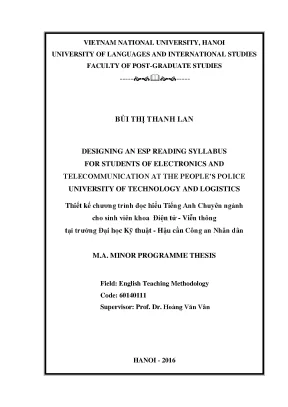
Luận văn: Thiết kế ESP Reading Syllabus cho Điện tử - Viễn thông - ĐH Kỹ thuật Hậu cần CAND

Đề cương đọc ESP ngành Điện tử Viễn thông. Cung cấp mục tiêu học tập, nội dung chính, và chuẩn đầu ra chi tiết của học phần cho người học.

2016

68
0
0

Phí lưu trữ

30 Point

Mục lục chi tiết

DECLARATION

ACKNOWLEDGEMENTS

ABSTRACT

TABLE OF CONTENTS

LIST OF ABBREVIATIONS

PART A: INTRODUCTION

I. Rationale

II. Aim and objectives

III. Scope of the study

IV. Methods of the study

V. Significance of the study

VI. Design of the study

1. CHAPTER 1: LITERATURE REVIEW

1.1. An overview of ESP

1.1.1. What is ESP?

1.1.2. Types of ESP

1.2. Overview of reading in ESP

1.2.1. Definition of reading

1.2.2. ESP reading instruction

1.2.3. Reading sub-skills

1.3. An overview of syllabus design

1.3.1. Definition of syllabus

1.3.2. Approaches to syllabus design

1.3.3. Types of syllabuses

1.3.4. Steps to design a syllabus

1.3.5. Needs analysis in syllabus design

1.3.6. Selecting and grading contents

1.3.7. Selecting and grading learning tasks

1.4. Summary of the chapter

2. CHAPTER 2: AN INVESTIGATION ON THE NEEDS OF STUDENTS TOWARDS AN ESP COURSE

2.1. Teaching and learning ESP and ESP situation at UTL

2.2. A survey of students‟ needs

2.2.1. The research questions

2.2.2. Data collection instruments

2.2.3. Subjects of the study

2.2.4. Data collection procedures

2.2.5. Findings and discussion

2.2.5.1. Students‟ problems in ESP reading
2.2.5.2. Oppinions on the goal of the ESP reading course
2.2.5.3. Opinions on the needed grammar topics
2.2.5.4. Opinions on the needed reading skills
2.2.5.5. Opinions on the needed exercises
2.2.5.6. Selections of reading topics

2.3. Summary of the chapter

3. CHAPTER 3: A PROPOSED ESP READING SYLLABUS

3.1. FOR THIRD-YEAR ET STUDENTS AT UTL

3.2. Setting goal for the course

3.3. Selecting the type of ESP syllabus

3.4. Selection of syllabus contents

3.5. Topics in the syllabus

3.6. Reading sub-skills in the syllabus

3.7. Reading exercises in the syllabus

3.8. Grammar and structures in the syllabus

3.9. Organization and duration of the syllabus

3.10. The proposed syllabus

3.11. Suggestions for using the syllabus

3.12. Suggestions for teaching methodology

3.13. Suggestions for assessment strategies

3.14. Suggestions for material selection

3.15. Summary of the chapter

Limitations and suggestions for further study

APPENDIX 9

APPENDIX 10

Tóm tắt

I. Tổng Quan Luận Văn Thiết Kế ESP Reading Syllabus

Luận văn này tập trung vào thiết kế một chương trình ESP Reading Syllabus cho sinh viên Điện tử và Viễn thông tại Trường Đại học Kỹ thuật - Hậu cần Công an Nhân dân. Bối cảnh là nhu cầu ngày càng cao về khả năng sử dụng tiếng Anh trong lĩnh vực khoa học, công nghệ và thương mại sau Thế chiến II. Trường Đại học Kỹ thuật - Hậu cần Công an Nhân dân (UTL) nhận thức rõ tầm quan trọng của tiếng Anh đối với sinh viên kỹ thuật. Tuy nhiên, chương trình hiện tại cho thấy sự không phù hợp với nhu cầu thực tế của sinh viên. Mục tiêu chính của luận văn là đề xuất một chương trình ESP Reading Syllabus mới, phù hợp với khung thời gian và mục tiêu đào tạo mới của trường. Quan trọng hơn, chương trình này hy vọng đáp ứng tốt hơn nhu cầu của sinh viên Điện tử và Viễn thông tại UTL. Luận văn dựa trên nghiên cứu nhu cầu, phân tích bối cảnh giảng dạy, và các nguyên tắc sư phạm hiện đại. Trích dẫn từ luận văn gốc: "A great emphasis has been placed on English as a foreign language learning at People‟s Police University of Technology and Logistics. However, the current syllabus for students of Electronics and Telecommunication has proved inadequate in addressing the students‟ needs."

1.1. ESP Syllabus for Electronics and Telecommunication Mục Tiêu

Mục tiêu của nghiên cứu này là thiết kế một chương trình đọc ESP mới, đáp ứng cả nhu cầu của người học và mục tiêu của chương trình đào tạo. Các mục tiêu cụ thể bao gồm: (1) khảo sát tình hình hiện tại của việc dạy và học tiếng Anh, đặc biệt là ESP tại UTL; (2) xác định nhu cầu của sinh viên mục tiêu; (3) đề xuất một chương trình đọc ESP cho sinh viên Điện tử và Viễn thông tại UTL. Phạm vi nghiên cứu giới hạn trong việc xây dựng một chương trình đọc ESP cho sinh viên Điện tử và Viễn thông tại UTL, những người đã hoàn thành 210 tiết học tiếng Anh tổng quát, đạt trình độ B1 theo CEFR. Thời lượng dự kiến cho khóa học là 45 tiết 50 phút. Trong thời gian này, kỹ năng đọc được ưu tiên hàng đầu, theo gợi ý của ban quản lý nhà trường.

1.2. Phương Pháp Nghiên Cứu ESP Syllabus Design

Nghiên cứu này sử dụng phương pháp hỗn hợp, kết hợp giữa nghiên cứu định tính và định lượng. Phương pháp chính là khảo sát, sử dụng bảng hỏi và phỏng vấn để thu thập dữ liệu từ sinh viên, giáo viên ESP và giáo viên chuyên ngành Điện tử và Viễn thông. Bảng hỏi được thiết kế dựa trên lý thuyết về nhu cầu mục tiêu và nhu cầu học tập. Các chủ đề đọc và từ vựng được thu thập từ các chương trình và sách giáo khoa đã được phê duyệt. Kỹ năng đọc vi mô được lấy từ lý thuyết về đọc ESP. Cấu trúc ngữ pháp được liệt kê dựa trên các cuộc thảo luận với giáo viên ESP. Dữ liệu thu thập được phân tích bằng phần mềm Microsoft Excel 2010 để tính toán tỷ lệ phần trăm và rút ra kết luận. Dữ liệu từ phỏng vấn được đánh giá và phân tích định tính.

II. Thách Thức Nhu Cầu và Vấn Đề ESP Reading Comprehension

Việc thiết kế ESP Reading Syllabus gặp nhiều thách thức, đặc biệt là việc xác định chính xác nhu cầu của sinh viên. Nhu cầu này bao gồm kiến thức ngôn ngữ, kỹ năng đọc và kiến thức chuyên ngành. Một trong những khó khăn chính là sự khác biệt về trình độ tiếng Anh giữa các sinh viên. Một số sinh viên có nền tảng tiếng Anh vững chắc, trong khi những người khác chỉ có kiến thức cơ bản. Chương trình ESP cần phải đáp ứng được nhu cầu của cả hai nhóm sinh viên. Bên cạnh đó, việc lựa chọn tài liệu đọc phù hợp cũng là một thách thức. Tài liệu cần phải liên quan đến chuyên ngành Điện tử và Viễn thông, nhưng cũng phải phù hợp với trình độ tiếng Anh của sinh viên. Việc cân bằng giữa tính chuyên môn và tính sư phạm là rất quan trọng. Theo tác giả luận văn, cần phân tích kỹ lưỡng nhu cầu người học để chương trình ESP phù hợp và hiệu quả. "At the time this study began, only four batches of students had been recruited: D1, D2, D3 and D4...From the experience of teaching D1 and D2 students and discussions with colleagues, the author, at a first glance, finds that the current ESP syllabuses do not meet the students‟ needs."

2.1. Needs Analysis for ESP Syllabus Các Yếu Tố Quan Trọng

Phân tích nhu cầu là bước quan trọng nhất trong việc thiết kế ESP Syllabus. Theo Hutchinson và Waters (1987), nhu cầu bao gồm necessities (những điều cần thiết), lacks (những thiếu sót) và wants (mong muốn). Necessities được xác định bởi yêu cầu của tình huống mục tiêu. Lacks là khoảng cách giữa những gì người học sẽ đạt được và những gì họ đã biết. Wants là mong muốn chủ quan của sinh viên. Phân tích nhu cầu cần trả lời các câu hỏi: Tại sao cần ngôn ngữ? Ngôn ngữ sẽ được sử dụng như thế nào? Nội dung sẽ là gì? Người học sẽ sử dụng ngôn ngữ với ai? Ngôn ngữ sẽ được sử dụng ở đâu? Khi nào ngôn ngữ sẽ được sử dụng? Trong nghiên cứu này, thông qua thảo luận với giáo viên Điện tử và Viễn thông và mục tiêu do ban đào tạo đặt ra, các câu trả lời cho hầu hết các câu hỏi này được giả định trước. Nghiên cứu tập trung vào việc tìm hiểu nội dung nào nên được đưa vào và ngôn ngữ sẽ được sử dụng như thế nào.

2.2. Khó Khăn Của Sinh Viên ESP Reading Materials for Electronics

Kết quả khảo sát cho thấy sinh viên gặp khó khăn lớn nhất trong việc hiểu các từ mới, đặc biệt là từ chuyên ngành. Thiếu kiến thức từ vựng tổng quát cũng là một trở ngại. Ngữ pháp đứng thứ ba trong danh sách các khó khăn. Giáo viên ESP cũng đồng ý rằng thiếu từ vựng tổng quát là khó khăn chính của sinh viên khi đọc tài liệu ESP. Một số giáo viên nhận thấy rằng sinh viên giỏi có thể liên kết các thuật ngữ tiếng Anh và tiếng Việt một cách dễ dàng, hoặc sử dụng từ điển. Chìa khóa thành công của họ là một vốn từ vựng tổng quát phong phú. Mặc dù ngữ pháp được dạy cẩn thận trong khóa học tiếng Anh tổng quát, sinh viên vẫn gặp khó khăn trong việc nhận ra các cấu trúc ngữ pháp trong các câu dài của văn bản ESP. Tóm lại, các khó khăn của sinh viên có thể được sắp xếp như sau: thiếu từ vựng chuyên ngành, thiếu từ vựng tổng quát, không có khả năng nhận ra cấu trúc ngữ pháp trong văn bản chuyên ngành và thiếu kỹ năng đọc.

III. Phương Pháp Thiết Kế ESP Syllabus for Technology Students

Phương pháp thiết kế ESP Reading Syllabus trong luận văn này dựa trên sự kết hợp giữa các phương pháp tiếp cận khác nhau, bao gồm tiếp cận dựa trên ngôn ngữ, tiếp cận dựa trên kỹ năng và tiếp cận dựa trên người học. Tiếp cận dựa trên ngôn ngữ tập trung vào việc phân tích các tình huống mục tiêu và lựa chọn nội dung ngôn ngữ phù hợp. Tiếp cận dựa trên kỹ năng tập trung vào việc phát triển các kỹ năng và chiến lược đọc cần thiết cho sinh viên. Tiếp cận dựa trên người học tập trung vào việc đáp ứng nhu cầu và mong muốn của sinh viên. Luận văn cũng áp dụng các nguyên tắc thiết kế syllabus hiện đại, bao gồm tính linh hoạt, tính thích ứng và tính tương tác. Trích dẫn: "In a nutshell, each approach has its own strengths since it bases and focuses on one aspect of pedagogy. However, it is this feature that, to some extent, weakens the effectiveness of a syllabus. Therefore, an integrated approach will be adopted in this study in order to maximize learning and also point out the language and the reading sub-skills that students needs to develop during the course."

3.1. Lựa Chọn Nội Dung ESP Reading Materials for Telecommunication

Nội dung của ESP Reading Syllabus bao gồm các chủ đề liên quan đến chuyên ngành Điện tử và Viễn thông, từ vựng chuyên ngành, cấu trúc ngữ pháp thường gặp trong tài liệu chuyên ngành và các bài tập thực hành kỹ năng đọc. Các chủ đề được lựa chọn dựa trên kết quả khảo sát nhu cầu của sinh viên và gợi ý của giáo viên chuyên ngành. Danh sách các chủ đề bao gồm: mạch điện tử, thiết bị điện tử, sóng vô tuyến, mạng điện thoại, hệ thống thu phát cầm tay, kỹ thuật viễn thông, hệ thống truyền dẫn, đo lường điện tử, thông tin liên lạc vệ tinh và công nghệ mạng truy cập. Từ vựng chuyên ngành được lựa chọn từ các tài liệu chuyên ngành và được trình bày một cách rõ ràng và dễ hiểu. Cấu trúc ngữ pháp được lựa chọn dựa trên tần suất sử dụng trong tài liệu chuyên ngành và được giải thích một cách chi tiết và có hệ thống.

3.2. Phát Triển Kỹ Năng Reading Strategies for ESP

Kỹ năng đọc được nhấn mạnh trong ESP Reading Syllabus. Các kỹ năng đọc được phát triển bao gồm: đọc lướt để nắm bắt ý chính, đọc quét để tìm thông tin cụ thể, đoán nghĩa từ trong ngữ cảnh, chọn lọc thông tin liên quan, xác định cấu trúc văn bản, hiểu mối quan hệ giữa các câu, hiểu các dấu hiệu liên kết và diễn ngôn, dự đoán, suy luận và phỏng đoán, xác định ý chính, ý phụ và ví dụ, xử lý và đánh giá thông tin. Các bài tập thực hành được thiết kế để giúp sinh viên phát triển các kỹ năng đọc này. Các bài tập bao gồm: chọn ý chính, trả lời câu hỏi mở, xác định đúng sai, tìm từ hoặc cụm từ đồng nghĩa hoặc trái nghĩa, điền vào chỗ trống, dịch câu và đối sánh tiêu đề và nội dung.

3.3. ESP Teaching Methodology Đề Xuất Kết Hợp Đa Dạng

Luận văn đề xuất phương pháp giảng dạy ESP kết hợp nhiều kỹ thuật, bao gồm hoạt động trước khi đọc, trong khi đọc và sau khi đọc. Hoạt động trước khi đọc giúp sinh viên làm quen với chủ đề và kích hoạt kiến thức nền. Hoạt động trong khi đọc giúp sinh viên thực hành các kỹ năng đọc. Hoạt động sau khi đọc giúp sinh viên ôn tập và áp dụng kiến thức đã học. Thời lượng cho mỗi giai đoạn có thể được phân bổ như sau: Trước khi đọc (15-25 phút), trong khi đọc (65-75 phút) và sau khi đọc (40-70 phút chia thành hai giai đoạn). Các hoạt động cụ thể có thể bao gồm: động não, thảo luận, dịch, ghi chú, viết tóm tắt và đọc phê phán.

IV. Ứng Dụng Thực Tiễn ESP Syllabus for Police University

Chương trình ESP Reading Syllabus được đề xuất có thể được áp dụng tại Trường Đại học Kỹ thuật - Hậu cần Công an Nhân dân. Chương trình này có thể giúp sinh viên Điện tử và Viễn thông nâng cao khả năng đọc hiểu tài liệu chuyên ngành bằng tiếng Anh. Điều này sẽ giúp họ học tập tốt hơn, nghiên cứu hiệu quả hơn và chuẩn bị tốt hơn cho sự nghiệp của mình. Chương trình cũng có thể được điều chỉnh để phù hợp với nhu cầu của các trường đại học khác có đào tạo chuyên ngành Điện tử và Viễn thông. Trích dẫn: "This syllabus can expectedly improve the ESP reading learning and teaching situation at UTL as it makes the course more responsive to the students‟ needs and harmonizes with the training goals of the university."

4.1. Đánh Giá ESP Assessment và Kiểm Tra

Việc đánh giá kết quả học tập của sinh viên cần tập trung vào khả năng đọc hiểu. Các bài kiểm tra giữa kỳ và cuối kỳ cần được thiết kế dưới dạng bài kiểm tra thành tích để đánh giá xem ESP Reading Syllabus có đạt được các mục tiêu của khóa học hay không. Nhu cầu của người học không phải lúc nào cũng giống nhau, do đó, bài kiểm tra cần bao gồm tất cả các mục tiêu và nhu cầu của sinh viên. Kiểm tra giữa kỳ được giao sau bài 5; hai bài kiểm tra tiến độ nên được đặt sau bài 3 và bài 8. Mục đích của các bài kiểm tra tiến độ này là để xem sinh viên có tiến bộ trong các kỹ năng đọc, ngữ pháp và từ vựng đã được thảo luận trong các bài học trước hay không.

4.2. Gợi Ý Tài Liệu ESP Materials Development và Lựa Chọn

Ngoài syllabus, cần có các tài liệu bổ sung về Điện tử và Viễn thông để khuyến khích sinh viên thực hành. Các tài liệu này bao gồm sách giáo trình tiếng Anh và tài liệu chuyên ngành. Các văn bản này không nên quá dài và có mật độ thuật ngữ chuyên ngành vừa phải. Vì sinh viên gặp khó khăn về từ vựng và ngữ pháp, nên một hoặc hai văn bản đầu tiên không nên quá khó, mà nên quen thuộc và gần gũi với kiến thức mà sinh viên đã học trong khóa học ESP. Có một số tài liệu (được liệt kê trong Phụ lục 11) do giáo viên và sinh viên Điện tử và Viễn thông gợi ý có thể hữu ích cho khóa học.

V. Kết Luận Tương Lai của Curriculum Development for ESP

Luận văn này đã trình bày một quy trình thiết kế ESP Reading Syllabus cho sinh viên Điện tử và Viễn thông. Quá trình này bao gồm phân tích nhu cầu, xác định mục tiêu, lựa chọn nội dung, phát triển kỹ năng và đánh giá kết quả. Luận văn cũng đưa ra một số gợi ý cho việc giảng dạy và học tập ESP hiệu quả hơn. Tuy nhiên, luận văn vẫn còn một số hạn chế. Do thời gian có hạn, tác giả không có cơ hội đánh giá chương trình syllabus được đề xuất. Nghiên cứu sâu hơn cần tập trung vào việc đánh giá và điều chỉnh chương trình để đáp ứng tốt hơn nhu cầu của sinh viên. Bên cạnh đó, việc phát triển tài liệu học tập phù hợp cũng là một hướng nghiên cứu quan trọng. Trích dẫn: "Due to the fact that UTL has been founded for only five years, no former students of the university who are currently working in the field of Electronics and Telecommunication available for needs analysis...thus, the syllabus should be critically evaluated in a further research."

5.1. Hạn Chế và Gợi Ý Nghiên Cứu Phân Tích Sâu Nhu Cầu

Do thực tế là UTL mới được thành lập được 5 năm, không có sinh viên cũ nào của trường hiện đang làm việc trong lĩnh vực Điện tử và Viễn thông để phân tích nhu cầu. Bất kỳ nghiên cứu sâu hơn nào về thiết kế syllabus nên xem xét điều này để nhu cầu tình huống mục tiêu sẽ được phân tích đầy đủ. Ngoài ra, do hạn chế về thời gian, tác giả không có cơ hội đánh giá syllabus được đề xuất; trong khi đó, cần phải sửa đổi syllabus và khắc phục mọi vấn đề phát sinh khi các tác nhân sư phạm luôn năng động; và trong nghiên cứu này, tác giả chỉ chọn sinh viên D1 và D3 làm mẫu.

5.2. Phát Triển Tài Liệu và Phân Tích Chuyên Ngành

Việc viết một cuốn sách giáo khoa hoặc điều chỉnh các tài liệu có sẵn để sử dụng làm sách giáo trình hoặc một bản biên soạn các tài liệu bổ sung cũng là cần thiết vì hiệu quả của một khóa học ESP phụ thuộc phần lớn vào tài liệu. Phân tích đăng ký, vốn là một điểm quan trọng trong ESP, cũng là một hướng nghiên cứu đáng khuyến khích để có thể thu thập và phân tích tài liệu EET, từ đó đưa ra nhiều gợi ý hơn về mặt ngôn ngữ cho các nhà thiết kế khóa học EET.

22/09/2025

Trích đoạn nội dung tài liệu

VIETNAM NATIONAL UNIVERSITY, HANOI UNIVERSITY OF LANGUAGES AND INTERNATIONAL STUDIES FACULTY OF POST-GRADUATE STUDIES ---------- BÙI THỊ THANH LAN DESIGNING AN ESP READING SYLLABUS FOR STUDENTS OF ELECTRONICS AND TELECOMMUNICATION AT THE PEOPLE’S POLICE UNIVERSITY OF TECHNOLOGY AND LOGISTICS Thiết kế chương trình đọc hiểu Tiếng Anh Chuyên ngành cho sinh viên khoa Điện tử - Viễn thông tại trường Đại học Kỹ thuật - Hậu cần Công an Nhân dân M. MINOR PROGRAMME THESIS Field: English Teaching Methodology Code: 60140111 Supervisor: Prof. Hoàng Văn Vân HANOI - 2016 TIEU LUAN MOI download : skknchat@gmail.com DECLARATION I declare that this thesis is the result of my own research. The study was done under the guidance of Prof.

Hoang Van Van at Vietnam National University, Ha Noi. Hanoi, 2016 Bùi Thị Thanh Lan i TIEU LUAN MOI download : skknchat@gmail.com ACKNOWLEDGEMENTS On the completion of this thesis, I would like to express my deepest gratitude to my supervisor, Prof. Hoang Van Van, who has offered me precious support, guidance, suggestions and encouragement throughout the research. My special thanks go to the lecturers of the Post-graduate cohort 22 at Vietnam National University - Hanoi, University of Languages and International Studies for their inspiring lectures.

I would like to express my deep gratitude to all the teachers, colleagues and students at People‟s Police University of Technology and Logistics for their willing participation in answering questionnaires and sharing ideas on relevant issues. Last but not least, I would like to express my heartfelt gratitude to my family who gave me supports during the study. ii TIEU LUAN MOI download : skknchat@gmail.com ABSTRACT A great emphasis has been placed on English as a foreign language learning at People‟s Police University of Technology and Logistics. However, the current syllabus for students of Electronics and Telecommunication has proved inadequate in addressing the students‟ needs.

Besides, this study is carried out in order to propose a new ESP syllabus which can fit the new time allowance of the credit training program at UTL. This study, therefore, aims to investigate the needs of ET students in their own perception and in the viewpoints of ESP and ET teachers, which serve as the basis for designing a new ESP reading syllabus. An analysis of needs was carried out based on Hutchinson & Water‟s (1987) framework, by the means of questionnaires and interviews to gather information from four sources: ET teachers, teachers of ESP, and ET students at UTL. The findings such as students‟ expectations, preferences and English competence, ESP teachers‟ expectations and suggestions, were taken into account in constructing the syllabus.

Based on the literature review and the survey findings, an ESP reading syllabus is proposed. This syllabus can expectedly improve the ESP reading learning and teaching situation at UTL as it makes the course more responsive to the students‟ needs and harmonizes with the training goals of the university. iii TIEU LUAN MOI download : skknchat@gmail.com TABLE OF CONTENTS DECLARATION .iii LIST OF ABBREVIATIONS. vii PART A: INTRODUCTION.

Aim and objectives. Scope of the study. Methods of the study. Significance of the study.

Design of the study .5 CHAPTER 1: LITERATURE REVIEW. An overview of ESP. What is ESP?. Types of ESP.

Overview of reading in ESP. Definition of reading. ESP reading instruction. Reading sub-skills.

An overview of syllabus design. Definition of syllabus. Approaches to syllabus design. Types of syllabuses.

Steps to design a syllabus. Needs analysis in syllabus design. Selecting and grading contents. Selecting and grading learning tasks.

Summary of the chapter. 21 CHAPTER 2: AN INVESTIGATION ON THE NEEDS OF STUDENTS TOWARDS AN ESP COURSE. Teaching and learning ESP and ESP situation at UTL. 22 iv TIEU LUAN MOI download : skknchat@gmail.

A survey of students‟ needs. The research questions. Data collection instruments. Subjects of the study.

Data collection procedures. Findings and discussion. Students‟ problems in ESP reading. Oppinions on the goal of the ESP reading course.

Opinions on the needed grammar topics. Opinions on the needed reading skills. Opinions on the needed exercises. Selections of reading topics.

Summary of the chapter…………………………………………………………32 CHAPTER 3: A PROPOSED ESP READING SYLLABUS. 33 FOR THIRD-YEAR ET STUDENTS AT UTL. Setting goal for the course. Selecting the type of ESP syllabus.

Selection of syllabus contents. Topics in the syllabus. Reading sub-skills in the syllabus. Reading exercises in the syllabus.

Grammar and structures in the syllabus. Organization and duration of the syllabus. The proposed syllabus. Suggestions for using the syllabus.

Suggestions for teaching methodology. Suggestions for assessment strategies. Suggestions for material selection. Summary of the chapter………………………………………………………….

Limitations and suggestions for further study .………………………………………………………………I v TIEU LUAN MOI download : skknchat@gmail.XII APPENDIX 9 ………………………………………………………………………XIII APPENDIX 10. ……………………………………………………………………XVI vi TIEU LUAN MOI download : skknchat@gmail.com LIST OF ABBREVIATIONS EGP: English for General Purposes ESP: English for Specific Purposes ET: Electronics and Telecommunication UTL: University of Technology and Logistics vii TIEU LUAN MOI download : skknchat@gmail.com PART A: INTRODUCTION I. Rationale As can be seen from books on the history of ESP, since the end of World War II business, science and technology has been unprecedentedly blooming. English has become the key to world‟s science, technology and commerce.

Being aware of this fact, Vietnamese educators have been paying great attention and investment on developing English training programs. In this trend, administration board of the University of Technology and Logistics (UTL) once confirmed that English is among the most important skills that students of technology should improve while training at UTL. The university, however, has been founded for only five years; curriculums, syllabuses, textbooks, therefore, are still in the process of experiment and adaptation. At the time this study began, only four batches of students had been recruited: D1, D2, D3 and D4.

D1 and D2 are following five year training program, meanwhile D3 and afterwards are following the new credit based program. D1 are now at their fifth year and they have completed both EGP and ESP courses. From the experience of teaching D1 and D2 students and discussions with colleagues, the author, at a first glance, finds that the current ESP syllabuses do not meet the students‟ needs. Topics of the lessons are not attractive and some are not practical to students‟ profession.

On the other hand, these topics are not properly sequenced as commented by some teachers of Electronics and Telecommunication. The exercises are rather monotonous, which can easily lead to boredom for both teachers and students. These reasons can be traced back to the process of conducting these syllabuses, in which needs analysis had not been carried out. Another reason for the author to start the study is that the new batches of students - D3, D4 and afterward will shift to follow the new training program, namely credit-based program.

This new program lasts only four years, one year shorter compared with the normal school-year program. As a matter of fact, curriculums and syllabuses for these students have to be remade or modified. ESP syllabuses are also 1 TIEU LUAN MOI download : skknchat@gmail.com to be redesigned so that the time for the course will be shortened from 75 forty-five- minute periods in two terms into 45 fifty-minute periods in one term. If the syllabus proposed in this study is approved for the new program, it would be a great honor to the author.

For the reasons above, this study is carried out in order to propose a new ESP syllabus which can fit the new time allowance and the goal of the new training program. More importantly, it is hoped that the new syllabus can be a positive response to the needs of students of Electronics and Telecommunication at UTL. Aim and objectives The study aims at designing a new ESP reading syllabus which can meet both the learners‟ needs and the objectives of the training program. To achieve this aim, these objectives are set as follows: - investigating the current situation of teaching and learning English, especially English for Specific Purposes at UTL; - identifying the needs of the target students; - proposing an ESP reading syllabus for students of Electronics and Telecommunication students at UTL.

Scope of the study The study is carried out to formulate an ESP reading syllabus for students of Electronics and Telecommunication at UTL. These target students have completed 210 forty-five minute periods of General English, which can help reach B1 level in CEFR scale. The study limits itself to these target students. Presumed time allotment for the course is 45 fifty-minute periods.

Within the given time, all the four language skills should not be equally focused in the syllabus. Reading is then chosen as the backbone of the course, as also suggested by the administration board of the university. Biases on other aspects of language are beyond the scope of this study. 2 TIEU LUAN MOI download : skknchat@gmail.

Methods of the study After critically reviewing literature on ESP reading syllabus design (see chapter 1, pages 5 - 21), the author finds out two points: (1) needs analysis is the basis to design a syllabus, and (2) to carry a successful needs analysis, survey method has been by far the most popularly used by researchers as it can help collect a large amount of data in a short time. Therefore, survey method is employed when analyzing the needs of target students. Data are collected from different relevant parties: ET students, ET teachers and ESP teachers. Data are collected by the means of questionnaires and interviews.

Basing on theory review (chapter 1) and need analysis (chapter 2.), together with the objectives set up by the training board as well as a qualitative assessment on the current situation of ESP teaching and learning at UTL (chapter 2.), a syllabus is constructed. Significance of the study The study is initially considered a progression of the author‟s ESP teaching practice. Besides, the study might be useful for course designers in general and especially ESP course designers at UTL in the way that it revises the theory of ESP and syllabus design. Thirdly, ESP teachers at UTL may find it beneficial as it suggests teaching methods and helps teachers understand their students‟ needs better.

Design of the study The study consists of three parts: Part A: Introduction. This part gives brief information on the rationale, aims and objectives, scope of the study and the methods of the study. This part consists of three chapters. Chapter 1 presents the theoretical background on which the study is based.

In this chapter, definitions and relevant features of syllabus, syllabus design, needs analysis, ESP, reading skill in ESP and types of reading exercises will be reviewed. Chapter 2 consists of two parts. Part 1 is an overview of teaching and learning EGP and ESP at the university. The second part discusses the first and the most important phase of designing the syllabus: needs analysis, which is carried out through 3 TIEU LUAN MOI download : skknchat@gmail.com a survey research.

The findings of needs analysis together with the assessment of ESP and ESP teaching and learning situation will be used as the basis for designing an ESP reading syllabus for the target students. Chapter 3 reports on the procedures of constructing the syllabus basing on theory reviewed in chapter 1 and needs analysis results in chapter 2, and finally proposes a complete syllabus with some suggestions to use it. This part summarizes what has been discussed in the study, points out the limitations, and makes some suggestions for further study. 4 TIEU LUAN MOI download : skknchat@gmail.com PART B: DEVELOPMENT CHAPTER 1: LITERATURE REVIEW This chapter presents the theories concerning ESP reading syllabus design.

It is divided into four main sections.

Nội dung được bảo vệ bản quyền — Tải xuống đầy đủ