Luận văn: Phân tích bản dịch Chương 8 'Marketing trên Mạng xã hội' Duy Tân

Phân tích bản dịch đề xuất chương 8 sách "The New Community Rules: Marketing on Social Web" của Tamar Weinberg. Luận văn nghiên cứu sâu dịch thuật chuyên ngành

Trường đại học

Đại học Duy Tân

Người đăng

Ẩn danh

2021

86
0
0

Phí lưu trữ

30 Point

Tóm tắt

I. Tổng quan về phân tích dịch Chương 8 Marketing trên Mạng xã hội

Nghiên cứu này tập trung phân tích bản dịch đề xuất của Chương 8 mang tên "Thông báo cho công chúng của bạn: Các mạng xã hội thông tin" từ cuốn sách "The New Community Rules: Marketing on Social Web" của tác giả Tamar Weinberg, xuất bản năm 2009. Đây là luận văn tốt nghiệp thuộc chuyên ngành Tiếng Anh Biên phiên dịch, được thực hiện tại Đại học Duy Tân vào tháng 5 năm 2021. Chương 8 đề cập đến các mạng xã hội mang tính thông tin như Wikipedia, Mahalo và các nền tảng tương tự. Nội dung hướng dẫn doanh nghiệp cách tận dụng các mạng xã hội này để truyền tải thông tin đến công chúng mục tiêu. Quá trình dịch thuật đòi hỏi người dịch phải am hiểu cả kiến thức marketing kỹ thuật số lẫn kỹ năng chuyển ngữ chuyên ngành. Nghiên cứu không chỉ dừng lại ở việc dịch word-for-word mà còn phân tích sâu các yếu tố ngữ cảnh, văn hóa và thuật ngữ để tạo ra bản dịch tự nhiên, chính xác và phù hợp với độc giả Việt Nam.

1.1. Giới thiệu về cuốn sách gốc và tác giả

Cuốn "The New Community Rules: Marketing on Social Web" của Tamar Weinberg là tài liệu chuyên sâu về marketing trên nền tảng mạng xã hội. Tác giả là chuyên gia trong lĩnh vực tiếp thị kỹ thuật số với nhiều năm kinh nghiệm thực tiễn. Cuốn sách cung cấp hướng dẫn toàn diện về cách doanh nghiệp xây dựng cộng đồng trực tuyến, tương tác với khách hàng và tối ưu hóa chiến lược marketing. Chương 8 tập trung vào các mạng xã hội thông tin, nơi người dùng chia sẻ và tìm kiếm kiến thức. Các nền tảng được đề cập bao gồm Wikipedia, Mahalo và nhiều dịch vụ tương tự khác.

1.2. Mục tiêu và phạm vi nghiên cứu dịch thuật

Mục tiêu chính của nghiên cứu là đề xuất bản dịch tiếng Anh sang tiếng Việt cho Chương 8, đồng thời phân tích các vấn đề dịch thuật phát sinh. Phạm vi nghiên cứu bao gồm việc đánh giá từ vựng chuyên ngành marketing, cấu trúc câu phức tạp và yếu tố văn hóa trong quá trình chuyển ngữ. Nghiên cứu cũng xem xét các chiến lược dịch thuật phù hợp để đảm bảo bản dịch giữ nguyên ý nghĩa gốc mà vẫn tự nhiên với người đọc Việt. Cuối cùng, nghiên cứu tổng hợp những khó khăn gặp phải và đưa ra giải pháp xử lý.

II. Phân tích vấn đề dịch thuật Marketing trên Mạng xã hội

Quá trình dịch thuật Chương 8 đặt ra nhiều thách thức đáng kể cho người dịch. Thứ nhất, thuật ngữ chuyên ngành marketing kỹ thuật số như "informational social networks", "user-generated content" hay "community building" không có sẵn từ tương đương trực tiếp trong tiếng Việt. Người dịch phải cân nhắc giữa việc giữ nguyên thuật ngữ gốc hoặc tạo ra cách dịch mới phù hợp. Thứ hai, cấu trúc ngữ pháp tiếng Anh trong văn bản gốc khá phức tạp, với nhiều mệnh đề phụ lồng ghép và cụm từ chuyên ngành. Việc chuyển đổi sang cấu trúc tiếng Việt mà không làm mất ý nghĩa là một thách thức lớn. Thứ ba, yếu tố văn hóa cũng ảnh hưởng đáng kể. Các ví dụ trong sách chủ yếu dựa trên bối cảnh phương Tây, cần được điều chỉnh để phù hợp với độc giả Việt Nam. Cuối cùng, phong cách viết học thuật nhưng vẫn dễ tiếp cận của tác giả cần được bảo toàn trong bản dịch, đòi hỏi sự cân bằng tinh tế giữa tính chính xác và tính dễ đọc.

2.1. Thách thức về thuật ngữ chuyên ngành

Thuật ngữ chuyên ngành là rào cản lớn nhất trong quá trình dịch thuật. Các khái niệm như "informational social networks" (mạng xã hội thông tin), "Talk pages" (trang bàn luận) hay "recommended links" (liên kết được đề xuất) đòi hỏi người dịch hiểu rõ bối cảnh sử dụng. Nhiều thuật ngữ không có từ tương đương trực tiếp trong tiếng Việt, buộc người dịch phải sáng tạo cách diễn đạt mới. Việc thiếu thống nhất thuật ngữ giữa các nguồn tài liệu tiếng Việt cũng gây khó khăn. Người dịch cần xây dựng bảng thuật ngữ riêng để đảm bảo tính nhất quán xuyên suốt bản dịch.

2.2. Khó khăn về cấu trúc ngữ pháp phức tạp

Văn bản gốc sử dụng nhiều cấu trúc câu phức tạp với nhiều mệnh đề quan hệ, cụm giới từ và phép lặp. Ví dụ, các câu mô tả quy trình hoạt động của Wikipedia và Mahalo thường dài, chứa nhiều lớp thông tin chồng chéo. Tiếng Việt ưu tiên câu ngắn, mạch lạc nên việc tách và sắp xếp lại thông tin là cần thiết. Ngoài ra, các đại từ chỉ định và từ nối trong tiếng Anh không có tương đương trực tiếp, đòi hỏi người dịch phải linh hoạt trong cách diễn đạt để giữ mạch logic tự nhiên.

III. Giải pháp và phương pháp dịch thuật hiệu quả

Để giải quyết các vấn đề dịch thuật, nghiên cứu áp dụng nhiều phương pháp và kỹ thuật khác nhau. Phương pháp dịch chính được sử dụng là kết hợp giữa dịch sát nghĩa và dịch ý, tùy thuộc vào từng trường hợp cụ thể. Đối với thuật ngữ chuyên ngành, người dịch áp dụng chiến lược mượn từ kèm giải thích khi cần thiết, hoặc tạo ra từ tiếng Việt tương đương dựa trên đặc điểm của nền tảng đó. Về cấu trúc câu, kỹ thuật tách câu và sắp xếp lại trật tự từ được áp dụng phổ biến để phù hợp với ngữ pháp tiếng Việt. Các câu phức tạp được chia thành nhiều câu ngắn, rõ ràng theo phong cách Hemingway. Đối với yếu tố văn hóa, người dịch thêm chú thích hoặc thay đổi ví dụ cho phù hợp với bối cảnh Việt Nam mà không làm thay đổi thông điệp cốt lõi. Việc xây dựng bảng thuật ngữ chuyên ngành cũng là giải pháp quan trọng để đảm bảo tính nhất quán. Cuối cùng, nhiều lần đọc và hiệu chỉnh được thực hiện để hoàn thiện chất lượng bản dịch.

3.1. Phương pháp dịch thuật được áp dụng

Nghiên cứu áp dụng kết hợp nhiều phương pháp dịch thuật. Phương pháp dịch sát nghĩa được ưu tiên cho các khái niệm kỹ thuật quan trọng. Phương pháp dịch ý áp dụng khi cấu trúc câu gốc quá phức tạp hoặc không phù hợp với văn phong tiếng Việt. Kỹ thuật bù trừ được sử dụng để bù đắp những yếu tố văn hóa bị mất trong quá trình dịch. Chiến lược ngoại lai hóa và bản địa hóa được cân nhắc tùy theo từng đoạn văn cụ thể. Việc tham khảo các tài liệu marketing tiếng Việt đã xuất bản cũng hỗ trợ quá trình lựa chọn phương pháp phù hợp.

3.2. Kỹ thuật xử lý từ vựng và cấu trúc câu

Đối với từ vựng chuyên ngành, kỹ thuật mượn từ (borrowing) được áp dụng với các thuật ngữ đã phổ biến như "blog", "wiki". Kỹ thuật dịch vay mượn kết hợp giải thích được dùng cho khái niệm mới. Về cấu trúc câu, kỹ thuật tách câu (splitting) giúp chuyển câu phức tạp thành nhiều câu ngắn. Kỹ thuật hoán đổi trật tự từ đảm bảo câu dịch tuân theo quy tắc ngữ pháp tiếng Việt. Kỹ thuật thêm bớt từ giúp câu dịch tự nhiên hơn mà không làm sai lệch ý nghĩa. Các phương pháp này được áp dụng linh hoạt dựa trên từng ngữ cảnh cụ thể.

IV. Kết luận và ứng dụng thực tiễn của nghiên cứu dịch thuật

Nghiên cứu phân tích dịch Chương 8 đã đạt được nhiều kết quả quan trọng. Bản dịch đề xuất không chỉ truyền tải chính xác nội dung gốc mà còn đảm bảo tính tự nhiên và dễ hiểu cho độc giả Việt Nam. Quá trình phân tích giúp nhận diện rõ ràng các khó khăn trong dịch thuật văn bản chuyên ngành marketing kỹ thuật số, từ đó đề xuất giải pháp cụ thể và khả thi. Nghiên cứu cũng cho thấy tầm quan trọng của việc am hiểu lĩnh vực chuyên môn khi thực hiện dịch thuật. Người dịch cần có kiến thức nền tảng về marketing trên mạng xã hội để đưa ra quyết định dịch thuật chính xác. Các kỹ thuật như tách câu, điều chỉnh trật tự từ và xây dựng bảng thuật ngữ proved là công cụ hiệu quả. Kết luận rút ra là dịch thuật chuyên ngành đòi hỏi sự kết hợp giữa năng lực ngôn ngữ và kiến thức chuyên môn. Nghiên cứu này có thể được ứng dụng làm tài liệu tham khảo cho các dự án dịch thuật tương tự trong lĩnh vực công nghệ và marketing số.

4.1. Kết quả đạt được từ quá trình phân tích dịch

Nghiên cứu đã hoàn thành bản dịch đề xuất cho Chương 8 với chất lượng cao. Các thuật ngữ chuyên ngành được xử lý nhất quán và chính xác. Cấu trúc câu được điều chỉnh phù hợp với ngữ pháp và văn phong tiếng Việt. Bản dịch giữ nguyên được phong cách viết rõ ràng, dễ tiếp cận của tác giả gốc. Bảng thuật ngữ chuyên ngành được xây dựng làm tài liệu tham khảo hữu ích. Những khó khăn và giải pháp được tổng hợp chi tiết, tạo cơ sở cho các nghiên cứu dịch thuật tiếp theo trong cùng lĩnh vực.

4.2. Ứng dụng thực tiễn và hướng phát triển

Kết quả nghiên cứu có nhiều ứng dụng thực tiễn trong lĩnh vực dịch thuật và marketing. Bản dịch có thể được sử dụng làm tài liệu giảng dạy cho sinh viên marketing và truyền thông. Bảng thuật ngữ chuyên ngành hỗ trợ biên dịch viên làm việc trong lĩnh vực công nghệ. Phương pháp dịch thuật đề xuất có thể áp dụng cho các dự án dịch tương tự về chủ đề mạng xã hội. Hướng phát triển bao gồm mở rộng nghiên cứu sang các chương khác của cuốn sách và áp dụng công nghệ hỗ trợ dịch thuật như phần mềm CAT tools để nâng cao hiệu quả công việc.
30/05/2026

Trích đoạn nội dung tài liệu

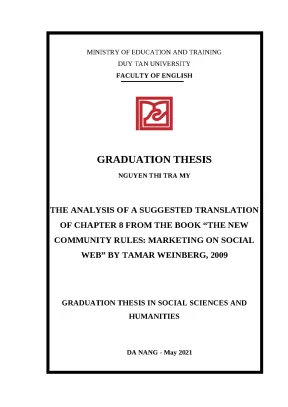
MINISTRY OF EDUCATION AND TRAINING DUY TAN UNIVERSITY FACULTY OF ENGLISH GRADUATION THESIS NGUYEN THI TRA MY THE ANALYSIS OF A SUGGESTED TRANSLATION OF CHAPTER 8 FROM THE BOOK “THE NEW COMMUNITY RULES: MARKETING ON SOCIAL WEB” BY TAMAR WEINBERG, 2009 GRADUATION THESIS IN SOCIAL SCIENCES AND HUMANITIES DA NANG - May 2021 MINISTRY OF EDUCATION AND TRAINING DUY TAN UNIVERSITY FACULTY OF ENGLISH GRADUATION THESIS NGUYEN THI TRA MY THE ANALYSIS OF A SUGGESTED TRANSLATION OF CHAPTER 8 FROM THE BOOK “THE NEW COMMUNITY RULES: MARKETING ON SOCIAL WEB” BY TAMAR WEINBERG, 2009 Major : English for Translation and Interpretation Code : 701 SUPERVISOR: NGUYEN THI BAO YEN, M.A DA NANG – May 2021 i ACKNOWLEDGEMENT To be able to complete this graduation thesis, the first sincere thanks I would like to express to all the teachers of Duy Tan University in general and the teachers of English in particular. I have learned a lot from them, who have been dedicated to teaching me over the past four years. Especially, I would like to express my deep gratitude to Ms. Nguyen Thi Bao Yen - my supervisor who has been enthusiastically instructing, gaving me very useful advice and feedback. Although she is very busy with her work, she still took the time to check and help me correct the mistakes during the completion of this thesis. Secondly, I would like to thank my family and friends who have always encouraged, cheered and supported me in the learning process as well as the process of implementing graduation projects. Thirdly, I hope I will achieve good results in my graduation and even on my journey because I think that is the most meaningful way to return their kindness. Finally, I would like to wish them all good health and get much success in their life. Yours sincerely, Nguyen Thi Tra My Student: Nguyen Thi Tra My Code:2320315608 ii STATEMENT OF AUTHORSHIP Except where reference is made in the text of the thesis, this thesis contains no material published elsewhere or extracted in the whole or in part from a thesis by which have qualified for or been awarded another degree or diploma. No other person’s work has been used without due acknowledgement in the thesis. This thesis has not been submitted for award of any degree or diploma in any other tertiary institution. Da Nang, May 2021 Nguyen Thi Tra My Student: Nguyen Thi Tra My Code:2320315608 iii ABSTRACT This paper is a suggested translation of Chapter 8 “Informing Your Public: The Informational Social Networks” in the book “The New Community Rules: Marketing on Social Web”. Firstly, I will introduce the general reason why I chose this topic, then I will translate from English version to Vietnamese version. Next, I analyse the complex vocabulary and structures in the translation and come to the suggested translation. The difficulties in the translation process and some necessary solutions are proposed at the end of the graduation thesis. In addition, through this graduation thesis, I myself also noticed some difficulties that I and other students still confuse in the translation and give some effective solutions to overcome. So I have listed some of the distinctions that I made during the translation process in the last part of this graduate paper. Lastly I hope my suggested version can provide necessary information and knowledge for some of the students who want to understand this field. Student: Nguyen Thi Tra My Code:2320315608 iv ABBREVIATIONS  P : Paragraph  SL : Source Language  TL : Target Language  IP : Internet Protocol  HTML : Hypertext Markup Language  WYSIWYG : What You See Is What You Get  Cur : Current  Prev : Previous  Rss : Really Simple Syndication  SeRP : Search Engine Results Page  Q&A : Question And Answer TABLE OF CONTENTS Student: Nguyen Thi Tra My Code:2320315608 v ACKNOWLEDGEMENT.i STATEMENT OF AUTHORSHIP. iv CHAPTER 1: INTRODUCTION. Aims and objectives. The scope of the study. The Text Features. The Text Length. The Text Source. Methods of study. 3 CHAPTER 2: THEORETICAL BACKGROUND. Concepts of translation. Types of categories. Full vs Partial Translation. Total and Retricted Translation. Free, Literal, and Word-for-word Translation. Principles and Methods of Translation. Principles of Translation. Methods of Translation. Rules of translation.12 Student: Nguyen Thi Tra My Code:2320315608 vi CHAPTER 3: SUGGESTED TRANSLATION. Words with Multiple meaning. Compound-complex Sentences. Sentences with Dummy Subjects.71 CHAPTER 5: DIFFICULTIES AND SOLUTIONS.73 CHAPTER 6: CONCLUSIONS AND SUGGESTIONS.75 REFERENCES SUPERVISOR'S COMMENTS EXAMINER'S COMMENTS Student: Nguyen Thi Tra My Code:2320315608 1 CHAPTER 1: INTRODUCTION 1. Rationale Social network is a service that connects members with similar interests on the internet with many different purposes regardless of space and time. Social networks have features like chat, e-mail, movies, voice chat, file sharing, blog, and editorial. Netizens connect together and become a part of every day for hundreds of millions of members around the world. Currently the world has hundreds of different social networks such as MySpace, Facebook, Twitter, Yahoo, etc. In addition, social media has the goal of creating a valuable community, enhancing the role of each user in building relationships. With the goals given, social networks have brought people many benefits such as: updating news, connecting relationships, business, advertising on social networks. Therefore, there are two reasons for me to choose "social network". Firstly, social networks are becoming more and more popular in countries around the world today. Secondly, social media is the link that connects people together. In short, I hope this will be the right choice for me to achieve good result on my graduation. Aims and objectives 1. Aims This graduation paper has been a reflection of myself over the past four years. During those years, I have received valuable support, help, encouragement of my supervisor, my teachers and friends at Duy Tan University. Student: Nguyen Thi Tra My Code: 2320315608 2 This graduation paper focuses on marketing on social web. Thereby, I show my ability and improve my translating skills in the field of social web as well as analyze difficult words, phrases, and structures in documents which are easily for readers misunderstand. This graduation paper is a reflection of my abilitíe that I have gathered and trained from teachers’ lectures through past four years. Translating one part in the book titled “Marketing on Social Web” will help students have more reference. Moreover, I would like to convey this translation to all those who are interested in books but they are not able to deal with specialized languages.Objectives After completing my graduation paper, I acquired the following targets:  To improve my translation skills, using suitable words and structures of any sentences.  To understand marketing on social web to translate it effectively.  To sum up the knowledge I learned in the past.  To translate the text smoothly and naturally.  To remove language barriers to help Vietnamese people understand clearly the book.  To analyze difficult and complex vocabularies, phrases, or structures which easily make misunderstand for readers. The scope of the study The text that I selected to translate is “The New Community Rules: Marketing on Social Web” by tamar weinberg, 2009. The graduation paper is translated from the original version and given the analysis of a suggested translation of the book. Besides, the paper will list some difficulties that students face in translation. Finally, some essential solutions are suggested. Student: Nguyen Thi Tra My Code: 2320315608 3 1. The Text Features The book “The New Community Rules: Marketing on Social Web” was written by Tamar Weinberg. The book about the Internet has evolved from a source of information to becoming a “social web” where individuals interact with peers through blogs, Twitter, social networks, wikis, and social news web- sites to gather information used to make well-researched choices. Tamar Weinberg wrote The New Community Rules: Marketing on the Social Web to provide readers with strategies to successfully get compelling ideas and products using social media. The Text Length There are 12 chapters and 368 pages in this book. I am going to translate 4,796 words of the Chapter 8 called “Informing Your Public: The Informational Social Networks”. The Text Source The text is a part of the book “The New Community Rules: Marketing on Social Web”. All content following this book was published by O’reilly Media on July 17, 2009. I got this book in Duy Tan University’s library and from the link https://epdf.tips/download/the-new-community-rules-marketing-on-the- social-web. Methods of study  Reading (scanning and skimming) the entire text to get the main content of the text.  Reading the chapter that were chosen carefully to get information.  Translating the text and taking notes difficult words, expressions, and structures of the text.  Discussing with the supervisor, colleagues, friends and referring those words, expressions and structures on the Internet.  Completing and giving a suggested version of the text. Student: Nguyen Thi Tra My Code: 2320315608 4 CHAPTER 2: THEORETICAL BACKGROUND 2. Concepts of translation English is the most widely used "second" and "learning" language in the world used for international communication in various fields like aviation, business, internet, science and technology. Accordingly, translation and interpretation are important and also difficult majors which create many job oppoturnities for students. To become a good translator, a language student should understand the theory background of translation. There are so many concepts of translation, which are developed by lots of famous linguists of translation.  Translation is the replacement of textual material in one language (source language) by equivalent textual material in another language (target language).[1]  Translation is a process of rendering the meaning of a text into another language in the way that the author intended the text. [3]  Translation is the act of transferring through which the content of a text is transferred from the SL into the TL.[8]  Translation is generally used to refer to all the process and methods used to convey the meaning of the source language in to the target language. [8] These concepts support the idea that translation is a complex process which requires also theoretical knowledge as well as practical experiences. Student: Nguyen Thi Tra My Code: 2320315608 5 2. Types of categories Types of categories of translation may be defined in terms of extent, levels, rank of translation. There are many methods to translate; however, my graduation paper used some types among of them. Full vs Partial Translation This distinction relates to the extent (in a syntagmatic sense) of source language text which is submitted to the translation process. The text may be a book, a simple volume, a chapter, a paragraph, a sentence, a clause, etc. It may be a figment, not co-existence with any formal literacy or linguistic unit. In a “full” translation, the entire text is submitted to the translation process; that is, every part of the source language text is replaced with target language text material. For example: What do you do everyday?  Bạn làm gì mỗi ngày? In a “partial” translation, some parts or parts of the source language text are left non-translated: they are simply transferred to and incorporated in the target language text. For example: There was a sharp fall in stock price in 2017  Đã có một sự tụt dốc mạnh trong giá cổ phiếu năm 2017 In “partial” translation, the process of transferring source language lexical items into a target language text is more complex than appears at first sight, seeming to remain “non-translated”. Total and Retricted Translation This distinction relates to the levels of language involved in translation. In “total” translation, all levels of source language text are replaced with target language material. Strictly speaking, “total” translation is a misleading Student: Nguyen Thi Tra My Code: 2320315608 6 term, since, though total replacement is involved, it is not replacement with equivalent at all levels. In “total” translation, source language grammar and lexis are replaced with equivalent target language grammar and lexis.

Nội dung được bảo vệ bản quyền — Tải xuống đầy đủ