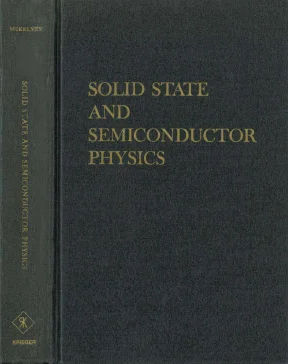
Vật Lý Chất Rắn và Bán Dẫn (Solid State and Semiconductor Physics) - John P. McKelvey

Trường đại học

The Pennsylvania State University

Người đăng

Ẩn danh

Thể loại

Sách giáo khoa

1984

529
0
0

Phí lưu trữ

135 Point

Tóm tắt

I. Tổng quan về sách Vật lý trạng thái rắn và bán dẫn của McKelvey

Cuốn sách "Solid State and Semiconductor Physics" của John Philip McKelvey là một tác phẩm giáo trình kinh điển trong lĩnh vực vật lý chất rắn và vật lý bán dẫn. Được xuất bản lần đầu năm 1966 bởi Harper & Row thuộc series Harper's Physics Series, cuốn sách sau đó được tái bản bởi nhà xuất bản Robert E. Krieger Publishing Company vào các năm 1982 và 1984 tại Malabar, Florida. Tác giả John P. McKelvey giảng dạy tại Đại học bang Pennsylvania, đã biên soạn cuốn sách dựa trên tài liệu giảng dạy thực tế cho khóa học hai học kỳ dành cho sinh viên năm cuối và nghiên cứu sinh bậc cao học chuyên ngành vật lý, kỹ thuật điện, luyện kim và khoa học vật liệu. Cuốn sách có cấu trúc rõ ràng với phần đầu tiên tập trung vào vật lý chất rắn tổng quát, phần thứ hai đi sâu vào nghiên cứu chi tiết về vật liệu và linh kiện bán dẫn. Phạm vi rộng lớn cùng cách trình bày chi tiết, dễ hiểu biến cuốn sách thành tài liệu tham khảo quý giá cho các nhà khoa học và kỹ sư tham gia nghiên cứu phát triển vật liệu bán dẫn.

1.1. Thông tin xuất bản và lịch sử phát hành

Cuốn sách "Solid State and Semiconductor Physics" của John Philip McKelvey được nhà xuất bản Robert E. Krieger Publishing Company, Inc. đặt tại Krieger Drive, Malabar, Florida 32950 phát hành lại. Ấn bản gốc năm 1966 do Harper & Row xuất bản tại New York thuộc series Harper's Physics Series nổi tiếng. Phiên bản tái bản được thực hiện theo thỏa thuận với tác giả, bảo lưu toàn bộ quyền tác giả theo bản quyền © 1966 của John P. McKelvey. Sách được in tại Hoa Kỳ, có mã ISBN 0-89874-396-6 và được phân loại trong danh mục Cataloging in Publication Data của Thư viện Quốc hội Mỹ với mã phân loại 6'22 và số đăng ký 81-19390.

1.2. Đối tượng và mục tiêu phục vụ của cuốn sách

Cuốn sách được thiết kế phục vụ đa dạng đối tượng độc giả trong lĩnh vực khoa học vật liệu và kỹ thuật. Đối tượng chính bao gồm sinh viên năm cuối đại học và nghiên cứu sinh mới bắt đầu chương trình cao học chuyên ngành vật lý, kỹ thuật điện, luyện kim và khoa học vật liệu. Ngoài vai trò giáo trình chính khóa, cuốn sách còn phục vụ như tài liệu tham khảo tổng quát cho các nhà khoa học và kỹ sư đang tham gia công tác nghiên cứu phát triển liên quan đến vật liệu và thiết bị bán dẫn. Sự đa dạng về nền tảng giáo dục của độc giả tiềm năng đã khiến tác giả bổ sung các chương độc lập về cơ học lượng tử và cơ học thống kê.

II. Phân tích nội dung và cấu trúc của cuốn sách vật lý bán dẫn

Cuốn sách Solid State and Semiconductor Physics của McKelvey có cấu trúc nội dung được xây dựng logic theo trình tự từ cơ bản đến nâng cao. Phần đầu tiên trình bày các khái niệm nền tảng về vật lý chất rắn, bao gồm cấu trúc tinh thể, mạng Bravais, các loại tinh thể và định luật Bragg. Nội dung đề cập chi tiết đến khoảng cách giữa các mặt phẳng tinh thể (hkl), vectơ pháp tuyến và phương trình mặt phẳng trong mạng trực tiếp cũng như mạng nghịch đảo. Phần thứ hai chuyển sang lĩnh vực bán dẫn chuyên sâu, kết hợp nhiều nguyên lý đã phát triển ở phần giới thiệu cùng tài liệu mới về đặc tính vật liệu bán dẫn, kỹ thuật chế tạo thiết bị và mạch điện tử. Tác giả trình bày từ góc nhìn của nhà vật lý nhưng vẫn cung cấp đủ chi tiết kỹ thuật về công nghệ vật liệu, phát triển tinh thể, chế tạo thiết bị bán dẫn để người đọc có cái nhìn toàn diện. Các bài tập cuối chương khuyến khích sinh viên tự xây dựng lập luận cho cấu trúc tinh thể ba chiều.

2.1. Cấu trúc tinh thể và mạng không gian

Nội dung về cấu trúc tinh thể trong cuốn sách trình bày chi tiết các khái niệm cơ bản về mạng không gian và phân loại tinh thể. Phần này giới thiệu cách tính khoảng cách d giữa các mặt phẳng liền kề bằng cách chọn một điểm mạng làm gốc, dựng trục theo phương a, b, c và tìm khoảng cách vuông góc giữa gốc và mặt phẳng có giao điểm a/h, b/k, c/l. Công thức tính khoảng cách sử dụng các góc phương hướng α, β, γ giữa pháp tuyến của mặt phẳng và các trục tọa độ. Trong mạng trực giao, phương trình mặt phẳng (hkl) được biểu diễn dưới dạng hx/a + ky/b + lz/c = 1, với gradient của hàm số f cho vectơ pháp tuyến.

2.2. Mạng nghịch đảo và điều kiện Bragg

Phần về mạng nghịch đảo giới thiệu khái niệm vectơ r* vuông góc với hai vectơ độc lập tuyến tính nằm trong mặt phẳng (hkl) của mạng trực tiếp. Đại lượng r* có độ lớn bằng n/d với n là số nguyên và d là khoảng cách giữa các mặt phẳng liền kề. Điều kiện Bragg được biểu diễn dưới dạng quan hệ vectơ trong mạng nghịch đảo bằng hình học đặc biệt: một vectơ AO có độ dài 1/λ theo hướng chùm tia X tới, kết thúc tại gốc mạng nghịch đảo. Quả cầu bán kính 1/λ được dựng quanh điểm A, khi cắt tại điểm (h',k',l') của mạng nghịch đảo sẽ cho điều kiện phản xạ Bragg thỏa mãn.

III. Phương pháp giảng dạy và cách tiếp cận vật lý bán dẫn

John Philip McKelvey áp dụng phương pháp giảng dạy kết hợp lý thuyết và thực hành trong cuốn sách Solid State and Semiconductor Physics. Cách tiếp cận từ góc nhìn của nhà vật lý đảm bảo tính khoa học nghiêm ngặt, đồng thời bổ sung chi tiết kỹ thuật về công nghệ vật liệu và mạch điện tử để hoàn thiện bức tranh toàn cảnh. Tác giả nhận thức rằng không có sự thay thế nào cho việc hiểu sâu sắc các hiện tượng lượng tử và thống kê trong vật lý chất rắn, nên đã dành riêng các chương giới thiệu cơ học lượng tử và cơ học thống kê. Các chương này không nhằm trình bày toàn diện mà chỉ cung cấp kiến thức nền tảng đủ để độc giả theo dõi nội dung tiếp theo và nắm bắt ý nghĩa vật lý. Phương pháp này đặc biệt hữu ích cho sinh viên có nền tảng giáo dục đa dạng, từ vật lý đến kỹ thuật điện và luyện kim. Cuốn sách cũng hướng dẫn người đọc tìm kiếm thêm nguồn tài liệu chuyên sâu về các chủ đề cụ thể như phát triển tinh thể và đặc tính thiết bị bán dẫn.

3.1. Tích hợp cơ học lượng tử và thống kê

Cuốn sách tích hợp các chương tự chứa về cơ học lượng tử và cơ học thống kê nhằm hỗ trợ sinh viên có nền tảng đa dạng. Tác giả xác định rõ các chương này không phải là tài liệu toàn diện mà chỉ là bài giới thiệu ngắn gọn, cung cấp đủ kiến thức làm việc để người đọc có thể theo dõi sự phát triển tiếp theo của luận điểm và đánh giá ý nghĩa vật lý. Cách tiếp cận này thừa nhận rằng hiểu biết sâu sắc về hiện tượng lượng tử và thống kê là không thể thiếu trong vật lý chất rắn, đồng thời tạo cầu nối cho sinh viên từ nhiều lĩnh vực khác nhau tiếp cận nội dung nâng cao về bán dẫn một cách hệ thống và logic.

3.2. Cân bằng giữa lý thuyết và ứng dụng kỹ thuật

McKelvey đạt được sự cân bằng tinh tế giữa lý thuyết vật lý thuần túy và chi tiết kỹ thuật ứng dụng. Từ quan điểm nhà vật lý, cuốn sách trình bày các nguyên lý cơ bản một cách nghiêm ngặt, nhưng đồng thời cung cấp đủ thông tin kỹ thuật về công nghệ vật liệu, phát triển tinh thể, chế tạo thiết bị bán dẫn, đặc tính thiết bị và mạch điện tử. Điều này giúp người đọc không chỉ hiểu nguyên lý mà còn biết cách tìm kiếm nguồn tài liệu chuyên sâu hơn. Phương pháp này phản ánh thực tế nghiên cứu hiện đại, nơi ranh giới giữa vật lý lý thuyết và ứng dụng kỹ thuật ngày càng mờ nhạt, đòi hỏi nhà nghiên cứu có kiến thức liên ngành toàn diện.

IV. Kết luận và giá trị của cuốn sách trong lĩnh vực vật lý bán dẫn

Cuốn sách Solid State and Semiconductor Physics của John Philip McKelvey, qua các ấn bản từ 1966 đến 1984, đã khẳng định vị trí quan trọng trong thư viện tài liệu giảng dạy và nghiên cứu vật lý bán dẫn. Được tái bản bởi nhà xuất bản Robert E. Krieger Publishing Company, cuốn sách tiếp tục phục vụ thế hệ sinh viên và nhà nghiên cứu mới. Giá trị cốt lõi nằm ở cách tiếp cận cân bằng giữa lý thuyết và thực hành, giữa chiều sâu vật lý và ứng dụng kỹ thuật. Cấu trúc hai phần rõ ràng, từ vật lý chất rắn tổng quát đến bán dẫn chuyên sâu, tạo nền tảng kiến thức vững chắc. Việc bổ sung các chương cơ học lượng tử và thống kê thể hiện sự quan tâm đến tính dễ tiếp cận cho độc giả đa ngành. Cuốn sách không chỉ là giáo trình mà còn là cẩm nang tham khảo cho các dự án nghiên cứu phát triển vật liệu và thiết bị bán dẫn trong thực tế công nghiệp và học thuật hiện đại.

4.1. Di sản giáo dục và ảnh hưởng học thuật

Cuốn sách để lại di sản giáo dục đáng kể trong lĩnh vực vật lý bán dẫn. Được biên soạn dựa trên kinh nghiệm giảng dạy thực tế tại Đại học bang Pennsylvania, tác phẩm phản ánh nhu cầu đào tạo thực tiễn cho sinh viên kỹ thuật và khoa học vật liệu. Việc được tái bản nhiều lần bởi nhà xuất bản Krieger cho thấy giá trị bền vững của nội dung. Cuốn sách đã phục vụ như cầu nối giữa lý thuyết vật lý cơ bản và ứng dụng công nghiệp bán dẫn, ảnh hưởng đến cách tiếp cận giảng dạy vật lý chất rắn tại nhiều trường đại học. Phạm vi rộng lớn từ cấu trúc tinh thể đến đặc tính thiết bị đặt nền tảng toàn diện cho nghiên cứu chuyên sâu.

4.2. Ứng dụng thực tế trong nghiên cứu và công nghiệp

Nội dung cuốn sách có tính ứng dụng cao trong nghiên cứu và phát triển công nghiệp bán dẫn. Các phần về kỹ thuật chế tạo thiết bị, đặc tính linh kiện và mạch điện tử cung cấp kiến thức thực tiễn cho kỹ sư và nhà nghiên cứu. Phần về cấu trúc tinh thể, mạng nghịch đảo và điều kiện Bragg có ứng dụng trực tiếp trong phân tích vật liệu bằng nhiễu xạ tia X. Kiến thức về vật lý bán dẫn được trình bày trong sách phục vụ quá trình thiết kế và tối ưu hóa các thiết bị bán dẫn hiện đại, từ transistor đến mạch tích hợp. Cuốn sách đóng vai trò tài liệu tham khảo quý giá cho các dự án nghiên cứu phát triển vật liệu mới và quy trình chế tạo tiên tiến.
21/04/2026

Trích đoạn nội dung tài liệu

SOLID STATE AND SEMICONDUCTOR PHYSICS SOLID STATE AND SEMICONDUCTOR PHYSICS John P. McKelvey THE PENNSYLVANIA STATE UNIVERSITY ROBERT E. KRIEGER PUBLISHING COMPANY MALABAR, FLORIDA Original Edition 1966 Reprint Edition 1982, 1984 Printed and Published by ROBERT E. KRIEGER PUBLISHING COMPANY, INC. KRIEGER DRIVE MALABAR, FLORIDA 32950 Copyright © 1966 by JOHN P. McKELVEY Reprinted by Arrangement All rights reserved. No part of this book may be reproduced in any form or by any electronic or mechanical means including information storage and retrieval systems without permission in writing from the publisher. Printed in the United States of America Library of Congress Cataloging in Publication Data McKelvey, John Philip. Solid state and semiconductor physics. Originally published: New York : Harper & Row, 1966. (Harper's physics series) Includes bibliographical references and index. Solid state physics. Series: Harper's physics series.6'22 81-19390 ISBN 0-89874-396-6 AACR2 PREFACE This book has arisen from source material used by the author in teaching a two-term course to seniors and beginning graduate students majoring in physics, electrical engineering, metallurgy, and materials sciences. The first term is ordinarily devoted to general solid state physics, the second to a detailed study of semicon- ductor materials and devices, in which (in addition to much new material) many applications of principles developed in the introductory section of the course are encountered. The present work, then, is essentially a text for such a course. We hope its scope is sufficiently broad and its treatment of fundamentals sufficiently detailed and understandable that it will also serve as a general reference book for scientists and engineers who are engaged in research and development work in- volving semiconductor materials and devices. In view of the diverse educational backgrounds of those who must interest themselves in this material, it was felt that the inclusion of self-contained chapters on quantum mechanics and statistical mechanics would be of great assistance. It should be noted, however, that these chapters are not intended to serve as com- prehensive treatments of these topics, but only as brief introductory essays which suffice, hopefully, to provide enough working knowledge to enable the reader to follow the subsequent development and appreciate the physical significance of all that follows. There is, of course, no substitute for a really profound appreciation of quantum and statistical phenomena in understanding solid state physics. The treatment throughout is from the point of view of the physicist, although enough technical detail on such subjects as materials technology and crystal growth, semiconductor device fabrication, and device characteristics and circuitry is in- cluded to round out these aspects of the over-all picture and indicate what sources must be consulted in order to obtain more detailed information about those sub- jects. The material on p n junction theory and semiconductor device analysis is - intended to be quite complete and to present a comprehensive and detailed discus- sion of analytical techniques which are useful in this rather important but somewhat neglected area. The choice of introductory topics in general solid state physics, in Chapters 1-8, includes only those subjects which are of central importance to semiconductor physics. The introductory section, therefore, is selective rather than comprehensive, although the material presented is about sufficient for a single-term intermediate solid state physics course. Clearly, it would have been impossible, in a book of manageable dimensions, to include also a treatment of dielectrics, magnetism, color centers, resonance experiments, and other such topics which are ordinarily included in general solid state physics texts. The level of presentation is intermediate; the author has tried to go far vi PREFACE beyond what can be accomplished in a qualitative way without any real use of quantum theory and statistical mechanics, while avoiding the formidable mathe- matical involvements of a full quantum-theoretical treatment. The line of approach is pragmatic rather than axiomatic, and a determined attempt has been made to present a physical as well as mathematical understanding of all the subject matter. Fundamental principles, rather than technical details, are emphasized throughout. The ,particle approach, as embodied in the free-electron transport theory, has been relied upon heavily; the justification of this approach in the light of the quantum theory has been emphasized in Chapter 8. No mathematics beyond vector analysis and ordinary differential equations is required. Although partial differential equa- tions and orthogonal function expansions are encountered on several occasions, the mathematical tools needed are developed on the spot. It is quite impossible for me to express adequately my gratitude to all of my associates who have contributed to this work. Specifically, however, I should like to thank Drs. John for helpful comments, discussions, and suggestions, and Dr. Brickwedde for generously providing secretarial services in a time of dire need. My former students, Drs. Pulver have also rendered much assistance in reading, criticizing, and correcting parts of the manuscript. Many of the students in my classes have pointed out errors in the manuscript notes and have made sug- gestions for improvements concerning various individual topics. I am unable to recall all of these contributions in specific terms, but I am grateful for them nevertheless. I must also thank Miss Frances Fogle, Mrs. Marion Shaw, and Miss Eileen Berringer for their invaluable services in typing the manuscript. McKELVEY University Park, Pa. April, 1966 CONTENTS Preface CHAPTER 1 SPACE LATTICES AND CRYSTAL TYPES 1.1 Concept of "Solid" 1 1.2 Unit Cells and Bravais Lattices 2 1.3 Some Simple Crystal Structures 6 1.4 Crystal Planes and Miller Indices 10 1.5 Spacing of Planes in Crystal Lattices 12 1.6 General Classification of Crystal Types 15 CHAPTER 2 X-RAY CRYSTAL ANALYSIS 2.2 Physics of X-Ray Diffraction: The Von Laue Equations 21 2.3 The Atomic Scattering Factor 25 2.4 The Geometrical Structure Factor 28 2.5 The Reciprocal Lattice 30 2.6 The Bragg Condition in Terms of the Reciprocal Lattice 34 CHAPTER 3 DYNAMICS OF CRYSTAL LATTICES 3.1 Elastic Vibrations of Continuous Media 38 3.2 Group Velocity of Harmonic Wave Trains 40 3.3 Wave Motion on a One-Dimensional Atomic Lattice 42 3.4 The One-Dimensional Diatomic Lattice 48 3.5 The Forbidden Frequency Region 52 3.6 Optical Excitation of Lattice Vibrations in Ionic Crystals 53 3.7 Binding Energy of Ionic Crystal Lattices 55 vii viii CONTENTS CHAPTER 4 OUTLINE OF QUANTUM MECHANICS 64 4.2 Black Body Radiation 64 4.3 The Photoelectric Effect 66 4.4 Specific Heat of Solids 67 4.5 The Bohr Atom 69 4.6 De Broglie's Hypothesis and the Wavelike Properties of Matter 72 4.8 The Time Dependence of the Wave Function 76 4.9 The Free Particle and the Uncertainty Principle 79 4.10 A Particle in an Infinitely Deep One-Dimensional Potential Well 84 4.11 A Particle in a One-Dimensional Well of Finite Depth 88 4.12 The One-Dimensional Harmonic Oscillator 95 4.13 Orthogonality of Eigenfunctions and Superposition of States 103 4.14 Expectation Values and Quantum Numbers 106 4.15 The Hydrogen Atom 112 4.16 Electron Spin, the Pauli Exclusion Principle and the Periodic System 124 CHAPTER 5 OUTLINE OF STATISTICAL MECHANICS 129 5.2 The Distribution Function and the Density of States 130 5.3 The Maxwell-Boltzmann Distribution 134 5.4 Maxwell-Boltzmann Statistics of an Ideal Gas 142 5.5 Fermi-Dirac Statistics 149 5.6 The Bose-Einstein Distribution 156 CHAPTER 6 LATTICE VIBRATIONS AND THE THERMAL PROPERTIES OF CRYSTALS 160 6.1 Classical Calculation of Lattice Specific Heat 160 6.2 The Einstein Theory of Specific Heat 162 CONTENTS ix 6.3 The Debye Theory of Specific Heat 165 6.5 Thermal Expansion of Solids 172 6.6 Lattice Thermal Conductivity of Solids 174 CHAPTER 7 THE FREE-ELECTRON THEORY OF METALS 180 7.2 The Boltzmann Equation and the Mean Free Path 181 7.3 Electrical Conductivity of a Free-Electron Gas 186 7.4 Thermal Conductivity and Thermoelectric Effects in Free-Electron Systems 191 7.6 The Hall Effect and Other Galvanomagnetic Effects 199 7.7 The Thermal Capacity of Free-Electron Systems 201 CHAPTER 8 QUANTUM THEORY OF ELECTRONS IN PERIODIC LATTICES 208 8.2 The Bloch Theorem 209 8.3 The Kronig-Penney Model of an Infinite One- Dimensional Crystal 212 8.4 Crystal Momentum and Effective Mass 217 8.5 Reduced Zone Representation; Electrons and Holes 220 8.6 The Free-Electron Approximation 224 8.7 The Tight-Binding Approximation 231 8.8 Dynamics of Electrons in Two- and Three-Dimensional Lattices; Constant Energy Surfaces and Brillouin Zones 236 8.9 Insulators, Semiconductors, and Metals 245 8.10 The Density of States Function and Phase Changes in Binary Alloys 249 X CONTENTS CHAPTER 9 UNIFORM ELECTRONIC SEMICONDUCTORS IN EQUILIBRIUM 256 9.2 Intrinsic Semiconductors and Impurity Semiconductors 259 9.3 Statistics of Holes and Electrons— The Case of the Intrinsic Semiconductor 263 9.4 Ionization Energy of Impurity Centers 267 9.5 Statistics of Impurity Semiconductors 270 9.6 Case of Incomplete Ionization of Impurity Levels (Very Low Temperature) 275 9.8 The Hall Effect and Magnetoresistance 281 9.9 Cyclotron Resonance and Ellipsoidal Energy Surfaces 290 9.10 Density of States, Conductivity and Hall Effect with Complex Energy Surfaces 300 9.11 Scattering Mechanisms and Mobility of Charge Carriers 308 CHAPTER 10 EXCESS CARRIERS IN SEMICONDUCTORS 320 10.2 Transport Behavior of Excess Carriers; the Continuity Equations 321 10.3 Some Useful Particular Solutions of the Continuity Equation 333 10.4 Drift Mobility and the Haynes-Shockley Experiment 342 10.5 Surface Recombination and the Surface Boundary Condition 346 10.6 Steady-State Photoconductivity 351 10.7 Transient Photoconductivity; Excess Carrier Lifetime 354 10.8 Recombination Mechanisms; the Shockley-Read Theory of Recombination 361 CHAPTER 11 MATERIALS TECHNOLOGY AND THE MEASUREMENT OF BULK PROPERTIES 371 11.1 Preparation of High-Purity Semiconductor Materials 371 11.2 The Growth of Single Crystal Samples 376 CONTENTS xi 11.3 Measurement of Bulk Resistivity 378 11.4 Measurement of Impurity Content and Mobility by the Hall Effect 381 11.5 L14Ieasurement of Excess Carrier Lifetime 382 11.6 Dislocations and Other Imperfections 383 CHAPTER 12 THEORY OF SEMICONDUCTOR p n JUNCTIONS - 390 12.2 The Equilibrium Internal Contact Potential 393 12.3 Potentials and Fields in the Neighborhood of a p n Junction - 395 12.4 Simplified Mathematical Model of the Abrupt p n Junction - 398 12.5 Junction Capacitance; Determination of Interval Potential 404 CHAPTER 13 p n - JUNCTICN RECTIFIERS AND TRANSISTORS 408 13.1 Theory of the p n Junction Rectifier - 408 13.2 Currents and Fields in p n Junction Rectifiers - 416 13.3 Junction Rectifiers of Finite Size; the Effects of Surfaces and "Ohmic" End Contacts 420 13.4 Physical Mechanisms of Breakdown in p n Junctions- 424 13.5 p n Junction Fabrication Technology - 428 13.6 p n p and n p n Junction Transistors - - - - 431 CHAPTER 14 p n - JUNCTIONS AT HIGH-CURRENT LEVELS; THE pin - - RECTIFIER 446 14.1 p n Junctions at High Current Densities - 446 14.2 The Analysis of the p4 i n+ Rectifier at High-Current -- Levels 448 14.3 Forward Voltage Drop in p i n Rectifiers - - as a Function of Temperature 456 xii CONTENTS CHAPTER 15 OTHER SEMICONDUCTOR DEVICES 461 15.1 The p n Photovoltaic Effect and p n Junction - - Photovoltaic Cells 461 15.2 Other Photo-Devices; Phototransistors, Particle Detectors and Infrared Detectors 468 15.5 Unipolar or Field Effect Transistors 475 CHAPTER 16 METAL-SEMICONDUCTOR CONTACTS AND SEMICONDUCTOR SURFACES 478 16.1 Metal-Semiconductor Contacts in Equilibrium 478 16.2 Metal-Semiconductor Contact Rectification 482 16.3 Surface States and the Independence of Rectifying Properties of Work Function 485 16.4 Potential, Field and Charge Within a Semiconductor Surface Layer 489 16.5 Surface Conductivity, Field Effect, and Surface Mobility; Properties of Actual Semiconductor Surfaces 495 APPENDIX A THE DIRAC 8-FUNCTION 500 APPENDIX B TENSOR ANALYSIS 502 INDEX OF NAMES 507 INDEX OF SUBJECTS 509 SOLID STATE AND SEMICONDUCTOR PHYSICS CHAPTER 1 SPACE LATTICES AND CRYSTAL TYPES 1•1 CONCEPT OF '!SOLID" Generally speaking, we apply the term solid to rigid elastic substances, that is, to substances that exhibit elastic behavior not only when subjected to hydrostatic forces, but also under tensile or shear stresses. There are, of course, materials that display both elastic and plastic or viscous behavior, so that this classification is not a com- pletely rigorous one. We shall nevertheless adopt it as a criterion of what a solid substance is, recognizing that there is a class of substances that exhibits both solid and fluid behavior.

Nội dung được bảo vệ bản quyền — Tải xuống đầy đủ