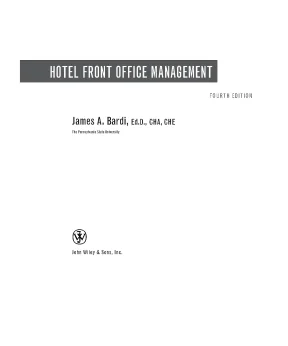
Giáo Trình Quản Lý Quầy Lễ Tân Khách Sạn - Ấn Bản thứ 4 bởi James A. Bardi

Trường đại học

The Pennsylvania State University

Chuyên ngành

Quản trị khách sạn

Người đăng

Ẩn danh

Thể loại

Giáo trình

2007

482
0
0

Phí lưu trữ

75 Point

Tóm tắt

I. Tổng quan về giáo trình Hotel Front Office Management

Giáo trình Hotel Front Office Management của James A. Bardi là tài liệu học thuật tiêu chuẩn trong lĩnh vực quản trị khách sạn. Cuốn sách do nhà xuất bản John Wiley & Sons phát hành, hiện đã qua bốn lần tái bản. Nội dung bao quát toàn bộ hoạt động của bộ phận tiền sảnh khách sạn. Đây là vị trí trung tâm tiếp xúc trực tiếp với khách hàng. Giáo trình cung cấp kiến thức từ cơ bản đến nâng cao về nghiệp vụ lễ tân. Người học nắm được quy trình đặt phòng, nhận phòng, trả phòng. Giáo trình cũng đề cập đến các chỉ số kinh doanh quan trọng. Các chỉ số này bao gồm công suất phòng, giá phòng trung bình ngày, tỷ lệ lợi nhuận và doanh thu trên mỗi phòng sẵn có. Cuốn sách kết hợp lý thuyết quản trị với thực tiễn vận hành. Sinh viên và nhân viên ngành khách sạn đều có thể áp dụng kiến thức một cách trực tiếp vào công việc hàng ngày.

1.1. Tác giả và bối cảnh ra đời giáo trình

James A. Bardi là chuyên gia có học vị CHA và CHE, giảng dạy tại Đại học Bang Pennsylvania. Ông có nhiều năm kinh nghiệm trong ngành quản trị khách sạn. Giáo trình Hotel Front Office Management được xuất bản lần đầu bởi John Wiley & Sons. Phiên bản thứ tư ra đời năm 2007 với nội dung cập nhật. Cuốn sách phản ánh những thay đổi trong ngành lưu trú thời kỳ hiện đại. Các yếu tố như công nghệ đặt phòng trực tuyến và quản lý doanh thu được bổ sung. Giáo trình được sử dụng rộng rãi tại nhiều trường đại học trên thế giới.

1.2. Cấu trúc và phạm vi nội dung giáo trình

Giáo trình được tổ chức thành các chương theo từng chủ đề cụ thể. Phần giới thiệu trình bày tổng quan về ngành quản trị khách sạn. Các chương tiếp theo đi sâu vào nghiệp vụ bộ phận tiền sảnh. Nội dung bao gồm kỹ năng giao tiếp, xử lý thanh toán, quản lý đặt phòng. Giáo trình cũng đề cập đến các loại hình khách sạn khác nhau. Khách sạn thương mại, khách sạn dân cư, khách sạn dịch vụ hạn chế đều được phân tích. Các chỉ số đánh giá hiệu quả kinh doanh được giải thích chi tiết. Cuối mỗi chương có danh mục từ khóa và câu hỏi ôn tập.

II. Phân tích các chỉ số kinh doanh trong quản trị tiền sảnh

Giáo trình Hotel Front Office Management nhấn mạnh tầm quan trọng của các chỉ số kinh doanh. Bốn yếu tố đo lường mức độ thành công tài chính của khách sạn. Công suất phòng là số phòng bán chia cho số phòng sẵn có. Giá phòng trung bình ngày tính bằng tổng doanh thu phòng chia số phòng đã bán. Tỷ lệ lợi nhuận thể hiện hiệu quả bán phòng ở mức giá cao nhất. Doanh thu trên mỗi phòng sẵn có cho biết khả năng sinh lời của từng phòng. Các chỉ số này phục vụ nhà đầu tư đánh giá khả năng sinh lời. Bộ phận tiền sảnh đóng vai trò quan trọng trong việc đạt các mục tiêu doanh thu. Nhân viên lễ tân trực tiếp tác động đến trải nghiệm khách hàng và quyết định chi tiêu. Việc theo dõi và phân tích chỉ số giúp quản lý đưa ra chiến lược phù hợp.

2.1. Công suất phòng và giá phòng trung bình ngày

Công suất phòng phản ánh hiệu quả hoạt động của bộ phận tiếp thị và bán hàng. Chỉ số này cũng đo lường nỗ lực marketing nội bộ tại tiền sảnh. Giá phòng trung bình ngày cho thấy mức giá trung bình mà khách sạn thu được. Hai chỉ số này có mối quan hệ mật thiết với nhau. Công suất cao không nhất thiết đồng nghĩa với lợi nhuận cao nếu giá thấp. Quản lý cần cân đối giữa việc lấp đầy phòng và duy trì mức giá hợp lý. Giáo trình hướng dẫn cách tính toán và phân tích hai chỉ số này một cách chi tiết.

2.2. Tỷ lệ lợi nhuận và doanh thu trên mỗi phòng sẵn có

Tỷ lệ lợi nhuận đánh giá mức độ thành công trong việc bán phòng cho khách sinh lời nhất. Chỉ số này xem xét hiệu quả bán hàng tồn kho phòng hàng ngày. Doanh thu trên mỗi phòng sẵn có là công cụ đo lường khả năng sinh lời. Mỗi cơ hội bán phòng trong ngày chỉ xuất hiện một lần duy nhất. Giáo trình giải thích cách tối ưu hóa hai chỉ số này. Nhân viên tiền sảnh cần được đào tạo kỹ năng bán thêm và bán chéo. Chiến lược định giá linh hoạt giúp tối đa hóa doanh thu theo mùa và nhu cầu thị trường.

III. Phương pháp đào tạo và ứng dụng giáo trình thực tiễn

Giáo trình Hotel Front Office Management cung cấp phương pháp đào tạo toàn diện. Phương pháp kết hợp giữa học tập truyền thống và đào tạo tại chỗ. Giáo trình khuyến khích sử dụng công nghệ thông tin trong giảng dạy. Các phương pháp học từ xa và hội nghị truyền hình được giới thiệu. Đào tạo trong dịch vụ giúp nhân viên cập nhật kỹ năng liên tục. Quản lý chất lượng toàn diện là nguyên tắc xuyên suốt nội dung. Giáo trình nhấn mạnh tầm quan trọng của dữ liệu nhân khẩu học và tâm lý học. Thông tin này giúp phân khúc thị trường và phục vụ khách hàng tốt hơn. Phương pháp giảng dạy bao gồm tình huống thực tế và bài tập tình huống. Người học có thể áp dụng kiến thức ngay vào môi trường làm việc thực tế.

3.1. Đào tạo nhân viên bộ phận tiền sảnh hiện đại

Giáo trình đề cập đến nhiều hình thức đào tạo nhân viên tiền sảnh. Đào tạo tại chỗ giúp nhân viên nắm vững quy trình vận hành hàng ngày. Học tập từ xa qua nền tảng trực tuyến mở rộng cơ hội tiếp cận kiến thức. Hội nghị truyền hình cho phép giao tiếp và học hỏi từ chuyên gia ở xa. Nhân viên cần thành thạo kỹ năng giao tiếp, xử lý tình huống và bán hàng. Giáo trình cung cấp các tình huống mô phỏng thực tế tại quầy lễ tân. Chương trình đào tạo liên tục đảm bảo chất lượng dịch vụ ổn định theo thời gian.

3.2. Phân khúc thị trường và chiến lược tiếp thị tiền sảnh

Giáo trình phân loại khách sạn theo nhiều tiêu chí thị trường khác nhau. Khách sạn thương mại phục vụ khách đi công tác và tham dự hội nghị. Khách sạn dân cư dành cho khách lưu trú dài hạn với hợp đồng thuê. Khách sạn dịch vụ hạn chế cung cấp tiện nghi cơ bản với giá phải chăng. Dữ liệu nhân khẩu học giúp xác định nhóm khách hàng mục tiêu. Thông tin tâm lý học揭示 động cơ và sở thích du lịch của khách. Bộ phận tiền sảnh thực hiện tiếp thị nội bộ thông qua dịch vụ chất lượng. Chiến lược marketing đại chúng kết hợp với tiếp cận cá nhân hóa mang lại hiệu quả cao.

IV. Kết luận và hướng ứng dụng giáo trình trong ngành khách sạn

Giáo trình Hotel Front Office Management là tài liệu không thể thiếu cho ngành khách sạn. Nội dung bao quát từ lý thuyết quản trị đến thực tiễn vận hành. Giáo trình giúp người học hiểu rõ vai trò của bộ phận tiền sảnh. Đây là trung tâm điều phối hoạt động và tạo ấn tượng đầu tiên với khách. Kiến thức về chỉ số kinh doanh hỗ trợ ra quyết định chiến lược. Quản lý có thể tối ưu hóa doanh thu và lợi nhuận dựa trên dữ liệu. Giáo trình cũng cập nhật xu hướng mới trong ngành lưu trú. Các loại hình khách sạn mở rộng như khách sạn all-suites và khách sạn extended stay. Nhà đầu tư sử dụng giáo trình để đánh giá tính khả thi của dự án. Ứng dụng thực tế của giáo trình trải rộng từ đào tạo đến hoạch định chiến lược kinh doanh.

4.1. Giá trị của giáo trình cho nhà đầu tư và quản lý

Nhà đầu tư sử dụng kiến thức từ giáo trình để phân tích khả năng sinh lời. Các chỉ số công suất phòng và RevPAR giúp đánh giá hiệu quả tài chính. Quản lý khách sạn áp dụng nguyên tắc quản lý chất lượng toàn diện. Giáo trình cung cấp công cụ lập kế hoạch và kiểm soát ngân sách. Kiểu dáng sở hữu khách sạn bao gồm chuỗi, nhượng quyền và quản lý hợp đồng. Mỗi mô hình có ưu nhược điểm riêng được phân tích chi tiết. Giáo trình trở thành cẩm nang tham khảo cho mọi cấp quản lý trong ngành.

4.2. Xu hướng phát triển và tương lai ngành quản trị tiền sảnh

Ngành khách sạn liên tục thay đổi theo xu hướng công nghệ và thị trường. Du lịch sinh thái mở ra phân khúc khách hàng mới quan tâm môi trường. Khách sạn chuỗi và khách sạn độc lập cạnh tranh trên nhiều phương diện. Công nghệ đặt phòng trực tuyến thay đổi cách khách tìm kiếm và đặt chỗ. Giáo trình cập nhật các xu hướng này để nội dung luôn phù hợp. Nhân viên tiền sảnh cần thích nghi với công nghệ mới và kỳ vọng khách hàng. Quản lý doanh thu trở thành kỹ năng cốt lõi trong vận hành khách sạn hiện đại.
21/04/2026

Trích đoạn nội dung tài liệu

qxp 1/11/06 3:25 PM Page i HOTEL FRONT OFFICE MANAGEMENT FOURTH EDITION James A., CHA, CHE The Pennsylvania State University John Wiley & Sons, Inc.qxp 1/11/06 3:25 PM Page iv 00_fm_4612.qxp 1/11/06 3:25 PM Page i HOTEL FRONT OFFICE MANAGEMENT FOURTH EDITION James A., CHA, CHE The Pennsylvania State University John Wiley & Sons, Inc.qxp 1/11/06 3:25 PM Page ii This book is printed on acid-free paper. Copyright © 2007 by John Wiley & Sons, Inc. All rights reserved. Published by John Wiley & Sons, Inc., Hoboken, New Jersey. Published simultaneously in Canada. No part of this publication may be reproduced, stored in a retrieval system, or transmitted in any form or by any means, electronic, mechanical, photocopying, recording, scanning, or otherwise, except as permitted under Section 107 or 108 of the 1976 United States Copyright Act, without either the prior written permission of the publisher, or authorization through payment of the appropriate per-copy fee to the Copyright Clearance Center, Inc., 222 Rosewood Drive, Danvers, MA 01923, 978-750-8400, fax 978-646-8600, or on the web at www. Requests to the publisher for permission should be addressed to the Permissions Department, John Wiley & Sons, Inc., 111 River Street, Hoboken, NJ 07030, (201) 748-6011, fax (201) 748-6008, or e-mail: permcoordinator@wiley. Limit of Liability/Disclaimer of Warranty: While the publisher and author have used their best efforts in preparing this book, they make no representations or warranties with respect to the accuracy or completeness of the contents of this book and specifically disclaim any implied warranties of merchantability or fitness for a particular purpose. No warranty may be created or extended by sales representatives or written sales materials. The advice and strategies contained herein may not be suitable for your situation. You should consult with a professional where appropriate. Neither the publisher nor author shall be liable for any loss of profit or any other commercial damages, including but not limited to special, incidental, consequential, or other damages. For general information on our other products and services, or for technical support, please contact our Customer Care Department within the United States at (800) 762-2974, outside the United States at (317) 572-3993 or fax (317) 572-4002. Wiley also publishes its books in a variety of electronic formats. Some content that appears in print may not be available in electronic books. For more information about Wiley products, visit our web site at www. Library of Congress Cataloging-in-Publication Data Bardi, James A., 1947– Hotel front office management / James A.94068—dc22 2005033575 Printed in the United States of America 10 9 8 7 6 5 4 3 2 1 00_fm_4612.qxp 1/11/06 3:25 PM Page iii Linda Your love, patience, and encouragement made this book possible. and Maria, Rob, Ryan, and David The joy of sharing this book with you makes it all worthwhile.qxp 1/11/06 3:25 PM Page iv 00_fm_4612.qxp 1/11/06 3:25 PM Page v Contents Preface vii Acknowledgments xi CHAPTER 1 Introduction to Hotel Management 1 CHAPTER 2 Hotel Organization and the Front Office Manager 37 CHAPTER 3 Effective Interdepartmental Communications 73 CHAPTER 4 Property Management Systems 95 CHAPTER 5 Systemwide Reservations 129 CHAPTER 6 Revenue Management 165 CHAPTER 7 Guest Registration 184 CHAPTER 8 Managing the Financials 222 CHAPTER 9 Guest Checkout 237 CHAPTER 10 Preparation and Review of the Night Audit 261 CHAPTER 11 Managing Hospitality 308 CHAPTER 12 Training for Hospitality 336 CHAPTER 13 Promoting In-house Sales 362 CHAPTER 14 Security 381 CHAPTER 15 Executive Housekeeping 411 Glossary 437 Index 453 00_fm_4612.qxp 1/11/06 3:25 PM Page vi 00_fm_4612.qxp 1/11/06 3:25 PM Page vii Preface he fourth edition of Hotel Front Office Management remains the T standard in addressing the demands of the hotel industry in the new millennium. Educators who are preparing professionals for roles as front office managers and general managers in hotels are required to meet the challenges of operations, technology, training, empowerment, and interna- tional applications. This edition continues to encourage students to take an active part in applying these concepts to the exciting world of hotel opera- tions. A brand-new chapter on housekeeping reviews the role of the executive housekeeper, a member of the management team. The emphasis on management continues to be central to this fourth edition. The structure of the text will assist students as they prepare for positions as entry-level managers. The logical presentation of chapters in order of opera- tions—an overview of lodging hospitality, a tour of the front office, a review of the guest cycle, and an analysis of guest services—will give students insight into the front office manager’s role in the hotel. Students will also benefit from the discussions of other departmental managers, including security and house- keeping, and how they relate to the front office. Specific changes to the fourth edition include the following: Chapter 1, “Introduction to Hotel Management,” is updated with respect to the founders of hotel industry, including the late Kemmons Wilson, the founder of Holiday Inn; Ray Shultz, founder of Hampton Inn; nota- tion of the progress of the limited-service hotel chain Hampton Inn; and the impact of the events of September 11, 2001. A section on branding is included to help students classify the multitude of names of hotel properties in the marketplace. Chapter 2, “Hotel Organization and the Front Office Manager,” includes a detailed procedure for preparing a front office schedule of employees.qxp 1/11/06 3:25 PM Page viii viii PREFACE Chapter 3, “Effective Interdepartmental Communications.” contains a new mini com- munication situation for students to analyze. Chapter 4, “Property Management Systems,” has expanded sections on choosing soft- ware and hardware. The term yield management is changed to revenue manage- ment. Intranet applications are included. Chapter 5, “Systemwide Reservations” (formerly “Reservations”), provides updates on the central reservations systems of Choice Hotels International, Intercontinen- tal Hotels Group (formerly Six Continents Hotels), and Carlson Hospitality World- wide. New discussion addresses global distribution systems (GDS) and the role of the Internet, including third-party websites. Chapter 6, “Revenue Management” (formerly “Yield Management”), presents new and pertinent examples of software applications. A new member of the front office staff, the revenue manager, is reviewed via a job listing. New buzzwords are defined: channel management of guest room sales by central reservation systems, GDS, third-party reservation system, toll-free phone number, travel agent, and so on are explored. Chapter 7, “Guest Registration,” has a new section on the latest self-check-in tech- nology. Chapter 8, “Managing the Financials” (formerly “Processing Guest Charge Pay- ments”), is consistent with the third edition, except for the title change. Chapter 10, “Preparation and Review of the Night Audit” (formerly “Night Audit”), includes sections on how to read the flash report and the night audit. Financial errors from the third edition are corrected. Chapter 11, “Managing Hospitality,” provides new insight into customer relationship management by integrating technology into delivering hospitality. Chapter 14, “Security,” describes changes since 9/11 to room key security and intro- duces biometrics, the measurement of voice, handprint, and facial characteristics. Each chapter is presented in smaller segments for greater ease in comprehension. The new chapter on housekeeping focuses on the management of the housekeeping department. This chapter features the role of the executive housekeeper as a manager and discusses the many management concepts required to organize this department, includ- ing assignment/workload; training; room inspection; housekeepers report; communica- tion (English as a second language); inventory control (linens, guest supplies, cleaning supplies, furniture); cleaning control; in-house versus outsourced laundry; the Occupa- tional Safety Health Act (OSHA); material safety data sheets; going green; and profes- sional associations. The fourth edition maintains high pedagogical standards. Features include Opening Dilemmas, which present a mini case study problem to solve with the help of subsequent chapter presentation: a Solution to the Opening Dilemma is included at the end of each chapter. Hospitality Profiles present commentaries from hotel front office managers, gen- 00_fm_4612.qxp 1/11/06 3:25 PM Page ix PREFACE ix eral managers, and other department managers in hotels, adding an element of human relations to the text. International Highlights are articles of interest that accentuate the international workforce and international career opportunities for graduates and provide a forum for professors and students to discuss this aspect of hotel management. Frontline Realities present unexpected yet very realistic situations that students must develop a method for handling. Case Studies in each chapter allow students to apply theory. A Glossary defines terms introduced in each chapter (these appear in boldface in the text). A completely revised instructor’s manual is available for the fourth edition. Will you like the fourth edition of Hotel Front Office Management? I think you will. I would appreciate your comments (jxb21@psu. My very best to the future professionals of the hotel industry.qxp 1/11/06 3:25 PM Page x 00_fm_4612.qxp 1/11/06 3:25 PM Page xi Acknowledgments wish to acknowledge the following professors, who provided insightful I reviews of individual chapters of this and previous editions: Thomas Jones, University of Nevada at Las Vegas, Robert McMullin, East Stroudsburg State University, and James Reid, New York City Technical College. Without their concern and thoughtful commentary, this effort for our students would not have been possible. I would like to express my appreciation to the following hospitality profes- sionals, who provided commentary for the Hospitality Profiles included in this fourth edition: Gary Budge, general manager, Sheraton Parsippany Hotel, Par- sippany, NJ; Marti Cannon, executive housekeeper, Sheraton Reading Hotel, Wyomissing, PA; Barry Griffith, Holiday Inn Express Hotel & Suites, general manager, Reading, PA; James Heale, controller, Sheraton Reading Hotel, Wyomissing, PA; Lee Johnson, area director of catering sales, Harbor Magic Hotels: Admiral Fell Inn, Pier 5 Hotel, and Brookshire Suites at the Inner Har- bor Baltimore, MD; John Juliano, director of safety and security, Royal Son- esta Hotel, Cambridge, MA; Debra Kelly, revenue manager, Sheraton Parsippany Hotel, Parsippany, NJ; Eric Long, general manager, Waldorf= Astoria, New York City; Joseph Longo, general manager, The Jefferson, Rich- mond, VA; and Patrick Mene, former vice president of quality for the Ritz- Carlton Hotel Company, L. Special thanks to Gary Budge and Debra Kelly for their time discussing the operations of room reservations and revenue management, and to Marti Can- non for her countless hours explaining the management of the housekeeping department. Their insights provided a framework that will help future genera- tions of hoteliers understand the business. One additional acknowledgment is offered to Dr. Trish Welch of Southern Illinois University, who was instrumental in making possible the first edition of Hotel Front Office Management. Her words of support to Van Nostrand Rein- hold for the initial prospectus and sample chapter are still greatly appreciated.qxp 1/11/06 3:25 PM Page xii 01_4612.qxp 1/11/06 3:27 PM Page 1 C H A P T E R 1 Introduction to Hotel Management O P E N I N G D I L E M M A CHAPTER FOCUS POINTS ■ Historical overview of the A hospitality career fair is scheduled at the end of the week at your hotel industry ■ Hotel classification college or university. Your recent review of this chapter has enticed you system to explore the career opportunities in limited-service and full-service ■ Trends that foster growth and employment in the hotels. Your instructor has asked you to prepare a list of possible hotel industry ■ Career development questions to ask the recruiter. What would you include in that list? The mere mention of the word hotel conjures up exciting images: a busy lobby filled with international dignitaries, celebrities, community leaders, attendees of conventions and large receptions, businesspersons, and family vacationers. The excitement you feel in a hotel lobby is something you will have forever in your career. Savor it and enjoy it. It is the beginning of understanding the con- cept of providing hospitality to guests. As you begin to grasp the principles of a well-operated hotel, you will discover the important role the front office plays in keeping this excitement intact. The front office is the nerve center of a hotel property. Communications and accounting are two of the most important functions of a front desk operation.

Nội dung được bảo vệ bản quyền — Tải xuống đầy đủ