Luận văn lịch sử hình thành và phát triển tổ chức ARZA - Michael Satz

Dưới đây là kết quả tạo meta tags cho bài viết "History of arza thesis michael satz": { "ai_description": "Tìm hiểu lịch sử và phương pháp nghiên cứu của

Chuyên ngành

Do Thái học

Tác giả

Ẩn danh

Người đăng

Ẩn danh

Thể loại

Luận văn tốt nghiệp
95
0
0

Phí lưu trữ

35 Point

Tóm tắt

I. Tổng quan về lịch sử ARZA luận án của Michael Satz

Lịch sử ARZA (Association of Reform Zionists of America) gắn liền với sự chuyển biến tư tưởng của phong trào Cải cách Do Thái Mỹ về chủ nghĩa phục quốc Do Thái. Luận án của Rabbi Michael Satz phân tích giai đoạn từ chối chủ nghĩa phục quốc trong thế kỷ 19 (điển hình là Pittsburgh Platform 1885) sang ủng hộ tích cực trong thế kỷ 20. ARZA được thành lập năm 1977 nhằm tạo cơ cấu cho người Do Thái cải cách tham gia tổ chức phục quốc toàn cầu. Tài liệu này khai thác nguồn tư liệu chính thức từ ARZA và phong trào Cải cách, bổ sung bằng phỏng vấn lãnh đạo quá khứ. Việc Satz là thành viên hội đồng ARZA từ 2002 đặt ra thách thức về tính khách quan, dù ông khẳng định nỗ lực tránh thiên lệch. Lịch sử ARZA phản ánh mối quan hệ phức tạp giữa Do Thái giáo cải cách, chủ nghĩa phục quốc và cộng đồng Do Thái toàn cầu.

1.1. Bối cảnh lịch sử phong trào Cải cách Do Thái

Phong trào Cải cách Do Thái Mỹ khởi đầu với lập trường chống chủ nghĩa phục quốc rõ rệt. Pittsburgh Platform 1885 tuyên bố bác bỏ ý tưởng trở về Palestine hay khôi phục luật pháp Do Thái quốc gia. Tới thập niên 1930, Columbus Platform 1937 thể hiện sự thay đổi đáng kể khi ủng hộ xây dựng Palestine thành quê hương Do Thái. Sự chuyển biến này phản ánh ảnh hưởng của các rabbi ủng hộ phục quốc như Abba Hillel Silver và Stephen S. Wise. Đến thập niên 1970, phong trào Cải cách đã hoàn toàn chấp nhận sự tồn tại của Israel và tìm cách định hình bản chất quốc gia này.

1.2. Quá trình hình thành ARZA

ARZA ra đời năm 1977 dưới sự lãnh đạo của UAHC nhằm tạo cấu trúc cho người Do Thái cải cách tham gia WZO. Sau quyết định năm 1976 cho phép thành lập tổ chức chi nhánh, Ủy ban lâm thời về Tư cách Phục quốc Do Thái do Rabbi Roland Gittelsohn đứng đầu đã tuyển dụng 15 thành viên chủ chốt. ARZA hoạt động như tổ chức cấp cao với các chi hội địa phương, tập trung vào vận động chính sách và xây dựng cộng đồng. Sự hình thành ARZA đánh dấu bước ngoặt khi phong trào Cải cách chính thức tham gia phong trào phục quốc toàn cầu.

II. Những thách thức trong quá trình phát triển ARZA

Sự phát triển của ARZA đối mặt nhiều thách thức từ quan điểm nội bộ phong trào Cải cách. Một số rabbi bảo thủ phản đối việc tham gia tổ chức phục quốc, lo ngại mất đi bản sắc tôn giáo thuần túy. Sự chia rẽ này thể hiện qua các cuộc tranh luận về vai trò của Israel trong đời sống Do Thái đương đại. Bên cạnh đó, ARZA phải đối mặt với thách thức xây dựng cơ sở thành viên vững mạnh khi nhiều tín đồ cải cách vẫn thờ ơ với chủ nghĩa phục quốc. Sự phụ thuộc vào nguồn tài liệu chính thức từ ARZA cũng hạn chế góc nhìn đa chiều về tổ chức. Những trở ngại này đòi hỏi ARZA phải liên tục điều chỉnh chiến lược vận động và truyền thông để thu hút sự tham gia rộng rãi hơn.

2.1. Sự chia rẽ quan điểm trong phong trào Cải cách

Phong trào Cải cách Do Thái Mỹ vốn có truyền thống coi trọng chủ nghĩa phổ quát hơn chủ nghĩa dân tộc. Nhiều rabbi theo trường phái cải cách truyền thống phản đối ARZA vì cho rằng chủ nghĩa phục quốc mâu thuẫn với giáo lý Do Thái tiến bộ. Những người ủng hộ ARZA lập luận rằng Israel cần thiết như quê hương tinh thần và vật chất cho toàn thể người Do Thái. Sự chia rẽ này phản ánh cuộc đấu tranh dai dẳng giữa chủ nghĩa phổ quát và chủ nghĩa dân tộc trong Do Thái giáo đương đại.

2.2. Thách thức về cơ sở thành viên

ARZA gặp khó khăn trong việc thu hút thành viên mới do nhiều tín đồ cải cách không quan tâm đến hoạt động phục quốc. Tổ chức phải cạnh tranh với các phong trào Do Thái khác thu hút sự quan tâm của cộng đồng. Sự phụ thuộc vào hệ thống hội thánh địa phương khiến ARZA khó tiếp cận tín đồ cải cách trẻ tuổi. Những thách thức này buộc ARZA phải cải tiến phương thức vận động, kết hợp giữa hoạt động chính trị và giáo dục cộng đồng để tăng cường sự tham gia.

III. Phương pháp nghiên cứu và đóng góp của luận án Satz

Luận án của Rabbi Michael Satz sử dụng phương pháp nghiên cứu lịch sử tổ chức, kết hợp phân tích tài liệu chính thức từ ARZA, phong trào Cải cách và phỏng vấn lãnh đạo quá khứ. Satz nhận thức rõ vị thế thành viên hội đồng ARZA từ 2002 có thể ảnh hưởng đến tính khách quan, nhưng khẳng định nỗ lực duy trì góc nhìn trung lập. Phương pháp tiếp cận này cho phép tái hiện lịch sử ARZA dưới góc độ tổ chức và chính sách. Luận án đóng góp quan trọng bằng cách cung cấp cái nhìn toàn diện về quá trình hình thành và phát triển ARZA trong bối cảnh lịch sử phong trào Cải cách. Những phát hiện của Satz cung cấp cơ sở cho các nghiên cứu tiếp theo về vai trò của Do Thái giáo cải cách trong chủ nghĩa phục quốc.

3.1. Nguồn tư liệu và phương pháp tiếp cận

Satz chủ yếu dựa vào các tài liệu chính thức từ ARZA, CCAR (Central Conference of American Rabbis) và UAHC (Union of American Hebrew Congregations). Những nguồn này bao gồm nghị quyết, tuyên bố chính sách và báo cáo hoạt động. Phỏng vấn 13 lãnh đạo quá khứ cung cấp góc nhìn trực tiếp về các quyết định quan trọng. Phương pháp nghiên cứu này đảm bảo tính hệ thống nhưng cũng giới hạn bởi tính chủ quan của nguồn tài liệu.

3.2. Những phát hiện quan trọng từ nghiên cứu

Nghiên cứu của Satz tiết lộ vai trò quan trọng của các rabbi như Alexander Schindler và David Polish trong quá trình thành lập ARZA. Những phát hiện này chỉ ra rằng ARZA không chỉ là tổ chức phục quốc mà còn là công cụ định hình bản sắc Do Thái cải cách đương đại. Luận án cũng làm nổi bật sự tương tác giữa ARZA, WZO (World Zionist Organization) và WUPJ (World Union for Progressive Judaism). Những đóng góp này cung cấp nền tảng cho hiểu biết sâu sắc hơn về mối quan hệ giữa Do Thái giáo cải cách và chủ nghĩa phục quốc.

IV. Tầm quan trọng và ứng dụng của lịch sử ARZA

Lịch sử ARZA mang ý nghĩa quan trọng trong việc hiểu mối quan hệ giữa Do Thái giáo cải cách, chủ nghĩa phục quốc và cộng đồng Do Thái toàn cầu. Những bài học từ ARZA cung cấp hướng dẫn cho các tổ chức Do Thái đương đại trong việc cân bằng giữa chủ nghĩa phổ quát và chủ nghĩa dân tộc. Lịch sử này cũng nhấn mạnh vai trò của giáo dục và vận động trong việc hình thành quan điểm cộng đồng. ARZA chứng tỏ rằng chủ nghĩa phục quốc có thể dung hòa với các giá trị Do Thái tiến bộ. Những ứng dụng thực tiễn bao gồm cải thiện chiến lược truyền thông, tăng cường sự tham gia của thế hệ trẻ và củng cố mối quan hệ giữa Israel và cộng đồng Do Thái hải ngoại.

4.1. Ảnh hưởng đến phong trào Do Thái đương đại

Lịch sử ARZA góp phần định hình quan điểm của phong trào Do Thái cải cách đương đại về Israel. Những thành tựu của ARZA chứng tỏ rằng chủ nghĩa phục quốc có thể dung hòa với các giá trị tiến bộ như nhân quyền và dân chủ. ARZA cũng đóng vai trò quan trọng trong việc đại diện cho người Do Thái cải cách trong WZO, đảm bảo tiếng nói của họ được lắng nghe trong cộng đồng Do Thái toàn cầu. Những ảnh hưởng này có ý nghĩa quan trọng trong bối cảnh Israel đương đại đối mặt nhiều thách thức.

4.2. Bài học cho các tổ chức Do Thái tương lai

Lịch sử ARZA cung cấp những bài học quý giá về sự thích ứng của các tổ chức Do Thái trước những thay đổi xã hội. ARZA chứng tỏ tầm quan trọng của sự linh hoạt trong tư duy và phương pháp tiếp cận. Những tổ chức Do Thái tương lai có thể học hỏi từ ARZA về cách kết hợp giữa truyền thống và đổi mới. Những bài học này đặc biệt quan trọng trong bối cảnh toàn cầu hóa và sự thay đổi nhanh chóng của cộng đồng Do Thái đương đại.
Tóm tắt và mô tả trên trang này được tạo với sự hỗ trợ của AI. Nếu bạn thấy nội dung không chính xác hoặc có vấn đề, vui lòng Báo lỗi nội dung.

30/05/2026
History of arza thesis michael satz

Trích đoạn nội dung tài liệu

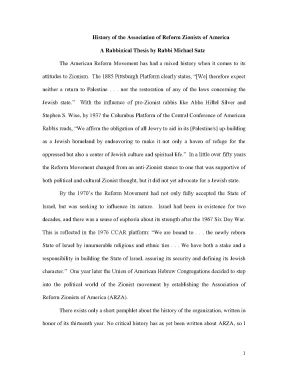
History of the Association of Reform Zionists of America A Rabbinical Thesis by Rabbi Michael Satz The American Reform Movement has had a mixed history when it comes to its attitudes to Zionism. The 1885 Pittsburgh Platform clearly states, “[We] therefore expect neither a return to Palestine. nor the restoration of any of the laws concerning the Jewish state.” With the influence of pro-Zionist rabbis like Abba Hillel Silver and Stephen S. Wise, by 1937 the Columbus Platform of the Central Conference of American Rabbis reads, “We affirm the obligation of all Jewry to aid in its [Palestine's] up-building as a Jewish homeland by endeavoring to make it not only a haven of refuge for the oppressed but also a center of Jewish culture and spiritual life.” In a little over fifty years the Reform Movement changed from an anti-Zionist stance to one that was supportive of both political and cultural Zionist thought, but it did not yet advocate for a Jewish state.

By the 1970’s the Reform Movement had not only fully accepted the State of Israel, but was seeking to influence its nature. Israel had been in existence for two decades, and there was a sense of euphoria about its strength after the 1967 Six Day War. This is reflected in the 1976 CCAR platform: “We are bound to. the newly reborn State of Israel by innumerable religious and ethnic ties.

We have both a stake and a responsibility in building the State of Israel, assuring its security and defining its Jewish character.” One year later the Union of American Hebrew Congregations decided to step into the political world of the Zionist movement by establishing the Association of Reform Zionists of America (ARZA). There exists only a short pamphlet about the history of the organization, written in honor of its thirteenth year. No critical history has as yet been written about ARZA, so I 1 will try to give a detailed history of the organization. This is a limited history, though, because most of the documents utilized were officially published by ARZA or the Reform Movement, and not necessarily the views of all of the members.

This is an organizational history, and not a history of the people that make up the organization, but I did interview many of the past leaders of ARZA and Reform Zionism in my research, and their voices are found in the work. While ARZA is an organization with paying members and chapters around the country, it is very much a top-down organization, and the research and writing of this project reflect that. By way of full disclosure, I am currently a member of the national board of ARZA, and I have been involved with the organization since my first year in rabbinical school in 2002. I have tried not to make the thesis an “insider’s history” of ARZA, but I was well aware of my Reform Zionist biases during the research and writing.

It should be added, though, that most of people written about left the organization before my involvement, and all of the events in this work happened prior to 1998. That being said, this thesis will examine the creation of ARZA in 1977 and how the organization influenced Zionist affiliation in the Reform Movement. I will take a critical look at who the leaders were who effected change in the Reform Movement’s views and what the historical and social factors were that led to the founding of ARZA. The thesis will critically look at ARZA as an organization from its founding in 1977 until 1998 when the ARZA merged with the North American Board of the World Union for Progressive Judaism creating a new entity.

Some of the issues that will be focused on include: the evolution of the Zionist question in the Reform Movement before the creation of ARZA; why it took until the 1970’s for the Reform Movement to officially 2 join the Zionist Movement; some of the thinkers that were influential for the founding of ARZA; ARZA’s influence on the American Reform Movement in matters of Zionist affiliation and thinking; ARZA’s successes and failures in the World Zionist Congress; ARZA’s role in creating a Reform Zionist theology; and ARZA’s role as an advocate for the State of Israel to American Jews. 3 Chapter 1 The Zionist Debate within the Reform Movement: 1885-1948 Much has been written about the Reform Movement’s shift from ideological anti- Zionism to an embrace of the idea of a Jewish State. This shift was often hard fought and very painful for the people involved. Rabbis and laypeople often changed their views back and forth, sought the middle ground with the opposition, and even demonized the other side.

Zionism was probably the only issue in the first half of the Twentieth Century that had the power to tear the Movement apart, but it was not always a history of pro- Zionist vs. The history of Zionism and Reform Judaism is one of ambiguity and nuance. This chapter seeks to be a survey of the Zionist question within the institutions of the Reform Movement in America from the late Nineteenth Century until the declaration of Israeli statehood. David Polish divides the evolution of the Zionist question in the Reform Movement into four time periods.

This chapter will use these time periods for ease, but it must be noted that there are inherent issues with using these dates because they all correspond to events that happened in the Central Conference of American Rabbis. While the CCAR is and was very influential in shaping the opinions of the Movement, the rabbis are not the Movement in its entirety. The periods are as follows: 1885-1917; 1917-1936; 1936-1943; 1943-1947, each time period corresponding to a shift in attitude towards Zionism in the CCAR.1 The first period begins before the formal inception of political Zionism with the publication of Theodore Herzl’s The Jewish State in 1896, but 1 David Polish, Renew Our Days: The Zionist Issue in Reform Judaism (Jerusalem, 1976), pp. 4 the seeds of Zionism were very much alive in the 1880’s in Europe when the Reform Movement in America was solidifying its base as a unified ideological movement with the Pittsburgh Platform of 1885.

1885-1917: Reform=Anti-Zionism In 1885 nineteen like-minded rabbis met in Pittsburgh to formulate a set of principles that could define Reform Judaism in America against Orthodoxy on one side and total universalism typified by Felix Adler’s Ethical Culture on the other. Called by Kaufmann Kohler and presided over by Isaac Mayer Wise, the conference saw itself as a continuation of the rabbinical conferences held in Germany in the 1840’s and the meeting of rabbis held in Philadelphia in 1869. These Reform rabbis wanted to create a document that affirmed what Reform Judaism was but also clearly showed what it was not. Overflowing with the optimism of its day, the “Declaration of Principles,” or as it is commonly called “The Pittsburgh Platform,” has eight planks that cover everything from the Reform view of God to Jewish law and social justice.

The underlying subtext of the document is the late Nineteenth-Century situation of the Jews in America. Jews were no longer forced to live apart from their Christian neighbors in ghettos, and as a part of this new society it was the Jews’ task and mission to teach Ethical Monotheism to the world. Through this mission, enlightened Jews could help usher in the messianic “brotherhood of man.” Many Reform leaders believed that the advent of this non- personal, universal “messiah” was imminent. This belief in universalism was so strong that these Reform leaders disregarded the traditional Jewish belief of the gathering of the exiles back to Land of Israel at the 5 time of the Messiah.

The rabbis in Pittsburgh believed that the Exile, or as they preferred to call it, the Dispersion, was actually not a punishment but divinely ordained for Jews to spread the truth of the universal God. Therefore, Reform Judaism, as set out by the Pittsburg Platform, rejected both the traditional view of exile, waiting for God to end the exile as found in the traditional prayerbook, and the new Zionist view that was fermenting mainly in Eastern Europe about a return to the Land. As the fifth plank of the Platform reads: We recognize in the modern era of universal culture of heart and intellect the approaching of the realization of Israel’s great Messianic hope for the establishment of the kingdom of truth, justice and peace among all men. We consider ourselves no longer a nation, but a religious community, and, therefore, expect neither a return to Palestine, nor a sacrificial worship under the sons of Aaron, nor the restoration of any of the laws concerning the Jewish state.2 The most important line of the plank for what would become the Zionist debate in Reform Judaism is: “We consider ourselves no longer a nation .” This would become the Movement’s main argument against political Zionism.

If the Jews were not a separate nation, but a religious group found in many nations, they should have no claim on any piece of land except the countries in which they live. The Pittsburgh Platform declared that we Jews were Americans of the Jewish religion. There was much debate at this convention, but nobody objected to the rejection of a separate Jewish nationality.3 2 “The Pittsburgh Platform” in Michael A. Meyer, Response to Modernity: A History of the Reform Movement in Judaism (Detroit, 1988), pp.

Greenstein, Turning Point: Zionism and Reform Judaism (Chico, CA, 1981), p. 6 The Central Conference of American Rabbis, founded in 1889 as the union of Reform rabbis, officially adopted the Pittsburgh Platform in 1891.4 The Platform was then the official “creed” of American Reform Judaism for the next five decades, and with that came official anti-Zionism. Naomi Wiener Cohen writes, “Reform did not merely question the means employed by the Zionists to achieve their ideal, but rather discarded on theological grounds the very objective, Orthodox as well as Zionist, of a return to Zion.”5 Right before the First Zionist Congress in Basle in 1897 and not long after it, both main bodies of Reform Judaism in America, the CCAR and the congregational Union of American Hebrew Congregations, came out on record as being against Zionism. The CCAR unanimously declared, “We totally disapprove of any attempt for the establishment of a Jewish state.

Such attempts show a misunderstanding of Israel’s mission.” And the UAHC resolution reads, “We are unalterably opposed to political Zionism. The Jews are not a nation, but a religious community. America is our Zion. Here, in the home of religious liberty, we have aided in founding this new Zion, the fruition of the beginning laid in the old.”6 By 1897, the American Jewish landscape was greatly changing.

The established Jewish community of German background that filled the membership of Reform congregations was witnessing a great wave of Jews, mainly from the Russian Empire, to the urban centers of America. These Jews spoke a foreign language, Yiddish, and were 4 David Polish, Renew Our Days: The Zionist Issue in Reform Judaism (Jerusalem, 1976), p. 5 Naomi Wiener Cohen, “The Reaction of Reform Judaism in America to Political Zionism (1897-1922),” Publications of the American Jewish Historical Society, vol. 7 on the whole more traditional than their Americanized cousins.

If they weren’t actually practicing traditional Judaism, traditional ways of thinking about Judaism were definitely prevalent in their communities. Because of this, seeing Judaism as only a religion would have been something very much against the very nature of the new immigrants. Jewish nationalism, Zionist or not, was very natural with the arriving Jews. This was seen as an ideological threat by Reform rabbis and laypeople alike for it stood in great contrast to the Pittsburgh Platform.

As Polish writes, “Anti-Zionism was a response to a two-fold challenge—the threat of Zionism to the security of American Reform, and the threat of East European immigrants bearing the Zionist message.

Nội dung được bảo vệ bản quyền — Tải xuống đầy đủ