Luận án kinh tế về tương tác giữa thị trường sản phẩm và thị trường vốn

Khám phá đề tài luận văn kinh tế Econ thesis final1 với nội dung nghiên cứu chuyên sâu về các vấn đề kinh tế học. Tài liệu phân tích chi tiết phương pháp luận

Chuyên ngành

Kinh tế học

Người đăng

Ẩn danh

Thể loại

Luận án tiến sĩ

2008

121
0
0

Phí lưu trữ

35 Point

Tóm tắt

I. Tổng quan về luận văn kinh tế về tương tác thị trường sản phẩm

Luận văn kinh tế 'Three Essays on Product Market and Capital Market Interaction' của Jaideep Chowdhury nghiên cứu mối quan hệ tương tác giữa quyết định tài chính và quyết định thị trường sản phẩm của doanh nghiệp. Nghiên cứu này đóng vai trò quan trọng trong việc kết hợp hai lĩnh vực: tổ chức công nghiệp (nghiên cứu quyết định thị trường sản phẩm) và tài chính doanh nghiệp (nghiên cứu quyết định tài trợ vốn). Luận văn chỉ ra rằng các quyết định tài chính và sản phẩm không tồn tại độc lập mà phụ thuộc lẫn nhau, đặc biệt khi xem xét ràng buộc tài chính, bồi thường quản lý và cấu trúc vốn. Kết quả nghiên cứu chứng minh rằng nợ doanh nghiệp ảnh hưởng đáng kể đến chiến lược cạnh tranh trên thị trường sản phẩm, ngay cả trong môi trường không có bất ổn cầu. Công trình này mở rộng hiểu biết về lý thuyết cân bằng Cournot và mô hình độc quyền khi kết hợp yếu tố tài chính.

1.1. Tầm quan trọng của tương tác thị trường sản phẩm và vốn

Nghiên cứu nhấn mạnh sự phụ thuộc lẫn nhau giữa quyết định tài chính và sản phẩm doanh nghiệp thông qua bằng chứng lý thuyết và mô hình toán kinh tế. Tác giả chứng minh rằng việc kết hợp nợ vào mô hình sản phẩm (như trong Cournot duopoly) dẫn đến sản lượng sản xuất thấp hơn so với trường hợp không có ràng buộc tài chính. Kết quả này trái ngược với quan niệm truyền thống cho rằng nợ thúc đẩy cạnh tranh quyết liệt hơn trên thị trường sản phẩm. Mối liên kết giữa hai thị trường được thể hiện thông qua biến chi phí sản xuất, vốn chịu ảnh hưởng bởi cấu trúc vốn doanh nghiệp.

1.2. Đóng góp chính của luận văn

Luận văn đóng góp ba điểm chính: (1) Chứng minh rằng nợ doanh nghiệp có thể dẫn đến sản lượng sản xuất thấp hơn trong môi trường không có bất ổn, (2) Phân tích tác động của bồi thường quản lý đến chiến lược cạnh tranh, (3) Mở rộng mô hình Cournot bằng cách tích hợp yếu tố tài chính. Kết quả nghiên cứu cung cấp cơ sở lý thuyết cho các chính sách quản trị doanh nghiệp trong bối cảnh tương tác giữa thị trường sản phẩm và vốn.

II. Phân tích tương tác giữa thị trường sản phẩm và thị trường vốn

Nghiên cứu phân tích tương tác giữa thị trường sản phẩm và vốn thông qua mô hình Cournot duopoly, nơi một doanh nghiệp chịu ràng buộc tài chính (firm 1) và doanh nghiệp còn lại không bị ràng buộc (firm 2). Kết quả lý thuyết cho thấy doanh nghiệp bị ràng buộc tài chính sản xuất ít hơn so với trường hợp không bị ràng buộc, trong khi doanh nghiệp đối thủ sản xuất nhiều hơn mức cân bằng Cournot tiêu chuẩn. Điều này xảy ra ngay cả khi không có bất ổn cầu, chứng minh rằng ràng buộc tài chính tác động trực tiếp đến quyết định sản xuất. Mô hình chứng minh rằng sản lượng sản xuất phụ thuộc vào chi phí sản xuất, vốn chịu ảnh hưởng bởi nợ doanh nghiệp. Kết quả này mở rộng nghiên cứu của Povel và Raith (2004) bằng cách loại bỏ yếu tố bất ổn cầu.

2.1. Mô hình Cournot duopoly với ràng buộc tài chính

Trong mô hình Cournot duopoly, doanh nghiệp bị ràng buộc tài chính (firm 1) phải đối mặt với chi phí sản xuất cao hơn do nợ doanh nghiệp. Điều này dẫn đến sản lượng sản xuất thấp hơn so với mức cân bằng tiêu chuẩn (q1* < q1**). Doanh nghiệp đối thủ (firm 2) tận dụng cơ hội này để tăng sản lượng sản xuất lên mức cao hơn (q2** > q2*). Kết quả lý thuyết chứng minh rằng sản lượng sản xuất của doanh nghiệp bị ràng buộc giảm 1/3 so với mức cân bằng tiêu chuẩn, trong khi doanh nghiệp đối thủ tăng sản lượng lên 1/3.

2.2. Ảnh hưởng của nợ doanh nghiệp đến sản lượng sản xuất

Nghiên cứu chứng minh rằng nợ doanh nghiệp ảnh hưởng trực tiếp đến sản lượng sản xuất thông qua chi phí sản xuất. Khi doanh nghiệp vay nợ, chi phí sản xuất tăng lên do phải trả lãi suất, dẫn đến sản lượng sản xuất giảm. Điều này xảy ra ngay cả khi không có bất ổn cầu, chứng minh rằng tương tác giữa thị trường sản phẩm và vốn tồn tại ngay cả trong môi trường ổn định. Kết quả nghiên cứu cung cấp bằng chứng lý thuyết cho thấy nợ doanh nghiệp có thể làm giảm sản lượng sản xuất, trái ngược với quan niệm truyền thống.

III. Giải pháp và phương pháp nghiên cứu trong luận văn

Luận văn sử dụng phương pháp nghiên cứu lý thuyết kết hợp mô hình toán kinh tế để phân tích tương tác giữa thị trường sản phẩm và vốn. Tác giả xây dựng mô hình Cournot duopoly và độc quyền, tích hợp yếu tố tài chính như nợ doanh nghiệp và ràng buộc tài chính. Phương pháp nghiên cứu bao gồm giải phương trình cân bằng Cournot, phân tích điều kiện tồn tại cân bằng, và so sánh sản lượng sản xuất giữa doanh nghiệp có nợ và không có nợ. Kết quả nghiên cứu chứng minh rằng nợ doanh nghiệp ảnh hưởng đáng kể đến sản lượng sản xuất, ngay cả trong môi trường không có bất ổn cầu. Phương pháp nghiên cứu này cung cấp cơ sở lý thuyết cho các chính sách quản trị doanh nghiệp trong bối cảnh tương tác giữa thị trường sản phẩm và vốn.

3.1. Phương pháp xây dựng mô hình toán kinh tế

Tác giả xây dựng mô hình Cournot duopoly và độc quyền, tích hợp yếu tố tài chính như nợ doanh nghiệp và ràng buộc tài chính. Mô hình bao gồm hàm lợi nhuận, hàm sản xuất, và điều kiện ràng buộc tài chính. Phương pháp nghiên cứu bao gồm giải phương trình cân bằng Cournot, phân tích điều kiện tồn tại cân bằng, và so sánh sản lượng sản xuất giữa doanh nghiệp có nợ và không có nợ. Kết quả nghiên cứu chứng minh rằng nợ doanh nghiệp ảnh hưởng đáng kể đến sản lượng sản xuất.

3.2. Phân tích điều kiện tồn tại cân bằng

Nghiên cứu phân tích điều kiện tồn tại cân bằng trong mô hình Cournot duopoly và độc quyền, tích hợp yếu tố tài chính. Tác giả chứng minh rằng sản lượng sản xuất phụ thuộc vào chi phí sản xuất, vốn chịu ảnh hưởng bởi nợ doanh nghiệp. Kết quả nghiên cứu cung cấp cơ sở lý thuyết cho các chính sách quản trị doanh nghiệp trong bối cảnh tương tác giữa thị trường sản phẩm và vốn.

IV. Kết luận và ứng dụng thực tiễn của nghiên cứu

Luận văn cung cấp những kết luận quan trọng về tương tác giữa thị trường sản phẩm và vốn, đặc biệt là ảnh hưởng của nợ doanh nghiệp đến sản lượng sản xuất. Kết quả nghiên cứu chứng minh rằng nợ doanh nghiệp có thể dẫn đến sản lượng sản xuất thấp hơn, ngay cả trong môi trường không có bất ổn cầu. Điều này cung cấp cơ sở lý thuyết cho các chính sách quản trị doanh nghiệp, đặc biệt là trong bối cảnh tương tác giữa thị trường sản phẩm và vốn. Kết luận này mở rộng hiểu biết về lý thuyết cân bằng Cournot và mô hình độc quyền khi kết hợp yếu tố tài chính. Nghiên cứu cũng đề xuất các hướng nghiên cứu tiếp theo, bao gồm phân tích tương tác trong môi trường bất ổn cầu và ứng dụng mô hình vào thực tiễn doanh nghiệp.
4.1. Tóm tắt kết quả nghiên cứu chính

Nghiên cứu chứng minh rằng nợ doanh nghiệp ảnh hưởng đáng kể đến sản lượng sản xuất, ngay cả trong môi trường không có bất ổn cầu. Kết quả này mở rộng hiểu biết về lý thuyết cân bằng Cournot và mô hình độc quyền khi kết hợp yếu tố tài chính. Tác giả cung cấp bằng chứng lý thuyết cho thấy sản lượng sản xuất của doanh nghiệp bị ràng buộc tài chính thấp hơn so với doanh nghiệp không bị ràng buộc, trong khi doanh nghiệp đối thủ sản xuất nhiều hơn.

4.2. Ứng dụng thực tiễn của nghiên cứu

Kết quả nghiên cứu cung cấp cơ sở lý thuyết cho các chính sách quản trị doanh nghiệp, đặc biệt là trong bối cảnh tương tác giữa thị trường sản phẩm và vốn. Các doanh nghiệp có thể sử dụng kết quả nghiên cứu để điều chỉnh chiến lược sản xuất và tài chính, nhằm tối ưu hóa sản lượng sản xuất và lợi nhuận. Ngoài ra, nghiên cứu cũng đề xuất các hướng nghiên cứu tiếp theo, bao gồm phân tích tương tác trong môi trường bất ổn cầu và ứng dụng mô hình vào thực tiễn doanh nghiệp.

Tóm tắt và mô tả trên trang này được tạo với sự hỗ trợ của AI. Nếu bạn thấy nội dung không chính xác hoặc có vấn đề, vui lòng Báo lỗi nội dung.

31/05/2026
Econ thesis final1

Trích đoạn nội dung tài liệu

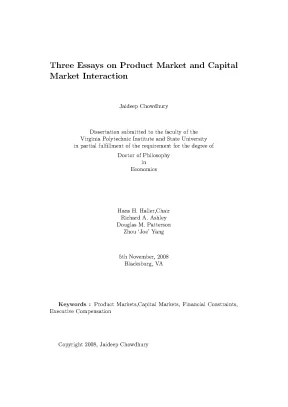
Three Essays on Product Market and Capital Market Interaction Jaideep Chowdhury Dissertation submitted to the faculty of the Virginia Polytechnic Institute and State University in partial fulfillment of the requirement for the degree of Doctor of Philosophy in Economics Hans H. Haller,Chair Richard A. Patterson Zhou ‘Joe’ Yang 5th November, 2008 Blacksburg, VA Keywords : Product Markets,Capital Markets, Financial Constraints, Executive Compensation Copyright 2008, Jaideep Chowdhury Three Essays on Product Market and Capital Market Interaction Jaideep Chowdhury ABSTRACT The Industrial Organization literature investigates the product market deci- sions of a firm while the corporate finance literature explores the financing decisions of the firm. But the truth is both the financing decisions and the product market decisions are interdependent and should be modeled together to develop a better understanding of a firm’s decisions.

This thesis takes a step in that direction. The manager of a firm caters to the equity holders of the firm who are protected by limited liability. Ex-ante debt is issued and at the time of product market decision, debt is exogenous. The traditional product market capital market interaction literature has argued that debt financing leads to more aggressive product market strategies.

If debt is treated as endogenous and/or the switching state of nature is endogenous, it can be shown that debt financing may lead to less aggressive product market strategies. Further, if external financing consists of both debt and equity financing, it is shown that a financially constrained firm shall produce less than what it would have pro- duced if it was not financially constrained. Finally, managerial compensation is reported to be one of the reasons for product market aggressiveness of a firm in the context of product market capital market interaction. Acknowledgment I am extremely grateful to my adviser Professor Hans Haller for his pa- tience, help and continuous support.

It has been a great learning experience for me and I enjoyed the opportunity to work under his supervision. I would like to thank Professor Richard Ashley for his helpful suggestions. I also benefited from the other members of my committee, Professor Dou- glas Patterson and Professor Zhou Joe Yang for their valuable insights and comments. I am also grateful to Dr Raman Kumar and Dr Nancy Lutz who were originally in my committee and gave me helpful suggestions.

My sincere thanks goes to my colleagues Ravishekhar Radhakrishnan, Dongryul Lee and Gokhan Sonaer for their feedbacks. Finally I want to thank my parents and my sister Jayita for their support and encouragement. They always stood by me in times of distress. iii Contents 1 Introduction 1 2 Limited Liability Effect with Endogenous Debt and Invest- ment 7 2.2 The Existing Literature .3 Brief Description of Oligopoly and Financial Constraint .2 Motivation of the paper .4 A Simple One Period Model of Duopoly and Financial Con- straint .1 The second stage of the game .2 The first stage of the game .5 Demand Uncertainty : Exogenous Debt and Switching State .6 Demand Uncertainty : Endogenous Debt and Switching State 18 2.7 Why Firms Produce Differently: An Insight .2 Exogenous Debt and Exogenous Switching State .3 Endogenous Debt and Endogenous Switching State .8 Demand Uncertainty: Endogenous Debt, Exogenous Switch- ing State .9 Demand Uncertainty : Exogenous Debt, Endogenous Switch- ing State .1 Cournot Duopoly: Appendix A .2 Stackelberg Equilibrium: Appendix B .3 Appendix C: Monopoly Equilibrium .4 Appendix D: Proof of Proposition 3 .5 Appendix E : Cournot Duopoly .7 Appendix G: Monopoly Firm .8 Appendix H: Cournot Duopoly.

41 3 Does Endogenous Equity Affect Endogenous Investment un- der Limited Liability? 43 3.2 The Existing Literature .1 The Model Set-up .1 Appendix A: Proof of Proposition 1. 62 4 Executive Compensation, Financial Constraint and Product Market Strategies 68 4.1 Definition of Financial Constraint .2 The Two Stage Game .3 The Three Stage Game .1 Aggressiveness In the Product Markets .2 Product Market Strategies and Managerial Compensa- tion .3 Managerial Compensation And Financial Constraints .4 Data and Methodology .2 Criteria For Financial Constraint. 108 vi List of Figures 3.1 Relationship Between Equilibrium Output and Discounted Cost of Equity. 56 vii List of Tables 4.1 Descriptive Statistics of mean of sales growth based on two financial constraint criteria and inferences based on t test of the difference of the mean of sales growth .2 Fixed Effect Regression of Sales Growth on financial constraint.Dependent Variable is Sales growth with respect to industry.3 Fixed Effect Regression of Sales Growth on Managerial Com- pensation.

Instrumental Variable approach .4 Regression of Sales Growth on Managerial Compensation .5 Fixed Effect Regression of Managerial Compensation on Sales Growth .6 Fixed Effect Regression of Managerial Compensation on Fi- nancial Constraint.Financial Constraint is based on Dividend Payment .7 Fixed Effect Regression of Managerial Compensation on Fi- nancial Constraint.Financial Constraint is based on Long Run Credit rating of the firm. 106 viii Chapter 1 Introduction Both the industrial organization literature and the corporate finance lit- erature have developed in leaps and bounds shedding new light into product market decisions and financing decisions of a firm. The traditional industrial organization literature offers insights into the product market behavior of a firm. The corporate finance literature investigates external financing by a firm to finance investments.

The literature of product market and capital markets interaction investigates how the output market decisions of a firm are affected by the financing decisions of the firm and vice versa, thereby linking the traditional industrial organization literature with the traditional corporate finance literature. But the interaction of these two major fields in Economics and Finance has not been explored rigorously. This is impor- tant because the product market decisions of a firm are often based on the financing of the firm and vice versa. Understanding just the product mar- ket decisions of the firm through the industrial organization literature is not sufficient.

Similarly, understanding just the financing decisions of the firm is not sufficient either. One should develop a broader perspective of the deci- sions made by a firm, by simultaneously exploring both the product market decisions and financing decisions of the firm. Only then one can develop a deeper understanding of the decisions made by the firm. There are gaps in our knowledge of how the product market and financial market interact.

This thesis is a humble attempt to bridge this gap. Chapter 2 explains the basic concept of why the product markets should be interrelated with the financial markets. The seminal paper of Brander and Lewis in 1986 was one of the first to start this literature. They demonstrate how debt financing lead a firm to produce more aggressively in the output market.

The manager of a firm caters to the equity holders of the firm. The equity holders are residual claimants of the firm. The firm issues debt to produce output. The revenue of the firm is uncertain and depends on the 1 state of the nature.

When the state of nature is bad, the revenue of the firm is not enough to repay the debt issued by the firm. The firm does not have to pay back the entire debt if the revenue generated is lower than the debt issued. The firm and hence the equity holders are said to be protected by limited liability. The equity holders care only about the good states of nature.

Once debt is issued, the equity holders want the firm to behave more aggressively in the output market. This entails the firm to maximize the revenue during the good states of nature with the cost of this aggressive output policy being the increased probability of not being able to pay back the debt. The equity holders are not worried about the prospect of not being able to pay back the debt as they are protected by limited liability. If the manager of the firm caters to the equity holders of the firm, the manager shall choose the more risky projects knowing fully well that the upper side of the risk shall benefit the equity holders while the downside risk is borne by the debt holders.

This creates an agency problem between the debt holders and the equity holders. There is a transfer of wealth from the debt holders to the equity holders if the manager chooses more risky projects. Debt financing leads to more aggressive behavior by the firm in the product market. This is the traditional story of the industrial organization literature.

Switching state of nature is that state of nature where revenue is just sufficient to repay the debt. In the traditional story of debt financing leading to more aggressive product market policies, the debt issued by the firm and the switching state of nature are treated as exogenous. Chapter 2 explores four different cases. Both debt and switching state are exogenous, both debt and switching state are endogenous, debt is exogenous and switching state is endogenous and finally debt is endogenous and switch- ing state is exogenous.

The demand is assumed to be uncertain when the financing decisions and the production decisions are made. Here is the time line of events. It is assumed that the firm issues debt in the first stage. In the second stage, after the money has already been raised through debt, the firm makes the output decision.

The output is produced before the demand is realized. The firm’s output decision is based on some estimated demand and not on the realized demand. In the third stage, the demand is realized and the revenue is generated. The debt holders are paid first, followed by the equity holders.

In the typical industrial organization literature, debt is usually assumed to be exogenous to the production decision. At the first stage, debt is issued. In the second stage, the debt has already been issued and the firm decides on the output. The firm’s output market decision is ex- ogenous to the amount of debt issued.

This assumption may not be feasible as the debt contract often specifies the purpose of issuing debt. In chapter 1, debt is treated both as exogenous and endogenous. Endogenous debt re- 2 quires the additional assumption of debt being used to finance the cost of production. This assumption links the amount of debt issued to the amount of output produced thereby rendering the debt issued as endogenous.

This linkage between debt and output was introduced in the literature by Povel and Raith in their well cited paper in 2004. Switching state of nature can also be endogenous. Recalling that switching state of nature is the state of nature at which revenue of the firm is exactly equal to the amount of debt issued, any rational manager can deduce that the switching state of nature depends on the output of the firm and hence is endogenous. When both debt and switching state of nature are exogenous, the tra- ditional result of debt financing leading to more aggressive production is arrived at.

The intuition of the result is that the manager protects the in- terest of the equity holders. The equity holders are residual claimants of the firm’s earnings. The manager issues debt ex-ante and then decides on the output. After the debt has been issued, the manager produces aggressively in order to generate higher revenue in good states of nature knowing well that the downside risk is covered by limited liability protection.

This is the typical agency problem argument between the equity holders and the debt holders. There is a transfer of wealth from the debt holders to the equity holders. When both debt and switching state of nature are endogenous, the above stated intuition breaks down. The debt issued is no longer ex-ante to the output produced.

Both debt and output are simultaneously determined. The manager no longer chooses riskier projects after issuing debt thereby transferring wealth from the debt holders to the equity holders. There are benefits of acting aggressively which accrue to the equity holders.

Nội dung được bảo vệ bản quyền — Tải xuống đầy đủ