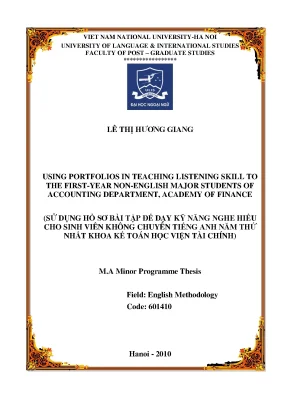
Luận văn: Sử dụng Portfolio dạy kỹ năng nghe cho sinh viên năm nhất Học viện Tài chính

Luận văn thạc sĩ phân tích using portfolios in teaching listening skill to the first year non english major students of, đánh giá thực trạng, chỉ ra hạn chế, đề xuất giải pháp khả

Chuyên ngành

English methodology

Người đăng

Ẩn danh

Thể loại

Thesis

2010

63
1
0

Phí lưu trữ

30 Point

Mục lục chi tiết

Declaration

Acknowledgements

Abstract

Table of contents

List of abbreviations

List of figures, tables and charts

1. CHAPTER 1: INTRODUCTION

1.1. Rationale of the study

1.2. Aims and research questions of the study

1.3. Scope of the study

1.4. Methods of the study

1.5. Design of the study

2. CHAPTER 2: LITERATURE REVIEW

2.1. Theoretical background of listening comprehension

2.1.1. Definitions of listening comprehension

2.1.2. Listening comprehension process

2.1.3. The importance of listening

2.2. Theoretical background of teaching and learning listening skill

2.2.1. Components skills for listening

2.2.2. Potential problems in learning to listen to English

2.2.3. Stages of a listening lesson

2.2.4. The roles of teachers in a listening lesson

2.2.5. Encouraging students' self-learning

2.3. Theoretical background of portfolio

2.3.1. Definitions of portfolio

2.3.2. The contents of portfolio

2.3.3. Phases of portfolio development

2.3.4. Benefits of using portfolios

2.3.5. Weakness associated with using portfolios

3. CHAPTER 3: THE STUDY

3.1. Context of the study

3.2. Introduction to the coursebook

3.3. Data collection procedure

3.4. Data collection instruments

4. CHAPTER 4: DATA ANALYSIS AND DISCUSSION

4.1. Data analysis of the students' survey questionnaire before the portfolio process

4.2. Students' motivation in learning listening skill

4.3. Students' past learning experience

4.4. Students' knowledge of portfolios

4.5. Data analysis of the students' survey questionnaire after the portfolio process

4.6. Students' feelings and awareness of the portfolio process

4.7. Students' attitudes towards the effects of portfolio listening activities

4.8. Students' opinion related to portfolio sharing activities

4.9. Students' difficulties in implementing the portfolio

4.10. Students' opinion to improve the self-learning portfolio

5. CHAPTER 5: FINDINGS AND SUGGESTIONS FOR USING PORTFOLIOS

5.1. Major findings and discussions

5.2. Students' previous motivations and learning experiences in listening as well as in the use of portfolios

5.3. Students' attitudes towards the effects of the portfolio listening activity

5.4. Students' difficulties in implementing the portfolio

5.5. Students' suggestions to improve the self-learning portfolio

5.6. Suggestions for using portfolios

5.7. Suggestion for the teachers

5.8. Suggestions for the students

5.9. Summary of the study

5.10. Limitations of the study

5.11. Suggestions for further researches

REFERENCES

APPENDICES

I. Appendix 1: Portfolio guidelines for students

II. Appendix 2: Listening portfolios

III. Appendix 3: Description of portfolio assessment and evaluation

IV. Appendix 4: Learning log

V. Appendix 5: Questionnaire (N01) for students

VI. Appendix 6: Questionnaire (N02) for students

Tóm tắt

I. Tổng Quan Dạy Kỹ Năng Nghe Bằng Portfolio Lợi Ích Cách Tiếp Cận

Trong bối cảnh toàn cầu hóa, kỹ năng nghe đóng vai trò then chốt. Phương pháp dạy kỹ năng nghe truyền thống đôi khi không đủ để đáp ứng nhu cầu học tập đa dạng của sinh viên. Do đó, việc ứng dụng portfolio trong giảng dạy kỹ năng nghe trở nên ngày càng phổ biến. Portfolio kỹ năng nghe không chỉ là một bộ sưu tập các bài tập mà còn là một công cụ hỗ trợ học sinh theo dõi tiến độ học nghe, lập kế hoạch học nghe hiệu quả và tự đánh giá kỹ năng nghe của bản thân. Nghiên cứu của Lê Thị Hương Giang tại Học viện Tài chính đã chỉ ra những tiềm năng to lớn của việc sử dụng portfolio trong việc nâng cao kỹ năng nghe cho sinh viên không chuyên ngữ. Việc sử dụng portfolio kỹ năng nghe còn giúp giáo viên đánh giá kỹ năng nghe học sinh một cách toàn diện hơn, không chỉ dựa trên các bài kiểm tra trên lớp. Điều này đặc biệt quan trọng đối với sinh viên năm nhất, những người đang làm quen với môi trường học tập mới. Tuy nhiên, việc triển khai portfolio hiệu quả đòi hỏi sự chuẩn bị kỹ lưỡng từ cả giáo viên và học sinh. Cần có hướng dẫn sử dụng portfolio chi tiết, rõ ràng để học sinh hiểu rõ mục tiêu và cách thức thực hiện. Ngoài ra, việc tạo động lực và khuyến khích kỹ năng tự học cũng là yếu tố then chốt để đảm bảo thành công của phương pháp này. Mục tiêu cuối cùng là giúp học sinh tự tin nghe tiếng Anh và sử dụng kỹ năng nghe một cách hiệu quả trong học tập và công việc.

1.1. Khái niệm và vai trò của Portfolio trong dạy kỹ năng nghe

Portfolio không chỉ đơn thuần là một tập hợp các bài làm của học sinh. Nó là một công cụ đánh giá toàn diện, phản ánh quá trình học tập và sự tiến bộ của học sinh theo thời gian. Theo Paulson, Paulson, và Meyer (1991), portfolio là “một bộ sưu tập có mục đích các tác phẩm của sinh viên, không chỉ thể hiện nỗ lực, tiến bộ và thành tích của sinh viên mà còn thể hiện sự tham gia của sinh viên trong việc lựa chọn nội dung và lựa chọn các tiêu chí đánh giá.” Trong bối cảnh dạy kỹ năng nghe, portfolio giúp học sinh tự học kỹ năng nghe, quản lý portfolio kỹ năng nghe, theo dõi tiến độ học nghe, tự đánh giá kỹ năng nghe, và lập kế hoạch học nghe. Nó cũng cho phép giáo viên đánh giá kỹ năng nghe học sinh một cách khách quan và toàn diện hơn, bao gồm cả quá trình và kết quả học tập.

1.2. Ưu điểm nổi bật của phương pháp Portfolio trong luyện nghe

Việc sử dụng portfolio trong luyện nghe tiếng Anh mang lại nhiều ưu điểm vượt trội. Thứ nhất, nó thúc đẩy kỹ năng tự họckỹ năng tự đánh giá của học sinh. Học sinh tự lựa chọn tài liệu luyện nghe, tự thiết kế bài tập và tự đánh giá kết quả. Thứ hai, portfolio giúp tăng cường sự tương tác giữa học sinh và giáo viên. Giáo viên có thể đưa ra phản hồi chi tiết về portfolio của học sinh, giúp học sinh nhận ra điểm mạnh, điểm yếu và có hướng cải thiện. Thứ ba, portfolio tạo ra một môi trường học tập linh hoạt và cá nhân hóa. Học sinh có thể lựa chọn phương pháp học nghe phù hợp với sở thích và trình độ của mình, như học tiếng Anh qua podcast, học tiếng Anh qua phim, hoặc học tiếng Anh qua video.

II. Thách Thức Khi Dạy Nghe Bằng Portfolio Vượt Qua Rào Cản Tự Học

Mặc dù có nhiều ưu điểm, việc áp dụng portfolio trong dạy kỹ năng nghe cũng đặt ra một số thách thức. Một trong những thách thức lớn nhất là việc khuyến khích kỹ năng tự học ở học sinh. Không phải học sinh nào cũng có đủ động lực và khả năng tự quản lý việc học tập của mình. Nhiều học sinh quen với việc học thụ động, chờ đợi giáo viên cung cấp kiến thức. Do đó, giáo viên cần có các biện pháp để tạo động lực và hướng dẫn học sinh tự học kỹ năng nghe. Một thách thức khác là việc thiết kế các hoạt động luyện nghe tiếng Anh phù hợp với trình độ và sở thích của học sinh. Cần có sự đa dạng trong tài liệu luyện nghe, từ các bài hội thoại đơn giản đến các bài giảng phức tạp, từ các chủ đề quen thuộc đến các chủ đề mới lạ. Ngoài ra, việc đánh giá kỹ năng nghe bằng portfolio cũng đòi hỏi sự công phu và khách quan từ phía giáo viên. Cần có các tiêu chí đánh giá rõ ràng, cụ thể và phù hợp với mục tiêu học tập.

2.1. Vấn đề về động lực và tính tự giác trong luyện nghe ở sinh viên

Nhiều sinh viên, đặc biệt là sinh viên năm nhất, thường thiếu động lực và tính tự giác trong luyện nghe tiếng Anh. Họ có thể cảm thấy chán nản, mệt mỏi khi phải tự mình tìm kiếm tài liệu luyện nghe, tự thiết kế bài tập và tự đánh giá kết quả. Một nghiên cứu của Lê Thị Hương Giang cho thấy rằng phần lớn sinh viên học kỹ năng nghe vì mục tiêu thi cử chứ không phải vì sở thích hay nhu cầu thực tế. Điều này cho thấy cần có các biện pháp để khơi gợi hứng thú và tạo động lực cho sinh viên trong luyện nghe.

2.2. Khó khăn trong việc lựa chọn và quản lý tài liệu luyện nghe phù hợp

Việc lựa chọn tài liệu luyện nghe phù hợp với trình độ và sở thích của học sinh là một thách thức không nhỏ. Có rất nhiều nguồn tài liệu luyện nghe khác nhau, từ sách giáo trình đến các trang web, ứng dụng ứng dụng luyện nghe. Tuy nhiên, không phải tài liệu nào cũng phù hợp với mọi đối tượng học sinh. Giáo viên cần hướng dẫn học sinh cách tìm kiếm, đánh giá và lựa chọn tài liệu luyện nghe phù hợp. Bên cạnh đó, việc quản lý portfolio kỹ năng nghe cũng đòi hỏi sự tổ chức và kỷ luật. Học sinh cần biết cách sắp xếp, lưu trữ và theo dõi tiến độ học nghe của mình.

2.3. Đảm bảo tính khách quan và hiệu quả trong đánh giá portfolio nghe

Việc đánh giá kỹ năng nghe bằng portfolio cần đảm bảo tính khách quan và hiệu quả. Cần có các tiêu chí đánh giá rõ ràng, cụ thể và phù hợp với mục tiêu học tập. Các tiêu chí này có thể bao gồm khả năng hiểu nội dung chính, khả năng nhận biết các chi tiết quan trọng, khả năng suy luận và đánh giá thông tin, và khả năng sử dụng kỹ năng note-taking. Ngoài ra, cần có sự thống nhất giữa các giáo viên về cách đánh giá kỹ năng nghe, để đảm bảo tính công bằng cho tất cả học sinh.

III. Cách Dạy Nghe Bằng Portfolio Hiệu Quả Hướng Dẫn Từng Bước Chi Tiết

Để dạy kỹ năng nghe bằng portfolio hiệu quả, cần tuân thủ một quy trình bài bản và có sự chuẩn bị kỹ lưỡng. Bước đầu tiên là xác định rõ mục tiêu học tập và các tiêu chí đánh giá. Mục tiêu học tập cần cụ thể, đo lường được, có thể đạt được, phù hợp và có thời hạn. Các tiêu chí đánh giá cần rõ ràng, cụ thể và phù hợp với mục tiêu học tập. Bước thứ hai là lựa chọn tài liệu luyện nghe phù hợp. Cần có sự đa dạng trong tài liệu luyện nghe, từ các bài hội thoại đơn giản đến các bài giảng phức tạp, từ các chủ đề quen thuộc đến các chủ đề mới lạ. Bước thứ ba là thiết kế các hoạt động luyện nghe tiếng Anh sáng tạo và hấp dẫn. Các hoạt động này có thể bao gồm transcription, dictation, shadowing, và note-taking. Bước thứ tư là hướng dẫn học sinh cách quản lý portfolio kỹ năng nghetheo dõi tiến độ học nghe. Bước cuối cùng là đánh giá kỹ năng nghe bằng portfolio và cung cấp phản hồi chi tiết cho học sinh.

3.1. Thiết lập mục tiêu học tập và tiêu chí đánh giá portfolio kỹ năng nghe

Mục tiêu học tập cần được xác định rõ ràng trước khi bắt đầu quá trình dạy kỹ năng nghe bằng portfolio. Mục tiêu này phải cụ thể, đo lường được (measurable), có thể đạt được (attainable), phù hợp (relevant) và có thời hạn (time-bound) - SMART. Ví dụ, mục tiêu có thể là: “Học sinh có thể hiểu được 70% nội dung chính của các bài nghe có độ khó trung bình trong vòng 3 tháng”. Tiêu chí đánh giá portfolio cũng cần rõ ràng và liên kết chặt chẽ với mục tiêu học tập, bao gồm các yếu tố như khả năng hiểu ý chính, chi tiết, từ vựng, ngữ pháp và khả năng phản xạ.

3.2. Lựa chọn tài liệu và thiết kế hoạt động luyện nghe phù hợp trình độ

Việc lựa chọn tài liệu luyện nghe đóng vai trò quan trọng trong thành công của phương pháp portfolio. Tài liệu nên đa dạng về chủ đề, độ khó và nguồn gốc (ví dụ: học tiếng Anh qua podcast, học tiếng Anh qua phim, học tiếng Anh qua video, tin tức, bài giảng). Các hoạt động luyện nghe tiếng Anh nên bao gồm nhiều kỹ năng khác nhau như transcription (chép chính tả), dictation (nghe viết), shadowing (nhại lại), note-taking (ghi chú). Cần đảm bảo tài liệu và hoạt động phù hợp với trình độ và sở thích của học sinh để duy trì động lực.

3.3. Hướng dẫn quản lý portfolio theo dõi tiến độ và phản hồi hiệu quả

Giáo viên cần hướng dẫn học sinh cách quản lý portfolio kỹ năng nghe một cách khoa học, bao gồm cách sắp xếp tài liệu, ghi chú, và theo dõi tiến độ học nghe. Có thể sử dụng các công cụ trực tuyến hoặc bảng tính để giúp học sinh theo dõi tiến bộ của mình. Quan trọng nhất là giáo viên cần cung cấp phản hồi thường xuyên, chi tiết và mang tính xây dựng về portfolio của học sinh, tập trung vào điểm mạnh, điểm yếu và gợi ý cải thiện. Phản hồi nên khuyến khích kỹ năng tự họckỹ năng tự đánh giá của học sinh.

IV. Ứng Dụng Thực Tế Portfolio Kinh Nghiệm Dạy Nghe cho Sinh Viên Tài Chính

Nghiên cứu của Lê Thị Hương Giang tại Học viện Tài chính đã chứng minh tính hiệu quả của việc sử dụng portfolio trong dạy kỹ năng nghe cho sinh viên năm nhất không chuyên ngữ. Nghiên cứu này đã chỉ ra rằng portfolio giúp nâng cao động lực học tập, cải thiện kỹ năng nghe, và phát triển kỹ năng tự học ở học sinh. Tuy nhiên, nghiên cứu cũng chỉ ra rằng cần có sự chuẩn bị kỹ lưỡng từ cả giáo viên và học sinh để đảm bảo thành công của phương pháp này. Cần có hướng dẫn sử dụng portfolio chi tiết, rõ ràng, các hoạt động luyện nghe tiếng Anh sáng tạo và hấp dẫn, và sự đánh giá kỹ năng nghe khách quan và hiệu quả.

4.1. Kết quả khảo sát về động lực và thái độ của sinh viên trước và sau khi dùng portfolio

Nghiên cứu của Lê Thị Hương Giang cho thấy rằng trước khi sử dụng portfolio, nhiều sinh viên thiếu động lực và tính tự giác trong luyện nghe tiếng Anh. Tuy nhiên, sau khi sử dụng portfolio, phần lớn sinh viên cảm thấy hứng thú hơn với việc luyện nghe, có ý thức hơn về việc tự học, và nhận thấy sự tiến bộ rõ rệt trong kỹ năng nghe của mình. Kết quả khảo sát cũng cho thấy rằng sinh viên đánh giá cao tính linh hoạt, cá nhân hóa và khả năng tương tác mà portfolio mang lại.

4.2. Phân tích chi tiết về sự cải thiện kỹ năng nghe thông qua portfolio nghe

Việc sử dụng portfolio kỹ năng nghe đã mang lại sự cải thiện đáng kể trong các khía cạnh khác nhau của kỹ năng nghe, bao gồm khả năng hiểu nội dung chính, khả năng nhận biết các chi tiết quan trọng, khả năng suy luận và đánh giá thông tin, và khả năng sử dụng kỹ năng note-taking. Sinh viên cũng trở nên tự tin hơn khi nghe chủ độngphản xạ nghe tốt hơn. Portfolio không chỉ giúp sinh viên cải thiện kỹ năng nghe mà còn giúp họ phát triển các kỹ năng mềm quan trọng khác như kỹ năng tự học, kỹ năng quản lý thời gian, và kỹ năng làm việc nhóm.

V. Nâng Cao Kỹ Năng Nghe Kết Luận Và Hướng Đi Mới Cho Portfolio

Việc sử dụng portfolio trong dạy kỹ năng nghe là một phương pháp hiệu quả và tiềm năng. Tuy nhiên, để phương pháp này phát huy tối đa hiệu quả, cần có sự chuẩn bị kỹ lưỡng, sự hướng dẫn tận tình từ giáo viên, và sự chủ động, tích cực từ học sinh. Trong tương lai, cần có thêm nhiều nghiên cứu về việc sử dụng portfolio trong dạy kỹ năng nghe ở các cấp độ và đối tượng khác nhau. Ngoài ra, cần có sự phát triển các công cụ và tài liệu hỗ trợ portfolio hiệu quả hơn, giúp giáo viên và học sinh tiết kiệm thời gian và công sức.

5.1. Tóm tắt các lợi ích và hạn chế của phương pháp portfolio trong dạy nghe

Tóm lại, portfolio mang lại nhiều lợi ích trong dạy kỹ năng nghe, bao gồm tăng động lực, cải thiện kỹ năng nghe, phát triển kỹ năng tự học, và tạo môi trường học tập linh hoạt. Tuy nhiên, phương pháp này cũng có một số hạn chế, như đòi hỏi sự chuẩn bị kỹ lưỡng, tốn thời gian và công sức, và cần có sự đánh giá kỹ năng nghe khách quan.

5.2. Đề xuất các hướng nghiên cứu và phát triển portfolio dạy nghe trong tương lai

Trong tương lai, cần có thêm nhiều nghiên cứu về việc sử dụng portfolio trong dạy kỹ năng nghe ở các cấp độ và đối tượng khác nhau, ví dụ như luyện nghe IELTS, luyện nghe TOEIC, luyện nghe giao tiếp. Ngoài ra, cần có sự phát triển các công cụ và tài liệu hỗ trợ portfolio hiệu quả hơn, giúp giáo viên và học sinh tiết kiệm thời gian và công sức, ví dụ như các ứng dụng luyện nghe tích hợp chức năng quản lý portfolio.

22/09/2025

Trích đoạn nội dung tài liệu

VIET NAM NATIONAL UNIVERSITY-HA NOI UNIVERSITY OF LANGUAGE & INTERNATIONAL STUDIES FACULTY OF POST – GRADUATE STUDIES ***************** LÊ THỊ HƯƠNG GIANG USING PORTFOLIOS IN TEACHING LISTENING SKILL TO THE FIRST-YEAR NON-ENGLISH MAJOR STUDENTS OF ACCOUNTING DEPARTMENT, ACADEMY OF FINANCE (SỬ DỤNG HỒ SƠ BÀI TẬP ĐỂ DẠY KỸ NĂNG NGHE HIỂU CHO SINH VIÊN KHÔNG CHUYÊN TIẾNG ANH NĂM THỨ NHẤT KHOA KẾ TOÁN HỌC VIỆN TÀI CHÍNH) M.A Minor Programme Thesis Field: English Methodology Code: 601410 Hanoi - 2010 TIEU LUAN MOI download : skknchat@gmail.com VIET NAM NATIONAL UNIVERSITY-HA NOI UNIVERSITY OF LANGUAGE & INTERNATIONAL STUDIES FACULTY OF POST – GRADUATE STUDIES ***************** LÊ THỊ HƯƠNG GIANG USING PORTFOLIOS IN TEACHING LISTENING SKILL TO THE FIRST-YEAR NON-ENGLISH MAJOR STUDENTS OF ACCOUNTING DEPARTMENT, ACADEMY OF FINANCE (SỬ DỤNG HỒ SƠ BÀI TẬP ĐỂ DẠY KỸ NĂNG NGHE HIỂU CHO SINH VIÊN KHÔNG CHUYÊN TIẾNG ANH NĂM THỨ NHẤT KHOA KẾ TOÁN HỌC VIỆN TÀI CHÍNH) M.A Minor Programme Thesis Field: English Methodology Code: 601410 Supervisor: Lâm Thị Phúc Hân, M.A Hanoi - 2010 TIEU LUAN MOI download : skknchat@gmail.com 4 TABLE OF CONTENTS Declaration ……………………………………………………………………………. i Acknowledgements …………………………………………………………………… ii Abstract ………………………………………………………………………………. iii Table of contents ……………………………………………………………………. iv List of abbreviations ………………………………………………………………….

vii List of figures, tables and charts ……………………………………………………… viii CHAPTER 1: INTRODUCTION …………………………………………………. Rationale of the study…………………………………………………………… 1 1. Aims and research questions of the study ……………………………………… 2 1. Scope of the study ……………………………………………………………….

Methods of the study ……………………………………………………………. Design of the study ……………………………………………………………. 3 CHAPTER 2: LITERATURE REVIEW ………………………………………… 4 2. Theoretical background of listening comprehension …………………………… 4 2.

Definitions of listening comprehension ………………………………………. Listening comprehension process ……………………………………………. The importance of listening …………………………………………………. Theoretical background of teaching and learning listening skill ……………….

Components skills for listening ………………………………………………. Potential problems in learning to listen to English …………………………… 9 2. Stages of a listening lesson …………………………………………………… 10 2. The roles of teachers in a listening lesson …………………………………….

Encouraging students' self-learning …………………………………………. Theoretical background of portfolio ……………………………………………. Definitions of portfolio ………………………………………………………. The contents of portfolio ……………………………………………………… 16 TIEU LUAN MOI download : skknchat@gmail.

Phases of portfolio development ……………………………………………… 18 2. Benefits of using portfolios …………………………………………………… 19 2. Weakness associated with using portfolios …………………………………… 19 2. 20 CHAPTER 3: THE STUDY ……………………………………………………….

Context of the study ……………………………………………………………. Introduction to the coursebook ………………………………………………. Data collection procedure ……………………………………………………. Data collection instruments …………………………………………………… 27 CHAPTER 4: DATA ANALYSIS AND DISCUSSION ………………………… 27 4.

Data analysis of the students' survey questionnaire before the portfolio process 28 4. Students' motivation in learning listening skill ………………………………. Students' past learning experience ……………………………………………. Students' knowledge of portfolios …………………………………………….

Data analysis of the students' survey questionnaire after the portfolio process 30 4. Students' feelings and awareness of the portfolio process ……………………. Students' attitudes towards the effects of portfolio listening activities ………. Students' opinion related to portfolio sharing activities ……………………….

Students' difficulties in implementing the portfolio ………………………… 35 4. Students' opinion to improve the self-learning portfolio ……………………. 36 CHAPTER 5: FINDINGS AND SUGGESTIONS FOR USING PORTFOLIOS 37 5. Major findings and discussions ………………………………………………….

Students' previous motivations and learning experiences in listening as well as in the use of portfolios ……………………………………………………………. 37 TIEU LUAN MOI download : skknchat@gmail. Students' attitudes towards the effects of the portfolio listening activity ……. Students' difficulties in implementing the portfolio ………………………….

Students' suggestions to improve the self-learning portfolio …………………. Suggestions for using portfolios ………………………………………………. Suggestion for the teachers …………………………………………………. Suggestions for the students ………………………………………………….

Summary of the study …………………………………………………………. Limitations of the study ………………………………………………………… 43 6. Suggestions for further researches ……………………………………………… 43 REFERENCES ……………………………………………………………………. 44 APPENDICES ……………………………………………………………………… I Appendix 1: Portfolio guidelines for students ……………………………………….

I Appendix 2: Listening portfolios ……………………………………………………. II Appendix 3: Description of portfolio assessment and evaluation …………………. III Appendix 4: Learning log …………………………………………………………… IV Appendix 5: Questionnaire (N01) for students ……………………………………… V Appendix 6: Questionnaire (N02) for students ……………………………………… VI TIEU LUAN MOI download : skknchat@gmail.com 7 LIST OF ABBREVIATIONS AOF: Academy of Finance L2: Second Language TIEU LUAN MOI download : skknchat@gmail.com 8 LIST OF FIGURES, TABLES AND CHARTS TABLES Table 1: Students' feelings and awareness of the portfolio process Table 2: Students' attitudes towards the effects of listening portfolio activities Table 3: Students' opinion related to portfolio sharing activities CHARTS Chart 1: Students' reasons for learning listening skill Chart 2: Students' frequency of listening to English outside the class Chart 3: Students' knowledge of portfolios Chart 4: Students' difficulties in implementing the portfolio Chart 5: Students' opinion to improve the self-learning portfolio TIEU LUAN MOI download : skknchat@gmail.com 9 CHAPTER 1: INTRODUCTION 1. Rationale English is thought to be one of the decisive factors for people's success at the period of globalization.

Therefore, it leads to the increasing number of users of English in many parts of the world. Since the open-door policy was introduced in Vietnam, English has become increasingly important not only as a means of global communication but also as bridge to mankind's knowledge. To students, nowadays, English is not only a subject in the curriculum at university but also a key to gain access to the information world that proves of great value to all people in general and to students of Academy of Finance in particular. However, obtaining a good language competence is not easy for all students; it requires a huge effort from them, especially self-study.

Of four language skills - listening, speaking, reading and writing, listening is believed to be the most difficult skill to students. They encounter difficulties in comprehending the information due to unfamiliarity with the pronunciation, stress, intonation and a lack of listening skill, etc. To overcome such difficulties, it is necessary for students to spend much more time practicing listening skill at home. The time to practice listening in class is not enough because every week students have only two periods lasting 90 minutes to learn this skill.

The question posed for English teachers is how to help students overcome difficulties and improve their listening skill. One of the ways to help students deal with difficulties is using portfolios to learn at home. Surely, portfolios which reflect what students have done at home are a useful additional learning tool. On one hand, portfolios help teachers to assess what students have done at home.

On the other hand, portfolios keep students continuously learning. It is obvious that portfolios can improve students' listening skill and encourage their self-learning, which is the decisive factor for their success in learning English. For the above reasons, the author decided to choose the study entitled "Using portfolios in teaching listening skill to first-year non-English major students of Accounting Department, Academy of Finance". TIEU LUAN MOI download : skknchat@gmail.

Aims and research questions of the study The major aims of the study are: - To investigate students' motivation and learning experiences in listening skill. - To examine students' attitudes towards the effects of the portfolio listening activity. - To give some suggestions for using the portfolio to enhance students' autonomy in learning listening skill. In order to implement the study, the following research questions were formulated: 1.

Were first-year students autonomous learners in terms of motivations and learning experiences in listening skill? 2. What are students' attitudes towards the effects of the portfolio listening activity? 3. What should teachers do to help students to develop their autonomy in learning listening skill? 1. Scope of the study The study is concerned with using portfolios in teaching listening skill to the first- year non-English major students of Accounting Department, Academy of Finance.

Other approaches to teach listening skill intended for students at other levels of English language proficiency would be beyond the scope. Methods of the study 54 first-year non-English major students were chosen randomly to take part in the research of applying portfolio listening activity to develop learner self-study. They came from two classes of Accounting Department, AOF. They are both male and female, at the age from 19 to 20 and have learnt English for at least three years at high school.

Questionnaires were delivered to first-year students at AOF before and after the portfolio process to collect the most reliable data for this study. This research also based itself on some previous studies in listening skill and portfolios. Design of the study TIEU LUAN MOI download : skknchat@gmail.com 11 The study is comprised of five chapters: Chapter I: Introduction; Chapter II: Literature review; Chapter III: The study; Chapter IV: Major findings and discussions and Chapter V: Conclusion. Chapter I: Introduction This chapter introduces the rationale, the aims, research questions, the scope, the methodology and the design of the study.

Chapter II: Literature review This chapter reviews the literature related to the nature of listening comprehension, the importance of listening, components skills for listening, potential problems in learning to listen to English, stages of a listening lesson, the roles of teachers in a listening lesson, ways of encouraging students' self-learning, definitions of portfolio, the contents of portfolio, phases of portfolio development, benefits of using portfolios and weakness associated with using portfolios. Chapter III: The study This chapter presents the methodology used in the study including the context, participants, data collection procedure, data collection instruments and data analysis. Chapter IV: Major findings and discussions This chapter shows some major findings which lead to some suggestions for using the portfolio. Chapter V: Conclusion This chapter summarizes the main points discussed in the paper and some limitations of the study.

Future researches will also be presented in the chapter. TIEU LUAN MOI download : skknchat@gmail.com 12 CHAPTER 2: LITERATURE REVIEW Introduction This chapter discusses a variety of issues in the theories of listening skills and portfolios. Three main features will be presented: theoretical background of listening comprehension, theoretical background of teaching and learning listening skill and theoretical background of portfolios. Theoretical background of listening comprehension 2.

Definitions of listening comprehension In the globalized information age in which we live, technological advances make global communication become much easier. It is believed that to be part of global community, listening has taken on increased importance in a native language as well as in a second or foreign language. Thus, there have been numerous definitions of listening which present different views towards the concept. Mary Underwood (1989: 1) states that "Listening is the activity of paying attention to and trying to get meaning from something we hear".

The author also emphasizes: "To listen successfully to spoken language, we need to be able to work out what speakers mean when they use particular words in particular way on particular occasions, not simple to understand the words themselves". Gary Buck (2001: 31) states that "listening comprehension is an active process of constructing meaning and this is done by applying knowledge to the incoming sound" in which "a number of different types if knowledge are involved: both linguistic knowledge and non-linguistic knowledge". Sharing the same view, listening is viewed as "an active, purposeful processing of making sense of what we hear" (Helgesen, 2003: 24). Rost (2002: 279) defines listening as "the mental process of constructing meaning from spoken input".

Richards and Schmidt (2002: 313) point out that "listening comprehension is the process of understanding speech in a first or second language. The study of listening comprehension in second language learning focuses on the role of individual linguistic TIEU LUAN MOI download : skknchat@gmail. phonemes, words, grammatical structures) as well as the role of listener's expectations, the situation and context, background knowledge and topic". All in all, listening has been conceptualized in different ways.

However, the words like "active" and "construct" have been found and highlighted. Listeners are considered as an "active model builder" (Anderson & Lynch, 1988: 11), who goes through a complex process, drawing upon knowledge of linguistic code, cognitive processing skill, scheme- based understanding, and contextual clues to reach the essence of spoken message. Listening comprehension process Listening comprehension is regarded theoretically as an active process in which individuals concentrate on selected aspects of aural input, form meaning from passages, and associate what they hear with existing knowledge.

Nội dung được bảo vệ bản quyền — Tải xuống đầy đủ