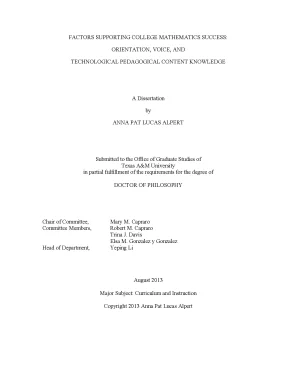
Tổng quan về luận án
Bối cảnh giáo dục đại học thế kỷ 21 chứng kiến sự gia tăng mạnh mẽ của nhu cầu nhân lực trong các lĩnh vực Khoa học, Công nghệ, Kỹ thuật và Toán học (STEM), đóng vai trò chiếc cầu nối kinh tế quyết định đến năng lực cạnh tranh quốc gia (Obama, 2009; Parker, Bustillos, & Behringer, 2010; Capraro, 2011). Tuy nhiên, một nghịch lý lớn tồn tại dai dẳng tại các trường cao đẳng và đại học là tỷ lệ sinh viên bị xếp vào các lớp toán phát triển (developmental/remedial mathematics) lên tới hơn 50% (Bailey, Jeong, & Cho, 2010; Calcagno, Crosta, Bailey, & Jenkins, 2007). Nghiên cứu của Tiến sĩ Anna Pat Lucas Alpert (2013) tại Đại học Texas A&M với tiêu đề "Factors Supporting College Mathematics Success: Orientation, Voice, and Technological Pedagogical Content Knowledge" đã tiên phong phân tích và giải quyết đứt gãy cấu trúc (structural disjunction) giữa chuẩn tốt nghiệp trung học phổ thông và tiêu chí đánh giá xếp lớp toán đại học.
Khoảng trống nghiên cứu (research gap) cốt lõi xuất phát từ sự không tương thích sâu sắc về môi trường khảo thí và công nghệ tính toán: học sinh trung học tại bang Texas đạt chuẩn tốt nghiệp ("college eligible") thông qua kỳ thi Exit Level Mathematics TAKS vốn không giới hạn thời gian và cho phép sử dụng máy tính đồ thị (graphing calculator), nhưng khi bước vào đại học, các bài kiểm tra xếp lớp chuẩn hóa mang tính quyết định cao (high-stakes placement tests) như ACCUPLACER, COMPASS hay ASSET lại áp đặt áp lực thời gian khắt khe và triệt để hạn chế công nghệ (cấm tuyệt đối máy tính ở phần số học và chỉ cho phép máy tính bốn chức năng cơ bản ở phần đại số) (Conley, 2007, 2010; Mattern & Packman, 2009; TEA, 2008).
Luận án được thiết kế theo mô hình ba bài báo khoa học liên kết chặt chẽ nhằm giải quyết ba câu hỏi và giả thuyết nghiên cứu chính:
- Câu hỏi 1 (Định lượng): Liệu một khóa định hướng ngắn hạn ở trường trung học về mục đích, hậu quả, áp lực thời gian và hạn chế công nghệ tính toán của các bài kiểm tra xếp lớp toán đại học có cải thiện đáng kể điểm số và mức độ tự tin của học sinh không, và nhóm học sinh nào hưởng lợi nhiều nhất?
- Giả thuyết $H_1$: Điểm số và mức độ tự tin sau định hướng (post-test) trên cả bài kiểm tra Số học và Đại số sẽ cao hơn có ý nghĩa thống kê ($p < 0.05$) so với trước định hướng (pre-test), với mức độ tác động khác biệt theo giới tính, chủng tộc và phân luồng học lực.
- Câu hỏi 2 (Định tính): Học sinh tham gia định hướng nhận thức như thế nào về trải nghiệm này và xác định những yếu tố nào hỗ trợ thành công trong môn toán đại học?
- Giả thuyết $H_2$: Tiếng nói người học (student voice) sẽ phản ánh sự bất an về năng lực tính toán không công nghệ và chỉ ra các rào cản nhận thức về chính sách khảo thí xếp lớp.
- Câu hỏi 3 (Phương pháp luận & Mô phỏng): Thông qua việc sử dụng Microsoft Excel làm nền tảng công nghệ cho môn Thống kê Nhập môn, liệu kỹ thuật tái lấy mẫu phi tham số Bootstrap (bootstrapping) với các mức under-sampling, at-sampling và over-sampling có tạo ra các khoảng tin cậy 95% ổn định từ tập dữ liệu thực tế ($50 < n < 100$) để minh chứng tính khái quát hóa và hỗ trợ khung năng lực TPCK của giảng viên?
- Giả thuyết $H_3$: Các phân phối Bootstrap 250 lần tái mẫu sẽ củng cố ý nghĩa thống kê của can thiệp định hướng và cung cấp khung sư phạm thực hành trực quan.
Nghiên cứu áp dụng khung lý thuyết tích hợp gồm Năng lực Sư phạm Công nghệ Nội dung (Technological Pedagogical Content Knowledge - TPCK) của Koehler & Mishra (2008), Thuyết Công cụ Tư duy (Mindtools Framework) của Jonassen et al. (2008), và Mô hình Điểm Động lực Hoàn thành (Completion/Momentum Points Model) của Hội đồng Điều phối Giáo dục Đại học Texas (THECB, 2011b, 2012). Đóng góp đột phá của nghiên cứu nằm ở việc chứng minh một can thiệp tối giản chỉ kéo dài 3 ngày giảng dạy và 3 ngày phi giảng dạy đã tạo ra bước nhảy vọt thống kê về điểm số toán học ($d = 0.4$ cho số học toàn nhóm, $d = 0.9$ cho nhóm học sinh giỏi) và giải tỏa rào cản chi phí giáo dục bù đắp vốn tiêu tốn 6.2 năm học đại học trung bình với chi phí khoảng 18,000 USD mỗi năm đối với sinh viên bị mắc kẹt trong các lớp học dự bị (Bailey et al., 2010; "College & Career Readiness", 2013).
Phạm vi nghiên cứu bao gồm mẫu định lượng $N = 88$ học sinh Đại số II (Algebra II) thuộc trường trung học 3A vùng nông thôn miền Trung Texas, mẫu nghiên cứu trường hợp định tính $N = 12$ sinh viên đại học được theo dõi dọc, và mô phỏng điện toán 750 mẫu lặp Bootstrap trên Microsoft Excel.
Literature Review và Positioning
Tổng quan y văn chỉ ra rằng giáo dục bù đắp (developmental/remedial education) trong hệ thống đại học Mỹ có lịch sử từ thập niên 1630 tại Đại học Harvard qua các gia sư tiếng Latinh, chuyển sang chương trình số học và đọc viết tại Đại học Wisconsin năm 1849, và bùng nổ tại các trường cao đẳng cộng đồng sau Đạo luật G.I. Bill 1944 và Đạo luật Giáo dục Đại học 1965 (Breneman & Haarlow, 1998; Mellow, 2000). Tuy nhiên, chính sách khảo thí xếp lớp bắt buộc từ thập niên 1980 đã làm nảy sinh cuộc tranh luận gay gắt giữa hai luồng quan điểm đối lập:
- Luồng quan điểm thứ nhất (Chuẩn hóa và Sàng lọc): Các nhà hoạch định chính sách bảo thủ cho rằng các kỳ thi chẩn đoán một lần như TASP, COMPASS hay ACCUPLACER là bộ lọc cần thiết để duy trì tính nghiêm ngặt học thuật và bảo vệ tiêu chuẩn của các khóa học chuyển tiếp (THECB, 2004; Mattern & Packman, 2009).
- Luồng quan điểm thứ hai (Bất bình đẳng và Rào cản Hệ thống): Các nhà nghiên cứu giáo dục hiện đại (Bailey, 2009; Bailey et al., 2010; Hughes & Scott-Clayton, 2011; Sedlacek, 2004) lập luận rằng các bài kiểm tra này có giá trị dự báo kém, không đo lường được tiềm năng học tập mà chỉ phản ánh sự xói mòn kỹ năng tạm thời hoặc sự bỡ ngỡ với định dạng khảo thí. Dẫn chứng tiêu biểu từ Hughes & Scott-Clayton (2011, tr. 328) khẳng định: "Students are assigned to remediation on the basis of assessments, but remediation is not clearly improving outcomes. This calls into question not only the effectiveness of remedial instruction, but also the entire process by which students are assigned to remediation."
Conley (2010, tr. 6) đã phân tích sâu sắc bản chất khiếm khuyết của các bài kiểm tra xếp lớp:
"The exam score is not designed to provide insight into the specific nature of and reason for any deficiency. It is not clear if the student simply has forgotten material learned previously and needs only to refresh his or her memory, or if he or she has never been exposed to the material in the first place. The test cannot determine if a student needs a small amount of focused review or re-teaching of the material from scratch. It may not be clear if the problem is lack of content knowledge or lack of study skills. In short, while tests may identify deficiencies, they are not particularly useful in helping to identify how to remedy any particular deficiency."
Hơn nữa, gánh nặng tài chính và tâm lý đè nặng lên người học, như Bailey et al. (2010, tr. 257) nhấn mạnh:
"The costs of remediation to the taxpayer are substantial, but the financial, psychological, and opportunity costs borne by the students themselves may be even more significant. While they are enrolled in remediation, students accumulate debt, spend time and money, and bear the opportunity cost of lost earnings. In some states, they deplete their eligibility for financial aid."
Luận án của Alpert (2013) định vị chính xác vào khoảng trống chưa được khám phá: sự mất kết nối công nghệ khảo thí (assessment technology mismatch). Trong khi y văn quốc tế như chương trình đổi mới đánh giá tại Đại học City University of New York (CUNY) chỉ giới hạn thời gian học dự bị tối đa 2 học kỳ (Epper & Baker, 2009), hay các khảo sát đối sánh của OECD về chuyển tiếp toán học sau phổ thông tại Anh và Úc tập trung vào cải cách giáo trình toàn khóa, thì nghiên cứu này tập trung vào giải pháp can thiệp sớm (early pre-matriculation orientation) mang tính cấu trúc và chi phí cực thấp ngay tại cấp phổ thông.
Đóng góp lý thuyết và khung phân tích
Đóng góp cho lý thuyết
Luận án đã mở rộng và thách thức trực tiếp ba hệ thống lý thuyết nền tảng:
- Khung Năng lực TPCK (Koehler & Mishra, 2008; Mishra & Koehler, 2006): Mở rộng TPCK từ không gian lớp học đơn thuần sang chiều kích "Khảo thí và Đánh giá thích ứng công nghệ". TPCK không chỉ là việc giáo viên biết dùng phần mềm để dạy, mà là năng lực cấu trúc trải nghiệm học tập giúp học sinh giải trừ sự phụ thuộc công cụ tư duy (de-scaffolding), trang bị cho người học khả năng chuyển đổi linh hoạt giữa tính toán thủ công bằng bút chì - giấy và tính toán có trợ giúp của máy tính bốn chức năng.
- Lý thuyết Công cụ Nhận thức (Mindtools Framework của Jonassen et al., 2008): Thách thức định kiến nhị nguyên trong "cuộc chiến máy tính bỏ túi" (calculator wars). Nghiên cứu định nghĩa lại máy tính không phải là công cụ gian lận hay thay thế tư duy, mà là công cụ mở rộng nhận thức cần được tích hợp dựa trên bản chất động của toán học.
- Thuyết Định vị Trải nghiệm và Tiếng nói Người học (Student Voice & Constructivist Positioning của Lincoln & Guba, 1985; Stake, 2005): Chuyển dịch mô thức từ việc xem xét học sinh trượt chuẩn như những "đối tượng thiếu hụt năng lực" (deficit model) sang việc nhận diện các khiếm khuyết trong giao tiếp chính sách và thiết kế môi trường thi cử của hệ thống giáo dục.
Khung phân tích độc đáo
Khung phân tích của luận án tích hợp một cách khoa học ba chiều không gian:
- Chiều Can thiệp Thực nghiệm (Quasi-experimental Transition): Đánh giá sự biến thiên điểm số và tâm lý tự tin qua thước đo Likert 5 mức độ (1 = Rất tệ, 5 = Rất tốt).
- Chiều Hiện tượng học và Tự nhiên luận (Naturalistic Inquiry): Sử dụng phương pháp so sánh liên tục (constant comparative method) để mã hóa 5 chủ đề hiện sinh của người học.
- Chiều Tính toán và Khái quát hóa Phi tham số (Computational Generalizability): Tích hợp kỹ thuật Bootstrap của Efron & Tibshirani (1986) cùng "Quy tắc Mắt thường 4" (Rule of Eye 4) của Cumming & Finch (2005) để kiểm định độ trùng lặp khoảng tin cậy 95%, xác lập điều kiện biên (boundary conditions) rõ ràng cho việc chuyển giao kết quả nghiên cứu.
Phương pháp nghiên cứu tiên tiến
Thiết kế nghiên cứu
Luận án áp dụng triết lý đa phương pháp thực dụng (Pragmatic Mixed-Methods Paradigm) kết hợp giữa Thực chứng học thực nghiệm (Positivist quasi-experiment) trong Bài báo 1, Bản thể luận kiến tạo tự nhiên (Constructivist Naturalistic Inquiry) trong Bài báo 2, và Phương pháp luận mô phỏng điện toán (Computational Methodology) trong Bài báo 3. Thiết kế nghiên cứu đa tầng (multi-level design) được kiểm soát nghiêm ngặt theo tiến trình chuyển tiếp của người học từ lớp 10, 11, 12 sang năm thứ nhất đại học.
Quy trình nghiên cứu rigorous
Quy trình thu thập và xử lý dữ liệu được tổ chức chặt chẽ qua 3 phân hệ:
- Quy chuẩn Thực nghiệm (Bài báo 1): 6 phiên bản bài thi được hoán vị ngẫu nhiên cả về thứ tự câu hỏi lẫn phương án trả lời để triệt tiêu hiệu ứng nhớ đề. Đề thi gồm 15 câu trắc nghiệm nội dung và 1 câu hỏi định tính đo lường độ tự tin. Thời lượng 20 phút/bài được bấm giờ chuẩn xác nhằm tái hiện áp lực thi xếp lớp đại học.
- Quy chuẩn Định tính (Bài báo 2): Đảm bảo độ tin cậy học thuật (trustworthiness) thông qua 4 tiêu chuẩn của Lincoln & Guba (1985): Độ chân thực (Credibility) qua kiểm tra thành viên (member checks) với 4 sinh viên phản hồi xác thực văn bản phỏng vấn và trao đổi chuyên gia bình duyệt (peer debriefing); Độ chuyển giao (Transferability) qua mô tả đậm đặc (thick description); Độ tin cậy nhất quán (Dependability) và Độ xác nhận (Confirmability) qua nhật ký phản tư (reflexive journal) và hồ sơ lưu vết kiểm toán (audit trail).
- Quy chuẩn Mô phỏng (Bài báo 3): Sử dụng các hàm cú pháp chuyên sâu trên Microsoft Excel để tạo 250 mẫu lặp cho 3 kịch bản: Over-sampling ($n > N$), At-sampling ($n = N$), và Under-sampling ($n < N$).
Data và phân tích
Mẫu nghiên cứu định lượng gồm 88 học sinh được phân bổ chi tiết tại Bảng 1:
- Giới tính: 47 Nữ (59.5%) và 32 Nam (40.5%), 9 học sinh vắng mặt ở một số bài kiểm tra.
- Chủng tộc: 25 Da đen (Black), 27 Gốc Hispanic, 1 Trung Đông (Middle Eastern), 26 Da trắng (White).
- Phân luồng học lực: 2 lớp Nâng cao (Honors Algebra II, gồm các học sinh lớp 10 đã hoàn thành Đại số I từ lớp 8) do 2 giáo viên phụ trách (Mrs. L và Dr. G - Tiến sĩ Giáo dục Toán học); 5 lớp Đại số II Thường (Regular Algebra II, gồm học sinh lớp 11 và 12) do Mrs. L giảng dạy. Tỷ lệ học sinh da đen và gốc Hispanic ở các lớp thường cao gấp 2.5 đến 3 lần so với lớp nâng cao.
Dữ liệu định lượng hoàn chỉnh từ các cặp bài thi ($N = 76$ ở bài kiểm tra kiến thức, $N = 70$ ở khảo sát độ tự tin) được phân tích trên phần mềm SPSS để tính toán Paired samples t-test, Cohen's $d$, khoảng tin cậy 95% CI và Mô hình Tuyến tính Tổng quát (General Linear Model - GLM).
Phát hiện đột phá và implications
Những phát hiện then chốt
Kết quả thực nghiệm và định tính đã làm sáng tỏ những biến chuyển đột phá:
1. Sự tăng trưởng vượt bậc có ý nghĩa thống kê về năng lực toán học
Phân tích Paired samples t-test trên toàn bộ mẫu ($N = 76$) chỉ ra rằng điểm khác biệt giữa Post-test và Pre-test ở cả bốn phương diện đều đạt mức tăng trưởng dương có ý nghĩa thống kê cao ($p < 0.001$):
- Điểm trung bình môn Số học tăng $\Delta M = 1.408$ điểm ($95% \text{ CI } [1.004, 1.811]$), đạt mức tác động trung bình $d = 0.4$.
- Điểm trung bình môn Đại số tăng $\Delta M = 2.224$ điểm ($95% \text{ CI } [1.782, 2.665]$), $d = 0.2$.
2. Nhóm học sinh có nguy cơ cao và học sinh nữ đạt mức bứt phá lớn nhất
Trái với quan niệm thông thường rằng học sinh lớp thường khó thích ứng nhanh với việc tước bỏ máy tính đồ thị, phân tích tác động và GLM cho thấy:
- Môn Số học: Mức tăng trưởng hiệu ứng lớn nhất thuộc về nhóm Học sinh Nâng cao ($d = 0.9$), theo sát là nhóm Học sinh Da đen ($d = 0.6$) và Học sinh Nữ ($d = 0.4$).
- Độ tự tin môn Số học: Học sinh Nữ ($d = 0.60$) và Học sinh Da đen ($d = 0.48$) đạt mức tăng trưởng tự tin cao nhất. Ngược lại, nhóm học sinh nam và học sinh da trắng có khoảng tin cậy 95% chứa giá trị 0, phản ánh mức độ biến chuyển tâm lý không rõ rệt.
- Môn Đại số: Nhóm học sinh Da đen đạt quy mô tác động cao nhất ($d = 0.5/0.3$), tiếp theo là Nữ giới ($d = 0.4$) và Học sinh Nâng cao ($d = 0.4$).
- Phân tích GLM: Ước lượng tham số (Parameter Estimate $B$) cho thấy lợi ích can thiệp lớn nhất thuộc về phân khúc Nữ sinh Da đen lớp thường ($B = 8.620, N = 39$) và Nữ sinh Gốc Hispanic lớp thường ($B = 8.670, N = 6$). Đồng thời, Nữ sinh Gốc Hispanic có mức tăng vượt bậc về độ tự tin môn Đại số ($B = 2.304, N = 23$).
3. Bộc lộ 5 chủ đề cốt lõi từ tiếng nói người học ($N = 12$)
Nghiên cứu trường hợp định tính đã nhận diện 5 cấu trúc nhận thức sống động:
- Kiến thức về Toán Đại học: Học sinh hoàn toàn mơ hồ về ranh giới giữa tín chỉ đại học chuyển tiếp và lớp học bù đắp không tính tín chỉ.
- Công nghệ và Toán học: Cú sốc tâm lý khi bị tước bỏ máy tính đồ thị sau nhiều năm phụ thuộc; cảm giác bế tắc khi thực hiện các phép toán phân số và số thập phân bằng tay.
- Đánh giá và Kiểm tra Toán: Trải nghiệm thi cử bị ức chế bởi đồng hồ đếm ngược và định dạng khảo thí trực tuyến lạ lẫm.
- Dạy và Học Toán: Nhu cầu bức thiết về các phương pháp sư phạm trực quan, gắn liền bối cảnh thực tế thay vì ghi nhớ quy trình máy móc.
- Trải nghiệm, Hy vọng và Ước mơ Toán học: Khát vọng theo đuổi các ngành nghề danh giá (như trường hợp sinh viên Haley Posey với ước mơ theo học trường y để trở thành bác sĩ) nhưng bị đe dọa trực tiếp bởi rào cản kiểm tra xếp lớp.
4. Tính ổn định và khả năng khái quát hóa qua mô phỏng Bootstrap
Các biểu đồ khoảng tin cậy 95% được xây dựng từ 250 lần tái mẫu trên Excel ở cả 3 cấp độ (Under, At, Over-sampling) áp dụng "Rule of Eye 4" đều không có sự chồng lấn giữa Pre-test và Post-test, minh chứng rằng hiệu quả can thiệp định hướng có tính khái quát hóa cao, không phụ thuộc vào quy mô mẫu cục bộ.
Implications đa chiều
- Về mặt Lý thuyết: Cung cấp minh chứng thực nghiệm củng cố lý thuyết TPCK trong việc đào tạo giảng viên thống kê và toán học; chứng minh rằng năng lực công nghệ không đồng nghĩa với việc lạm dụng phần mềm mà là năng lực sư phạm giúp người học làm chủ các công cụ nhận thức ở nhiều cấp độ.
- Về mặt Phương pháp luận: Thiết lập giao thức phân tích dữ liệu giáo dục tinh gọn bằng Excel Bootstrap, cho phép các nhà nghiên cứu và giáo viên phổ thông thực hiện các phân tích thống kê suy luận nâng cao mà không cần phần mềm thương mại đắt tiền.
- Về mặt Thực tiễn: Cung cấp một bộ tài liệu ôn tập và định hướng có thể chuyển giao ngay cho các trường trung học, giúp học sinh xóa bỏ lỗ hổng kỹ năng số học cơ bản (phân số, tỷ lệ phần trăm, diện tích hình học phẳng).
- Về mặt Chính sách: Đưa ra khuyến nghị khẩn cấp cho các cơ quan quản lý giáo dục bang (như TEA và THECB) trong việc điều chỉnh chính sách kiểm tra đầu vào, loại bỏ các bài thi đánh giá một lần (one-shot testing) mang tính trừng phạt, chuyển sang cơ chế đánh giá đa tiêu chí.
Limitations và Future Research
Nghiên cứu thẳng thắn thừa nhận các giới hạn nội tại:
- Giới hạn Mẫu và Không gian: Nghiên cứu định lượng chỉ được triển khai tại một trường trung học đơn lẻ hạng 3A vùng nông thôn miền Trung Texas với quy mô $N = 88$, do đó tính đại diện cho các khu vực đô thị lớn hoặc các nhóm dân cư đa dạng khác cần được kiểm chứng thêm.
- Thời lượng Can thiệp Ngắn: Khoảng thời gian can thiệp thực tế chỉ gồm 3 ngày giảng dạy trực tiếp và 3 ngày tự ôn tập do bị gián đoạn bởi lịch công bố điểm thi TAKS của nhà trường.
- Công cụ Đo lường: Bài kiểm tra số học và đại số gồm 15 câu trắc nghiệm chỉ tập trung vào kỹ năng tính toán cơ bản, chưa đo lường toàn diện năng lực tư duy toán học bậc cao.
Chương trình nghiên cứu tương lai cần tập trung vào 4 hướng cụ thể:
- Mở rộng can thiệp định hướng trên quy mô toàn bang với thiết kế thử nghiệm ngẫu nhiên có đối chứng (RCT).
- Nghiên cứu dọc (longitudinal study) theo dõi sinh viên từ khi tham gia định hướng đến hết năm thứ hai đại học để đánh giá tỷ lệ duy trì (retention) và tích lũy tín chỉ STEM.
- Tích hợp sâu hơn mô hình Bootstrap trên Excel vào các khóa bồi dưỡng nghiệp vụ sư phạm TPCK cho giáo viên trung học.
- Đánh giá tác động của các nền tảng khảo thí thích ứng trên máy tính thế hệ mới đối với tâm lý phòng thi của học sinh thiểu số.
Tác động và ảnh hưởng
- Tác động Học thuật: Luận án tạo tiền đề cho các công bố quốc tế về TPCK trong giáo dục toán học và thống kê, cung cấp khung tham chiếu đo lường độ tự tin và kỹ năng toán học chuyển tiếp.
- Chuyển đổi Thực tiễn Giáo dục: Giúp các trường trung học nông thôn thiết lập cầu nối liên thông với các trường cao đẳng cộng đồng, giảm tỷ lệ học sinh bị xếp nhầm vào các lớp toán không tín chỉ.
- Tác động Chính sách và Kinh tế - Xã hội: Đóng góp trực tiếp vào mục tiêu của kế hoạch Closing the Gaps by 2015 (THECB, 2012), giúp ngân sách bang và người nộp thuế tiết kiệm hàng triệu USD chi phí bù đắp giáo dục, đồng thời rút ngắn thời gian hoàn thành văn bằng đại học cho sinh viên có hoàn cảnh khó khăn.
Đối tượng hưởng lợi
- Nghiên cứu sinh và Giới Học thuật: Tiếp cận quy trình nghiên cứu đa phương pháp kết hợp định lượng, nghiên cứu trường hợp tự nhiên và mô phỏng Bootstrap trên dữ liệu thực.
- Giảng viên Toán và Thống kê: Sở hữu khung sư phạm TPCK thực hành với các đoạn mã cú pháp Excel trực quan để giảng dạy khoảng tin cậy và kiểm định phi tham số.
- Học sinh Trung học và Phụ huynh: Được trang bị nhận thức rõ ràng về môi trường khảo thí đại học, bảo vệ quyền lợi tài chính và định hướng nghề nghiệp STEM.
- Các Nhà Quản lý và Hoạch định Chính sách: Có căn cứ khoa học vững chắc để tái cấu trúc hệ thống khảo thí xếp lớp, tối ưu hóa mô hình cấp vốn dựa trên điểm hoàn thành (Momentum Points Model).
Câu hỏi chuyên sâu
-
Đóng góp lý thuyết độc đáo nhất của luận án là gì?
- Luận án đã mở rộng khung lý thuyết TPCK (Koehler & Mishra, 2008) vào lĩnh vực đánh giá khảo thí thích ứng công nghệ. Nghiên cứu chứng minh rằng việc trang bị năng lực sư phạm công nghệ không chỉ dừng lại ở việc ứng dụng phần mềm hiện đại, mà còn bao gồm năng lực sư phạm giải trừ công nghệ (pedagogical de-scaffolding), giúp học sinh tái tạo tư duy tính toán nền tảng bằng bút chì - giấy và máy tính bốn chức năng để vượt qua các rào cản khảo thí đại học.
-
Sự đổi mới về phương pháp luận so với các nghiên cứu trước đây thể hiện như thế nào?
- Khác với các nghiên cứu truyền thống của Bailey et al. (2010) hay Calcagno et al. (2007) vốn chỉ dựa vào phân tích hồi quy dữ liệu thứ cấp quy mô lớn mà thiếu vắng tiếng nói thực tế của người học, hoặc các nghiên cứu trường hợp đơn lẻ thiếu kiểm định thống kê, luận án này đã tích hợp tam giác phương pháp luận độc đáo: Thử nghiệm can thiệp định lượng ngắn hạn ($N = 88$), Phân tích trường hợp tự nhiên chuyên sâu ($N = 12$, Lincoln & Guba, 1985), và Kiểm định khái quát hóa bằng mô phỏng 750 mẫu lặp Bootstrap phi tham số trên Microsoft Excel (Efron & Tibshirani, 1986) kết hợp chuẩn trực quan Rule of Eye 4 (Cumming & Finch, 2005).
-
Phát hiện bất ngờ nhất từ dữ liệu thực nghiệm là gì?
- Phát hiện phản trực giác nổi bật nhất là nhóm học sinh chịu nhiều thiệt thòi nhất trong hệ thống phân luồng (học sinh Nữ, học sinh Da đen và Gốc Hispanic trong các lớp Đại số II thường) lại là những người đạt mức cải thiện điểm số và độ tự tin cao nhất sau can thiệp. Phân tích GLM chứng minh chỉ số $B = 8.670$ ở nữ sinh Hispanic và $B = 8.620$ ở nữ sinh Da đen, khẳng định rào cản khảo thí trước đây không xuất phát từ năng lực nội tại của học sinh mà do sự bỡ ngỡ với định dạng bài thi và sự thiếu chuẩn bị về tâm lý thi cử không máy tính đồ thị.
-
Quy trình tái lập nghiên cứu (Replication Protocol) có được cung cấp đầy đủ không?
- Luận án cung cấp chi tiết toàn bộ giao thức nghiên cứu bao gồm: cấu trúc đề thi 15 câu hỏi hoán vị ngẫu nhiên, thang đo Likert độ tự tin 5 điểm, phân phối thời gian bài thi 20 phút, tài liệu hướng dẫn ôn tập 1 tuần, bộ câu hỏi phỏng vấn bán cấu trúc định tính, và chi tiết từng dòng lệnh cú pháp hàm Microsoft Excel dùng để sinh mẫu ngẫu nhiên và tính toán phân vị Bootstrap 2.5% và 97.5%.
-
Chương trình nghiên cứu 10 năm được định hình như thế nào?
- Chương trình 10 năm tập trung vào 3 trụ cột: (a) Chuẩn hóa và số hóa chương trình định hướng chuyển tiếp toán học trên toàn hệ thống trung học công lập; (b) Xây dựng bộ công cụ bồi dưỡng TPCK dựa trên phần mềm mã nguồn mở cho giáo viên toán - thống kê; (c) Vận động hành lang chính sách nhằm tích hợp dữ liệu đánh giá đa chiều thay thế các bài thi xếp lớp đơn lẻ trên toàn quốc.
Kết luận
- Nghiên cứu đã xác lập bằng chứng thực nghiệm vững chắc rằng một can thiệp định hướng ngắn hạn (3 ngày giảng dạy) có thể nâng cao vượt bậc điểm số môn Số học ($d = 0.4, p < 0.001$) và Đại số ($d = 0.2, p < 0.001$) cho học sinh trung học trước ngưỡng cửa đại học.
- Xác định chính xác nhóm hưởng lợi lớn nhất từ can thiệp là học sinh Nữ, học sinh Da đen và Gốc Hispanic ở các lớp học thường ($B > 8.6$), mở ra giải pháp thu hẹp khoảng cách bất bình đẳng trong giáo dục STEM.
- Làm sáng tỏ tiếng nói người học ($N = 12$) qua 5 chủ đề hiện tượng học, chứng minh tính cấp thiết của việc minh bạch hóa chính sách khảo thí và chuẩn bị tâm lý thi cử cho học sinh nông thôn.
- Tiên phong ứng dụng mô phỏng Bootstrap phi tham số 750 mẫu lặp trên Microsoft Excel kết hợp quy tắc Rule of Eye 4 để chứng minh tính khái quát hóa của can thiệp và bồi dưỡng khung năng lực TPCK cho giảng viên.
- Cung cấp luận cứ khoa học sắc bén phê phán mô hình kiểm tra xếp lớp một lần, đóng góp trực tiếp vào mục tiêu của Kế hoạch Cải cách Giáo dục Đại học Texas và các phong trào đổi mới giáo dục đại chúng trên toàn cầu.
- Mở ra ba hướng nghiên cứu chuyên sâu mới: Sư phạm TPCK thích ứng khảo thí, Đánh giá chuyển tiếp toán học đa tiêu chí, và Ứng dụng điện toán mô phỏng trong nghiên cứu giáo dục với cỡ mẫu thực tế.