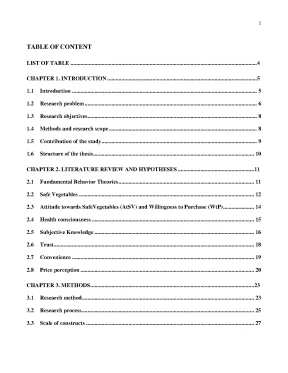
1 TABLE OF CONTENT LIST OF TABLE .4 Methods and research scope .5 Contribution of the study .6 Structure of the thesis. LITERATURE REVIEW AND HYPOTHESES .1 Fundamental Behavior Theories .3 Attitude towards SafeVegetables (AtSV) and Willingness to Purchase (WtP) .3 Scale of constructs. 27 LUAN VAN CHAT LUONG download : add luanvanchat@agmail.6 Attitude towards Safe Vegetables .7 Willingness to Purchase Safe Vegetables .6 Data analysis method. 33 CHAPTER 4: RESULTS AND DISCUSSION .2 Assessment scale of measurement .3 Result of testing assumptions.4 Results of regression .1 Summary of main results .3 Limitation and future research .54 LUAN VAN CHAT LUONG download : add luanvanchat@agmail.63 Appendix A: Vietnamese questionnaire.
63 Appendix B: Results of EFA. 68 Appendix C: Result of Regression (Model 1). 72 Appendix D: Result of Regression (Model 2). 75 LUAN VAN CHAT LUONG download : add luanvanchat@agmail.com 4 LIST OF TABLE Table 3.1 Timeline of research process .2: Result of qualitative pilot research .2 Result of collecting questionnaire .1 Characteristic of Sample .2 Result of Reliability test .3 Rotated Component Matrix of Independent Variables .4 Rotated Component Matrix of Mediating Variable and Dependent Variable .5 Correlation of all constructs .6 Regression of Model 1 .7 Regression of Model 2 .1 Result of indepth-interview for reason of not significant impact between Subjective Knowledge and Attitude towards Safe Vegetables .51 LUAN VAN CHAT LUONG download : add luanvanchat@agmail.1 Introduction A green economy gives the impression of an economy that is environmental-friendly, sensitive to the need of conserved natural resources.
Moreover, green economy minimizes pollution and emissions that damaging the environment while the production process is going on and makes products, services which is not harmful to the environment. That means green economy is when low-carbon, resource used efficiently, and social concerned. The key aim for a transition to a green economy is to enable economic growth and investment while increasing environmental quality and social inclusiveness (UNEP, 2011). Green economy is to get green growth, leading to social inclusiveness and culture inclusiveness.
There are over 120 countries apply green economy over the world (Đức Nhân & Việt Quốc, 2007). In green economy, sustainable production and sustainable consumption are two essential sides. Production and consumption of the economics, combine together in the cycle of producing-consuming goods. This study focuses on sustainable consumption, especially agricultural consumption.
Sustainable consumption concept is summarized as the way that provides consumers chances for using products and services efficiently, with low-impact on environment, social and economics. The final target of sustainable consumption is improving quality of life for generations; and the main idea is not less consuming, another word is intelligent consuming. Indirectly way, this leads less natural resources, less waste and less polluted environment. Sustainable consumption in agriculture means using agricultural foods with no chemicals.
Consumers’ health and environment according have benefit in direct effect. This study mentions about sustainable consumption on vegetables; because it is essential food every day for each person. LUAN VAN CHAT LUONG download : add luanvanchat@agmail.com 6 In Vietnam, many farmers follow VietGAP criteria for supplying high-quality vegetables, whereas the amount of consume does not increase. A lot of money for investment of growing, in contrast with situation of more not sold safe vegetables.
From enterprises and government, not worrying about quality products of customers causes this problem, according to Hồng Loan (2014). However, there is few comments of consumers about what they care about when deciding to buy vegetables.2 Research problem As a contribution in economic growth, “agriculture represents the most important source of income for the majority of the world’s population” (United Nations Environment Programme [UNEP], 2011, p. And “key policy option to improve sustainability and resilience is agricultural production systems” (UNEP (2013, p. Vietnam is a country, which has strength point of agriculture.
Natural farming, in spite of new concept in sustainable production and consumption, appears ages ago in Vietnam. By natural farming, there are very nutrients in foods, helping body of person healthy and no illness (Hoàng Hải Vân, 2014). Products of natural farming are natural vegetables with no chemicals. However, concept of natural vegetables is not popular.
Most of citizens are familiar with concept “safe vegetables”, which is produced under VietGAP criteria. Safe vegetables means there is limited chemicals inside the products, those are certified by Ministry of Agriculture and Rural Development. However, how much of popularly safe vegetables used still is a big question. Thus, habit of consuming safe vegetables is the general objective of this study.
Safe vegetables concept appears some recent years in Vietnam. It comes from overusing chemicals in order to get higher quantity of products. Thus, amount of toxicity, which is inside vegetables makes customers’ health worse. In recent years, along with trend of sustainable consumption, customers take care more about what they buy and what they LUAN VAN CHAT LUONG download : add luanvanchat@agmail.
According to Axist Research (2009), the Ministry of Agriculture and Rural Development in Ho Chi Minh City had “temporary regulations on the production of safe vegetables” before 1998; in period 1998 – 2001, the Ho Chi Minh City government had policy for approval of implementation program for clean vegetables; then, from 2001 to 2003, the Agricultural Department cooperated with the People’s Committee of districts to produce safe vegetables simultaniously; the land of production safe vegetables increased rapidly in following years. In line with increase of consumption of pure vegetables, such of organic products stores has appeared like chain stores of Ecomart, Organic Ecolife, Mr. Sach, Organica, Vinagap, XanhShop for selling local clean vegetables and imported vegetables; moreover all supermarkets also sell VietGAP vegetables and Green Label vegetables. However, the amount of clean vegetables is too little in comparison with total vegetables supplied, accounting only VietGAP vegetable, just 1% supplied products meets the need in Ho Chi Minh city (Xuan Huong, 2013).
Going with increasing of safe vegetables buying, some issues appear. The impressed point is chaos of supplying in March, 2014, non-certified vegetables are sold under certified label. Companies or stores just advertise that general production process with some pictures and no more information of ingredients, nutrition of products. Even though some supermarkets sell not safe vegetables in recent months (Tú Anh & Thiên Minh, 2014).
Moreover, there is no department is in charge of this issue. That makes customers confuse about quality of safe vegetables and farmers worry about outcome of their products, according to Nguyễn Hạnh (2014). Actually, there are lots of famers are growing safe vegetables in Vietnam. However, due to small size and not beautiful packaging, these suppliers could not co-working with supermarket to sell products; while consumers could not find out where selling safe vegetables.
In summary, some problems are customers’ trust LUAN VAN CHAT LUONG download : add luanvanchat@agmail.com 8 on quality of products, less provided information about process of growing, consumers themselves cannot differentiate between safe vegetables or not safe vegetables. As mentioned above, higher concern about safe vegetables leads to higher suppliers, thus much quantity of safe vegetables. However, willingness to buy does not go up accordingly. So that there is excess of safe vegetables unconsumed in the market, and a lot of money is not returned as profit.3 Research objectives In order to make customers have more believe on all kinds of safe vegetables, measurement of factors affecting willingness to purchase safe vegetables is necessary.
This study accordingly helps enterprises to raise resource for supporting marketing and brands for higher return. The purpose of this study is to apply TPB model for assessing willingness of purchasing safe vegetables in Vietnam with detail of explaining in part 2.1 of the next Chapter. Consequently, CEO of enterprises could find out the way for pushing sales. Further to the above discussion, this study aims to obtain following objectives: (1) To investigate some factors such as health consciousness, subjective knowledge, trust, price perception, convenience, affecting attitude towards safe vegetables.
(2) To examine relationship between attitude towards safe vegetables and willingness to purchase.4 Methods and research scope Two phases of this study were undertaken: a qualitative approach and quantitative approach. Because fundamental theories and most of literature come from outside Vietnamese research, this phase is to modify the scales to be suitable for Vietnamese LUAN VAN CHAT LUONG download : add luanvanchat@agmail. In-depth interview with whom bought safe vegetables at least one a month was taken to get response. Software MP3 recorder was used due to difficulty of distance.
The next phase is quantitative approach to test measurement and structural model. Mail survey and paper questionnaire were delivered to consumers in Ho Chi Minh City to get response. After getting database, SPSS version 16 was applied for analyzing, including EFA (Exploratory Factor Analysis) and regression.5 Contribution of the study This study will show how much some factors affecting attitude towards safe vegetables, and how much attitude towards safe vegetables affecting willingness to purchase. In total, this research provides the whole effect of factors that impacting behavior on consumers towards buying safe vegetables and measures how much each element affects on willingness to purchase.
Consequently, results of this study help enterprises know more about customers’ habit of choosing vegetables in Ho Chi Minh City. Therefore, companies could apply effective ways for increasing sales of safe vegetables, and increasing firms’ revenue accordingly. Thus, managers do their businesses more effectively. It is also good for both consumers and farmers.
Consumers get healthier due to fresh vegetables, and farmers get more income due to more selling products. There is little research about safe vegetables in Vietnam. Result of Truong et al. (2010) indicates that purchasing decision of organic foods of Vietnamese consumers depends on health and safety too much.
Other findings are perceived price and trust play as main points for purchasing intention safe vegetables (Nguyễn Thanh Hương, 2013). This research focuses on safe vegetables as an initial food everyday of citizens. Due to steadily changing of situation of economy, this one tests whether some internal factors have still LUAN VAN CHAT LUONG download : add luanvanchat@agmail.com 10 significant or not. Different scales from previous studies in Vietnam are applied, and two internal factors as convenience and knowledge are added in this research.6 Structure of the thesis This thesis is structured into five chapters: Chapter 1: Introduction to overview the study: research problems, research objectives and research method as well as benefit of this study.
Chapter 2: Literature review to provide review of literature on all independent variables, mediating variable and dependent variable. They all are health consciousness, subjective knowledge, trust, price perception, convenience, attitude and willingness to Purchase. Moreover, hypotheses are given in this chapter for readers to follow the model. Chapter 3: Method to indicate process of making questionnaire and doing measurement of each construct, from designing to implementing.
Chapter 4: Results and discussion. Data analysis will be discussed in there. And some of discussion will be mentioned. Chapter 5: Conclusion with limitation and potential way for future research.
LUAN VAN CHAT LUONG download : add luanvanchat@agmail. LITERATURE REVIEW AND HYPOTHESES The overall of this study is introduced in Chapter 1. This chapter introduces the theories, which are proposed by many scholars in academic field, related to each of factors in the model and research model of this study. Firstly, two types of behavior theories are introduced for analyzing which is suitable for this research.
Then, concept of safe vegetables is mentioned for clarifying what it is. Thirdly, related theories of each construct are introduced, including attitude, willingness to purchase, health consciousness, subjective knowledge, trust, convenience and price perception. Lastly, research model is proposed with hypotheses discussion.1 Fundamental Behavior Theories There are two favorite theoretical models predicting attitude of customers to consume products: Technology Acceptance Model (TAM) and Theory of Planned Behavior (TPB). The technology acceptance model (TAM) adjusted by Davis (1986) from Theory of reasoned action (TRA) of Ajzen and Fishbein (1980) to “explain the causal relationship between users’ internal beliefs (usefulness and ease of use), attitude, intention, and computer usage behavior” (Yousafzai, Foxall & Pallister, 2007a).