Luận văn phân tích thần học dòng Phanxicô của Bonaventure - Liam A. Farrer

Dưới đây là meta tags được tạo cho bài viết "Farrer liam a 201511 ma thesis": { "ai_description": "Tìm hiểu nghiên cứu luận án tiến sĩ Farrer Liam về chủ đề

Trường đại học

University of St. Michael's College

Chuyên ngành

Thần học

Người đăng

Ẩn danh

Thể loại

Luận văn thạc sĩ

2015

127
0
0

Phí lưu trữ

35 Point

Tóm tắt

I. Tổng quan về luận án MA 2015 của Liam Farrer về Bonaventure

Luận án thạc sĩ năm 2015 của Liam Andrew Farrer, mang tựa đề "Enkindling the Seraphic Fire Within: A Lonerganian Analysis of the Franciscan Charism of Bonaventure of Bagnoregio", nghiên cứu mối quan hệ giữa triết học Bernard Lonergan và thần học Franciscan của Bonaventure xứ Bagnoregio. Công trình này phân tích cách Bonaventure diễn giải linh hồn Franciscan thông qua phương pháp nội tâm học của Lonergan, nhằm vượt qua quan niệm truyền thống về Bonaventure như người 'đồng hóa' triết lý của Thánh Phanxicô. Farrer lập luận rằng thay vì sao chép nguyên văn tư tưởng Phanxicô, Bonaventure đã dịch ngôn ngữ thần học từ lý thuyết (Itinerarium mentis in Deum) sang thực tiễn (Legenda Maior) thông qua trải nghiệm nội tâm. Nghiên cứu này đóng góp quan trọng vào lĩnh vực thần học so sánh giữa dòng Franciscan và triết học hiện đại.

1.1. Bối cảnh học thuật nghiên cứu

Luận án ra đời trong bối cảnh học thuật thế kỷ XX-XXI khi giới nghiên cứu thần học Franciscan chia thành hai luồng chính: phe ủng hộ quan điểm truyền thống (Bonaventure là người kế thừa trực tiếp Thánh Phanxicô) và phe phê phán (như Paul Sabatier, Ewert Cousins). Sabatier từng nhận định Bonaventure "không hiểu người thầy mà mình muốn trở thành", trong khi Cousins nhấn mạnh sự đối lập giữa triết lý "truyền thống suy đoán" của Bonaventure và tinh thần "đơn giản trực tiếp" của Phanxicô. Farrer đã dựa vào những nghiên cứu này để xây dựng giả thuyết về vai trò của nội tâm học trong tư tưởng Bonaventure.

1.2. Phương pháp tiếp cận Lonerganian

Farrer áp dụng lý thuyết chuyển hóa nội tâm (interiority) của Bernard Lonergan để phân tích thần học Bonaventure. Theo Lonergan, chuyển hóa nội tâm là quá trình nhận thức vượt qua các tầng nhận thức thông thường để đạt tới sự hiểu biết sâu sắc về bản thân và thần thánh. Farrer cho rằng Bonaventure đã sử dụng phương pháp này khi chuyển đổi từ lý thuyết (Itinerarium) sang thực hành (Legenda Maior). Cách tiếp cận này giúp giải thích sự khác biệt giữa hai tác phẩm quan trọng của Bonaventure, vốn thường bị hiểu nhầm là mâu thuẫn trong tư tưởng của ông.

II. Phân tích những vấn đề trong nghiên cứu truyền thống về Bonaventure

Nghiên cứu truyền thống thường đánh giá Bonaventure dựa trên quan điểm rằng ông là người kế thừa trực tiếp tinh thần của Thánh Phanxicô. Tuy nhiên, cách tiếp cận này vấp phải hai vấn đề chính: thứ nhất, sự khác biệt rõ rệt giữa tư tưởng lý thuyết trong Itinerarium mentis in Deum (1259) và tư tưởng thực hành trong Legenda Maior (1263); thứ hai, sự nhầm lẫn giữa vai trò của Bonaventure trong việc hệ thống hóa hiến pháp Dòng Phanxicô (1260) với quan niệm sai lầm về ông như 'nhà sáng lập thứ hai'. Farrer chỉ ra rằng những nghiên cứu trước đây đã bỏ qua khía cạnh nội tâm học, vốn giải thích được sự chuyển đổi từ lý thuyết sang thực hành trong tư tưởng Bonaventure. Những quan niệm sai lệch này đã khiến giới học giả đánh giá thấp vai trò đích thực của Bonaventure trong việc duy trì linh hồn Franciscan.

2.1. Sự khác biệt giữa Itinerarium và Legenda Maior

Itinerarium mentis in Deum thể hiện tư tưởng thần học mang tính lý thuyết, tập trung vào sự tiến triển tâm linh thông qua các tầng nhận thức siêu hình. Ngược lại, Legenda Maior lại thể hiện tinh thần thực hành thông qua những câu chuyện về cuộc đời Thánh Phanxicô. Sự khác biệt này đã khiến nhiều học giả nghi ngờ về tính nhất quán trong tư tưởng Bonaventure. Farrer lập luận rằng sự khác biệt này không phải là mâu thuẫn mà là sự chuyển đổi từ lý thuyết sang thực hành, phù hợp với phương pháp nội tâm học của Lonergan. Qua đó, ông chứng minh Bonaventure đã thành công trong việc dịch ngôn ngữ thần học từ lý thuyết sang trải nghiệm sống.

2.2. Hiểu lầm về vai trò nhà sáng lập thứ hai

Quan niệm Bonaventure là 'nhà sáng lập thứ hai' của Dòng Phanxicô xuất phát từ sự hiểu lầm về vai trò của ông trong việc hệ thống hóa hiến pháp Dòng vào năm 1260. Những nghiên cứu trước đây như của Moorman đã bỏ qua sự thật rằng hầu hết hiến pháp đã được thiết lập từ năm 1239-1242 dưới thời John xứ Parma. Farrer chỉ ra rằng thuật ngữ 'reformatio' trong các tài liệu đương thời đã bị hiểu nhầm thành 'sự thành lập mới'. Sự hiểu lầm này đã khiến giới học giả đánh giá sai vai trò của Bonaventure trong việc bảo tồn linh hồn Franciscan thông qua việc chuyển đổi từ lý thuyết sang thực hành.

III. Giải pháp phương pháp luận dựa trên nội tâm học Lonergan

Farrer đề xuất phương pháp luận dựa trên lý thuyết nội tâm học của Bernard Lonergan để phân tích thần học Bonaventure. Theo Lonergan, chuyển hóa nội tâm bao gồm bốn loại chuyển hóa: chuyển hóa trí tuệ, đạo đức, tôn giáo và siêu hình. Farrer tập trung vào chuyển hóa tôn giáo, vốn liên quan đến sự thay đổi quan điểm về thần thánh thông qua trải nghiệm nội tâm. Ông lập luận rằng Bonaventure đã sử dụng phương pháp này khi chuyển đổi từ Itinerarium (tập trung vào lý thuyết) sang Legenda Maior (tập trung vào thực hành). Phương pháp luận này giúp giải thích sự khác biệt trong tư tưởng Bonaventure mà không phải là mâu thuẫn. Farrer cũng nhấn mạnh tầm quan trọng của việc hiểu rõ phương pháp nội tâm học để đánh giá đúng vai trò của Bonaventure trong lịch sử thần học Franciscan.

3.1. Áp dụng chuyển hóa tôn giáo vào phân tích

Chuyển hóa tôn giáo theo Lonergan là quá trình thay đổi quan điểm về thần thánh thông qua trải nghiệm nội tâm. Farrer lập luận rằng Bonaventure đã trải qua chuyển hóa này khi viết Legenda Maior, nơi ông thể hiện tinh thần thực hành hơn là lý thuyết. Quá trình này bao gồm sự thay đổi từ quan điểm thần học trừu tượng sang trải nghiệm sống động về đức tin. Farrer cho rằng Legenda Maior không phải là sự thoái lui khỏi lý tưởng ban đầu của Bonaventure mà là sự thể hiện tinh thần Franciscan thông qua trải nghiệm nội tâm. Phương pháp này giúp giải thích tại sao Legenda Maior lại được coi là tác phẩm quan trọng nhất của Bonaventure trong việc truyền đạt linh hồn Franciscan.

3.2. Chuyển đổi từ lý thuyết sang thực hành

Farrer chỉ ra rằng sự chuyển đổi từ Itinerarium sang Legenda Maior không phải là sự mâu thuẫn mà là sự phát triển tự nhiên trong tư tưởng Bonaventure. Itinerarium thể hiện giai đoạn lý thuyết, tập trung vào sự tiến triển tâm linh thông qua các tầng nhận thức siêu hình. Trong khi đó, Legenda Maior thể hiện giai đoạn thực hành, tập trung vào việc áp dụng đức tin vào cuộc sống hàng ngày. Sự chuyển đổi này phù hợp với phương pháp nội tâm học của Lonergan, vốn nhấn mạnh tầm quan trọng của việc chuyển đổi từ lý thuyết sang thực hành. Farrer lập luận rằng đây chính là điểm độc đáo trong tư tưởng Bonaventure, giúp ông vượt qua những giới hạn của phương pháp thần học truyền thống.

IV. Kết luận và ứng dụng của luận án Farrer 2015

Luận án của Farrer đã đóng góp quan trọng vào lĩnh vực nghiên cứu thần học Franciscan bằng cách giới thiệu phương pháp nội tâm học của Lonergan vào phân tích tư tưởng Bonaventure. Kết luận chính của ông là Bonaventure không phải là người sao chép nguyên văn tư tưởng Thánh Phanxicô mà là người đã dịch ngôn ngữ thần học từ lý thuyết sang thực hành thông qua trải nghiệm nội tâm. Điều này giúp giải thích sự khác biệt giữa Itinerarium và Legenda Maior mà không phải là mâu thuẫn. Luận án cũng cung cấp phương pháp luận mới cho nghiên cứu thần học so sánh, đặc biệt trong việc phân tích mối quan hệ giữa triết học hiện đại và thần học cổ điển. Kết quả nghiên cứu của Farrer có thể ứng dụng trong giảng dạy thần học, nghiên cứu lịch sử tôn giáo, và phát triển các phương pháp phân tích văn bản thần học mới.

4.1. Đóng góp chính của nghiên cứu

Nghiên cứu của Farrer đã thay đổi cách hiểu về vai trò của Bonaventure trong lịch sử thần học Franciscan. Thay vì coi ông là người kế thừa trực tiếp tư tưởng Thánh Phanxicô, Farrer chứng minh rằng Bonaventure đã sử dụng phương pháp nội tâm học để dịch ngôn ngữ thần học từ lý thuyết sang thực hành. Điều này giúp giải thích sự khác biệt giữa hai tác phẩm quan trọng của ông mà không phải là mâu thuẫn. Kết quả nghiên cứu này cũng cung cấp phương pháp luận mới cho việc nghiên cứu thần học so sánh, đặc biệt trong việc phân tích mối quan hệ giữa triết học hiện đại và thần học cổ điển.

4.2. Hướng phát triển tương lai

Luận án của Farrer mở ra nhiều hướng nghiên cứu mới trong lĩnh vực thần học so sánh. Một hướng nghiên cứu tiềm năng là áp dụng phương pháp nội tâm học của Lonergan vào phân tích các tác phẩm thần học khác của Bonaventure hoặc các tác giả Franciscan khác. Ngoài ra, nghiên cứu này cũng có thể được mở rộng sang lĩnh vực nghiên cứu so sánh giữa thần học và triết học hiện đại. Trong giảng dạy, luận án có thể được sử dụng như tài liệu tham khảo cho các khóa học về thần học Franciscan, lịch sử thần học, hoặc phương pháp luận nghiên cứu thần học.
Tóm tắt và mô tả trên trang này được tạo với sự hỗ trợ của AI. Nếu bạn thấy nội dung không chính xác hoặc có vấn đề, vui lòng Báo lỗi nội dung.

31/05/2026
Farrer liam a 201511 ma thesis

Trích đoạn nội dung tài liệu

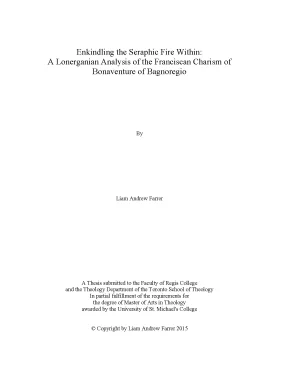
Enkindling the Seraphic Fire Within: A Lonerganian Analysis of the Franciscan Charism of Bonaventure of Bagnoregio By Liam Andrew Farrer A Thesis submitted to the Faculty of Regis College and the Theology Department of the Toronto School of Theology In partial fulfillment of the requirements for the degree of Master of Arts in Theology awarded by the University of St. Michael's College © Copyright by Liam Andrew Farrer 2015 Enkindling the Seraphic Fire Within: A Lonerganian Analysis of the Franciscan Charism of Bonaventure of Bagnoregio. Liam Andrew Farrer Master of Arts in Theology University of St. Michael’s College 2015 Abstract Within current scholarship, the general consensus seems to be that Bonaventure did not, according to Paul Sabatier, “[understand] him whose disciple he wanted and believed himself to be.

Cousins takes up this line of thinking in his analysis of Bonaventure’s theology contrasting Bonaventure’s presupposition of the “speculative tradition” with the “simpleness and directness” of Francis of Assisi. This contrast contains the implication that Bonaventure’s work cannot be considered to be truly Franciscan, given the differing expression of his ideas from those in the orders foundational texts; however, I hypothesize that Bonaventure’s operates in, what Bernard Lonergan calls, the realm of interiority. I will argue that as a result of this Bonaventure is able to transpose his understanding of Franciscan spirituality from the realm of theory, as is seen in the Itinerarium mentis in Deum, to the realm of common sense, as is seen in the Legenda Maior. ii Acknowledgements “Praise and bless my Lord and give Him thanks and serve Him with great humility.

Francis wrote these words, which end the magnificent Canticle of Creation, shortly before he entered into his eternal reward. I have chosen to begin my acknowledgements with them as I feel they express both the sentiment that I have towards God for blessing me with the wonderful ministry of studying theology, and the attitude that I hope to have as I move forward in it. God has truly blessed me over the past two years and continues to do so, so to Him I owe my greatest debt of thanks. Secondly, I must thank Our Lady of Mount Carmel.

As Thomas Aquinas notes, “a captain does not intend as a last end the preservation of a ship entrusted to him, since a ship is ordained to something else as its end, viz.”2 Our Lady, stella maris, has been the constant star by which I am able to navigate, and for this I am extremely grateful. Thirdly, I owe clear debts of thanks to St. Francis of Assisi, Bl. John of Parma, St.

Bonaventure, and Bernard Lonergan, as well as less noticeable ones, amongst others, to the Prophet Elijah, and Sts. Ignatius of Loyola and Thérèse of Liseux. Given that a thesis is an earthly endeavor, there are also several people I should thank who have not yet gone to their eternal reward. Firstly, I would like to thank my parents, as well as my brother, for their continued love and support.

Secondly, I would like to thank the people who were instrumental in getting me here both academically, personally, and spiritually throughout my program: my supervisor, Fr. Gilles Mongeau, SJ; the members of my 1 Francis of Assisi, “The Canticle of the Creatures,” in Francis of Assisi: Early Documents, Vol. Edited by Regis Armstrong, OFM Cap, J. Wayne Hellman, OFM Conv, and William J.

Translated by Regis Armstrong, OFM Cap et. 2 Thomas Aquinas, Summa Theologiae, 1-2, Q5, A2. iii committee, Profs. John Berkman and Jeremy Wilkins; my program advisor, Sr.

Gill Goulding, CJ; the Rector Emeritus of Regis College, Fr. Bert Foliot, SJ; my spiritual director, Sr. Mary Agnes Roger, DCJ,; my pastor Fr. Christopher Cauchi and the Toronto Newman Centre; Fr.

Robert Doran, SJ; Fr. Peter Drilling; Prof. Thomas Reynolds; Fr. Micheal Shields, SJ; my fellow members of the Lonergan Research Institute, especially Brian Bajzek, Eric Mabry, and Justin Schwartz; the Jesuits of the Cardoner and Regis College communities; the staff and students of Regis College; The Newman Centre Catholic Students Club; the Catholic communities at Hazelburn Co-Op and Harrison Carmel; my classmates at TST; and my own cohort particularly Dcn.

Shane Daly, SJ, Marc-Alexandre Ladouceur, Peter San Filipo, and Daniel and Sarah Pettipas. Were I to thank everyone I wanted to thank, it would perhaps take up more pages than the thesis itself, so I can only hope that if anyone who feels they deserved to be thanked by name and isn’t reads this, they will know that just as the Lord knows the number of hairs on their head, so too does He know my immense gratitude and affection for all you have done for me. Thus, I can only say with St. Francis, “May the Lord bless you and keep you; may He show His face to you and be merciful to you.

May He turn His countenance to you and give you peace.”3 As I was finishing this thesis, I was given news of the death of Joshua Balden, a Wycliffe College student and seminarian for the Anglican Church of Canada with whom I was acquainted, was unexpectedly called from life. A few days later, on the solemnity of Our Lady of Mount Carmel, I was given the news of the death of a friend, colleague and benefactor from my undergraduate days, John Dietrich Senior. Without Jack’s generosity in helping to fund my missionary work, I would have never been set on the course that lead to 3 Francis of Assisi, “The Praises of God and the Blessing B: A Blessing for Brother Leo,” in Francis of Assisi: Early Documents, Vol. iv me studying theology.

Soon after on the feast of the great Franciscan doctor St. Lawrence of Brindisi, my former ethics professor Dr. Ernest McCullough went to his eternal reward. Again shortly after on the feast of St.

Joachim and St. Anne, the grandparents of Our Lord, my own grandfather Rory O’Sullivan entered into the kingdom prepared for him, after a long and valiant struggle with cancer. I should like to dedicate the first chapter of this thesis to Joshua, the second to Jack, the third to Ernie, and the thesis as a whole to my Grandfather. May their souls and the souls of all the faithful departed, through the mercy of God, rest in peace.

Liam Farrer The Feast of the Transverberation of Saint Theresa of Avila Toronto, Canada. v Table of Contents Acknowledgements. 1 Chapter 1: “Take me as your model of discipleship, for I am a true disciple:” Methodological and Historical Concerns .2 Lonergan’s Notion of Conversion .3 The Realms of Meaning. The Foundation of the Friars .1 The Problem of the Gyrovagi .2 The Hound of the Lord .3 The Poverello of Assisi.

32 Chapter 2: “A Sentinel for the House of Israel:” Bonaventure’s Understanding of Franciscan Life. A Seraphic Spark Ignited. The Myth of the Second Founder. Bonaventure and Theology.

The Next Question. 54 Chapter 3: “We May Say With Philip:” Reading Bonaventure’s System .1 The Triple Way .5 The Six Steps to the Throne of Solomon. The Mens Journey .1 The Prologues as Examples of Differentiated Consciousness.2 The World Outside the Mens .3 The World Inside the Mens .4 The World Above the Mens.111 vi Introduction In the year 1997, as the Catholic Church prepared to enter into the new millennium, Robert M. Doran noted that there remained a task, within the realm of systematic theology, that he felt must be completed with a “certain urgency”: “the task of integrating” the theologies of Bernard Lonergan and Hans Urs Von Balthasar, “and of allowing them to complement and, when necessary, even correct on another.” Doran went on to note that “if we cannot achieve this sort of integration, we may well find ourselves engaged in something similar to the Aristotelian-Augustinian disputes in the Middle Ages.”4 Expressing his desire to forestall the theological disputes that may arise from these camps, he goes on to state that by showing how “Lonergan and Balthasar do not differ in a dialectical fashion, but rather are related in a way that at times provides mutual complementarity and at times reflects genetic relations that go both ways,” such conflict may be at best avoided and at worst tempered.5 While this hope appears to be proving very fruitful for modern systematic theology overall, both on the levels of publishing and teaching, what is of particular interest for this project is not Doran’s proposal itself, but rather his initial justification for making it, that the complementarity between the two theologians is reminiscent of the “complementary and genetic.

relations between Bonaventure and Aquinas.”6 Doran is not the first theologian to draw attention to the 4 Robert M. Doran, SJ, “Lonergan and Balthasar: Methodological Considerations” in Theological Studies 58:1 (1997,) 569. Doran, to his great credit, acknowledges that Thomas did a great amount of wok in integrating the works of Aristotle into Augustinian theology as opposed to contributing to the divide. For more on Thomas’ use of Augustine in his theology cf.

Michael Dauphinais, Barry David, and Matthew Levering, eds. Aquinas the Augustinian, (Washington D.: Catholic University of America Press, 2007. For examples of the genetic relationship between Lonergan and Balthasar, cf. Dadosky The Eclipse and Recovery of Beauty: A Lonerganian Approach (Toronto: 1 2 need for a more convergent reading of these great medieval doctors.

In a discussion on synderesis, published in his 1981 book Free and Faithful in Christ, Bernard Häring broached the same topic, stating, St. Bonaventure has no intention of devaluating the intellectual aspect so strongly emphasized by St. it seems to me that the two theories when proposed by the great teachers Thomas and Bonaventure are not opposed but complete each other. Or, let us say that they manifest the same vision but from different angles.

However, as soon as the two schools became antagonistic, there was a militant emphasis on one aspect as against the other, and thus the wholeness was shattered.7 While a naïve reader may take Doran’s language of complementarity as a sign that the problem of shattered wholeness has been dealt with in the years since Häring’s initial observation, this is unfortunately not so. The false dichotomy between the Franciscan and Dominican theological schools may no longer exist at the forefront of Catholic theology; yet the fact remains that even the broadest survey of literature shows that when Bonaventure is read outside of the realm of specialists, he is rarely read on his own, almost exclusively being used alongside Aquinas.8 More importantly, in comparison to Aquinas, Bonaventure is rarely Toronto University Press, 2014,) Peter Drilling “Balthasar & Lonergan on Divine Action in the Word”, MS, Lonergan Research Institute Graduate Seminar Series, 3 October 2014, Lonergan Research Institute, and Gill Golding, CJ and Jeremy D. Wilkins, “Lonergan and Balthasar” Forthcoming Graduate Seminar, Regis College, Toronto, ON, Fall 2015. 7 Bernard Häring, CSsR, Free and Faithful in Christ: Moral Theology for Priests and Laity, Volume One: General Moral Theology, (New York: Seabury Press, 1978,) 231-232.

8 I feel it is important to use the phrase Catholic as opposed to Christian theology in this context, due to the fact that the scholars of the Radical Orthodoxy movement still base a large portion of their theology on the premise that John Duns Scotus is completely opposed to Aquinas. For a very general overview of this debate one ought to consult Daniel P. Horan, OFM Postmodernity and Univocity: A Critical Account of Radical Orthodoxy and John Duns Scotus, (Minneapolis: Fortress Press, 2014). It should be noted that Horan’s book, while 3 used as a point of comparison with regards to the work of modern theologians.

While this may not seem like a problem, I am convinced that this lack of major dialogue with Bonaventure relegates his unique theological contributions to the realm of history, thus preventing them from reaching their systematic potential.

Nội dung được bảo vệ bản quyền — Tải xuống đầy đủ