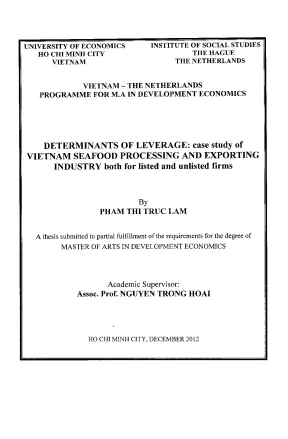
UNIVERSITY OF ECONOMICS INSTITUTE OF SOCIAL STUDIES HO CHI MINH CITY THE HAGUE VIETNAM THE NETHERLANDS VIETNAM- THE NETHERLANDS PROGRAMME FOR M.A IN DEVELOPMENT ECONOMICS DETERMINANTS OF LEVERAGE: case study of VIETNAM SEAFOOD PROCESSING AND EXPORTING INDUSTRY both for listed and unlisted firms By PHAM THI TRUC LAM A thesis submitted in partial fulfillment of the requirements for the degree of MASTER OF ARTS IN DEVELOPMENT ECONOMICS Academic Supervisor: Assoc. NGUYEN TRONG HOAI HO CHI MINH CITY, DECEMBER 2012 N VAN CHAT LUONG download : add luanvanchat@agmail. CERTIFICATION ;; "I certificate that the substance of the thesis has not already been submitted for any degree and is not currently submitted for any other degree. I certify that to the best of my knowledge and help received in preparing the thesis and all sources used have been acknowledged in the thesis." Signature Pham Thi True Lam Date.
UAN VAN CHAT LUONG download : add luanvanchat@agmail.co ACKNOWLEDGMENTS = First and foremost, I would like to send my dearest thank to my supervisor, Assoc. Nguyen Trong Hoai for his guidance and support. In addition, I would also like to express my gratitude to all persons and organizations for their support, provision of assistance and information that made this thesis possible. I am also grateful to the lecturers and staff of the project who • helped improve my knowledge and fulfill the programme.
Finally, I am greatly indebted to my family for their love for and support of me, keeping me in good condition for learning. I am also grateful to my close friends for their warm encouragement. 11 UAN VAN CHAT LUONG download : add luanvanchat@agmail.co ABSTRACT Although there are many prior studies about leverage as well as capital structure on the world in general and Vietnam in particular, results of these researches are still inconsistent. Moreover, in context of Vietnam, most of studies about leverage are of listed firms.
So, this study works with data of both listed and unlisted firms. The purpose of this study is to examine the relative importance of ' some factors to the leverage of Vietnam seafood processing and exporting enterprises. A sample of 20 listed and 15 unlisted enterprises for a period of 3 years from 2009 to 20 11 was chosen and tested base on pecking order theory and trade off theory. The results finding from the thesis is that firm growth opportunities and firm size have positive related to leverage, profitability, liquidity have a negative effect to leverage whereas tangibility assets and non-debt tax shield have no impact on leverage of Vietnam seafood processing and exporting enterprises.
Key words: leverage, pecking order theory, trade off theory 111 UAN VAN CHAT LUONG download : add luanvanchat@agmail.co CONTENTS Certification. iv List of Tables. vii List of Abbreviations. vii CHAPTER I: INTRODUCTION FOR THE STUDY .5 Structure of the thesis:.
4 CHAPTER II: LITERATURE REVIEW FOR DETERMINANTS OF LEVERAGE .1 The Modigliani-Miller theorem: .2 Agency cost theory: .3 Trade-off theory: .4 The pecking-order theory: .3 Determinants of leverage: .1 Leverage and Profitability: .2 Leverage and firm size: .3 Leverage and Firm Growth: .4 Leverage and Non-debt tax shield : .5 Leverage and tangible assets: .6 Leverage and liquidity: .4 Empirical review on determinants of leverage: .1 Empirical evidences finding from the world:. 20 IV UAN VAN CHAT LUONG download : add luanvanchat@agmail.2 Empirical evidences finding from Vietnam perspective:. 25 CHAPTER III: RESEARCH METHODOLOGY .1 Data and variables description: .2 Description of variables: .2 Methods of estimation: .1 Ordinary Least Squares (OLS) estimator: .2 Fixed Effects (FE) estimator: .3 Random Effects Estimator (RE): .4 Hausman specification test:. 33 CHAPTER IV: OVERVIEW OF SEAFOOD PROCESSING AND EXPORTING ENTERPRISES .1 Introduction of the seafood export industry: .2 Analysis of capital structure of the seafood enterprises: .1 Debt to equity ratio: .2 The equity growth rate:.
42 CHAPTER V: EMPIRICAL RESULTS .2 Analysis of the correlation between all variables: .2 Hausman specification test: .3 Fixed effects estimator:. 49 • v UAN VAN CHAT LUONG download : add luanvanchat@agmail. 53 CHAPTER VI: CONCLUSION, POLICY RECOMMENDATION AND LIMITATION .3 Limitation and suggestion for further study:. 68 " • Vl UAN VAN CHAT LUONG download : add luanvanchat@agmail.co LIST OF TABLES Table 2.1: Summary of leverage determinants Table 3.1: Variable, description and its expected sign Table 4.1: The equity growth rate Table 5.1: Descriptive statistics of sample variables Table 5.2: Correlation coefficient matrix Table 5.3: Result of auxiliary regression models of each dependent variable Table 5.4: Result ofOLS estimator Table 5.5: Result ofHausman test Table 5.6: Result of Fixed effects estimator vii UAN VAN CHAT LUONG download : add luanvanchat@agmail.com - - - - -- -- ------------------------ LIST OF ABBREVIATIONS NDTS Non debt tax shield SEAs Seafood processing and exporting enterprises SMEs Small and medium enterprises FE Fixed effects RE Random effects GDP Gross Domestic Product GSO General Statistics Office of Vietnam OLS Ordinary Least Square STD Short term debt LTD Long term debt TTD Total debt EQTY Equity ASS Total assets Vlll UAN VAN CHAT LUONG download : add luanvanchat@agmail.
CHAPTER 1: INTRODUCTION FOR THE STUDY This chapter will explain the reason for choosing the thesis, its objectives and research questions. In addition, this part also presents a brief of methodology and finally abbreviates the structure of the thesis.1 Problem statement: One of the most important decisions confronting a firm in corporate finance is the design of its capital structure. In order to finance for investment, the firms can choose either internal or external funds. Internal fund is the firm retained earnings whereas external fund can be raised from issuing equity or taking debt.
Sometimes, firms may take too much or without taking debt. An effective debt ratio or leverage should not only help reducing the weighted average cost of capital of the firm but also it still can increase firm value. To decide how much leverage the firm should take on, the firms need to know which factors affect leverage. However, over 50 years since the first research of Modigliani and Miller (1958) about leverage, the question of them about what factors affect leverage are still unresolved until now.
This seems to be the most enigmatic and interested issue of many researchers. However, until now, the effort of researchers to solve the debt equity choice also does not bring results that satisfy all of them. The results are still inconsistent between researches at different countries and different industries. Moreover, Myers ( 1984) also suggests that "the average debt ratio will vary from industry to industry because asset risk, asset type and requirements for external fund also vary by industry" (p.
In case of Vietnam, there are also some studies testing for determinants of the leverage of Vietnam companies, such as Nguyen and Ramachandran (2006), Dzung et al. (2012) and the empirical results of these studies also contain conflicts as results from many other studies in the world. Seafood is considered to be one of major industries and one of the key. export sectors of Vietnam.
Each year, it contributes largely to GDP. Particularly, 1 UAN VAN CHAT LUONG download : add luanvanchat@agmail.com in year 2011, total value of seafood product is 99.432 billion VND, contributes about 4% to GDP (Source: GSO 2011 ). Vietnam has many outstanding advantages .- in the industry to develop this field as high position in most leading markets, diversified channel of distribution, large farming area with lot of species of seafood. However, with many changing about interest rate through past these years, many seafood enterprises have been affected strongly as most of their sources of capital are loan from bank.
In year 2009-2010, in order to support for firms in time of difficulties of the economy in Vietnam as well as the world economy crisis, the Government loosed monetary policy. However, this forced credit growth become too high, leaving far growth of GDP. This created unbalance and pushed up inflation rate. Therefore, by the year 2011, to control inflation, the Government has employed tightening monetary policy through controlling credit strictly and limiting in supplying money for the economy.
Commercial banks become short of fund to finance for trade. According this context, loan interest rate increase and conditions to be approved for lending from bank are also more serious. This makes a lot of enterprises hard to reach of loan capital. Together with many other difficulties of seafood firm as lacking of source of material, higher cost of input, decreasing of export market, lacking of capital lead many seafood firms to a more difficult situation, even more a lot of firms must go bankrupt.
Only at the beginning of the year 2012, 470/800 exporting seafood firms must stop working, not exclude large companies. The problem is these enterprises depend too much on debt while the way of using debt is ineffectively. So, now restructuring of capital structure become the most important problem for Vietnam seafood enterprises. To improve financial ability and avoid risk of financial, seafood enterprises need to have a suitable leverage.
In order to do that, it's very important for firms to know whether leverage of firms may be impacted by which factors. Finding factors affecting leverage will help enterprises to control its leverage through impacting on these factors. 2 UAN VAN CHAT LUONG download : add luanvanchat@agmail.2 Research objectives: The main objective of this thesis is to examine the impact of some factors as profitability, firm growth opportunities, firm size, tangibility assets, non debt tax shield and liquidity on leverage in context of Vietnam seafood processing and exporting enterprises. It is to consider whether these factors are significant, if yes, it is positive or negative related to leverage and which theory help to explain leverage of the firms better: pecking order or trade off theory.
The specific objectives are as follows: - To examine the significant impact of factors on leverage - To give some policy recommendations to the firms to find a better way of financing debt for Vietnam seafood processing and exporting enterprises.3 Research questions: The study focuses on answering the questions: - What factors affect leverage of Vietnam seafood processmg and exporting enterprises? - What policy recommendations for Vietnam seafood processing and exporting enterprises to raise effect of using leverage? Basing on the list of factors affecting on leverage from the prior literatures, this study will do the examination on some selected factors in case of Vietnam seafood processing and exporting enterprises.4 Research Methodology: This paper uses annual panel data of 35 seafood processing and exporting enterprise in Vietnam for the period 2009-2011 include both listed and unlisted • firms. To estimate the impact of independent variables as profitability, non-debt tax shield, firm size, firm growth opportunities, tangibility assets and liquidity on leverage of the firms, two methods will be used: Ordinary Least Square and Fixed 3 UAN VAN CHAT LUONG download : add luanvanchat@agmail.5 Structure of the thesis: This thesis is organized in six chapters as follows: Chapter 1: explains the reason for choosing the thesis, its objectives and research questions and briefly about methodology which is used to test for hypotheses. Chapter II: demonstrates the literature review. It starts with the concept of leverage and capital structure.
Following is some theories and prediction of theories about determinants of leverage. Empirical studies are also presented in this part. Chapter III: descriptions data and variables which be used in the model. This chapter also presents about different estimation techniques together with hypothesis testes.
Chapter IV: presents turnover of seafood firms through some years, its export market as well as major seafood product. This chapter also analyzes capital structure of these firms. Chapter V: indicates empirical results corresponding to each estimation technique as well as results of hypothesis testes. Chapter VI: gives conclusion of empirical results, suggest recommendations and limitation of the thesis.
4 UAN VAN CHAT LUONG download : add luanvanchat@agmail.