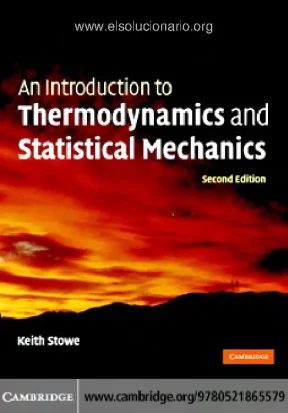
Giới thiệu Nhiệt động lực học và Cơ học thống kê, Ấn bản thứ hai - Keith Stowe

Chuyên ngành

Vật lý

Người đăng

Ẩn danh

Thể loại

Sách giáo khoa

2007

573
0
0

Phí lưu trữ

135 Point

Tóm tắt

I. Tổng quan về sách Introduction to Thermodynamics and Statistical Mechanics

Introduction to Thermodynamics and Statistical Mechanics là giáo trình chuẩn đại học về nhiệt động học và cơ học thống kê, được viết bởi Giáo sư Keith Stowe thuộc Đại học California Polytechnic State University. Cuốn sách đã được tái bản lần thứ hai sau hơn 10 năm giảng dạy và thu nhận phản hồi từ sinh viên. Nội dung sách bắt đầu từ những hành vi lượng tử quan trọng, dạy sinh viên cách tính toán xác suất để tạo nền tảng vững chắc cho các chương sau. Sách giới thiệu các khái niệm nhiệt động học cổ điển như năng lượng nội tại, tương tác, entropy và định luật hai quan trọng. Phần còn lại tập trung vào cơ học thống kê, nghiên cứu các hệ nhỏ tương tác với các bể chứa lớn. Cuốn sách cung cấp tóm tắt ý tưởng và kết quả sau mỗi chủ đề, cùng nhiều bài tập về nhà với đáp án cho bài lẻ và giải bài chẵn dành cho giảng viên. Đây là tài liệu không thể thiếu cho sinh viên vật lý và kỹ thuật.

1.1. Tác giả Keith Stowe và hành trình sáng tác

Keith Stowe là giáo sư vật lý tại Đại học California Polytechnic State University với hơn 32 năm giảng dạy. Ông từng công tác tại nhiều trường đại học danh tiếng gồm University of Washington, Harvard, University of North Carolina và University of Michigan. Ngoài cuốn Introduction to Thermodynamics and Statistical Mechanics, ông còn viết các cuốn sách về khoa học đại dương. Bản in đầu tiên ra mắt năm 2007 do Cambridge University Press xuất bản, đánh dấu bước ngoặt trong giảng dạy nhiệt động học bậc đại học. Bản thứ hai được hiệu chỉnh dựa trên phản hồi thực tế từ hàng nghìn sinh viên qua một thập kỷ.

1.2. Cấu trúc nội dung và phương pháp tiếp cận

Cuốn sách được chia thành nhiều phần logic. Phần đầu tiên đặt nền tảng với bối cảnh tổng quan. Phần hai tập trung vào các hệ thống nhỏ, giới thiệu cách áp dụng xác suất vào vật lý. Tiếp theo là phần nhiệt động học cổ điển, trình bày năng lượng nội tại, tương tác và entropy. Cuối cùng là phần cơ học thống kê chuyên sâu. Phương pháp của Stowe bắt đầu từ cơ học lượng tử, xây dựng nền tảng tính xác suất trước khi đi vào nhiệt động học. Cách tiếp cận này giúp sinh viên hiểu bản chất thay vì chỉ ghi nhớ công thức. Mỗi chương đều có bài tập phân loại theo mức độ khó khác nhau.

II. Các vấn đề cốt lõi trong nhiệt động học và cơ học thống kê

Nhiệt động học và cơ học thống kê là hai trụ cột của vật lý thống kê hiện đại, nhưng sinh viên thường gặp nhiều khó khăn khi tiếp cận. Vấn đề đầu tiên là sự khác biệt giữa hai phương pháp: nhiệt động học cổ điển sử dụng các đại lượng vĩ mô như nhiệt độ, áp suất và thể tích, trong khi cơ học thống kê đi từ vi mô lên thông qua phân bố xác suất. Thứ hai, khái niệm entropy thường gây nhầm lẫn vì có nhiều cách định nghĩa khác nhau. Thứ ba, định luật hai nhiệt động học có vẻ đơn giản nhưng ứng dụng thực tế phức tạp. Cuốn sách của Keith Stowe giải quyết những vấn đề này bằng cách xây dựng nền tảng xác suất vững chắc trước khi giới thiệu nhiệt động học. Việc hiểu rõ phân bố xác suất, bao gồm xác suất của các sự kiện độc lập và phụ thuộc lẫn nhau, là chìa khóa để nắm bắt toàn bộ nội dung. Các ví dụ thực tế như phân tử khí trong phòng giúp minh họa trực quan các khái niệm trừu tượng.

2.1. Thách thức trong việc hiểu xác suất và phân bố lượng tử

Một trong những thách thức lớn nhất là hiểu cách tính toán xác suất trong các hệ vật lý. Sách trình bày rằng khi các tiêu chí thống kê độc lập, xác suất tổng hợp là tích các xác suất riêng lẻ. Ví dụ, một phân tử không khí trong phòng trống có xác suất nằm ở phần trước là 1/3 và ở nửa trên là 1/2, do đó xác suất ở cả hai vị trí là 1/6. Ngoài ra, các đại lượng lượng tử như động lượng góc bị lượng tử hóa, chỉ nhận các giá trị rời rạc. Điện tử, proton, neutron đều là fermion với spin bán nguyên, tuân theo nguyên lý loại trừ Pauli, tạo nên sự khác biệt cơ bản so với boson.

2.2. Nhầm lẫn phổ biến về nhiệt động học cổ điển

Nhiều sinh viên nhầm lẫn giữa năng lượng nội tại và nhiệt lượng. Năng lượng nội tại là tổng năng lượng vi mô của hệ, còn nhiệt lượng là quá trình truyền năng lượng do chênh lệch nhiệt độ. Một nhầm lẫn khác là xem entropy như thước đo hỗn loạn thay vì là thước đo số trạng thái vi mô tương ứng với trạng thái vĩ mô. Định luật hai nhiệt động học phát biểu rằng entropy của hệ kín không bao giờ giảm, nhưng nhiều người hiểu sai rằng entropy luôn tăng. Thực tế, entropy có thể giữ nguyên trong quá trình thuận nghịch. Cuốn sách của Stowe giải thích rõ ràng những điểm tinh tế này qua các ví dụ cụ thể và bài tập thực hành.

III. Phương pháp học hiệu quả với giáo trình Keith Stowe

Giáo trình của Keith Stowe được thiết kế với phương pháp sư phạm rõ ràng để tối ưu việc học. Phương pháp đầu tiên là xây dựng kiến thức theo tầng từ xác suất đến nhiệt động học rồi cơ học thống kê. Sinh viên nên tuân theo thứ tự chương vì mỗi chương dựa trên nền tảng của chương trước. Thứ hai, mỗi chủ đề kết thúc bằng hộp tóm tắt ý tưởng và kết quả, giúp sinh viên ôn tập nhanh chóng. Thứ ba, hệ thống bài tập phong phú với nhiều mức độ khó khác nhau là công cụ rèn luyện hiệu quả. Bài lẻ có đáp án để tự kiểm tra, bài chẵn dành cho thảo luận trên lớp. Phương pháp thứ tư là áp dụng lý thuyết vào tình huống thực tế, như tính xác suất phân tử khí hay phân tích chu trình nhiệt động học. Cuốn sách cũng khuyến khích sinh viên vẽ đồ thị và sơ đồ tư duy để trực quan hóa các khái niệm trừu tượng. Sự kết hợp giữa lý thuyết chặt chẽ và ví dụ thực tiễn tạo nên trải nghiệm học tập toàn diện.

3.1. Chiến lược tiếp cận từng phần của cuốn sách

Phần Setting the Scene cung cấp nền tảng tổng quan, giúp sinh viên hình dung bức tranh toàn cảnh. Phần Small Systems giới thiệu cách áp dụng thống kê vào các hệ vật lý nhỏ, đây là nền tảng cho mọi thứ sau đó. Phần nhiệt động học cổ điển cần được học kỹ vì định nghĩa năng lượng nội tại, entropy và định luật hai là cốt lõi. Phần cơ học thống kê yêu cầu sự vững chắc về toán học, đặc biệt là tích phân và chuỗi. Sinh viên nên đọc mỗi chương hai lần: lần đầu để nắm ý chính, lần hai để hiểu chi tiết và làm bài tập. Việc ghi chú và tạo bảng tổng hợp công thức giúp ích rất nhiều.

3.2. Tận dụng bài tập và tài liệu bổ sung

Hệ thống bài tập trong sách được phân loại rõ ràng theo mức độ, từ cơ bản đến nâng cao. Sinh viên nên bắt đầu với bài tập dễ để xây dựng tự tin trước khi thử bài khó. Bài lẻ có sẵn đáp án, cho phép kiểm tra ngay lập tức. Đối với giảng viên, giải bài tập chẵn được cung cấp trên website Cambridge University Press. Ngoài ra, các hộp tóm tắt sau mỗi chủ đề là tài liệu ôn tập xuất sắc trước kỳ thi. Sinh viên cũng nên tham khảo thêm các tài liệu bổ sung về toán cao cấp và cơ học lượng tử để hiểu sâu hơn. Việc thảo luận nhóm và giải bài tập cùng nhau cũng nâng cao hiệu quả học tập đáng kể.

IV. Kết luận và ứng dụng thực tế của nhiệt động học thống kê

Cuốn An Introduction to Thermodynamics and Statistical Mechanics của Keith Stowe không chỉ là giáo trình đại học mà còn là cầu nối giữa lý thuyết và ứng dụng thực tế. Nhiệt động học và cơ học thống kê có ứng dụng rộng rãi trong nhiều lĩnh vực khoa học và kỹ thuật. Trong vật lý chất rắn, chúng giải thích tính chất của chất bán dẫn và vật liệu từ. Trong hóa học, chúng dự đoán hướng phản ứng và trạng thái cân bằng. Trong kỹ thuật, chúng là nền tảng cho thiết kế động cơ nhiệt, hệ thống làm lạnh và nhà máy điện. Cơ học thống kê cũng đóng vai trò quan trọng trong vật lý thiên văn, giúp hiểu cấu trúc ngôi sao. Cuốn sách bản thứ hai của Stowe, xuất bản năm 2007 bởi Cambridge University Press, đã được kiểm chứng qua hơn một thập kỷ sử dụng trong giảng dạy. Sự kết hợp giữa nền tảng lượng tử, lý thuyết xác suất và nhiệt động học cổ điển tạo nên một tác phẩm toàn diện, chuẩn bị cho sinh viên bước vào nghiên cứu chuyên sâu hoặc ứng dụng công nghiệp.

4.1. Ứng dụng trong khoa học vật liệu và kỹ thuật

Nhiệt động học thống kê là công cụ thiết yếu trong khoa học vật liệu. Nó giải thích tại sao vật liệu có tính chất cơ học, nhiệt và điện cụ thể. Trong kỹ thuật hóa học, nguyên lý Gibbs và phương trình trạng thái giúp thiết kế quy trình sản xuất hiệu quả. Cơ học thống kê cũng ứng dụng trong nghiên cứu polymer, tinh thể lỏng và vật liệu nano. Các phương pháp Monte Carlo và phân tử động lực học, dựa trên nguyên lý thống kê, mô phỏng hành vi vật liệu ở cấp nguyên tử. Cuốn sách của Stowe cung cấp nền tảng lý thuyết vững chắc để hiểu và áp dụng các phương pháp tính toán hiện đại này trong nghiên cứu và công nghiệp.

4.2. Hướng phát triển và tài liệu tham khảo tiếp theo

Sau khi nắm vững nội dung cuốn sách, sinh viên có thể tiến tới các chủ đề nâng cao hơn. Cơ học thống kê lượng tử, lý thuyết trường thống kê và vật lý vật chất ngưng tụ là các hướng phát triển tự nhiên. Các cuốn sách nâng cao như Statistical Mechanics của Pathria hoặc Statistical Physics của Landau Lifshitz là lựa chọn tốt. Nghiên cứu trong lĩnh vực vật lý thống kê hiện đại tập trung vào hệ phức tạp, vật lý sinh học và tính toán lượng tử. Nền tảng từ giáo trình Stowe giúp sinh viên chuyển tiếp mượt mà sang các chủ đề này. Việc duy trì đọc tạp chí khoa học và tham dự hội thảo cũng rất quan trọng cho sự phát triển chuyên môn.
21/04/2026

Trích đoạn nội dung tài liệu

org This page intentionally left blank www.org An Introduction to Thermodynamics and Statistical Mechanics, Second Edition This introductory textbook for standard undergraduate courses in thermodynamics has been completely rewritten to explore a greater number of topics more clearly and concisely. Starting with an overview of important quantum behaviors, the book teaches students how to calculate probabilities in order to provide a firm foundation for later chapters. It then introduces the ideas of “classical thermodynamics” -- internal energy, interactions, entropy, and the fundamental second law. These ideas are explored both in general and as they are applied to more specific processes and interactions. The remainder of the book deals with “statistical mechanics” -- the study of small systems interacting with huge reservoirs. The changes in this Second Edition have been made as a result of more than 10 years of classroom testing and feedback from students. To help students review the important concepts and test their newly gained knowledge, each topic ends with a boxed summary of ideas and results. Every chapter has numerous homework problems, covering a broad range of difficulties. Answers are given to odd-numbered problems, and solutions to even-numbered problems are available to instructors at www. K    S   is a professor of physics at California Polytechnic State University and has worked there for 32 years. He has spent time at the University of Washington, Harvard, the University of North Carolina, and the University of Michigan. As well as having written the First Edition of Introduction to Thermodynamics and Statistical Mechanics, he has also written books on ocean science.org An Introduction to Thermodynamics and Statistical Mechanics Second Edition Keith Stowe California Polytechnic State University www.org CAMBRIDGE UNIVERSITY PRESS Cambridge, New York, Melbourne, Madrid, Cape Town, Singapore, São Paulo Cambridge University Press The Edinburgh Building, Cambridge CB2 8RU, UK Published in the United States of America by Cambridge University Press, New York www.org Information on this title: www. Stowe 2007 This publication is in copyright. Subject to statutory exception and to the provision of relevant collective licensing agreements, no reproduction of any part may take place without the written permission of Cambridge University Press. First published in print format 2007 ISBN-13 978-0-511-27406-0 eBook (EBL) ISBN-10 0-511-27406-8 eBook (EBL) ISBN-13 978-0-521-86557-9 hardback ISBN-10 0-521-86557-3 hardback Cambridge University Press has no responsibility for the persistence or accuracy of urls for external or third-party internet websites referred to in this publication, and does not guarantee that any content on such websites is, or will remain, accurate or appropriate.org Contents Preface page vii List of constants, conversions, and prefixes xii Part I Setting the scene 1 1 Introduction 3 Part II Small systems 23 2 Statistics for small systems 25 3 Systems with many elements 40 Part III Energy and the first law 63 4 Internal energy 65 5 Interactions between systems 79 Part IV States and the second law 99 6 Internal energy and the number of accessible states 101 7 Entropy and the second law 117 8 Entropy and thermal interactions 135 Part V Constraints 153 9 Natural constraints 155 10 Models 186 11 Choice of variables 210 12 Special processes 226 13 Engines 252 14 Diffusive interactions 287 Part VI Classical statistics 327 15 Probabilities and microscopic behaviors 329 16 Kinetic theory and transport processes in gases 352 17 Magnetic properties of materials 369 18 The partition function 382 v vi Contents Part VII Quantum statistics 399 19 Introduction to quantum statistics 401 20 Quantum gases 422 21 Blackbody radiation 438 22 The thermal properties of solids 457 23 The electrical properties of materials 477 24 Low temperatures and degenerate systems 504 Appendices 531 Further reading 537 Problem solutions 538 Index 551 www.org Preface Goals The subject of thermodynamics was being developed on a postulatory basis long before we understood the nature or behavior of the elementary constituents of matter. As we became more familiar with these constituents, we were still slow to place our trust in the “new” field of quantum mechanics, which was telling us that their behaviors could be described correctly and accurately using probabilities and statistics. The influence of this historical sequence has lingered in our traditional ther- modynamics curriculum. Until recently, we continued to teach an introductory course using the more formal and abstract postulatory approach. Now, however, there is a growing feeling that the statistical approach is more effective. It demon- www.org strates the firm physical and statistical basis of thermodynamics by showing how the properties of macroscopic systems are direct consequences of the behaviors of their elementary constituents. An added advantage of this approach is that it is easily extended to include some statistical mechanics in an introductory course. It gives the student a broader spectrum of skills as well as a better understanding of the physical bases. This book is intended for use in the standard junior or senior undergraduate course in thermodynamics, and it assumes no previous knowledge of the subject. I try to introduce the subject as simply and succinctly as possible, with enough applications to indicate the relevance of the results but not so many as might risk losing the student in details. There are many advanced books of high quality that can help the interested student probe more deeply into the subject and its more specialized applications. I try to tie everything straight to fundamental concepts, and I avoid “slick tricks” and the “pyramiding” of results. I remain focused on the basic ideas and physical causes, because I believe this will help students better understand, retain, and apply the tools and results that we develop. Active learning I think that real learning must be an active process. It is important for the student to apply new knowledge to specific problems as soon as possible. This should be a vii www.org viii Preface daily activity, and problems should be attempted while the knowledge is still fresh. A routine of frequent, timely, and short problem-solving sessions is far superior to a few infrequent problem-solving marathons. For this reason, at the end of each chapter the text includes a very large number of suggested homework problems, which are organized by section. Solutions to the odd-numbered problems are at the end of the book for instant feedback. Active learning can also be encouraged by streamlining the more passive components. The sooner the student understands the text material, the sooner he or she can apply it. For this reason, I have put the topics in what I believe to be the most learning-efficient order, and I explain the concepts as simply and clearly as possible. Summaries are frequent and are included within the chapters wherever I think would be helpful to a first-time student wrestling with the concepts. They are also shaded for easy identification. Hopefully, this streamlining of the passive aspects might allow more time for active problem solving. Changes in the second edition The entire book has been rewritten. My primary objective for the second edition has been to explore more topics, more thoroughly, more clearly, and with fewer words. To accomplish this I have written more concisely, combined related topics, and reduced repetition. The result is a modest reduction in text, in spite of the broadened coverage of topics. In addition I wanted to correct what I considered to be the two biggest problems with the first edition: the large number of uncorrected typos and an incomplete description of the chemical potential. A further objective was to increase the number and quality of homework problems that are available for the instructor or student to select from. These range in difficulty from warm-ups to challenges. In this edition the number of homework problems has nearly doubled, averaging around 40 per chapter. In addition, solutions (and occasional hints) to the odd- numbered problems are given at the back of the book. My experience with students at this level has been that solutions give quick and efficient feedback, encouraging those who are doing things correctly and helping to guide those who stumble. The following list expands upon the more important new initiatives and fea- tures in this edition in order of their appearance, with the chapters and sections indicated in parentheses. r Fluctuations in observables, such as energy, temperature, volume, number of particles, etc. (Sections 3A, 3C, 7C, 9B, 19A) r Improved discussion and illustrations of the chemical potential (Sections 5C, 8A, 9E, 14A) r The explicit dependence of the number of accessible states on the system’s internal energy, volume, and number of particles (Chapter 6) r Behaviors near absolute zero (Sections 9H, 24A, 24B) Preface ix r Entropy and the third law (Section 8D) r A new chapter on interdependence among thermodynamic variables (Chapter 11) r Thermal conduction, and the heat equation (Section 12E) r A more extensive treatment of engines, including performance analysis (Section 13F), model cycles, a description of several of the more common internal combustion engines (Section 13H), and vapor cycles (Section 13I) r A new chapter on diffusive interactions, including such topics as diffusive equilibrium, osmosis, chemical equilibrium, and phase transitions (Chapter 14) r Properties of solutions (colligative properties, vapor pressure, osmosis, etc.) (Section 14B) r Chemical equilibrium and reaction rates (Section 14C) r A more thorough treatment of phase transitions (Section 14D) r Binary mixtures, solubility gap, phase transitions in minerals and alloys, etc. (Section 14E) r Conserved properties (Section 16E) r Calculating the chemical potential for quantum systems (Section 19E) r Chemical potential and internal energy for quantum gases (Section 20D) r Entropy and adiabatic processes in photon gases (Section 21E) r Thermal noise (Section 21F) r Electrical properties of materials, including band structure, conductors, intrinsic and doped semiconductors, and p--n junctions (Chapter 23) r Update of recent advances in cooling methods (Section 24A) r Update of recent advances in Bose--Einstein condensation (Section 24B) r Stellar collapse (Section 24C) Organization The book has been organized to give the instructor as much flexibility as possible. Some early chapters are essential for the understanding of later topics. Many chapters, however, could be skipped at a first reading or their order rearranged as the instructor sees fit. To help the instructor or student with these choices, I give the following summary followed by more detailed information. Summary of organization Part I Introduction Chapter 1 essential if the students have not yet had a course in quantum mechan- ics. Summarizes important quantum effects Part II Small systems Chapter 2 and Chapter 3 insightful, but not needed for succeeding chapters x Preface Part III Energy and the first law Chapter 4, Chapter 5 and Chapter 6 essential Part IV States and the second law Chapter 6, Chapter 7 and Chapter 8 essential Part V Constraints Chapter 9 essential Chapter 10, Chapter 11, Chapter 12, Chapter 13 and Chapter 14 any order, and any can be skipped Part VI Classical statistics Chapter 15 essential Chapter 16, Chapter 17 and Chapter 18 any order, and any can be skipped Part VII Quantum statistics Chapter 19, Chapter 20 A, B essential Chapter 21, Chapter 22, Chapter 23 and Chapter 24 any order, and any can be skipped More details Part I -- Introduction Chapter 1 is included for the benefit of those students who have not yet had a course in quantum mechanics. It summarizes important quantum effects that are used in examples throughout the book. Part II -- Small systems Chapters 2 and 3 study systems with only a few ele- ments. By studying small systems first the student develops both a better appre- ciation and also a better understanding of the powerful tools that we will need for large systems in subsequent chapters. However, these two chapters are not essen- tial for understanding the rest of the book and may be skipped if the instructor wishes. Part III -- Energy and the first law Chapters 4 and 5 are intended to give the student an intuitive physical picture of what goes on within interacting systems on a microscopic scale.

Nội dung được bảo vệ bản quyền — Tải xuống đầy đủ