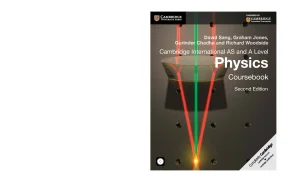
Tổng quan về giáo trình
Cambridge International AS and A Level Physics Coursebook (Second Edition) là giáo trình chuẩn hóa do Nhà xuất bản Đại học Cambridge (Cambridge University Press) ấn hành (ISBN: 978-1-107-69769-0), biên soạn bởi nhóm tác giả David Sang, Graham Jones, Gurinder Chadha và Richard Woodside. Giáo trình được thiết kế bám sát khung chương trình đào tạo môn Vật lý mã số 9702 của Hội đồng Khảo thí Quốc tế Cambridge (Cambridge International Examinations). Trong hệ thống giáo dục, tài liệu này giữ vị trí cầu nối quan trọng giữa chương trình trung học cơ sở (IGCSE/O Level) và các học phần Vật lý đại cương tại các trường đại học thuộc khối ngành Khoa học Tự nhiên, Công nghệ và Kỹ thuật.
Mục tiêu học tập (learning outcomes) của giáo trình được quy định cụ thể tại đầu mỗi chương:
- Định nghĩa chính xác các đại lượng, khái niệm và định luật vật lý nền tảng.
- Thiết lập và giải quyết các phương trình toán học mô tả hiện tượng vật lý.
- Rèn luyện kỹ năng phân tích đồ thị tọa độ và xử lý số liệu thực nghiệm.
- Phát triển năng lực lập kế hoạch, tiến hành và đánh giá các quy trình đo đạc trong phòng thí nghiệm.
Cấu trúc giáo trình phân chia thành ba phần chính:
- AS Level (Chương 1 đến 16 và chuyên đề P1): Giảng dạy trong năm thứ nhất, bao gồm cơ học, sóng học, điện học cơ bản và kỹ năng thực hành AS.
- A Level (Chương 17 đến 32 và chuyên đề P2): Giảng dạy trong năm thứ hai, bao gồm chuyển động tròn, trường hấp dẫn, dao động, nhiệt học nâng cao, điện từ học, vật lý lượng tử, vật lý hạt nhân, chẩn đoán hình ảnh y khoa và kỹ năng phân tích thực nghiệm nâng cao.
- Hệ thống phụ lục và tài nguyên: Bao gồm Phụ lục 1 (Đại lượng và đơn vị vật lý), Phụ lục 2 (Dữ liệu, công thức và mối quan hệ toán học), Phụ lục 3 (Bảng tuần hoàn hóa học), Bảng thuật ngữ (Glossary), Danh mục tra cứu (Index) và đĩa CD-ROM đính kèm.
Điểm đặc trưng của giáo trình là việc xây dựng nội dung xoay quanh 5 chủ đề xuyên suốt (themes): Mô hình của các hệ vật lý (Models of physical systems); Kiểm chứng dự đoán bằng chứng cứ (Testing predictions against evidence); Toán học như một ngôn ngữ và công cụ giải quyết vấn đề (Mathematics as a language and problem-solving tool); Vật chất, năng lượng và sóng (Matter, energy and waves); Lực và trường (Forces and fields).
+-------------------------------------------------------------------------------+
|       Cambridge International AS and A Level Physics Coursebook (9702)        |
+---------------------------------------+---------------------------------------+
|          NĂM THỨ NHẤT: AS LEVEL       |          NĂM THỨ HAI: A LEVEL         |
|  - Chương 1 đến 16: Động học, Lực,    |  - Chương 17 đến 32: Trường hấp dẫn,  |
|    Năng lượng, Điện học, Sóng cơ      |    Dao động, Khí lý tưởng, Lượng tử   |
|  - Chuyên đề P1: Kỹ năng thực hành    |  - Chuyên đề P2: Lập kế hoạch, phân   |
|    cơ bản và xử lý sai số             |    tích và đánh giá thực nghiệm       |
+---------------------------------------+---------------------------------------+
|  Phụ lục 1-3 | Bảng thuật ngữ (Glossary) | CD-ROM (Đáp án, Lời giải chi tiết)  |
+-------------------------------------------------------------------------------+
Nội dung kiến thức cốt lõi
Các chương và chủ đề chính
Giáo trình tổ chức 32 chương học cùng 2 chương kỹ năng thực hành chuyên biệt theo tiến trình logic chặt chẽ:
- Chương 1 & 2 (Kinematics & Accelerated Motion): Thiết lập sự khác biệt giữa đại lượng vô hướng (scalar) và đại lượng vector (vector) qua cặp khái niệm quãng đường - độ dịch chuyển ($d$ và $s$), tốc độ - vận tốc ($v$). Giới thiệu phương pháp giải tích đồ thị độ dịch chuyển – thời gian ($s-t$) và vận tốc – thời gian ($v-t$). Dẫn xuất 4 phương trình chuyển động biến đổi đều:
$$v = u + at$$
$$s = \frac{(u + v)}{2} \times t$$
$$s = ut + \frac{1}{2}at^2$$
$$v^2 = u^2 + 2as$$
Khảo sát gia tốc trọng trường tự do ($g = 9.81\text{ m s}^{-2}$) và chuyển động ném (projectiles) dựa trên việc phân tích các thành phần chuyển động vuông góc độc lập ($v_x = v \cos\theta, v_y = v \sin\theta$).
- Chương 3 & 4 (Dynamics & Forces): Phân tích các định luật chuyển động Newton, hệ thức $F = ma$, khái niệm khối lượng quán tính, lực cản môi trường và điều kiện cân bằng lực, mômen lực (moment of a force), ngẫu lực (torque of a couple).
- Chương 5 & 6 (Work, Energy, Power & Momentum): Nghiên cứu công cơ học, thế năng trọng trường ($E_p = mgh$), động năng ($E_k = \frac{1}{2}mv^2$), công suất ($P = \frac{W}{t}$) và nguyên lý bảo toàn động lượng trong va chạm đàn hồi và không đàn hồi một chiều cũng như hai chiều.
- Chương 8, 9, 10, 11 & 12 (Electric Fields & Practical Circuits): Khảo sát cường độ điện trường, dòng điện, hiệu điện thế, định luật Ohm, điện trở suất ($\rho = \frac{RA}{L}$), định luật Kirchhoff 1 và 2, mạch phân áp (potential dividers) và mạch đo điện thế (potentiometer circuits).
- Chương 13, 14 & 15 (Waves, Superposition & Stationary Waves): Khảo sát sóng dọc, sóng ngang, phương trình sóng ($v = f\lambda$), hiệu ứng Doppler, nguyên lý chồng chập sóng, hiện tượng giao thoa qua thí nghiệm hai khe Young ($\lambda = \frac{ax}{D}$), cách mạng nhiễu xạ ($d \sin\theta = n\lambda$) và sự hình thành sóng dừng với các nút (nodes) và bụng (antinodes).
- Chương 17, 18 & 19 (Circular Motion, Gravitational Fields & Oscillations): Định lượng chuyển động tròn qua radian và vận tốc góc ($\omega$), lực hướng tâm ($F = \frac{mv^2}{r} = mr\omega^2$), định luật vạn vật hấp dẫn của Newton, thế hấp dẫn ($\phi = -\frac{GM}{r}$), dao động điều hòa (SHM: $a = -\omega^2 x$), dao động tắt dần và hiện tượng cộng hưởng (resonance).
- Chương 21 & 22 (Thermal Physics & Ideal Gases): Nội năng, nhiệt dung riêng, nhiệt ẩn hóa hơi/nóng chảy, các định luật thực nghiệm về chất khí (Boyle, Charles) và phương trình trạng thái khí lý tưởng $pV = nRT = NkT$, mô hình động học giải thích áp suất chất khí ($pV = \frac{1}{3}Nm\langle c^2 \rangle$) và mối liên hệ giữa động năng phân tử với nhiệt độ nhiệt động lực học ($E_k = \frac{3}{2}kT$).
- Chương 26, 27, 28 & 29 (Electromagnetism & AC): Khảo sát từ trường, lực từ tác dụng lên dây dẫn ($F = BIL \sin\theta$) và điện tích chuyển động ($F = Bqv \sin\theta$), hiệu ứng Hall, định luật cảm ứng điện từ Faraday, định luật Lenz, dòng điện xoay chiều hình sin, giá trị hiệu dụng ($I_{\text{rms}} = \frac{I_0}{\sqrt{2}}$) và máy biến áp.
- Chương 30, 31 & 32 (Quantum, Nuclear Physics & Medical Imaging): Bản chất hạt của ánh sáng qua hiệu ứng quang điện ($hf = \Phi + \frac{1}{2}mv_{\text{max}}^2$), bước sóng de Broglie ($\lambda = \frac{h}{p}$), quang phổ vạch nguyên tử, năng lượng liên kết hạt nhân, quy luật phân rã phóng xạ ($x = x_0 e^{-\lambda t}$), và các nguyên lý kỹ thuật chẩn đoán hình ảnh: sản xuất tia X, độ suy giảm tia X, chụp cắt lớp vi tính (CAT), kỹ thuật siêu âm chẩn đoán và cộng hưởng từ (MRI).
Kiến thức nền tảng được xây dựng
- Các lý thuyết nền tảng (Fundamental theories): Hệ thống cơ học cổ điển Newton; Thuyết động học phân tử chất khí; Thuyết điện từ học cổ điển; Thuyết lượng tử ánh sáng (photon) và mô hình hạt nhân nguyên tử.
- Các nguyên lý cốt lõi (Core principles): Nguyên lý bảo toàn động lượng; Nguyên lý bảo toàn năng lượng toàn phần; Nguyên lý chồng chập sóng; Nguyên lý mômen lực trong trạng thái cân bằng tĩnh; Nguyên lý bảo toàn điện tích (Định luật Kirchhoff 1).
- Khung cấu trúc thiết yếu (Essential frameworks): Hệ đơn vị quốc tế SI gồm 7 đơn vị cơ bản (mét, kilôgam, giây, ampe, kenvin, mol, candela) và quy tắc dẫn xuất đơn vị ($1\text{ N} = 1\text{ kg m s}^{-2}$); Khung phân tích vector vuông góc hai chiều; Mô hình hóa toán học từ dữ liệu thực nghiệm thông qua phương trình tuyến tính ($y = mx + c$).
Kỹ năng phát triển
- Kỹ năng kỹ thuật phòng thí nghiệm (Technical skills): Vận hành các thiết bị đo đạc vật lý: cổng quang học (light gates), máy đếm nhịp ghi thời gian (ticker-timer), cảm biến chuyển động siêu âm (motion sensor), dao động ký tia điện tử (cathode-ray oscilloscope - c.r.o), các loại cầu đo điện thế và thiết bị quang học.
- Kỹ năng phân tích (Analytical skills): Xác định các đại lượng vật lý dựa trên độ dốc (gradient) và diện tích hình học dưới đường cong của đồ thị; Phân loại và định lượng các dạng sai số thực nghiệm bao gồm sai số hệ thống (systematic errors), sai số ngẫu nhiên (random errors), và sai số phần trăm (percentage uncertainty).
- Năng lực thực hành (Practical competencies): Thiết kế và lập kế hoạch quy trình thí nghiệm (chuyên đề P1 và P2), ghi chép và bảng biểu hóa số liệu, kiểm chứng các mối quan hệ hàm số, nhận diện các giới hạn kỹ thuật trong phép đo và đề xuất phương án cải tiến thiết bị.
Phương pháp giảng dạy và học tập
Giáo trình áp dụng mô hình sư phạm tích hợp lý thuyết và thực nghiệm, tổ chức cấu trúc bài học thành chu trình khép kín:
- Bối cảnh dẫn nhập (Context): Mở đầu bằng một hiện tượng thực tế (ví dụ: ảnh chụp hoạt nghiệm stroboscopic về động tác tung hứng, vận tốc chạy của báo săn cheetah, cơ chế bung túi khí ô tô).
- Hình thành khái niệm và dẫn xuất toán học: Định nghĩa học thuật chuẩn xác, đi kèm các bước chứng minh công thức từ định luật gốc (ví dụ: chứng minh công thức động năng $E_k = \frac{1}{2}mv^2$ từ phương trình chuyển động $v^2 = u^2 + 2as$ và định luật Newton $F = ma$).
- Ví dụ giải mẫu từng bước (Worked Examples): Hướng dẫn học viên phương pháp giải toán định lượng theo 3 bước chuẩn mực:
- Bước 1: Liệt kê các đại lượng đã biết và đại lượng cần tìm kèm đơn vị.
- Bước 2: Lựa chọn phương trình vật lý phù hợp, biến đổi đại số để đưa đại lượng cần tìm về một vế trước khi thay số.
- Bước 3: Thực hiện phép tính, kiểm tra tính cân bằng thứ nguyên và ghi kết quả với chữ số có nghĩa và đơn vị đo chuẩn.
- Hộp thực nghiệm (Practical Boxes): Các hộp chuyên đề như Box 1.1 (Đo tốc độ trong phòng thí nghiệm), Box 2.1 (Đo gia tốc), Box 2.2 (Đo gia tốc trọng trường $g$) cung cấp sơ đồ lắp ráp chi tiết thiết bị, so sánh ưu - nhược điểm và độ chính xác của từng phương pháp.
+-------------------------------------------------------------------------------+
|                       QUY TRÌNH TIẾP CẬN SƯ PHẠM                              |
+-------------------------------------------------------------------------------+
| 1. Bối cảnh thực tế  -->  2. Định nghĩa &      -->  3. Ví dụ mẫu 3 bước        |
|    (Contexts)                Dẫn xuất công thức        (Worked Examples)      |
+-------------------------------------------------------------------------------+
|                                      |                                        |
|                                      v                                        |
| 5. Đánh giá cuối chương  <--  4. Câu hỏi tự đánh giá <-- Hộp thực nghiệm       |
|    (End-of-chapter Qs)        (Self-assessment Qs)       (Practical Boxes)    |
+-------------------------------------------------------------------------------+
Hệ thống đánh giá được phân tầng khoa học:
- Câu hỏi tự đánh giá (Self-assessment questions): Phân bổ trực tiếp sau từng mục kiến thức nhỏ nhằm giúp người học kiểm tra ngay mức độ tiếp thu khái niệm.
- Bài tập cuối chương (End-of-chapter questions): Gồm hệ thống câu hỏi ngắn củng cố lý thuyết và các câu hỏi dạng đề thi (exam-style questions) có quy định thang điểm cụ thể cho từng ý (ví dụ: [1], [2], [3], [4] điểm), giúp học viên làm quen với cấu trúc barem điểm thi chuẩn của Cambridge.
- Tình huống nghiên cứu (Case Studies): Lồng ghép bài toán điều tra tai nạn giao thông dựa trên vết trượt phanh của xe (skid marks) để minh họa việc ứng dụng phương trình chuyển động trong thực tế (trang 23).
- Chỉ dẫn tự học (Self-study guidelines): Tác giả khuyến nghị người học luôn tự giải các bài tập trước khi xem phần diễn giải hoặc đáp án; sử dụng đĩa CD-ROM đi kèm để tra cứu toàn bộ lời giải chi tiết và hướng dẫn ôn tập.
Điểm nổi bật và cập nhật
- Cập nhật theo khung chương trình mới: Phiên bản thứ hai (Second edition) được tái cấu trúc hoàn toàn nhằm đáp ứng chuẩn đầu ra của đề cương Cambridge International AS and A Level Physics (9702). Nội dung phân tách rõ rệt giữa chương trình AS Level và A Level, giúp việc phân bổ kế hoạch giảng dạy theo niên chế 2 năm đạt tính chuẩn xác cao.
- Tích hợp chuyên đề thực nghiệm chuyên sâu (P1 và P2): Điểm bổ sung trọng tâm của phiên bản này là hai chương P1 (Practical skills at AS level) và P2 (Planning, analysis and evaluation). Các chương này chuẩn hóa phương pháp xử lý số liệu thực nghiệm, tính toán sai số tuyệt đối, sai số phần trăm, kỹ thuật vẽ đồ thị với đường khớp tối ưu (best fit line) và đánh giá độ tin cậy của mô hình thí nghiệm.
- Tích hợp công nghệ đo lường hiện đại: Giáo trình cập nhật việc ứng dụng các cảm biến vi cơ điện tử (micro-mechanical acceleration sensors) trong công nghiệp ô tô (trang 18) và việc sử dụng cảm biến chuyển động siêu âm (ultrasound motion sensors) kết nối máy tính để thu thập dữ liệu thời gian thực.
- Mở rộng ứng dụng thực tế và liên ngành:
- Y sinh học: Chương 32 phân tích chuyên sâu các kỹ thuật tạo ảnh y khoa đương đại gồm ống phát tia X, sự suy giảm chùm tia X ($I = I_0 e^{-\mu x}$), máy chụp cắt lớp điện toán (CAT scanner), đầu dò siêu âm áp điện và kỹ thuật ghi hình cộng hưởng từ (MRI).
- Viễn thông và Kỹ thuật số: Chương 20 cung cấp kiến thức về điều chế tín hiệu biên độ (AM), điều chế tần số (FM), chuyển đổi tương tự - số (ADC), truyền dẫn cáp quang và kênh truyền thông vệ tinh.
- Điện tử học ứng dụng: Chương 25 giới thiệu hoạt động của bộ khuếch đại thuật toán (op-amp) ở chế độ đảo (inverting) và không đảo (non-inverting), liên kết trực tiếp với các mạch cảm biến nhiệt độ, ánh sáng trong thực tế.
Đối tượng sử dụng giáo trình
- Học viên và sinh viên:
- Học sinh theo học chương trình Cambridge International AS and A Level Physics (lớp 11 và lớp 12) chuẩn bị cho các kỳ thi chuẩn hóa quốc tế.
- Học sinh các chương trình dự bị đại học (Foundation programs), chương trình Tú tài quốc tế hoặc các khóa học chuyển tiếp đại học.
- Sinh viên năm thứ nhất các trường đại học theo học các học phần Vật lý đại cương (General Physics) thuộc khối ngành Kỹ thuật (Điện, Cơ khí, Xây dựng), Khoa học máy tính, Khoa học vật liệu và Y - Dược.
- Kiến thức tiên quyết (Prerequisites):
- Đã hoàn thành chương trình Vật lý cơ sở (tương đương cấp độ IGCSE/O Level hoặc chương trình trung học cơ sở).
- Kiến thức toán học: Đại số căn bản, giải phương trình bậc nhất và bậc hai, lượng giác cơ bản (sin, cos, tan của tam giác vuông), tính chất hình học, biểu diễn và đọc hiểu đồ thị hai trục tọa độ Đề-các ($x-y$). Giáo trình không yêu cầu kiến thức toán giải tích vi phân và tích phân phức tạp do toán học đã được chuẩn hóa theo khung đề cương 9702.
- Giảng viên và phương thức giảng dạy:
- Sử dụng làm tài liệu giảng dạy chính khóa trên lớp, xây dựng giáo án lý thuyết và bài tập.
- Khai thác hệ thống hộp thực nghiệm (Boxes) và hai chương P1, P2 để thiết kế các buổi thực hành phòng thí nghiệm.
- Sử dụng ngân hàng câu hỏi cuối chương có barem điểm để biên soạn các đề kiểm tra định kỳ và thi thử. Giảng viên có thể kết hợp cùng đĩa tài nguyên Teacher’s Resource CD-ROM (ISBN 978-1-107-66300-8).
- Nghiên cứu độc lập và tham khảo: Người tự học có thể sử dụng giáo trình độc lập nhờ văn phong khoa học chuẩn mực, hệ thống giải nghĩa thuật ngữ (Glossary), phụ lục công thức (Appendix 2) và đĩa CD-ROM đi kèm chứa toàn bộ đáp án và lời giải chi tiết từng bước.
Câu hỏi thường gặp (FAQ)
1. Giáo trình này phù hợp với đối tượng nào?
Giáo trình được thiết kế chuẩn mực cho học sinh học chương trình Cambridge International AS & A Level Physics (mã môn 9702), học viên các chương trình dự bị đại học quốc tế, và sinh viên năm thứ nhất các khối ngành kỹ thuật hoặc khoa học tự nhiên cần tài liệu chuẩn về vật lý đại cương.
2. Cần chuẩn bị những kiến thức nền tảng nào trước khi học?
Người học cần có kiến thức vật lý tổng quát cấp trung học cơ sở (tương đương IGCSE/O Level) và nền tảng toán học đại số cơ bản, lượng giác tam giác vuông và kỹ năng phân tích đồ thị $x-y$. Giáo trình không yêu cầu toán cao cấp vi tích phân.
3. Điểm khác biệt của giáo trình này so với các tài liệu vật lý khác là gì?
Giáo trình phân định cấu trúc rõ ràng giữa hai cấp độ AS Level (năm 1) và A Level (năm 2); tích hợp riêng hai chương kỹ năng thực nghiệm và xử lý sai số (P1, P2); sử dụng quy trình giải mẫu 3 bước nhất quán trong các Worked Examples; và cung cấp hệ thống câu hỏi cuối chương phân bổ theo thang điểm thi thực tế.
4. Phương pháp tự học giáo trình này để đạt hiệu quả cao?
Người học cần theo dõi 5 chủ đề cốt lõi xuyên suốt sách; đọc kỹ mục tiêu học tập ở đầu mỗi chương; tự giải các câu hỏi trong bài trước khi xem lời giải mẫu; làm đầy đủ các bài tập cuối chương và đối chiếu với đáp án chi tiết trên CD-ROM; đồng thời tra cứu định nghĩa tại phần Glossary và công thức tại Appendix 2.
5. Giáo trình có tài liệu bổ trợ nào đi kèm?
Mỗi cuốn sách kèm theo một đĩa CD-ROM chứa toàn bộ đáp án và lời giải chi tiết cho tất cả câu hỏi tự đánh giá và bài tập cuối chương, tài liệu chỉ dẫn phương pháp ôn thi, và danh mục tài liệu đọc thêm (Further reading). Ngoài ra, giảng viên có thể tham khảo ấn bản bổ trợ Teacher’s Resource CD-ROM (ISBN 978-1-107-66300-8).
Kết luận
Cambridge International AS and A Level Physics Coursebook (Second Edition) là tài liệu học thuật cung cấp toàn diện kiến thức vật lý đại cương từ cơ học cổ điển, điện từ học đến vật lý hiện đại và ứng dụng y sinh. Giá trị cốt lõi của giáo trình nằm ở tính chuẩn hóa học thuật, cấu trúc phân tầng rõ ràng giữa lý thuyết định lượng, công cụ toán học và phương pháp luận thực nghiệm khoa học.
Lộ trình học tập đề xuất là hoàn thành tuần tự chương trình AS Level (Chương 1 đến 16 và chuyên đề P1) trong năm thứ nhất để xây dựng nền tảng vững chắc về động học, động lực học, điện học và sóng học; sau đó tiếp tục hoàn thành chương trình A Level (Chương 17 đến 32 và chuyên đề P2) trong năm thứ hai để làm chủ các chủ đề nâng cao về trường lực, nhiệt động lực học, vật lý lượng tử và kỹ thuật hạt nhân. Người học có thể khai thác tối đa nguồn tài nguyên số trên đĩa CD-ROM, hệ thống thuật ngữ Glossary và các phụ lục tra cứu để phục vụ cho quá trình học tập và nghiên cứu chuyên sâu.