Giới thiệu lý thuyết và chính sách ngoại thương quốc tế hiện đại

Tài liệu học Unit I: Thương mại quốc tế và chính sách. Phân tích các nguyên lý, rào cản thương mại, và vai trò của chính sách trong nền kinh tế toàn cầu.

Người đăng

Ẩn danh
382
0
0

Phí lưu trữ

75 Point

Tóm tắt

I. Tổng quan về thương mại quốc tế và chính sách

Thương mại quốc tế là hoạt động trao đổi hàng hóa, dịch vụ và vốn giữa các quốc gia. Hoạt động này đã phát triển nhanh hơn tốc độ tăng trưởng sản lượng toàn cầu trong suốt 250 năm qua. Số liệu thống kê cho thấy giá trị xuất khẩu hàng hóa thế giới tăng từ 55 tỷ USD năm 1950 lên hơn 6.350 tỷ USD năm 2000. Đây là minh chứng rõ ràng cho sự mở rộng không ngừng của thị trường quốc tế. Ba yếu tố thúc đẩy thương mại quốc tế bao gồm môi trường kinh doanh cạnh tranh, toàn cầu hóa quản lý và chính sách tự do hóa thương mại của các quốc gia thành viên. Thương mại quốc tế khác biệt so với thương mại nội địa ở nhiều khía cạnh. Sự khác biệt chính nằm ở yếu tố di chuyển nhân tố sản xuất, tiền tệ, luật pháp và văn hóa giữa các quốc gia. Tuy nhiên, cả hai loại hình thương mại đều hướng tới mục tiêu tối ưu hóa nguồn lực và gia tăng phúc lợi xã hội. Các lý thuyết kinh tế cổ điển và hiện đại đã giải thích sâu sắc nguyên nhân và động lực thúc đẩy thương mại giữa các quốc gia.

1.1. Khái niệm và tầm quan trọng của thương mại quốc tế

Thương mại quốc tế được định nghĩa là hoạt động trao đổi hàng hóa và dịch vụ vượt qua biên giới quốc gia. Hoạt động này đóng vai trò then chốt trong nền kinh tế toàn cầu. Thương mại quốc tế giúp các quốc gia khai thác lợi thế so sánh, tiếp cận hàng hóa đa dạng và nâng cao hiệu quả sử dụng nguồn lực. Xu hướng toàn cầu hóa và tự do hóa thương mại đã khiến thị trường quốc tế mở rộng nhanh chóng. Các nước đang phát triển có tốc độ tăng trưởng xuất khẩu cao hơn các nước phát triển. Điều này tạo ra cơ hội bình đẳng hơn trong thương mại thế giới.

1.2. So sánh thương mại nội địa và thương mại quốc tế

Thương mại nội địa và thương mại quốc tế có nhiều điểm tương đồng. Cả hai đều dựa trên nguyên tắc phân công lao động và trao đổi hàng hóa nhằm đạt lợi ích kinh tế. Tuy nhiên, sự khác biệt rất đáng kể. Thương mại quốc tế đối mặt với rào cản ngôn ngữ, khác biệt tiền tệ, hệ thống pháp luật riêng biệt và hạn chế di chuyển nhân tố sản xuất. Rủi ro chính trị và biến động tỷ giá hối đoái cũng là thách thức lớn. Chi phí vận chuyển quốc tế cao hơn đáng kể so với nội địa. Các yếu tố văn hóa và xã hội cũng ảnh hưởng sâu sắc đến mô hình thương mại quốc tế.

II. Phân tích các lý thuyết thương mại quốc tế chính

Nhiều lý thuyết kinh tế đã giải thích nguyên nhân và lợi ích của thương mại quốc tế. Adam Smith đề xuất lý thuyết lợi thế tuyệt đối. Lý thuyết này khẳng định mỗi quốc gia nên chuyên sản xuất hàng hóa có chi phí thấp hơn so với các quốc gia khác. David Ricardo mở rộng lý thuyết này bằng học thuyết lợi thế so sánh. Theo Ricardo, ngay cả khi một quốc gia kém hiệu quả trong mọi ngành sản xuất, quốc gia đó vẫn có thể hưởng lợi từ thương mại bằng cách tập trung vào hàng hóa có chi phí tương đối thấp nhất. Haberler phát triển lý thuyết chi phí cơ hội. Lý thuyết này loại bỏ giả định bất hợp lý của lý thuyết giá trị lao động cổ điển. Thay vì đo lường chi phí bằng lao động, Haberler sử dụng chi phí cơ hội để xác định lợi thế thương mại. Lý thuyết Heckscher-Ohlin đại diện cho lý thuyết hiện đại. Lý thuyết này giải thích thương mại dựa trên sự khác biệt về sự dồi dào các yếu tố sản xuất giữa các quốc gia. Quốc gia có nhiều lao động sẽ xuất khẩu hàng hóa thâm dụng lao động. Quốc gia có nhiều vốn sẽ xuất khẩu hàng hóa thâm dụng vốn. Mỗi lý thuyết cung cấp góc nhìn riêng nhưng đều hướng tới giải thích lợi ích của thương mại tự do.

2.1. Lý thuyết lợi thế tuyệt đối và lợi thế so sánh

Adam Smith cho rằng thương mại quốc tế phát sinh khi mỗi quốc gia có lợi thế tuyệt đối trong sản xuất một loại hàng hóa nhất định. Quốc gia nào sản xuất hàng hóa với chi phí thấp hơn sẽ xuất khẩu hàng hóa đó. David Ricardo bổ sung quan trọng bằng lý thuyết lợi thế so sánh. Ngay cả khi một quốc gia không có lợi thế tuyệt đối ở bất kỳ sản phẩm nào, thương mại vẫn mang lại lợi ích. Quốc gia nên chuyên môn hóa sản xuất hàng hóa mà mình có lợi thế so sánh lớn nhất hoặc bất lợi so sánh nhỏ nhất. Lý thuyết này trở thành nền tảng cơ bản của kinh tế học thương mại quốc tế hiện đại.

2.2. Lý thuyết chi phí cơ hội và lý thuyết Heckscher Ohlin

Lý thuyết chi phí cơ hội của Haberler cải tiến đáng kể so với lý thuyết cổ điển. Thay vì dựa trên lý thuyết giá trị lao động, Haberler sử dụng chi phí cơ hội để đo lường lợi thế sản xuất. Chi phí cơ hội phản ánh lượng hàng hóa phải hy sinh để sản xuất thêm một đơn vị hàng hóa khác. Lý thuyết Heckscher-Ohlin giải thích thương mại dựa trên sự khác biệt về nguồn lực yếu tố sản xuất. Quốc gia dồi dào lao động xuất khẩu hàng hóa thâm dụng lao động. Quốc gia dồi dào vốn xuất khẩu hàng hóa thâm dụng vốn. Lý thuyết này áp dụng thực tiễn hơn vì phản ánh đúng cấu trúc kinh tế đa dạng của các quốc gia trên thế giới.

III. Cán cân thanh toán và cơ chế điều chỉnh bất ổn

Cán cân thanh toán quốc tế là bảng thống kê ghi nhận toàn bộ giao dịch kinh tế giữa cư dân trong nước với phần còn lại của thế giới. Cán cân thanh toán bao gồm hai tài khoản chính. Tài khoản vãng lai ghi nhận giao dịch hàng hóa, dịch vụ và chuyển nhượng một chiều. Tài khoản vốn ghi nhận giao dịch đầu tư và tài chính quốc tế. Cán cân thanh toán có thể rơi vào trạng thái bất ổn. Tình trạng bất ổn xuất hiện khi tổng thu ngoại tệ không cân bằng với tổng chi ngoại tệ. Nguyên nhân gây bất ổn được phân thành ba nhóm. Nhóm nhân tố kinh tế bao gồm bất ổn phát triển, bất ổn chu kỳ và bất ổn dài hạn. Bất ổn phát triển thường xảy ra ở các nước đang phát triển do nhập khẩu lớn hàng hóa tư bản. Bất ổn chu kỳ liên quan đến biến động kinh doanh giữa thời kỳ suy thoái và hưng thịnh. Nhóm nhân tố chính trị bao gồm chiến tranh, bất ổn nội bộ và thay đổi chính sách. Nhóm nhân tố xã hội bao gồm thiên tai, dịch bệnh và thay đổi tập quán tiêu dùng. Cơ chế điều chỉnh bất ổn sử dụng nhiều công cụ khác nhau. Các công cụ bao gồm điều chỉnh tỷ giá hối đoái, chính sách tài khóa, chính sách tiền tệ và kiểm soát thương mại.

3.1. Cấu trúc và phân loại cán cân thanh toán

Cán cân thanh toán có cấu trúc rõ ràng gồm nhiều phần. Tài khoản vãng lai chứa tài khoản hàng hóa, tài khoản dịch vụ và tài khoản thu nhập yếu tố. Tài khoản hàng hóa ghi nhận kim ngạch xuất nhập khẩu hữu hình. Tài khoản dịch vụ bao gồm du lịch, vận tải và bảo hiểm. Tài khoản thu nhập yếu tố ghi nhận lương và lợi nhuận từ nước ngoài. Tài khoản vốn ghi nhận đầu tư trực tiếp, đầu tư danh mục và các khoản vay. Cuối cùng, dự trữ ngoại hối của ngân hàng trung ương điều chỉnh phần chênh lệch. Cấu trúc này phản ánh toàn diện quan hệ kinh tế quốc tế của mỗi quốc gia.

3.2. Nguyên nhân gây bất ổn cán cân thanh toán

Nguyên nhân bất ổn cán cân thanh toán được phân thành ba nhóm chính. Nhóm nhân tố kinh tế gồm bất ổn phát triển, chu kỳ và dài hạn. Bất ổn phát triển xuất phát từ nhu cầu nhập khẩu tư bản lớn ở nước đang phát triển. Bất ổn chu kỳ liên quan đến biến động sản xuất và thương mại trong chu kỳ kinh doanh. Bất ổn dài hạn tồn tại do xu hướng cơ cấu kinh tế như thu nhập cao dẫn đến nhập khẩu tăng. Nhóm nhân tố chính trị bao gồm chiến tranh và thay đổi chính sách đột ngột. Nhóm nhân tố xã hội gồm thiên tai và dịch bệnh. Mỗi nhóm nguyên nhân đòi hỏi phương pháp điều chỉnh phù hợp.

IV. Kết luận và ứng dụng lý thuyết thương mại quốc tế

Thương mại quốc tế là trụ cột quan trọng của nền kinh tế toàn cầu hiện đại. Các lý thuyết từ Adam Smith đến Heckscher-Ohlin đã xây dựng nền tảng vững chắc để hiểu nguyên nhân và lợi ích của thương mại tự do. Lợi thế tuyệt đối, lợi thế so sánh, chi phí cơ hội và lý thuyết yếu tố sản xuất đều chỉ ra rằng hợp tác thương mại mang lại lợi ích chung. Cán cân thanh toán quốc tế phản ánh sức khỏe kinh tế của mỗi quốc gia. Bất ổn cán cân thanh toán có thể xuất phát từ nhiều nguyên nhân kinh tế, chính trị và xã hội. Cơ chế điều chỉnh cần được áp dụng linh hoạt để duy trì sự cân bằng. Ứng dụng thực tiễn của các lý thuyết này rất rộng rãi. Chính phủ sử dụng lý thuyết thương mại để xây dựng chính sách xuất nhập khẩu. Doanh nghiệp áp dụng lợi thế so sánh để lựa chọn ngành sản xuất chiến lược. Tổ chức quốc tế dựa vào lý thuyết này để thúc đẩy tự do hóa thương mại toàn cầu. Hiểu biết sâu sắc về thương mại quốc tế và chính sách là điều kiện tiên quyết để tham gia hiệu quả vào nền kinh tế thế giới.

4.1. Ứng dụng lý thuyết trong xây dựng chính sách thương mại

Các lý thuyết thương mại quốc tế có giá trị ứng dụng cao trong thực tiễn hoạch định chính sách. Chính phủ dựa vào lý thuyết lợi thế so sánh để xác định ngành ưu tiên xuất khẩu. Chính sách thuế quan và hạn ngạch được xây dựng dựa trên phân tích lợi ích và thiệt hại từ thương mại. Lý thuyết Heckscher-Ohlin giúp quốc gia định hướng phát triển ngành phù hợp với nguồn lực sẵn có. Ví dụ, quốc gia có nhiều lao động giá rẻ nên phát triển ngành sản xuất thâm dụng lao động. Tổ chức WTO sử dụng các nguyên tắc thương mại tự do để đàm phán cắt giảm rào cản thương mại đa phương.

4.2. Ý nghĩa của cán cân thanh toán đối với nền kinh tế

Cán cân thanh toán là công cụ đo lường sức khỏe kinh tế quốc gia trong quan hệ quốc tế. Thặng dư cán cân thanh toán cho thấy quốc gia thu nhiều ngoại tệ hơn chi ra. Ngược lại, thâm hụt kéo dài cảnh báo rủi ro mất cân đối tài chính. Ngân hàng trung ương sử dụng dữ liệu cán cân thanh toán để điều chỉnh chính sách tiền tệ. Tỷ giá hối đoái được can thiệp nhằm ổn định cán cân thanh toán. Nhà đầu tư quốc tế quan sát cán cân thanh toán để đánh giá rủi ro đầu tư. Quốc gia duy trì cán cân thanh toán ổn định sẽ thu hút nhiều đầu tư nước ngoài hơn.
21/04/2026

Trích đoạn nội dung tài liệu

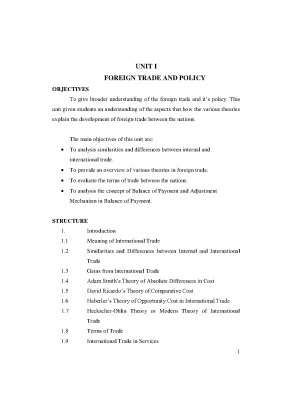
UNIT I FOREIGN TRADE AND POLICY OBJECTIVES To give broader understanding of the foreign trade and it‘s policy. This unit given students an understanding of the aspects that how the various theories explain the development of foreign trade between the nations. The main objectives of this unit are:  To analysis similarities and differences between internal and international trade.  To provide an overview of various theories in foreign trade.  To evaluate the terms of trade between the nations.  To analysis the concept of Balance of Payment and Adjustment Mechanism in Balance of Payment.1 Meaning of International Trade 1.2 Similarities and Differences between Internal and International Trade 1.3 Gains from International Trade 1.4 Adam Smith‘s Theory of Absolute Differences in Cost 1.5 David Ricardo‘s Theory of Comparative Cost 1.6 Haberler‘s Theory of Opportunity Cost in International Trade 1.7 Heckscher-Ohlin Theory or Modern Theory of International Trade 1.8 Terms of Trade 1.9 International Trade in Services 1 1.10 Meanings of Balance of Payment 1.11 Structure of Balance of Payment 1.12 Balance of Payments Disequilibrium 1.13 Adjustment Mechanism in balance of Payments Account 1.15 Self-Assessment Questions 1. Introduction:- The international trade has been growing faster than world output indicates that the international market is expanding faster than the domestic markets. There are indeed many Indian firms too whose foreign business is gro wing faster than the domestic business. Business, in fact, is increasingly becoming international or global in its competitive environment, orientation, content and strategic intent. This is manifested/ necessitated/ facilitated by the following facts: (a) The Competitive business Environment (b)Globalisation of management (c) The universal liberlisation Policy by member countries. Table - 1 Growth of World Merchandise Exports Value of merchandise exports Year (in billions of US $) 1950 55 1960 113 1970 280 1980 1846 1990 3311 2000 6350 2002 6272 2 Table-1 shows the growth of world merchandise exports. The table indicates that during 1950-60, the value of world exports more than double. In the next decade it increased nearly 2 ½ times. During the 1970s, the value of the world exports increased by about 5 ½ times. Worldwide inflation, particularly the successive hikes in oil prices, significantly contributed to this unprecedented sharp increase in the value of world exports. During 1980-90, the value of world exports increased by 80 per cent. Between 1990 and 2000, it increased by over 90 per cent. In fact, exports of developing countries have been increasing faster than those of the developed. Historically, trade growth consistently outpaced overall economic growth for at least 250 years, except for a comparatively brief period from 1913 to 1950 characterised by heavy protectionism which was almost a by-product of the two World Wars. Between 1720 and 1913, trade growth was about one-and- a-half times the GDP growth. Slow GDP growth between 1913 and 1950 - the period with the lowest average economic growth rate since 1820 – was accompanied by even slower trade growth, as war and protectionism undermined international trade. This period was also plagued by the great depression. The Second half of the twentieth century has seen trade expand substantially faster than output. In the last two decades of the twentieth century, world trade has grown twice as fast as world real GDP (6 per cent versus 3 per cent). That trade has been growing faster than world output means that a growing proportion of the national output is traded internationally. The foreign trade-GDP ratio (i., the value of the exports expressed as a percentage of the 3 value of GDP) generally rises with economic development. This ratio has been generally high for the economically advanced countries when compared with that of the less developed countries. However, by the beginning of the 1990s, the developing countries overtook the developed countries in the trade-GDP ratio and today it is substantially high for developing countries over the developed ones. There are some extreme cases like Singapore and Hong Kong with exceptionally high foreign trade-GDP ratio of well over 200 per cent. Because of the faster trade growth, by the beginning of the 1990s, the developing countries overtook the developed countries in the trade-GDP ratio and today it is substantially high for developing countries over the developed ones. In 2001, the trade-GDP ratio was 38 per cent for high income economies and 49 per cent for the developing countries. The developing countries, thus, are much more integrated than the developed ones with the global economy by trade. Among he developing countries, it was 51 per cent for middle income economies and 39 per cent for low income economies. India presented an interesting case. There was near stagnation in its foreign trade-GDP ratio for about four decades since the commencement of development planning. During this period it hovered around 15 per cent. The inward looking economic policy, import compression and very slow progress on the export front were responsible for this. Since the economic liberalization, ushered in 1991, there has, however, been an increase in India‘s foreign trade- GDP ratio – it is about 20 per cent now. This unit concentrate on the main dimension of foreign trade and policy namely various trade theories, Terms of Trade, Balance of Payments and Adjustment Mechanism in Payments.1 Meanings of International Trade:- Internal trade or domestic trade refers to the exchange of goods and services between the buyers and sellers within the political boundaries of the same country. It may be carried on either as a wholesale trade or a retail trade. External trade or international trade, on the other hand, is the trade between different countries i. it extends beyond the political boundaries of the countries engaged in it. In other words, it is the trade between two countries. Hence, it is also known as foreign trade. The need for international trade was not so compelling in those days. Trading with nations beyond the seas was not, however unknown to ancient Indians. Evidences about our international trade are found in the ancient literatures of our country particularly in our Sangam Literatures. There was a regular ―Trade Route‖ across the seas to the distant Jawa and Sumatra islands in the east and up to the Arabian Peninsula in the west. But the volume of such trade was insignificant and continued to remain so tight through the middle ages and up to the advent of the British rule in India. It is only after the establishment of the British rule that India‘s foreign trade took a definite shape. International trade on large scale has become a phenomenon of the 20 th century especially after the Second World War. There is practically no country today, which is functioning as a closed system. Even socialist countries like Russia and China are now taking concrete steps to capture foreign markets for the products produced in their country. International trade, thus, has become as essential ingredient of the normal economic life of any country. In terms of economic development, international trade is a potentially effective engine of growth.2 Similarities and Differences between Internal and International Trade:- In this section similarities and differences between the internal and international trade are focused. The general procedure, mechanism and operations are similar to both internal trade and international trade. The following are the basic similarities between the two. Satisfaction of Consumer: Both in domestic trade and in international trade, success depends upon effectively satisfying the basic requirements of the consumers. Goodwill Creation: It is necessary to build goodwill both in the domestic market as well as in the international market. If a firm is able to develop goodwill of the consumers, its task will be much simpler than the one, which is not able to build up its own reputation. In both the cases, the seller should take all positive measures to gain the confidence of the consumers in his product. Market Research: The marketing programme should be formulated after a careful market research and survey. This proposition shall hold good in both the cases. Failure to assess the target market shall ultimately bring failure in the task of marketing. Product Planning and Development: Research and development with a view to product improvement and adaptation is necessary in both internal and international trade. The marketer should keep a constant watch over the market situation and the changes occurring in the consumer‘s tastes and the preferences and develop or modify his product to suit the needs of his customers. 6 However, there are certain special features, which differentiate internal trade from international trade. They are explained as following manner: 1. Demand and Supply: Demand and supply cannot work out their full effects where foreign trade is concerned. Where as such factors can work out their full efforts in the case of internal trade. Physical Obstacle to Commerce: Where international trade is carried on, a far greater degree of inequality between conditions of production in different countries is necessary to stimulate trade when the countries are widely separated than when they are adjoining. Artificial Barriers to Trade: The natural difficulties may be increased by artificial barriers to trade, either through prohibitive laws as in war time of through customs duties or protective tariffs in the context of international trade. Obstacles to Migration of Labour: Serious obstacles to the migration of labour from country to country such as language differences are often prohibitive, while feelings of patriotism help to keep men in their own country. According to Briggs ―For every man who will so change his habits as to go to work abroad, there are a hundred who will move from district to district within a country.‖ Even, though a relatively small migration is necessary to equalise the conditions in two countries neighbouring states may persist for generations is standards of life which are markedly different. Obstacles of Mobility of Capital: Men who refuse to leave their own land may invest capital abroad, but a home investment is usually preferred to a foreign. A foreign loan must offer a much higher rate of interest than a home loan. Not only is there a real risk of loss of interest 7 and even capital, but an investor feels a sense of insecurity when money is invested abroad. Differences in Economic Environment from country to country: Different countries have different facilities in carrying out their productive activities. Differences in system of national and local taxation, regulations for health, sanitation, factory organisation, education and insurance, policy regarding the transport and public utilities, laws relating to industrial combinations and trade, etc., do exist as between countries. These differences bring about a difference in the costs of production between them. Currency differences are still more important because of the fact that exchange is thereby hampered. For instance, if an Indian manufacturer wishes to sell goods in the U.A or English, he must know the value of the U.A or England currency units in terms of Indian money. Apart form this, each country is under the control of a separate central bank, each following a separate monetary policy which may greatly affect the foreign trade of the country. The geographical and climatic conditions may give rise to territorial division of labour and localization of industries. Some countries may have natural resources is abundance such as iron ore, coal, etc., whereas in some other countries climatic conditions give advantages to them. Long-distance: International trade is predominantly long-distance. This may affect the transport costs and the mobility of the different factors of production. Preference: Preference for home and the prejudice against foreigners remain as one of the major factors that would explain as to why the rates of earning of the different of equal efficiency would not be equalized between different countries.3 Gains from International Trade:- In this section the various gains of international trade can be listed as follows: 1. International Specialisation: International trade enables to specialize in the production of those goods in which each country has special advantages.

Nội dung được bảo vệ bản quyền — Tải xuống đầy đủ