Khóa luận về vai trò của thần học trong nhận thức luận - Thomas Rubino

Dưới đây là meta tags cho bài viết 'The theological thesis theologys role in western epistemology' theo yêu cầu: { "ai_description": "Tìm hiểu vai trò của

Trường đại học

The College of William and Mary

Chuyên ngành

Nghiên cứu tôn giáo

Người đăng

Ẩn danh

Thể loại

Khóa luận tốt nghiệp

2019

111
0
0

Phí lưu trữ

35 Point

Tóm tắt

I. Tổng quan về vai trò thần học trong nhận thức luận phương Tây

Thần học đóng vai trò then chốt trong nhận thức luận phương Tây khi xác định nền tảng tri thức qua niềm tin tôn giáo. Từ thời kỳ Trung cổ đến Khai sáng, các triết gia như Augustine, Aquinas và Ockham đã xây dựng hệ thống nhận thức kết hợp giữa lý trí và đức tin. Thần học cung cấp khuôn khổ siêu hình cho việc hiểu biết về chân lý, nơi các chân lý tôn giáo được coi là nền tảng cho nhận thức về thế giới. Sự tương tác giữa thần học và nhận thức luận phản ánh quan điểm rằng kiến thức không chỉ đến từ kinh nghiệm cảm tính mà còn từ mặc khải thiêng liêng. Mối quan hệ này đã định hình tư duy phương Tây trong nhiều thế kỷ, tạo nên sự cân bằng giữa lý trí khoa học và đức tin tôn giáo.

1.1. Thần học trong nhận thức luận thời Trung cổ

Thời Trung cổ, thần học và triết học gắn bó chặt chẽ khi các nhà thần học như Augustine và Aquinas sử dụng lý trí để lý giải đức tin. Augustine cho rằng kiến thức chân thực đến từ sự mặc khải của Chúa, trong khi Aquinas lập luận rằng lý trí và đức tin bổ trợ cho nhau. Ockham sau đó nhấn mạnh tầm quan trọng của logic trong việc xác định chân lý, tách biệt nhận thức về thế giới vật chất và siêu hình. Những quan điểm này thiết lập nền tảng cho nhận thức luận phương Tây, nơi thần học đóng vai trò trung tâm trong việc xác định chân lý.

1.2. Ảnh hưởng của Khai sáng đến thần học nhận thức luận

Thời Khai sáng, các triết gia như Hume và Schleiermacher thách thức vai trò của thần học trong nhận thức luận. Hume cho rằng kiến thức chỉ đến từ kinh nghiệm cảm tính, loại trừ đức tin tôn giáo khỏi phạm vi tri thức hợp lệ. Schleiermacher, ngược lại, lập luận rằng tôn giáo là một hình thức nhận thức độc lập, dựa trên trực giác và cảm xúc. Sự thay đổi này phản ánh sự chuyển dịch từ thần học sang chủ nghĩa duy vật trong nhận thức luận phương Tây.

II. Phân tích mối quan hệ giữa thần học và nhận thức luận phương Tây

Mối quan hệ giữa thần học và nhận thức luận phương Tây phức tạp và đa chiều, phản ánh sự tiến hóa của tư duy triết học qua các thời kỳ. Thần học cung cấp nền tảng siêu hình cho nhận thức luận, nơi chân lý tôn giáo được coi là chân lý tối cao. Các triết gia như Augustine lập luận rằng kiến thức chân thực đến từ sự mặc khải của Chúa, trong khi các nhà tư tưởng Khai sáng như Hume phản đối quan điểm này, cho rằng kiến thức chỉ đến từ kinh nghiệm cảm tính. Sự đối lập giữa thần học và chủ nghĩa duy vật đã dẫn đến những cuộc tranh luận gay gắt về bản chất của chân lý và kiến thức.

2.1. Thần học như nền tảng siêu hình của nhận thức luận

Thần học đóng vai trò là nền tảng siêu hình cho nhận thức luận phương Tây bằng cách cung cấp một khuôn khổ lý giải về thế giới và vị trí của con người trong đó. Các nhà thần học như Aquinas lập luận rằng lý trí và đức tin bổ trợ cho nhau, nơi lý trí giúp lý giải đức tin và đức tin cung cấp nền tảng siêu hình cho nhận thức. Quan điểm này cho phép sự kết hợp giữa khoa học và tôn giáo, tạo nên sự cân bằng giữa lý trí và đức tin trong nhận thức luận.

2.2. Sự thách thức của chủ nghĩa duy vật đối với thần học

Chủ nghĩa duy vật, với quan điểm rằng kiến thức chỉ đến từ kinh nghiệm cảm tính, đã thách thức vai trò của thần học trong nhận thức luận. Hume lập luận rằng đức tin tôn giáo không thể được coi là kiến thức hợp lệ vì nó không dựa trên kinh nghiệm cảm tính. Sự thách thức này dẫn đến sự thay đổi trong nhận thức luận phương Tây, nơi chủ nghĩa duy vật trở thành quan điểm thống trị trong giới học thuật.

III. Giải pháp hài hòa thần học và nhận thức luận hiện đại

Giải pháp hài hòa thần học và nhận thức luận hiện đại đòi hỏi sự kết hợp giữa lý trí khoa học và trực giác tôn giáo. Max Müller đề xuất thần học so sánh như một phương pháp nghiên cứu tôn giáo khách quan, cho phép nghiên cứu khoa học về tôn giáo mà không cần phải từ bỏ đức tin tôn giáo. Quan điểm này cho phép sự tồn tại song song giữa nghiên cứu khoa học về thế giới tự nhiên và nhận thức về thực tại tôn giáo. Sự hài hòa này không chỉ giải quyết xung đột giữa thần học và khoa học mà còn mở ra những hướng nghiên cứu mới trong lĩnh vực nhận thức luận.

3.1. Thần học so sánh như phương pháp nghiên cứu tôn giáo

Thần học so sánh, do Max Müller đề xuất, là một phương pháp nghiên cứu tôn giáo khách quan dựa trên so sánh các hệ thống tôn giáo khác nhau. Phương pháp này cho phép nghiên cứu tôn giáo mà không cần phải từ bỏ đức tin tôn giáo cá nhân. Thần học so sánh cung cấp một khuôn khổ lý thuyết cho việc nghiên cứu tôn giáo trong giới học thuật, nơi tôn giáo được coi là một phần của văn hóa và lịch sử con người.

3.2. Tích hợp thần học vào nhận thức luận khoa học

Việc tích hợp thần học vào nhận thức luận khoa học đòi hỏi sự chấp nhận rằng tôn giáo có thể cung cấp những hiểu biết sâu sắc về thế giới mà khoa học không thể. Schleiermacher lập luận rằng tôn giáo là một hình thức nhận thức độc lập, dựa trên trực giác và cảm xúc. Sự tích hợp này không chỉ mở rộng phạm vi của nhận thức luận mà còn tạo nên sự đa dạng trong phương pháp nghiên cứu khoa học.

IV. Kết luận vai trò thần học trong nhận thức luận phương Tây

Thần học đóng vai trò không thể phủ nhận trong nhận thức luận phương Tây khi cung cấp nền tảng siêu hình cho việc hiểu biết về chân lý. Từ thời kỳ Trung cổ đến hiện đại, thần học đã tương tác với nhận thức luận theo nhiều cách khác nhau, từ sự bổ trợ lẫn nhau đến những xung đột gay gắt. Mặc dù chủ nghĩa duy vật đã thách thức vai trò của thần học trong giới học thuật, những nỗ lực hài hòa thần học và khoa học vẫn tiếp tục. Sự kết hợp giữa lý trí khoa học và trực giác tôn giáo mở ra những hướng nghiên cứu mới, nơi tôn giáo được coi là một phần không thể tách rời của nhận thức luận phương Tây.

4.1. Tầm quan trọng của thần học trong lịch sử nhận thức luận

Thần học đã đóng vai trò quan trọng trong lịch sử nhận thức luận phương Tây bằng cách cung cấp nền tảng siêu hình cho việc hiểu biết về chân lý. Các nhà thần học như Augustine và Aquinas đã xây dựng hệ thống nhận thức kết hợp giữa lý trí và đức tin, tạo nên sự cân bằng giữa khoa học và tôn giáo. Sự tương tác giữa thần học và nhận thức luận phản ánh quan điểm rằng kiến thức không chỉ đến từ kinh nghiệm cảm tính mà còn từ mặc khải thiêng liền.

4.2. Triển vọng tương lai cho thần học trong nhận thức luận

Tương lai của thần học trong nhận thức luận phương Tây phụ thuộc vào khả năng hài hòa giữa lý trí khoa học và trực giác tôn giáo. Những nỗ lực như thần học so sánh và tích hợp thần học vào nhận thức luận khoa học mở ra những hướng nghiên cứu mới. Sự chấp nhận đa dạng trong phương pháp nghiên cứu khoa học sẽ tạo nên một nền nhận thức luận phong phú hơn, nơi tôn giáo được coi là một phần không thể tách rời của tri thức con người.
Tóm tắt và mô tả trên trang này được tạo với sự hỗ trợ của AI. Nếu bạn thấy nội dung không chính xác hoặc có vấn đề, vui lòng Báo lỗi nội dung.

31/05/2026
The theological thesis theologys role in western epistemology

Trích đoạn nội dung tài liệu

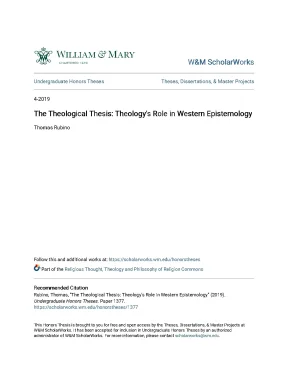
W&M ScholarWorks Undergraduate Honors Theses Theses, Dissertations, & Master Projects 4-2019 The Theological Thesis: Theology's Role in Western Epistemology Thomas Rubino Follow this and additional works at: https://scholarworks.edu/honorstheses Part of the Religious Thought, Theology and Philosophy of Religion Commons Recommended Citation Rubino, Thomas, "The Theological Thesis: Theology's Role in Western Epistemology" (2019). Undergraduate Honors Theses.edu/honorstheses/1377 This Honors Thesis is brought to you for free and open access by the Theses, Dissertations, & Master Projects at W&M ScholarWorks. It has been accepted for inclusion in Undergraduate Honors Theses by an authorized administrator of W&M ScholarWorks. For more information, please contact scholarworks@wm.

The Theological Thesis: Theology’s Role in Western Epistemology A thesis submitted in partial fulfillment of the requirement for the degree of Bachelor of Arts in Religious Studies from The College of William and Mary by Thomas J. Rubino Accepted for __________________________________ (Honors, High Honors, Highest Honors) ________________________________________ Kevin Vose, Director ________________________________________ Alexander Angelov ________________________________________ Jessica Stephens Williamsburg, VA May 3, 2019 1 INTRODUCTION The Theological Thesis explores faith and theology within, and tangential to, knowledge throughout the course of Western epistemological history. Chapter I studies qualifications for truth and knowledge in the pre-Enlightenment epistemologies of Saint Augustine of Hippo (354- 430), Saint Thomas Aquinas (c. 1224-1274) and William of Ockham (c.

1285-1345) to uncover how the understanding of faith’s relationship with knowledge changed throughout the Middle Ages. Chapter II does the same for the epistemologies of Enlightenment contemporaries David Hume (1711-1776) and Friedrich Schleiermacher (1768-1834), surveying epistemic modifications to the aforementioned relationship in the so-called Age of Reason. Chapter III looks at the foundation of the contemporary Western secular study of religion in Max Müller’s (1823-1900) comparative theology and proposes a modified understanding of theology to allow for concurrent secular study of the natural world and a religious reality, without resorting to the dogmatic theologies of historical religions. This project seeks to bridge the epistemic divide between materialist attitudes in the academy and idealist worldviews typically associated with theology or metaphysics.

With the increasing secularization of the Western academy, materialism, the conception of reality composed exclusively of observable objects and relationships between those objects, has emerged as its predominant epistemological stance. Idealism, the conception of reality composed both of observable and immaterial objects, fails to meet the evidential stipulations materialist epistemology requires of knowledge. If, as I argue, materialist knowledge holds no superior claim to absolute truth than does idealist knowledge, the prevailing attitude in secular academia must adjust to consider those objects it abandoned in dispensing with the construction of theology. Dogmatic theology’s general thesis affirming the real existence of immaterial 2 reality may thus be incorporated into fashioning a new methodology for studying the immaterial, an epistemic system I term “secular theology”.

3 CHAPTER I The Western academy emerged in the strictly Christian environment of medieval Europe. Scholasticism centered upon Christian theology and the legacy of Western learning is steeped in Catholic tradition. Although scholars of the age are often called theologians, their epistemological contributions range far beyond theology, including logic, metaphysics and science. To better understand the radical shift in Western epistemology brought on by the Enlightenment, it is necessary to study the words and teachings of scholars who preceded it.

Three of the most influential thinkers of the Middle Ages, Saint Augustine of Hippo, Thomas Aquinas and William of Ockham, build upon the ideas of their predecessors and contemporaries to advance understanding of knowledge, truth and ultimate reality. Augustine Augustine was born in 354 in the North African village of Tagaste to a pagan father and a Christian mother.1 Christian influence in his early life and admiration for the reason and rhetoric of Cicero lead Augustine to Manicheism during his education in Carthage, a group which claimed to reconcile the teachings of Christ with study of the natural world.2 Augustine began to doubt Manicheism when it could provide no solace following the death of a close friend and his doubt only deepened as he continued his education and discovered studies of the natural world contrary to the understanding of the Manichees.3 Upon moving to Milan, Augustine had Christianity presented to him by the bishop Ambrose and saw, for the first time, how reason could corroborate the tenets of faith. Afterwards, Augustine studied Scripture and Platonic 1 Roy W. Battenhouse, “The Life of Saint Augustine” in A Companion to the Study of Saint Augustine, edited by Roy W.

Battenhouse, New York: Oxford University Press, 1955, 19., 26-27 4 philosophy concurrently, incorporating Platonic concepts into his understanding of Christianity.4 After a long battle between his worldly aspirations and spiritual goals, Augustine met Pontitianus, who introduced him to Christian monasticism and incited religious fervor in his heart with stories of heroes such as Saint Anthony. Augustine experienced what he reports as a miraculous conversion, thus beginning his new life as a Christian.5 In 391, Augustine traveled to Hippo, where the bishop Valerius recruited him as a priest and gave him permission to build a monastery nearby.6 Valerius had Augustine named co-bishop of Hippo in 395, and when the former died later that year, Augustine became sole bishop of the see.7 During his episcopacy, Augustine penned the two works which this paper surveys, The Confessions in 4008 and On The City of God between 413-426.9 In 430, the bishop passed away.10 Augustine saw truth as inseparable from God. God is all that is true and all that is true is God. To Augustine, the words “God” and “truth” bore the same meaning and he often used “truth” in reference to God or as an epithet for God.11 If God and truth are one and the same, any path toward one must lead also to knowledge of the other, and falsehood is nothing less than heresy.

Augustine’s path to true knowledge and his path to knowledge of God were one and the same because any true knowledge is necessarily knowledge of God. 8 Eugène Portalie, A Guide to the Thought of Saint Augustine, translated by Ralph J. Bastian, Chicago: Henry Regnery Company, 1960, 39. 11 “Thee, who art the Truth, O God”.

Augustine, Confessions, translated. Bourke, Washington: The Catholic University of America Press, 1953, X, 23. 5 An experienced scholar and philosopher prior to his conversion to Christianity, Augustine was no stranger to the Platonic principles of reason. In fact, the Neoplatonic writings of Plotinus led Augustine to eventually accept Christianity and he continued to extol the virtues of reason throughout his life.12 However, reason could not operate as a path to truth on its own.

Augustine argued that reason is secondary to faith because “nisi credideritis, non intelligetis, unless you believe, you will not understand”.13 If all truth is God, then any path to truth must be bound by faith in that God. Reason unguided by faith is just as likely to produce misinformation as it is to produce knowledge.14 Pursuing virtue must be a religious venture, as without the influence of faith one would turn away from truth and fall into vice.15 Because all things derive their existence from God, all which exists must be fundamentally true.16 Falsehood arises when misinterpretation results in a marred understanding of existent truth. Augustine illustrates this point by saying that bread is inoffensive to a healthy palate but objectionable to an unhealthy one, light is needed by healthy eyes, but painful to sore ones and the justice of God is loved by the faithful but despised by the wicked.17 Deceit is not in the bread itself, not in the light and not in the will of God, as each of these are proven true through their existence. Falsity is found in the human interpretation of each, when personal biases are applied to objective ultimate.

Reason is subject to these same rules, as it is not itself corrupted but becomes blinded or misled by false interpretation.18 Just as a healthy palate is needed to enjoy bread, healthy eyes are needed to 12 Portalie, 12-13, 13 Robert E. Cushman, “Faith and Reason” in A Companion to the Study of Saint Augustine, edited by Roy W. Battenhouse, New York: Oxford University Press, 1955, 287. 15 Augustine, The City of God, translated by Gerald G.

Walsh and Daniel J. Honan, Washington: The Catholic University of America Press, 1954, XIX, 25. 16 Augustine, Confessions, VII, 15. 17 Augustine, Confessiosn, VII, 16.

6 utilize light and righteousness is needed to appreciate divine justice, a proper foundation is necessary to achieve knowledge through reason. For Augustine, this foundation was faith. Although faith is prior to reason, reason is far from irrelevant in Augustine’s thought. It serves a crucial role as a path to knowledge, even religious knowledge.

Augustine wrote that religious knowledge is derived from two sources, authority and reason.19 Faith and reason are deeply intertwined, and knowledge can only be achieved through belief followed by rationality. God, or truth, is the source of reason, and even ratio naturalis, natural reason, the study of physical phenomena which directs its attention away from the transcendent to the wholly material, is a commendable way to pursue knowledge. Augustine interpreted reason to be the image of God in which humanity is created, and through reason humans fulfill their nature and interact with the divine.20 All reason is derived from God, the truth, and application of reason guided by faith illuminates both the divine and material worlds. To help his readers recognize truth, Augustine described the qualities which define it.

In an ever-changing world, God alone, and therefore truth, is immutable. The only constant, the only ultimate, is truth.21 Furthermore, only God is incorruptible.22 While all else can be changed through interaction with other things, God is always the transmuter, never the transmuted. As the source and ruler of all things, God is eternal truth and the fixture upon which the truth of God’s creations depends. God does not seek to deceive, nor does God seek to mask truth.

Humans hide truth from themselves by lack of faith or actions of the will.23 Anyone who chases truth “piously, chastely and diligently” is able to ascertain it.24 Augustine believed truth is not 19 Portalie, 115. 21 Augustine, Confessions, VII, 12. 22 Augustine, Confessions, VII, 4. 7 inherently hidden or beyond human reach.

Ignorance blinds one to the truth right before them, and recognizing truth is not so much unveiling the nature of reality as it is finally seeing what had been there all along. Truth is not hidden from us, we hide ourselves from it. Augustine understood truth to be God and God to be truth. No truth in the world can exist separate from God because ultimate legitimacy is derived from the heavenly creator.

Like God, truth is immutable and incorruptible. Because truth and God exist as one, knowledge of the unchanging and eternal is knowledge of God, no matter the path taken to arrive at it. As reason is the quality of God that humans alone among God’s creations share, it leads one to this knowledge of the immutable but must be pointed in the correct direction by faith to avoid corruption. An important caveat to Augustine’s understanding of knowledge is that none can understand God as God understands Godself.

God is ultimate truth, and as corruptible, mutable beings, humans are fundamentally incapable of fully comprehending the everlasting.25 Augustine understood God to be the “sun of the soul”, and like the sun, is not something which can be perceived directly, but illuminates all else and is the means by which the soul is able to know.26 The only being of perfect knowledge is God, but that does not mean humans cannot attain truth, and Augustine sets out pathways through which one can open their eyes to the eternal. Augustine acknowledges that knowledge can exist without faith, but it cannot be fully trusted if lacking the confirmation of belief. Christ, as eternal truth made flesh, must be the principium, origin, of knowledge because materialized yet uncorrupted truth provides humans something familiar to follow in their own pursuit.

Nội dung được bảo vệ bản quyền — Tải xuống đầy đủ