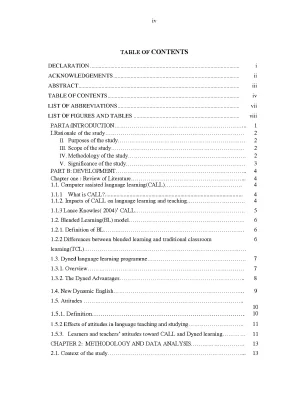
iv TABLE OF CONTENTS DECLARATION. iii TABLE OF CONTENTS. iv LIST OF ABBREVIATIONS. vii LIST OF FIGURES AND TABLES.
viii PARTA:INTRODUCTION………………………………………………………….Rationale of the study……………………………………………………………… 2 II. Purposes of the study………………………………………………………… 2 III. Scope of the study…………………………………………………………… 2 IV. Methodology of the study…………………………………………………….
Significance of the study……………………………………………………. 4 Chapter one : Review of Literature…………………………………………………. Computer assisted language learning(CALL)………………………………….1 What is CALL?. Impacts of CALL on language learning and teaching………………………… 4 1.3 Lance Knowles( 2004)’ CALL………………………………………………… 5 1.
Blended Learning(BL) model…………………………………………………… 6 1. Definition of BL……………………………………………………………….2 Differences between blended learning and traditional classroom 6 learning(TCL)………………………………………………………………………… 1. Dyned language learning programme…………………………………………… 7 1. The Dyned Advantages……………………………………………………….
New Dynamic English………………………………………………………….2 Effects of attitudes in language teaching and studying………………………. Learners and teachers’ attitudes toward CALL and Dyned learning………… 11 CHAPTER 2: METHODOLOGY AND DATA ANALYSIS………………………. Context of the study……………………………………………………………. 13 TIEU LUAN MOI download : skknchat@gmail.
Questionnaires for students………………………………………………………. Questionnaires for teachers………………………………………………………. Interviews for teachers………………………………………………………. Interviews for students……………………………………………………….
Data collection and analysis……………………………………………………. Findings from questionaires and interviews……………………………………. Findings from questionaires and interviews for teachers……………………. Findings from questionaires and interviews for students…………………….
Teachers’ perception and attitudes…………………………………………… 33 2. Students’ understanding and attitudes………………………………………… 33 2. Inconsistency in the responses between teachers and students………………. Benefits in the application of NDE at HUBT………………………………….
Problems in the application of NDE at HUBT………………………………. Summary of the findings…………………………………………………………… 36 II.Limitations of the study…………………………………………………………. 37 IVSuggestions for further research…………………………………………………. Questionnaires for teacher.
Questionnaires for students. Interview questions for teachers and students. Interview transcripts with teachers. Interview transcripts with students.
XIII TIEU LUAN MOI download : skknchat@gmail.com vi LIST OF ABBREVIATIONS 1. Hanoi University of Business and Technology = HUBT 2. Blended Learning = BL 3. Computer assisted language learning = CALL 4.
New Dynamic English = NDE TIEU LUAN MOI download : skknchat@gmail.com vii LIST OF FIGURES AND TABLES FIGURES Figure 1: Improvements of learners’ pronunciation……………………………….16 Figure 2: Most effective activity to practice pronunciation from teachers’ opinion.17 Figure 3: Most interesting activity to practice pronunciation from teachers’ opinion….17 Figure 4: The workload of grammar in each module……………………………….18 Figure 5: Level of grammar exercises in each module……………………………….…18 Figure 6: Teachers’ views on tests…………………………………………….19 Figure 7: Reasons for teachers’ views on tests………………………………….19 Figure 8: Working schedule in terms of content……………………………………….20 Figure 9: Working schedule in terms of time allocation ………………………….…20 Figure10: Workload of supplementary materials in each module……………….21 Figure 11: Linguistic level of supplementary materials………………………………….21 Figure 12: Design of supplementary materials………………………………….21 Figure13: Problems in delivering supplementary materials………………….22 Figure 14: Difficulties in delivering NDE lessons……………………….………………24 Figure 15: Students’ English pronunciation after studying English………….26 Figure 16: Most Effective activity for students to practice pronunciation…….26 Figure17: Most effective activity for students to practice pronunciation……….…26 Figure 18: Students’ enrichment of vocabulary……………………………………….…27 Figure19: Students’ ability to use vocabulary……………………………….27 Figure 20: Complexity of grammar exercises in NDE………………………………….28 Figure 21: Effectiveness of grammatical exercises in NDE………………………….…28 Figure 22: Kind of test that students like……………………………………………….29 Figure23: Reasons that students like the test…………………………………….29 Figure 24: The most difficult lesson…………………………………….…32 Figure25: The most interesting lesson……………………………………….……32 Figure 26: Students’ recommendations…………………………………….33 TIEU LUAN MOI download : skknchat@gmail.com viii TABLES Table 1 : Vocabulary presented in each module………………………………….17 Table 2: Teachers’ perception about skills development………….19 Table 3: Teachers’ perception of and attitudes to the difficulties…………………….23 Table 4 : Teachers’ perception of and attitudes to NDE’ benefits…………………….24 Table 5: Teachers’ recommendations to improve NDE………………………………….25 Table 6: Students’ perception of and attitudes to skills development……….28 Table 7: Students’ attitudes to supplementary materials……………………….30 Table 8: Students’ perception of and attitudes to NDE’ benefits ……….31 Table 9: Students’ perception of and attitudes to challenges ….32 TIEU LUAN MOI download : skknchat@gmail.com 1 PART A INTRODUCTION I. Rationale of the study These days computer use has increasingly penetrated into daily life. It is not surprising to find a similar trend in the academic world. Computers are becoming important components of education and the number of computers used at schools is increasing.
Although the notion of face-to-face classroom instruction is still prevalent in many organisational and educational settings, there seems a rush and enthusiasm for computer-based approach. Computer technology can be regarded as an educational tool supporting language teaching. In fact, a wide range of electronic technologies have been developed to supplement second language teaching and learning (Bas & Kuzucu, 2009;Warschauer, 1996). These technologies include hardware delivery methods such as audiotape recorders, videotape recorders, computers and the Internet.
In addition, there are many innovative electronic tools oriented to language such as speech production and recognition, text analysis, text translation, and software for visualisation and animation, electronic mail, list serve discussion groups, streaming audio and video and real-time synchronous as well as asynchronous communication opportunities that bring the target language environment to the learner (LeLoup & Porterio, 1997). One of the recent educational technology for language teaching, more specifically English Language teaching, is the Computer Assisted Language Learning (CALL) method which is combining with face to face classroom instruction to form a new Blended Learning(BL) model. In recent years, some of the countries such as China, France, Malaysia, Korea, Miyanmar, Turkey and Vietnam are using an English Language teaching software named DynED, which stands for Dynamic English Education. In these countries, this software is used in a way that it assists English language teaching process at schools.
In Vietnam, Dyned was first applied in Le Van Tam primary school in 2006 and got positive attitudes from teachers and students. So far, Dyned has been experimenting in about 40 schools and universities. And this program has been getting different opinions from administrators, teachers and students. At Ha Noi University of Business and TIEU LUAN MOI download : skknchat@gmail.com 2 Technology(HUBT) after a year of experiment, the application of New Dynamic English(NDE) which is a Dyned component, has caused a controversy over its effectiveness among teachers and students.
Hence, this research is done to explore the perception of and attitudes of HUBT English teachers and their students toward the course with the hope to reveal the benefits and challenges in applying NDE so as to find ways to improve the course. Purpose The major aims of the study are as follows To investigate what HUBT English teachers and students perceive and think of New Dynamic English. To discover benefits and challenges in the application of New Dynamic English at HUBT. In light of the goals of the study, the following research questions are made: 1.
What are the HUBT English teachers’ understandings of and anttitudes to New Dynamic English ? 2. What are benenits and difficulties in the application of New Dynamic English at HUBT? III. Scope of the study The study involves HUBT English teachers from faculty of English, who have ever taken part in teaching New Dynamic English and their second year, non English majors as the main participants of the research. Due to the limit of the study and constrain of time, my thesis would focus on investigating the teachers and students’ perception and attitudes toward NDE in terms of its content, organization, working schedule, supplementary materials and assessment.
Methodology of the study In order to collect reliable and valid data for the study, different methods were combined. TIEU LUAN MOI download : skknchat@gmail.com 3 To start with, the literature review was extensively carried out, critically examining the relevant theoretical frame concerning Dyned program, computer assisted language learning method as well as the matters relating to attitudes in language learning. Questionnaire which is time- saving and realiable means of data collection was employed primarily to obtain teachers and students’ evaluative comments on New Dynamic English programme, to reveal the difficulties they faced in the application of NDE as well as disclose their expectation for the improvement of the program at HUBT. Interview, a method of collecting data to facilitate the results of the questionnaires, was conducted to get better insights about the issues from teachers.
The data would be coded into text for convenience. Significance of the study Firstly, the study serves as a reference source for HUBT administrators and English teaching staffs who are directly involved in New Dynamic English program and administrators as well as for students who are beneficiaries of the program. They will be made aware of both benefits and challenges in the application of NDE and thus promote the quality & effectiveness of the program. Secondly, it would make a contribution to the research area in the field of computer assisted learning, blended learning model as well as relating to the application of language learning software.
Finally, the thesis would also be helpful for those who share similar concern with the researcher. TIEU LUAN MOI download : skknchat@gmail.com 4 PART B: DEVELOPMENT CHAPTER I : REVIEW OF LITERATURE 1. Computer assisted language learning(CALL) 1.1 What is CALL? According to Kocak (1997) CALL is “a term used by teachers and students to describe the use of computers as part of a language course”. Hardisty & Windeatt (1989) give a more detailed definition that CALL is traditionally considered as a method of 'presenting, reinforcing and testing' particular language items in which the learner is first presented with a rule and some examples, and then answers a series of questions which test her/his knowledge of the rule and the computer gives appropriate feedback and awards a mark which may be stored for later inspection for the teacher and reference for the learner.
Impacts of CALL on language learning and teaching. In fact, CALL has a lot of effects on language learning in term of methods, context and language knowledge acquisition. Higgins (1995) indicates that the value of CALL is that it allows a richer form of language exploration and the use of computers is compatible with a variety of approaches, methods and techniques. This gives teachers much flexibility in their teaching practise.
According to Kramsch and Andersen (1999) multimedia technology can provide authentic cultural contexts that are important for language learning. In other words it creates a supportive learning environment. Kocak’s( 1997) study investigates the effectiveness of CALL on vocabulary learning and teaching and draws a conclusion that “computer instruction may offer a noteworthy experience to students with respect to vocabulary learning”. Besides, CALL considerably influences the development of language skills.
As some researchers who advocated CALL programs, especially voice-interactive, say that CALL can improve learners' speaking skills (Ehsani, & Knodt, 1998; James, 1996). Moreover, computer technology in combination with a conferencing system is considered an effective means of providing goal-directed writing courses tailored to different learning styles TIEU LUAN MOI download : skknchat@gmail. So, making complete use of CALL to develop integrative language skills is truly valuable in language teaching and learning. However, working with the computer, as any other teaching aid, needs to be linked with ordinary classroom work and CALL lessons, like other lessons, need to be planned carefully because Jones & Fortescue (1987) warns that the computer is a resource and not a programmed-learning machine.3 Lance Knowles( 2004)’ CALL Long-Term Memory Working Memory Visual Auditory Conceptual Buffer Buffer Buffer The diagram shows how various processors in the brain communicate with the working memory, which is instrumental in the learning process.
The multiple processors such as the visual, auditory, conceptual and many others are involved and can be activated in well designed activites. In addition, these processors work in parallel in the unconscious process and interact with the working memory and long term memory to interprete language. In fact, when languages are repeated many times, neurons are connected, then create automaticity. Making use of this working process of the brain, people create a new model of language learning naming Computer Assisted Language Learning( CALL).
CALL can simultaneously activate auditory, phonological, and visual systems in the brain. Lance Knowles (2004) states that CALL is an emerging force in language education and affirms that “CALL is now moving toward a blended model where the computer TIEU LUAN MOI download : skknchat@gmail.com 6 provides the necessary optimal input and practice activities, and the classroom provides the human element accommodating and utilizing the needs and lives of the learners in a social context”.