Tổng quan luận án
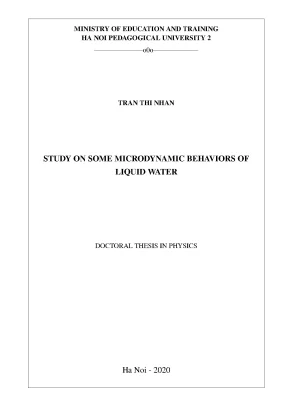
Luận án tiến sĩ vật lý với tiêu đề "Study on some microdynamic behaviors of liquid water" (Nghiên cứu một số hành vi động lực học vi mô của nước lỏng) do nghiên cứu sinh Trần Thị Nhàn (Tran Thi Nhan) thực hiện tại Trường Đại học Sư phạm Hà Nội 2 (Ha Noi Pedagogical University 2) dưới sự hướng dẫn khoa học của PGS. Lê Tuấn (Assoc. Prof. Le Tuan), bảo vệ vào năm 2020. Luận án thuộc chuyên ngành Vật lý lý thuyết và Vật lý toán (Theoretical Physics and Mathematical Physics), mã số đào tạo 9 44 01 03.
Tính cấp thiết và khoảng trống nghiên cứu
Nước là thành phần chính của tế bào sống và là dung môi cơ bản cho các phản ứng hóa học và quá trình truyền thông tin sinh học. Việc nghiên cứu các hành vi động lực học vi mô liên quan đến tương tác giữa hệ nước lỏng và trường điện từ đóng vai trò quan trọng trong việc lý giải các hiện tượng sinh lý, quá trình hydrat hóa, cũng như các ứng dụng trong y học, công nghiệp thực phẩm, công nghiệp hóa chất và viễn thám hải dương.
Mặc dù đã có nhiều nghiên cứu thực nghiệm và lý thuyết, cơ chế vi mô điều khiển hành vi động lực học của nước lỏng và dung dịch điện phân dưới tác dụng của trường điện từ ở các dải tần số khác nhau vẫn chưa được làm sáng tỏ hoàn toàn. Một số vấn đề tồn tại khoảng trống nghiên cứu lớn bao gồm:
- Nguồn gốc vật lý của chế độ "âm thanh nhanh" (fast sound) và sự tách hai nhánh dao động mật độ tập thể trong nước lỏng ở dải tần số terahertz (THz).
- Cơ chế vi mô đằng sau sự phụ thuộc nhiệt độ của hằng số điện môi ở dải tần số thấp (1000 Hz – 1 MHz) và sự tồn tại của điểm đẳng điện môi (isopermittive point).
- Cơ chế tán sắc của độ dẫn điện vi sóng (microwave conductivity) trong các dung dịch điện phân.
- Quy luật suy giảm phi tuyến của độ điện thẩm tĩnh và sự gia tăng phi tuyến của độ dẫn điện riêng tĩnh trong dung dịch điện phân nồng độ cao (lên đến 5 mol/L).
Mục tiêu nghiên cứu
Luận án xác định ba mục tiêu nghiên cứu cụ thể:
- Nghiên cứu động lực học chịu trách nhiệm cho sự tán sắc của các dao động mật độ tập thể cùng với sự cùng tồn tại của chế độ âm thường (ordinary mode) và chế độ âm dị thường (anomalous mode / fast sound) trong nước lỏng.
- Nghiên cứu sự tán sắc hằng số điện môi của nước ở dải tần số thấp và làm rõ bản chất vật lý của điểm đẳng điện môi bằng cách tiếp cận vi mô.
- Nghiên cứu động lực học điện từ phi tuyến của hệ nước trong tương tác giữa dung dịch nước điện phân và trường điện từ ở các dải tần số khác nhau nhằm làm sáng tỏ các cơ chế vi mô gây ra sự tán sắc độ dẫn vi sóng, sự suy giảm phi tuyến của độ điện thẩm tĩnh và sự gia tăng phi tuyến của độ dẫn điện riêng tĩnh.
Đối tượng và phạm vi nghiên cứu
- Đối tượng nghiên cứu: Nước lỏng tinh khiết và các dung dịch nước điện phân (điển hình là dung dịch natri clorua $\text{NaCl}$ và xesi iodua $\text{CsI}$).
- Phạm vi không gian và cấu trúc: Cấu trúc phân tử, mạng lưới liên kết hydro cục bộ (cấu trúc tứ diện) và tương tác vi mô ở thang khoảng cách từ $0{,}1\text{ nm}$ đến $100\text{ nm}$.
- Phạm vi tần số và phổ năng lượng: Thang năng lượng kích thích tập thể $5\text{ meV} - 30\text{ meV}$ (dải terahertz), dải tần số thấp ($1000\text{ Hz} - 1\text{ MHz}$), dải vi sóng ($20\text{ MHz} - 100\text{ GHz}$, đặc biệt là vùng dưới $8\text{ GHz}$ và quanh $10\text{ GHz}$) và dải cộng hưởng cao tần ($> 10^{12}\text{ Hz}$).
- Phạm vi nhiệt động và nồng độ: Khảo sát ở nhiệt độ phòng ($298\text{ K}$) và các dải nhiệt độ lân cận; nồng độ dung dịch điện phân từ dung dịch loãng đến nồng độ đậm đặc dưới $5\text{ mol/L}$.
Tổng quan tài liệu và vị trí của luận án
Các hướng nghiên cứu trước đây
-
Hiện tượng âm thanh nhanh và dao động mật độ tập thể:
Năm 1974, A. Rahman và F. H. Stillinger thông qua mô phỏng Động lực học phân tử (MD) đã phát hiện ra các kích thích tập thể lan truyền trong nước lỏng. Hàng loạt nghiên cứu thực nghiệm tiếp theo bằng tán xạ neutron không đàn hồi (INS), tán xạ tia X không đàn hồi (IXS), tán xạ tử ngoại không đàn hồi (IUS) và mô phỏng MD đã khẳng định sự cùng tồn tại của hai nhánh dao động mật độ tập thể. Để mô tả hiện tượng này, hai mô hình chính đã được sử dụng:
- Mô hình độ nhớt đàn hồi / hồi phục cấu trúc (viscoelastic / structural relaxation model): Giải thích hai chế độ âm dựa trên thời gian hồi phục tạo/phá vỡ liên kết hydro $\tau_F$ so với thang thời gian thăng giáng mật độ.
- Mô hình tương tác hai chế độ (two-mode interaction model): Giả định sự tách nhánh dưới xuất phát từ tương tác giữa kích thích tuyến tính với kích thích không tán sắc có năng lượng $\Omega_0 \approx 5-6\text{ meV}$, thông qua hệ số liên kết $\beta(Q)$.
-
Hằng số điện môi tần số thấp và điểm đẳng điện môi:
Năm 2011, A. Uriber và cộng sự đã chỉ ra sự phụ thuộc nhiệt độ dị thường của hằng số điện môi tương đối của nước trong vùng tần số $1000\text{ Hz} - 1\text{ MHz}$, ghi nhận điểm đẳng điện môi $\omega_{iso}$ (tại đó hằng số điện môi không phụ thuộc vào nhiệt độ). Dưới tần số $\omega_{iso}$, hằng số điện môi tăng theo nhiệt độ; trên $\omega_{iso}$, hằng số điện môi giảm khi nhiệt độ tăng. Các mô hình vĩ mô cổ điển của Debye (1929), Onsager (1936) và Kirkwood (1939) chỉ phù hợp cho dải tần số trên $1\text{ GHz}$, không giải thích được cơ chế vi mô của điểm đẳng điện môi.
-
Điện động lực học vi sóng và hiện tượng điện tĩnh phi tuyến của dung dịch điện phân:
Nhiều nghiên cứu thực nghiệm đo phổ hồi phục điện môi của dung dịch điện phân quanh $10\text{ GHz}$. Độ dẫn tĩnh tăng tuyến tính theo nồng độ ion theo mô hình Drude, độ dẫn vi sóng không đổi ở tần số dưới $8\text{ GHz}$ và suy giảm ở tần số cao. Về độ điện thẩm tĩnh, Haggis và cộng sự nghiên cứu sự suy giảm tuyến tính ở dung dịch loãng. Đối với dung dịch đậm đặc, lý thuyết trường (2012) và mô hình vi trường (2016) đưa ra các biểu thức toán học phức tạp, gây trở ngại cho việc mở rộng lý thuyết Debye-Hückel (D-H). Về độ dẫn điện riêng tĩnh, mô hình Falkenhagen mở rộng lý thuyết Debye-Hückel-Onsager chỉ áp dụng được đến nồng độ $0{,}1\text{ mol/L}$, và các hiệu chỉnh sau đó cũng chỉ phù hợp cho dung dịch dưới $2\text{ mol/L}$.
Khoảng trống luận án lựa chọn giải quyết
Luận án tập trung giải quyết:
- Thiếu một mô hình giải tích định lượng giải thích bản chất vật lý của sự tách hai nhánh âm thanh dải THz dựa trên sự tương đồng giữa trạng thái mạng liên kết hydro của nước lỏng và trạng thái giả thủy tinh (glass-like phase).
- Thiếu cơ sở lý thuyết vi mô và nhiệt động lực học để giải thích sự hình thành điểm đẳng điện môi $\omega_{iso}$.
- Nhu cầu xây dựng mô hình thống kê giải tích đơn giản, tường minh để mô tả sự suy giảm phi tuyến của độ điện thẩm tĩnh và độ dẫn riêng tĩnh của dung dịch điện phân đậm đặc lên đến $5\text{ mol/L}$.
Cơ sở lý thuyết và phương pháp nghiên cứu
Cơ sở lý thuyết và khung phân tích
- Lý thuyết Phonon-Polariton (PP) hiệu chỉnh: Áp dụng lý thuyết phân cực phonon trong vật lý chất rắn (bán dẫn) của Igor Tamm (1932) kết hợp với các phương trình điện từ Maxwell và điều kiện không có điện tích tự do $\nabla \cdot \mathbf{D} = 0$. Mô hình đưa vào tần số Frenkel $\omega_F = 1/\tau_F$ (với $\tau_F$ là thời gian hồi phục cấu trúc của mạng liên kết hydro) để xác định ngưỡng chuyển tiếp từ chế độ thủy động lực học ($\Omega < \omega_F$) sang chế độ giả thủy tinh ($\Omega > \omega_F$).
- Lý thuyết Jellium: Xem xét nước lỏng như một hệ plasma cấu thành từ cation $\text{O}^{-2\delta}$ (khối lượng $m_O$) và anion $\text{H}^{+\delta}$ (khối lượng $m_H$), với $\delta$ là điện tích hiệu dụng ($\delta \approx 0{,}33e$). Lý thuyết này được dùng để xác định tần số plasmon của nước lỏng $\omega_{pw}$ và mở rộng cho dung dịch điện phân.
- Mô hình kết hợp Drude - Jellium: Sử dụng mô hình Drude kết hợp lý thuyết Jellium và phân bố thống kê Logistic để định lượng sự tán sắc của độ dẫn điện vi sóng theo tần số và nồng độ ion.
- Thống kê Langevin hiệu chỉnh: Ứng dụng lý thuyết thống kê Langevin (thường dùng trong nghiên cứu thuận từ chất rắn) có bổ sung tương tác của điện trường cục bộ do ion phát ra và hiệu ứng pha loãng mật độ lưỡng cực nước để mô tả sự suy giảm phi tuyến của độ điện thẩm tĩnh.
- Mô hình chuyển vùng tương tác điện trường: Mở rộng lý thuyết dẫn điện kim loại sang dung dịch điện phân thông qua việc phân chia hai vùng: vùng tương tác yếu (weak interaction regime) và vùng tương tác mạnh (strong interaction regime).
- Nhiệt động lực học cân bằng: Sử dụng phương trình van't Hoff để tính toán biến thiên enthalpy ($\Delta H$) và năng lượng tự do Gibbs ($\Delta G$) tại điểm đẳng điện môi.
Phương pháp nghiên cứu
- Phương pháp lý thuyết giải tích: Thiết lập và giải hệ phương trình vi phân chuyển động của các hạt tích điện, phương trình sóng phân cực, biến đổi Fourier của thế tương tác Coulomb $\phi(Q) = 4\pi\delta^2/Q^2$, và biến đổi Laplace cho các hàm đáp ứng phân cực định hướng $F_P^{or}(t)$ và $f_P^{or}(t)$.
- Phương pháp tính toán số: Tính toán các thông số động lực học của nước lỏng gồm môđun thể tích, môđun trượt, môđun dọc, hằng số điện môi dải THz, vận tốc pha ($v_p$) và vận tốc nhóm ($v_g$) của các nhánh dao động tập thể.
- Phương pháp phân tích dữ liệu thực nghiệm: Khớp và kiểm chứng các biểu thức giải tích lý thuyết với tập dữ liệu thực nghiệm đo đạc từ INS, IXS, phổ tán sắc điện môi từ $10^2\text{ Hz}$ đến $100\text{ GHz}$, và độ dẫn điện của dung dịch $\text{NaCl}$, $\text{CsI}$.
Nguồn tư liệu và dữ liệu
Luận án sử dụng các tập dữ liệu thực nghiệm đã công bố:
- Số liệu phổ INS của J. Teixeira và cộng sự, số liệu tán xạ IXS của F. Sette và G. Ruocco.
- Dữ liệu phổ điện môi của nước lỏng và dung dịch muối $\text{NaCl}$ ở các nồng độ ($0{,}4\text{ mol/L}$ ở $5^\circ\text{C}$, dải $0 - 5\text{ mol/L}$) từ các công trình của R. Buchner, J. Barthel, U. Kaatze.
- Dữ liệu đo hằng số điện môi tần số thấp ($1000\text{ Hz} - 1\text{ MHz}$) của A. Uriber (2011).
Nội dung chính theo từng chương
Chapter 1: PROPERTIES AND COMPLICATED BEHAVIORS OF WATER
Chương 1 tổng hợp các đặc tính vật lý cơ bản, cấu trúc phân tử và các hành vi điện môi phức tạp của nước lỏng:
- Cấu trúc phân tử và liên kết hydro: Phân tử nước có dạng chữ V, góc liên kết trung bình xấp xỉ $104{,}5^\circ$, đường kính phân tử khoảng $2{,}75\text{ \AA}$, độ dài liên kết $\text{O-H}$ khoảng $0{,}96\text{ \AA}$. Nguyên tử oxy mang điện tích âm $-2\delta$, nguyên tử hydro mang điện tích dương $+\delta$ ($\delta$ là điện tích điện tử suy giảm). Momen lưỡng cực trong pha khí là $6{,}17 \times 10^{-30}\text{ C}\cdot\text{m}$ (khoảng $1{,}85\text{ D}$), tăng lên khoảng $8\text{ - }9{,}8 \times 10^{-30}\text{ C}\cdot\text{m}$ trong pha lỏng do hiện tượng phân cực tương hỗ. Bốn liên kết hydro sắp xếp theo cấu trúc tứ diện cục bộ quanh mỗi phân tử nước. Thời gian sống trung bình của liên kết hydro khoảng $1\text{ ps}$.
- Sự tự ion hóa: Hằng số phân ly $K_D = [\text{H}^+][\text{OH}^-]/[\text{H}_2\text{O}] = 1{,}8 \times 10^{-16}$. Ở $298\text{ K}$, nồng độ ion $\text{H}^+$ là $10^{-7}\text{ mol/L}$ ($\text{pH} = 7$), nồng độ nước nguyên chất là $55{,}6\text{ mol/L}$. Hệ số khuếch tán của ion $\text{H}^+$ đạt $9 \times 10^{-9}\text{ m}^2/\text{s}$, gấp 4,5 lần hệ số khuếch tán của phân tử nước ($2 \times 10^{-9}\text{ m}^2/\text{s}$). Thời gian sống của proton $\text{H}^+$ khoảng $100\text{ }\mu\text{s}$, trong khi thời gian sống của ion hydronium $\text{H}_3\text{O}^+$ là $1\text{ ps}$.
- Các thông số vật lý cơ bản: Bảng 1.1 trong luận án so sánh các tính chất của nước tinh khiết với methanol và dimethyl ether ở $298\text{ K}$.
| Đặc tính vật lý |
Nước ($\text{H}_2\text{O}$) |
Methanol ($\text{CH}_3\text{OH}$) |
Dimethyl ether ($(\text{CH}_3)_2\text{O}$) |
| Khối lượng phân tử ($\text{g/mol}$) |
18 |
32 |
46 |
| Khối lượng riêng ($\text{kg/L}$) |
1,00 |
0,79 |
0,713 |
| Nhiệt độ sôi ($\text{K}$) |
373 |
338 |
248 |
| Nhiệt độ có khối lượng riêng cực đại ($\text{K}$) |
277 |
Không có |
Không có |
| Nhiệt dung riêng ($\text{J/kg}\cdot\text{K}$) |
4180 |
2530 |
2370 |
| Nhiệt hóa hơi ($\text{kJ/kg}$) |
2300 |
1160 |
400 |
| Sức căng bề mặt ($\text{mN/m}$) |
72,6 |
22,6 |
15,0 |
| Tốc độ âm thanh thường ($\text{m/s}$) |
1525 |
1076 |
985 |
- Phổ điện môi và các mô hình bán thực nghiệm: Phân cực định hướng $P_\mu$ và phân cực cảm ứng $P_\alpha$ đóng góp vào phân cực tổng cộng: $P = P_\mu + P_\alpha = \varepsilon_0(\varepsilon_s - 1)E$.
Phương trình Debye biểu diễn hằng số điện môi phức:
$$\varepsilon(\omega) = \varepsilon_\infty + \frac{\varepsilon_s - \varepsilon_\infty}{1 + i\omega\tau_0}$$
Phần thực $\varepsilon'(\omega)$ và phần ảo $\varepsilon''(\omega)$:
$$\varepsilon'(\omega) = \varepsilon_\infty + \frac{\varepsilon_s - \varepsilon_\infty}{1 + (\omega\tau_0)^2}, \quad \varepsilon''(\omega) = \frac{(\varepsilon_s - \varepsilon_\infty)\omega\tau_0}{1 + (\omega\tau_0)^2}$$
Đối với quá trình hồi phục phi Debye, luận án điểm lại phương trình Cole-Cole (tham số $0 \le \alpha_D < 1$), phương trình Cole-Davidson (tham số $0 < \beta_D \le 1$), và phương trình Havriliak-Negami.
- Các mô hình vi mô: Trình bày phương trình Onsager cho chất lỏng phân cực đồng nhất và phương trình Kirkwood-Fröhlich có chứa thừa số tương tác $g_K$:
$$\frac{(\varepsilon - \varepsilon_\infty)(2\varepsilon + \varepsilon_\infty)}{\varepsilon(\varepsilon_\infty + 2)^2} = \frac{N_0 \mu^2}{18 \varepsilon_0 k_B T} g_K$$
- Chuyển động khuếch tán: Thời gian hồi phục định hướng tuân theo phương trình Arrhenius: $\tau_r = \tau_{r0} \exp\left(\frac{E_A}{k_B T}\right)$ với năng lượng hoạt hóa $E_A = 1{,}85\text{ kcal/mol}$. Khoảng cách nhảy trung bình của phân tử nước là $L \approx 1{,}6\text{ \AA}$.
- Tần số Plasmon của nước: Ứng dụng lý thuyết Jellium cho hệ dao động lưỡng cực tích điện, tần số plasmon của nước nguyên chất $\omega_{pw}$ được xác định bằng biểu thức:
$$\omega_{pw}^2 = \frac{N_0 \delta^2}{\varepsilon_0} \left( \frac{1}{2m_H} + \frac{1}{m_O} \right)$$
Giá trị tính toán đạt bậc $10^{12}\text{ Hz}$ ($\text{THz}$) với $\delta \approx 0{,}33e$.
Chapter 2: SOME DYNAMIC FEATURES OF LIQUID WATER
Chương 2 tập trung xây dựng mô hình Phonon-Polariton hiệu chỉnh và mô hình vi mô cho điện môi tần số thấp:
- Lý thuyết Phonon-Polariton trong chất bán dẫn: Xét tương tác giữa sóng điện từ và phonon quang học ngang (TO). Từ hệ phương trình Maxwell và hàm điện môi $\varepsilon(\omega) = \varepsilon_\infty \frac{\omega_{LO}^2 - \omega^2}{\omega_{TO}^2 - \omega^2}$, hệ thức tán sắc của hai nhánh polariton $\omega_\pm(Q)$ được xác định:
$$\omega_\pm^2(Q) = \frac{1}{2} \left{ \left( \frac{c_0^2 Q^2}{\varepsilon_\infty} + \omega_{LO}^2 \right) \pm \left[ \left( \frac{c_0^2 Q^2}{\varepsilon_\infty} + \omega_{LO}^2 \right)^2 - 4 \frac{c_0^2 Q^2}{\varepsilon_\infty} \omega_{TO}^2 \right]^{1/2} \right}$$
Tần số quang học dọc $\omega_{LO}$ và ngang $\omega_{TO}$ liên hệ qua hệ thức Lyddane-Sachs-Teller: $\omega_{LO} = \omega_{TO} \sqrt{\varepsilon_0/\varepsilon_\infty}$. Vùng tần số giữa $\omega_{TO}$ và $\omega_{LO}$ tạo nên khe phân cực (polariton gap), nơi sóng điện từ bị suy giảm hàm mũ.
- Mô hình PP hiệu chỉnh cho dao động mật độ tập thể trong nước lỏng: Ở tần số cao hơn tần số Frenkel ($\Omega > \omega_F = 1/\tau_F$), mạng liên kết hydro không kịp tái sắp xếp, nước lỏng chuyển sang trạng thái động lực học tương tự pha thủy tinh (glass-like regime). Kích thích tập thể truyền dọc theo mạng liên kết hydro tương tự phonon trong tinh thể băng.
- Sự tán sắc của hai chế độ âm: Nhánh trên tương ứng với chế độ âm thanh nhanh (fast sound) có vận tốc pha đạt xấp xỉ $3000 - 3200\text{ m/s}$ (gấp đôi vận tốc âm thường $1525\text{ m/s}$). Nhánh dưới tiếp cận tiệm cận với tần số dao động liên kết uốn phân tử $\text{O-O-O}$ ở vùng năng lượng $5 - 6\text{ meV}$.
- Tương quan âm - điện và thế rung siêu âm (ultrasonic vibration potential): Khảo sát sự kết cặp giữa trường âm thanh và phân cực điện môi vi mô.
- Cách tiếp cận vi mô cho hằng số điện môi tần số thấp và điểm đẳng điện môi: Luận án giải thích cơ chế vi mô của điểm $\omega_{iso}$ ($1000\text{ Hz} - 1\text{ MHz}$). Bằng việc áp dụng phương trình van't Hoff biểu diễn đồ thị $\ln K$ theo $1/T$, luận án xác định các đại lượng nhiệt động lực học cân bằng ($\Delta H$ và $\Delta G$) của hệ nước lỏng tại điểm đẳng điện môi.
Chapter 3: MICROWAVE ELECTRODYNAMICS OF ELECTROLYTE SOLUTIONS
Chương 3 khảo sát động lực học điện từ dải sóng vi sóng của dung dịch điện phân:
- Lý thuyết Jellium cho dung dịch điện phân: Mở rộng lý thuyết Jellium để tính toán tần số plasmon hiệu dụng của dung dịch điện phân có tính đến mật độ và khối lượng của các ion hòa tan ($\text{Na}^+$, $\text{Cl}^-$).
- Mô hình kết hợp Drude - Jellium: Xây dựng mô hình định lượng cho sự tán sắc độ dẫn vi sóng $\sigma(\omega)$. Độ dẫn điện xoay chiều (AC conductivity) tại $1\text{ GHz}$ và phổ tần số của độ dẫn vi sóng được khảo sát chi tiết.
- Quy luật phân bố độ dẫn vi sóng: Phổ độ dẫn vi sóng tuân theo phân bố thống kê dạng Logistic. Ở vùng tần số thấp (dưới $8\text{ GHz}$), độ dẫn điện gần như không đổi và bằng độ dẫn tĩnh $\sigma_0$. Khi tần số tăng lên trên $10\text{ GHz}$, độ dẫn điện giảm rõ rệt và tiệm cận về 0 ở tần số rất cao do các ion không kịp đáp ứng theo sự đảo chiều nhanh của điện trường ngoài.
- Hệ số khuếch tán: Khảo sát sự phụ thuộc nhiệt độ của hệ số khuếch tán ion trong dung dịch điện phân thông qua biểu thức dạng Arrhenius.
Chapter 4: NONLINEAR ELECTROSTATICS OF ELECTROLYTE SOLUTIONS
Chương 4 thiết lập các mô hình thống kê mô tả hiện tượng tĩnh điện phi tuyến trong dung dịch điện phân đậm đặc:
- Mô hình thống kê cho sự suy giảm phi tuyến của độ điện thẩm tĩnh: Khi nồng độ dung dịch muối tăng lên đến $5\text{ mol/L}$, độ điện thẩm tĩnh $\varepsilon_s$ suy giảm phi tuyến mạnh. Luận án áp dụng hàm Langevin $L(x) = \coth(x) - 1/x$ kết hợp với hiệu chỉnh trường điện cục bộ do ion tạo ra và sự suy giảm mật độ thể tích của các phân tử nước do sự chiếm chỗ của ion.
- Độ dài chắn Debye phi tuyến: Độ dài chắn Debye $\lambda_D$ được tính toán lại dựa trên hàm độ điện thẩm tĩnh phi tuyến phụ thuộc nồng độ $\varepsilon_s(c)$ và độ dài chắn của dung môi tinh khiết.
- Phân chia vùng tương tác điện trường yếu và mạnh:
- Vùng tương tác yếu (weak interaction regime): Ứng với dung dịch loãng, điện trường cục bộ giữa các ion nhỏ hơn trường liên kết phân tử; độ dẫn điện riêng tĩnh tuân theo mô hình mở rộng Debye-Hückel-Onsager.
- Vùng tương tác mạnh (strong interaction regime): Ứng với dung dịch đậm đặc, điện trường cục bộ giữa các ion lân cận trở nên rất mạnh, làm biến đổi cấu trúc đám mây ion và tạo thành các cặp ion liên kết (tiếp xúc CIP, chia sẻ dung môi SIP, hoặc ngăn cách dung môi kép 2SIP).
- Mô hình độ dẫn điện riêng tĩnh: Xây dựng biểu thức giải tích dựa trên lý thuyết dẫn điện kim loại hiệu chỉnh để mô tả sự gia tăng phi tuyến của độ dẫn điện riêng tĩnh $\kappa$ theo nồng độ cho cả dung dịch loãng và dung dịch đậm đặc (khớp với dữ liệu thực nghiệm dung dịch $\text{NaCl}$ đến $5\text{ mol/L}$). Bảng 4.1 trong luận án cung cấp các giá trị tham số khớp $b$ cho các hệ dung dịch.
Kết quả và những đóng góp mới
Luận án tự xác định các đóng góp mới về mặt lý thuyết và thực tiễn như sau:
- Ứng dụng thành công lý thuyết Phonon-Polariton hiệu chỉnh cho chất lỏng: Luận án đã mở rộng lý thuyết Phonon-Polariton từ vật lý bán dẫn sang nghiên cứu động lực học nước lỏng ở dải tần số THz. Mô hình giải thích định lượng sự cùng tồn tại của chế độ âm thường và chế độ âm thanh nhanh (fast sound), xác định rõ vùng bước sóng, dải phổ năng lượng ($5 - 30\text{ meV}$) và ngưỡng chuyển pha động lực học tại tần số Frenkel $\omega_F$.
- Làm rõ bản chất vi mô và nhiệt động học của điểm đẳng điện môi: Đưa ra mô hình giải thích sự tán sắc điện môi của nước ở dải tần số thấp ($1000\text{ Hz} - 1\text{ MHz}$), làm sáng tỏ nguồn gốc của điểm đẳng điện môi $\omega_{iso}$ và xác định các thông số nhiệt động lực học cân bằng ($\Delta H, \Delta G$) bằng phương trình van't Hoff.
- Thiết lập mô hình Drude - Jellium cho điện động lực học vi sóng: Định lượng thành công sự tán sắc của độ dẫn điện vi sóng trong dung dịch điện phân theo nồng độ và tần số, chứng minh quy luật biến thiên tuân theo thống kê Logistic.
- Xây dựng mô hình thống kê Langevin hiệu chỉnh cho độ điện thẩm tĩnh phi tuyến: Đưa ra công thức giải tích mô tả sự suy giảm phi tuyến của độ điện thẩm tĩnh trong dung dịch điện phân nồng độ cao (dưới $5\text{ mol/L}$), khắc phục sự phức tạp về mặt toán học của các lý thuyết vi trường và lý thuyết trường trước đó.
- Mô hình hóa độ dẫn điện riêng tĩnh qua hai vùng tương tác: Thiết lập mô hình giải tích mô tả độ dẫn điện riêng tĩnh của dung dịch điện phân từ nồng độ loãng đến nồng độ đậm đặc dựa trên sự chuyển tiếp giữa vùng tương tác điện trường yếu và mạnh.
Hạn chế và hướng nghiên cứu tiếp
Hạn chế của nghiên cứu
- Hạn chế về dữ liệu thực nghiệm tần số thấp: Việc đo đạc thực nghiệm hằng số điện môi ở dải tần dưới vài kHz gặp khó khăn do hiệu ứng phân cực điện cực (electrode polarization), dẫn đến việc kiểm chứng trực tiếp mô hình ở dải tần số siêu thấp còn phụ thuộc vào độ chính xác của các kỹ thuật đo khử phân cực.
- Hạn chế về dải cộng hưởng cao tần: Các quá trình cộng hưởng nguyên tử và điện tử ở tần số trên $10^{12}\text{ Hz}$ chưa được mô hình hóa chi tiết do hạn chế về kỹ thuật đo đạc thực nghiệm quang phổ ở dải tần này.
- Đối tượng khảo sát: Luận án mới tập trung kiểm chứng mô hình trên nước tinh khiết và các chất điện ly đơn giản loại 1:1 ($\text{NaCl}$, $\text{CsI}$).
Hướng nghiên cứu tiếp
- Mở rộng mô hình Phonon-Polariton hiệu chỉnh và lý thuyết Jellium cho các chất lỏng phân cực phức tạp khác và các dung dịch chứa ion đa hóa trị ($2:1, 2:2$).
- Nghiên cứu sâu hơn về tương tác điện âm (electro-acoustic coupling) và tiềm năng ứng dụng trong việc giải thích các quá trình truyền dẫn thông tin sinh học qua màng tế bào.
- Ứng dụng hàm độ điện thẩm phi tuyến $\varepsilon_s(c)$ mới thiết lập để mở rộng hoàn chỉnh lý thuyết Debye-Hückel trong việc tính toán hệ số hoạt độ ion trung bình của dung dịch điện phân đậm đặc.
Giá trị tham khảo
Luận án mang lại giá trị tham khảo chuyên môn cho các đối tượng:
- Nghiên cứu sinh và giảng viên ngành Vật lý lý thuyết, Vật lý chất cô đặc và Hóa lý: Tham khảo phương pháp luận kết hợp các lý thuyết vật lý chất rắn (Phonon-Polariton, Jellium, thống kê Langevin) để mô hình hóa cấu trúc và động lực học chất lỏng.
- Các nhà nghiên cứu trong lĩnh vực Lý sinh và Y sinh học: Sử dụng các kết quả về hằng số điện môi tần số thấp ($1\text{ kHz} - 1\text{ MHz}$) và tương tác điện từ vi mô để nghiên cứu hiện tượng dẫn truyền ion qua kênh màng sinh học, hiện tượng tán sắc $\alpha$ và $\beta$ trong các mô sinh học.
- Kỹ sư và nhà khoa học trong ngành Viễn thám và Công nghệ hóa chất: Ứng dụng các công thức giải tích về độ dẫn vi sóng và độ điện thẩm tĩnh của dung dịch nước muối để nâng cao độ chính xác của các mô hình viễn thám vi sóng bề mặt đại dương và tính toán cân bằng hóa lý dung dịch điện phân.
Câu hỏi thường gặp
1. Hiện tượng "âm thanh nhanh" (fast sound) trong nước lỏng là gì và được luận án giải thích như thế nào?
Âm thanh nhanh là chế độ dao động mật độ tập thể lan truyền trong nước lỏng ở dải tần số THz với vận tốc pha đạt khoảng $3000 - 3200\text{ m/s}$, lớn hơn gấp đôi vận tốc âm thanh thông thường ($1525\text{ m/s}$). Luận án giải thích hiện tượng này bằng mô hình Phonon-Polariton hiệu chỉnh: ở tần số cao hơn tần số Frenkel ($\Omega > \omega_F = 1/\tau_F$), mạng lưới liên kết hydro không kịp tái sắp xếp và thể hiện tính chất đàn hồi như pha thủy tinh (glass-like regime), cho phép các phonon quang học lan truyền và kết cặp với trường điện từ vi mô.
2. Điểm đẳng điện môi (isopermittive point) của nước lỏng xuất hiện ở đâu và có tính chất gì?
Điểm đẳng điện môi $\omega_{iso}$ xuất hiện trong dải tần số thấp từ $1000\text{ Hz}$ đến $1\text{ MHz}$ (được A. Uriber phát hiện năm 2011). Tại tần số này, hằng số điện môi của nước không thay đổi theo nhiệt độ. Khi tần số $\omega < \omega_{iso}$, hằng số điện môi tăng khi nhiệt độ tăng; ngược lại, khi $\omega > \omega_{iso}$, hằng số điện môi giảm khi nhiệt độ tăng.
3. Tần số plasmon của nước tinh khiết được tính toán theo mô hình nào và có giá trị bao nhiêu?
Tần số plasmon của nước tinh khiết được tính toán bằng lý thuyết Jellium, xem nước là hệ plasma gồm cation $\text{O}^{-2\delta}$ và anion $\text{H}^{+\delta}$ (với $\delta \approx 0{,}33e$). Biểu thức xác định là:
$$\omega_{pw} = \sqrt{\frac{N_0 \delta^2}{\varepsilon_0} \left( \frac{1}{2m_H} + \frac{1}{m_O} \right)}$$
Kết quả tính toán cho thấy giá trị tần số plasmon của nước nằm ở bậc $10^{12}\text{ Hz}$ (vùng tần số terahertz).
4. Tại sao độ dẫn điện vi sóng của dung dịch điện phân lại suy giảm ở tần số cao trên 10 GHz?
Ở tần số dưới $8\text{ GHz}$, độ dẫn điện vi sóng giữ nguyên giá trị bằng độ dẫn tĩnh do các ion tự do chuyển động theo kịp pha của điện trường ngoài. Khi tần số tăng lên trên $10\text{ GHz}$, chu kỳ dao động của điện trường ngắn hơn thời gian hồi phục của ion trong dung môi, các ion không thể tái định hướng kịp thời, dẫn đến độ dẫn vi sóng suy giảm theo quy luật thống kê Logistic và tiệm cận về 0 ở tần số rất cao.
5. Mô hình thống kê Langevin giải quyết vấn đề suy giảm độ điện thẩm tĩnh trong dung dịch đậm đặc ra sao?
Trong dung dịch nồng độ cao (lên đến $5\text{ mol/L}$), độ điện thẩm tĩnh suy giảm phi tuyến do hai hiệu ứng: sự pha loãng mật độ phân tử nước lưỡng cực bởi các ion chiếm chỗ và sự định hướng bão hòa của các lưỡng cực nước dưới tác dụng của điện trường cục bộ cường độ mạnh do các ion phát ra. Luận án sử dụng hàm Langevin $L(x)$ để mô tả giải tích dạng tường minh sự bão hòa phân cực này, thay thế các phương trình vi trường phức tạp trước đây.
Kết luận
Luận án tiến sĩ của tác giả Trần Thị Nhàn đã phát triển thành công hệ thống mô hình lý thuyết vi mô để giải thích các hành vi động lực học và tĩnh điện phi tuyến phức tạp của nước lỏng và dung dịch điện phân trên nhiều dải tần số. Bằng việc tùy biến sáng tạo các lý thuyết vật lý chất rắn như Phonon-Polariton, Jellium và thống kê Langevin, công trình đã làm sáng tỏ nguồn gốc của chế độ âm thanh nhanh dải THz, bản chất của điểm đẳng điện môi tần số thấp, quy luật tán sắc độ dẫn vi sóng và sự suy giảm độ điện thẩm tĩnh ở nồng độ cao. Các kết quả đạt được cung cấp cơ sở giải tích vững chắc, góp phần hoàn thiện lý thuyết vi mô về hệ chất lỏng phân cực và dung dịch điện ly.