Luận văn hoạt hình tác giả nữ và tự truyện - Mary Ferris Vertulfo

Nghiên cứu chi tiết về luận văn tốt nghiệp Vertulfo, bao gồm cấu trúc, phương pháp nghiên cứu và kết quả đạt được trong đề tài khoa học.

Trường đại học

Robert D. Clark Honors College

Chuyên ngành

Nghệ thuật

Người đăng

Ẩn danh

Thể loại

Khóa luận tốt nghiệp

2018

82
0
0

Phí lưu trữ

30 Point

Tóm tắt

I. Tổng quan về luận án Final thesis Vertulfo

Luận án Final thesis Vertulfo của Mary Ferris Vertulfo (2018) nghiên cứu vai trò của hoạt hình như một phương pháp kể chuyện cấp tiến. Dựa trên phân tích giao thoa giữa thể loại hồi ký nữ giới và kỹ thuật đạo diễn hoạt hình, đề tài khám phá khả năng của hoạt hình trong việc phá vỡ các quy ước kể chuyện truyền thống. Vertulfo kết hợp nghiên cứu học thuật với sản xuất phim ngắn để khởi xướng cuộc thảo luận về các câu chuyện hoạt hình phản ánh trải nghiệm cá nhân của phụ nữ. Luận án cũng phân tích phim ngắn Mark của tác giả thông qua góc nhìn phê bình, kiểm nghiệm ảnh hưởng cá nhân, mục tiêu nghệ thuật và kỹ thuật sản xuất. Công trình nhấn mạnh sự phân biệt giới trong ngành hoạt hình và đề xuất hoạt hình như một phương tiện giao thoa giữa nghệ thuật, nghiên cứu và tự thể hiện.

1.1. Mục tiêu nghiên cứu của luận án

Vertulfo xác định hai mục tiêu chính: (1) điều tra hoạt hình như phương pháp kể chuyện cấp tiến thông qua phân tích hồi ký nữ giới, (2) phản ánh trải nghiệm cá nhân của phụ nữ trong ngành hoạt hình. Tác giả sử dụng phim ngắn Mark làm trường hợp nghiên cứu để minh họa quá trình sáng tạo tích hợp nghiên cứu lý thuyết và thực hành sản xuất. Mục tiêu bao gồm xây dựng diễn ngôn về các câu chuyện hoạt hình mang tính cấp tiến, phá vỡ các cấu trúc quyền lực truyền thống trong ngành. Nghiên cứu nhấn mạnh sự cần thiết của đa ngành trong hoạt hình, kết nối giữa lý thuyết nữ quyền, nghiên cứu hồi ký và thực hành sáng tạo.

1.2. Phương pháp luận nghiên cứu

Phương pháp nghiên cứu của Vertulfo kết hợp phân tích văn bản, phê bình phim ảnh và sản xuất phim ngắn. Tác giả sử dụng phương pháp giao thoa giữa nghiên cứu học thuật và thực hành sáng tạo, với trọng tâm là phân tích các đạo diễn nữ hoạt hình tiên phong. Nghiên cứu tiến hành thông qua đánh giá phê bình các tác phẩm hoạt hình nữ giới, khảo sát các quy ước thể loại hồi ký, và phân tích phim Mark. Phương pháp này nhằm mục đích tạo ra sự đối thoại giữa lý thuyết và thực hành, khám phá cách hoạt hình có thể phục vụ như phương tiện kể chuyện cấp tiến.

II. Phân tích vấn đề về hoạt hình nữ giới và hồi ký

Vertulfo chỉ ra rằng phụ nữ trong ngành hoạt hình thường bị đẩy vào vị trí ngoại vi, phải vật lộn để được công nhận trong môi trường nam giới thống trị. Luận án phân tích sự phân biệt giới trong ngành, từ các rào cản gia nhập đến sự đánh giá thấp các tác phẩm do nữ sáng tạo. Hoạt hình nữ giới thường bị xếp vào thể loại 'cảm tính' hoặc 'thiếu tính khách quan', điều này hạn chế khả năng thể hiện trải nghiệm cá nhân. Vấn đề mở rộng đến cả quá trình sản xuất, nơi phụ nữ phải đối mặt với sự cô lập trong vai trò đạo diễn, biên kịch hoặc nhà sản xuất. Nghiên cứu nhấn mạnh sự cần thiết phải tái cấu trúc ngành để công nhận và thúc đẩy đa dạng giới trong hoạt hình.

2.1. Sự thiệt thòi của nữ giới trong ngành hoạt hình

Vertulfo tài liệu hóa các thống kê cho thấy tỷ lệ phụ nữ trong vai trò lãnh đạo sáng tạo của hoạt hình chỉ chiếm dưới 20%. Phụ nữ thường bị giới hạn vào các vai trò kỹ thuật hoặc hỗ trợ thay vì vị trí đạo diễn. Sự phân biệt này bắt nguồn từ các định kiến lịch sử về 'tính nữ' gắn liền với hoạt hình thương mại thấp cấp. Ngay cả những nữ đạo diễn tiên phong như Lotte Reiniger cũng phải đối mặt với sự đánh giá thấp công trình của họ trong suốt sự nghiệp. Luận án lập luận rằng sự thiệt thòi này không chỉ là vấn đề số lượng mà còn là vấn đề cấu trúc ngành.

2.2. Hồi ký nữ giới như phương tiện cấp tiến

Hồi ký nữ giới trong hoạt hình được Vertulfo coi là phương tiện cấp tiến vì khả năng phá vỡ các quy ước kể chuyện truyền thống. Thể loại này cho phép phụ nữ chiếm lĩnh không gian kể chuyện, thể hiện trải nghiệm cá nhân vốn thường bị coi là 'không quan trọng'. Vertulfo trích dẫn các tác phẩm của Sue William Silverman và Molly Haskell để lập luận rằng hồi ký nữ giới yêu cầu sự quan sát toàn diện về bản thân, bao gồm cả bề mặt lẫn nội tâm. Hoạt hình, với khả năng biến đổi trực quan, trở thành phương tiện lý tưởng để thể hiện những câu chuyện phức tạp này.

III. Giải pháp Hoạt hình nữ giới như phương tiện cấp tiến

Vertulfo đề xuất hoạt hình nữ giới như phương pháp cấp tiến thông qua hai chiến lược chính: (1) tái cấu trúc ngành để công nhận phụ nữ trong vai trò lãnh đạo sáng tạo, (2) sử dụng hoạt hình như phương tiện kể chuyện cá nhân. Luận án lập luận rằng hoạt hình, với khả năng biến đổi trực quan, có thể phá vỡ các cấu trúc quyền lực truyền thống trong kể chuyện. Giải pháp bao gồm việc thúc đẩy đa dạng giới trong sản xuất hoạt hình, từ giáo dục đến phân phối. Vertulfo minh họa cách phim Mark của cô thể hiện phương pháp này thông qua việc kết hợp nghiên cứu lý thuyết với thực hành sáng tạo, tạo ra một câu chuyện vừa cá nhân vừa mang tính phê bình xã hội.

3.1. Hoạt hình nữ giới như can thiệp chính trị

Vertulfo lập luận rằng hoạt hình nữ giới không chỉ là nghệ thuật mà còn là can thiệp chính trị. Bằng cách chiếm lĩnh không gian kể chuyện vốn thường bị nam giới thống trị, phụ nữ có thể thách thức các cấu trúc quyền lực hiện có. Hoạt hình cho phép thể hiện trải nghiệm cá nhân theo cách không thể trong các phương tiện truyền thống. Luận án trích dẫn các đạo diễn nữ tiên phong như Lotte Reiniger và các nhà lý luận nữ quyền như Molly Haskell để chứng minh cách hoạt hình nữ giới có thể phục vụ như phương tiện cấp tiến. Giải pháp bao gồm việc tạo ra các diễn đàn và không gian an toàn cho phụ nữ trong ngành.

3.2. Phương pháp luận sản xuất cấp tiến

Vertulfo đề xuất phương pháp sản xuất hoạt hình tích hợp nghiên cứu lý thuyết và thực hành sáng tạo. Quá trình sản xuất phim Mark minh họa cách kết hợp phân tích văn bản với sản xuất phim. Phương pháp này bao gồm việc sử dụng các công cụ kỹ thuật số để tạo ra các lớp kể chuyện đa chiều, kết hợp nghiên cứu hồi ký với kỹ thuật hoạt hình. Giải pháp nhấn mạnh sự cần thiết của giáo dục đa ngành, nơi sinh viên vừa học lý thuyết nữ quyền vừa được đào tạo kỹ thuật sản xuất hoạt hình. Phương pháp này nhằm mục đích tạo ra thế hệ mới các nhà làm phim nữ giới có khả năng kể chuyện cấp tiến.

IV. Kết luận và ứng dụng luận án Vertulfo

Vertulfo kết luận rằng luận án của cô không chỉ là nghiên cứu học thuật mà còn là lời kêu gọi hành động cho ngành hoạt hình. Kết quả nghiên cứu chứng minh hoạt hình nữ giới có thể phục vụ như phương tiện cấp tiến để phá vỡ các cấu trúc quyền lực truyền thống. Luận án đề xuất các ứng dụng thực tiễn bao gồm việc thúc đẩy đa dạng giới trong giáo dục hoạt hình, tạo ra các diễn đàn cho phụ nữ sáng tạo, và phát triển các phương pháp sản xuất tích hợp nghiên cứu lý thuyết. Vertulfo nhấn mạnh tầm quan trọng của việc công nhận hoạt hình nữ giới không chỉ như nghệ thuật mà còn như hình thức can thiệp chính trị. Kết luận mở ra triển vọng về một ngành hoạt hình đa dạng và cấp tiến hơn.

4.1. Tầm quan trọng của luận án đối với ngành

Vertulfo lập luận rằng luận án của cô có ý nghĩa quan trọng đối với ngành hoạt hình bằng cách cung cấp khuôn khổ lý thuyết cho hoạt hình nữ giới cấp tiến. Nghiên cứu chứng minh cách hoạt hình có thể vượt ra khỏi vai trò giải trí để trở thành phương tiện kể chuyện cá nhân và chính trị. Kết luận nhấn mạnh tầm quan trọng của việc tài liệu hóa các trải nghiệm của phụ nữ trong ngành, từ đó tạo ra các tiền lệ cho các thế hệ tương lai. Luận án cũng đề xuất các hướng nghiên cứu tiếp theo, bao gồm khảo sát các đạo diễn nữ trên toàn cầu và phát triển các phương pháp sản xuất cấp tiến.

4.2. Hướng phát triển tương lai

Vertulfo đề xuất ba hướng phát triển tương lai dựa trên luận án: (1) mở rộng nghiên cứu để bao gồm các đạo diễn nữ từ các nền văn hóa khác nhau, (2) phát triển các chương trình giáo dục kết hợp lý thuyết nữ quyền với đào tạo kỹ thuật hoạt hình, (3) tạo ra các diễn đàn trực tuyến nơi phụ nữ trong ngành có thể chia sẻ kinh nghiệm và tài nguyên. Luận án cũng kêu gọi ngành hoạt hình thiết lập các chính sách thúc đẩy đa dạng giới, từ tuyển dụng đến phân phối sản phẩm. Những đề xuất này nhằm mục đích biến hoạt hình nữ giới trở thành làn sóng cấp tiến trong ngành giải trí.
Tóm tắt và mô tả trên trang này được tạo với sự hỗ trợ của AI. Nếu bạn thấy nội dung không chính xác hoặc có vấn đề, vui lòng Báo lỗi nội dung.

31/05/2026
Final thesis vertulfo

Trích đoạn nội dung tài liệu

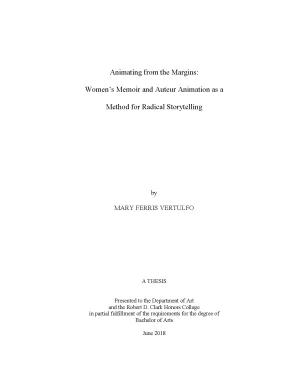
Animating from the Margins: Women’s Memoir and Auteur Animation as a Method for Radical Storytelling by MARY FERRIS VERTULFO A THESIS Presented to the Department of Art and the Robert D. Clark Honors College in partial fulfillment of the requirements for the degree of Bachelor of Arts June 2018 An Abstract of the Thesis of Mary Ferris Vertulfo for the degree of Bachelor of Arts in the Department of Art to be taken June 2018 Title: Animating from the Margins: Women’s Memoir and Auteur Animation as a Method for Radical Storytelling Approved: _______________________________________ Rick Silva This thesis explores the potential of animation as a medium for investigating conventions and constructions of storytelling. Through an intersectional analysis of the work of female auteur animators and the genre of memoir, animated film and its production serve as a method for radical and subversive storytelling. The project combines traditional academic research and the investigation of production and critique to begin a discourse surrounding animated narratives which illuminate women’s experiences and personal narratives.

It also investigates my short film Mark through a critique which inspects my personal influences, goals, and techniques as a product and synthesis of stylistic conventions of animation and graphic narrative. Concepts of self and creation are treated both personally and critically to address the effects of the discrimination of the personal narratives and creative practices of women within the industry, and a reflection of my own practice serves to examine the process of animating as inherently interdisciplinary. ii Acknowledgements I would like to thank my advisor, Rick Silva, for working with me throughout my undergraduate education. He has patiently guided me through multiple films and countless projects, and has completely shaped my work and passion for animation.

I am so grateful to have had the privilege of working with Professor Ben Saunders and Professor Louise Bishop both during my thesis project and throughout my other academic and artistic endeavors. Additionally, I would like to thank Michael Salter and Aidan Grealish for helping me push myself this past year. My friends, family, peers, and instructors have always been my greatest supporters, and I could have not completed this project without their endless patience and encouragement. Lastly, I would like to thank the faculty and administration of the Robert D.

Clark Honors College and the Art & Technology program. I am forever grateful to have had the opportunity to work on this project and to pursue my love of research and animation. iii Table of Contents Chapter 1: Introduction 1 Preface 1 List of Terms 6 Chapter 2: Literature and Film Review 12 Women in Animation: Working within the margins 12 Lotte Reiniger: Accessible production and innovation 13 The Boys Club and the rise of the feminist auteur 16 Women’s Auteur and Graphic Memoir 17 Women’s Memoir and Centering Self-identity 18 Animating a View: Ecstatic truth, Visual theory, and Argumentation 20 The Social Responsibility of the Animator 21 Critique 22 Persepolis (2007) 22 Rocks in my Pocket (2014) 24 Chapter 3: The Creative Project 26 Narrative and Technical Goals and Processes 26 Goals 27 Inspiration 28 Building a Non-linear Narrative Structure 31 Technical Process 33 Creating Mark and Self Critique 46 Style and Stylistic Influences 47 Close Reading the Narrative Construction of Mark 49 Scene-by-Scene Analysis 53 Voicemails 66 Reflection 67 Concluding Remarks 70 Bibliography 73 iv List of Accompanying Materials 1. Mark link: https://vimeo.com/260161044 v List of Figures Figure 1: A storyboarded image (left) and a rough animation still (right) for the same scene.

35 Figure 2: Illustration of acetate cel used for animation. 36 Figure 3: Outlined background without color or animatic overlayed. 37 Figure 4: Character model sheet for Jane. 39 Figure 5: Character model sheet for Mark (previously named Max).

39 Figure 6: Outlined animation cel. 41 Figure 7: Colored and outlined animation cel.10 42 Figure 9: A still from scene 5.2, consisting of layers “CC 5.2 mark”, and “BG 5. 45 vi List of Tables Table 1: Shot list of the first two scenes. 64 vii Chapter 1: Introduction Preface The work of an artist is to introduce change; their motivation often lies in innovation within their creative practice and field, transformation and translation within visual communication and interdisciplinary spaces, and perhaps most importantly, revolution within cultural spheres and social margins.

This thesis, the product of both traditional academic research, creative production, and critique, will investigate the motivations and methods by which women animators instigate change and social critique; it analyzes the intersection between women’s auteur animation, independent animation and animated memoir from a feminist perspective, establishing the processual relationship between them as a radical act which resists conventions of male narrative construction within both the medium and the genre. It serves to not only elevate the work of women animators and the discourse surrounding the medium, but also builds a framework of analysis which helps me understand my own work and creative process, as well as the history of women’s animation. My artistic practice revolves around fabricating lies—constructing non-existent characters, imagined realities and illusions of life—to communicate narrative. In return, I ask my audience to suspend their disbelief and vision of reality to partake in my personal interpretation of the truth; to abandon their own notions of personhood, order, and comfort.

To animate, by definition, is to bring thing to life, 1 and I have found very few media as convincing, accessible, and exciting as animation in the pursuit of 1 “Animation.” Merriam Webster, Merriam Webster. Animation blurs boundaries of fact and fiction, defies the laws of physics, and consistently breaks conventions of filmmaking. It is animated by nature—it resists fixed formulations of technology and intent. It is a medium that requires you to establish rules, and then, 24 times a second, it encourages you to break them.

Narrative animation only complicates the medium further, and it can be more easily understood functioning as a metaphor. Animation, as a medium, exists as a type of fiction. Everything is constructed, and regardless of how close it may imitate life, by definition, it is everything but. Animation operates as the vehicle.

Comparatively, the act of writing personal narrative is the act of uncovering some form of truth whether or not it is accurate—and thus, the narrative being communicated is the tenor. Animated memoir acts as a crafted metaphor, whereas the visual image informs the narrative—a lie which communicates the ecstatic truth 2—offering established visual systems from which the audience can develop a deeper understanding of the story being pursued by the animator. The practicality, complexity, and pure formal qualities of animation seem to assert the potential of the investigation of personal memoir within the medium, and for visual studies generally. These qualities have drawn me to animation not only an artist who explores memoir and identity, but even inadvertently; as a child, desperate for representation and diversity on the screen, I was attracted to animated film like the flickering of a flame, hungry to see my own personal experiences—or at least something similar—affirmed and celebrated.

This thesis was originally developed as a 2 Ebert, Roger. “Herzog's Minnesota Declaration: Defining 'Ecstatic Truth' | Roger Ebert's Journal | Roger Ebert.” Roger Ebert, 30 Apr. 2 methodical investigation of my own interests, influences, and body of work, with the intention of acknowledging my weaknesses as an animator and storyteller to create what is often vaguely referred to as “better work”—to become a more efficient writer, animator, and communicator, and to frame and share my own stories in a way that impacted and inspired others, just as other films had impacted and inspired me. The goal I had made for myself illuminated one of the fundamental issues that animation faces as a medium; throughout the past century, the use and perception of the medium in the public eye has remained unmoving.

Innovation in art and the creation of “better work” requires that the artist overturns conventions of their chosen medium; it makes sense that the histories of form and function, storytelling and style, and vehicle and tenor are inextricably linked. As Paul Wells notes in his book, Animation: Genre and Authorship, animation, though omnipresent in the modern era, suffers from both a history of systematic neglect within academic circles, as well as within creative circles. 3 The conventional understanding of the medium is informed primarily by its relationship to American cartoons—as Maureen Furniss clarifies; in every artistic medium, there are dominant forms of expression that tend to define it within the minds of people in the general public, if not specialists in the field. Within the realm of animation, one can identify at least four such traits: animation is (1) American and (2) created with cel artwork (3) made by famous men (4) at the Disney studio.

4 It’s this mythical understanding of the operation of the Disney studio that establishes Disney as the “creative fountainhead from which all other animation 3 Wells, Paul. Animation: Genre and Authorship. Art in Motion: Animation Aesthetics. 3 springs,” 5 but also directly contributes to the lack of academic interest in the medium.

After all, how could it be possible that a medium so well understood and rigidly defined by its repetition of form and genre be worth of study or debate? The industrialization of American animation and the “Disney Myth” has injected both stylistic and narrative standards into the medium that are held to be the ideal, crafted with male-defined conventions of perspective, structure, and storytelling at the forefront, while also contributing to the “tradition of obscurity” which plagues those working within the industry—the constant lack of accreditation of early animated films only continued to bury the women that helped produce them, preventing women animators from establishing their names within the industry circles. 6 Resisting this narrative of tradition in animation–what Judith Mayne describes to be purely fundamental feminist inquiry in her essay, The Woman at the Keyhole: Women's Cinema and Feminist Criticism, requires “reading against the grain” 7 and the acknowledgement that these standards have become historically naturalized within the medium for both the creator and the consumer. To be clear, no artist can exist in a vacuum, and subverting tradition isn’t a requirement or a condition for creating beautiful and effecting narrative animation. Innovative narrative animation doesn’t demand that we reject established institutions of 5 Taylor, K.

Nationality, Gender, and Genre: The Multiple Marginalization of Lotte Reiniger and The Adventures of Prince Achmed (1926). Department of English College of Arts and Sciences University of South Florida, 31 Mar. Full Length Animated Feature Films. and Foreword by John Halas.

New York: Hastings, 1977. "The Woman at the Keyhole: Feminism and Women’s Cinema." Revision: Essays in Feminist Film Criticism. Mary Ann Doane, Patricia Mellencamp and Linda Williams. Frederick, MD: U Pub.

4 animation, but that we refuse passive consumption of animation in order to advance the critical discourse surrounding the medium. In fact, it can be argued that the alteration in the perception of the complex relationships between the past, present, and future of animation is necessary to enrich the scholarly and academic approach to the animation studies. 8 In interrogating animated narrative, we gain much more than a basic understanding of semiotics and visual theory, and in the same way, investigating memoir reveals more than an understanding of self. Jennifer Anne McCue explains in Empowering the Female Voice: Interdisciplinarity, Feminism, and the Memoir, that personal narratives “reveal life experiences that are undeniably and intrinsically connected to cultural contexts,” exemplifying societal norms.

The similarities between the medium and the genre—the fact that though both are deeply entrenched in male conventions and contexts of storytelling and therefore equally present opportunities to critique the cultural conventions they arise from—present them as an ideal pairing through which women animators can share and explore their personal narratives and perspectives through constructed visual languages. Understanding these conventions not only allows me to develop and investigate my own practice and narrative self, but informs my work and reinforces the value of women in animation.

Nội dung được bảo vệ bản quyền — Tải xuống đầy đủ