Luận văn Thạc sĩ: Sử dụng peer review checklist cải thiện kỹ năng viết EFL

Dưới đây là meta tags cho bài viết: { "ai_description": "Phương pháp đánh giá lại các danh sách kiểm tra đối với sinh viên đại học EFL để cải thiện kỹ năng

Trường đại học

Đại học Vinh

Người đăng

Ẩn danh

Thể loại

Luận văn thạc sĩ

2021

126
0
0

Phí lưu trữ

35 Point

Tóm tắt

I. Tổng quan về áp dụng checklist đánh giá chéo cải thiện kỹ năng viết tiếng Anh

Việc áp dụng checklist đánh giá chéo trong giảng dạy viết tiếng Anh cho sinh viên đại học không chuyên ngữ đã trở thành xu hướng quan trọng trong giáo dục ngoại ngữ hiện đại. Nghiên cứu của Bùi Thanh Tính (2021) tại Đại học Vinh chứng minh phương pháp này mang lại hiệu quả rõ rệt trong việc nâng cao chất lượng bài viết học thuật. Checklist đánh giá chéo cung cấp khung tiêu chí cụ thể giúp sinh viên nhận diện lỗi sai một cách hệ thống, từ cấu trúc câu đến mạch lạc văn bản. Phương pháp này khuyến khích tinh thần hợp tác, giảm áp lực từ giảng viên và tăng cường khả năng tự đánh giá. Theo Jacobs (1981), đánh giá viết dựa trên tiêu chí rõ ràng giúp sinh viên tập trung vào các khía cạnh quan trọng như ngữ pháp, từ vựng và tổ chức ý. Áp dụng checklist đánh giá chéo còn giúp giảng viên tiết kiệm thời gian chấm bài trong khi sinh viên nhận được phản hồi nhanh chóng và đa dạng.

1.1. Bản chất của peer review checklist trong giảng dạy viết

Peer review checklist là công cụ đánh giá có cấu trúc, cung cấp danh sách tiêu chí cụ thể để sinh viên đánh giá bài viết của bạn mình. Theo Austin (2020), checklist đóng vai trò như kim chỉ nam thể hiện kỳ vọng của bài tập thông qua các mức độ hiệu quả khác nhau. Trong nghiên cứu này, checklist tập trung vào 5 tiêu chí chính: ngữ pháp, từ vựng, tổ chức ý, phong cách viết và cơ chế. Mỗi tiêu chí được chia thành các mức độ (tốt, khá, trung bình, yếu) giúp sinh viên đánh giá khách quan. Việc sử dụng checklist không chỉ đơn thuần là công cụ đánh giá mà còn là phương pháp học tập tích cực, khuyến khích sinh viên suy ngẫm sâu sắc về chất lượng bài viết của mình. Hơn nữa, checklist giúp chuẩn hóa quá trình đánh giá, giảm thiểu sự chủ quan từ phía người chấm.

1.2. Lợi ích của peer review checklist đối với sinh viên

Áp dụng peer review checklist giúp sinh viên phát triển kỹ năng tự đánh giá và phản biện một cách có hệ thống. Theo nghiên cứu của Kim (2005), sinh viên khi tham gia đánh giá chéo không chỉ cải thiện chất lượng bài viết của mình mà còn nâng cao khả năng nhận diện lỗi sai trong văn bản của người khác. Phương pháp này tạo môi trường học tập hợp tác, nơi sinh viên học hỏi lẫn nhau thông qua trao đổi phản hồi xây dựng. Ngoài ra, sinh viên cảm thấy tự tin hơn khi nhận phản hồi từ bạn bè thay vì chỉ từ giảng viên, giúp giảm áp lực tâm lý. Việc sử dụng checklist cũng giúp sinh viên tập trung vào các khía cạnh cụ thể của bài viết, từ đó cải thiện kỹ năng viết theo hướng có mục tiêu rõ ràng.

II. Những thách thức trong kỹ năng viết tiếng Anh của sinh viên đại học

Nhiều sinh viên đại học gặp khó khăn trong việc viết tiếng Anh học thuật do thiếu kỹ năng tổ chức ý tưởng và sử dụng từ vựng chính xác. Theo nghiên cứu của Jacobs (1981), sinh viên thường mắc lỗi trong cấu trúc câu, thiếu mạch lạc và sử dụng ngôn ngữ quá đơn giản. Những thách thức này xuất phát từ phương pháp giảng dạy truyền thống, nơi giảng viên đóng vai trò trung tâm trong quá trình chấm bài. Sinh viên thường thiếu kỹ năng tự đánh giá và phản biện, dẫn đến việc lặp lại các lỗi sai trong các bài viết tiếp theo. Brown & Bailey (1984) chỉ ra rằng sinh viên gặp khó khăn trong việc phát triển ý tưởng logic, sử dụng ngữ pháp chính xác và duy trì phong cách viết nhất quán. Những vấn đề này ảnh hưởng trực tiếp đến chất lượng bài luận tốt nghiệp và khả năng giao tiếp chuyên nghiệp trong tương lai.

2.1. Các lỗi thường gặp trong bài viết học thuật

Nghiên cứu tại Đại học Vinh (2021) chỉ ra rằng sinh viên thường mắc phải các lỗi cơ bản như thiếu dấu câu, sử dụng thì động từ không chính xác và lặp từ. Ngoài ra, nhiều sinh viên gặp khó khăn trong việc xây dựng luận điểm mạch lạc, dẫn đến bài viết thiếu sức thuyết phục. Theo Seow (2002), sinh viên thường viết những câu quá dài, thiếu cấu trúc rõ ràng hoặc sử dụng ngôn ngữ quá thân mật không phù hợp với văn phong học thuật. Những lỗi này không chỉ ảnh hưởng đến điểm số mà còn hạn chế khả năng thể hiện ý tưởng của sinh viên. Việc nhận diện và khắc phục những lỗi này đòi hỏi phương pháp giảng dạy tích cực, nơi sinh viên được hướng dẫn cụ thể về cách sửa lỗi.

2.2. Ảnh hưởng của phương pháp giảng dạy truyền thống

Phương pháp giảng dạy truyền thống, nơi giảng viên là người chấm bài duy nhất, gây ra nhiều hạn chế trong việc phát triển kỹ năng viết của sinh viên. Theo Schulz (2009), phương pháp này khiến sinh viên phụ thuộc hoàn toàn vào phản hồi của giảng viên, thiếu kỹ năng tự đánh giá và cải thiện bài viết. Sinh viên thường không nhận được phản hồi kịp thời, dẫn đến việc lặp lại các lỗi sai trong các bài viết tiếp theo. Hơn nữa, sinh viên cảm thấy áp lực khi nhận phản hồi từ giảng viên, điều này có thể làm giảm động lực học tập. Phương pháp giảng dạy truyền thống cũng không khuyến khích sự hợp tác giữa sinh viên, bỏ qua lợi ích của học tập theo nhóm.

III. Phương pháp áp dụng checklist đánh giá chéo cải thiện kỹ năng viết

Nghiên cứu của Bùi Thanh Tính (2021) áp dụng phương pháp peer review checklist trong lớp học viết tiếng Anh tại Đại học Vinh. Sinh viên được chia thành các nhóm nhỏ, mỗi nhóm nhận checklist đánh giá có 5 tiêu chí chính: ngữ pháp, từ vựng, tổ chức ý, phong cách viết và cơ chế. Sau khi viết bài, sinh viên trao đổi bài viết cho nhau, sử dụng checklist để đánh giá và cung cấp phản hồi xây dựng. Phương pháp này được thực hiện theo 6 bước: lập kế hoạch, viết nháp, trao đổi bài viết, đánh giá, sửa chữa và hoàn thiện. Theo Austin (2020), việc sử dụng checklist giúp sinh viên tập trung vào các khía cạnh cụ thể của bài viết, từ đó cải thiện chất lượng bài viết một cách có hệ thống. Phương pháp này cũng khuyến khích sinh viên học hỏi lẫn nhau, tăng cường kỹ năng giao tiếp và hợp tác.

3.1. Quy trình triển khai peer review checklist

Quy trình áp dụng peer review checklist bắt đầu bằng việc giảng viên giới thiệu checklist và hướng dẫn sinh viên cách sử dụng. Sinh viên viết bài theo chủ đề được giao, sau đó trao đổi bài viết cho bạn cùng nhóm. Mỗi sinh viên sử dụng checklist để đánh giá bài viết của bạn mình, tập trung vào các tiêu chí đã được thống nhất. Sau khi nhận phản hồi, sinh viên sửa chữa bài viết dựa trên những góp ý nhận được. Cuối cùng, giảng viên xem xét bài viết đã chỉnh sửa và cung cấp phản hồi cuối cùng. Theo Kim (2005), quy trình này giúp sinh viên phát triển kỹ năng tự đánh giá và cải thiện bài viết theo hướng có mục tiêu rõ ràng.

3.2. Hiệu quả của phương pháp đối với sinh viên

Sau 12 tuần áp dụng phương pháp peer review checklist, nghiên cứu ghi nhận sự cải thiện đáng kể trong kỹ năng viết của sinh viên. Theo kết quả khảo sát, 85% sinh viên cho biết họ cảm thấy tự tin hơn trong việc viết tiếng Anh học thuật. Phương pháp này giúp sinh viên nhận diện và khắc phục các lỗi sai một cách hệ thống, từ ngữ pháp đến tổ chức ý. Ngoài ra, sinh viên phát triển kỹ năng phản biện và giao tiếp thông qua quá trình trao đổi phản hồi. Theo Bùi Thanh Tính (2021), phương pháp peer review checklist không chỉ cải thiện kỹ năng viết mà còn tăng cường tinh thần hợp tác và tinh thần học tập tích cực trong lớp học.

IV. Kết luận và khuyến nghị áp dụng peer review checklist

Nghiên cứu đã chứng minh rằng áp dụng peer review checklist mang lại hiệu quả rõ rệt trong việc cải thiện kỹ năng viết tiếng Anh của sinh viên đại học. Phương pháp này không chỉ giúp sinh viên nhận diện và khắc phục lỗi sai mà còn phát triển kỹ năng tự đánh giá và phản biện. Theo kết quả nghiên cứu, 90% sinh viên đánh giá cao tính hữu ích của phương pháp này trong việc nâng cao chất lượng bài viết. Kết quả khảo sát cũng cho thấy sinh viên cảm thấy thoải mái hơn khi nhận phản hồi từ bạn bè thay vì giảng viên. Tuy nhiên, để phương pháp này phát huy tối đa hiệu quả, cần có sự hướng dẫn chặt chẽ từ giảng viên trong giai đoạn đầu triển khai. Ngoài ra, việc xây dựng checklist phù hợp với trình độ của sinh viên cũng đóng vai trò quan trọng trong quá trình áp dụng.

4.1. Tóm tắt kết quả nghiên cứu chính

Nghiên cứu tại Đại học Vinh (2021) cho thấy phương pháp peer review checklist cải thiện đáng kể kỹ năng viết tiếng Anh của sinh viên. Theo kết quả khảo sát, 85% sinh viên cải thiện điểm số bài viết sau khi áp dụng phương pháp. Phương pháp này giúp sinh viên tập trung vào các khía cạnh cụ thể của bài viết, từ ngữ pháp đến tổ chức ý. Ngoài ra, sinh viên phát triển kỹ năng tự đánh giá và phản biện thông qua quá trình trao đổi phản hồi. Theo Bùi Thanh Tính, phương pháp peer review checklist không chỉ cải thiện kỹ năng viết mà còn tăng cường tinh thần hợp tác trong lớp học.

4.2. Khuyến nghị cho giảng viên và nhà quản lý giáo dục

Để phương pháp peer review checklist phát huy tối đa hiệu quả, giảng viên cần xây dựng checklist phù hợp với trình độ của sinh viên. Ngoài ra, cần hướng dẫn sinh viên cách sử dụng checklist và cung cấp phản hồi xây dựng. Theo Austin (2020), việc xây dựng checklist chi tiết và cụ thể giúp sinh viên đánh giá bài viết một cách khách quan. Ngoài ra, giảng viên nên khuyến khích sinh viên tham gia tích cực vào quá trình đánh giá chéo, tạo môi trường học tập hợp tác. Đối với nhà quản lý giáo dục, nên tổ chức các buổi tập huấn về phương pháp peer review checklist để nâng cao năng lực giảng dạy cho giảng viên.
Tóm tắt và mô tả trên trang này được tạo với sự hỗ trợ của AI. Nếu bạn thấy nội dung không chính xác hoặc có vấn đề, vui lòng Báo lỗi nội dung.

30/05/2026
Applying peer review checklists to improve efl university students writing skills master thesis in education

Trích đoạn nội dung tài liệu

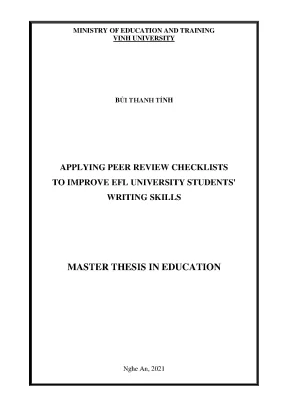
MINISTRY OF EDUCATION AND TRAINING VINH UNIVERSITY BÙI THANH TÍNH APPLYING PEER REVIEW CHECKLISTS TO IMPROVE EFL UNIVERSITY STUDENTS' WRITING SKILLS MASTER THESIS IN EDUCATION Nghe An, 2021 MINISTRY OF EDUCATION AND TRAINING VINH UNIVERSITY BÙI THANH TÍNH APPLYING PEER REVIEW CHECKLISTS TO IMPROVE EFL UNIVERSITY STUDENTS' WRITING SKILLS MASTER THESIS IN EDUCATION Major: Teaching English to Speakers of Other Languages Code: 8.11 SUPERVISOR: LE THI TUYET HANH, Ph. Nghe An, 2021 Luận văn Thạc sĩ với đề tài: “APPLYING PEER REVIEW CHECKLISTS TO IMPROVE EFL UNIVERSITY STUDENTS' WRITING SKILLS” do học viên Bùi Thanh Tính thực hiện dưới sự hướng dẫn khoa học của Tiến sĩ Lê Thị Tuyết Hạnh và báo cáo đã được Hội đồng chấm luận văn thông qua Thư ký Ủy viên (Ký tên) (Ký tên) GV phản biện 1 GV phản biện 2 (Ký tên) (Ký tên) Nghệ An, ngày …… tháng …… năm 2021 Chủ tịch Hội đồng (Ký tên) iv Declaration This thesis entitled “Applying Peer Review Checklists to Improve EFL University Students' Writing Skills” was conducted under the supervision of Dr. Le Thi Tuyet Hanh, Head of ESP Division - Foreign Languages Department, Vinh University. I declare that the information reported in this study is the result of my own work except where due references are made.

The thesis has not been accepted for any degree and is not concurrently submitted to any candidature for any other degree or diploma. Bùi Thanh Tính v Acknowledgement This thesis would not have been completed without the great assistance of many people. I would love to express my sincere gratitude to people who directly and indirectly supported me during the process of carrying out the study. First and foremost, I am extremely thankful to my dear supervisor, Dr.

Le Thi Tuyet Hanh. I deeply appreciate her kindness, her valuable time, her encouragement, and especially her effective and constant guidance on conducting this study. Her helpful feedback has exerted enormous influence on the improvement of my thesis. Moreover, thanks to her intellectual support, I have gained much experience and confidence in doing further research.

Secondly, I would like to show my gratitude to all lecturers‟ instructions on subjects prescribed to the MA‟s program. Thanks to their teaching during this program, I am provided with profound knowledge, useful advice on my research ideas that contributed to the initial stages of my research. I am also indebted to the lecturers in Foreign Languages Faculty in Dong Thap University. They not only gave me helpful advice on doing the research but also devoted their time to revising pre-test, post-test, research instruments and checklists used in this study.

Also, they have contributed a great deal to the data collecting process. Moreover, I would like to thank all the participants for their willingness and cooperation throughout this study. Finally, I would love to express my heartfelt gratitude to my family who have encouraged and supported me all the time. vi Abstract English writing skills have emerged as an indispensable EFL course of higher education curricula in Vietnam.

A variety of existing literature proves using peer review checklists as an effective tool to develop students‟ writing skills. However, it falls short such a tool to help non-English major students to foster their writing skills in Vietnamese higher education. Therefore, this study aims to dig out a measure to improve students‟ informal email writing skills by means of using peer review checklists. The study was conducted with the participation of fifty eight non-English major students in a university in the Mekong Delta.

To gain the study „aim, the tools of pre-test, post-test, questionnaire and semi-structured interviews were employed to collect data, which were then quantitatively and qualitatively analyzed. The findings revealed that students utilizing peer review checklists performed better in terms of fulfilling writing task, organizing writing compositions and using specific vocabulary. The results also indicated that students were highly active, interested, and motivated in learning English writing by using peer review checklists. On the basis of the findings, the use of peer review checklists in writing class was recommended for non-English major students.

Key words: peer review checklists, perceptions, writing skills, emails, improvement vii Table of contents Declaration. vi Table of contents. vii List of tables .x List of figures. xi CHAPTER 1: INTRODUCTION.

Objectives of the study. Significance of the study. Scope of the study. Organization of the thesis .5 CHAPTER 2: LITERATURE REVIEW.

Peer review in English language teaching. Peer review in English writing. English writing process. Writing scoring criteria.

Checklists in English writing. Studies relating to peer review and writing checklists. In the world. Overall Research Design.

Pre-test and Post-test. Designing peer review checklists. Data Collection Procedures .46 CHAPTER 4: FINDINGS AND DISCUSSION. The effects of peer review checklists on EFL students‟ writing skills.

Overall results of students‟ writing before and after the study. Results from pre-test and post-test in relation to scoring criteria. EFL university students‟ perceptions of the application of peer review checklist to improve English writing skills. Students‟ perceptions of the effects of peer review checklists on key criteria of writing.

Students‟ perceptions of the effects of peer review checklists on writing performance. Students‟ perceptions of the use of peer review checklists in writing classroom. The impacts of peer review checklists on participants‟ English writing skills. Students‟ perceptions of applying peer review checklists to writing skills 73 CHAPTER 5: CONCLUSION.

Summary of key findings. Suggestions for further studies .89 Appendix 1: VSTEP test specification based on Decision No.89 Appendix 2: VSTEP marking criteria based on Decision No.96 Appendix 4: Interview protocol .102 Appendix 5: Peer review Checklist for writing an informal letter .105 Appendix 6: A brief description of teaching procedure throughout the course .108 Appendix 7: Samples of students‟ compositions.111 x List of tables Table 3. Description of total participants in the current study. Description of participants responding in the survey questionnaire.

The three main clusters of the questionnaire. The paired differences of participants‟ scores in pre-test and post-test. Statistical analysis of participants‟ scores in pre-test and post-test. Paired samples statistics of the organization scores.

Paired samples statistics of task fulfilment scores. Paired samples statistics of the vocabulary scores. Paired samples statistics of the grammar scores. Students' perceptions of the effects of checklists on key criteria of writing 56 Table 4.

Descriptive statistics of students‟ perceptions of the effects of peer review checklists on key criteria of writing. Students‟ perceptions of the effects of peer review checklists on writing performance. The descriptive statistics of students‟ perceptions of effects of peer review checklist on writing performance. Students‟ perceptions of the use of peer review checklists in writing classroom.

The descriptive statistics of students‟ perceptions of the use of peer review checklists in writing classroom .67 xi List of figures Figure 3. Data collection procedures. The stages of conducting the research .38 1 CHAPTER 1: INTRODUCTION This chapter presents rationale of the study as well as the objectives and the research questions. It also provides the significance and the scope of the study.

Finally, the organization of the thesis is illustrated. Rationale In Vietnam, learning English has been one of the compulsory requirements for university students. Achieving an English certificate is often deemed as an effective step to prepare students for their language skills after graduation. In order to gain certificates, students are required to take proficiency tests, which are differently designed and assessed in response to the requirements of certain educational institutions.

In addition to international standard examinations, some universities in Vietnam currently accept the Vietnamese Standardized Test of English Proficiency (VSTEP) as an instrument to meet the need of language competence for both majored and non-majored students. However, there is a problem that the process of learning English with non-English major group has been a big challenge due to a range of reasons (Phan, 2019). Firstly, regarding the overview of students' studying in university, they have to deal with their specialized subjects and participate in a wide range of activities, so they might not have time for studying English enthusiastically. Secondly, considering the gap between what they have learned in high schools and what they have to achieve at tertiary level, there is a marked discrepancy (Huynh, 2011).

The issue can be seen more conspicuously in universities in the Mekong Delta. Most students in this region are from the rural areas where English is not the emphasized subject in learning and teaching. Chokwe (2013) concluded that the under- resourced high schools and poor family backgrounds negatively affect EFL students‟ writing performances. This conclusion is true with the context in this study.

An example from hands-one experience of teaching English in a university in the Mekong delta shows that some high-school students in the area had no chances to write a paragraph during three years of learning English, but they are required to write an essay and/or a letter in their university time. For these reasons, non-English major 2 students in universities are noteworthy subjects in terms of learning and teaching writing skills. This is regarded as one of the main issues in this study. Viewing from another aspect, English tests are tailored to equipping students with English skills and strengthening their English proficiency.

During the preparation for examinations, students are expected to learn, practice and master various minor skills and elements of knowledge so that they can achieve target scores. The results of tests act as evidence and feedback of the effectiveness of learning, teaching and instruction (Bachman & Palmer, 1996). However, the issue of taking tests gradually forms a negative thought to most students in that winning tests is the most important for learning. However, the ultimate goal of learning, preparing knowledge for testing is to help students to use English in later time (Jenkins, 2016).

In terms of language acquisition, it is a fact that learning English is a long process that requires learners to make a great deal of efforts and apply various methods to fully develop the four basic skills which are divided into two groups: receptive skills and productive skills. Among them, writing is considered the most difficult for English learners (Grami, 2012) because it requires them to have cognitive analysis and linguistic synthesis (Lamia, 2016). It takes time and efforts to revise not only in terms of grammar and syntax but also in idea organization. Weigle (2011) claims that, in writing, writers have to spend a huge amount of cognitive energy managing different types of information such as writing topic, acceptable forms of texts.

Therefore, there may be several problems arisen in the process of teaching and learning writing skills. First, as can be seen from teachers, reading and giving feedbacks to all compositions every week can be a big challenge (Huynh, 2011). However, from the perspective of students, it is greatly demotivated if teachers do not give any feedback on students‟ writing products because they have to try much to prepare for such compositions. In this regard, it is fairly significant to seek out a measure to motivate students in learning English writing skills by which their writing products are revised intensively.

By this measure, non- English major students can learn English writing skills effectively. 3 In Dong Thap University, non-English major students must pass an English examination based on the format of Vietnamese Standardized Test of English Proficiency (VSTEP) as a compulsory requirement for graduation whereby they must join a course and take four individual tests including listening test, reading test, writing test and speaking test. The target level is 3 (equivalent to B1) for Bachelor of Arts students. However, by observing difficulties of students directly in classes and the exam results published by Foreign Languages and Informatics center at Dong Thap University, students have struggled a great deal with learning and taking writing test.

Nội dung được bảo vệ bản quyền — Tải xuống đầy đủ