Luận văn Duong Tuan Minh: Yếu tố tài chính ảnh hưởng lợi nhuận BĐS niêm yết VN

Phân tích các yếu tố tài chính quan trọng ảnh hưởng đến lợi nhuận của các công ty bất động sản niêm yết tại Việt Nam. Nghiên cứu sâu về ngành bất động sản.

Chuyên ngành

Tài chính

Người đăng

Ẩn danh

Thể loại

Luận văn thạc sĩ

2018

83
1
0

Phí lưu trữ

30 Point

Tóm tắt

I. Tổng quan về yếu tố tài chính ảnh hưởng lợi nhuận công ty BĐS

Lợi nhuận là chỉ tiêu quan trọng nhất đánh giá hiệu quả hoạt động của doanh nghiệp bất động sản niêm yết trên thị trường chứng khoán Việt Nam. Nghiên cứu sử dụng ROA (Return on Assets) làm thước đo lợi nhuận chính. ROA được chọn vì tính ổn định cao hơn ROE và ROI trong suốt thời gian nghiên cứu. Các yếu tố tài chính ảnh hưởng đến lợi nhuận bao gồm tỷ lệ tăng trưởng doanh nghiệp, vòng quay các khoản phải thu, doanh thu trên vốn sử dụng và quy mô công ty. Thị trường bất động sản Việt Nam giai đoạn 2009-2018 trải qua nhiều biến động. GDP tăng trưởng ổn định ở mức 6-7% nhưng lạm phát có thời điểm lên đến 23%. Ngành bất động sản chịu tác động mạnh từ chính sách tín dụng và lãi suất ngân hàng. Việc xác định các yếu tố tài chính then chốt giúp nhà đầu tư và nhà quản lý đưa ra quyết định chính xác hơn. Mô hình dữ liệu bảng được áp dụng để phân tích mối quan hệ giữa các biến số độc lập và lợi nhuận.

1.1. Vai trò của ROA trong đánh giá lợi nhuận BĐS

ROA là tỷ số lợi nhuận trên tài sản, phản ánh khả năng sinh lời từ tổng tài sản của doanh nghiệp. So với ROE và ROI, ROA có tính ổn định cao hơn qua các giai đoạn thị trường biến động. ROE dễ bị ảnh hưởng bởi cấu trúc vốn, trong khi ROI có cách tính khác nhau giữa các nghiên cứu. Đối với ngành bất động sản, ROA cho thấy bức tranh toàn diện về hiệu quả sử dụng tài sản. Nghiên cứu tại Việt Nam cho thấy ROA trung bình của các công ty BĐS niêm yết dao động mạnh, phản ánh tính chu kỳ của ngành.

1.2. Bối cảnh thị trường BĐS Việt Nam

Thị trường bất động sản Việt Nam có đặc thù riêng biệt so với các thị trường phát triển. Giai đoạn 2003-2009, chứng khoán BĐS Việt Nam vượt trội so với Mỹ, Anh, Australia. Tuy nhiên, trong giai đoạn khủng hoảng tài chính toàn cầu 2009, lợi nhuận sụt giảm nghiêm trọng. Tỷ lệ lạm phát cao và biến động lãi suất là thách thức lớn. Chính sách tín dụng thắt chặt ảnh hưởng trực tiếp đến dòng tiền và khả năng phát triển dự án. Thị trường chứng khoán Việt Nam thuộc loại thị trường mới nổi với rủi ro cao hơn.

II. Phân tích các yếu tố tài chính ảnh hưởng lợi nhuận

Nghiên cứu xác định bốn yếu tố tài chính chính có tác động đáng kể đến lợi nhuận. Thứ nhất, tỷ lệ tăng trưởng doanh nghiệp (FGR) phản ánh tốc độ mở rộng hoạt động kinh doanh. Thứ hai, vòng quay các khoản phải thu (RT) đo lường hiệu quả quản lý công nợ khách hàng. Thứ ba, doanh thu trên vốn sử dụng (SCE) thể hiện khả năng tạo doanh thu từ nguồn vốn đầu tư. Thứ tư, quy mô công ty (SIZE) ảnh hưởng đến lợi nhuận theo hướng nghịch. Các công ty lớn có xu hướng đạt ROA thấp hơn do chi phí quản lý tăng. Kết quả hồi quy cho thấy mối tương quan giữa các biến số độc lập đều nhỏ hơn 0.8, loại bỏ hiện tượng đa cộng tuyến. GDP và lạm phát không có tác động có ý nghĩa thống kê đến lợi nhuận. Vòng quay hàng tồn kho và tỷ lệ nợ ngắn hạn cũng không ảnh hưởng đáng kể.

2.1. Tác động của tỷ lệ tăng trưởng và vòng quay phải thu

Tỷ lệ tăng trưởng doanh nghiệp có mối quan hệ dương với ROA. Công ty tăng trưởng nhanh thường tận dụng tốt cơ hội thị trường, mở rộng danh mục dự án và đa dạng hóa nguồn thu. Vòng quay các khoản phải thu phản ánh khả năng thu tiền từ khách hàng mua bất động sản. Vòng quay cao cho thấy chính sách bán hàng hiệu quả, giảm rủi ro nợ xấu. Ngành BĐS thường có chu kỳ thanh toán dài, nên quản lý phải thu đặc biệt quan trọng. Công ty nào thu tiền nhanh sẽ có dòng tiền ổn định hơn để tái đầu tư.

2.2. Ảnh hưởng của quy mô công ty đến lợi nhuận

Quy mô công ty có mối tương quan âm với ROA trong nghiên cứu này. Hiện tượng này có thể giải thích bởi hiệu ứng giảm dần theo quy mô. Công ty lớn phải đối mặt với chi phí quản lý hành chính cao hơn, quy trình ra quyết định phức tạp hơn. Ngoài ra, các công ty BĐS lớn tại Việt Nam thường có danh mục dự án đa dạng, bao gồm cả dự án có tỷ suất lợi nhuận thấp. Ngược lại, công ty nhỏ có thể tập trung vào phân khúc sinh lời cao. Tuy nhiên, công ty lớn có ưu thế về tiếp cận vốn và thương hiệu.

III. Phương pháp nghiên cứu và mô hình phân tích dữ liệu

Nghiên cứu áp dụng phương pháp dữ liệu bảng (panel data) kết hợp giữa cross-section và time-series. Mẫu nghiên cứu bao gồm các công ty bất động sản niêm yết trên sàn HOSE và HNX trong giai đoạn 2009-2018. Dữ liệu tài chính được thu thập từ báo cáo tài chính đã kiểm toán. Phương pháp ước lượng chính là hồi quy OLS kết hợp kiểm định Hausman để lựa chọn mô hình hiệu ứng cố định hoặc hiệu ứng ngẫu nhiên. Kiểm định Durbin-Watson được sử dụng để phát hiện tự tương quan. Giá trị DW dao động trong khoảng chấp nhận được, cho thấy không có vấn đề nghiêm trọng về tự tương quan. Kiểm định đa cộng tuyến sử dụng ma trận tương quan giữa các biến số. Tất cả hệ số tương quan đều dưới ngưỡng 0.8. Quy trình phân tích bao gồm kiểm định ý nghĩa riêng lẻ từng biến số bằng t-test và kiểm định ý nghĩa đồng thời bằng F-test.

3.1. Xây dựng mô hình hồi quy dữ liệu bảng

Mô hình hồi quy ban đầu bao gồm tất cả các biến số độc lập: tỷ lệ tăng trưởng, vòng quay phải thu, doanh thu trên vốn sử dụng, quy mô công ty, vòng quay hàng tồn kho, tỷ lệ nợ ngắn hạn, GDP, tỷ lệ nợ trên vốn chủ. Quá trình loại bỏ biến số không có ý nghĩa thống kê được thực hiện tuần tự. Biến X2 (vòng quay phải trả) được loại bỏ đầu tiên. Tiếp theo là X4 (tỷ lệ nợ ngắn hạn trên tổng nợ), X5 (tỷ số thanh toán hiện hành), X6 (GDP) và X9 (vòng quay hàng tồn kho). Mô hình cuối cùng保留 các biến có ý nghĩa thống kê ở mức 5%.

3.2. Kiểm định và xử lý vấn đề thống kê

Kiểm định ý nghĩa riêng lẻ sử dụng t-statistic với mức ý nghĩa 5%. Kết quả cho thấy bốn biến số có tác động có ý nghĩa đến ROA. Kiểm định ý nghĩa đồng thời bằng F-test xác nhận mô hình có sức giải thích tổng thể tốt. Kiểm định tự tương quan Durbin-Watson dựa trên bảng giá trị Bhargava (1983) cho kết quả chấp nhận được. Kiểm định đa cộng tuyến bằng ma trận tương quan cho thấy không có vấn đề multicollinearity. Phương pháp loại bỏ biến số tuần tự giúp tối ưu hóa mô hình cuối cùng.

IV. Kết luận và khuyến nghị cho doanh nghiệp BĐS niêm yết

Nghiên cứu xác định bốn yếu tố tài chính có tác động có ý nghĩa đến lợi nhuận công ty BĐS niêm yết Việt Nam. Tỷ lệ tăng trưởng doanh nghiệp có tác động dương mạnh nhất đến ROA. Vòng quay phải thu và doanh thu trên vốn sử dụng cũng có tác động dương. Quy mô công ty có tác động nghịch, đặt ra thách thức cho các tập đoàn BĐS lớn. Các yếu tố vĩ mô như GDP và lạm phát không có tác động trực tiếp có ý nghĩa. Nhà quản lý nên tập trung cải thiện hiệu quả quản lý công nợ và tối ưu hóa quy mô hoạt động. Chính sách bán hàng linh hoạt giúp tăng vòng quay phải thu. Đa dạng hóa nguồn vốn và cải thiện khả năng tiếp cận tín dụng là yếu tố then chốt. Nhà đầu tư cần đánh giá kỹ các chỉ số tài chính nội tại thay vì dựa vào yếu tố vĩ mô. Kết quả nghiên cứu cung cấp cơ sở khoa học cho việc ra quyết định đầu tư và quản trị doanh nghiệp.

4.1. Khuyến nghị cho nhà quản lý doanh nghiệp

Nhà quản lý công ty BĐS nên ưu tiên chiến lược tăng trưởng bền vững thay vì mở rộng quy mô nhanh. Cải thiện vòng quay phải thu thông qua chính sách bán hàng linh hoạt, chương trình khuyến mãi và chiết khấu thanh toán sớm. Thiết lập hệ thống quản lý công nợ hiệu quả, giảm thời gian thu tiền trung bình. Tối ưu hóa cơ cấu vốn, cân đối giữa nợ ngắn hạn và dài hạn. Đầu tư công nghệ quản lý tài chính để theo dõi dòng tiền thời gian thực. Xây dựng mối quan hệ tốt với ngân hàng để tiếp cận nguồn vốn ưu đãi.

4.2. Ý nghĩa đối với nhà đầu tư chứng khoán

Nhà đầu tư nên phân tích kỹ các chỉ số tài chính nội tại của doanh nghiệp BĐS trước khi ra quyết định. ROA là chỉ tiêu quan trọng nhất cần theo dõi, đặc biệt xu hướng thay đổi qua các năm. Công ty có tỷ lệ tăng trưởng ổn định, vòng quay phải thu cao thường có tiềm năng sinh lời tốt. Quy mô công ty lớn không đảm bảo lợi nhuận cao hơn. Nhà đầu tư nên đa dạng hóa danh mục, không tập trung vào một công ty BĐS duy nhất. Thị trường BĐS có tính chu kỳ cao, cần kiên nhẫn và có tầm nhìn dài hạn.
28/05/2026
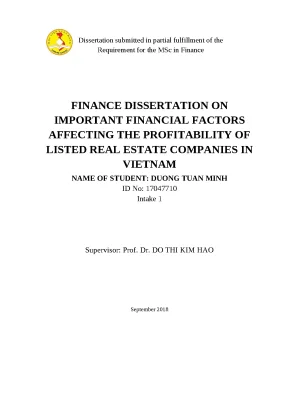
Finance dissertation onimportant financial factorsaffecting the profitability oflisted real estate companies invietnam

Trích đoạn nội dung tài liệu

Dissertation submitted in partial fulfillment of the Requirement for the MSc in Finance FINANCE DISSERTATION ON IMPORTANT FINANCIAL FACTORS AFFECTING THE PROFITABILITY OF LISTED REAL ESTATE COMPANIES IN VIETNAM NAME OF STUDENT: DUONG TUAN MINH ID No: 17047710 Intake 1 Supervisor: Prof. DO THI KIM HAO September 2018 ACKNOWLEDGEMENT I would like to express my grateful attitude to Dr. Do Thi Kim Hao, for her guidance and supervision. She has provided many useful advices and suggestions for this dissertation.

Additionally, I would like to reveal my thankful to all the teachers participating in the Master of Finance program, because they have always helped me in absorbing the knowledge in the most effective way and building the logical thinking as well as the problem-solving skills. Last but not least, I would like to express my sincere thankful to my family, especially my wife, for their continuing encouragement. iv Chapter 1: Introduction. Rationale of dissertation.

Research methods of the dissertation. Organization of the dissertation. Purposes of the dissertation. Methods of collecting data.

12 Chapter 2: Literature review.1 Review of related literature and researches.2 Review for related literature and researchesin Europe.3 Review for related literature and researchesin Asia.4 Review for related literature and researchesin Africa.5 Review for related literature and researchesin Vietnam.20 Chapter 3: Methodology of research. Data collection methods. Dependent variable and independent variables:. Data analyzes process.

Overview of panel data used for regression model.2 The formula of panel data.3 Techniques for estimatingpanel data:. Testing for the significance of statistics:.29 Chapter 4: Analyzing the researched data and presenting the findings. Testing for significant of statistics.1 Testing for individual significance of statistics. Joint significant testing.

Testing for autocorrelation. Testing for multicollinearity. 44 Chapter 5: Conclusion and recommendation. 49 iv List of Figures Figure 1: GDP, GDP Growth and inflation of Vietnam from 2009 to 2019.1 Figure 2: The Durbin-Watson value based on Bhargave (1983).44 Figure 3: The result for testing of multicollinearity.46 List of table Table 1 The highest profitable real estate firms listed in Vietnam in 2017.5 Table 2 Top ten listed real estate firms with fastest increasing in profit.5 Table 3 Top listed real estate firms with declined profit in 2017 comparing to 2016.7 Table 4 Top listed real estate firms with the highest inventory in 2017 comparing to 2016.7 Table 5: The regression model on independent variables.73 Table 6: The regression model after eliminating X2, Payable turnover.73 Table 7: The regression model after eliminating X4, Short term debt overtotal debt.74 Table 8: The regression model after eliminating X5, Current Ratio.75 Table 9: The regression model after eliminating X6, Gross Domestic Products.75 Table 10: Theregressionmodel after eliminating X9, Inventory Turnover.76 Table 11: Theregressionmodel after eliminating X10, Interest CoverageRatio.77 Table 12: Theregressionmodel for joint significant testing.77 Table 13: Theregressionmodel for testing of autocorrelation.78 Table 14: Theregressionmodel for testing of multicollinearity.79 iv Chapter 1: Introduction This chapter reveals the reasons for choosing the subject of the dissertation, the conceptual basic of profit and profitability, objectives of the dissertation, methods of collecting data and organization of the dissertation.

Rationale of dissertation According to “Investing in Vietnam in 2018” of KPMG, since the financial crisis in 2008, Vietnam macroeconomic has experienced a swift recovery leading to considerable growth in real estate sector. Specifically, Vietnam’s real GDP reached the increasing rate of 7.3% in average during the period from 2005 to 2008 before plummeted to 5.3% in 2009 due to the financial crisis in 2008. The recovery of Vietnamese economy started in 2012, with GDP growth steadily going up and achieving 6% in 2014. GDP per capita in 2017 was $2,385 and rose by 10% comparing with the numbers in 2016, based on “Q42017 Quarterly Market Briefing Viet Nam” of Savills Vietnam.

The growth rate is predicted to increase at practically 6. Figure 1: GDP, GDP Growth and inflation of Vietnam from 2009 to 2019 Page 1 The consumer price index (CPI) reached a new peak at 22.9% in 2008 due to the financial crises before recovering in a slower pace at 7.4% in 2009 as the result of many solutions of the government such as tightened monetary and credit policies. After that, the economy experienced a wide fluctuation in inflation rate during 2011 to 2016 from 18.7% in 2016 as various inflation control methods from the Government became effective. However, the swiftly rising in demand for goods and services, reducing credit and growing investment from the economic growth of the country resulting to an upsurge in inflation rate to 4.1% in 2017, according to World Bank.

The average rate of price rises during the period from 2016 to 2020 is predicted to keep steady at 4%. In 2017, the Foreign Direct Investment (FDI) capital from foreign investors in Vietnam set a new record, 35.9 billion USD, including increased capital and newly-registered capital, increasing by 44. The capital from foreign investors was invested in 19 different industries and the real estate industry ranked third with $3.05 billion, after manufacturing, distribution and power generation. The total trading value of merger and acquisition in real estate field was $8 billion in 2017 and the investors prefer to make investment to property companies in Ho Chi Minh City with greater transparency in financial statements.

The Vietnamese real estate market continues to considerably fascinate to foreign investors, roughly by merger and acquisition. Joint ventures are gaining the popular among foreign investors who have robust financial equity and they will follow record then co-operate with local developers who own lands as well as have strong integration with the local government and community. According to “Overview on Merger and Acquisition activities in Vietnam in 2017” of JLL company, there are many sectors in real estate industry will be invested million dollars such as office, residential, hospitality, industrial and retail. Investors stay optimistic on real estate market in Vietnam with increasing number of investors searching for transparency land.

In 2017, Vietnam real estate market Page 2 recorded the highest number of foreign equity investors, mainly private capital funds, searching to reimburse their capital in swift and efficient manner. The demand for hiring operating office buildings in core location continue to increase. The considerable need to invest in Vietnam market is in accordance with growing requests for property in Asia - Pacific in which the amount of investment in the area from January to September in 2017 rose by 12%, $97 billion, comparing with the figures in 2016. According to “1Q18 Vietnam Property Market Brief’ of JLL Company, there were approximately 127,000 newly found enterprises during 2017 which was higher by 15.

The newly registered capital of these companies in 2017 was 45.4% higher than the figure in 2016 and the average capital in 2017, at 10. At the end of 2017, the number of enterprises putting an end to their business activities declined by 0. Moreover, Vietnam was one of the top ten fastest developing tourist destination in the world based on the numbers of visitors with many newly hospitality accommodation, according to Colliers International. In 2017, there were more than 13 million international visitors and this number is 30% higher than 2016.

The hospitality accommodation continued to growth swiftly with more than 25,000 accommodations with more than 100 five-star hotels, 250 four-star hotels and nearly 500 three-star hotels. In general, the country’s economic growth will be strengthened by increasing consumption, rising direct investment from foreign investors, better export performance, stronger integration with international economy and enhancing in the administration and regulation system. With a stable political environment, low labor and operating costs, the continuous support from the Government as well as promised development of economic, Vietnam is considered as a dynamic country and an ideal investment for both foreign and domestic private investors to contribute in the growth of economy. Page 3 This rapid recovery in economy has enabled an uptrend for the real estate industry where the demand, supply and price are continued to rise since 2012.

The real estate field has increased by 4.07% which was the highest rate since 2011 and accounts for 0.21% of total GDP growth. Based on the report of Vietnam Real estate Association, the proportion of credit for trading and construction of real estate companies in 2017 was approximately 15% which was lower than the number in 2016, 17. The consumption credit of the consumers continued to grow in 2017 as the credit outstanding balance for purchasing houses for living, hiring houses, building and repairing houses for living or buying land to build houses was 52.9% in 2017, which was increased by 3. This indicates the growing demands from the customers in the market.

The real estate market has enjoyed the high liquidity from many suppliers and giant projects along with the support from City Governments. There are consistency robust demand from investors in the real estate markets due to the improved income and demographic shift from countryside to modern and developed cities. The number of transactions of apartments has increased dramatically along with the drop in real estate inventory. The growing trend in real estate market allows real estate developers to have promising development and profitable business.

According to the report of Vietnam Real Estate Association, the number of real estate companies increased considerably by 62% comparing with 2016. Additionally, according to Vietnam Investment Review, in 2017, 59 large listed companies in Vietnam stock exchange had considerable profit in their financial statements, around 155.8 billion USD) which was higher by 39% than the numbers in 2016. Specifically, the consolidated sales revenue of Vingroup rose significantly to 3,97 billion USD and increased by 57% in comparison with 2016. The sales revenue of Vingroup accounted for 58% of the total sales revenue earned by all listed real estate companies.

Therefore, the consolidated net profit of Vingroup reached a new peak at 186.6 million USD and grew by 74% comparing to 2016. Page 4 Company name Sales revenue (million USD) After-tax profit (million USD) Vingroup Joint 3,970 186.6 Stock Company Novaland 511.58 Table 1 The highest Vincom Retail profitable242.5 real estate firms 88.61 Dat Xanh Group listed in Vietnam 126.5 in 2017 ^33 Kinh Bac Group 55.7 Nam Long Group 138.51 Khang Dien Housing 144.28 Phat Dien Real Estate 22.68 Quoc Cuong Gia Lai Group 35.63 Van Phu Invest 38.54 Table 2 Top ten listed real estate firms with fastest increasing in profit Company name After-tax profit (billion VND) 2017 2016 Increase/ (decrease) (%) VRC Real Estate and Investment Joint 78.91 stock company Source: Financial statements of listed companies and Vietnam Investment Review Van Phat Invest 421.69 NovaLand Group came second in the top most profitable real estate companies with sales revenue of $511.2 million and after tax profit of $90.58 million which increased by 58% and 22.5% comparing with 2016, respectively. Vincom Retail Joint Stock Company, one subsidiary of VinGroup, is listed on Ho Chi Minh Stock Exchange and ranked third in the top firms by earning around $240 million of revenue and $88 million of net profit. Among these 59 companies, there were 13 companies had increased their profit in 2017 more than 100%.

VRC Real Estate and Investment Joint Stock Company ranked first in these 13 companies with their profit up by 33 times comparing with 2016. Van Phu Invest Company came second in the top fastest development real estate companies in Vietnam, as their profit increased by 22 times in comparison with 2016. De Tam Company ranked third in the list with the net profit was 3.6 billion VND in 2017. Page 5 De Tam Joint Stock Company 3.94 Quoc Cuong Gia Lai Joint Stock 423.05 Company Long Giang Investment & Urban 104.38 Development Joint Stock Company Khang Phuc House Trading Investment 124.54 Company Limited Hoang Quan Consulting-Trading- 75.90 Services Real Estate Corporation Sai Gon Telecommunication & 146.57 Technologies Corporation Investment and Trading Of Real Estate 79.18 Joint Stock Company Van Phat Hung Corporation 190.79 Cuu Long Petro Urban Development & 10.13 Investment Corporation Development Investment Construction 130.

Nội dung được bảo vệ bản quyền — Tải xuống đầy đủ