Luận văn Thạc sĩ: Phân tích & định giá Apple, Oracle, IBM, Microsoft - Ngoc Uyen Luu

Phân tích và định giá chuyên sâu 4 tập đoàn công nghệ hàng đầu: Apple, Oracle, IBM, Microsoft. Luận văn thạc sĩ này khám phá chiến lược, tài chính và triển

Trường đại học

University of the West of England

Chuyên ngành

Tài chính

Người đăng

Ẩn danh

Thể loại

Luận văn thạc sĩ

2018

99
1
0

Phí lưu trữ

35 Point

Tóm tắt

I. Tổng quan về phân tích và định giá công ty công nghệ

Phân tích và định giá công ty công nghệ là hoạt động đánh giá toàn diện hiệu quả kinh doanh của các tập đoàn hàng đầu trong ngành. Apple Inc., Oracle Corporation, IBM Corporation và Microsoft Corporation là bốn đại diện tiêu biểu nhất. Mỗi công ty có thế mạnh riêng về sản phẩm, dịch vụ và thị trường mục tiêu. Apple nổi bật với iPhone và hệ sinh thái phần cứng. Oracle dẫn đầu về phần mềm doanh nghiệp và cơ sở dữ liệu. IBM chuyên về dịch vụ công nghệ thông tin và trí tuệ nhân tạo. Microsoft thống trị thị trường hệ điều hành và điện toán đám mây. Việc định giá giúp nhà đầu tư xác định giá trị nội tại của cổ phiếu. Từ đó đưa ra quyết định đầu tư hợp lý. Bối cảnh kinh tế vĩ mô, cạnh tranh ngành và năng lực tài chính là ba yếu tố cốt lõi cần phân tích. Thị trường Mỹ và châu Á - Thái Bình Dương được đánh giá là khu vực có tiềm năng phát triển lớn nhất cho ngành công nghệ.

1.1. Bối cảnh thị trường công nghệ toàn cầu

Thị trường công nghệ toàn cầu đang trải qua giai đoạn tăng trưởng mạnh mẽ. Khu vực Mỹ và châu Á - Thái Bình Dương là hai thị trường trọng điểm. Các công ty lớn liên tục mở rộng sự hiện diện tại các khu vực này. Nhu cầu về điện toán đám mây, trí tuệ nhân tạo và thiết bị di động ngày càng tăng. Cạnh tranh trong ngành diễn ra gay gắt giữa các tập đoàn lâu đời và các công ty mới nổi. Đầu tư vào nghiên cứu và phát triển là yếu tố quyết định duy trì lợi thế cạnh tranh. Các công ty Trung Quốc được hậu thuẫn bởi chính phủ cũng đang trở thành đối thủ đáng gờm.

1.2. Vị thế của bốn công ty lớn trong ngành

Apple Inc. sở hữu hệ sinh thái sản phẩm khép kín với biên lợi nhuận cao. Oracle Corporation tập trung vào phần mềm doanh nghiệp với tỷ suất lợi nhuận ổn định. IBM Corporation đang trong giai đoạn tái cơ cấu, chuyển dịch sang điện toán đám mây và trí tuệ nhân tạo. Microsoft Corporation đạt tăng trưởng mạnh nhờ Azure và các dịch vụ đám mây. Mỗi công ty có chiến lược phát triển khác nhau. Apple ưu tiên đổi mới sản phẩm. Oracle mở rộng mảng cloud. IBM đầu tư vào Watson. Microsoft đa dạng hóa danh mục dịch vụ. Sự khác biệt này tạo nên bức tranh đa dạng cho ngành công nghệ.

II. Phân tích các yếu tố ảnh hưởng đến định giá công ty

Nhiều yếu tố ảnh hưởng đến giá trị định giá của các công ty công nghệ. Yếu tố kinh tế vĩ mô đóng vai trò quan trọng. Tăng trưởng GDP, lãi suất và tỷ giá hối đoái tác động trực tiếp đến doanh thu và lợi nhuận. Lực lượng cạnh tranh trong ngành cũng là yếu tố then chốt. Mô hình phân tích năm lực lượng của Porter cho thấy mức độ cạnh tranh gay gắt giữa các công ty hiện hữu. Rào cản gia nhập ngành rất cao do chi phí đầu tư lớn và yêu cầu nhận diện thương hiệu mạnh. Sức mạnh thương chi phối của nhà cung cấp và khách hàng ở mức trung bình. Mối đe dọa từ sản phẩm thay thế thấp đối với các công ty lớn. Apple có doanh thu ổn định từ iPhone. Oracle duy trì lợi nhuận tốt từ phần mềm doanh nghiệp. IBM gặp khó khăn với tăng trưởng doanh thu âm. Microsoft tăng trưởng mạnh nhờ chuyển đổi số.

2.1. Phân tích kinh tế vĩ mô và ngành

Kinh tế vĩ mô toàn cầu năm 2018 cho thấy xu hướng tăng trưởng tích cực. Nền kinh tế Mỹ được hỗ trợ bởi chính sách thuế mới và tiêu dùng nội địa mạnh. Khu vực châu Á - Thái Bình Dương tăng trưởng nhờ công nghệ hóa và đô thị hóa. Ngành công nghệ chịu ảnh hưởng từ chính sách thương mại và quy định pháp lý. Cạnh tranh trong ngành rất khốc liệt. Các công ty phải liên tục đầu tư vào nghiên cứu phát triển. Chi phí gia nhập ngành cực kỳ cao. Điều này tạo rào cản tự nhiên bảo vệ các công ty lớn khỏi đối thủ mới.

2.2. Phân tích tình hình tài chính các công ty

Phân tích tỷ số tài chính giúp đánh giá sức khỏe tài chính từng công ty. Apple có tỷ suất lợi nhuận ròng cao, phản ánh hiệu quả kinh doanh xuất sắc. Oracle duy trì tỷ lệ nợ trên vốn chủ sở hữu ở mức 88,69%, cho thấy sử dụng nợ ở mức vừa phải. ROE của Oracle đạt khoảng 20%, mức chấp nhận được trong ngành. IBM có các chỉ số tài chính suy giảm, phản ánh khó khăn trong hoạt động kinh doanh. Microsoft có biên lợi nhuận hoạt động cải thiện liên tục nhờ tăng trưởng dịch vụ đám mây. Tỷ lệ đòn bẩy và khả năng thanh toán là chỉ tiêu quan trọng cần theo dõi.

III. Phương pháp định giá và áp dụng mô hình định giá

Định giá công ty công nghệ đòi hỏi nhiều phương pháp khác nhau. Mô hình dòng tiền chiết khấu được sử dụng phổ biến nhất. Phương pháp này tính toán giá trị hiện tại của dòng tiền tương lai. Mô hình tỷ số thị trường so sánh các chỉ số như P/E, P/B với đối thủ cùng ngành. Phân tích DCF yêu cầu dự báo doanh thu, biên lợi nhuận và tốc độ tăng trưởng. Đối với Apple, mức giá mục tiêu được xác định là 188 USD. Oracle có vị thế tài chính linh hoạt để đảm bảo lợi nhuận cho cổ đông. IBM cần đánh giá thận trọng do xu hướng doanh thu tiêu cực. Microsoft hưởng lợi từ xu hướng chuyển đổi số toàn cầu. Kết hợp nhiều phương pháp định giá giúp tăng độ chính xác. Nhà đầu tư cần xem xét cả yếu tố định lượng và định tính. Báo cáo thường niên và dữ liệu Bloomberg là nguồn thông tin đáng tin cậy.

3.1. Mô hình dòng tiền chiết khấu và tỷ số thị trường

Mô hình dòng tiền chiết khấu tính giá trị nội tại dựa trên dòng tiền tự do trong tương lai. Tỷ lệ chiết khấu phản ánh rủi ro đầu tư vào từng công ty. Mô hình tỷ số thị trường so sánh P/E, EV/EBITDA với trung bình ngành. Apple có P/E hợp lý so với tốc độ tăng trưởng. Oracle có EV/EBITDA ổn định nhờ biên lợi nhuận cao. IBM có P/E cao do lợi nhuận giảm sút. Microsoft có P/E phản ánh kỳ vọng tăng trưởng mạnh từ cloud. Việc kết hợp cả hai phương pháp giúp đưa ra đánh giá toàn diện hơn.

3.2. Kết quả định giá và mức giá mục tiêu

Kết quả định giá cho thấy sự khác biệt rõ rệt giữa các công ty. Apple có mức giá mục tiêu 188 USD, phản ánh tiềm năng tăng trưởng từ sản phẩm mới. Oracle được định giá dựa trên dòng tiền ổn định từ phần mềm doanh nghiệp. IBM bị đánh giá thấp do triển vọng doanh thu không mấy khả quan. Microsoft được kỳ vọng tăng trưởng mạnh nhờ Azure và Office 365. Nhà đầu tư cần cân nhắc khẩu vị rủi ro khi lựa chọn cổ phiếu. Chiến lược đầu tư nên phù hợp với mục tiêu dài hạn của từng nhà đầu tư.

IV. Kết luận và khuyến nghị đầu tư công ty công nghệ

Kết quả phân tích cho thấy sự phân hóa rõ nét giữa bốn công ty công nghệ. Apple và Microsoft có hiệu quả hoạt động vượt trội. Hai công ty này xứng đáng nằm trong danh mục đầu tư dài hạn. Oracle duy trì vị thế ổn định với tỷ suất lợi nhuận tốt. Cổ phiếu Oracle phù hợp với nhà đầu tư ưa thích sự ổn định. IBM đang đối mặt nhiều thách thức. Tăng trưởng doanh thu dự báo âm trong vài năm tới. Nhà đầu tư cần thận trọng với cổ phiếu IBM. Thị trường Mỹ và châu Á - Thái Bình Dương tiếp tục là động lực tăng trưởng chính. Các công ty cần tăng cường đầu tư vào nghiên cứu phát triển để duy trì lợi thế cạnh tranh. Chiến lược đa dạng hóa sản phẩm và mở rộng dịch vụ đám mây là chìa khóa thành công. Khuyến nghị đầu tư cần được cập nhật thường xuyên theo biến động thị trường.

4.1. Khuyến nghị cho từng cổ phiếu

Apple Inc. được khuyến nghị mua với mức giá mục tiêu 188 USD. Sức mạnh thương hiệu và hệ sinh thái sản phẩm là lợi thế cạnh tranh bền vững. Microsoft Corporation được khuyến nghị mua nhờ tăng trưởng dịch vụ đám mây mạnh mẽ. Oracle Corporation được khuyến nghị nắm giữ với kỳ vọng lợi nhuận ổn định. IBM Corporation được khuyến nghị bán hoặc giảm tỷ trọng. Tình hình tài chính xấu đi và triển vọng doanh thu tiêu cực là nguyên nhân chính. Mỗi khuyến nghị phù hợp với từng khẩu vị rủi ro khác nhau của nhà đầu tư.

4.2. Ứng dụng thực tế cho nhà đầu tư

Nhà đầu tư có thể áp dụng kết quả phân tích này vào thực tế. Việc đa dạng hóa danh mục giúp giảm thiểu rủi ro. Đầu tư vào cả Apple và Microsoft cân bằng giữa tăng trưởng và ổn định. Theo dõi sát sao các yếu tố kinh tế vĩ mô giúp điều chỉnh chiến lược kịp thời. Báo cáo tài chính hàng quý là nguồn thông tin cập nhật quan trọng. Nhà đầu tư cá nhân nên tham khảo ý kiến chuyên gia tài chính trước khi ra quyết định. Chiến lược đầu tư dài hạn thường mang lại kết quả tốt hơn giao dịch ngắn hạn.
28/05/2026
115 company analysis and valuation of apple inc oracle corporation ibm corporation and microsoft corporation masters thesis

Trích đoạn nội dung tài liệu

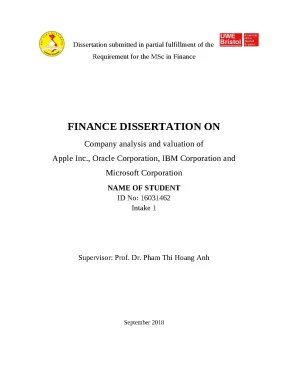
UWE University of the Dissertation submitted in partial fulfillment of the Bristol West of England Requirement for the MSc in Finance FINANCE DISSERTATION ON Company analysis and valuation of Apple Inc., Oracle Corporation, IBM Corporation and Microsoft Corporation NAME OF STUDENT ID No: 16031462 Intake 1 Supervisor: Prof. Pham Thi Hoang Anh September 2018 University of the West of England BRISTOL FINANCE DISSERTATION Name: Ngoc Uyen Luu Student no: 16031462 Supervisor: Prof. Pham Thi Hoang Anh Project title: Company analysis and valuation of Apple Inc., Oracle Corporation, IBM Corporation and Microsoft Corporation Date submission: September, 26th 2018 Word count: 2 Executive Summary This dissertation studies the 4 global leading companies in the technology sector are Apple Inc., Oracle Corporation, IBM Corporation and Microsoft Corporation. It evaluates all internal and external factors which influence these companies’ performance and prospects to give the investment recommendations to investors.

Based on the macro- economic analysis, the US and Asia- Pacific is recognised as the regions with the most potential for the development of the technology sector. Because of that, technology companies should focus on developing and increasing their presence in these markets. The industry analysis represents an intense competition between existing companies. Thus, they need to come up with more innovative tactics and spend more on R&D to compete more effective for the coming years.

In the company analysis, it can be seen that Apple Inc. and Microsoft Corporation are the companies have an outstanding performance. IBM Corporation is having trouble when its financial ratios show a worsening financial position and its sale growth is predicted to be negative in the next few years. The valuation models are applied to calculate the intrinsic values of the four companies.

The target price of Apple Inc., Oracle Corporation, IBM Corporation and Microsoft Corporation are $188. Combining all analyses, recommendations are made for each stock. 3 Acknowledgements This study was the result of a one-year process of researching and putting in writing during the year of 2017/18. First of all, in order to fulfil this study, I would like to express my great thanks to lots of people for their contribution and help during my research process.

In particular, special mention and sincere thank have to go to Prof. Pham Thi Hoang Anh, my supervisor at Banking Academy VIetnam. I could not have completed this dissertation without her careful guidance, right direction and constructive suggestions. Last but not least, I also would like to thank my lecturers, my friends and all of authors of the journal article and books that I have given references in my research.

4 Table of Contents Abbreviations. An overview on the technology market. Area of the study. Organisation of the study.10 Chapter II: Macroeconomic analysis.

Overview of the global economy in 2018. Key macroeconomic factors analysis:. Summary of the US economy:. Key macroeconomic indicators analysis:.

Summary of the European economy:. Asia- Pacific economy. Key macroeconomic indicators analysis:. Summary of the Asia- Pacific economy:.22 Chapter III: Industry analysis.Error! Bookmark not defined.

Bargaining power of buyers. Bargaining power of suppliers. Threat of new entrants. Threat from substitutes.

Rivalry among existing players. 27 Chapter IV: Company Analysis. 87 6 APPL Apple Inc. CPI Consumer Price Index CSFTA China- Singapore Free Trade Agreement DPS Dividend per Share Abbreviatio EBITDA Earnings before Interests, Taxes, nsDepreciation, and Amortization EPS Earnings per Share EU European Union GDP Gross Domestic Product IBM International Business Machines Corporation IMF International Monetary Fund IT Information Technology MSFT Microsoft Corporation OECD Organisation for Economic Co-operation and Development ORCL Oracle Corporation P/E Price/Earnings R&D Research and Development ROA Return on Assets ROE Return on Equity UK United Kingdoms US United States 7 Chapter I: Introduction I.

An overview on the technology market The technology sector contains businesses revolving around the manufacturing of electronics, creation of software, computers or products and services relating to information technology (Bloomberg, 2018). It is considered as a leading sector for growth- based investment. This sector performed well in 2017, it had increased 15.6% since the January 2017 (Sands, 2018). However, Brexit caused a decline in the performance of technology sector.

It creates more risk and uncertainty for the business when just in the UK, according to KPMG report in 2018, 70 percent of tech workers are considering leaving the UK. The technology sector is dominated by 3 leading companies, namely Apple (APPL), Microsoft (MSFT) and Facebook (FB). The stocks of these companies had returned 10.8% and 13%, respectively, in December 2017 in compared with their performance in the same period in 2016. These firms carry out their business across the world with the main driver of sales in 2017 being focused on 3 regions: Europe, Asia- Pacific and the US (Datamonitor, 2018).

In 2018, the technology sector is forecasted to have an explosive growth (Bajarin, 2017). According to researchers, there will be potential tripling of demand for tech- related goods and services over the next decade. With the growth of the importance of technology in society, the technology sector has become a bellwether of the overall stock market and economy. Area of the study This dissertation not only focuses on analysing but also assessing the intrinsic values of 4 largest firms in the technology sector are: Apple Inc., Oracle, IBM and Microsoft.

The analysis consists of 3 main regions: Asia, Europe and US that these companies operate but US is more focused because this in the region that all 4 companies mainly operate. By doing all of these 8 analyses, this study wants to understand deeply the technology sector’s leaders and provide some investment recommendations for investors who have purpose to invest in these companies. Study objectives Objectives of this study are having an overview of technology sector and provide investment recommendations 1) Providing current technology sector insights 2) Analysing crucial macroeconomic indicators of the economies in Asia, US, Europe 3) Analysing technology industry in these 3 regions 4) Base on the financial statements, gearing ratios, profitability ratios, investment ratios of Apple Inc., Oracle, IBM and Microsoft are analysed. In the next step, this paper uses the valuation models to calculate the intrinsic value of these companies.

After analysing and assessing the intrinsic value, this project will provide investment recommendations. Methodology The top- down analysis method will be used in this project. It will start with technology sector economic evaluation, consist of macroeconomic analysis and industry analysis. By evaluating these, the project wants to analyse industrial and macroeconomic condition, which are vital indicators of the firms’ potential profit.

Then, it focuses on 4 companies’ performance and recommend a price, using the valuation models. Macroeconomic analysis: This project uses PEST analysis which include: political, economic, social and culture impacts, aim at evaluating the important macroeconomic determinants: inflation, unemployment rate, GDP, exchange rate and CPI. 9 Industry analysis: This study illustrates technology sector overview before pointing out the impact of market trends on firms in this industry. The determinants affect market competition are analysed also.

Company analysis and valuation: By using the financial statements of 4 companies, financial websites: IMF, MarketLine, WB and financial databases: OSIRIS, Datastream, this study will evaluate profitability and financial situation of these firms. After that, the intrinsic values will be calculated and analysed. It combines with SWOT analysis to analyse the strengths, weaknesses, opportunities, threats of companies, give an insight into these firms. Organisation of the study This project is divided into 8 chapters.

Chapter 1 provides a brief introduction to the area of the study and the objectives of the study. The next chapter is chapter 2 evaluates global economy in the recent year and three regions: Asia, Europe and US. In the third chapter, the study aims at analysing technology industry’s vital indicators and the factors affect market competition. To examine this, Porter’s Five Forces is used as an analytical tool.

From chapter 4 to chapter 7, there are brief descriptions of 4 chosen companies, their performance and their future forecast. The calculation of intrinsic values, investment recommendations are also included in these chapters. Chapter 8 is the report summarisation. 10 Chapter II: Macroeconomic analysis This chapter presents an overview of the global economy in 2018.

Not only that, by applying PEST method and analysing important macroeconomic determinants, it provides an insight into three main markets, consisting of: US, Europe and Asia. Overview of the global economy in 2018 In 2017 the global economy has a sluggish acceleration. Weak international trade and reducing investment within other culprits tended to decrease world growth to its weakest pace since 2010. Although 2018 has a better outlook, the unusually heightened uncertainty about policy direction in some big economies may affect the recovery prospects (World Bank, 2018).

IMF (International Monetary Fund) predicted the global economic growth will increase rapidly from 3. This increase comes from the rebound of investment, manufacturing and trade. Stronger activity and expectations of more robust global demand, combined with oil supply agreed restrictions made commodity prices recover from its troughs in 2017 (IMF, 2018). The higher commodity prices, the more it helps in removing global headline inflation, and decreasing in deflationary pressures.

Financial markets are buoyant and expect continued policy support in China and fiscal expansion and deregulation in the US. When market sentiment and confidence are still strong, growth in short term could be higher than the expectation. In US, because of the rebound of manufacturing activity, the economy is predicted to grow at 2.7% in compared with last year (Amadeo, 2018). The surge of interest rate hikes in US that faster than expectation could tighten financial conditions and strengthening of US dollar could affect the emerging and developing economies rely heavily on external financing.

The Europe economy is expected to grow a healthy 1.7% in 2018 when the largest economies such as Germany, Italy, and Spain are expected to grow at 2% (European 11 Commission, 2018). In the Asia Pacific region, growth is forecasted 5.5% but warned that near term outlook has significant uncertainty and medium-term growth has to deal with the difficulties from the productivity growth slowdown of some economies. IMF raises the economic outlook of the world’s second largest economy China to 6.7% due to the policy support in public investment and expansionary credit. In the first quarter of 2018, China’s economy grew 6.9% which is higher than the target 6.5% of government for 2018.

However, many economists believe that this growth is not sustainable when the growth relies on domestic credit growth, rapid growth could cause financial stability issues (Financial Times, 2018). China has to deal with the challenge of decreasing credit growth reliance. Overall, the economic growth of global will grow in a rapid pace in 2018 as investment, trade and manufacturing rebound. In this chapter, PEST analysis is used to analyse the influences of macroeconomic on technology sector in US, Europe and Asia Pacific.

PEST analysis: • Political analysis: US has a strong democratic setup which has been proved and effective rule of law with the elections are considered transparent and fair. It also has massive political and economic impact on national and worldwide policymaking. However, US has to deal with the increase in the threat of terrorism due to the interventionist policies regarding the ‘War of Terror’. This leads to an increasing in number of terrorist attacks and the flow of illegal immigrants.

Another problem of US is many of president Trump policies counter the legacy of Obama especially in healthcare and pharmaceutical industry. President Trump might dismantle the structure of Obamacare, challenge the whole sector. • Economic analysis: US has one of the most developed economic systems in the world with strong manufacturing and service sectors. US’s real GDP in 2017 was 16.81 trillion dollars, grew 3.2%, the fastest growth in the last 2 years.

The economy is strengthened by its diversity and strong position in services and manufacturing sectors. US is a forerunner in automotive, telecom, aerospace, electronics, chemicals and IT (information technology). In terms of budget deficit, from $1.75% of GDP, it shrank to $587 billion in 2017, 3.

Nội dung được bảo vệ bản quyền — Tải xuống đầy đủ