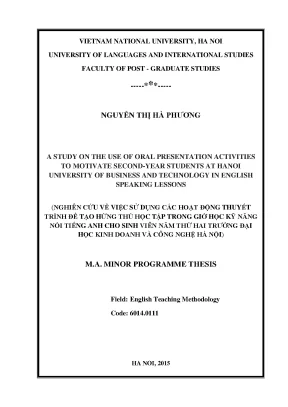
Luận văn thạc sĩ a study on the use of oral presentation activities to motivate the second year students at hanoi university of business and technology in english speaking lessons

Luận văn thạc sĩ phân tích a study on the use of oral presentation activities to motivate the second year students at hanoi, đánh giá thực trạng, chỉ ra hạn chế, đề xuất giải pháp

Người đăng

Ẩn danh

Thể loại

M. Minor Programme Thesis

2015

65
0
0

Phí lưu trữ

30 Point

Mục lục chi tiết

DECLARATION

ACKNOWLEDGEMENTS

ABSTRACT

CONTENTS

PART A. INTRODUCTION

1. Aims and Objectives of the Study

2. Scope of the Study

3. Design of the Study

4. Significance of the Study

1. Chapter 1: LITERATURE REVIEW

1.1. Definitions of Oral Presentation

1.2. Types of Oral Presentation

1.3. The Advantages and Disadvantages of Oral Presentations

1.4. Oral Presentation Activities

1.5. Conceptions of Speaking

1.6. Characteristics of a successful speaking activity

1.7. Definitions of Motivation

1.8. Motivation and English speaking learning

1.9. Review of Previous Relevant Studies

2. Chapter 2: RESEARCH METHODOLOGY

2.1. Context of the study

2.2. Survey questionnaire for teachers

2.3. Survey questionnaire for students

2.4. Procedures of collecting data

2.5. Procedures of analyzing data

3. Chapter 3: RESULTS AND DISCUSSIONS

3.1. Research question 1: How are OPAs Used in English Speaking Lessons to Motivate Students?

3.2. Research question 2: To what extent are the students motivated when OPAs are applied in English speaking lessons?

3.3. Teachers‟ recommendations and students‟ expectations for improving OPAs in English speaking lessons

3.4. Summary and Conclusion of the Study

3.5. Implications of the study

3.6. Limitations of the study

3.7. Suggestions for further study

Appendix 1: Survey questionnaire for students

Appendix 2: Survey questionnaire for teachers

LIST OF ABBREVIATIONS

LIST OF TABLES

PART A. INTRODUCTION

1.1. Rationale of the Study

1.2. Aims and Objectives of the Study

1.3. Research Methodology

1.4. Scope of the Study

1.5. Design of the Study

1.6. Significance of the Study

PART B. DEVELOPMENT

1. Chapter 1: LITERATURE REVIEW

1.1. Definitions of Oral Presentation

1.2. Types of Oral Presentation

Tóm tắt

I. Tổng Quan Thuyết Trình Tiếng Anh Tạo Động Lực cho Sinh Viên

Thuyết trình tiếng Anh đóng vai trò quan trọng trong việc phát triển kỹ năng giao tiếpthuyết trình cho sinh viên. Không chỉ là một hình thức kiểm tra đánh giá, mà còn là cơ hội để sinh viên rèn luyện confidence building English presentation, public speaking in English for students và trau dồi communication skills English for students. Việc tạo động lực cho sinh viên tham gia thuyết trình tiếng Anh hiệu quả sẽ giúp họ vượt qua overcoming stage fright English presentationconfidence building English presentation, đồng thời nâng cao khả năng student engagement in English speaking. Theo nghiên cứu của Nguyễn Thị Hà Phương, việc sử dụng các hoạt động thuyết trình giúp sinh viên cảm thấy hứng thú hơn với môn học và tự tin hơn khi sử dụng tiếng Anh. (Motivation in English presentations là yếu tố then chốt để inspiring students in English presentations). Quan trọng hơn hết là kỹ năng giúp sinh viên effective English presentation skills, phục vụ cho công việc trong tương lai.

1.1. Tầm quan trọng của Thuyết trình tiếng Anh trong học tập

Thuyết trình tiếng Anh không chỉ là một bài tập trên lớp, mà còn là một kỹ năng thiết yếu cho sự thành công trong học tập và sự nghiệp. Nó giúp sinh viên rèn luyện khả năng diễn đạt ý tưởng một cách mạch lạc, rõ rànglogic. Đồng thời, nó cũng giúp sinh viên nâng cao khả năng nghiên cứu, tổng hợp thông tinlàm việc nhóm. Các hoạt động thuyết trình trên lớp là một phương pháp học tập hiệu quả (presentation techniques for student motivation), khuyến khích sinh viên chủ động tìm tòi và khám phá kiến thức mới. Theo Al-Issa (2010), thuyết trình còn giúp sinh viên phát triển các kỹ năng mềm như làm việc nhóm, giải quyết vấn đềtư duy phản biện. English for academic presentations là kỹ năng cần thiết để trình bày các nghiên cứu học thuật một cách chuyên nghiệp. Do vậy, đầu tư vào Thuyết trình tiếng Anh: Tạo động lực cho sinh viên là đầu tư vào tương lai của sinh viên.

1.2. Thách thức thường gặp khi Thuyết trình bằng tiếng Anh

Mặc dù mang lại nhiều lợi ích, thuyết trình tiếng Anh cũng đặt ra không ít thách thức cho sinh viên. Một trong những thách thức lớn nhất là sự thiếu tự tin khi nói trước đám đông. Sinh viên thường lo sợ mắc lỗi ngữ pháp, phát âm không chuẩn hoặc không diễn đạt được ý tưởng một cách trôi chảy. Bên cạnh đó, việc chuẩn bị tài liệu, thiết kế slideluyện tập cũng tốn khá nhiều thời gian và công sức. Theo Marmiene (2006), việc chọn lọc tài liệu phù hợp và đảm bảo tính chính xác của thông tin cũng là một thách thức không nhỏ. Overcoming stage fright English presentation là một vấn đề lớn đối với nhiều sinh viên. Ngoài ra, một số sinh viên có thể gặp khó khăn trong việc làm việc nhóm hoặc giao tiếp hiệu quả với các thành viên khác trong nhóm.

II. Vượt Qua Rào Cản Cách Tạo Động Lực Thuyết Trình Tiếng Anh

Để giúp sinh viên vượt qua những rào cản và khơi dậy niềm đam mê với thuyết trình tiếng Anh, cần có sự phối hợp chặt chẽ giữa giảng viên và sinh viên. Giảng viên đóng vai trò là người hướng dẫn, khuyến khíchtạo điều kiện cho sinh viên phát triển kỹ năng thuyết trình. Sinh viên cần chủ động, tích cựcsẵn sàng học hỏi để tiếp thu kiến thứcrèn luyện kỹ năng. (Engaging students English presentation đòi hỏi sự sáng tạo và linh hoạt từ cả hai phía). Nghiên cứu cho thấy sự hỗ trợ từ giảng viên giúp tăng đáng kể sự tự tin và động lực của sinh viên khi thuyết trình.

2.1. Vai trò của Giảng viên trong việc Khơi Gợi Động Lực

Giảng viên đóng vai trò then chốt trong việc tạo động lực cho sinh viên khi thuyết trình tiếng Anh. Đầu tiên, giảng viên cần lựa chọn những chủ đề thuyết trình phù hợp với trình độsở thích của sinh viên. Thứ hai, giảng viên cần cung cấp cho sinh viên những tài liệu tham khảo, mẫu slidelời khuyên hữu ích. Thứ ba, giảng viên cần tạo ra một môi trường học tập thoải mái, cởi mởkhuyến khích sinh viên chia sẻ ý tưởng, đặt câu hỏiphản biện. Theo Ur (1996), một hoạt động thuyết trình thành công cần tạo cơ hội cho sinh viên nói nhiều, tham gia tích cực và cảm thấy hứng thú với chủ đề. Việc correcting the mistakes at appropriate time giúp sinh viên tiến bộ nhanh chóng. English presentation tips for students từ giảng viên là vô cùng quý giá.

2.2. Biện pháp Tự Tạo Động Lực cho Sinh viên

Bên cạnh sự hỗ trợ từ giảng viên, sinh viên cũng cần chủ độngtích cực trong việc tạo động lực cho bản thân. Điều quan trọng nhất là xác định rõ mục tiêu của việc thuyết trình. Sinh viên cần tự hỏi bản thân: "Tôi muốn đạt được điều gì thông qua bài thuyết trình này?". Sau đó, sinh viên cần lập kế hoạch, chuẩn bị tài liệuluyện tập một cách có hệ thốngbài bản. Theo Richards Miles, sinh viên nên tập trung vào việc cải thiện khả năng giao tiếp hơn là chỉ học cách trình bày. Cuối cùng, sinh viên cần tạo cho mình một tâm lý thoải mái, tự tinsẵn sàng đối mặt với những thử thách. Motivational speeches for students in English có thể giúp sinh viên tìm thấy nguồn cảm hứng.

III. Bí Quyết Thuyết Trình Tiếng Anh Phương Pháp Kích Thích Tham Gia

Để kích thích sự tham gia của sinh viên trong các buổi thuyết trình tiếng Anh, cần áp dụng những phương pháp giảng dạy sáng tạo và linh hoạt. Các phương pháp này cần tập trung vào việc tạo ra một môi trường học tập tương tác cao, nơi sinh viên cảm thấy thoải mái chia sẻ ý tưởng và thể hiện bản thân. (Thực hành nhiều hơn là phương pháp giúp sinh viên trở nên effective English presentation skills). Theo kinh nghiệm của nhiều giảng viên, việc sử dụng các hoạt động nhóm và trò chơi giúp tăng tính tương tác và hứng thú của sinh viên.

3.1. Ứng dụng Trò chơi và Hoạt động Nhóm vào Thuyết trình

Sử dụng trò chơi và hoạt động nhóm là một cách hiệu quả để tăng tính tương tác và hứng thú của sinh viên trong các buổi thuyết trình tiếng Anh. Các trò chơi như "role-play", "debate", "story-telling" không chỉ giúp sinh viên rèn luyện kỹ năng nói mà còn giúp họ phát triển khả năng làm việc nhóm, tư duy phản biện và giải quyết vấn đề. Các hoạt động nhóm như "brainstorming", "think-pair-share" giúp sinh viên chia sẻ ý tưởng, học hỏi lẫn nhau và xây dựng sự tự tin. Theo Boyce, Janet S. Alber-Morgan, Sheila R and Riley, Jeanetta G (2007), các trò chơi hợp tác giúp sinh viên cảm thấy an toàn và thoải mái hơn khi phát biểu ý kiến. Presentation techniques for student motivation cần sự sáng tạo và đổi mới liên tục.

3.2. Tích hợp Công nghệ vào Quá trình Thuyết trình Tiếng Anh

Việc tích hợp công nghệ vào quá trình thuyết trình tiếng Anh không chỉ giúp bài thuyết trình trở nên sinh động và hấp dẫn hơn mà còn giúp sinh viên làm quen với các công cụ hỗ trợ thuyết trình hiện đại. Sử dụng các phần mềm như PowerPoint, Prezi, Canva giúp sinh viên thiết kế slide chuyên nghiệp và trực quan. Sử dụng các trang web như YouTube, TED Talks giúp sinh viên tìm kiếm tài liệu tham khảo và học hỏi kinh nghiệm từ những người thuyết trình giỏi. Hơn nữa, việc Engaging students English presentation đòi hỏi sự linh hoạt trong việc sử dụng phương tiện và công nghệ. Theo Al-lssa (2010), thuyết trình còn giúp sinh viên học cách sử dụng công nghệ một cách hiệu quả.

IV. Áp Dụng Thực Tế Nghiên Cứu về Động Lực Thuyết Trình Tiếng Anh

Nhiều nghiên cứu đã chứng minh tầm quan trọng của việc tạo động lực cho sinh viên trong các buổi thuyết trình tiếng Anh. Các nghiên cứu này tập trung vào việc tìm hiểu các yếu tố ảnh hưởng đến động lực của sinh viên, các phương pháp tạo động lực hiệu quả và các kết quả đạt được khi áp dụng các phương pháp này. (Việc theo dõi và đánh giá thường xuyên giúp cải thiện effective English presentation skills). Các nghiên cứu cũng chỉ ra rằng sự hỗ trợ từ giảng viên, sự tương tác giữa sinh viên và việc sử dụng các phương pháp giảng dạy sáng tạo đều có tác động tích cực đến động lực của sinh viên.

4.1. Phân tích Kết quả Nghiên cứu về Động Lực của Sinh viên

Các kết quả nghiên cứu cho thấy rằng sinh viên có xu hướng cảm thấy tự tin và hứng thú hơn khi thuyết trình về các chủ đề mà họ quan tâm. Sự hỗ trợ từ giảng viên, đặc biệt là việc cung cấp phản hồi mang tính xây dựng, cũng đóng vai trò quan trọng trong việc tăng cường động lực của sinh viên. Theo Nguyen Thi Tam (2012), sinh viên đánh giá cao việc được tự do lựa chọn chủ đề thuyết trình và được làm việc nhóm với bạn bè. Các kết quả nghiên cứu cũng chỉ ra rằng việc sử dụng các phương pháp giảng dạy sáng tạo và tích hợp công nghệ giúp tăng tính tương tác và hứng thú của sinh viên. Kỹ năng English presentation delivery skills rất cần thiết cho sự thành công.

4.2. Đề xuất Cải thiện Động Lực Dựa trên Nghiên cứu

Dựa trên các kết quả nghiên cứu, có một số đề xuất để cải thiện động lực của sinh viên trong các buổi thuyết trình tiếng Anh. Đầu tiên, giảng viên cần tạo điều kiện cho sinh viên lựa chọn chủ đề thuyết trình phù hợp với sở thích và trình độ của mình. Thứ hai, giảng viên cần cung cấp phản hồi mang tính xây dựng và khuyến khích sinh viên tự đánh giá kết quả của mình. Thứ ba, giảng viên cần sử dụng các phương pháp giảng dạy sáng tạo và tích hợp công nghệ để tăng tính tương tác và hứng thú của sinh viên. Cuối cùng, cần có sự phối hợp chặt chẽ giữa giảng viên và sinh viên để tạo ra một môi trường học tập tích cực và khuyến khích sự tham gia của sinh viên.

V. Kết luận Nâng cao khả năng Thuyết Trình Tiếng Anh cho Sinh Viên

Tạo động lực cho sinh viên trong các buổi thuyết trình tiếng Anh là một quá trình liên tục và đòi hỏi sự nỗ lực từ cả giảng viên và sinh viên. Bằng cách áp dụng các phương pháp giảng dạy sáng tạo, khuyến khích sự tham gia của sinh viên và tạo ra một môi trường học tập tích cực, có thể giúp sinh viên vượt qua những rào cản và phát triển kỹ năng thuyết trình tiếng Anh một cách hiệu quả. (Confidence building English presentation là một quá trình lâu dài cần sự kiên trì). Nghiên cứu và kinh nghiệm thực tế đều cho thấy tầm quan trọng của việc tạo động lực trong việc nâng cao chất lượng giảng dạy và học tập.

5.1. Tổng kết Các Giải pháp Tạo Động Lực Thuyết Trình

Các giải pháp tạo động lực thuyết trình cho sinh viên bao gồm: lựa chọn chủ đề phù hợp, cung cấp phản hồi xây dựng, sử dụng phương pháp giảng dạy sáng tạo, tích hợp công nghệ, khuyến khích sự tham gia của sinh viên và tạo ra môi trường học tập tích cực. Việc áp dụng các giải pháp này cần linh hoạt và phù hợp với từng đối tượng sinh viên và từng hoàn cảnh cụ thể. Sự thành công của quá trình tạo động lực phụ thuộc vào sự phối hợp chặt chẽ giữa giảng viên và sinh viên.

5.2. Hướng Nghiên cứu Tương lai về Thuyết Trình Tiếng Anh

Trong tương lai, cần có thêm nhiều nghiên cứu về các phương pháp tạo động lực thuyết trình hiệu quả hơn, đặc biệt là trong bối cảnh hội nhập quốc tế và sự phát triển của công nghệ. Các nghiên cứu nên tập trung vào việc tìm hiểu các yếu tố ảnh hưởng đến động lực của sinh viên, các phương pháp đánh giá kết quả học tập hiệu quả và các mô hình giảng dạy phù hợp với từng đối tượng sinh viên. English presentation for beginners cũng là một lĩnh vực cần được quan tâm nghiên cứu.

22/09/2025

Trích đoạn nội dung tài liệu

VIETNAM NATIONAL UNIVERSITY, HA NOI UNIVERSITY OF LANGUAGES AND INTERNATIONAL STUDIES FACULTY OF POST - GRADUATE STUDIES -----***----- NGUYỄN THỊ HÀ PHƢƠNG A STUDY ON THE USE OF ORAL PRESENTATION ACTIVITIES TO MOTIVATE SECOND-YEAR STUDENTS AT HANOI UNIVERSITY OF BUSINESS AND TECHNOLOGY IN ENGLISH SPEAKING LESSONS (NGHIÊN CỨU VỀ VIỆC SỬ DỤNG CÁC HOẠT ĐỘNG THUYẾT TRÌNH ĐỂ TẠO HỨNG THÚ HỌC TẬP TRONG GIỜ HỌC KỸ NĂNG NÓI TIẾNG ANH CHO SINH VIÊN NĂM THỨ HAI TRƢỜNG ĐẠI HỌC KINH DOANH VÀ CÔNG NGHỆ HÀ NỘI) M. MINOR PROGRAMME THESIS Field: English Teaching Methodology Code: 6014.0111 HA NOI, 2015 TIEU LUAN MOI download : skknchat@gmail.com VIETNAM NATIONAL UNIVERSITY, HA NOI UNIVERSITY OF LANGUAGES AND INTERNATIONAL STUDIES FACULTY OF POST - GRADUATE STUDIES -----***----- NGUYỄN THỊ HÀ PHƢƠNG A STUDY ON THE USE OF ORAL PRESENTATION ACTIVITIES TO MOTIVATE SECOND-YEAR STUDENTS AT HANOI UNIVERSITY OF BUSINESS AND TECHNOLOGY IN ENGLISH SPEAKING LESSONS (NGHIÊN CỨU VỀ VIỆC SỬ DỤNG CÁC HOẠT ĐỘNG THUYẾT TRÌNH ĐỂ TẠO HỨNG THÚ HỌC TẬP TRONG GIỜ HỌC KỸ NĂNG NÓI TIẾNG ANH CHO SINH VIÊN NĂM THỨ HAI TRƢỜNG ĐẠI HỌC KINH DOANH VÀ CÔNG NGHỆ HÀ NỘI) M. MINOR PROGRAMME THESIS Field: English Teaching Methodology Code: 6014. Nguyễn Phƣơng Nga HA NOI, 2015 TIEU LUAN MOI download : skknchat@gmail.com DECLARATION I hereby declare that the minor thesis entitled “A study on the use of oral presentation activities to motivate the second-year students at Hanoi University of Business and Technology in English speaking lessons” is my original work and based on my own research.

I have proved fully documented references to the others‟ work. I also accept all the requirements of Hanoi University of Languages and International Studies relating to the retention and use of M.A Graduation Thesis deposited in the library. Hanoi, 2015 Nguyễn Thị Hà Phương i TIEU LUAN MOI download : skknchat@gmail.com ACKNOWLEDGEMENTS First and foremost, I would like to express my sincere gratitude to my beloved supervisor Assoc.Dr Nguyen Phuong Nga for her continuous support of my thesis, for her patience, motivation, enthusiasm and immense knowledge. Her guidance helped me during the time of research and writing of this thesis.

Besides my supervisor, I would like to take this chance to express my gratitude to all the lecturers in Faculty of Post-graduate Studies, Hanoi University of Language and International Studies, Vietnam National University for their interesting lectures which have inspired me to conduct this thesis. My sincere thanks also go to the second-year students and my colleagues at Hanoi University of Business and Technology for their willingness to take part in the research. Without their help, this study could not be completed successfully. Last but not least, I would like to thank my family especially my husband and my son for their love, special care and support during the process of writing this thesis.

ii TIEU LUAN MOI download : skknchat@gmail.com ABSTRACT Teaching and learning English effectively depends on many factors among which motivation is considered as an important one. The question how to keep English learners motivated especially in English speaking lessons is not easy to answer. This study was conducted to investigate the situation of using oral presentation activities to motivate second-year students at Hanoi University of Business and Technology in English speaking lessons. Survey questionnaires for teachers and students were employed to find out the answers for the research questions.

Based on the findings of the research it was revealed that oral presentation acitivites were applied in English speaking lessons at different level of frequency and the use of oral presentation activities were beneficial to students when students to some extents were motivated and they became more interested in English speaking activities. However, during the application of oral presentation activities, there were still some obstacles for teachers and difficulties for students which should be taken in consideration to find out the solutions. From the findings of the study, some suggestions for improving oral presentation activities have given out to help make English lessons more interesting to students. iii TIEU LUAN MOI download : skknchat@gmail.com CONTENTS PART A: INTRODUCTION.

Aims and Objectives of the Study. Scope of the Study. Design of the Study. Significance of the Study .5 Chapter 1: LITERATURE REVIEW.

Definitions of Oral Presentation .2 Types of Oral Presentation. The Advantages and Disadvantages of Oral Presentations. Oral Presentation Activities. Conceptions of Speaking.

Characteristics of a successful speaking activity. Definitions of Motivation. Motivation and English speaking learning. Review of Previous Relevant Studies .21 Chapter 2: RESEARCH METHODOLOGY.

Context of the study .30 iv TIEU LUAN MOI download : skknchat@gmail.com Survey questionnaire for teachers .30 Survey questionnaire for students .3 Procedures of collecting data .4 Procedures of analyzing data .31 Chapter 3: RESULTS AND DISCUSSIONS. Research question 1: How are OPAs Used in English Speaking Lessons to Motivate Students?. Research question 2: To what extent are the students motivated when OPAs are applied in English speaking lessons?. Teachers‟ recommendations and students‟ expectations for improving OPAs in English speaking lessons.

Summary and Conclusion of the Study. Implications of the study. Limitations of the study. Suggestions for further study.

I Appendix 1: Survey questionnaire for students. I Appendix 2: Survey questionnaire for teachers. VI v TIEU LUAN MOI download : skknchat@gmail.com LIST OF ABBREVIATIONS HUBT: Hanoi University of Business and Technology OPAs: Oral Presentation Activities CLT: Communicative Language Teaching EFL: English as Foreign Language ESL: English as Second Language EGAP: English for General Academic Purposes LIST OF TABLES Table 3. Teachers‟ frequency in using OPAs to motivate students in English speaking lessons Table 3.

Students‟ opinions on the use of OPAs in their English speaking lessons Table 3. Teachers‟ and students‟ opinions on the use of OPAs in English speaking lessons Table 3. Obstacles for teachers in using OPAs in English speaking lessons Table 3. Students‟ difficulties when participating in OPAs in their English speaking lessons Table 3.

Teachers‟ perceptions of students‟ motivation of OPAs in English speaking lessons Table 3. The level of students‟ motivation by the use of OPAs in their English speaking lessons Table 3. Teachers‟ and students‟ opinions on the motivation level by OPAs Table 3. Teachers‟ perception of students‟ benefits from participating OPAs in English speaking lessons Table 3.

The level of benefit from the use of OPAs in students English speaking lessons Table 3. Teachers‟ recommendation to make OPAs more effective in English speaking lessons Table 3. Students‟ expectation from OPAs in English speaking lessons Table 3. Students‟ preference in giving oral presentations vi TIEU LUAN MOI download : skknchat@gmail.com PART A: INTRODUCTION This part introduces briefly about the study including rationale, aims and objectives, research methodology, scope, design and significance of the study.

Rationale of the Study There is now a growing demand for mastering English since it is not only a useful means people need for their future career but also gives them the access to the modern world in the era of informatics and technology. Therefore, teaching and learning English nowadays are paid much more attention than ever before and play a significant role in developing policies of many countries in the world. In Vietnam, thanks to the open-door and integration policy, English has been widely used and becomes the most popular foreign language in the country among many foreign languages. Moreover, English now is also a compulsory subjects at schools and universities.

As known that “The aims of foreign language instruction, especially English language instruction, is commonly defined in terms of four essential skills, reading, writing, listening, and speaking, of which speaking is becoming the most important aspect in developing one‟s communicative competence” (Moore, 1992: 9). In the recognition of the importance of speaking skill, there has been a dramatic change in the methodology of teaching English in recent years when the methods of English teaching have changed from traditional grammar translation approach to communicative approach which is now applied in many universities in Vietnam in general and in Hanoi University of Business and Technology in particular where the author has been teaching English for five years. As a teacher of English, the author would really like to help her students to master English so that they are able to communicate confidently in English not only inside the class but also in daily life. However, like many students at other universities, students at HUBT have low level of participation in English speaking activities.

Generally speaking, the students do not pay much attention to their speaking skills; 1 TIEU LUAN MOI download : skknchat@gmail.com they usually keep quiet in speaking lessons because they feel shy or afraid of making mistakes and revealing their weaknesses. Among a variety of reasons for students‟ poor participations students‟ lack of motivation is one reason that teachers should pay special attention and seek for solutions to motivate students to speak English. Students once motivated will be likely to be involved more in English speaking activities in the classroom as well as practice it more outside in the daily life. Among all the methods used to motivate students‟ participation in speaking lessons, “presentation activity is a great way to have students practice all language system areas (vocabulary, grammar, discourse and phonology) and skills (speaking, reading, writing and listening)” (Hayton, 2005).

In brief, all of the reasons mentioned above have inspired the author to conduct “A study on the use of oral presentation activities to motivate the second-year students at Hanoi University of Business and Technology in English speaking lessons”. Aims and Objectives of the Study The study aims to explore the situation of using oral presentation activities (hereafter OPAs) to motivate second-year students at Hanoi Unversity of Business and Technology (HUBT) in English speaking lessons to find out whether students are motivated to join and to speak English. With the aim above, there are three specific objectives below: - to study how OPAs are used in English speaking lessons - to study whether the students are motivated to speak English - to give suggestions to motivate students in English speaking lessons Two research questions will be addressed as follows: 1. How are OPAs used in English speaking lessons to motivate students? 2.

To what extent are the students motivated by OPAs? 2 TIEU LUAN MOI download : skknchat@gmail. Research Methodology In order to answer the two research questions, this study involves qualitative methodology. Specifically, it conducts survey questionnaires for students and teachers. The detail of the methodology applied in the study is discussed in Chapter 2 of Part II.

Scope of the Study There are a variety of activities to motivate students in English speaking lessons; however, the author‟s intention is investigating the current situation of using oral presentation activities as a motivator in English speaking lessons. Moreover, the study is only limited to the second-year students of Accounting Faculty at HUBT where the author has been working as a teacher of English for nearly five years. Therefore, the study limits itself to the teaching and learning speaking English for second-year students at Faculty of Accounting only, not for all second-year students of HUBT. Design of the Study The study consists of three parts: Introduction, Development, and Conclusion.

Part 1, Introduction, presents the rationale, the aims and objectives, the methodology, the scope, the design and the significance of the study. The second part is Development which includes three chapters: Chapter 1, Literature Review, deals with the theoretical background of the study and critical review of previous relevant studies. Chapter 2, Methodology, presents methodology of the study including data collection procedure and data analysis. Chapter 3, Results and Discussion, states the findings from the study and discusses some recommendations.

The third part is Conclusion presenting the summary of the major findings, the conclusions and limitations of the study; implications as well as suggestions for further studies are included in this part. References are the last part of the study, followed by Appendices 3 TIEU LUAN MOI download : skknchat@gmail.

Nội dung được bảo vệ bản quyền — Tải xuống đầy đủ