Lawrence of Brindisi: Mary in the Psalms - Daniel Clough STL Thesis (2021)

Dưới đây là thông tin meta tags cho bài viết "Stl thesis clough": { "ai_description": "Nghiên cứu phương pháp Stl thesis clough trong lĩnh vực phát triển và

Trường đại học

International Marian Research Institute, University of Dayton

Chuyên ngành

Thần học Thánh Mẫu

Người đăng

Ẩn danh

Thể loại

Luận văn thạc sĩ

2021

112
0
0

Phí lưu trữ

35 Point

Tóm tắt

I. Tổng quan về Mariology của St

St. Lawrence of Brindisi (1559–1619) là một linh mục và triết gia Ý, nổi tiếng với sự kết hợp giữa tri thức thế tục và thần học. Trong Mary in the Psalms, ông áp dụng Kinh Thánh để khám phá vai trò của Maria như mô hình sống tâm linh. Psalms trở thành nền tảng để ông xây dựng Mariology thông qua bốn nghĩa giải Kinh: nghĩa thực, nghĩa biểu tượng, nghĩa đạo đức và nghĩa thượng thiên. Công trình này không chỉ là nghiên cứu học thuật mà còn là hướng dẫn thực hành cho đời sống tín hữu. Tác phẩm Mariale của ông, viết năm 1609, là trung tâm phân tích, trong đó Psalms được giải thích để thể hiện Maria như thành phố Thiên Đàng, mẹ từ bi và mẫu mực đức tin. Ông kết hợp tri thức Kinh Thánh với truyền thống Mariology của Giáo hội, đặc biệt là thông qua các tác phẩm như Explanatio in GenesimLutheranismi Hypotyposis.

1.1. Vai trò của Psalms trong Mariology của Lawrence

Psalms đóng vai trò trung tâm trong Mariology của Lawrence vì chúng chứa đựng các hình ảnh về Maria như thành phố Thiên Đàng (Psalm 147:12–13), núi nơi Thiên Chúa cư ngụ (Psalm 68:16–17) và mẹ từ bi (Psalm 103:13). Ông giải thích Psalms theo bốn nghĩa giải Kinh, trong đó nghĩa biểu tượng (allegorical) mô tả Maria như hình ảnh của Giáo hội, nghĩa đạo đức (moral) chỉ dẫn cách sống theo Maria, và nghĩa thượng thiên (anagogical) hướng đến Thiên Đàng. Ví dụ, Psalm 68:16–17 không chỉ nói về núi Zion mà còn chỉ Maria như nơi Thiên Chúa chọn để hiện diện. Lawrence kết hợp Psalms với các kinh nguyện Mariology như Salve Regina để tạo ra một hệ thống thần học toàn diện.

1.2. Sự khác biệt với Mariology truyền thống

Khác với Mariology truyền thống tập trung vào các sự kiện lịch sử như Sinh Đản và Lên Trời, Lawrence nhấn mạnh vào mặt tâm linh của Maria thông qua Psalms. Ông không chỉ mô tả Maria như một nhân vật lịch sử mà còn như một mô hình sống thực hành, thể hiện qua đức tin, hy vọng và từ bi. Ví dụ, ông giải thích Psalm 118:22–23 (đá bị bỏ rơi) như Maria trong cuộc sống tâm linh, nơi cô bị bỏ rơi nhưng cuối cùng trở thành đá góc của Giáo hội. Sự khác biệt này giúp ông liên kết Mariology với thực hành tinh thần, chứ không chỉ là học thuyết. Ông cũng sử dụng Psalms để chỉ ra Maria như một gương mẫu cho đời sống cầu nguyện và đức hạnh.

II. Phân tích vấn đề Cách Lawrence giải thích Psalms về Maria

Lawrence gặp thách thức khi giải thích Psalms về Maria vì nhiều psalm không có liên kết trực tiếp với cô. Ông giải quyết vấn đề này bằng cách áp dụng bốn nghĩa giải Kinh, trong đó nghĩa biểu tượng và nghĩa đạo đức trở thành công cụ chính. Ông không chỉ dừng lại ở nghĩa thực mà còn khám phá các tầng nghĩa sâu hơn. Ví dụ, Psalm 45:13–14 (vua con gái) được ông giải thích như Maria là mẹ của Chúa, trong khi Psalm 132:13–14 (đứa con được chọn) mô tả Maria như nơi Thiên Chúa chọn để hiện diện. Một vấn đề khác là cách ông kết hợp Psalms với các kinh nguyện Mariology như MagnificatAve Maria, tạo ra một hệ thống thần học thống nhất. Ông cũng chỉ ra rằng Maria không chỉ là đối tượng của Psalms mà còn là người thực hiện các giá trị tâm linh trong chúng.

2.1. Phân biệt giữa nghĩa thực và nghĩa biểu tượng

Lawrence phân biệt rõ nghĩa thực (literal) và nghĩa biểu tượng (allegorical) trong Psalms. Nghĩa thực là những lời nói trực tiếp của Kinh Thánh, trong khi nghĩa biểu tượng là cách ứng dụng chúng vào Maria. Ví dụ, Psalm 68:16–17 về núi Zion được ông giải thích như Maria là núi nơi Thiên Chúa cư ngụ. Ông cũng chỉ ra rằng nghĩa biểu tượng không phức tạp hóa Kinh Thánh mà chỉ mở rộng hiểu biết về Maria. Ông sử dụng các ví dụ từ Kinh Thánh như thành phố Thiên Đàng (Psalm 147:12) để mô tả Maria như một cộng đồng tin tưởng, chứ không chỉ là một cá nhân. Điều này giúp ông tránh sự đơn giản hóa và tạo ra một Mariology phong phú.

2.2. Vấn đề về tính ứng dụng của Psalms cho Maria

Một vấn đề lớn là Psalms không có đề cập trực tiếp đến Maria, vì vậy Lawrence phải tìm cách liên kết chúng một cách hợp lý. Ông giải quyết vấn đề này bằng cách sử dụng bốn nghĩa giải Kinh, trong đó nghĩa đạo đức (moral) trở thành cầu nối giữa Psalms và Maria. Ví dụ, Psalm 118:22–23 (đá bị bỏ rơi) được ông giải thích như Maria trong cuộc sống tâm linh, nơi cô bị bỏ rơi nhưng cuối cùng trở thành đá góc của Giáo hội. Ông cũng kết hợp Psalms với các kinh nguyện Mariology như Magnificat để tạo ra một hệ thống thần học thống nhất. Điều này cho phép ông áp dụng Psalms vào Maria một cách logic và thuyết phục, chứ không phải là giải thích quá mức.

III. Giải pháp Phương pháp giải thích Psalms của Lawrence

Lawrence sử dụng phương pháp giải thích Psalms kết hợp bốn nghĩa giải Kinh với Mariology thông qua ba bước chính: phân tích nghĩa thực, ứng dụng nghĩa biểu tượng và đạo đức, và chỉ ra nghĩa thượng thiên. Ông không chỉ dừng lại ở nghĩa thực mà còn khám phá các tầng nghĩa sâu hơn để mô tả Maria như một mô hình sống tâm linh. Ví dụ, trong Mariale, ông giải thích Psalm 68:16–17 như Maria là núi nơi Thiên Chúa cư ngụ, trong khi Psalm 118:22–23 mô tả Maria như đá góc của Giáo hội. Ông cũng sử dụng Psalms để chỉ ra Maria như mẹ từ bi (Psalm 103:13) và mẫu mực đức tin (Psalm 112:1–2). Phương pháp này giúp ông tạo ra một Mariology thực hành, chứ không chỉ là học thuyết.

3.1. Sử dụng bốn nghĩa giải Kinh trong Mariology

Lawrence áp dụng bốn nghĩa giải Kinh (literal, allegorical, moral, anagogical) để giải thích Psalms về Maria. Nghĩa thực là cơ sở, trong khi nghĩa biểu tượng mô tả Maria như thành phố Thiên Đàng (Psalm 147:12). Nghĩa đạo đức chỉ dẫn cách sống theo Maria, ví dụ Psalm 118:22–23 như đá góc của Giáo hội. Nghĩa thượng thiên chỉ ra Maria như hướng đến Thiên Đàng, như trong Psalm 68:16–17. Ông kết hợp các nghĩa này để tạo ra một Mariology toàn diện, trong đó Psalms không chỉ là lời cầu nguyện mà còn là hướng dẫn sống. Phương pháp này giúp ông tránh sự đơn giản hóa và tạo ra một hệ thống thần học phong phú.

3.2. Kết hợp Psalms với Mariology truyền thống

Lawrence kết hợp Psalms với Mariology truyền thống thông qua các kinh nguyện như MagnificatAve Maria. Ông sử dụng Psalm 113:7–9 (như Maria nâng Chúa lên) và Psalm 103:13 (như Maria là mẹ từ bi) để xây dựng một Mariology thực hành. Ông cũng chỉ ra rằng Maria không chỉ là đối tượng của Psalms mà còn là người thực hiện các giá trị tâm linh trong chúng. Ví dụ, Psalm 112:1–2 mô tả Maria như người có đức tin và hy vọng, trong khi Psalm 68:16–17 mô tả cô như núi nơi Thiên Chúa cư ngụ. Phương pháp này giúp ông tạo ra một Mariology thống nhất, kết hợp giữa Kinh Thánh và truyền thống Mariology của Giáo hội.

IV. Kết luận Ứng dụng của Mariology Psalms trong đời sống tín hữu

Mariology của Lawrence qua Psalms có ứng dụng thực tiễn trong đời sống tín hữu thông qua ba khía cạnh: cầu nguyện, đức hạnh và hy vọng. Ông chỉ ra rằng Psalms không chỉ là lời cầu nguyện mà còn là hướng dẫn sống theo Maria. Ví dụ, Psalm 68:16–17 khuyến khích tín hữu nhìn Maria như núi nơi Thiên Chúa cư ngụ, trong khi Psalm 118:22–23 khuyến khích họ tin tưởng vào Maria như đá góc của Giáo hội. Ông cũng nhấn mạnh rằng Maria không chỉ là một hình tượng lịch sử mà còn là một mô hình sống tâm linh, thể hiện qua đức tin, hy vọng và từ bi. Ứng dụng này giúp tín hữu áp dụng Mariology vào đời sống hàng ngày, đặc biệt là trong cầu nguyện và thực hành đức tin.

4.1. Maria như mô hình sống tâm linh

Lawrence mô tả Maria như mô hình sống tâm linh thông qua Psalms, trong đó cô thể hiện đức tin (Psalm 112:1–2), hy vọng (Psalm 130:5–6) và từ bi (Psalm 103:13). Ông chỉ ra rằng Maria không chỉ là đối tượng của Psalms mà còn là người thực hiện các giá trị tâm linh trong chúng. Ví dụ, Psalm 68:16–17 mô tả Maria như núi nơi Thiên Chúa cư ngụ, trong khi Psalm 118:22–23 mô tả cô như đá góc của Giáo hội. Ứng dụng này giúp tín hữu học tập từ Maria và áp dụng vào đời sống hàng ngày, đặc biệt là trong cầu nguyện và thực hành đức tin. Ông khuyến khích tín hữu nhìn Maria như một gương mẫu, chứ không chỉ là một hình tượng lịch sử.

4.2. Psalms và Mariology trong đời sống cầu nguyện

Psalms và Mariology của Lawrence có ứng dụng trong đời sống cầu nguyện thông qua việc áp dụng các giá trị tâm linh của Maria. Ví dụ, Psalm 68:16–17 khuyến khích tín hữu cầu nguyện để trở thành nơi Thiên Chúa cư ngụ, trong khi Psalm 118:22–23 khuyến khích họ tin tưởng vào Maria như đá góc của Giáo hội. Ông cũng chỉ ra rằng Maria không chỉ là đối tượng của Psalms mà còn là người hướng dẫn trong cầu nguyện. Ứng dụng này giúp tín hữu tạo ra một mối liên hệ sâu sắc với Maria, đặc biệt là trong các thời khắc khó khăn. Ông khuyến khích tín hữu sử dụng Psalms và Mariology để tăng cường cuộc sống tâm linh, chứ không chỉ là học thuyết.
Tóm tắt và mô tả trên trang này được tạo với sự hỗ trợ của AI. Nếu bạn thấy nội dung không chính xác hoặc có vấn đề, vui lòng Báo lỗi nội dung.

31/05/2026
Stl thesis clough

Trích đoạn nội dung tài liệu

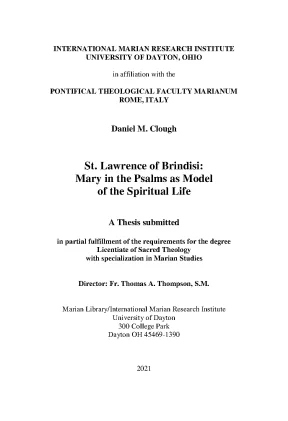
INTERNATIONAL MARIAN RESEARCH INSTITUTE UNIVERSITY OF DAYTON, OHIO in affiliation with the PONTIFICAL THEOLOGICAL FACULTY MARIANUM ROME, ITALY Daniel M. Lawrence of Brindisi: Mary in the Psalms as Model of the Spiritual Life A Thesis submitted in partial fulfillment of the requirements for the degree Licentiate of Sacred Theology with specialization in Marian Studies Director: Fr. Marian Library/International Marian Research Institute University of Dayton 300 College Park Dayton OH 45469-1390 2021 ii Vidimus et approbamus: Thomas A. – Director Sebastien Abalodo, S.

– Revisore Daytonensis (USA), ex aedibus International Marian Research Institute, et Romae, ex aedibus Pontificiae Facultatis Theologicae Marianum, die 21 Maius 2021. Clough All Rights Reserved iii This thesis is dedicated to my wife, Kate Clough May God reward her for supporting me in my studies and for helping to raise our children for the glory for God. We place our family under Mary’s Mantle so that we may always be led to her Son who will show us the light of His mercy. 1 Table of Contents Introduction.

3 Chapter 1 – Life and Mariology of St. Lawrence of Brindisi .1 The Life and Mission of St. Lawrence of Brindisi .2 The Writings of St. Lawrence of Brindisi .4 Analogy or Similarity to Christ .5 Mary in Lutheranismi Hypotyposis .6 Mary in Explanatio in Genesim .7 Mary in the Mariale.

17 Chapter 2 – Mary in the Psalms Using the Spiritual Senses .1 Principles of Interpretation in Explanatio in Genesim .2 The Spirituality of the Psalms in Brindisi .3 Ways of Seeing Mary in the Psalms .4 Comparison to the Collection of Masses of the Blessed Virgin Mary. 32 Chapter 3 – Mary in the Psalms According to the Mariale (Part 1) .1 Mary as the City of God .2 Spiritual Senses of the “City of God” .3 The Faithful Soul .5 Mary as Mother of God.2 Mother of Mercy .1 The Mercy of God the Father.2 Jesus Christ as Mercy .3 Mary, Mother and Advocate. 58 Chapter 4 – Mary in the Psalms According to the Mariale (Part 2) .1 The Virtues of Mary .2 Mary Had the Light of Faith .3 She is Queen of Virtues .4 She Conformed Her Heart to a Virtuous Life .5 Joy Accompanied Her Virtues .6 She Had Divine Wisdom, Trust and Hope in the Lord .2 Methodology in this Thesis .1 Explanation of the Methodology.2 Data Analysis of the Psalms in the Mariale .3 Chart of the Psalms Used in the Mariale .1 Use of the Hebrew Text .2 Mary in the Psalms .3 The Spirituality of the Psalms .4 The Heavenly Jerusalem. 96 Appendix – Responsorial Psalms in the Lectionary and in the Collection of Masses of the Blessed Virgin Mary.

102 3 Introduction The purpose of this thesis is to examine the Mariology of St. Lawrence of Brindisi to show how he applied the psalms to Mary. In order to understand this application it is necessary to explore both his principles of Mariology and the hermeneutic he used in interpreting Sacred Scripture. The focus of this thesis will be his work, the Mariale, but this volume alone is not sufficient for having a complete understanding of his method of biblical interpretation.

His work, Explanatio in Genesim, will be reviewed to show the principles he had in mind when writing the Mariale. It will be shown how he found the literal sense of the text important for understanding the mysteries of the faith. His sermons in the Mariale were not meant to be scholarly examinations but Brindisi often went back to the Hebrew text to have the best possible meaning of what the sacred writer intended. Next, it will be shown how finding Mary in the psalms requires the use of the spiritual senses of Scripture.

Then there will be shown a spirituality of the psalms with Mary as a model of the faithful and also an intercessor on their behalf. Finally, the psalms will show the way to heaven and it is Mary who led the way by living a virtuous life and now she aids the faithful in attaining the same goal. This thesis will begin with an overview of the life and mission of St. Lawrence of Brindisi, as well as an introduction to his Mariology.

There will then follow an examination of the psalms as a way of prayer, which will be based on what he says in the introduction of Explanatio in Genesim, and how this forms the basis for his Marian interpretation. This examination will help show the right context in which to view his interpretation used in the Mariale. Beginning with the literal sense, the faithful are led higher to find Mary in the Old Testament, then to find out how to live a virtuous life like Mary and with her, and finally to come to the heavenly goal with Mary. The first chapter will be an overview of Brindisi’s life and explain his mission of preaching throughout Europe.

After this discussion of his background, his Mariology will be introduced, especially as it appears in the Mariale. This work was originally written in Latin and has since been translated into English and 4 Italian. The foundation of his mariological principles can be found there; however, this thesis will not only be limited to this volume of his collected works. The English version of his works focuses on his sermons, including the Mariale, while some of his other writings remain untranslated.1 Due to the amount of writings Brindisi has throughout ten Latin volumes, some of which have two or three tomes for each section, it seems prudent to limit this study to a few volumes.

The scope of this study will be limited: volumes 1 and 3 of his collected works: 1. Explanatio in Genesim. In addition, a selection of sermons throughout the liturgical year will be studied, especially if relevant psalms are referenced. The study hopes to begin to explore the topic concerning the psalms, because Mary in the psalms has not been thoroughly studied.

The second chapter will explore the third volume of Brindisi’s works, which is his commentary on the Book of Genesis, Explanatio in Genesim.2 The focus will be on the introduction of this volume where his principles of interpretation are written. These principles will be used in order to find a paradigm for understanding Mary in the psalms. Then this chapter will begin to explain the spiritual senses as found in the psalms and the ways of seeing Mary in the psalms. Finally, there will be a comparison of the Marian psalms in the Collection of Masses of the Blessed Virgin Mary with those is found in the Mariale.

The third chapter will focus on Brindisi’s Mariale in order to show the areas where Mary is explained using the psalms. The Mariale will be the principle source for this chapter. The psalms are frequently used by St. Lawrence of Brindisi to provide a support for his Mariology in his Sermons.

According to the interpretation of Brindisi in the Mariale, the psalms have a mariological interpretation. This chapter will examine two of the Marian themes present in the Mariale: Mary as the City of God, and Mary as the Mother of Mercy. The fourth chapter will 1 Lawrence of Brindisi, Opera Omnia: The Collected Sermons and Homilies of St. Lawrence of Brindisi in twelve books, 12 vols.

2 Laurentius a Brundusio, Opera Omnia, vol. 3, Explanatio in Genesim (Patavii: Ex Officina typograhica Seminarii, 1935). 5 continue this explanation with another Marian theme, which is the virtues of Mary. This thesis will seek to examine some of the Marian images shown to be in the psalms and to show forth Mary in a greater light.

The goal of Brindisi was to help the faithful to live a virtuous life and so be glorified with Mary in heaven. The psalms to be studied will be those Brindisi presents in his writings, especially Psalm 45, Psalm 46, Psalm 48, Psalm 87, Psalm 89, Psalm 132, and others.3 While he comments specifically on Psalm 87 in several sermons, there are numerous references to the psalms throughout his writings, which help bring out their relation to Mary. In Explanatio in Genesim, he makes a few references to psalms as they relate to Mary. This can be seen in Gen.

3:15 where he calls Christ the seed of the woman and explains how he is the Son of the handmaid of the Lord, referring to Psalm 85:16 and Psalm 115:16, Mary being the handmaid.4 While some of his other works will be referenced, the primary work to be studied will be the Mariale. Some of the Marian images that appear in the Mariale are: Mary as the City of God; Mother of Mercy; the virtues of Mary; and Mary’s heavenly intercession. The first part of the fourth chapter will examine the virtues of Mary. The second part of this chapter will look at the methodology used in this thesis in order to show how these themes and psalms were chosen.

After the methodology has been explained, there will be a data analysis of the references that Brindisi gives for the psalms, both in the English and Latin editions of the Mariale. The purpose of this analysis is to look at trends and see if any psalms appear to be more important than others. Finally, the chart of psalm references will be provided in order to show the page numbers and Marian themes that Brindisi gives in the Mariale. This chart will show references to all psalms used, regardless of whether they were examined in this thesis.

The fifth chapter and conclusion of the thesis will explain how Brindisi’s use of the four senses of Scripture can be used to develop a spirituality from the psalms. This spirituality is meant to 3 Laurentius a Brundusio, Opera Omnia, vol. 4 Laurentius a Brundusio, Opera Omnia, vol. 2, Explanatio in Genesim, 288.

6 help the faithful live a virtuous life and ultimately to lead them to heaven. He was always interested in having the most accurate literal sense of the text; this is shown by his frequent quoting of the original Hebrew text. He then wanted to bring out the allegorical sense of the Old Testament to show how it relates to Jesus and Mary. The Bible was not meant to be studied as something only happening in the past; the moral sense was also brought forth in order to show which virtues were needed to be practiced in the present.

He shows Mary as an example of the spiritual life and a model to follow. The goal of these virtues is to lead people to heaven, and Mary is shown to have gone where all others hope to follow. Studying the psalms in relation to Mary will enable the faithful to know, follow, and be happy with God forever in heaven. For Brindisi, the Old Testament is essential in order to understand Mary’s role in the Church.

His use of the psalms for his understanding of Mary has not been studied thoroughly, although he dedicated an entire section of his Mariale about her in Psalm 87. Other writers have commented on the psalms of the liturgy in reference to Mary, but generally the spiritual senses of the psalms are not applied. This thesis will show the underlying principles of interpretation found in Explanatio in Genesim which will help to better understand application of the spiritual senses when making a Marian interpretation of the psalms. It will also bring forth the Marian dimension he intends to express, especially as it leads to a pastoral application and not so much a doctrinal explanation.

In this way, the spiritual senses of the psalms as they relate to Mary and to the moral life will be brought out, thereby leading on toward the goal of the heavenly Jerusalem, which is the reward of living a moral life.

Nội dung được bảo vệ bản quyền — Tải xuống đầy đủ