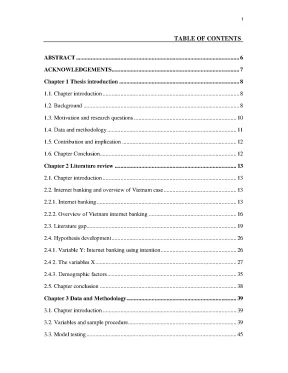
1 TABLE OF CONTENTS ABSTRACT. 7 Chapter 1 Thesis introduction. Motivation and research questions. Data and methodology.
Contribution and implication. 12 Chapter 2 Literature review. Internet banking and overview of Vietnam case. Overview of Vietnam internet banking.
Variable Y: Internet banking using intention. 38 Chapter 3 Data and Methodology. Variables and sample procedure. 45 LUAN VAN CHAT LUONG download : add luanvanchat@agmail.
46 Chapter 4 Result analysis. Reliability analysis result. Exploratory Factor Analysis (EFA). Linear regression result.
Discussion on the hypotheses 1 and 2. Discussion on hypothesis 3. Discussion on the research questions. 65 Chapter 5 Thesis conclusion.
Review of research questions, hypotheses and result. Detail table of mean and standard deviation of items. Data result from SPSS solution for Variable Y. KMO and Barlett’s test.
Total variance explained. 78 LUAN VAN CHAT LUONG download : add luanvanchat@agmail. Linear regression analysis. One way – ANOVA analysis.
Independent samples T-Test. 87 LUAN VAN CHAT LUONG download : add luanvanchat@agmail.com 4 LIST OF TABLES Table 2-1: The e-banking service of some banks in Vietnam. 17 Table 2-2: Research model. 37 Table 3-1: The summary of items of variables.
40 Table 3-2 : Content of demographic factors. 45 Table 3-3: Sample procedure. 47 Table 3-4: The summary of data and methodology. 47 Table 4-1: Demographic profile.
49 Table 4-2: The summary compared mean and standard deviation of items. 50 Table 4-3: The summary of reliability test. 54 Table 4-4: KMO and Bartlett's Test. 55 Table 4-5: Total Variance Explained.
55 Table 4-6: Rotated Component result. 56 Table 4-7: Model Summary. 57 Table 4-8: Model ANOVA. 57 Table 4-9: The linear relationship result.
58 Table 4-10: Demographic impact result. 62 Table 4-11: Result on the independent t-test on 2 selected ariables. 63 Table 4-12: Research question and hypothesis related. 65 LUAN VAN CHAT LUONG download : add luanvanchat@agmail.com 5 ABBREVIATIONS AND SYMBOLS ABBREVIATION Demo Demographic EFA Exploratory Factor Analysis H Hypothesis RQ Research Question Std Dev.
Standard Deviation TAM Technology Acceptance Model TPB Technology Planned Behavior SYMBOL α Cronbach alpha ≠ Differences LUAN VAN CHAT LUONG download : add luanvanchat@agmail.com 6 ABSTRACT The purpose of this research is to explore extendedly the impact of technology acceptance; and the external environment factors on internet banking using intention in Vietnam. Then, the result from this study shows out that all variables have the impact on internet banking using intention in Vietnam. The convenience; availability and accessibility and security variables as the technology acceptance have the significant positive impact on internet banking using intention. Whereas, the external environment factors all have the considerable impact on internet banking using intention.
Privacy is the only one which has the negative impact on internet banking using intention with the study. Beside the main variables from technology acceptance and external environment categories, the research introduces the significant demographic factors to test their impact on internet banking using intention. The result gives out that the age, education level and income level factors have the impact on internet banking using intention. Because the key paper does not work on the regression relationship analysis, the study here actually helps extend it by the regression relationship result.
Moreover, the combination of variables from the different existing studies helps the reader have the interesting view on this topic. Furthermore, the research contributes to the academic in term of the impact of many variables on internet banking using intention in Vietnam. It certainly indicates the implication for the academic researchers, internet banking users, bank and policymakers. However, there are some limitations with the thesis including the method, respondent and sample … LUAN VAN CHAT LUONG download : add luanvanchat@agmail.com 7 ACKNOWLEDGEMENTS I would like to thank my supervisor - Doctor Quoc Pham Phu due to his enthusiasm tutorial, careful guidance, remarkable patience, useful feedback and spiritual encouragement.
Without his concern, I can’t finish my thesis here. Moreover, I would like to thank the comments from the board on my work which helps me revise my paper in the good way. Finally, I would like to thanks other individuals and the respondents who contribute to my thesis done. April 21, 2014 Hiep Phan Duy LUAN VAN CHAT LUONG download : add luanvanchat@agmail.com 8 Thesis introduction Chapter 1 1.
Chapter introduction This study here mentions about the individual users’ intention to use internet banking in Vietnam. In term of adoption, it further investigates the impact of variables extracted from technology acceptance and the external environment theory on Vietnam internet banking adoption. Specifically, the thesis examines the variables of convenience, availability and accessibility, content and design, speed, security, privacy, bank image and management, fees and charges which are identified in a research about Malaysia internet banking adoption. Moreover, it is an attempt to extend more variables by adding two more variables including added service and government support from the other existing research to help introduces the big picture about the impact of the variables on internet banking using intention in Vietnam adoption.
The content of this chapter includes 6 main parts.2 is about the background on the variables which are argued to have the impact on internet banking using intention in Vietnam adoption.3 declares the motivation and the research questions of this thesis.4 introduces the research objectives and the hypothesis.5 describes in brief the data, methodology and the result analysis.6 discusses about the contribution and implication which are expected from this working paper.7 summaries the structure of thesis. Background The variables mentioned in the thesis are the current argument about the impact of the technology acceptance model and external environment factors on the internet LUAN VAN CHAT LUONG download : add luanvanchat@agmail.com 9 banking users’ adoption. Actually, the technology acceptance model (TAM), the technology planned behavior (TPB), the external factors or the structural model… are conducted popularly in the previous studies for a purpose of finding out the internet banking preference in many markets including Vietnam market. For instance, it comes out here with 2 studies which mentioned about internet banking using intention in Vietnam.
Chong, Ooi, Lin and Tan (2010) work on the perceived usefulness, the perceived of use, the trust and the government support as the key impacts on internet banking using intention in Vietnam adoption. Moreover, Pham, Cao, Nguyen and Tran(2013) investigate about the impact of perceived risk, the perceived ease of use, the perceived benefit, the trust, the perceived risk, the bank image, the subjective norms on the intention to use Vietnam banking adoption. Both 2 studies here build up the basic variables which come from the technology acceptance model and the technology planed behavior. These ideas are certainly the background for the development of specific variables like the convenience, the availability and accessibility, the content and design, the speed, security, privacy… in the recent studies.
Actually, these variables appear with the Malaysia studies about internet banking using intention. Poon (2008) identifies10 variables including the convenience, the availability, the accessibility, the content, the design, the speed, the security, the privacy, the bank image and management and fees and charges. Moreover, Sohail and Shanmugham (2003) explore the variables like accessibility, reluctance, costs, trust, security, convenience and ease of use. LUAN VAN CHAT LUONG download : add luanvanchat@agmail.
Motivation and research questions As mentioned in the part 1.2, the Malaysia authors use the more detail measures to explore the variables with users’ adoption momentum of internet banking in Malaysia. This one motivates my attempt to follow this way to find out something for internet banking using intention in Vietnam. These more detail variables to the internet banking acceptance bring me out with the question as follow: Research question 1 (RQ1): Do the variables including convenience; availability and accessibility; content and design; speed; security; privacy; bank image and management; fees and charges affect the internet banking using intention in Vietnam? Beside the variables from the Key study, there is an attempt to add some more variables to bring out the bigger picture about the internet banking users’ preference. The added ones come from the other existing papers about internet banking using intention in both Vietnam and foreign market as an extension with this research.
Research question 2 (RQ2): Do the added variables including government support and added service affect the internet banking using intention in Vietnam? Finally, Demographic factors are mentioned in this thesis; however, they are the selected ones which are supposed to be the suitable factors with internet banking using intention in Vietnam situation. Research (RQ3): Do the demographic factors including gender; age; education level; income level and internet accessibility have the impacts on the internet banking using intention in Vietnam? LUAN VAN CHAT LUONG download : add luanvanchat@agmail.com 11 Certainly, the thesis is to find out the answer on the three main objectives. The first objective is about the impact of variables from the study in Malaysia to internet banking using intention in Vietnam. Poon (2008) explores the significant impact of variables like convenience; availability and accessibility; content and design; speed; security; privacy; bank management & image and fees & charges.
The second objective is to confirm the significant impact of the added variables on the thesis model. Bauer, Hammerschmidt and Falk (2004) argue about Added services as the quality portal of internet banking to the customer benefit which is my first added variables in this thesis. Moreover, Chong, Ooi, Lin and Tan (2010) figure out the important role of government support determinant in Vietnam; therefore, it can’t be ignored to become the second added variables with this thesis. Finally, the third objective is about to examine Demographic factors on the Vietnam banking adoption.
These factors are extracted from the Malaysian research to be worked out here in the thesis. Demographic factors are investigated dependently beside the main variables. Data and methodology A questionnaire is prepared to collect the information of the Vietnamese users. These persons take a survey about the variables as above to the internet banking acceptance.
The data from the survey is crunched with the three steps of analysis including reliability test with cronbach alpha; the exploratory analysis (EFA) and the linear analysis. The result from the regression relationship is used to work on discussion, contribution and implication. LUAN VAN CHAT LUONG download : add luanvanchat@agmail. Contribution and implication This thesis has some contributions for the academic research when it continues to explore the behavior of internet banking users on the theories of technology acceptance model and external environment factors.
Moreover, an attempt to add up the variables from the foreign studies helps the researchers in Vietnam have more idea on the topic of internet banking adoption. Furthermore, the relationships between the variables as well as Demographic factors to internet banking using intention in Vietnam can support for the key papers and give out some implication. Thus, the implication of this thesis is the interest subject to the academic researchers, Vietnam internet banking users. Chapter Conclusion The thesis here consists of 5 chapters including introduction, literature review, methodology, result and conclusion which helps find out the answer for the relationship between the detail variables and the internet banking using intention.
Actually, the next chapter discusses about the literature background for the thesis topic. LUAN VAN CHAT LUONG download : add luanvanchat@agmail.com 13 Literature review Chapter 2 2. Chapter introduction The literature review is an important chapter which introduces the rationale to develop any research. Here, I would like to take advantage of the existing studies on internet banking using intention to build up my own story.
This step certainly enhances the reliability on my thesis. The reference sources for my topic are absolutely matched with the larger number of existing studies and papers. Thus, this chapter consists of the 3 main parts. The first one mentions about the overview of Vietnam internet banking.
The next one argues about the gap of my study.