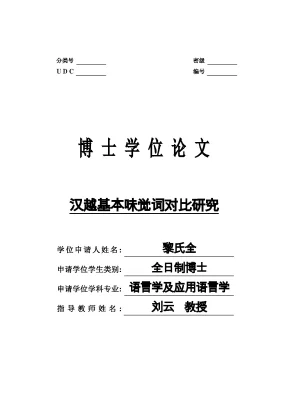
分类号 密级 UDC 编号 博士学位论文 汉越基本味觉词对比研究 学位申请人姓名: 黎氏全 申请学位学生类别: 全日制博士 申请学位学科专业: 语言学及应用语言学 指导教师姓名: 刘云 教授 博士学位论文 汉越基本味觉词对比研究 论文作者:黎氏全 指导教师:刘 云 教授 学科专业:语言学及应用语言学 研究方向:应用语言学 2020年5月 Dissertation A comparative study of Chinese and Vietnamese basic taste words By Li Shi Quan Supervisor: Professor Liu Yun Specialty: Linguistics and Applied Linguistics Research Area: Applied Linguistics School of Literature Central China Normal University May, 2020 华中师范大学学位论文原创性声明和使用授权说明 原创性声明 本人郑重声明:所呈交的学位论文,是本人在导师指导下,独立进行研究工作 所取得的研究成果。除文中已经标明引用的内容外,本论文不包含任何其他个人或 集体已经发表或撰写过的研究成果。对本文的研究做出贡献的个人和集体,均已在 文中以明确方式标明。本声明的法律结果由本人承担。 作者签名: 日期:2020 年 6 月 8 日 学位论文版权使用授权书 学位论文作者完全了解华中师范大学有关保留、使用学位论文的规定,即:研 究生在校攻读学位期间论文工作的知识产权单位属华中师范大学。学校有权保留并 向国家有关部门或机构送交论文的复印件和电子版,允许学位论文被查阅和借阅; 学校可以公布学位论文的全部或部分内容,可以允许采用影印、缩印或其它复制手 段保存、汇编学位论文。(保密的学位论文在解密后遵守此规定) 保密论文注释:本学位论文属于保密,在 年解密后适用本授权书。 非保密论文注释:本学位论文不属于保密范围,适用本授权书。 作者签名: 导师签名: 日期:2020 年 6 月 8 日 日期:2020 年 6 月 8 日 本人已经认真阅读“CALIS 高校学位论文全文数据库发布章程”,同意将本人的 学位论文提交“CALIS 高校学位论文全文数据库”中全文发布,并可按“章程”中的 规定享受相关权益。同意论文提交后滞后:□半年;□一年;□二年发布。 作者签名: 导师签名: 日期:2020 年 6 月 8 日 日期:2020 年 6 月 8日 摘 要 味觉作为基本的感觉之一,是人类认知世界、理解世界的重要工具。有了味觉,我们才可 以认识美食、感受美味。而味觉是在饮食的基础上形成的,它既是饮食的重要特征之一,又蕴 涵着丰富的文化内涵和民族精神价值。因此,味觉词不仅是一种语言现象,更是一种文化现象, 引起了国内外学术界的高度重视。然而,中国的语言学对味觉词的研究,从总体上看还不够丰 富,研究内容主要集中于味觉词的语义方面,研究方法较为单一,研究深度也有待加强。汉外 对比研究虽然众多,但着重于与英语、日语、韩语等语种的对比。在越南,关于味觉词的研究 寥寥可数,专门、系统地对汉越味觉词进行的对比研究更是一片空白。本研究从宏观、中观与 微观的视角对汉越基本味觉词的语义、构词及语用三个层面的认知进行全面和细致对比,并尝 试阐明这两种不同语言在味觉的词汇表征方面的异同和动因。 论文选取汉语中的基本味觉词“酸”、“甜”、 “苦”、 “辣”、 “咸”和越南语中与之相对应的 “chua”、“ngọt” 、“đắng(khổ)”、“cay”、“mặn”为研究对象,首先以认知语言学有关认知域的 理论为基础,对味觉词的义域进行划分、定名及分析,然后把其分为“相同、相似、相异”三 种情况去考察汉越味觉词语义表现的异同,从此阐释造成其差异背后的深层原因。此外,还采 用了静态语言理论与动态言语实例结合法,探讨了汉越味觉词的引申义、构词能力和语用特点。 通过研究,我们得出以下结论: (一)在语义方面,汉越味觉词呈现出共性多于差异性的特点,其中“苦”与“đắng(khổ)” 语义基本相同; “酸”与“chua”和“甜”与“ngọt”语义共性大于差异性;“辣”与“cay”语 义异同参半; “咸”与“mặn”语义差异性大于共性。此外,两者在语义引申方面体现出一些整 体性的倾向:一是从语义引申的途径上看,在隐喻投射的过程中基本体现出了“味觉现象—生 理感觉—心理感觉 —抽象概念”的模式;二是从语境依赖程度上看,汉越味觉词语义在一定的 程度上都受到语境的影响;三是从语义指向上看,汉越味觉词语义都倾向于内指,但倾向程度 有时有所不同;四是从语义指称对象上看,汉越味觉词语义使用范围有时不一致;五是从语义 色彩上看,汉越味觉词的褒贬色彩大多相似。 人类具有共同的认知方式和生理机制引起了汉越味觉词语义朝“同”的方向发展,但文化 的差异和语言的约束导致汉越味觉词引申意义朝“异”的方向发展。因此,我们以认知、语言、 文化三平面为基础,建立了汉越味觉词引申差异对比的阐释模式,从而寻求两者语义异同背后 的深刻原因。从认知角度看,我们发现造成汉越味觉词语义表现相同的一个重要原因就是人类 都具有共同的生理机制和心理机制,对味觉的感受大体一致。从语言角度看,作为语言词汇系 统的一部分,味觉词的引申意义会受到其所在的整个语言系统的影响和制约,在一定程度上导 I 致了其语义表现的差异。而另一方面,语言接触又会使汉越味觉词语义产生很多相似之处。从 物质文化看,自然地理环境、气候条件及生活方式等直接影响了民族的饮食习惯和味觉偏好, 这对汉越味觉词引申的结果和其隐含的褒贬意义有着重大的影响。从社会文化看,中越两国人 民都受到深远的儒家思想影响,因此很多汉越味觉词的引申义明显地反映了儒家的价值观与人 生观。在思维方式上,中越文化都重视二元统一,两国人民习惯于直观思维、内向思维。此外, 佛教观念渗透到越南人的思想意识中并给越南语言留下了深刻的烙印。这些都是造成汉越味觉 词引申意义有异有同的重要原因。 (二)在构词方面,汉越两种语言的味觉形容词的构词法从宏观上看大异小同。从结构上 看,汉语味觉词仅有附加式、复合式两种构词方式,而没有重叠式的构词法,越南语味觉词的 构词方式分为重叠式、附加式、复合式三种类型。研究结果发现,在重叠式上看越南味觉词具 有零基式重叠 AA 和部分重叠 AA 式等两种类型。从附加式上看汉越味觉词均有“词根+叠音后 缀”(ABB 式)和“词根+不叠音后缀”两种类型,其中以 ABB 附加式为主,A 词根是基本味 觉词。然而,在越南语 ABB 式里有一些 AB、BB 具有独特的功能和特点。从复合式上看,汉 越味觉词又包括两种类型,第一类是“基本味觉+基本味觉”;第二类是“基本味觉词+其他成 分” 。汉越味觉词在复合式的第一类构词法中完全对应。第二类构词法中,汉越味觉词存在共同 点和不同点。其共同点是由基本味觉词与其他词素结合在一起构成复合词,这些复合词不仅表 示味道,而且大多带着引申意义;但整体上看,在复合式的构词方式上,越南语味觉词的构词 能力与汉语味觉词相比,较为薄弱。越南语“基本味觉词+其它成分”组合只有联合式、偏正 式复合词,而汉语除了联合式、偏正式之外,还有动宾式及主谓式复合组合。这也是两者复合 式在第二类构词法中的不同点。 (三)在语用方面,我们从交际对话、形容词生动形式和固定短语三个角度去研究汉越味 觉词的语用特点,通过分析我们发现,在实际使用的过程中,汉越基本味觉词都呈现出很多特 殊的语用特点。在交际对话中,汉越味觉词既遵循又违反合作原则。在形容词生动形式中,汉 越味觉词能够改变词语的语义程度、感情色彩和语体色彩。在固定短语中,汉越味觉词主要出 现在成语、惯用语、歇后语和俗语等固定短语。这些短语信息丰富,形式简洁,语言生动,语 体鲜明,语义蕴含着民族深刻的处世之道和哲学思维。 本研究具有重要的理论和实践意义。在理论上,丰富了隐喻理论和味觉相关的研究。在实 践上,不仅加深我们对汉越味觉词的理解和掌握,而且对我们更好地认识中越两国的文化和思 维方式颇有裨益,同时还为汉越词汇教学、词典编纂、翻译工作提供了积极的贡献。 关键词:味觉词;汉越对比;语义对比;差异阐释;构词方式;语用特点 II Abstract As one of the basic senses, taste is an important tool for humans to recognize and understand the world. With taste, we can know food and feel delicious. Taste is formed on the basis of diet. It is not only one of the important characteristics of diet, but also contains rich cultural connotation and national spiritual value.
Therefore, taste words are not only a linguistic phenomenon, but also a cultural phenomenon, which has drawn great attention from academic circles at home and abroad. However, the study of taste words in Chinese linguistics is not rich enough in general. The research content mainly focuses on the semantic aspects of taste words. The research method is relatively simple and the research depth needs to be strengthened.
Although there are many comparative studies between Chinese and foreign, it focuses on comparison with English, Japanese, Korean and other languages. In Vietnam, there are few studies on taste words, and the comparative study of Chinese and Vietnamese taste words is a blank. This study makes a comprehensive, detailed comparison of the meanings, meanings, and word formation of the basic taste words in Chinese and Vietnamese from a macro, meso, and micro perspective, and clarifies the similarities and differences between the two and their causes. The thesis selects the basic taste words "acid", "sweet", "bitter", "spicy", "salty" in Chinese and the corresponding "chua", "ngọt", "đắng(khổ)", "cay", "mặn" in Vietnamese as the research object.The first based on the theory of cognitive linguistics about cognitive domains, the sense domain of taste words is divided, named and analyzed, and then divided into" identical, similar, different " .These three situations are used to examine the similarities and differences in the meaning of Chinese and Vietnamese taste sense words, and the underlying reasons behind the differences are explained from this point on.
In addition, a combination of static language and dynamic speech examples is used to explore the metaphorical meaning, word-building ability and pragmatic characteristics of Chinese and Vietnamese taste perception words. Through research, we come to the following conclusions: (1) In terms of semantics, Chinese-Vietnamese taste words present more characteristics than differences. The semantics of "bitter" and " đắng (khổ)" are basically the same; "acid" and "chua" and "sweet" and "ngọt" have greater semantics."Spicy" and "cay" are half the same and half different; the semantic differences between "salty" and "mặn" are greater than common. In addition, the two show some overall tendencies in semantic extension: First, from the perspective of semantic extension, in the process of metaphor projection, the"taste phenomenon-physiological feeling-psychological feeling-abstract concept" is basically reflected model; the second is that from the perspective of context dependence, the meaning of Hanyue taste words is affected by context to a certain extent; the third is III that the meaning of Chinese and Vietnamese taste words tends to refer internally, but the degree of inclination is sometimes different; the fourth is that the scope of the meaning of Chinese and Vietnamese taste words is sometimes used from the perspective of semantic reference inconsistent; Fifth, from the perspective of semantic color, most of the praise and derogatory colors of Chinese and Vietnamese taste words are similar.
Humans have a common cognitive style and physiological mechanism, which has caused the meaning of Han and Yue taste words to develop in the same direction, but cultural differences and language constraints have led to the development of Han Yue taste words in the direction of "different". Therefore, based on the three planes of cognition, language, and culture, we have established an explanatory model for the comparison of the extended differences between Chinese and Vietnamese taste perception words, in order to seek the profound reasons behind the similarities and differences between the two. From a cognitive perspective, we find that an important reason for the same meaning of Chinese and Vietnamese taste sense words is that humans have common physiological and psychological mechanisms, and the perception of taste is generally consistent. From a linguistic perspective, as a part of the vocabulary system of a language, the extended meaning of taste words will be affected and restricted by the entire language system in which it is located, which leads to a certain degree of difference in its semantic performance.
On the other hand, language contact will bring many similarities to the metaphorical meaning of Chinese and Vietnamese taste words. From the perspective of material culture, natural geographical environment, climatic conditions, and lifestyles have a direct impact on the nation's eating habits and taste preferences, which has a significant impact on the results of Han and Yue taste extensions and their implied significance. From the perspective of social culture, the people of China and Vietnam are affected by far-reaching Confucianism. Therefore, the extended meanings of many Han-Vietnamese taste words clearly reflect the Confucian values and outlook on life.
In terms of thinking, Chinese and Vietnamese cultures attach importance to dual unification, and the people of both countries are used to intuitive thinking and introverted thinking. In addition, the Vietnamese people's ideology also contains rich Buddhist concepts, which has left a deep mark on the Vietnamese language. These are the important reasons that lead to the difference in meaning between Chinese and Vietnamese taste words. (2) In terms of word formation, the word formation of taste adjectives in the Chinese and Vietnamese languages is different from a macro perspective.
From a structural point of view, Chinese taste words have only two additional word formation methods, and there is no overlapping word formation. Vietnamese word formation words are divided into three types: overlapping, additive, and IV compound. The research results found that Vietnamese taste words have two types: zero-based overlapping AA and partially overlapping AA. Judging from the additive form, the Chinese and Vietnamese taste words have two types: ―stem + redundant suffix‖(ABB style)and ―stem + non-redundant suffix‖.
Among them, ABB addendum is the main type, and the A root is the basic taste word. However, there are some AB and BB in Vietnamese ABB style with unique functions and features. From a compound perspective, Chinese and Vietnamese taste words include two types, the first type is "basic taste + basic taste"; the second type is "basic taste + other ingredients". Chinese-Vietnamese taste words correspond exactly in the first type of compound word formation.
In the second type of word formation, Chinese and Vietnamese taste words have similarities and differences. Its common point is that the basic taste words are combined with other morphemes to form compound words. These compound words not only express taste, but also carry extended meanings. But on the whole, in the compound word formation, the word formation of Vietnamese taste words Compared with Chinese taste words, the ability is weaker.
The combination of "basic taste words and other components" in Vietnamese only has joint and partial formal compound words. In addition to joint and partial formal Chinese, there are verb-object and subject-predicate compound combinations. This is also the difference between the two compound types in the second type of word formation. (3) In terms of pragmatics, we study the pragmatic characteristics of Chinese and Vietnamese taste words from the perspective of communicative dialogue, fixed phrases and vivid forms of adjectives.
Through analysis, we find that in the actual use process, the basic taste words of Chinese and Vietnamese They all show many special pragmatic characteristics. In actual communication, Chinese and Vietnamese taste words both follow and violate the principle of cooperation. Among the fixed phrases, Chinese and Vietnamese taste words mainly appear in fixed phrases such as idioms, idioms, diabetics and common sayings. These phrases are rich in information, concise in form, vivid in language, distinctive in style, and profound in meaning and philosophy of the nation.
In the vivid form of adjectives, Chinese and Vietnamese taste words can change the semantic level, emotional color and stylistic color of words. This research has important theoretical and practical significance. In theory, it enriches the research on metaphor theory and taste. In practice, it not only deepens our understanding and mastery of Chinese and Vietnamese taste words, but also helps us to better understand the culture and thinking modes of China and Vietnam.
At the same time, it also provided positive contributions for Chinese and Vietnamese vocabulary comparison, dictionary compilation and translation. V Keywords: taste words; contrast between Chinese and Vietnamese; semantic contrast; interpretation of differences; word formation; pragmatic characteristi VI 目 录 摘 要 ·················································································································I ABSTRACT ······································································································III 第一章 绪论 ·······································································································1 1.1 选题缘由及研究意义 ······················································································1 1.1 选题缘由 ································································································1 1.2 研究意义 ································································································2 1.2 研究综述 ·····································································································3 1.1 中国味觉词的研究现状 ··············································································3 1.2 越南味觉词的研究现状 ·············································································13 1.3 汉越味觉词的对比研究 ·············································································14 1.4 对现有研究的简要评价 ·············································································15 1.3 研究范围 ····································································································16 1.1 味与味觉 ·······························································································16 1.2 味觉词的定义及分类 ················································································17 1.3 基本味觉词及研究对象 ·············································································17 1.4 理论依据 ····································································································18 1.1 语义对比的理论框架 ················································································18 1.2 差异解释的阐释模式 ················································································21 1.5 研究方法和语料 ···························································································24 1.1 研究方法 ·······························································································24 1.2 语料说明 ·······························································································24 第二章 汉越“酸/chua”语义对比 ·········································································25 2.1 汉越“酸/chua”词义域划分的思路···································································25 2.2 汉越“酸/chua”语义统计及分析······································································28 2.1“酸/chua”的语义分布统计 ·······································································28 2.2“酸/chua”语义内涵分析 ··········································································29 2.3 汉越“酸/chua”语义异同的总结······································································41 2.1 语义共性的总结 ······················································································42 2.2 语义个性的总结 ······················································································42 2.4 汉越“酸/chua”语义异同的原因 ·····································································43 2.1 认知因素 ·······························································································43 2.2 语言因素 ·······························································································44 2.3 文化因素 ·······························································································45 第三章 汉越“甜/ngọt”语义对比 ··········································································47 3.1 汉越“甜/ngọt”词义域划分的思路 ···································································47 3.2 汉越“甜/ngọt”的语义统计及分析 ···································································49 3.1“甜/ngọt”的语义分布统计 ·······································································49 3.2“甜/ngọt”的语义内涵分析 ·······································································50 3.3 汉越“甜/ngọt”语义异同的总结 ······································································65 3.1 语义共性的总结 ······················································································66 3.2 语义个性的总结 ······················································································67 3.4 汉越“甜/ngọt”语义异同的原因 ······································································67 3.1 认知因素 ·······························································································67 3.2 语言因素 ·······························································································68 3.3 文化因素 ·······························································································68 第四章 汉越“苦/đắng(khổ)”语义对比 ··································································71 4.1 汉越“苦/đắng(khổ)”词义域划分的思路 ····························································71 4.2 汉越“苦/đắng(khổ)”的语义统计及分析 ····························································74 4.1“苦/đắng(khổ)”的语义分布统计 ································································74 4.2“苦/đắng(khổ)”的语义内涵分析 ································································75 4.3 汉越“苦/đắng(khổ)”语义异同的总结 ·······························································87 4.1 语义共性的总结 ······················································································88 4.2 语义个性的总结 ······················································································89 4.4 汉越“苦/đắng(khổ)”语义异同的原因 ·······························································89 4.1 认知因素 ·······························································································89 4.2 语言因素 ·······························································································90 4.3 文化因素 ·······························································································91 第五章 汉越“辣/cay”语义对比 ···········································································93 5.1 汉越“辣/cay”词义域划分的思路 ····································································93 5.2 汉越“辣/cay”的语义统计及分析 ····································································95 5.1“辣/cay”的语义分布统计·········································································95 5.2“辣/cay”的语义内涵分析·········································································96 5.3 汉越“辣/cay”语义异同的总结 ·····································································106 5.1 语义共性的总结 ····················································································106 5.2 语义个性的总结 ····················································································107 5.4 汉越“辣/cay”语义异同的原因 ·····································································108 5.1 认知因素 ·····························································································108 5.2 语言因素 ·····························································································109 5.3 文化因素 ·····························································································110 第六章 汉越“咸/mặn”语义对比 ········································································112 6.1 汉越“咸/mặn”词义域划分的思路 ·································································112 6.2 汉越“咸/mặn”语义统计及分析 ····································································114 6.1“咸/mặn”的语义分布统计······································································114 6.2“咸/mặn”的语义内涵分析······································································115 6.3 汉越“咸/mặn”语义异同的总结 ····································································122 6.4 汉越“咸/mặn”语义异同的原因 ····································································123 第七章 汉越味觉词构词方式对比 ········································································125 7.1 汉语味觉词构词方式 ···················································································125 7.1 重叠式 ·······························································································125 7.2 附加式 ································································································126 7.3 复合式 ································································································127 7.2 越南语味觉词构词方式 ················································································129 7.1 重叠式 ································································································129 7.2 附加式 ································································································130 7.3 复合式 ································································································131 7.3 汉越味觉词构词方式对比分析 ·······································································132 7.1 重叠式对比 ··························································································132 7.2 附加式对比 ··························································································132 7.3 复合式对比 ··························································································133 第八章 汉越味觉词的语用特点 ···········································································134 8.1 汉越味觉词在交际对话中“合作原则”下的语用特点 ········································134 8.1 交际对话的合作原则 ··············································································134 8.2 汉语味觉词在交际对话中“合作原则”下的语用特点 ····································134 8.3 越南语味觉词在交际对话中“合作原则”下的语用特点 ·································136 8.2 汉越味觉词生动形式的语用特点 ····································································138 8.1 汉越味觉词生动形式的类型 ·····································································138 8.2 汉语味觉词生动形式的语用特点 ·······························································139 8.3 越南语味觉词生动形式的语用特点 ····························································141 8.3 汉越味觉词在熟语构成中的语用特点 ······························································144 8.1 汉语味觉词在熟语构成中的语用特点 ·························································144 8.2 越南语味觉词在熟语构成中的语用特点 ······················································148 8.4 总结 ········································································································151 第九章 结语 ····································································································152 9.1 本论文的基本结论 ······················································································152 9.1 关于汉越味觉词语义的共同特征和个性差异 ················································152 9.2 关于汉越味觉词引申差异原因的阐释 ·························································153 9.3 关于汉越味觉词的构词方式 ····································································154 9.4 关于汉越味觉词的语用特点 ····································································155 9.2 研究反思 ··································································································155 9.1 创新之处 ·····························································································155 9.2 研究局限和未来展望 ··············································································156 参考文献 ··········································································································157 图目录 ·············································································································157 表目录 ·············································································································166 第一章 绪论 1.1 选题缘由及研究意义 1.1 选题缘由 感觉是人类认识世界和理解外部世界的最初途径。通过感觉,我们可以辨别所有客观事物 的颜色、形状、声音、软硬、味道、气味等不同属性,从而能把事物之间区别开来,在此基础 上,逐渐丰富了人类对世界的认识和理解。根据刺激物的来源可以把感觉分为外部感觉和内部 感觉,其中内部感觉是指由机体内部的刺激所引起的感觉,反之外部感觉是指身体外部刺激感 觉器官所引起的感觉,包括触觉、嗅觉、味觉、视觉和听觉五种。① 饮食是人最基本的生理需求,随着人类的发展,饮食不仅是一种生存方式,而且还成为一 门学科、一种艺术形式。味觉作为最基本的感觉之一,是人类认知世界、理解世界的重要工具。 有了味觉,我们才可以认识饮食、感受美味。而味觉是在饮食的基础上形成的,它既是饮食的 重要特征之一,又蕴涵着丰富的文化内涵和民族精神价值。因此深入探讨汉越味觉词可以使我 们窥见认知、语言、文化等诸多因素的密切关系,同时加深我们对两国人民饮食文化、风俗习 惯和思维方式的了解,有利于促进两国人民的友好交流。 语言是文化的载体,不同的民族有着不同的民族文化和思维方式,因此味觉词在各语言中 的表现也不尽相同。汉语和越南语也不例外。由于地理位置、历史条件、语言接触等原因使得 汉语和越南语有很多相同之处,但两国人民毕竟处于不同的生活环境且经过不同的发展历程, 使得汉语和越南语在表达“味觉”时有共性也有个性。此外,在语言实践中,味觉词除了基本 意义之外,还发展出很多复杂的引申义,比如“火辣的身材” 、 “nụ cười chua chát” “甜蜜的微笑”、 (酸涩的笑容)“ngậm đắng nuốt cay(茹苦含辛)”等。这使得汉语学习者和越南语学习者在 、 学习和翻译过程中碰到很多困难,大多数的学者只能掌握味觉词的基本意义,而对其引申意义 混淆不清。 味觉词一直是语言难题,它不仅是一种语言现象,更是一种文化现象,因此引起了国内外 学术界的高度重视。然而,中国的语言学对味觉词的研究,从总体上看还不够丰富,研究内容 主要集中于味觉词的语义方面,研究方法较为单一,研究深度也有待加深。汉外对比研究虽然 众多但着重于英语、日语、韩语等这些语种。在越南,关于味觉词的研究寥寥可数,专门、系 统地对汉越味觉词进行的对比研究更是一片空白。 针对目前汉越味觉词语研究的现状,本文选取汉越基本味觉词“酸(chua)、甜(ngọt)、 苦(đắng/khổ)、辣(cay)、咸(mặn)”为研究对象,分别从语义特征、构词方式、隐喻认知、 ① 彭聃龄.普通心理学[M].北京:北京师范大学出版社,2016:92-93. 1 语用特点等方面进行了对比与分析并详细阐释该类词语在两种语言中的异同之处,然后以此为 切入口,尽量揭示这些异同背后的原因和规律。 1.2 研究意义 本文运用了理论和实践相结合的研究方法,在认知、语言、文化的理论基础上,对汉越基 本味觉词的语义、构词及语用等三层面的认知进行全面、细致地对比与分析,揭示汉越两个民 族对味觉词的认知规律和异同点,并对造成差异的原因进行深入解读,本论文的研究意义可以 体现在以下几方面: (一)加深我们对汉越味觉词的理解和掌握 味觉词在我们日常生活中的使用频率较为高,它们在语义、构词、语用等方面呈现出丰富 而复杂的特点,因此探讨汉越味觉词之引申意义、构词方式及语用特点并阐明其异同之处,不 仅可以加深对语言本身系统性的认知而且还可以加强对汉越味觉词系统的理解和掌握。 (二)有助于了解中越两国人民的人文文化和思维方式 语言和词汇是文化的载体,语言存在的差异会直接或间接地反映出民族文化、思维方式、 道德观念的不同。分析汉越基本味觉词的差异并阐释其差异背后的深层原因将会有助于对中越 两国人民文化、思维的了解,通过汉越味觉词系统的对比研究促进中越两国文化交流,增进两 国人民之间的相互理解和传统友谊。 (三)提高词汇教学的效果和互译工作的质量 汉越两种语言都属于单音节的、有声调的语言,两国人民的友好往来和语言长期的接触使 得两者存在很多相同之处。然而,由于中越文化背景与思维方式的不同,导致两国语言之间存 在较大的差异。二者的相同性和相异性互相并存、互相交叉使得学习者遇到很多困难。此研究 成果可以运用到词汇教学中,提高学生的语言习得能力和语言运用能力,最终对跨文化教学工 作产生助益。此外,在汉越互译过程中经常涉及到味觉词,本文的研究成果还可以用于汉越翻 译实践,让译者充分了解汉越味觉词各方面的差异,避免翻译不当。 (四)为词典编纂工作提供有益的参考价值 在研究的过程中,我们发现汉越味觉词的语义扩展情况比汉越词典释义更加复杂。本人希 望这项研究可以为汉越词典编纂实践提供具有一定参考价值的相关材料,对今后汉越词典释义 编纂工作做出积极贡献。 2 1.2 研究综述 1.