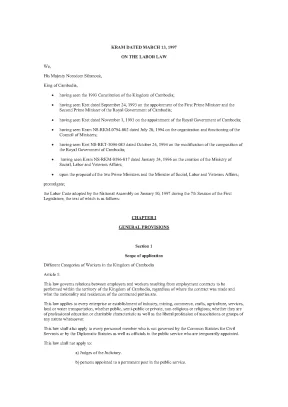
KRAM DATED MARCH 13, 1997 ON THE LABOR LAW We, His Majesty Norodom Sihanouk, King of Cambodia, ! having seen the 1993 Constitution of the Kingdom of Cambodia; ! having seen Kret dated September 24, 1993 on the appointment of the First Prime Minister and the Second Prime Minister of the Royal Government of Cambodia; ! having seen Kret dated November 1, 1993 on the appointment of the Royal Government of Cambodia; ! having seen Kram NS-RKM-0794-002 dated July 20, 1994 on the organization and functioning of the Council of Ministers; ! having seen Kret NS-RKT-1094-083 dated October 24, 1994 on the modification of the composition of the Royal Government of Cambodia; ! having seen Kram NS-RKM-0196-017 dated January 24, 1996 on the creation of the Ministry of Social, Labor and Veterans Affairs; ! upon the proposal of the two Prime Ministers and the Minister of Social, Labor and Veterans Affairs; promulgate; the Labor Code adopted by the National Assembly on January 10, 1997 during the 7th Session of the First Legislature, the text of which is as follows: CHAPTER I GENERAL PROVISIONS Section 1 Scope of application Different Categories of Workers in the Kingdom of Cambodia Article 1: This law governs relations between employers and workers resulting from employment contracts to be performed within the territory of the Kingdom of Cambodia, regardless of where the contract was made and what the nationality and residences of the contracted parties are. This law applies to every enterprise or establishment of industry, mining, commerce, crafts, agriculture, services, land or water transportation, whether public, semi-public or private, non-religious or religious; whether they are of professional education or charitable characteristic as well as the liberal profession of associations or groups of any nature whatsoever. This law shall also apply to every personnel member who is not governed by the Common Statutes for Civil Servants or by the Diplomatic Statutes as well as officials in the public service who are temporarily appointed. This law shall not apply to: a) Judges of the Judiciary.
b) persons appointed to a permanent post in the public service. c) personnel of the Police, the Army, the Military Police, who are governed by a separate statute. d) personnel serving in the air and maritime transportation, who are governed by a special legislation. These workers are entitled to apply the provisions on freedom of union under this law.
e) domestics or household servants, unless otherwise expressly specified under this law. These domestics or household servants are entitled to apply the provisions on freedom of union under this law. Article 2: All natural persons or legal entities, public or private, are considered to be employers who constitute an enterprise, in the sense of this law, provided that they employ one or more workers, even discontinuously. Every enterprise may consist of several establishments, each employing a group of people working together in a defined place such as in factory, workshop, work site, etc., under the supervision and direction of the employer.
A given establishment shall be always under the auspices of an enterprise. The establishment may employ just one person. If this establishment is unique and independent, it is both considered as an enterprise and an establishment. Article 3: "Workers", in the sense of this law, are every person of all sex and nationality, who has signed an employment contract in return for remuneration, under the direction and management of another person, whether that person is a natural person or legal entity, public or private.
To clearly determine the characteristics of a worker, one shall not take into account of neither the jurisdictional status of the employer nor that of the worker, as well as the amount of remuneration. Article 4: "Domestics or household servants" are those workers who are engaged to take care of the homeowner or of the owner’s property in return for remuneration. Article 5: "Employees or helpers" are those who are contracted to assist any person in return for remuneration, but who do not perform manual labor fully or who do so incidentally. Article 6: "Laborers" are those workers who are not household servants or employees, namely those who perform mostly manual labor in return for remuneration, under the direction of the employer or his representative.
The status of laborer is independent of the method of remuneration; it is determined exclusively by the nature of the work. Article 7: "Artisans" are persons, who practice a manual trade personally on their own account, working at home or outside, whether or not they use the motive force of automatic machines, whether or not they have a shop with a signboard, who primarily sell the products of their own work carried out either alone or with the help of their spouse or family members who work without pay, or with the help of workers or apprentices, but the entire workshop is solely under the direction of their own. The number of non-family workers, who regularly work for an artisan, cannot exceed seven; if this number is exceeded, the employer loses the status of artisan. Article 8: "Apprentices" are those who have entered into an apprenticeship contract with an employer or artisan who has contracted to teach or use someone to teach the apprentice his occupation; and in return, the apprentice has to work for the employer according to the conditions and term of the contract.
Article 9: In accordance with the stability of employment, it is distinguished: ! regular workers ! casual workers, who are engaged to perform an unstable job. Regular workers are those who regularly perform a job on a permanent basis. Casual workers are those who are contracted to: ! perform a specific work that shall normally be completed within a short period of time. ! perform a work temporarily, intermittently and seasonally.
Article 10: Casual workers are subject to the same rules and obligations and enjoy the same rights as regular workers, except for the clauses stipulated separately. Article 11: In accordance with the method of remuneration, workers are classified as follows: ! workers remunerated on a time basis (monthly, daily, and hourly), who are paid daily or at intervals not longer than fifteen days or one month. ! workers remunerated by the amount produced or piecework. ! workers remunerated on commission.
Section 2 Non-discrimination Article 12: Except for the provisions fully expressing under this law, or in any other legislative text or regulation protecting women and children, as well as provisions relating to the entry and stay of foreigners, no employer shall consider on account of: ! race, ! color, ! sex, ! creed, ! religion, ! political opinion, ! birth, ! social origin, ! membership of workers' union or the exercise of union activities; To be the invocation in order to make a decision on: ! hiring, ! defining and assigning of work, ! vocational training, ! advancement, ! promotion, ! remuneration, ! granting of social benefits, ! discipline or termination of employment contract. Distinctions, rejections, or acceptances based on qualifications required for a specific job shall not be considered as discrimination. Section 3 Public order Article 13: The provisions of this law are of the nature of public order, excepting derogations provided expressly. Consequently, all rules resulted from a unilateral decision, a contract or a convention that do not comply with the provisions of this law or any legal text for its enforcement, are null and void.
Except for the provisions of this law that cannot be derogated in any way, the nature of public order of this law is not obstructive to the granting of benefits or the rights superior to the benefits and the rights defined in this law, granted workers by a unilateral decision of an employer or a group of employers, by an employment contract, by a collective convention or agreement, or by an arbitral decision. Section 4 Publicity Article 14: The employer must keep at least one copy of the labor law at the disposal of his workers and, in particular, of the workers' representatives in every enterprise or establishment set forth in Article 1 of this law. Section 5 Forced labor Article 15: Forced or compulsory labor is absolutely forbidden in conformity with the International Convention No. 29 on the forced or compulsory labor, adopted on June 28, 1930 by the International Labor Organization and ratified by the Kingdom of Cambodia on February 24, 1969.
This article applies to everyone, including domestics or household servants and all workers in agricultural enterprises or businesses. Article 16: Hiring of people for work to pay off debts is forbidden. CHAPTER II ENTERPRISES - ESTABLISHMENTS Section 1 Declaration of the opening and closing of the enterprise Article 17: All employers to whom this labor law is applied, shall make a declaration to the Ministry in Charge of Labor when opening an enterprise or establishment. This declaration is called a declaration of the opening of the enterprise or establishment, that must be made in writing and be submitted to the Ministry in Charge of Labor before the actual opening of the enterprise or establishment.
Employers who employ fewer than eight workers on a permanent basis and who do not use machinery, shall make and submit this declaration to the Ministry in Charge of Labor within thirty days following the actual opening of the enterprise or establishment. Article 18: For the closing of the enterprise, employers shall also make a declaration to the Ministry in Charge of Labor within thirty days following the closing of the enterprise. Article 19: A Prakas (ministerial order) of the Ministry in Charge of Labor shall define the formality and procedure of the declarations to follow in each case. Article 20: Every employer shall establish and neatly keep a register of an establishment that was numbered and initialed by the Labor Inspector.
The model of the register shall be set by a Prakas of the Ministry in Charge of Labor. Section 2 Declaration on movement of personnel Article 21: Every employer must make the declaration to the Ministry in Charge of Labor each time when hiring or dismissing a worker. This declaration must be made in writing within fifteen days at the latest after the date of hiring or dismissal. This period is extended to thirty days for agricultural enterprises.
The declaration of hiring and dismissal is not applied to: ! Casual employment with a duration of less than thirty continuous days. ! Intermittent employment for which the actual length of employment does not exceed three months within twelve consecutive months. Section 3 Internal regulations of the enterprise Article 22: Every employer of an enterprise or establishment, set out in Article 17 above, who employs at least eight workers shall always establish an internal regulation of the enterprise. Article 23: Internal regulations adapt the general provisions of this law in accordance with the type of enterprise or establishment and the collective agreements that are relevant to the sector of activity of the aforementioned enterprise or establishment, such as provisions relating to the condition of hiring, calculation and payment of wages and perquisites, benefits in kind, working hours, breaks and holidays, notice periods, health and safety measures for workers, obligations of workers and sanctions that can be imposed on workers.
Article 24: The internal regulations must be established by the manager of enterprise after consultation with workers' representatives, within three months following the opening of the enterprise, or within three months after the promulgation of this law if the enterprise already exists. Before coming into effect, the internal regulations shall be [visaed] by the Labor Inspector. This visa shall be issued within a period of sixty days. Article 25: The articles of internal regulations that suppress or limit the rights of workers, set forth in laws and regulations in effect or in conventions or collective agreements applicable to the establishment, are null and void.
The Labor Inspector shall require the inclusion of enforceable provisions in virtue of laws and regulations in effect.